From The Pages Of The Communist International- In Honor Of The Anniversary Of The Founding Of The Communist International (March 1919) -Desperately Seeking Revolutionary Intellectuals-Now- And Then
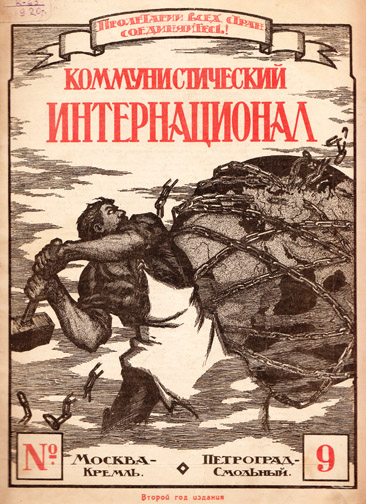
Click below to link to the Communist International Internet Archives"
Frank Jackman comment from the American Left History blog (2007):
BOOK REVIEW
‘LEFT-WING’ COMMUNISM-AN INFANTILE DISORDER, V.I. LENIN, UNIVERSITY PRESS OF THE PACIFIC, CALIFORNIA, 2001
An underlying premise of the Lenin-led Bolshevik Revolution in Russia in 1917 was that success there would be the first episode in a world-wide socialist revolution. While a specific timetable was not placed on the order of the day the early Bolshevik leaders, principally Lenin and Trotsky, both assumed that those events would occur in the immediate post-World War I period, or shortly thereafter. Alas, such was not the case, although not from lack of trying on the part of an internationalist-minded section of the Bolshevik leadership.
Another underlying premise, developed by the Leninists as part of their opposition to the imperialist First World War, was the need for a new revolutionary labor international to replace the compromised and moribund Socialist International (also known as the Second International) which had turned out to be useless as an instrument for revolution or even of opposition to the European war. The Bolsheviks took that step after seizing power and established the Communist International (also known as the Comintern or Third International) in 1919. As part of the process of arming that international with a revolutionary strategy (and practice) Lenin produced this polemic to address certain confusions, some willful, that had arisen in the European left and also attempted to instill some of the hard-learned lessons of the Russian revolutionary experience in them.
The Russian Revolution, and after it the Comintern in the early heroic days, for the most part, drew the best and most militant layers of the working-class and radical intellectuals to their defense. However, that is not the same as drawing experienced Bolsheviks to that defense. Many militants were anti-parliamentarian or anti-electoral in principle after the sorry experiences with the European social democracy. Others wanted to emulate the old heroic days of the Bolshevik underground party or create a minority, exclusive conspiratorial party.
Still others wanted to abandon the reformist bureaucratically-led trade unions to their then current leaderships, and so on. Lenin’s polemic, and it nothing but a flat-out polemic against all kinds of misconceptions of the Bolshevik experience, cut across these erroneous ideas like a knife. His literary style may not appeal to today’s audience but the political message still has considerable application today. At the time that it was written no less a figure than James P. Cannon, a central leader of the American Communist Party, credited the pamphlet with straightening out that badly confused movement (Indeed, it seems every possible political problem Lenin argued against in that pamphlet had some following in the American Party-in triplicate!). That alone makes it worth a look at.
I would like to highlight one point made by Lenin that has currency for leftists today, particularly American leftists. At the time it was written many (most) of the communist organizations adhering to the Comintern were little more than propaganda groups (including the American party). Lenin suggested one of the ways to break out of that isolation was a tactic of critical support to the still large and influential social-democratic organizations at election time. In his apt expression- to support those organizations "like a rope supports a hanging man".
However, as part of my political experiences in America around election time I have run into any number of ‘socialists’ and ‘communists’ who have turned Lenin’s concept on its head. How? By arguing that militants needed to ‘critically support’ the Democratic Party (who else, right?) as an application of the Leninist criterion for critical support. No, a thousand times no. Lenin’s specific example was the reformist British Labor Party, a party at that time (and to a lesser extent today) solidly based on the trade unions- organizations of the working class and no other. The Democratic Party in America was then, is now, and will always be a capitalist party. Yes, the labor bureaucrats and ordinary workers support it, finance it, drool over it but in no way is it a labor party. That is the class difference which even sincere militants have broken their teeth on for at least the last seventy years. And that, dear reader, is another reason why it worthwhile to take a peek at this book.
******
Desperately Seeking Revolutionary Intellectuals-Now, And Then
Commentary
No, this is not a Personals section ad, although it qualifies as a Help Wanted ad in a sense. On a number of occasions over past several years, in reviewing books especially those by James P. Cannon the founder of The Socialist Workers Party in America, I have mentioned that building off of the work of the classical Marxists, including that of Marx and Engels themselves, and later that of Lenin and Trotsky the critical problem before the international working class in the early part of the 20th century was the question of creating a revolutionary leadership to lead imminent uprisings. Armed with Lenin’s work on the theory of the imperialist nature of the epoch and the party question and Trotsky’s on the questions of permanent revolution and revolutionary timing the tasks for revolutionaries were more than adequately defined.
The conclusion that I drew from that observation was that the revolutionary socialist movement was not as desperately in need of theoreticians and intellectuals as previously (although having them is always a good thing). It needed leaders steeped in those theories and with a capacity to lead revolutions. We needed a few good day-to-day practical leaders to lead the fight for state power.
In that regard I have always held up, for the early part of the 20th century, the name Karl Liebknecht the martyred German Communist co-leader (along with Rosa Luxemburg) of the aborted Spartacist uprising of 1919 as such an example. In contrast the subsequent leadership of the German Communists in the 1920’s Paul Levi, Henrich Brandler and Ernest Thaelmann did not meet those qualifications. For later periods I have held up the name James P. Cannon, founder of the American Socialist Workers Party (to name only the organization that he was most closely associated with), as a model. That basically carries us to somewhere around the middle of the 20th century. Since I have spend a fair amount of time lately going back to try to draw the lessons of our movement I have also had occasion to think, or rather to rethink my original argument on the need for revolutionary intellectuals. That position stands in need of some amendment now.
Let’s be clear here about our needs. The traditional Marxist idea that in order to break the logjam impeding humankind’s development the international working class must rule is still on the historic agenda. The Leninist notions that, since the early part of the 20th century, we have been in the imperialist era and that a ‘hard’ cadre revolutionary party is necessary to take state power are also in play. Moreover, the Trotskyist understanding that in countries of belated development the working class is the only agency objectively capable of leading those societies to the tasks traditionally associated with the bourgeois revolution continues to hold true. That said, we are seriously in need of revolutionary intellectuals who can bring these understandings into the 21st century.
It is almost a political truism that each generation will find its own ways to cope with the political tasks that confront it. The international working class movement is no exception in that regard. Moreover, although the general outlines of Marxist theory mentioned above hold true such tasks as the updating of the theory of imperialism to take into account the qualitative leap in its globalization is necessary (as is, as an adjunct to that, the significance of the gigantic increases in the size of the ‘third world’ proletariat). Also in need of freshening up is work on the contours of revolutionary political organization in the age of high speed communications, the increased weight that non-working class specific questions play in world politics (the national question, religion, special racial and gender oppressions) and various other tasks that earlier generations had taken for granted or had not needed to consider. All this moreover has to be done in a political environment that sees Marxism, communism, even garden variety reform socialism as failed experiments. To address all the foregoing issues is where my call for a new crop of revolutionary intellectuals comes from.
Since the mid- 20th century we have had no lack of practical revolutionary leaders of one sort or another - one thinks of Fidel Castro, Che Guevara and even Mao in his less rabid moments. We have witnessed any number of national liberation struggles, a few attempts at political revolution against Stalinism, a few military victories against imperialism, notably the Vietnamese struggle. But mainly this has been an epoch of defeats for the international working class. Moreover, we have not even come close to developing theoretical leaders of the statue of Lenin or Trotsky.
As a case in point, recently I made some commentary about the theory of student power in the 1960’s and its eventual refutation by the May 1968 General Strike lead by the working class in France. One of the leading lights for the idea that students were the ‘new’ working class or a ‘new’ vanguard was one Ernest Mandel. Mandel held himself out to be an orthodox Marxist (and Trotskyist, to boot) but that did not stop him from, periodically, perhaps daily, changing the focus of his work away from the idea of the centrality of the working class in social struggle an ideas that goes back to the days of Marx himself.
And Mandel, a brilliant well-spoken erudite scholar probably was not the worst of the lot. The problem is that he was the problem with his impressionistic theories based on , frankly, opportunistic impulses. Another example, from that same period, was the idea of Professor Regis Debray ( in the service of Fidel at the time ) that guerrilla foci out in the hills were the way forward ( a codification of the experience of the Cuban Revolution for which many subjective revolutionary paid dearly with their lives). Or the anti-Marxist Maoist notion that the countryside would defeat the cities that flamed the imagination of many Western radicals in the late 1960’s. I could go on with more examples but they only lead to one conclusion- we are, among other things, in a theoretical trough. This, my friends, is why today I have my Help Wanted sign out. Any takers?

