Sunday, June 19, 2016

The Con Is On-In Honor Of Verbal Kint

The Con Is On-In Honor Of Verbal Kint


By Sam Lowell   


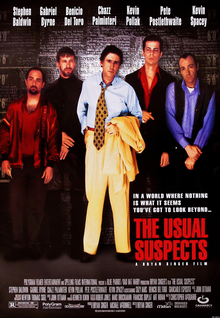
One night in Jack’s, the much frequented bar by Zack James’ old 1960s corner boys in Adamsville, he was telling a few of the guys, Jack Callahan, Jimmy Jenkins, Bart Webber, Frank Jackman maybe Kenny Jackson who stepped in for a moment, about a film that he had recently seen, a film that kind of made Kevin Spacey as an actor, titled The Usual Suspects (a title taken, consciously taken, from a line uttered by Claude Rains’ Vichy French gendarme character in the film classic Casablanca). The reason Zack was so hopped up on the film was that it featured Spacey as a very crafty con man. When they all heard that expression, that con man, the assembled crowd lifted their heads in unison. Even some thirty years later, thirty years from the time when they hung around Salducci’s Pizza Parlor and plotted their own cons, they responded that way to a type of criminal mind that they could still relate to even though any such criminal action on their own parts had been given up by the time they graduated from high school as being too hard to keep up once they had opportunities to escape that narrow corner boy con artist world. It was either Jack or Bart who chimed up and asked Zack to give them the “skinny” on the film, see what they had “missed” by not turning pro. See whether they would have worshipped the Kevin Spacey character Verbal Kint like a living god the way that they did the king hell king of the 1960s Adamsville night, Pretty James Preston.       

Zack agreed to tell the tale at least in outline although he was not sure that Pretty James Preston was in the same league as Verbal Kint, or would have been if he had decided to stick with con artistry rather than move on to more sullen criminal activity, move on to armed a robberies (and taking virtue from impressible young girls, a subject that was still on his mind whenever he thought about Pretty, especially after Pretty  had taken his girl Mimi Murphy away, away to who knows where after he fell down). The way that this Verbal Kint set up his game was to act like a small time con man, you know, taking old ladies for their insurance money, bait and switch stuff, flimflam stuff. Added in to those small time clips was to act the fool, ac the king’s court jester, act stupid and best of all put on the old “crip,” act, you know act all handicapped, disabled, or whatever they call a guy who looks like he would need help just to cross the street, that con men have been doing since Hector was a pup to get others to blow them off as so much wind.

In any case Verbal puts this little scam together, gave the cops anonymous information so that four other big time con men with specialized skills including the ability to work with heavy guns and other weapons, wound up in the same New York City police line-up with him. The key guy, the legendary Dean Keaton, who had been accused of half the big time hustles on the East Coast, was the guy Verbal hooked into leading the expedition. Hooked into the deal since Dean had declared himself out, said he was nothing but a straight and narrow dude. After a little work by Verbal, very little because no con man ever retires as long as he draws breathe, on Dean’s ego he fell, fell in as leader since the others were strictly guys who work aspects of a con, work as hired help, when it gets big, too big for them to plan in their simple blam, blam ways.              

So Dean pulled the guys through a couple of capers, soft and easy money like falling rain, got them so they didn’t mind working with each other, getting them to trust each other as much as one thief can trust another which is none too far. Then Verbal sprung his trap. Brought in this guy, a mouth-piece for a Mister Big to tell them if they knew what was good for them they would do Mister Big’s bidding. (That Mister Big had a name which they all recognized, recognized as somebody not to cross, not to say no to if he wanted you for a caper, but Zack didn’t feel the need to say the name since all the guys knew every real caper had some real banker/backer and so the actual name was not important, just the fear he could put on if you didn’t co-operate like with Pretty James Preston when he got his “wanting habits” on as Zack used to call  it when Pretty needed dough for some frail or his bike, man, his bad-ass bike) They collectively balked for a minute but once the mouth-piece laid out the plan, or rather the dough involved, a dope deal of course with the numbers his was putting out, and the consequences for them and their loved ones if they didn’t they came on board.

The caper involved an exchange of dough for a boatload of dope with a group of bad guys from Europe and Latin America. The thing went awry as Verbal had planned from the beginning with nothing but gun fire and explosions, all boom, boom around with only Verbal and some other guy surviving. Verbal surviving with all the dough when the deal went down.

Here is the beauty of the caper though, the getting away with it part that always is the tip-off of whether a con works, or some guy named Verbal Kint  did a ton of time and they throw away the key for good measure. Naturally the feds, FBI, Customs, once the boom, boom came into play wanted to find out what the hell happened so they interrogated Verbal mercilessly. The FBI offered immunity for Verbal’s story seeing him as the day labor not the boss whom they assumed was Dean Keaton. So Verbal gave them what they wanted, a beautiful story line made out of pure cloth about the whole thing being set-up by a unknown Mister Big under penalty of personal destruction for not co-operating. And the best part as he spinned his tale Verbal giving them Dean Keaton as the Mister Big. And so Verbal walked, walked away from his cripple act too. See old Verbal was really Mister Big if anybody was asking. The Feds had egg all over their faces. Good. As Zack said that the guys ate it up. Jack, who was still hustling Toyotas as Mister Toyota of Eastern Massachusetts and so not so far from his youthful cons as he might have thought but who had a good sense of who had the goods and who didn’t when they were kids said right out of the blue that old Verbal would have had Pretty James for lunch and had time for a nap.         

All the time Zack though was relating the story line he was thinking about damn Pretty James and his antics. Not his antics which every guy who hung around Salducci’s (and before that Doc’s Drugstore over on Newbury Street when they were in elementary school and Harry’s Variety Store in junior high school to show the corner boy progression as each grouping came of age) came to admire and wonder at (except when they had been the “victim” of Pretty’s’ con, or had been the fall guys when some scam didn’t work and they had been out some dough that he had inveigled them into “lending” him) but those that cut him personally to the quick. The times when he was a kid and Pretty made a sap out of him more than once but more importantly, more leaving him feeling like Pretty should burn in the gates of hell for what he did to, and with, Mimi Murphy as much as he admired him as a kid.       

Sure the sap stuff was kids’ stuff, you know grabbling Zack’s milk money along with the others in order to buy something, maybe rings, and then selling them to the kids, including Zack at a jacked up price although much less than what they would cost at the jewelry store. What nobody knew, nobody but Zack after he figured it out was that Pretty was grabbing the milk money for “walking around” money and doing the “five-finger” discount, “clipping” the rings. (That “Pretty” moniker had been hung on him in elementary school from a remark a teacher had made about him being too pretty, and he was, to be a bad boy, little did she know. He would only answer then to Pretty James Preston or somebody would get a fistful of knuckles as Jimmy Jenkins found out soon enough but later he would answer to just Pretty, especially when the girls called him that.). Or the time in junior high when he started raffles in school with kids’ grabbing tickets left and right to win television sets, radios, recorder players. And then holding the drawings with a rigged tumbler with fake name winners. Pretty just kept the dough because there were no winners, no merchandise either. He had made up all the names in the tumbler and thrown away all the other names. Beautiful.


Here is the real beauty of Pretty though on as he refined that basic scam- when he was running a classic pyramid scheme, a Pozzi deal really. He would sell the tickets say for a dollar a piece, collect maybe fifty or hundred bucks and the hold a “drawing.” There would be one prize some beat Radio Shack transistor radio maybe worth ten bucks and that was that. Of course junior high kids didn’t know how much the damn thing cost could care less, cared only that they had not won. Next day, hell, the very next morning before school Pretty had new tickets ready for the suckers. This drawing though got him a couple of hundred bucks and he distributed a couple of radios and a television. See he had worked a deal with some of the older guys who were hanging around Salducci’s Pizza Parlor before they graduated to something else and were doing the midnight creep around town, the midnight creep being B&E in the nighttime to certain houses which had televisions or warehouses with the same. The deal was they would sell him the merchandise whatever it was and he would cut them into a share of the profits from the raffles. That racket got Pretty most of the way to sixteen, got him plenty of admiration once he took us under his wing and let others be the “suckers” grabbling cheapjack stuff from his raffles.              

That sixteen was important because something turned in Pretty, not the con part, no way, he lived for the con, but his whole attitude toward society changed quite a bit from basically seeing the whole world as fair game for his various basically harmless if morally dubious grifts fits to “carrying a chip on his shoulder.” Started see the whole world as his to exploit whatever way he wanted. His scams got more ingenious but also more perverse. Moreover at sixteen he got his big ass motorcycle which he got by some fucked up scheme. Somehow he thought that bike, and it was a great big monster, a British bike not a Harley pig bike make him king of the world. Made him fast, which it did. That sixteen was the year he did his first robbery, armed robbery to boot, nothing big just a local gas station where he scared the gas jockey so much that when it came time for him to identify Pretty he suddenly got amnesia, couldn’t remember what the guy looked like. And Pretty did not wear a mask, and the jockey knew exactly who Pretty was since he would fill up the bike’s tank there all the time. Pretty became an urban legend off of that one.        

That sixteen though was the time that Pretty started treating his corner boys like shit though. That would have been okay probably but it still stuck in Zack’s gut after all the years Pretty had been dead and Mimi had been missing that Pretty had taken Mimi away from Zack right in front of his eyes. Zack had been cultivating his relationship with the pretty, nicely-shaped, red-headed Mimi, known around as one of those Irish Catholic girls in the neighborhood who had the rosary in her hand and a Bible between her knees and so Zack had played it slow and by the book unlike with other girls who he tried to fuck the first night, the first date or the second. Yeah he had it bad for her. One summer afternoon between sophomore and junior year Zack and Mimi had been walking along Adamsville Beach when a big boom motorcycle came up behind them and Zack knew it could only be Pretty whom he had not seen in a while since he had dropped out of school in the spring saying to everybody that he didn’t need any more school education since he knew how he was going to make his bones. That was just after the famous armed robbery at the local gas station. Pretty didn’t say one blessed word to Zack or Mimi but just nodded toward Mimi to get on the back of his bike. And just like that she did. That night from the scuttlebutt in the girls’ lav at school according to Zack’s sister who had been friendly with Mimi she let Pretty have his way with her.

For a while, a couple of years, he would see Mimi and Pretty usually on the back of one of Pretty’s bikes (one of them after a while including a big old Vincent Black Lightening another British bike that was supposed to be super-fast) and then he didn’t see or heard anything for a while until the time of the great Riverdale National Bank robbery, or rather attempted robbery, where Pretty was gunned down by a fleet of Riverdale coppers after being winged by some bank security guard who must have thought that the money was his own that was being stolen. The newspaper said witnesses had seen a pretty red-head across the street from the bank who looked frightened at what had happened. She had fled, Mimi had fled and while Zack had heard a rumor that she was for a time up in Portland working as a model or in some whorehouse, or doing something around there he never tried to find out and she never came back to Adamsville even for her parents’ funerals. Zack had to chuckle, a bitter chuckle, as he thought about what Jack had said about how even now old Verbal would have had Pretty for lunch and had time for a nap. Little good that knowledge would ever do Zack though.       

Scenes In Search Of The Blue-Pink Great American West Night-Scene Two: Hayes-Bickford Breakout -October 1962

Scene Two: Hayes-Bickford Breakout -October 1962


Here I am again sitting, 3 o’clock in the morning sitting, bleary-eyed, slightly distracted after mulling over the back and forth of the twelve hundredth run-in (nice way to put it, right?) with Ma that has driven me out into this chilly October 1962 early morning. And where do I find myself sitting at this time of morning? Tired, but excitedly expectant, on an uncomfortable, unpadded bench seat on this rolling old clickity-clack monster of a Red Line subway car as it now waggles its way out past Kendall Station on its way to Central Square and then to the end of the line, Harvard Square. My hangout, my muse home, my night home, at least my weekend night home, my place to make sense of the world in a world that doesn’t make much sense, at least not enough much sense. Sanctuary, Harvard Square Hayes-Bickford sanctuary, misbegotten teenage boy sanctuary, recognized by international law, recognized by canon law, or not.


That beef with Ma, that really unnumbered beef, forget about the 1200 I said before, that was just a guess, has driven me to take an “all-nighter” trip away from the travails of the old home town, North Adamsville, across Boston to the never-closed Hayes-Bickford cafeteria that beckons just as you get up the stairs from the Harvard subway tunnel. Damn, let me just get this off my chest and then I can tell the rest of the story. Ma said X, I pleaded for Y (hell this homestead civil war lent itself righteously to a nice algebraic formulation. You can use it too, no charge). Unbeknownst to me Y did not exist in Ma’s universe. Ever. Sound familiar? Sure, but I had to get it off my chest.


After putting on my uniform, my Harvard Square “cool” uniform: over-sized flannel brownish plaid shirt, belt-less black cuff-less chino pants, black Chuck Taylor logo-ed Converse sneakers, a now ratty old windbreaker won in a Fourth of July distance race a few years back when I really was nothing but a wet-behind-the ears kid to ward off the chill, and, and the absolutely required midnight sunglasses to hide those bleary eyes from a peeking world I was ready to go. To face the unlighted night, and fight against the dawn’s rising for another day. Oh ya, I forgot, I had to sneak out of the house stealthily, run like some crazed broken-field football player down the back of the property, and, after catching my breathe, walk a couple of miles over bridge and nasty, hostile (hostile if anyone was out, and anyone was sniping for a misbegotten teenage boy, for any purpose good or evil) Dorchester streets to get to the Fields Corner subway stop. The local Eastern Mass. bus had stopped its always erratic service hours ago, and, any way, I usually would rather walk than wait, wait my youth away, for those buses to amble along our way with their byzantine schedules.


Right now though I am thinking, as those subway car wheels rattle beneath my feet, who knows, really, how or why it starts, that wanderlust start, that strange feeling in the pit of your stomach that you have to move on, or out, or up or you will explode, except you also know, or you damn well come to know that it eats away at a man, or a woman for that matter, in different ways. Maybe way back, way back in the cradle it was that first sense that there was more to the world that the four corners of that baby world existence and that if you could just, could just get over that little, little side board there might be something better, much better over the horizon. But, frankly that just seems like too much of a literary stretch even for me, moody teenage boy that I am, to swallow so let’s just say that it started once I knew that the ocean was a way to get away, if you needed to get away. But see I didn’t figure than one out for myself even, old Kenny from the old neighborhood in third grade is the one who got me hip to that, and then Johnny James and his brother filled in the rest of the blanks and so then I was sea-worthy, dream sea-worthy anyway.


But, honestly, that sea dream stuff can only be music for the future because right now I am stuck, although I do not always feel stuck about it, trying to figure my way out of high school world, or at least figure out the raging things that I want to do after high school that fill up my daydream time (study hall time, if you really want to know). Of course, as well, that part about the ocean just mentioned, well there was a literal part to the proposition since ocean-at-my-back (sometimes right at my back) New England homestead meant unless I wanted to take an ill-advised turn at piracy or high-seas hijacking or some such thing east that meant I had to head west. Right now west though is Harvard Square, its doings and not doings, it trumpet call to words, and sounds, and actions in the October Friday night all-night storm brewing.


The train now rounds the squeaky-sounding bend out of Central Square and stops at the station. So now I leave my pensive seat and stand waiting, waiting for the driver to release the pressure to let the sliding train door open, getting ready to jump off the old subway, two-steps-at-a-time my way up the two flights of stairs and head for mecca to see if things jump for me tonight. The doors open at last. Up the two-stepped stairs I go, get to the surface and confront the old double-glassed Hayes door entrance and survey the vast table-filled room that at this hour has a few night owl stranglers spotted throughout the place.


You know the old Hayes-Bickford, or one of them, if you live in Boston, or New York City, or a few other places on the East Coast, don’t you? Put your tray on the metal slider (hey, I don’t know what you call that slider thing, okay) and cruise down the line from item to item behind the glass-enclosed bins of, mostly, steamy food, if you are looking for fast service, for a quick between doing things, pressing things, meal. Steamed and breaded everything from breakfast to lunch to dinner anytime topped off by dishwater quality coffee (refills on demand, if you feel lucky). But this is not the place to bring your date, certainly not your first date, except maybe for a quick cup of that coffee before going to some event, or home. What this is, really, is a place where you can hang out, and hang out with comfort, because nobody, nobody at all, is going to ask you to leave, at least if you act half-way human. And that is what this place is really about, the humans in all their human conditions doing human things, alien to you or not, that you see floating by you, as you take a seat at one of the one-size-fits all wooden tables with those red vinyl seat-covered chairs replete with paper place settings, a few off-hand eating utensils and the usual obligatory array of condiments to help get down the food and drink offered here.


Let me describe who is here at this hour on an early Saturday morning in October 1962. I will not vouch for other times, or other days, but I know Friday and Saturday nights a little so I can say something about them. Of course there is the last drink at the last open barroom crowd, said bar already well-closed in bluelaw Massachusetts, trying to get sober enough by eating a little food to traverse the road home. Good luck. Needless to say eating food in an all-night cafeteria, any all-night cafeteria, means only one thing-the person is so caught up in a booze frenzy that he (mainly) or she (very occasionally) is desperate for anything to hang the name food on to. Frankly, except for the obligatory hard-dollar coffee-steamed to its essence, then through some mystical alchemic process re-beaned, and served in heavy ceramic mugs that keep in the warmth to keep the eyes open the food here is strictly for the, well, the desperate, drunk or sober.

I might mention a little more about the food as I go along but it is strictly to add color to this little story. Maybe, maybe it will add color to the story but this is mainly about the “literary” life at the old Hayes and the quest for the blue-pink night not the cuisine so don’t hold me to it.


Here is the kicker though; there are a few, mercifully few this night, old winos, habitual drunks, and street vagabonds (I am being polite here) who are nuzzling their food, for real. This is the way that you can tell the "last drink" boys, the hail fellows well met, who are just out on the town and who probably go to one of the ten zillion colleges in the area and are drawn like moths (and like wayward high schools kids, including this writer) to the magic name, Harvard Square. They just pick at their food. Those other guys (again, mainly, guys) those habituals and professional waywards work at it like it is their last chance for salvation.


Harvard Square, bright lights, dead of nights, see the sights. That vision is nothing but a commercial, a commercial magnet for every young (and old) hustler within fifty miles of the place to come and display their “acumen”. Their hustle. Three card Monte, quick-change artistry, bait and hook, a little jack-rolling, fake dope-plying, lifting an off-hand wallet, the whole gamut of hustler con lore. On any given Harvard Square weekend night there have got to be more young, naïve, starry-eyed kids hanging out trying to be cool, but really, like me, just learning the ropes of life than you could shake a stick at to set a hustler’s heart, if he (mainly) or she (sometimes) had a heart.


I’ll tell you about a quick con that got me easy in a second but right now let me tell you that at this hour I can see a few con artists just now resting up after a hard night’s work around a couple of tables, comparing notes (or, more likely, trying to con each other, there is no honor among thieves in this little night world. Go to it, boys). As to the con that got me, hey it was simple, a guy, an older guy, a twenty-five year old or something like that guy, came up to me while I was talking to a friend and said did I (we) want to get some booze. Sober, sixteen years old, and thrill-seeking I said sure (drinking booze is the coin of the realm for thrills these days, among high school kids that I know, maybe the older set, those college guys, are, I hear, experimenting with drugs but if so it is very on the QT).


He said name your poison, I did, and then he “suggested” a little something for himself. Sure, whatever is right. I gave him the money and he returned a few minutes later with a small bag with the top of a liquor bottle hanging out. He split. We went off to a private area around Harvard Yard (Phillips Brook House, I think) and got ready to have our first serious taste of booze, and maybe get rum brave enough to pick up some girls. Naturally, the bottle was a booze bottle alright but it had been opened (how long before is anyone’s guess) and filled with water. Sucker, right. Now the only reason that I am mentioning this story right here is that the guy who pulled this con is sitting, sitting like the King of Siam, just a few tables away from where I am sitting. The lesson learned for the road, for the future road that beckons: don’t accept packages from strangers without inspecting them and watch out for cons, right? No, hell no. The lesson is this: sure don’t fall for wise guy tricks but the big thing is to shake it off, forget about it if you see the con artist again. You are way to cool to let him (or occasionally her) think that they have conned you. Out loud, anyway.


But wait, I am not here at almost four o’clock in the Hayes-Bickford morning, the Harvard Square Hayes-Bickford morning, to talk about the decor, the food if that is what it is, about the clientele, humble, slick, or otherwise. I am here looking for “talent”, literary talent that is. See, I have been here enough, and have heard enough about the ”beats” (or rather pseudo-beats, or “late phase” beats at this time) and the “folkies” (music people breaking out of the Pop 40 music scene and going back to the roots of America music, way back) to know that a bunch of them, about six in all, right this minute are sitting in a far corner with a light drum tapping the beat listening to a guy in black pants(always de rigueur black), sneakers and a flannel shirt just like me reciting his latest poem. That possibility is what drove me here this night, and other nights as well. See the Hayes is known as the place where someone like Norman Mailer had his buttered toast after one of his “last drink” bouts. Or that Bob Dylan sat at that table, that table right over there, writing something on a napkin. Or some parallel poet to the one now wrapping up his seventy-seven verse imitation Allen Ginsberg's Howl master work went out to San Francisco and blew the lid off the town, the City Lights town, the literary town.


But I better, now that the six-ish dawn light is hovering, trying to break through the night wars, get my droopy body down those subway stairs pretty soon and back across town before anyone at home notices that I am missing. Still I will take the hard-bitten coffee, re-beaned and all, I will take the sleepy eyes that are starting to weigh down my face, I will even take the con artists and feisty drunks just so that I can be here when somebody’s search for the blue-pink great American West night, farther west than Harvard Square night, gets launched.

*****Frank Jackman’s Fate-With Bob Dylan’s Masters of War In Mind

*****Frank Jackman’s Fate-With Bob Dylan’s Masters of War In Mind


From The Pen Of Sam Lowell

Jack Callahan’s old friend from Sloan High School in Carver down in Southeastern Massachusetts Zack James (Zack short for Zachary not as is the fashion today to just name a baby Zack and be done with it) is an amateur writer and has been at it since he got out of high school. Found out that maybe by osmosis, something like that, the stuff Miss Enos taught him junior and senior years about literature and her favorite writers Hemingway, Edith Wharton and Dorothy Parker to name a few, that she would entice the English class stuck with him with through college where although he majored in Political Science he was in thrall to the English literature courses that he snuck in to his schedule. Snuck in although Zack knew practically speaking he had a snowball’s chance in hell, an expression he had learned from Hemingway he thought,  of making a career out of the literary life as a profession, would more likely wind driving a cab through dangerous midnight sections of town  occasionally getting mugged for his night’s work. That Political Science major winding up producing about the same practical results as the literary life though. Stuck with him, savior stuck with him, through his tour of duty during the Vietnam War, and savior stayed with him through those tough years when he couldn’t quite get himself back to the “real” world after ‘Nam and let drugs and alcohol rule his life so that he wound up for some time as a “brother under the bridge” as Bruce Springsteen later put the situation in a song that he played continuously at times after he first heard it “Saigon, long gone…."  Stuck with him after he recovered and started building up his sports supplies business, stuck with him through three happy/sad/savage/acrimonious “no go” marriages and a parcel of kids and child support.  And was still sticking with him now that he had time to stretch out and write longer pieces, and beat away on the word processor a few million words on this and that.  

Amateur writer meaning nothing more than that he liked to write and that writing was not his profession, that he did not depend on the pen for his livelihood(or rather more correctly these days not the pen but the word processor). That livelihood business was taken up running a small sports apparel store in a mall not far from Lexington (the Lexington of American revolutionary battles to give the correct own and state) where he now lived. Although he was not a professional writer his interest was such that he liked these days with Jimmy Shore, the famous ex-runner running the day to day operations of the store, to perform some of his written work in public at various “open mic” writing (and poetry) jams that have sprouted up in his area.

This “open mic” business was a familiar concept to Jack from the days back in the 1960s when he would go to such events in the coffeehouses around Harvard Square and Beacon Hill to hear amateur folk-singers perfect their acts and try to be recognized as the new voice of their generation, or something like that. For “no singing voice, no musical ear” Jack those were basically cheap date nights if the girl he was with was into folk music. The way most of the "open mics" although they probably called them talent searches then, worked was each performer would sign up to do one, two, maybe three songs depending on how long the list of those wishing to perform happened to be (the places where each performer kicked in a couple of bucks in order to play usually had shorter lists). These singers usually performed in the period in front of the night’s feature who very well might have been somebody who a few weeks before had been noticed by the owner during a pervious "open mic" and asked to do a set of six to sixteen songs depending on the night and the length of the list of players in front of him or her. The featured performer played, unlike the "open mic" people, for the “basket” (maybe a hat) passed around the crowd in the audience and that was the night’s “pay.” A tough racket for those starting out like all such endeavors. The attrition rate was pretty high after the folk minute died down with arrival of other genre like folk rock, heavy rock, and acid rock although you still see a few old folkies around the Square or playing the separate “open mic” folk circuit that also ran through church coffeehouses just like these writing jams.

Jack was not surprised then when Zack told him he would like him to come to hear him perform one of his works at the monthly third Thursday “open mic” at the Congregational Church in Arlington the next town over from Lexington. Zack told Jack that that night he was going to perform something he had written and thought on about Frank Jackman, about what had happened to Frank when he was in the Army during Vietnam War times.

Jack knew almost automatically what Zack was going to do, he would somehow use Bob Dylan’s Masters of War lyrics as part of his presentation. Jack and Zack ( a Vietnam veteran who got “religion” on the anti-war issue while he in the Army and became a fervent anti-war guy after that experience despite his personal problems) had met Frank in 1971 when they were doing some anti-war work among the soldiers at Fort Devens out in Ayer about forty miles west of Boston. Frank had gotten out of the Army several months before and since he was from Nashua in the southern part of New Hampshire not far from Devens and had heard about the G.I. coffeehouse, The Morning Report, where Jack and Zack were working as volunteers he had decided to volunteer to help out as well.

Now Frank was a quiet guy, quieter than Jack and Zack anyway, but one night he had told his Army story to a small group of volunteers gathered in the main room of the coffeehouse as they were planning to distribute Daniel Ellsberg’s sensational whistle-blower expose The Pentagon Papers to soldiers at various spots around the base (including as it turned out inside the fort itself with one copy landing on the commanding general’s desk for good measure). He wanted to tell this story since he wanted to explain why he would not be able to go with them if they went inside the gates at Fort Devens.

Jack knew Zack was going to tell Frank’s story so he told Frank he would be there since he had not heard the song or Frank’s story in a long while and had forgotten parts of it. Moreover Zack wanted Jack there for moral support since this night other than the recitation of the lyrics he was going to speak off the cuff rather than his usual reading from some prepared paper.  

That night Zack was already in the hall talking to the organizer, Eli Walsh, you may have heard of him since he has written some searing poems about his time in three tours Iraq. Jack felt right at home in this basement section of the church and he probably could have walked around blind-folded since the writing jams were on almost exactly the same model as the old folkie “open mics.” A table as you entered to pay your admission this night three dollars (although the tradition is that no one is turned away for lack of funds) with a kindly woman asking if you intended to perform and direct you to the sign-up sheet if so. Another smaller table with various cookies, snacks, soda, water and glasses for those who wished to have such goodies, and who were asked to leave a donation in the jar on that table if possible. The set-up in the hall this night included a small stage where the performers would present their material slightly above the audience. On the stage a lectern for those who wished to use that for physical support or to read their work from and the ubiquitous simple battery-powered sound system complete with microphone. For the audience a bevy of chairs, mostly mismatched, mostly having seen plenty of use, and mostly uncomfortable. After paying his admission fee he went over to Zack to let him know he was in the audience. Zack told him he was number seven on the list so not to wander too far once the session had begun.

This is the way Zack told the story and why Jack knew there would be some reference to Bob Dylan’s Masters of War that night:

Hi everybody my name is Zack James and I am glad that you all came out this cold night to hear Preston Borden present his moving war poetry and the rest of us to reflect on the main subject of this month’s writing jam-the endless wars that the American government under whatever regime of late has dragged us into, us kicking and screaming to little avail.  I want to thank Eli as always for setting this event up every month and for his own thoughtful war poetry. [Some polite applause.] But enough for thanks and all that because tonight I want to recite a poem, well, not really a poem, but lyrics to a song, to a Bob Dylan song, Masters of War, so it might very well be considered a poem in some sense.   

You know sometimes, a lot of times, a song, lyrics, a poem for that matter bring back certain associations. You know some song you heard on the radio when you went on your first date, your first dance, your first kiss, stuff like that which is forever etched in your memory and evokes that moment every time you hear it thereafter. Now how this Dylan song came back to me recently is a story in itself.

You remember Eli back in October when we went up to Maine to help the Maine Veterans for Peace on their yearly peace walk that I ran into Susan Rich, the Quaker gal we met up in Freeport who walked with us that day to Portland. [Eli shouted out “yes.”] I had not seen Susan in about forty years before that day, hadn’t seen her since the times we had worked together building up support for anti-war G.I.s out at the Morning Report coffeehouse in Ayer outside Fort Devens up on Route 2 about thirty miles from here. That’s when we met Frank Jackman who is the real subject of my presentation tonight since he is the one who I think about when I think about that song, think about his story and how that song relates to it.   

Funny as many Dylan songs as I knew Masters of War, written by Dylan in 1963 I had never heard until 1971. Never heard the lyrics until I met Frank out at Fort Devens where after I was discharged from the Army that year I went to do some volunteer anti-war G.I. work at the coffeehouse outside the base in Army town Ayer. Frank too was a volunteer, had heard about the place somehow I forget how, who had grown up in Nashua up in southern New Hampshire and after he was discharged from the Army down at Fort Dix in New Jersey came to volunteer just like me and my old friend Jack Callahan who is sitting in the audience tonight. Now Frank was a quiet guy didn’t talk much about his military service but he made the anti-war soldiers who hung out there at night and on weekends feel at ease. One night thought he felt some urge to tell his story, tell why he thought it was unwise for him to participate in an anti-war action we were planning around the base. We were going to pass out copies of Daniel Ellsberg’s explosive whistle-blower expose The Pentagon Papers to soldiers at various location around the fort and as it turned out on the base. The reason that Frank had balked at the prospect of going into the fort was that as part of his discharge paperwork was attached a statement that he was never to go on a military installation again. We all were startled by that remark, right Jack? [Jack nods agreement.]

And that night the heroic, our kind of heroic, Frank Jackman told us about the hows and whys of his Army experience. Frank had been drafted like a ton of guys back then, like me, and had allowed himself to be drafted in 1968 at the age of nineteen not being vociferously anti-war and not being aware then of the option of not taking the subsequent induction. After about three week down at Fort Dix, the main basic training facility for trainees coming from the Northeast then, he knew two things-he had made a serious mistake by allowing himself to be drafted and come hell or high water he was not going to fight against people he had no quarrel with in Vietnam. Of course the rigors of basic training and being away from home, away from anybody who could help him do he knew not what then kept him quiet and just waiting. Once basic was over and he got his Advanced Infantry Training assignment also at Fort Dix which was to be an infantryman at a time when old Uncle Sam only wanted infantrymen in the rice paddles and jungles of Vietnam things came to a head.

After a few weeks in AIT he got a three day weekend pass which allowed him to go legally off the base and he used that time to come up to Boston, or really Cambridge because what he was looking for was help to file an conscientious objector application and he knew the Quakers were historically the ones who would know about going about that process. That is ironically where Susan Rich comes in again, although indirectly this time, since Frank went to the Meeting House on Brattle Street where they were doing draft and G.I. resistance counseling and Susan was a member of that Meeting although she had never met him at that time. He was advised by one of the Quaker counselors that he could submit a C.O. application in the military, which he had previously not been sure was possible since nobody told anybody anything about that in the military, when he got back to Fort Dix but just then, although they were better later, the odds were stacked against him since he had already accepted induction. So he went back, put in his application, took a lot of crap from the lifers and officers in his company after that and little support, mainly indifference, from his fellow trainees. He still had to go through the training, the infantry training though and although he had taken M-16 rifle training in basic he almost balked at continuing to fire weapons especially when it came to machine guns. He didn’t balk but in the end that was not a big deal since fairly shortly after that his C.O. application was rejected although almost all those who interviewed him in the process though he was “sincere” in his beliefs. That point becomes important later.

Frank, although he knew his chances of being discharged as a C.O. were slim since he had based his application on his Catholic upbringing and more general moral and ethical grounds. The Catholic Church which unlike Quakers and Mennonites and the like who were absolutely against war held to a just war theory, Vietnam being mainly a just war in the Catholic hierarchy’s opinion. But Frank was sincere, more importantly, he was determined to not got to war despite his hawkish family and his hometown friends’, some who had already served, served in Vietnam too, scorn and lack of support. So he went back up to Cambridge on another three day pass to get some advice, which he actually didn’t take in the end or rather only partially took up  which had been to get a lawyer they would recommend and fight the C.O. denial in Federal court even though that was also still a long shot then.  

Frank checked with the lawyer alright, Steve Brady, who had been radicalized by the war and was offering his services on a sliding scale basis to G.I.s since he also had the added virtue of having been in the JAG in the military and so knew some of the ropes of the military legal system, and legal action was taken but Frank was one of those old time avenging Jehovah types like John Brown or one of those guys and despite being a Catholic rather than a high holy Protestant which is the usual denomination for avenging angels decided to actively resist the military. And did it in fairly simple way when you think about it. One Monday morning when the whole of AIT was on the parade field for their weekly morning report ceremony Frank came out of his barracks with his civilian clothes on and carrying a handmade sign which read “Bring the Troops Home Now!”

That sign was simply but his life got a lot more complicated after that. In the immediate sense that meant he was pulled down on the ground by two lifer sergeants and brought to the Provost Marshal’s office since they were not sure that some dippy-hippie from near-by New York City might be pulling a stunt. When they found out that he was a soldier they threw him into solitary in the stockade.

For his offenses Frank was given a special court-martial which meant he faced six month maximum sentence which a panel of officers at his court-martial ultimately sentenced him to after a seven day trial which Steve Brady did his best to try to make into an anti-war platform but given the limitation of courts for such actions was only partially successful. After that six months was up minus some good time Frank was assigned to a special dead-beat unit waiting further action either by the military or in the federal district court in New Jersey. Still in high Jehovah form the next Monday morning after he was released he went out to that same parade field in civilian clothes carrying another homemade sign “Bring The Troops Home Now!” and he was again manhandled by another pair of lifer sergeants and this time thrown directly into solitary in the stockade since they knew who they were dealing with by then. And again he was given a special court-martial and duly sentenced by another panel of military officers to the six months maximum.

Frank admitted at that point he was in a little despair at the notion that he might have to keep doing the same action over and over again for eternity. Well he wound up serving almost all of that second sex month sentence but then he got a break. That is where listening to the Quakers a little to get legal advice did help. See what Steve Brady, like I said an ex-World War II Army JAG officer turned anti-war activist lawyer, did was take the rejection of his C.O. application to Federal District Court in New Jersey on a writ of habeas corpus arguing that since all Army interviewers agreed Frank was “sincere” that it had been arbitrary and capricious of the Army to turn down his application. And given that the United States Supreme Court and some lower court decisions had by then had expanded who could be considered a C.O. beyond the historically recognized groupings and creeds the cranky judge in the lower court case agreed and granted that writ of habeas corpus. Frank was let out with an honorable discharge, ironically therefore entitled to all veteran’s benefits but with the stipulation that he never go onto a military base again under penalty of arrest and trial. Whether that could be enforced as a matter of course he said he did not want to test since he was hardily sick of military bases in any case.                                       

So where does Bob Dylan’s Masters of War come into the picture. Well as you know, or should know every prisoner, every convicted prisoner, has the right to make a statement in his or her defense during the trial or at the sentencing phase. Frank at both his court-martials rose up and recited Bob Dylan’s Masters of War for the record. So for all eternity, or a while anyway, in some secret recess of the Army archives (and of the federal courts too) there is that defiant statement of a real hero of the Vietnam War. Nice right?      

Here is what had those bloated military officers on Frank’s court-martial board seeing red and ready to swing him from the highest gallow, yeah, swing him high.

Masters Of War-Bob Dylan 

Come you masters of war
You that build all the guns
You that build the death planes
You that build the big bombs
You that hide behind walls
You that hide behind desks
I just want you to know
I can see through your masks

You that never done nothin’
But build to destroy
You play with my world
Like it’s your little toy
You put a gun in my hand
And you hide from my eyes
And you turn and run farther
When the fast bullets fly

Like Judas of old
You lie and deceive
A world war can be won
You want me to believe
But I see through your eyes
And I see through your brain
Like I see through the water
That runs down my drain

You fasten the triggers
For the others to fire
Then you set back and watch
When the death count gets higher
You hide in your mansion
As young people’s blood
Flows out of their bodies
And is buried in the mud

You’ve thrown the worst fear
That can ever be hurled
Fear to bring children
Into the world
For threatening my baby
Unborn and unnamed
You ain’t worth the blood
That runs in your veins

How much do I know
To talk out of turn
You might say that I’m young
You might say I’m unlearned
But there’s one thing I know
Though I’m younger than you
Even Jesus would never
Forgive what you do

Let me ask you one question
Is your money that good
Will it buy you forgiveness
Do you think that it could
I think you will find
When your death takes its toll
All the money you made
Will never buy back your soul

And I hope that you die
And your death’ll come soon
I will follow your casket
In the pale afternoon
And I’ll watch while you’re lowered
Down to your deathbed
And I’ll stand o’er your grave
’Til I’m sure that you’re dead

Copyright © 1963 by Warner Bros. Inc.; renewed 1991 by Special Rider Music

As The 100th Anniversary Of World War I (Remember The War To End All Wars) Continues... Some Remembrances-The First Small Anti-War Cries Are Raised To Stop The Madness - Lenin's War Against War

As The 100th Anniversary Of World War I (Remember The War To End All Wars) Continues... Some Remembrances-The First Small Anti-War Cries Are Raised To Stop The Madness -

 
From The Pen Of Frank Jackman  


The events leading up to World War I (known as the Great War before the world got clogged up with expansive wars in need of other numbers and names and reflecting too in that period before World War II a certain sense of “pride” in having participated in such an adventure even if it did mow down the flower of European youth from all classes) from the massive military armament of almost all the capitalist and imperialist parties in Europe and elsewhere in order to stake their claims to their unimpeded share of the world’s resources had all the earmarks of a bloodbath early on once the industrial-sized carnage set in with the stalemated fronts. Also clogged in the trenches, or rather thrown in the nearest bin were the supposedly eternal pledges not honored by most of the Social-Democrats and other militant leftist formations representing the historic interest of the international working-class to stop those imperialist capitalist powers and their hangers-on in their tracks at the approach of war were decisive for 20th century history. Other than isolated groups and individuals mostly in the weaker lesser capitalistically developed countries of Europe the blood lust got the better of most of the working class and its allies as young men rushed to the recruiting stations to “do their duty” and prove their manhood.


Decisive as well as we head down the slope to the first months of the second year of the war although shrouded in obscurity early in the war in exile was the soon to be towering figure of one Vladimir Lenin (a necessary nom de guerre in hell broth days of the Czar’s Okhrana ready to send one and all to the Siberian frosts and that moniker business, that nom de guerre not a bad idea in today’s NSA-driven frenzy to know all, to peep at all), leader of the small Russian Bolshevik Party ( a Social-Democratic Party in name anyway adhering to the Second International under the sway of the powerful German party although not for long), architect of the theory of the “vanguard party” building off of many revolutionary experiences in Russia and Europe in the 19th century), and author of an important, important to the future communist world perspective, study on the monopolizing tendencies of world imperialism, the ending of the age of “progressive” capitalism (in the Marxist sense of the term progressive in a historical materialist sense that capitalism was progressive against feudalism and other older economic models which turned into its opposite at this dividing point in history), and the hard fact that it was a drag on the possibilities of human progress and needed to be replaced by the establishment of the socialist order. But that is the wave of the future as 1914 turns to 1915 in the sinkhole trenches of Europe that are already a death trap for the flower of the European youth.  


Lenin also has a "peace" plan, a peace plan of sorts, a way out of the stinking trench warfare stalemate eating up the youth of the Eurasian landmass. Do what should have been done from the beginning, do what all the proclamations from all the beautifully-worded socialist manifestos called on the international working-class to do. Not a simple task by any means especially in that first year when almost everybody on all sides thought a little blood-letting would be good for the soul, the individual national soul, and in any case the damn thing would be over by Christmas and everybody could start producing those beautifully worded-manifestos against war again. (That by Christmas peace “scare” turned out to be a minute “truce” from below by English and German soldiers hungry for the old certainties banning the barbed wire and stinking trenches for a short reprieve in the trench fronts in France and played soccer before returning to drawn guns-a story made into song and which is today used as an example of what the lower ranks could do-if they would only turn the guns around. Damn those English and German soldiers never did turn the damn things around until too late and with not enough resolve and the whole world has suffered from that lack of resolve.)


Lenin’s hard-headed proposition: turn the bloody world war among nations into a class war to drive out the war-mongers and bring some peace to the blood-soaked lands. But that advanced thinking is merely the wave of the future as the rat and rain-infested sinkhole trenches of Europe were already in the first year a death trap for the flower of the European youth.   


The ability to inflict industrial-sized slaughter and mayhem on a massive scale first portended toward the end of the American Civil War once the Northern industrial might tipped the scales their way as did the various German-induced wars attempting to create one nation-state out of various satraps almost could not be avoided in the early 20th century once the armaments race got serious, and the technology seemed to grow exponentially with each new turn in the war machine. The land war, the war carried out by the “grunts,” by the “cannon fodder” of many nations was only the tip of the iceberg and probably except for the increased cannon-power and range and the increased rapidity of the machine-guns would be carried out by the norms of the last wars. However the race for naval supremacy, or the race to take a big kink out of British supremacy, went on unimpeded as Germany tried to break-out into the Atlantic world and even Japan, Jesus, Japan tried to gain a big hold in the Asia seas.


The deeply disturbing submarine warfare wreaking havoc on commerce on the seas, the use of armed aircraft and other such technological innovations of war only added to the frenzy. We can hundred years ahead, look back and see where talk of “stabs in the back” by the losers and ultimately an armistice rather than decisive victory on the blood-drenched fields of Europe would lead to more blood-letting but it was not clear, or nobody was talking about it much, or, better, doing much about calling a halt before they began the damn thing among all those “civilized” nations who went into the abyss in July of 1914. Sadly the list of those who would not do anything, anything concrete, besides paper manifestos issued at international conferences, included the great bulk of the official European labor movement which in theory was committed to stopping the madness.


A few voices, voices like Karl Liebknecht (who against the party majority bloc voting scheme finally voted against the Kaiser’s war budget, went to the streets to get rousing anti-war speeches listened to in the workers’ districts, lost his parliamentary immunity and wound up honorably in the Kaiser’s  prisons) and Rosa Luxemburg ( the rose of the revolution also honorably prison bound) in Germany, Lenin and Trotsky in Russia (both exiled at the outbreak of war and just in time as being on “the planet without a passport” was then as now, dangerous to the lives of left-wing revolutionaries), some anti-war anarchists like Monette in France and here in America the Big Bill Haywood (who eventually would controversially flee to Russia to avoid jail for his opposition to American entry into war), many of his IWW (Industrial Workers Of the World) comrades and the stalwart Eugene V. Debs (who also went to jail, “club fed” for speaking the truth about American war aims in a famous Cleveland speech and, fittingly, ran for president in 1920 out of his Atlanta Penitentiary jail cell),  were raised and one hundred years later those voices have a place of honor in this space.


Those voices, many of them in exile, or in the deportations centers, were being clamped down as well when the various imperialist governments began closing their doors to political refugees when they were committed to clapping down on their own anti-war citizens. As we have seen in our own times, most recently in America in the period before the “shock and awe” of the decimation of Iraq in 2002 and early 2003 the government, most governments, are able to build a war frenzy out of whole cloth. Even my old anti-war amigo from my hometown who after I got out of the American Army during the Vietnam War marched with me in countless rallies and parades trying to stop the madness (and plenty of other “wise” heads from our generation of ’68 made that sea-change turn with him).


At those times, and in my lifetime the period after 9/11 when we tried in vain to stop the Afghan war in its tracks is illustrative, to be a vocal anti-warrior is a dicey business. A time to keep your head down a little, to speak softly and wait for the fever to subside and to be ready to begin the anti-war fight another day. Be ready to fight the operative words.


So imagine in the hot summer of 1914 when every nationality in Europe felt its prerogatives threatened how the fevered masses, including the beguiled working-classes bred on peace talk without substance, would not listen to the calls against the slaughter. Yes, one hundred years later is not too long or too late to honor those ardent anti-war voices as the mass mobilizations began in the countdown to war, began four years of bloody trenches and death.                   


Over the next period as we continue the long night of the 100th anniversary of World War I and beyond I will under this headline post various documents, manifestos and cultural expressions from that time in order to give a sense of what the lead up to that war looked like, the struggle against its outbreak before the first frenzied shots were fired, the forlorn struggle during and the massive struggles after it in places like Russia, Germany, Hungary, Bulgaria, and the hodge-podge colonies all over the world map, in order to create a newer world out of the shambles of the battlefields.     


 V. I.   Lenin

The “Peace” Slogan Appraised


Written: Written in July–August 1915
Published: First published in the magazine Proletarskaya Revolutsia No. 5 (28), 1924. Published according to the manuscript.
Source: Lenin Collected Works, Progress Publishers, [197[4]], Moscow, Volume 21, pages 287-289.
Translated:
Transcription\Markup: D. Walters and R. Cymbala
Public Domain: Lenin Internet Archive 2002 (2005). You may freely copy, distribute, display and perform this work; as well as make derivative and commercial works. Please credit “Marxists Internet Archive” as your source.
Other Formats:   TextREADME


In its issue of June 27, 1915, the Vienna Arbeiter-Zeitwig, central organ of the Austrian Social-Democrats, cites a very instructive declaration contained in the German governmental Norddeutsche Aligemeine Zeitung.
The declaration deals with an article by one of the best known (and vilest) opportunists of the “Social-Democratic.” Party of Germany named Quarck, who said inter alia:
We German Social-Democrats and our Austrian comrades have repeatedly declared ourselves ready to establish contacts (with the British and French Social-Democrats) for the purpose of beginning peace talks. The German Imperial Government know of this, and have not placed the slightest obstacle in our way.”
Nationalliberale Korrespondenz, a German national-liberal paper, has said that the concluding words permit of a double interpretation. The first is that the government have put no obstacles in the way of “international political action” by the Social-Democrats, insofar as it does not transgress the limits of legality and “is not dangerous to the State”. This, the paper says, is perfectly intelligible from the angle of “political freedom”.
The second interpretation is that the German Government “at least tacitly approve of the Social-Democratic internationalist peace propaganda, and even consider it a suitable means of laying down the initial basis for exploring the possibility of peace”.
The national-liberal paper naturally considers this latter interpretation out of the question. In this it has the official support of the government newspaper, which goes on to say that “the government have nothing in common with   internationalist peace propaganda and have authorised neither Social-Democratic nor any other intermediaries to conduct that propaganda”.
An edifying farce, is it not? Will anybody believe that the German Government, who have forbidden Vorwärts to write about the class struggle, have introduced harsh military laws against popular meetings and veritable “military slavery” for the proletariat—that this government have, out of sheer liberalism, “put no obstacles” in the way of Messrs. Quarck and Südekum, or that they are not in constant communication with the latter gentlemen?
Is it not a thousand times more likely that Quarck inadvertently told the truth (namely, that the peace propaganda was started by the German Social-Democrats when they had reached a direct or indirect understanding with their government), and that he was “officially refuted” only for the purpose of concealing the truth.
This is a lesson to those phrase-lovers who, like Trotsky (see No. 105 of Nashe Slovo), defend—in opposition to us—the peace slogan, alleging among other things that “all Left-wingers” have united for the purpose of “action” under this very slogan! The Junker government have now demonstrated the correctness of our Berne resolution (Sotsial-Demokrat No. 40), which says that the propaganda of peace “unaccompanied by a call for revolutionary mass action” can only “sow illusions” and “turn the proletariat into a plaything in the hands of the secret diplomacy of the belligerent countries”.[1]
This has been literally proved!
In a few years diplomatic history will prove that there was an understanding, direct or indirect, between the opportunists and the governments on peace palaver and this, not in Germany alone! Diplomacy may conceal such things, but murder will out!
When the Lefts began to unite under the peace slogan, this deserved encouragement, provided it was the first step in protest against the chauvinists, in the same fashion as the Gaponade was the Russian worker’s first timid protest against the tsar. But since the Lefts are even   now confining themselves to this slogan (slogans are the business of intelligent political leaders), they are shoddy Lefts, there is consequently not a grain of “action” in their resolutions, and they are consequently a plaything in the hands of the Sudekums, Quarcks, Sembats, Hyndmans, Joffres, and Hindenburgs.
Anyone who fails to understand this even today, when the peace slogan ("unaccompanied by a call for revolutionary mass action") has been prostituted by the Vienna Conference[2] of Bernstein, Kautsky and Co. with the Scheidernanns (the German Vorstand, their Executive), is simply an unwitting participant in the social-chauvinist humbugging of the people.


Notes


[2] The reference is to the Conference of Socialists of Germany and Austria-Hungary, held in Vianna in April 1915. The Conference approved of the social-chauvinist stand taken by the leadership of the German and Austrian socialist parties, wich justified the war and stated, in their resolutions, that this did not run counter to proletarian unity and to the workers’ international solidarity in the struggle for peace.