Sunday, July 21, 2013

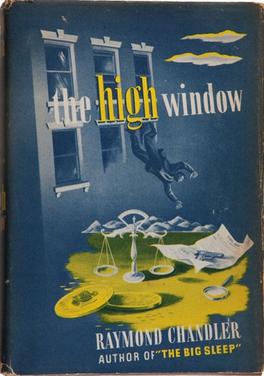
Out in the 1940s Crime Noir Night –Raymond Chandler’s The High Window


From The Pen Of Frank Jackman

Book Review

The High Window, Raymond Chandler, Vintage Crime Books, New York, 1942

Yah, like the man said one time the rich are different from you and me. They try , try very hard, to not let anything untoward come into their radar dust on the furniture to murder to mayhem if that what turns out to be the case when they go off the deep end. They just let the hired help pick up the mess and sort things out the best they, the help, can. And if you were trying to keep murder and mayhem away from your door in the 1940s night and if you resided in the precincts of Southern California around Los Angeles , L.A, the city of angels (and angles) then Raymond Chandler’s private eye Philip Marlowe was your man. And the reason that he was your man was because he fixed up your messes, fixed it up with bandages if  he had to but he fixed them, and they stayed fixed until or unless you strayed from the reservation again.

So, yah, if you needed a man you could trust, needed a guy who worked the both the seamy side and the high side and didn’t miss a beat, needed a guy who didn’t mind taking a punch or two, a slug or two, for good of the cause, needed a guy who for his own private reasons chased after windmills then old Marlowe was your man. Your man at twenty-five a day and expenses. Cheap at any price. Just ask the Murdocks in the tale in The High Window reviewed here, although like a lot of stuff with the rich (and maybe not just the rich) they probably have forgotten how close they came to perdition. 

See the Brasher Doubloon was missing, a rare old coin, from the late Mr. Murdock’s collection. So dear rich inebriated (for her asthmatic condition, okay) old, to be kind, bitch Mrs. Murdock sent for one Philip Marlowe to find the damn thing. Find it on the cheap and quietly, if possible. Problem was that the prime suspect in the theft was her beloved doted on pampered son who was into a local mobster for some serious gambling debt dough. But well before that hard fact was established some people who got in the way would up dead, very dead, for their efforts. Part of the body pile-up was due to the greed of a number of people trying to make imitation copies of the coin, part of the pile-up was due to knowing too much about the operation and part was just people getting in the way for no good reason, what would be now called collateral damage.

Needless to say Old Marlowe gets to the bottom of the whole thing, takes his usual fair share of lumps, takes his fair share of abuses from the cops when he tries, as he always does, to protect, rightly or wrongly, his client, and takes his fair share of abuse from his dear client along the way. As a bonus he also plays Sir Galahad to the rescue to Mrs. Murdock’s secretary, a frail high strung young woman who was made the patsy for Mrs. Murdock’s murder of her first husband out that high window of the title. All for twenty-five a day.  Yah, the rich are different from you and me.

Oh, about Raymond Chandler, about the guy who wrote the book. Like I said in another review he, along with Brother Dashiell Hammett, turned those dreary gentile drawing room sleuths who dominated the reading market way back in the day on its head and gave us tough guy blood and guts detectives we could admire, could get behind, warts and all. Thanks, guys.

In Chandler’s case he drew strength from his seemingly starling use of language to describe Marlowe’s environment much in the way a detective would use his heightened powers of observation during an investigation, missing nothing. Marlowe was able to size up, let’s say, a sizzling blonde, as a statuesque, full-bodied and ravishing dame and then pick her apart as nothing but a low-rent gold-digger. Of course that never stopped him from taking a run at one or two of them himself and then sending them off into the night, or to the clink, to fend for themselves. He also knew how to blow off a small time chiseler, a grifter, as so much flamboyance and hot air not neglecting to notice that said grifter had moisture above his upper lip indicating that he stood in fear of something if only his shadow as he attempted to pull some caper, or tried to pull the wool over Marlowe’s eyes.

The list of descriptions goes on and on -sullen bartenders wiping a random whisky glass, flighty chorus girls arm in arm with wrong gee gangsters, Hollywood starlet wannabes displaying their wares a little too openly , old time geezers, toothless, melting away in some thankless no account job, guys working out of small-time airless no front cheap jack offices in rundown building s on the wrong side of town doing, well, doing the best they can. And cops, good cops, bad cops, all with that cop air about them of seen it all, done it all, blasé, and by the way spill your guts before the billy- club comes down (that spill your guts thing a trait that our Marlowe seems organically incapable of having). He had come from them, from the D.A.s office in the old days, had worked with them on plenty of cases but generally he tried to treat them like one might a snake not quite sure whether it is poisonous or not.          

At the same time Chandler was a master of setting the details of the space Marlowe had to work in- the high hill mansions and the back alley rooming houses (although usually not the burgeoning ranchero middle class locales since apparently that segment of society has not need of his services and therefore no need of a description of their endless sameness and faux gentility). He has a fix on the museum-like quality of the big houses, the places like General Sternwood’s in The Big Sleep or Mrs. Murdock’s in The High Window reflecting old wealth California. And he has a razor sharp sense of the arrivisite, the new blood all splash and glitter, all high- ceiling bungalow, swimming pools, and landscaped gardens.

But where Chandler made his mark was in his descriptions of the gentile seedy places, the mansions of old time Bunker Hill turned to rooming houses with that faint smell of urine, that strong smell of liquor, that loud noise that comes with people living too close together, too close to breath their simple dreams. Or the descriptions of the back alley offices in the rundown buildings that had seen better days populated by the failed dentists, the sly repo men, the penny ante insurance brokers, the con artists, the flotsam and jetsam of the losers in the great American West night just trying to hang on from rent payment to rent payment. Those denizens of these quarters usually had a walk on role, or wound up with two slugs to the head, but Chandler knew the type, had the type down solid.                     

Nor was Chandler above putting a little social commentary in Marlowe’s mouth. Reflections on such topics as that very real change after World War II in the kind of swarms that were heading west to populate the American Western shore night. The rise of the corner boys hanging, just hanging, around blasted storefronts, a few breaking off into the cranked up hot rod hell’s highway night. The restless mobsters for broken back East looking to bake out in the southern California sun while taking over the vast crime markets. The wannabe starlets ready to settle for less than stardom for the right price. The old California money (the gold rush, gold coast, golden era money) befuddled by the all new waves coming in. And above all a strong sense of the rootlessness, the living in the moment, the grabbing while the grabbing was good mentality that offended old Marlowe’s honor code.   

And of course over a series of books Chandler expanded the Marlowe character, expanded his range of emotions, detailed his growing world-weariness, his growing wariness, his small compromises with that code of honor that he honed back in the 1930s . Yes, Marlowe  the loner, the avenging angel , the righter of wrongs, maybe little wrongs but wrongs in this wicked old world. The guy who sometimes had to dig deep sometimes in his office desk drawer to grab a shot of whiskey to help him think things through. Marlowe the guy of a thousand punches, the guy of a hundred knocks on the head, the guy who had taken a more than one slug for the cause, the guy who was every insurance company’s nightmare and a guy who could have used some Obamacare health insurance no questions asked . Yah, Marlowe.     


From the Archives of Marxism-V.I. Lenin on the State


Workers Vanguard No. 893
25 May 2007

From the Archives of Marxism-V.I. Lenin on the State

The question of the class nature of the state is a decisive dividing line between revolutionary Marxists and reformists. The understanding that the capitalist state—which at its core consists of the cops, military, prison system and courts—is the instrument for organized violence to ensure bourgeois rule over the proletariat, and that it must be smashed through socialist revolution, is elementary to Marxism. We reprint below key passages on the state from Bolshevik leader V.I. Lenin’s The State and Revolution (1917)—written shortly before the October Revolution—and The Proletarian Revolution and the Renegade Kautsky (1918) as well as the “Theses on Bourgeois Democracy and the Dictatorship of the Proletariat,” drafted by Lenin and adopted by the founding congress of the Communist International in March 1919.

In these works, Lenin defends the Marxist understanding of the state against Social Democratic leaders, particularly Karl Kautsky, who obfuscated and falsified Marxism in the service of parliamentary reformism. Stripping bourgeois democracy of its class character—i.e., portraying the capitalist state as representing the interests of the classless “people”—inevitably leads to political support to the capitalist class and bourgeois nationalism. The German Social Democracy graphically demonstrated this when, except for a revolutionary minority, the party supported its “own” bourgeoisie during the interimperialist First World War of 1914-18.

In his writings on the state, Lenin draws upon key works, such as Friedrich Engels’ The Origin of the Family, Private Property, and the State (1884) and Marx’s writings on the 1871 Paris Commune. After France under the regime of Napoleon III was defeated by Prussia in 1870, a right-wing government was formed, acquiring a “democratic” sanction through the electoral support of the mass of peasant petty proprietors, then the majority of the populace. When that government sent the army into Paris to disarm the predominantly working-class National Guard, the proletarian forces drove out the army. This led to the formation of the Commune, which governed the city for nearly three months before the army crushed it, slaughtering over 20,000 people. Marx and Engels described the Commune as the first historical expression of the dictatorship of the proletariat.

* * *

Engels elucidates the concept of the “power” which is called the state, a power which arose from society but places itself above it and alienates itself more and more from it. What does this power mainly consist of? It consists of special bodies of armed men having prisons, etc., at their command….

A standing army and police are the chief instruments of state power. But how can it be otherwise?...

Civilised society is split into antagonistic, and, moreover, irreconcilably antagonistic, classes, whose “self-acting” arming would lead to an armed struggle between them. A state arises, a special power is created, special bodies of armed men, and every revolution, by destroying the state apparatus, clearly shows us how the ruling class strives to restore the special bodies of armed men which serve it, and how the oppressed class strives to create a new organisation of this kind, capable of serving the exploited instead of the exploiters….

The state is a special organisation of force: it is an organisation of violence for the suppression of some class. What class must the proletariat suppress? Naturally, only the exploiting class, i.e., the bourgeoisie. The working people need the state only to suppress the resistance of the exploiters, and only the proletariat can direct this suppression, can carry it out. For the proletariat is the only class that is consistently revolutionary, the only class that can unite all the working and exploited people in the struggle against the bourgeoisie, in completely removing it….

The petty-bourgeois democrats, those sham socialists who replaced the class struggle by dreams of class harmony, even pictured the socialist transformation in a dreamy fashion—not as the overthrow of the rule of the exploiting class, but as the peaceful submission of the minority to the majority which has become aware of its aims. This petty-bourgeois utopia, which is inseparable from the idea of the state being above classes, led in practice to the betrayal of the interests of the working classes, as was shown, for example, by the history of the French revolutions of 1848 and 1871, and by the experience of “socialist” participation in bourgeois Cabinets in Britain, France, Italy and other countries at the turn of the century….

The essence of Marx’s theory of the state has been mastered only by those who realise that the dictatorship of a single class is necessary not only for every class society in general, not only for the proletariat which has overthrown the bourgeoisie, but also for the entire historical period which separates capitalism from “classless society,” from communism. Bourgeois states are most varied in form, but their essence is the same: all these states, whatever their form, in the final analysis are inevitably the dictatorship of the bourgeoisie. The transition from capitalism to communism is certainly bound to yield a tremendous abundance and variety of political forms, but the essence will inevitably be the same: the dictatorship of the proletariat….

To decide once every few years which member of the ruling class is to repress and crush the people through parliament—this is the real essence of bourgeois parliamentarism, not only in parliamentary-constitutional monarchies, but also in the most democratic republics….

From this capitalist democracy—that is inevitably narrow and stealthily pushes aside the poor, and is therefore hypocritical and false through and through—forward development does not proceed simply, directly and smoothly, towards “greater and greater democracy,” as the liberal professors and petty-bourgeois opportunists would have us believe. No, forward development, i.e., development towards communism, proceeds through the dictatorship of the proletariat, and cannot do otherwise, for the resistance of the capitalist exploiters cannot be broken by anyone else or in any other way.

And the dictatorship of the proletariat, i.e., the organisation of the vanguard of the oppressed as the ruling class for the purpose of suppressing the oppressors, cannot result merely in an expansion of democracy. Simultaneously with an immense expansion of democracy, which for the first time becomes democracy for the poor, democracy for the people, and not democracy for the money-bags, the dictatorship of the proletariat imposes a series of restrictions on the freedom of the oppressors, the exploiters, the capitalists.

The State and Revolution

* * *

Marxists have always maintained that the more developed, the “purer” democracy is, the more naked, acute, and merciless the class struggle becomes, and the “purer” the capitalist oppression and bourgeois dictatorship. The Dreyfus case in republican France, the massacre of strikers by hired bands armed by the capitalists in the free and democratic American republic—these and thousands of similar facts illustrate the truth which the bourgeoisie is vainly seeking to conceal, namely, that actually terror and bourgeois dictatorship prevail in the most democratic of republics and are openly displayed every time the exploiters think the power of capital is being shaken.

The imperialist war of 1914-18 conclusively revealed even to backward workers the true nature of bourgeois democracy, even in the freest republics, as being a dictatorship of the bourgeoisie. Tens of millions were killed for the sake of enriching the German or the British group of millionaires and multimillionaires, and bourgeois military dictatorships were established in the freest republics.

—“Theses on Bourgeois Democracy and the Dictatorship of the Proletariat”

* * *

The only “correction” Marx thought it necessary to make to the Communist Manifesto he made on the basis of the revolutionary experience of the Paris Communards.

The last preface to the new German edition of the Communist Manifesto, signed by both its authors, is dated June 24, 1872. In this preface the authors, Karl Marx and Friedrich Engels, say that the programme of the Communist Manifesto “has in some details become out-of-date,” and they go on to say:

“...One thing especially was proved by the Commune, viz., that ‘the working class cannot simply lay hold of the ready-made state machinery and wield it for its own purposes’....”

...Marx’s idea is that the working class must break up, smash the “ready-made state machinery,” and not confine itself merely to laying hold of it.

The State and Revolution

* * *

“We,” the revolutionary Marxists, never made speeches to the people that the Kautskyites of all nations love to make, cringing before the bourgeoisie, adapting themselves to the bourgeois parliamentary system, keeping silent about the bourgeois character of modern democracy and demanding only its extension, only that it be carried to its logical conclusion.

“We” said to the bourgeoisie: You, exploiters and hypocrites, talk about democracy, while at every step you erect thousands of barriers to prevent the oppressed people from taking part in politics. We take you at your word and, in the interests of these people, demand the extension of your bourgeois democracy in order to prepare the people for revolution for the purpose of overthrowing you, the exploiters. And if you exploiters attempt to offer resistance to our proletarian revolution we shall ruthlessly suppress you; we shall deprive you of all rights; more than that, we shall not give you any bread, for in our proletarian republic the exploiters will have no rights, they will be deprived of fire and water, for we are socialists in real earnest, and not in the Scheidemann or Kautsky fashion.

The Proletarian Revolution and the Renegade Kautsky

* * *

Only the soviet organization of the state can really effect the immediate breakup and total destruction of the old, i.e., bourgeois, bureaucratic and judicial machinery, which has been, and has inevitably had to be, retained under capitalism even in the most democratic republics, and which is, in actual fact, the greatest obstacle to the practical implementation of democracy for the workers and the working people generally. The Paris Commune took the first epoch-making step along this path. The soviet system has taken the second.

—“Theses on Bourgeois Democracy and the Dictatorship of the Proletariat”

Saturday, July 20, 2013

From The Marxist Archives- The Capitalist State and Proletarian Revolution

Workers Vanguard No. 892  
11 May 2007


TROTSKY


LENIN

The Capitalist State and Proletarian Revolution

(Quote of the Week)


Echoing the notion that the state embodies the interests of society as a whole, a pillar of bourgeois ideology, the reformist left puts forward the proposition that the institutions of the capitalist state can be pressured into serving the interests of the working class and the oppressed. Combatting such illusions, the 1938 founding document of the then-Trotskyist Socialist Workers Party upheld the Marxist understanding that the emancipation of the proletariat requires a socialist revolution that smashes the capitalist state and replaces it with a workers state.

In any society, the real power is held by those who own and control the means whereby that society lives, the instruments of production, distribution, and communication. In capitalist society, such ownership and control is held and exercised by the big bourgeoisie, by the bankers and industrialists. Through its hold on the major natural resources, the factories, mines, banks, railroads, ships, airplanes, telegraph, radio, and press, the big bourgeoisie effectively dominates capitalist society, runs society in such a manner as to secure and maintain its own interest and privilege, and upholds the system of the exploitation of the great majority. The state or government, far from representing the general interests of society as a whole, is in the last analysis simply the political instrument through which the owning class exercises and maintains its power, enforces the property relations which guarantee its privileges, and suppresses the working class. In these essential functions all of the organs and institutions of the state power cooperate—the bureaucracy, the courts, police, prisons, and the armed forces. The particular political forms of capitalist society (monarchy, democracy, military dictatorship, fascism) in no way affect the basic social dictatorship of the controlling minority, and are only the different means through which that dictatorship expresses itself. The belief that in such a country as the United States we live in a free, democratic society, in which fundamental economic change can be effected by persuasion, by education, by legal and purely parliamentary methods, is an illusion....

Since the capitalist state is the political instrument of capitalist dictatorship, and since the workers can carry out socialization only through the conquest and maintenance of political power, the workers must, as the necessary political phase of the change of ownership and control of the productive mechanism, take control of state power through the overthrow of the capitalist state and the transfer of sovereignty from it to their own workers’ state—the dictatorship of the proletariat.

Opportunities for the workers to take power have come and will come in the course of the disintegration of material life and of culture under capitalist dictatorship. The masses find themselves faced with growing hunger, impoverishment, curtailment of social services, and the threat or actuality of fascism and war. When the profound social discontent generated by the crisis of capitalism extends to a decisive majority of the working class and of the productive sections of the population generally, and when these have been won to the perspective of revolutionary change, the workers will be in a position to take power and to put an end to the destructive course of capitalist dictatorship.

—“Declaration of Principles” (1938),
reprinted in The Founding of the Socialist Workers Party (1982)

***********

New International, February 1938


James P. Cannon

The New Party Is Founded

(February 1938)


Source: New International, Vol.4 No.2, February 1938, pp.41-42.
Transcription/Mark-up: Einde O’Callaghan.

ALL THE EXPERIENCE of the class struggle on a world scale, and especially the experience of the past twenty years, teaches one lesson above all others, a lesson summed up in a single proposition: The most important problem of the working class is the problem of the party. Success or failure in this domain spells the difference between victory or defeat every time. The struggle for the party, the unceasing effort to construct the new political organization of the vanguard on the ruins of the old one, concentrates within itself the most vital and progressive elements of the class struggle as a whole. From this point of view every concrete step in the direction of a reconstructed party has outstanding importance. The convention of the left-wing branches of the disintegrated Socialist Party at Chicago over the New Year’s week-end, which resulted in the formal launching of a new organization the Socialist Workers Party, section of the Fourth International thus claims first attention from the revolutionary internationalists throughout the world. For them – and their judgment is better than any other because they foresee and prepare the future – it marks a new milestone on the historic road of workers’ liberation.
The reconstruction of the revolutionary labor movement in the form of a political party is not a simple process. In the midst of unprecedented difficulties, complications and contradictions the work goes ahead, like all social movements, in zig-zag fashion. The new movement takes shape through a series of splits and fusions which must appear like a Chinese puzzle to the superficial observer. But how could it be otherwise? The frightful disintegration of the old movements, on a background of world-wide social upheaval, disoriented and scattered the revolutionary militants in all directions. They could not find their way together, and draw the same basic conclusions, in a day. The new movement is fraught with catastrophic reverses, forward leaps and deadening periods of seeming stagnation. But for all that it is a movement, with an invincible historic motor force, and it moves along. The Chicago convention, which brought all the preceding work of the Fourth Internationalists in the US to a fruitful culmination, is a forceful reminder of this fact.
The Chicago convention itself was a striking illustration of this contradictory process of fusion and split – and a step forward. It crossed the last t and dotted the last i on the split of the moribund Socialist Party. At the same time, it recorded the complete fusion of the left-wing socialists with the former members of the Workers Party, just as the Workers Party earlier came into existence through a fusion of the Communist Left Opposition and revolutionary militants of independent origin. The invincible program of the Fourth International is the magnet which attracts to itself all the vital revolutionary elements from all camps. It is the basis, and the only basis, on which the dispersed militants can come together and forge the new movement.
This was demonstrated once again at the Chicago convention when the resolution for the Fourth International was carried without a single dissenting vote. The two currents; former Workers Party and “native” socialists, which were about equally represented; showed complete unity on this decisive question. The 76 regular and 36 fraternal delegates from 35 cities in 17 states, who constituted the convention, came to this unanimous decision after due consideration of the question and ample pre-convention discussion. Although the great bulk of time and discussion at the convention were devoted to American affairs, and properly so, the great matters of principle embodied in the international question inspired and guided everything.
This significant victory of the Fourth International in America cannot be without far-reaching influence on the international arena. The brief period of struggle as a faction within the Socialist Party comes to a definite end, and the American section of the Fourth International takes the field again as an independent party, with forces more than doubled, without any losses or splits, and with a firmer unity than ever before. Principled politics in this case also has proved to be the best and most effective kind of practical politics.
Those too-clever politicians of the centrist school have sought to avoid clear-cut answers to the international question in the hope of keeping divergent forces together. They have nothing to show for it but disintegration and splits, and the creeping paralysis of blind-alley pessimism in their ranks. The “Trotskyists,” on the other hand, have held their own ranks firm, and have united with other serious revolutionary forces in an expanding movement inspired by enthusiasm and confidence in its future. That is, first of all, because they put the main question of internationalism squarely. Experience showed that the left-wing socialists who mean business, and they are the only ones worth counting, preferred this kind of politics.
When our plenum-conference last July decided to take up the impudent challenge of the gag-law bureaucrats of the SP and fight the issue out without compromise, some comrades questioned the wisdom of this strategy, fearing disintegration in our ranks. The convention removed all ground for argument on this score. In the five-months campaign from July to New Year’s we not only held our own, but gained. Numerous branches not affiliated to the organized left wing in July, were represented by delegates at the convention. Denver; Salt Lake City; Kansas City, Joplin and St. Louis in Missouri; Rochester; Quakertown, Sellerville and a third branch in Pennsylvania – these were among the new branches enlisted under the banner of the new party at the convention. As for the remnants of the Socialist Party, it did not claim the attention of the convention in any way. Nobody felt the necessity for discussion on this dead issue of the past. All attention was directed to the future – to the problem of penetrating the mass movement of the workers and the struggle against Stalinism.
The outstanding point on the agenda, and the one allotted the most time in the discussion, was the trade union question. And even this discussion was pretty much limited to the narrower question of practical work and tactics in the trade unions and the exchange of experience in this field. The principles and strategy of Bolshevism in regard to the trade unions were regarded as clearly established and taken for granted.
The predominance of the trade union question in its practical and tactical aspects corresponded to the most pressing needs of the hour, and to the composition and temper of the convention. The slogan “to the masses” dominated the convention from beginning to end. The conception of the Fourth Internationalists as primarily a circle of isolated theorists and hairsplitters, a conception industriously circulated by the centrists who manoeuvre all the time with non-existent “mass movements” in a vacuum, could find little to sustain it at Chicago. The great bulk of the delegates consisted of practical and qualified trade unionists who have done serious Bolshevik work in the labor movement and have modest results to show for it.
The discussion and reports from the various districts clearly showed that we already have a good foundation of trade union activity to build upon. Our positions and influence in various unions – such as they are – have not been gained by appointment or sufferance from the top, but by systematic work from below, in the ranks. That is all to the good. What is ours is ours; nobody gave it to us and nobody can take it away.
It must be admitted that the preoccupation of our national movement with problems of theoretical education carried with it a certain neglect and even a minimizing of trade union work. A serious weakness and a danger which should not be concealed. The Chicago convention was one continuous warning and demand to correct this fault and to do it by drastic measures. But if systematic national organization and direction of our trade union work have been lacking, our comrades in various localities and unions, guided by a sure instinct and a firm grasp of their theory, have gone to work in the unions with a will and have achieved good results. In some cases the fruits of their work stand out conspicuously. The convention heard matter-of-fact reports from all sections of the country. In sum total this work and its results, considering the size of our movement and its freedom from “big” pretensions, impressed the convention as fairly imposing.
This discussion, and the concrete program which issued from it, gave the convention its tone and its buoyant spirit of proletarian optimism. Revolutionary activists in the class struggle, in general, have no time for skeptical speculation and pessimistic brooding. Our proletarian convention reflected no trace of these diseases, so fashionable now on the intellectual fringes of the movement. The trade union discussion was a striking revelation that the revolutionary health of a party, and of its individual members, requires intimate contact with the living mass movement, with its struggle and action, its hopes and aspirations.
The whole course of our convention was turned in this direction. It was decided to “trade unionize” the party, to devote 90 percent of the party work to this field, to coordinate and direct this work on a national scale, and to establish the necessary apparatus to facilitate this design.
Our trade union work in the days ahead is concerned, of course, not as an end in itself – that is mere opportunism – but as a practical means to a revolutionary end. In order to aim seriously at the struggle for power a party must be entrenched in the sources of power – the workers’ mass movement and especially the trade unions. Our convention could devote itself so extensively to the practical side of this question only thanks to the fact that the theoretical ground had been cleared and firm positions on the important principle questions consciously worked out.
The party arrived at these positions by the method of party democracy. Six months of intensive discussion preceded the convention. Three months of more or less informal discussion on the Spanish, Russian and international questions after the July plenum, were followed by another three-month period of formal discussion. This discussion was organized by the National Committee. Internal discussion bulletins were published, membership meetings were held, etc. All points of view were fairly presented. The bulk of the space in the bulletins and approximately equal time in the membership meetings were given over to minorities which turned out in the end to be tiny minorities.
In a live and free party, where members do their own thinking and that is the only kind of a party worth a fig – everybody does not come to the same conclusion at the same moment. Common acceptance of basic principles does not insure uniform answers to the concrete questions of the day. The party position can be worked out only in a process of collective thought and exchange of opinion. That is possible only in a free, that is, a democratic party.
The method of party democracy entails certain “overhead charges”. It takes time and energy. It often interferes with other work. On occasions it taxes patience. But it works. It educates the party and safeguards its unity. And in the long run the overhead expenses of the democratic method are the cheapest. The quick and easy solutions of bureaucratic violence usually claim drawn-out installment payments in the form of discontent in the ranks, impaired morale and devastating splits.
Discussions among the Bolsheviks, sometimes taking the form of factional struggle, are carried on in dead earnest, corresponding to the seriousness of the questions and of the people involved. A philistine reading one of our pre-convention discussion bulletins, or listening by chance at a membership meeting, might well imagine our party to be a mad-house of dissension, recrimination, revolts against the leadership and, in general, “fights among themselves”. But, to get a clear picture, one must judge the democratic process at the end, not in the middle. True, Bolsheviks are in earnest and they readily dispense with polite amenities. They put questions sharply, because as a rule, they feel them deeply. And nobody ever thinks of sparing the sensibilities of leaders; they are assumed to be pupils of Engels who warned his opponents that he had a tough hide.
But it is precisely through this free democratic process, and not otherwise, that a genuine party arrives at conclusions which represent its own consciously won convictions. The discussion is not aimless and endless. It leads straight to a convention and a conclusion – in our case a conclusion so close to unanimous, that its authority is unshakeable. Then the discussion can and must come to an end. The emphasis in party life shifts from democracy to centralism. The party goes to work on the basis of the convention decisions.
The resolutions submitted to the convention by the National Committee on all the important questions, formulating the standpoint which has been advocated in our press, were all accepted by the convention without significant amendments. Much pre-convention discussion had been devoted to the Russian question, as a result of the unspeakable Moscow Trials and the subsequent blood purges. Some comrades challenged the designation of the Soviet Union as a workers’ state, although frightfully degenerated, which can yet be restored to health by a political revolution without a social overturn. This minority opinion, however, found little echo in the ranks.
The resolution of the National Committee, which calls for the unconditional defense of the Soviet Union against imperialist attack – a position which necessarily presupposes an uncompromising struggle against the Stalinist bureaucracy in war or peace was adopted by a vote of 66 against 3 for one minority position and 2 for another. This virtual unanimity is the best assurance for the future theoretical stability of the party. A false position on the question of the Russian revolution, now as always since 1917, spells fatal consequences for any political organization. The revolutionary Marxists have always said they would be at their posts and be the best fighters for the Soviet Union in the hour of danger. As this crucial hour draws near the American soldiers of the Fourth International have renewed this declaration and pledge.
With a firm theoretical position and a decisive orientation to mass work the new party of the Fourth International has every right to face the future with confidence. This confidence is also fortified by the objective political situation and by the present state of affairs in the radical labor movement All signs point to a mighty acceleration of the class struggle as the country slides into another devastating crisis and the inevitable war draws ever nearer to the point of explosion. Meanwhile the situation among the radical labor groupings and tendencies is clearing up. Stalinism is self-disclosed as the movement of jingo-traitors. The Socialist Party of Altman, Thomas & Co. – having expelled its vitalizing left wing – presents only the pathetically futile spectacle of an opportunist sect, lacking the merit of consistent principle on the one side or of mass support on the other. The Lovestoneites, the one-time unacknowledged attorneys of Stalinism are now merely the attorneys and finger-men of pseudo-progressive labor bureaucrats in a couple of important unions. The various groups and cliques which challenged the bona fide movement of the Fourth International and attempted to fight it from the “left” have all, without exception, fallen into pitiful disintegration and demoralization.
The Socialist Workers Party, unfurling the banner of the Fourth International from the hour of its birth, has no rival in the field. It is the only revolutionary party, the heir of the rich traditions of the past and the herald of the future.


The Latest From The United National Anti-War Coalition (UNAC) Website- Immediate, Unconditional Withdrawal Of All U.S./Allied Troops, Mercenaries, Contractors, Etc. From Afghanistan! Hands Off Iran! -Hands Off Syria!

Click on the headline to link to the United National Anti-War Coalition (UNAC) website for more information about various anti-war, anti-imperialist, anti-capitalist actions around the country.

Every once in a while it is necessary, if for no other reason than to proclaim from the public square that we are alive, and fighting, to show “the colors,” our anti-war colors. While, as I have mentioned many times in this space, endless marches are not going to end any war the street opposition to the wars in Afghanistan and Iraq as well as protests against other imperialist adventures has been under the radar of late. It is time for anti-warriors to get back where we belong in the struggle against Obama’s wars. The UNAC appears to be the umbrella clearing house these days for many anti-war, anti-imperialist and anti-capitalist actions. Not all the demands of this coalition are ones that I would raise but the key one is enough to take to the streets. Immediate, Unconditional Withdrawal Of All U.S./Allied Troops, Mercenaries, Contractors, Etc. From Afghanistan and Iraq! Hands Off Iran And Syria!         

BostonUNAC.org | 781-285-8622 | BostonUNAC(S)gmail.com

The Latest From The Cindy Sheehan’s Soapbox Blog


Click on the headline to link to Cindy Sheehan’s Soapbox blog for the latest from her site.

Markin comment:

I find Cindy Sheehan’s Soapbox rather a mishmash of eclectic politics and basic old time left-liberal/radical thinking. Not enough, not nearly enough, in our troubled times but enough to take the time to read about and get a sense of the pulse (if any) of that segment of the left to which she is appealing. One though should always remember, despite our political differences, her heroic action in going down to hell-hole Texas to confront one President George W. Bush in the dog days of 2005 when he was riding high and when many others were resigned to accepting the lies of that administration or who had “folded” their tents when the expected end to the Iraq War did not materialize in 2003. Hats off on that one, Cindy Sheehan.   

Markin comment:

I place some material in this space which may be of interest to the radical public that I do not necessarily agree with or support. Off hand, as I have mentioned before, I think it would be easier, infinitely easier, to fight for the socialist revolution straight up than some of the “remedies” provided by the commentators in these entries. But part of that struggle for the socialist revolution is to sort out the “real” stuff from the fluff as we struggle for that more just world that animates our efforts.


The Latest From “The Rag Blog”

Markin comment:I find this The Rag Blog very useful to monitor for the latest in what is happening with past tense radical activists and activities. Anybody, with some kind of name, who is still around from the 1960s has found a home here. So the remembrances and recollections are helpful for today’s activists. Strangely the politics are almost non-existent, as least ones that would help today, except to kind of retroactively “bless” those old-time left politics that did nothing (well, almost nothing) but get us on the losing end of the class (and cultural) wars of the last forty plus years. Still this is a must read blog for today’s left militants.

*******

17 July 2013


Lamar W. Hankins : Voter Suppression is Republican Hallmark

Political cartoon by John Darkow / Columbia Daily Tribune. Image from FireIntheBelly.
Voter suppression is a hallmark
of today’s Republicans
If it took nearly 100 years to assure racial fairness in voting under law, then it might take longer than 48 years to remedy that problem in actual practice.
By Lamar W. Hankins / The Rag Blog / July 17, 2013

I have never seen a modern definition of democracy that was not based on near-universal suffrage. It seems that the five Republicans on the Supreme Court prefer a political system that allows states to pass voting laws that suppress the vote, denying voting to many U.S. citizens.

They found section 4(B) of the Voting Rights Act (VRA) unconstitutional because it was not based on current data about voting rights violations in the nine states identified by Congress that have historically engaged in race discrimination in voting. As a result, those nine states, including Texas, no longer are required to get pre-clearance of changes to their voting laws from the attorney general or a three-judge court (section 5) until, or unless, the old data are updated.

Because section 2 of the act was unchanged, state and local governments continue to be prohibited from engaging in election practices that discriminate against and disenfranchise minority voters. However, without pre-clearance, costly and time-consuming lawsuits must be brought against discriminatory voting practices to enforce Section 2.

Congress decided in 1965, and most recently in 2006, that section 2 was not a sufficient remedy for voting discrimination. That’s why it established the pre-clearance requirement.

The U.S. began as a political system that distrusted universal suffrage, limiting the right to vote to those who owned property, were male, were not slaves, and were 21 years of age or older. One of our most revered founders and later president, John Adams, explained in a letter written in May 1776, why women, those under 21, and those who do not own property should be excluded from the voting franchise:

But why exclude women? You will say, because their delicacy renders them unfit for practice and experience, in the great business of life, and the hardy enterprises of war, as well as the arduous cares of state. Besides, their attention is so much engaged with the necessary nurture of their children, that nature has made them fittest for domestic cares. And children have not judgment or will of their own.

True. But will not these reasons apply to others? Is it not equally true, that men in general in every society, who are wholly destitute of property, are also too little acquainted with public affairs to form a right judgment, and too dependent upon other men to have a will of their own? If this is a fact, if you give to every man, who has no property, a vote, will you not make a fine encouraging provision for corruption by your fundamental law?

Such is the frailty of the human heart, that very few men, who have no property, have any judgment of their own. They talk and vote as they are directed by some man of property, who has attached their minds to his interest...”
In 1969, an acquaintance who rented an apartment and wanted to vote in a bond election in the City of Georgetown went to City Hall and rendered his wrist watch for taxation and paid the taxes so that he could vote in the election. At that time, only those who paid property taxes were allowed to vote in bond elections in that town. That same year, the Supreme Court found such voting restrictions violated the Equal Protection clause of the Fourteenth Amendment and thereafter bond elections were open to voting by all citizens.

The Voting Rights Act was renewed by Congress in 2006 by overwhelming margins (Senate -- 98-0; House -- 390-33). The data used in 2006, when the act was reauthorized were data from 1975. However, extensive hearings conducted before the 2006 vote yielded 15,000 pages of new testimony showing that persistent voting discrimination based on race continued to exist in the nine targeted states after the 1975 data were compiled.

And the VRA prevented more than 700 discriminatory laws from taking effect in the last 30 years -- over 100 of them occurred in Shelby County, Alabama, since 1982. Shelby County was the plaintiff in the case just decided. Now, many recently-passed laws that suppress the vote (such as the Texas voter ID law) or unfairly discriminate against minorities (such as redistricting that dilutes minority voting) are being implemented.

More than 140 billboards, playing on the myth of "voter fraud," were placed in black and Latino neighborhoods in Ohio and Wisconsin in 2012. Image from Colorlines.
While the VRA eliminated explicit legal barriers to minority voting registration (such as poll taxes and discriminatory literacy tests), the dissent recognized newer forms of discrimination, such as racial gerrymandering to dilute minority votes; at-large voting in cities with large minority populations, which prevent representative elections; and racially-discriminatory annexation by cities to dilute minority votes.

And more recently, we have experienced voter identification laws that require obtaining expensive documents (which may be impossible for poor people to pay for, even if the documents are available), purges of voting rolls aimed at minorities (which often erroneously delete eligible voters from the voting rolls), voter intimidation at the polls, and practices that have yet to be addressed in most jurisdictions, such as tricking voters to vote on non-election days or at the wrong locations, all of which have the effect of reducing minority voting.

Since the voting rights decision, some states are making plans to eliminate early voting, same-day registration, and Sunday voting hours. But the voter ID laws, which are now being rushed into place (including in Texas) are the least justified because there is almost no in-person voter fraud in the U.S. according to a national investigative reporting project funded by the Carnegie Corporation of New York and the John S. and James L. Knight Foundation, which called such fraud “infinitesimal.”

It found that the “photo ID laws disproportionately affect minorities, students, the disabled and the elderly,” which is just what today’s Republicans want.

Of course, it was Chief Justice John Roberts’ predecessor, Republican William Rehnquist, who was accused by four witnesses, during his 1986 confirmation hearings as Chief Justice, of voter intimidation and harassment at polling locations in Phoenix in the early 1960s. So it is not surprising that the Republican members of the Supreme Court are insensitive to, or look favorably on, minority voting discrimination.

Another insensitive Republican and Arizona member of the Supreme Court famously ridiculed voters in Florida during the 2000 presidential election case decided by the court in favor of George W. Bush. Justice Sandra Day O’Connor thought that any voters who could not follow voting instructions were too stupid to have their votes counted, even if their intent could be determined by a close examination of the ballots. Evidently, she thought confusing ballot presentations should be blamed on the voters, not the election officials who created the confusion.

But not all Republicans seem to agree with the Supreme Court about the Voting Rights Act. House Speaker John Boehner, commenting on the act’s renewal in 2006, said that it is "an effective tool in protecting a right that is fundamental to our democracy." It is gratifying to see that a majority of Americans seem to agree with Boehner’s assessment. An ABC/Washington Post poll released near the end of June showed that one-third of those polled approve of the Supreme Court’s decision, but just over half (51%) disapprove.

Paul Krugman had this to say in a recent column about voting rights:
America today... (is) a place where everyone celebrates the right to vote, yet many politicians work hard to disenfranchise the poor and nonwhite... But that very hypocrisy is, in a way, a good sign. The wealthy may defend their privileges, but given the temper of America, they have to pretend that they’re doing no such thing. The block-the-vote people know what they’re doing, but they also know that they mustn’t say it in so many words. In effect, both groups know that the nation will view them as un-American unless they pay at least lip service to democratic ideals -- and in that fact lies the hope of redemption.
I wish I shared Krugman’s optimism. But I view the likelihood that America will be redeemed from its sins of hypocrisy about discrimination about as much as I believe that most Republicans will embrace the Affordable Care Act. The Americans who work to deny voting rights and disenfranchise minorities without admitting that this is what they are doing are like those who will not utter racially and ethnically derogatory names in polite company, but who are under their skin vicious racists. I know these people because some of them are my relatives and acquaintances.

A few years ago, these people who would deny fundamental rights if they have sufficient cover to do so included both Democrats and Republicans. But now, most of these hypocrites have moved over to the Republican Party or are members of fringe groups. This movement is as true of Supreme Court Justices as it is of politicians. The Republicans on today’s court torture logic and routinely ignore precedent in their efforts to justify their political conclusions. They often seek indirect ways to achieve the results they favor, as they have done in the VRA case.

Justice Ginsburg’s dissent to the VRA ruling raised the point that it took nearly 100 years after passage of the Fourteenth Amendment (adopted in 1866 to guarantee equal protection of the laws for African-Americans) and the Fifteenth Amendment (adopted in 1870 to guarantee the right to vote for African-American men), to pass the Voting Rights Act to end the discrimination those amendments were intended to address.

If it took nearly 100 years to assure racial fairness in voting under law, then it might take longer than 48 years to remedy that problem in actual practice. Fixing society is not a mechanical process like fixing a car that has broken down. Human beings and societies are more difficult to fix than engines.

Republicans want to suppress the vote of people who may vote for Democrats. That is the clear purpose of unneeded and unjustified laws that impact the voter turnout for elections. And gerrymandering is almost always used to reduce the election of members of the opposite party. The evidence supports these facts, even if most Republicans are too disingenuous to admit it.

[Lamar W. Hankins, a former San Marcos, Texas, city attorney, is also a columnist for the San Marcos Mercury. This article © Freethought San Marcos, Lamar W. Hankins. Read more articles by Lamar W. Hankins on The Rag Blog.]

The Rag Blog


Free Bradley Manning Now!

Update 7/18/13: Amnesty International calls Judge’s decision a ‘travesty of justice’


Original Watercolor Portrait of Private Bradley Manning by Court Artist Debra Van Poolen.  Medium:  Watercolor
Original Watercolor Portrait of Private Bradley Manning by Court Artist Debra Van Poolen. Medium: Watercolor
Amnesty International expressed its disappointment with today’s ruling, calling out the government on the charge of ‘aiding the enemy’. Judge Lind’s refusal to drop the charge is a ‘travesty of justice’, they said.
“The charge of ‘aiding the enemy’ is ludicrous. What’s surprising is that the prosecutors in this case, who have a duty to act in the interest of justice, have pushed a theory that making information available on the internet – whether through Wikileaks, in a personal blog posting, or on the website of The New York Times – can amount to ‘aiding the enemy’,” said Widney Brown, Senior Director of International Law and Policy at Amnesty International.
Out In The 1950s Hollywood Night-Jack Palance’s The Big Knife


From The Pen Of Frank Jackman

DVD Review

The Big Knife, starring Jack Palance, Ida Lupino, Rod Steiger, from a play by Clifford Odets, 1955

Hollywood has apparently always subscribed to the notion that there is no such thing as bad publicity and the film under review, The Big Knife, which derides the old time pre-1950s studio system and pokes into the seamy, steamy side of the business is a case in point. That studio system, essentially a form of indentured servitude, meant that a actor signed to a studio was committed to that studio for the duration whatever other offers from other sources and offer to do non-studio material might come along. Needless to say the actors, especially the rising star actors, got short shrift under that arrangement and eventually that system was scraped but at the time period in the film it was in full sway.

The film based on a play by Clifford Odets (more on him later) portrays a very successful Hollywood actor Charlie Castle (Jack Palance) who is pushed this way and that by the powers that be in Hollywood under the old studio system. The powers that be, or rather the power that be, is one Sam Hoff (Rod Steiger) based on maybe seven different real Hollywood tyrannical bosses in the old days and who come hell or high water was intent on keeping the system intact. Charlie nevertheless tried to push back goaded by his wife, Marion (Ida Lupino), who longs for Charlie to go back to his old idealistic self and stop making ugly films that only benefit the bottom line, Hoff’s bottom line. The tension between Charlie and Hoff, between Charlie (a sometime philander as well as semi-idealist) and Marion, and between Charlie and his old time sense of himself that he still was a creative artist and not a hack drive the major action of the film. Of course as such uneven struggles go, the struggle between a weak semi-idealist artist and a profit- driven corporation who hold a career-threatening secret about the man can only end one way. Charlie in the end, Charlie Castle the man of clay, must take the fall, and he does.

So much for the rough plot-line of this melodrama, and whatever its pretensions that is the way the film plays out. What is more interesting is are the characters around the main characters. Apparently in putting this one together every possible stereotype was thrown in the pot from the pampered but proud leading actor to the loyal if distraught Hollywood wife and everything else in between. That in between includes that aforementioned raging studio boss, the yes-man flak man who will spin anything the boss tells him to spin, a groveling agent (Charlie’s). a loyal friend, a disloyal friend’s wife who is out strictly for kicks, kicks with whomever she eyes, a starlet who will do anything for success and a gentile writer who has had it with Hollywood and wants to go back to New York to write the great American novel ( a tip to Odets himself). That obvious mix along with plenty of over the top melodramatic moments at the end make this gentle-hard look at Hollywood’s insides less than it could have been.

A special word on Clifford Odets. There is plenty of talk in the film about lost idealists and idealism, about selling out the values of lost and hungry youth to the monster Hollywood. Odets when he wrote this thing could have used own checkered past as a guide-stone. Odets had no problem naming names of Communists that he knew before the House Un-American Activities Committee (HUAC) when they called him up. A snitch, no question. Others, remember the Hollywood Ten, told that committee to go to hell. So, yes, there is a certain sense in which this storyline is the storyline of Odets shabby little later life. Take warning.


Free Bradley Manning Now!

Military struggles to support claim of Manning’s ‘disloyalty’; Govt tries to change charge sheet: trial report, day 20

By Nathan Fuller, Bradley Manning Support Network. July 19, 2013.
Specialist Jihrleah Showman, drawn by Debra Van Poolen.
Bradley Manning’s former supervisor at Ft. Drum and then in Iraq, Specialist Jihrleah Showman, testified this morning that in a counseling session, Manning said that the American flag “meant nothing to him” and that he felt no “allegiance to this country or any people,” but that she never even wrote the statement down.
The government elicited that allegation in very brief rebuttal questioning, after which defense lawyer David Coombs spent nearly two hours drawing out her support for that statement, why she failed to document it at the time, and why she didn’t report it when first questioned for this investigation, implying throughout that Showman fabricated the allegation after Manning’s arrest. Coombs asked if Manning actually said that one shouldn’t have “blind allegiance” to a flag and shouldn’t be a blind “automaton,” which Showman denied.
Showman said that in an August 2009 counseling session in which Manning’s body language implied he was merely “putting up” with the conversation, she asked him why he joined the military. When he gave a boilerplate reason about wanting to broaden his knowledge and experience, she said she tapped the flag pin on her shoulder and asked what it meant to him, and that’s when she alleges Manning said he felt no allegiance to the U.S.
But she never wrote the statement down. Despite summarizing several other counseling sessions, in which she documented lesser details such as Manning’s “excessive caffeine consumption,” smoking habits, and tardiness to ‘formulation,’ she didn’t write down his statements of purported disloyalty. Showman said this was because she reported the incident to her direct supervisor, MSGT Paul David Adkins, and that he said he’d take care of it. She also said that he instructed her not to document the statement, because he was handling it from there.
Showman also said that in June 2009, she’d recommended Manning for ‘soldier of the month.’ This calls into question another claim she made, that before deploying to Iraq with him in October 2009, she had a “feeling in [her] gut” that Manning was a “spy.” That feeling apparently didn’t compel Showman to talk to anyone superior to Adkins, as he was directly above her in the chain of command, even though the unit commander had an “open-door policy.”
Showman was interviewed upon Manning’s arrest on May 27, 2010, by Army CID investigators, and she didn’t mention the ‘disloyalty’ statements then. However, in a sworn statement a month later, the comments were included.
Coombs elicited evidence that may suggest Showman had a bias against Manning, which would further undermine the reliability of her claims. She once referred to him as “faggotty,” but while she suspected he was gay, she says the comments were about his inability to do a lot of pushups. She testified that the two got along, despite an incident in which she told him Manning to “fix your shit before you fix mine,” and then he punched her in the face. Showman held him in what she called a UFC move, a “guillotine” chokehold, and pinned him down.
Coombs played video from the documentary ‘We Steal Secrets,’ in which Showman said that she was the “last person he probably should’ve punched,” and an audio interview in which she said someone who gave classified information to a non-American source was “not a whistleblower,” despite having already testified in Manning’s pretrial hearing in December 2011 and suspecting she might testify again. Showman would not have been allowed to discuss the case, and in response to questioning about the audio interview she said she wasn’t referring to Manning specifically but about the issue generally.
Paul David Adkins, drawn by Clark Stoeckley.
Balonek and Adkins can’t confirm Showman’s story
In the afternoon testimony, Chief Warrant Officer 1 Kyle Balonek, who was in Ft. Drum with Manning and Showman’s unit, though not in August 2009, said he never heard about the statement, and if it were made, he’d have expected it to be written down. He also never recalled Manning making any anti-American statements.
In a bizarre and protracted afternoon session, MSGT Adkins was called to testify about whether he recalled such statements being reported up the chain. He first said he didn’t recall Manning ever making any disloyal comments or such comments ever being reported to him, and then said that he had been diagnosed with memory loss, something of which Coombs was not aware. His answers from then on where very slow, and he largely responded that he didn’t remember. He eventually confirmed in prosecution questioning that he did sign a statement in 2011, written by his lawyer, in which he said Showman had testified correctly (it didn’t say when) that Manning had made disloyal comments and that they were reported up the chain. The defense established, however, that that statement was to be sent to an appeal board in response to his reduction in rank.
Responding to defense questioning, Adkins reviewed his three sworn statements from from June 10, July 3, and July 15, 2010, in response to the Army CID investigation into Manning’s disclosures, and confirmed that nowhere in any of them did he reference disloyal or otherwise anti-American comments. He also signed a sworn statement on April 29, 2011, just two months before the reduction appeal statement, which made no reference to any disloyal statements from Manning.
Government moves to change its charge sheet
The government responded to the defense’s argument that it mischarged Manning in saying he stole entire CIDNE-I and –A and USF-I databases instead of documents within them. Following some questioning, prosecutors said they wanted to amend the charge sheet to say Manning stole “portions” of those databases, to change three of the specifications (4, 6 and 16). A minor change is allowed, but a major charge is not – the defense argues this change is major because it misled Manning about what he was charged with and because the defense can’t now go back and re-question government witnesses about the value of that property.
Coombs said that if the judge doesn’t find the change to be major and doesn’t acquit Manning of the greater “stealing government property” charges, the defense would move for a mistrial on those charges.
Joshua Ehersman on Iraqi Federal Police incident
Chief Ehersman was recalled briefly to the stand to confirm that the IED incident the defense recounted in opening arguments happened in December, which he did, but he could not confirm that fellow soldiers were celebrating about it.
Recess until closing arguments on Thursday, July 25
The judge will rule on the theft charges on the morning of Thursday, July 25, and then the parties will make closing arguments. Then the judge will go into deliberations, which could take days. Sentencing is scheduled to begin July 31, but will be pushed back if she needs more time to deliberate.