Tuesday, August 13, 2013

Out in the 1930s Crime Noir Night –Raymond Chandler’s Trouble Is My Business


From The Pen Of Frank Jackman
 
Book Review

Trouble Is My Business, Raymond Chandler, Vintage Crime Books, New York, 1978

You’ve got that right brother, trouble, trouble with a capital T is Raymond Chandler’s classic hard-boiled private detective Philip Marlowe’s business. We have followed old Phillip Marlowe through thick and thin in this space in the seven Raymond Chandler-created full-length novels. Our intrepid private eye, private dick, shamus, gumshoe or whatever you call a guy that, privately, and for too little dough scrapes off other peoples’ dirt, and does it not badly at that, in your neighborhood. And kept his code of honor intact, well mostly intact, as he, for example, tried to spare an old man some anguish, some wild daughters anguish in The Big Sleep, or tried to find gigantic Moose’s Velma, Velma who did not want to be found, not by Moose anyway, in Farewell, My Lovely or find that foolish old timey coin in The High Window despite his client’s ill-winded manners.  And on it went.           

But see not all trouble, trouble with a capital T or not, is worthy of the world historic Chandler Marlowe treatment dished out in full detail like in those seven novels. Sometimes the caper to be solved or case to be squared is of a lesser magnitude and so we have the Raymond Chandler compilation under review, Trouble Is My Business, to, well, shed some light on Marlowe’s lesser cases. Not that they were necessarily any easier to solve, or that he didn’t take as many bumps on the head or guns in his ribs as the longer pieces but there were fewer moving parts to deal with. So a few cases could be lumped together, four in all, as a kind of sampler for those who might not have grown up in the 1940s and 1950s enthralled by the Marlowe mystique.      

Take the title story, Troubles Is My Business, where a high-roller, a Mayfair swell, for his own purposes, hires Marlowe second-hand to get some dame, some cash-craving dame, a gold-digger, to lay off his son, his adopted son, to keep an eye on him, and keep him away from those addicted roulette tables that he has made his home , and squash those markers that a certain mobster, a California mobster transplanted from back East holds until that son inherits a cool few million. Naturally Marlowe tries to do an end-around by getting to the dame, getting her to lay off the son. And naturally as well that ill-bred son winds up dead, very dead, in that dame’s apartment. All signs point to the dame or the mobster or both but it only takes our boy about fifty pages to figure out what evil forces are working the scenes. And without giving anything away, once again we are going to have our noses rubbed in the hard fact that the rich, the very rich really, as F. Scott Fitzgerald used to say, are different from you and me, and get away with a hell of a lot more than you and me.         

Another story, Finger Man, where Marlowe I am sure with some qualms found himself before a D.A.s grand jury telling all he knows about the nefarious doings of one set of “connected” politicians and their criminal consorts in trying to run everything that moved in some Pacific Coast town. And for his troubles he got set up, set up bad taking a long- time friend down with him before the dust cleared. Naturally a dame, a red-headed dame which tells you a little how bad things were, was knee-deep in the set-up and it almost worked except the bad guys (crooks and politicians alike) left too many moving parts to their plan and Marlowe was able to skate right through the trap. Although, as usual, he took his fair share of bumps on the head, shots fired at him, cigarette smoked and stubbed out, and dips into that bottom desk drawer whiskey bottle that will die an easy death before he is through with it. 

Or how about this one, Goldfish, another in a long line of tales about searching for that El Dorado, that pot of gold, except this time it is pearls, the Leander pearls no less, and they are not in the ocean but are loose in the land as a result of a very heavy robbery where guys were killed and others guys got sent up to the big house for their efforts. But here is the kicker-the guy who would know where those pearls are, the guy who stole them and did his time to keep them, isn’t talking, is as quiet as a mouse about their whereabouts.  Until Marlowe, and a nefarious pack of chiselers and other grifters, get hot on his trail. This one is a little off-balanced though since the dame who figures here is nothing but a desperado out of the Bonnie and Clyde mold and not one of gallant Marlowe’s frails. Of course she has company and as the number of those in for a cut dwindle due to various eternal departures inflicted many ways but mainly by the old equalizer , the gun,  a precious one, Marlowe, is left to figure where those damn pearls are so he can get the reward for their return from the eager insurance company. Hint: strangely enough gold fish actually do enter into this one at the end. Go figure. 

Or finally this one, Red Wind, a case taking us back to home ground Los Angeles and a case that our boy was not even looking for, he was just out for a quick beer before dipping into that desk drawer whiskey bottle, or something like that. And damn if pearls weren’t involved in this one too, although they came with a scent this time, perfume, sandalwood, so you know there will     be trouble for Marlowe to keep his mind on business. Yah, old Marlowe was just minding his own business when trouble hit him square in the face. A little off-hand bump off of a guy who was looking for a gal, among other things, smelling of sandalwood in order sell her back some young girl pearls that some flyboy war hero gave her back in the day. And that little action led to a another murder, some blackmail, revelations of some matrimonial duplicity, a few scuffles with the cops, good and bad, and the usual assortment of  bump and slugs Marlowe seems drawn to like a moth to flame.  Yes, in this one he is back on his horse tilting at windmills for a dame, and not even going under the sheets with her. Jesus.     

Oh yah, about Raymond Chandler, about the guy who wrote this selection of short Marlowe stories. Like I said in another review he, along with Brother Dashiell Hammett turned the dreary gentile drawing-room sleuth by-the-numbers crime novels that dominated the reading market back in the day on its head and gave us tough guy blood and guts detectives we could admire, could get behind, warts and all. Thanks, guys.

[Hammett, the author of The Thin Man, and creator of The Maltese Falcon’s Sam Spade, maybe the most famous tough guy detective of them all. Sam, who come to think of it like Marlowe, also had a judgment problem when it came to women, women wearing that damn perfume that stops a man, even a hard-boiled detective man cold, although not an assortment of Hollywood women but one up north in Frisco town.]

In Chandler’s case he drew strength from his startling use of language to describe Marlowe’s environment much in the way a detective would use his heightened powers of observation during an investigation, missing nothing. Marlowe was able to size up, let’s say, a sizzling blonde, as a statuesque, full-bodied and ravishing dame and then pick her apart as nothing but a low-rent gold-digger. Of course that never stopped him from taking a run at one or two of them himself and then sending them off into the night, or to the clink, to fend for themselves. He also knew how to blow off a small time chiseler, a grifter, as so much flamboyance and hot air not neglecting to notice that said grifter had moisture above his upper lip indicating that he stood in fear of something if only his shadow as he attempted to pull some caper, or tried to pull the wool over Marlowe’s eyes. Or noticing a frayed collar or a misshapen dress that indicated that a guy or gal was on cheap street and just maybe not on the level, maybe scratching like crazy for his or her coffee and cakes.  

The list of such descriptive language goes on and on -sullen bartenders wiping a random whisky glass, flighty chorus girls arm in arm with wrong gee gangsters, Hollywood starlet wannabes displaying their wares a little too openly, old time geezers, toothless, melting away in some thankless no account job, guys working out of small-time airless no front cheap jack offices in rundown building s on the wrong side of town doing, well, doing the best they can. And cops, good cops, bad cops, all with that cop air about them of seen it all, done it all blasé, and by the way spill your guts before the billy- club comes down on your fragile head.  (That spill your guts thing, by the way a trait that our Marlowe seems organically incapable of doing, except when it suited his purposes. No cop or gangster could force anything out of him, and they tried, believe me they tried. ) He had come from them, from the cops, from the D.A.s office in the old days, had worked with them on plenty of cases but generally he tried to treat them like one might a snake not quite sure whether it is poisonous or not.

At the same time Chandler was a master of setting the details of the space Marlowe had to work in- the high hill mansions and the back alley rooming houses (although usually not the burgeoning ranchero middle class locales since apparently that segment of society has not need of his services and therefore no need of a description of their endless sameness and faux gentility). He had a fix on the museum-like quality of the big houses, the places like General Sternwood’s in The Big Sleep or Mrs. Murdock’s in The High Window reflecting old wealth California. And he has a razor sharp sense of the arrivisite, the new blood all splash and glitter, all high-ceiling bungalow, swimming pools, and landscaped gardens.

But where Chandler made his mark was in his descriptions of the gentile seedy places, the mansions of old time Los Angeles Bunker Hill turned to rooming houses with that faint smell of urine, that strong smell of liquor, that loud noise that comes with people living too close together, too close to breath their simple dreams. Or the descriptions of the back alley offices in the rundown buildings that had seen better days populated by the failed dentists, the sly repo men, the penny- ante insurance brokers, the con artists, the flotsam and jetsam of the losers in the great American West night just trying to hang on from rent payment to rent payment. Those denizens of these quarters usually had a walk on role, or wound up with two slugs to the head, but Chandler knew the type, had the type down solid.

Nor was Chandler above putting a little social commentary in Marlowe’s mouth. Reflections on such topics as that very real change after World War II in the kind of swarms that were heading west to populate the American Western shore night. The rise of the corner boys hanging, just hanging, around blasted storefronts, a few breaking off into the cranked up hot rod hell’s highway night. The restless mobsters for broken back east looking to bake out in the southern California sun while taking over the vast crime markets. The wannabe starlets ready to settle for less than stardom for the right price. The old California money (the gold rush, gold coast, golden era money) befuddled by the all new waves coming in. And above all a strong sense of the rootlessness, the living in the moment, the grabbing while the grabbing was good mentality that offended old Marlowe’s code of honor.

And of course over a series of books Chandler expanded the Marlowe character, expanded his range of emotions, detailed his growing world-weariness, his growing wariness, his small compromises with that code of honor that he had honed back in the 1930s. Yes, Marlowe the loner, the avenging angel , the righter of wrongs, maybe little wrongs but wrongs in this wicked old world. The guy who sometimes had to dig deep in his office desk drawer to grab a shot or six of whiskey to help him think things through. Marlowe the guy of a thousand punches, the guy of a hundred knocks on the head, the guy who had taken a more than one slug for the cause, the guy who was every insurance company’s nightmare and a guy who could have used some serious Obamacare health insurance no questions asked . Yah, Marlowe.


From The Marxist Archives-For a Class-Struggle Workers Party!

Workers Vanguard No. 918
1 August 2008
TROTSKY
LENIN
For a Class-Struggle Workers Party!
(Quote of the Week)

In 1948 Henry Wallace’s “third party” presidential candidacy was discussed in the then-Trotskyist Socialist Workers Party (SWP), with some elements wanting to support his bourgeois Progressive Party campaign. SWP leader James P. Cannon’s report laid out the fundamental Marxist criteria for assessing the class character of a party, criteria we uphold today in opposing the capitalist “third party” Greens and their left-liberal presidential candidate Cynthia McKinney, who is hailed by reformist leftists.
The Wallace party must be opposed and denounced by every class criterion. In the first place it is programmatically completely bourgeois, as all the comrades have recognized. Its differences with the Republican and Democratic parties are purely tactical. There is not a trace of a principled difference anywhere. And by principled difference I mean a class difference....
It would be very, very bad and demoralizing if we would allow for a moment the anti-war demagogy of Wallace to be taken by any member of our party as something preferable to the blatant aggressiveness of Truman and Marshall. That would be nothing less than the preparation of the minds of party members for “lesser evil” politics—based on the theory that one kind of capitalist tactics in the expansion of American imperialism is preferable to another, and that the workers should intervene to support one against the other....
The class character of the party is determined first by its program; secondly by its actual policy in practice; and thirdly by its composition and control. The Wallace party is bourgeois on all these counts; by its program, its policy and practice, its composition and control....
Wallace is the, as yet, unacknowledged, candidate for the role of diverting the workers’ movement for independent political action into the channel of bourgeois politics dressed up with radical demagogy which costs nothing. That is what we have to say, and that’s what we have to fight—vigorously and openly, and with no qualifications at all. We have to be 100% anti-Wallaceites. We have to stir up the workers against this imposter, and explain to them that they will never get a party of their own by accepting substitutes.
—James P. Cannon, “Election Policy in 1948” (February 1948)
**********

James P. Cannon

On the1948 Wallace Campaign

‘A Diversion & An Obstacle’

In 1948, Henry A. Wallace, Franklin D. Roosevelt’s vice president from 1941 to 1945, ran for president on the Progressive Party slate. Wallace’s campaign posed many of the same political issues for leftists as Ralph Nader’s recent presidential bid. In 1948, some members of the then-Trotskyist Socialist Workers Party/U.S. (SWP) argued for backing the Wallace campaign, but the majority, led by James P. Cannon, firmly rejected this. The James P. Cannon Inernet Archive would like to thank the International Bolshevik Tendency for providing the text for this speech. The following text is excerpted from Cannon’s remarks on the question at the SWP National Committee’s February 1948 plenum:

The Wallace party must be opposed and denounced by every class criterion. In the first place it is programmatically completely bourgeois, as all the comrades have recognized. Its differences with the Republican and Democratic parties are purely tactical. There is not a trace of a principled difference anywhere. And by principled difference I mean a class difference.
A reasonable argument could be made for the support of Wallace’s movement in any circle of American capitalism. The fundamental issue that he is raising is the question of policy towards the Soviet Union. Wallace’s policy can be just as much a preparation for war as the Truman-Marshall program. Just as much. It is a matter of opinion as to which is the most effective way of preparing war against the Soviet Union—whether by an outward effort to reach agreement by concessions in order to prepare better and put the onus of responsibility on the Soviet Union before the fight starts, or by the rough and tumble “get tough” policy of Truman and Marshall. At any rate it is a tactical difference within the camp of the bourgeoisie.
It would be very, very bad and demoralizing if we would allow for a moment the antiwar demagogy of Wallace to be taken by any member of our party as something preferable to the blatant aggressiveness of Truman and Marshall. That would be nothing less than the preparation of the minds of party members for “lesser evil” politics—based on the theory that one kind of capitalist tactics in the expansion of American imperialism is preferable to another, and that the workers should intervene to support one against the other.
If I read the documents correctly, the argument is made by the Chicago comrades that the capitalists do not support Wallace and therefore it is not a capitalist party. I think it is quite correct that all, or nearly all, of the monopoly capitalists at the present moment oppose Wallace. That is not decisive at all as to the class character of the party. The class character of the party is not determined by the class that supports the party at the moment but rather by the class that the party supports. In other words, by its program. That is the decisive line.
The class character of the party is determined first by its program; secondly by its actual policy in practice; and thirdly by its composition and control….
The control of the Wallace movement rests in the hands of Wallace and those he supports. He determines the candidates and he determines the program. To talk about getting into the movement to change its program and get another candidate—that’s absurd! The program and the candidate are presented to you in a finished package: Wallace for President, and Wallace’s program. He made a speech in Cincinnati where he took up the challenge. He said: “Yes, I accept the support of the Communists, but when they come into our movement they don’t come in to support their program—they support our program.” He was quite right.
Of course you have only to look around to see that the bulk of Wallace’s organized support at the moment is Stalinist—the Stalinist party, Stalinist-dominated unions, Stalinist front organizations, etc. But these Stalinist unions in the Wallace movement function as supporting organizations and not as controlling powers. They roughly play the same role toward Wallace’s wrapped-up, pre-determined program as the PAC and the Political Committee of the AFL will play in the Truman movement….They represent far more workers than the Stalinists in the Wallace camp, but that still doesn’t make the Democratic Party a labor party.
The same is true about the Wallace movement. Get into the Wallace movement and change its program and candidate? Even from a practical point of view it seems to be completely utopian. The whole movement is organized on the basis of the candidacy of Wallace and his program. To join the formation and holler for a different program, a different man—this seems to contradict the whole premise of the movement. They would say to you: “If you’re not a Wallace man, why do you join the Wallace movement?” It would be a very difficult question to answer.
The Wallace movement has another ugly side to it. It appears as a one-man Messiah movement. He is the head of a “Gideon’s Army” throwing the bible at his adversaries. That, it seems to me, is the worst kind of substitute for independent political action by the workers’ own organizations. Wallace’s Messiah movement is a diversion and an obstacle in the way of a labor party. Support for it cannot be considered for a moment. On the contrary, it must be exposed and fought.

America’s Two-Party System


The traditional two-party system in the United States has been very well suited for normal times. The ruling capitalists couldn’t ask for anything better than this system which absorbs shocks and grievances by shifting people from one bourgeois party to another. But that system can blow up in time of crisis. The aggravation of the crisis which we all see ahead can shake up the whole American political situation, so that the old two-party system will no longer suffice to serve the needs of the American bourgeoisie.
The Democratic Party is a badly shaken organism already. The whole structure can fly apart in times of crisis. It is quite evident now that the AFL-CIO scheme to deliver the labor vote once more to the Democratic Party is meeting strong resistance, even if this resistance is more passive than active. That seems to be one of the undisputable factors of the present political situation. The AFL and CIO chiefs may raise five, ten or even fifteen million dollars for the election campaign. But there is no confidence among them that they can get out the labor vote for Truman as they did for Roosevelt.
The less it becomes possible to mobilize the workers’ votes for one or the other of these two old bourgeois parties, the more impelling and powerful will become the urge of the workers to found a party of their own or to seek a substitute for it. That mood of the workers will create a condition wherein American capitalism will objectively require a pseudo-radical party to divert the workers from a party of their own. This development, in my opinion, will most likely precede the development of a mass fascist party. America will most likely see a new radical bourgeois reform party before the development of American fascism on a mass scale.
That is what really happened in the Thirties, in a peculiarly distorted form. Roosevelt revamped the Democratic Party to serve the role of a pseudo-radical, “almost” workers party. By that he choked off entirely, for the period, the development toward an independent labor party. The Roosevelt “New Deal” became a sort of American substitute for the social program of the old, social democracy. Is a repetition of that performance likely within the framework of the Democratic Party? I doubt that very much. I think there can be only one Roosevelt episode. The whole trend since his death has been in the other direction.
Next time, the role played by Roosevelt—which was a role of salvation for American capitalism—will most likely require a new party. In the essence of the matter that is what Wallace’s party is. Wallace is the, as yet, unacknowledged, candidate for the role of diverting the workers’ movement for independent political action into the channel of bourgeois politics dressed up with radical demagogy which costs nothing. That is what we have to say, and that’s what we have to fight—vigorously and openly, and with no qualifications at all. We have to be 100% anti-Wallaceites. We have to stir up the workers against this imposter, and explain to them that they will never get a party of their own by accepting substitutes.

Summary


The slogan: “Build An Independent Labor Party!” is a slogan for the class mobilization of the workers. In some incomprehensible way this seems to have been transformed in the minds of some comrades as a mere demand to break the two-party system of the capitalists. This is not the same thing at all. It means merely a bourgeois party shake-up and not a class alignment.
Now, a break-up of the two party parliamentary system in America is undoubtedly a good thing. It destroys the fetish of the trade union bureaucracy to the effect that it is impossible to operate on the political field outside the traditional pattern. Splits in the two old bourgeois parties are bound to shake up the labor bureaucracy, loosen things up and create a more favorable situation for agitation for the formation of a labor party. But this break-up of the two-party system and splits in the bourgeois parties come about under the pressure of social crisis. These are not our tasks. Bourgeois parties are not the arena for our operation. Our specific task is the class mobilization of the workers against not only the two old parties, but any other capitalist parties which might appear.
The opposing comrades admit that we would have to pay a price to work inside the Wallace party. The admission price is just simply this: Get in there and rustle votes for Wallace for president. If you won’t pay that price you cannot get in. You have no grounds even to haggle, because it is a Wallace for President movement. That is a price we cannot pay, because it is a price of principle. It is against our principles to solicit votes for bourgeois candidates under any circumstances. It vitiates the whole concept of independent working class political action.
It is wrong to assume that the Wallace party has a great future—that it is certain or nearly certain to become a future labor party. And it is doubly wrong to say, “This is the last chance to get in,” or something approximately of that sort. A mass labor party in the United States, by its very nature, couldn’t be a closed corporation….
Influence in mass parties is not determined by how long you have been there, but how much force you have. If we are in the unions and have forces there, we will be a power in any labor party formation that arises, the moment we join it, roughly in proportion to the strength of our forces in the unions and the general propagandistic power of our press.

LaFolette’s 1924 Campaign


We had an experience in 1924 in this country of a third party headed by Senator LaFollette, which was quite different from the Wallace movement in this respect—that it had a much broader base of support in the labor movement. Instead of merely one small sector of the trade union movement supporting it, as is the case with the Wallace party, LaFollette’s party was supported officially by the AFL and by the Railroad Brotherhoods, and even by the Socialist Party, which gave up its traditional independence. The Communist Party ran its own candidates and for the first time put itself on the national political map. The Socialist Party traded its independence for the privilege of going along with this bourgeois movement supported by the workers. They broke for the first time their traditional principle of no combinations with bourgeois parties and no support of bourgeois parties. That was an important stage in the degeneration of the American Socialist Party. They gave a finger to the LaFollette movement; eventually the bulk of the Social Democrats gave their whole hand to Roosevelt.
Out In The Be-Bop Night- Scenes From Search For The Blue-Pink Great American West Night-The Ballad Of Captain Cob And The S.S. Blue-Pink Night


Markin comment:

I already told you today the story about the Moline Meltdown that was part of the search in the old days for the great blue-pink American West night so I don’t have to repeat that here but I did start to think that the story of Captain Cob and the S.S. Blue-Pink Night that was part of it would be easier to tell and I would not get myself so balled up in the telling if it was done as a ballad. Shorter and more to the point, if nothing else. Also an important source for this story, or model for the story if you will, was Red Sovine’s Big Joe and Phantom 309 as translated by Tom Waits. And Big Joe was nothing but a “talking” ballad in the old Hank Williams or Woody Guthrie style. So I am in good company. Here goes:

The Ballad Of Captain Cob And The S.S. Blue-Pink Night


Okay, let me tell this thing straight through even though I know it will sound off-kilter to you anyway I say it, hell, it will sound half off-kilter to me and I lived through it:

See, back a few years ago, ya, it was back a few years ago when I was nothing but a summer-sweltered sixteen year old high school kid, a city boy high school kid, with no dough, no way to get dough, and nobody I knew who had dough to put a touch on, I went off the deep end.

Plus, plus I had about thirty-six beefs with Ma, around par for the course for a whole summer but way too many for a couple of weeks in, and not even Fourth of July yet.
Worst, worst, if you can believe this, I had a few, two maybe, beefs with the old man, and having a beef with him with Ma the official flak-catcher meant things were tough, too tough to stay around.

Sure, I know, how tough can it be at sixteen to stay put waiting for the summer heat to break and maybe have some clean clear wind bring in a change of fortune. But don’t forget, don’t ever forget when I’m telling you this story that we are talking about a sixteen year old guy, with no dough and plenty of dreams, always plenty of dreams, whatever color they turned out to be.

I threw a few things together in an old green, beaten to hell knapsack, you know enough to get by until things break, that stuff and about three dollars, and I headed out the door like a lot of guys headed out that same kind of door before me in search of fame and fortune.

I hit the main street with a swagger and immediately start thumbing as if my life depended on it. Right away a car, I didn’t see where it had come from before it came into my view, a late model car, looked like a 1961 Ford, slowed down, the driver rolled down his passenger side window and asked where was I heading.

I said “west, I guess,” he said “I’m heading up to Maine to work. Too bad I can’t help you.” As he readied to make tracks I say, “Hey, wait a minute, I‘ll take that ride, North or West it’s all the same to me.” Whoever said that my fortune could not be made in Maine just as easily as in California.

This guy, if you are thinking otherwise, turned out to be pretty interesting, he wasn’t any fruit like a lot of guys who stop when they see a young guy with a dour, carrying the weight of the world on his shoulders pan like mind, and are ready to pounce on that fact.

Seems that Kenny, Kenny of a thousand ships, his name was, worked the boats, the ferries out of Portland and Bar Harbor over to Nova Scotia and filled the time we traveled with stories about different funny things that happened on the trips back and forth.

And this one story that I didn’t think anything about when he told it. He is going on a bit about how one time out in the misty mist his uncle, Captain Cob, Captain Caleb Cob, some old swamp Yankee, whom he served under in some boat saved a bunch of people off an island ferry, off of Portland Light, got them to shore, and went back out looking for more.

Well, he is telling his stories, and I am telling mine about this and that, but mainly about my love of the sea, and about going west to see the Pacific when I get tired of the Atlantic.

Suddenly, Kenny says out of the blue, “Hey, if you’re gonna bum around I’ll leave you off at Old Orchard Beach, right at the beach, there’s plenty of places to sleep without being bothered.

See, though this guy, Kenny, was so good, such a good guy, that when we get there he doesn’t just let me off on Route One and so I have to thumb another ride into town like most guys would do but takes me right down to the pier, the amusement park pier.

Then he says you know it is probably better to get away from this crowded area, let me take you down Route 9 to the Saco jetty where you can set yourself up in an empty boat. Okay, that sounds right and besides it’s won’t be dark for hours yet and it’s not dark enough for me to make my big teenage city boy moves.

I could see right away that Kenny was right, this place was quiet and there were many row boats just waiting to be used for housekeeping purposes. But, what got my attention was, maybe fifty yards away, was the start of the longest jetty in the world, or so I thought.

Hey, I have walked a few jetties and while you have to be careful for the ill-placed boulders when you get to the end you are feeling like the king of the sea, and old Neptune better step aside. I started walking out,

Christ this is tough going I must be a little tired from all the travel. Nah it’s more than that, the granite slaps are placed helter-skelter so you can’t bound from one to another and you practically have to scale them. After about a hundred yards of scraping my hands silly, and raw, I say the heck with this and head back.

But put sixteen, hunger for adventure, and hunger to beat old fellaheen king Neptune down together and you know this is not the end. I go around looking at my boat selection just exactly like I am going to rent an apartment. Except before I set up housekeeping I am going to take an old skiff out along the jetty to the end. So I push one off the sand, jump in and start rowing.

Now I am an ocean guy, no question. And I know my way around boats, a little, so I don’t think much of anything except that I will go kind of slow as I work my way out. Of course a skiff ain’t nothing but a glorified rowboat, if that. It’s all heavy lifting and no “hi tech” like navigation stuff or stuff that tells you how far the end of jetty is. Or even that there is a heavy afternoon fog starting to roll in on the horizon. Ya, but intrepid that’s me.

Hey, I’m not going to England just to the end of the jetty. I said that as the fog, the heavy dark fog as it turned out, enveloped the boat and its new-found captain. I started rowing a little harder and a little more, I ain’t afraid to say it, panic-stricken.

See I thought I was rowing back to shore but I know, know deep somewhere in my nautical brain, that I am drifting out to sea. I’m still rowing though, as the winds pick up and rain starts slashing away at the boat. Or course, the seas have started swelling, water cresting over the sides. Christ, so this is the way it is going to finish up for me.

What seemed like a couple more hours and I just plain stopped rowing, maybe I will drift to shore but I sure as hell am not going to keep pushing out to sea. Tired, ya, tired as hell but with a little giddy feeling that old Neptune is going be seeing me soon so I decide to put my head down and rest.

Suddenly I am awoken by the distinct sound of a diesel engine, no about six diesels, and a big, flashing light coming around my bow. I yell out, “over here.” A voice answers, “I know.”

Next thing I know an old geezer, a real old geezer decked out in his captain’s gear is putting a rope around the bow of my boat and telling me to get ready to come aboard.
After getting me a blanket, some water and asking if I wanted a nip of something (I said yes) he said I was lucky, lucky as hell that he came by. Then he asked what I was doing out here in the open sea with such a rig, and wasn’t I some kind of fool boy.

Well, I told my story, although he seemed to know it already like he made a daily habit of saving sixteen year old city boys from the sea, or themselves. So we swapped stories for a while as we headed in, and I had a nip or two more.

As we got close to Saco pier though he blurted out that he had to let me off before the dock because he had some other business on the Biddeford side.

Here is where it gets really weird though. He asked me, as we parted, did I know the name of his boat (a trawler, really). I said I couldn’t see it in all the fog and swirling sea. He told me she was the “S.S. Blue-Pink Night”.

I blurted out, “Strange name for a boat, what is it a symbol or something.”

Then he told me about how he started out long ago on land, as a kid just like me, maybe a little older, heading to California, and the warm weather and the strange blue-pink night skies and the dreams that come with them. I said how come you’re still here but he said he was pressed for time.

Here is the thing that really threw me off. He gave me a small dried sea shell, a clam shell really, that was painted on its inner surface and what was painted on it was a very intricate, subliminally beautiful scene of what could only be that blue-pink California sky.

I said, “thanks; I’ll always remember you for this and the rescue.” He said, “Hell lad that ain’t nothing but an old clam shell." When you get over to that Saco café at the dock just show it to them and you can get a meal on it. That meal is what you’ll remember me by.”

Hungry, no famished, I stumbled into the Saco café, although that was not its name but some sea name, and it was nothing but a diner if you though about it, a diner that served liquor to boot so there were plenty of guys, sea guys, nursing beers until the storm blew over, or whatever guys spend half the day in a gin mill waiting to blow over.

I stepped to the counter and tell the waitress, no, I asked politely just in case this was a joke, whether this old clam shell from the captain of the “Blue-Pink Night” got me a meal, or just a call to take the air.

All of a sudden the whole place, small as it was, went quiet as guys put their heads down and pretended that they didn’t hear or else though the joint doubled up as a church.

I asked my question again and the waitress said, “What’ll you have?”

The she said did I know anything about the captain, and how did he look, and where did he meet me, and a whole bunch of questions like this was some mystery, and I guess maybe there was at that.

Then the waitress told me this (and I think every other guy in the room by the loudness of her voice),

“A few years back, yes, about six or seven years ago, there was a big storm that came through Portland Light, some say a perfect storm, I don’t know, but it was a howler.

Well, one of the small ferries capsized out there and somehow someone radioed that there were survivors clinging to the boat. Well, the old captain and his nephew, I think, started up the old “Blue-Pink Night” and headed out, headed out hard, headed out full of whiskey nips, and one way or another, got to the capsized boat and brought the survivors into shore and then headed out again.

And we never saw them again.

And here is the funny part; when he was unloading his passengers he kept talking, talking up a perfect storm about seeing the blue-pink night when he was out there before and maybe it was still there.

I guess the booze got the best of him. But hear me son, old captain was square with every one in this place, he used to own it then, and some of his kin are sitting right here now. He was square with them too. So, eat up kid, eat up on the house, ‘cause I want you to save that old clam shell and any time you’re on your uppers you can always get a meal here. Just remember how you got it.”

“Thanks, ma’am,” I said.

Then I slowly, like my soul depended on it, asked, “Oh, by the way what was that old captain’s nephew’s name?” and I said it in such a way that she knew, knew just as well as I did, that I knew the answer.

“Kenny, Kenny Cob, bless his soul.”

Defense begins sentencing case with Bradley Manning’s unit: trial report, day 32

By Nathan Fuller, Bradley Manning Support Network. August 12, 2013
Col. David Miller, drawn by Debra Van Poolen.
The prosecution rested its sentencing case last week, so Pfc. Bradley Manning’s defense began calling its witnesses today, giving us a better picture of Manning’s unit and chain of command before and during his deployment to Iraq.
Before those witnesses, the parties argued over whether the defense should have to turn over long-form documents from Manning’s ‘sanity board,’ which confirmed that he was fit to stand trial, despite the fact that it contains personal mental health information. Court martial rules protect the defendant from having to turn over such records unless he or she is making a ‘mental health defense,’ with some exceptions. One such exception is if the defense intends to qualify a mental health specialist as an expert, which Manning’s defense plans to do. At the end of the day, Judge Denise Lind ruled in favor of the government, forcing the defense to turn over all of the documents at issue, except for Manning’s statements.
Defense lawyer David Coombs explained that he was not calling the witness to give a ‘mental health defense,’ or to “lessen” or take away from any of Manning’s decisions, or to avoid taking any responsibility. Instead, the defense will present evidence of Manning’s issues before disclosing documents, pre- and during deployment to Iraq, to give the judge context for the circumstances.
The defense is offering this testimony, Coombs explained, for extenuation and mitigation. In the merits portion of the trial, Manning was blocked from presenting a whistle-blower defense, with the government precluding discussion of motive. Manning was still able to present a stirring account of his reasoning with a providence inquiry statement in February. Now the defense is explaining his surroundings while in the Army. (As a reminder, here’s a timeline of Bradley’s major events, including when he joined the Army, deployed to Iraq, and was arrested.)
Today, we heard from Col. David Miller, Capt. Matthew Freeberg, Maj. Elijah Dreher, Lt. Col. Brian Kerns, Maj. Clifford Clausen, Capt. Michael Johnson, and Capt. Elizabeth Fields – all from Manning’s unit or from his chain of command at the battalion or division level. Their testimony revealed a unit, battalion, and division marred by accusations of weak leadership, confused responsibilities, muddled regulations, and an understaffed intelligence section.
Failures to lead the intelligence shop
One recurring theme was the inadequacy of then-MSG Paul David Adkins, the senior Non-Commissioned Officer-in-Charge (NCOIC) of Manning’s intelligence section, and Maj. Clausen, the Brigade S2, or intelligence unit leader. Executive Officer Lt. Col. Kerns testified that he’d felt Adkins was a “weak leader” and that Maj. Clausen wasn’t up to the task of providing the command with the valuable intelligence. He later learned that Adkins stripped supervisors of what they had understood as their responsibility to discipline and counsel soldiers. In a previous statement that Coombs had him read, Kerns had said he felt Adkins shouldn’t have deployed to Iraq, but didn’t want to say so today.
Maj. Clausen was similarly hesitant to confirm previous statements. He’s said that he felt Adkins was a below average leader, but on the stand he said that that was his personal opinion, and that professionally he had no problems with him.
Testifying telephonically, Capt. Michael Johnson was more forthcoming. He described Clausen as an “absentee leader” who stopped in to the S2 shop “maybe once a day” to smile, tell everyone they were doing a great job, and “punch out.” He said that the chain of command in the S2 section was clear but that responsibilities were not.
Capt. Fields’s 2011 sworn statement was perhaps most critical of Adkins, though she had apparently changed her mind by the time she testified today. In that statement, she averred that Adkins’s supervisory ability was “terrible,” and that he ignored problems. But asked to confirm that she believes that today, Capt. Fields – a lieutenant at the time – said thatdue to her “experience” since then, she now believes Adkins was performing to the “best of his ability.”
Recall that Adkins testified in the rebuttal portion of the end of the trial’s merits phase, claiming a memory problem that went back to 2006 prevented him from recalling important details. On the stand today, several witnesses who’d interacted with Adkins daily in 2009 and 2010 said they had no recollection of him having any such issue.
Manning’s behavioral issues largely ignored
Bradley Manning was involved in multiple incidents while in Iraq. A gay Army private under Don’t Ask Don’t Tell and a compassionate thinker who wore a ‘Humanist’ dog tag living among soldiers who he felt disregarded non-American life, Manning didn’t exactly fit in with those he would later call “a bunch of hyper-masculine trigger happy ignorant rednecks.” Earlier in the trial, his supervisor Specialist Jihrleah Showman confirmed that she’d called Manning “faggotty” for failing to do enough pushups .
In May 2010, Manning punched Showman, and she tackled him in a headlock. In December 2009, he flipped over a table, allegedly reached for a weapon, and was restrained by a superior. Adkins found him one day curled up in a ball.
Several senior officers testified today that they only later learned about some of these incidents, and that they probably should have learned about them before.
Manning referred himself at one point to a psychiatrist, but the understaffed intelligence section likely didn’t want to read enough into the incidents to prevent Manning from remaining in theater with the rest of the unit.
Tomorrow’s witness list includes Chief Warrant Officer 2 (CW2) Kyle Balonek, CW2 Joshua Ehersman, Paul Adkins (now retired), and four others. Court will resume at 9:30am ET.
Video leaked, but no new press restrictions
Over the weekend, a leaked video of 16 edited seconds of Manning’s trial was published online. The judge announced this morning that the video was taken in the public spectators’ overflow trailer, so additional security measures will be applied there, but no where else.

Monday, August 12, 2013


http://politicalcontext.org/wp-content/uploads/2012/07/Giroux.gif

"The American public needs more than a show of outrage or endless demonstrations. It needs to develop a formative culture for producing a language of critique, possibility, and broad-based political change."

America’s Descent Into Madness

by Henry A. Giroux
America has entered one of its periods of historical madness, but this is the worst I can remember: worse than McCarthyism, worse than the Bay of Pigs and in the long term potentially more disastrous than the Vietnam War. – John le Carré
America is descending into madness. The stories it now tells are filled with cruelty, deceit, lies, and legitimate all manner of corruption and mayhem. The mainstream media spins stories that are largely racist, violent, and irresponsible —stories that celebrate power and demonize victims, all the while camouflaging its pedagogical influence under the cheap veneer of entertainment. Unethical grammars of violence now offer the only currency with any enduring value for mediating relationships, addressing problems, and offering instant pleasure. A predatory culture celebrates a narcissistic hyper-individualism that radiates a near sociopathic lack of interest in or compassion and responsibility for others. Anti-pubic intellectuals dominate the screen and aural cultures urging us to shop more, indulge more, and make a virtue out of the pursuit of personal gain, all the while promoting a depoliticizing culture of consumerism. Undermining life-affirming social solidarities and any viable notion of the public good, right-wing politicians trade in forms of idiocy and superstition that mesmerize the illiterate and render the thoughtful cynical and disengaged. Military forces armed with the latest weapons from Afghanistan play out their hyper-militarized fantasies on the home front by forming robo SWAT teams who willfully beat youthful protesters and raid neighborhood poker games. Congressional lobbyists for the big corporations and defense contractors create conditions in which war zones abroad can be recreated at home in order to provide an endless consumer products, such as high tech weapons and surveillance tools for gated communities and for prisons alike.

The issue of who gets to define the future, own the nation’s wealth, shape the reach of state resources, control of the global flows of goods and humans, and invest in institutions that educate an engaged and socially responsible citizens has become largely invisible. And yet these are precisely these issues that offer up new categories for defining how matters of representations, education, economic justice, and politics are to be defined and fought over. The stories told by corporate liars and crooks do serious harm to the body politic, and the damage they cause together with the idiocy they reinforce are becoming more apparent as America descends into authoritarianism, accompanied by the pervasive fear and paranoia that sustains it.

The American public needs more than a show of outrage or endless demonstrations. It needs to develop a formative culture for producing a language of critique, possibility, and broad-based political change. Such a project is indispensable for developing an organized politics that speaks to a future that can provide sustainable jobs, decent health care, quality education, and communities of solidarity and support for young people. At stake here is a politics and vision that informs ongoing educational and political struggles to awaken the inhabitants of neoliberal societies to their current reality and what it means to be educated not only to think outside of a savage market-driven commonsense but also to struggle for those values, hopes, modes of solidarity, power relations, and institutions that infuse democracy with a spirit of egalitarianism and economic and social justice. For this reason, any collective struggle that matters has to embrace education as the center of politics and the source of an embryonic vision of the good life outside of the imperatives of predatory capitalism. As I have argued elsewhere, too many progressives are stuck in the apocalyptic discourse of foreclosure and disaster and need to develop what Stuart Hall calls a “sense of politics being educative, of politics changing the way people see things.” This is a difficult task, but what we are seeing in cities that stretch from Chicago to Athens, and other dead zones of capitalism throughout the world is the beginning of a long struggle for the institutions, values, and infrastructures that make critical education and community the core of a robust, radical democracy. This is a challenge for young people and all those invested in the promise of a democracy that extends not only the meaning of politics, but also a commitment to economic justice and democratic social change.
The stories we tell about ourselves as Americans no longer speak to the ideals of justice, equality, liberty, and democracy. There are no towering figures such as Martin Luther King, Jr. whose stories interweave moral outrage with courage and vision and inspired us to imagine a society that was never just enough. Stories that once inflamed our imagination now degrade it, overwhelming a populace with nonstop advertisements that reduce our sense of agency to the imperatives of shopping. But these are not the only narratives that diminish our capacity to imagine a better world. We are also inundated with stories of cruelty and fear that undermine communal bonds and tarnish any viable visions of the future. Different stories, ones that provided a sense of history, social responsibility, and respect for the public good, were once circulated by our parents, churches, synagogues, schools, and community leaders. Today, the stories that define who we are as individuals and as a nation are told by right-wing and liberal media that broadcast the conquests of celebrities, billionaires, and ethically frozen politicians who preach the mutually related virtues of the free market and a permanent war economy.
These neoliberal stories are all the more powerful because they seem to undermine the public’s desire for rigorous accountability, critical interrogation, and openness as they generate employment and revenue for by right-wing think tanks and policy makers who rush to fill the content needs of corporate media and educational institutions. Concealing the conditions of their own making, these stories enshrine both greed and indifference encouraging massive disparities in wealth and income. In addition, they also sanctify the workings of the market, forging a new f political theology that inscribes a sense of our collective destiny to be governed ultimately and exclusively by market forces. Such ideas surely signal a tribute to Ayn Rand’s dystopian society, if not also a rebirth of Margaret Thatcher’s nonfiction version that preached the neoliberal gospel of wealth: there is nothing beyond individual gain and the values of the corporate order.
The stories that dominate the American landscape embody what stands for commonsense among market and religious fundamentalists in both mainstream political parties: shock-and-awe austerity measures; tax cuts that serve the rich and powerful and destroy government programs that help the poor, elderly, and sick; attacks on women’s reproductive rights; attempts to suppress voter ID laws and rig electoral college votes; full-fledged assaults on the environment; the militarization of everyday life; the destruction of public education, if not critical thought itself; an ongoing attack on unions, on social provisions, and on the expansion of Medicaid and meaningful health care reform. These stories are endless, repeated by the neoliberal and neoconservative walking dead who roam the planet sucking the blood and life out of everyone they touch—from the millions killed in foreign wars to the millions incarcerated in our nation’s prisons.
All of these stories embody what Ernst Bloch has called “the swindle of fulfillment.” That is, instead of fostering a democracy rooted in the public interest, they encourage a political and economic system controlled by the rich, but carefully packaged in consumerist and militarist fantasy. Instead of promoting a society that embraces a robust and inclusive social contract, they legitimate a social order that shreds social protections, privileges the wealthy and powerful and inflicts a maddening and devastating set of injuries upon workers, women, poor minorities, immigrants, and low- and middle-class young people. Instead of striving for economic and political stability, they inflict on Americans marginalized by class and race uncertainty and precarity, a world turned upside-down in which ignorance becomes a virtue and power and wealth are utilized for ruthlessness and privilege rather than a resource for the public good.
Every once in a while we catch a brutal glimpse of what America has become in the narratives spun by politicians whose arrogance and quests for authority exceed their interest to conceal the narrow-mindedness, power-hungry blunders, cruelty, and hardship embedded in the policies they advocate. The echoes of a culture of cruelty can be heard in politicians such as Senator Tom Coburn, a Republican from Oklahoma, who believes that even assistance to those unemployed, homeless, and working poor suffering the most in his home state should be cut in the name of austerity measures. We hear it in the words of Mike Reynolds, another politician from Oklahoma who insists that government has no responsibility to provide students with access to a college education through a state program “that provides post-secondary education scholarship to qualified low-income students.” We find evidence of a culture of cruelty in numerous policies that make clear that those who occupy the bottom rungs of American society—whether low-income families, poor minorities of color and class, or young, unemployed, and failed consumers—are considered disposable, utterly excluded in terms of ethical considerations and the grammar of human suffering.
In the name of austerity, budget cuts are enacted that fall primarily on those individuals and groups who are already disenfranchised, and will thus seriously worsen the lives of those people now suffering the most. For instance, Texas has enacted legislation that refuses to expand its Medicaid program, which provides healthcare for low-income people. As a result, healthcare coverage will be denied to over 1.5 low-income residents as a result of Governor Perry’s refusal to be part of the Obama administration’s Medicaid expansion. This is not merely partisan politics; it is an expression of a new form of cruelty and barbarism now aimed at those considered disposable in a neo-Darwinian survival-of-the-fittest society. Not surprisingly, the right-wing appeal to job-killing and provision-slashing austerity now functions as an updated form of medieval torture, gutting myriad of programs that add up to massive human suffering for the many and benefits for only a predatory class of neo-feudal bankers, hedge fund managers, and financiers that feed off the lives of the disadvantaged.
The general response from progressives and liberals does not take seriously the ways in which the extreme right-wing articulates its increasingly pervasive and destructive view of American society. For instance, the views of new extremists in Congress are often treated, especially by liberals, as a cruel hoax that is out of touch with reality or a foolhardy attempt to roll back the Obama agenda. On the left, such views are often criticized as a domestic version of the tactics employed by the Taliban—keeping people stupid, oppressing women, living in a circle of certainty, and turning all channels of education into a mass propaganda machine of fundamentalist Americanism. All of these positions touch on elements of a deeply authoritarian agenda. But such commentaries do not go far enough. Tea Party politics is about more than bad policy, policies that favor the rich over the poor, or for that matter about modes of governance and ideology that represent a blend of civic and moral turpitude. The hidden order of neoliberal politics in this instance represents the poison of neoliberalism and its ongoing attempt to destroy those very institutions whose purpose is to enrich public memory, prevent needless human suffering, protect the environment, distribute social provisions, and safeguard the public good. Within this rationality, markets are not merely freed from progressive government regulation, they are removed from any considerations of social costs. And where government regulation does exits, it functions primarily to bail out the rich and shore up collapsing financial institutions and for what Noam Chomsky has termed America’s only political party, “the business party.” The stories that attempt to cover over America’s embrace of historical and social amnesia at the same time justify authoritarianism with a soft-edge and weakens democracy through a thousand cuts to the body politic. How else to explain the Obama administration’s willingness to assassinate American citizens allegedly allied with terrorists, secretly monitor the email messages and text messages of its citizens, use the NDAA to arrest and detain indefinitely American citizens without charge or trial, subject alleged spies to an unjust military tribunal system, use drones as part of a global assassination campaign to arbitrarily kill innocent people, and then dismiss such acts as collateral damage. As Jonathan Turley points out, “An authoritarian nation is defined not just by the use of authoritarian powers, but by the ability to use them. If a president can take away your freedom or your life on his own authority, all rights become little more than a discretionary grant subject to executive will.”
At the heart of neoliberal narratives are ideologies, modes of governance, and policies that embrace a pathological individualism, a distorted notion of freedom, and a willingness both to employ state violence to suppress dissent and abandon those suffering from a collection of social problems ranging from dire poverty and joblessness to homelessness. In the end, these are stories about disposability in which growing numbers of groups are considered dispensable and a drain on the body politic, the economy, and the sensibilities of the rich and powerful. Rather than work for a more dignified life, most Americans now work simply to survive in a survival-of-the-fittest society in which getting ahead and accumulating capital, especially for the ruling elite, is the only game in town. In the past, public values have been challenged and certain groups have been targeted as superfluous or redundant. But what is new about the politics of disposability that has become a central feature of contemporary American politics is the way in which such anti-democratic practices have become normalized in the existing neoliberal order. A politics of inequality and ruthless power disparities is now matched by a culture of cruelty soaked in blood, humiliation, and misery. Private injuries not only are separated from public considerations such narratives, but narratives of poverty and exclusion have become objects of scorn. Similarly, all noncommercial public spheres where such stories might get heard are viewed with contempt, a perfect supplement to the chilling indifference to the plight of the disadvantaged and disenfranchised.
Any viable struggle against the authoritarian forces that dominate the United States must make visible the indignity and injustice of these narratives and the historical, political, economic, and cultural conditions that produce them. This suggests a critical analysis of how various educational forces in American society are distracting and miseducating the public. Dominant political and cultural responses to current events—such as the ongoing economic crisis, income inequality, health care reform, Hurricane Sandy, the war on terror, the Boston Marathon bombing, and the crisis of public schools in Chicago, Philadelphia, and other cities—represent flashpoints that reveal a growing disregard for people’s democratic rights, public accountability, and civic values. As politics is disconnected from its ethical and material moorings, it becomes easier to punish and imprison young people than to educate them. From the inflated rhetoric of the political right to market-driven media peddling spectacles of violence, the influence of these criminogenc and death-saturated forces in everyday life is undermining our collective security by justifying cutbacks to social supports and restricting opportunities for democratic resistance. Saturating mainstream discourses with anti-public narratives, the neoliberal machinery of social death effectively weakens public supports and prevents the emergence of much-needed new ways of thinking and speaking about politics in the twenty-first century. But even more than neutralizing collective opposition to the growing control and wealth of predatory financial elites—which now wield power across all spheres of U.S. society—responses to social issues are increasingly dominated by a malignant characterization of marginalized groups as disposable populations. All the while zones of abandonment accelerate the technologies and mechanisms of disposability. One consequence is the spread of a culture of cruelty in which human suffering is not only tolerated, but viewed as part of the natural order of things.
Before this dangerously authoritarian mindset has a chance to take hold of our collective imagination and animate our social institutions, it is crucial that all Americans think critically and ethically about the coercive forces shaping U.S. culture—and focus our energy on what can be done to change them. It will not be enough only to expose the falseness of the stories we are told. We also need to create alternative narratives about what the promise of democracy might be for our children and ourselves. This demands a break from established political parties, the creation of alternative public spheres in which to produce democratic narratives and visions, and a notion of politics that is educative, one that takes seriously how people interpret and mediate the world, how they see themselves in relation to others, and what it might mean to imagine otherwise in order to act otherwise. Why are millions not protesting in the streets over these barbaric policies that deprive them of life, liberty, justice, equality, and dignity? What are the pedagogical technologies and practices at work that create the conditions for people to act against their own sense of dignity, agency, and collective possibilities? Progressives and others need to make education central to any viable sense of politics so as to make matters of remembrance and consciousness central elements of what it means to be critical and engaged citizens.
There is also a need for social movements that invoke stories as a form of public memory, stories that have the potential to move people to invest in their own sense of individual and collective agency, stories that make knowledge meaningful in order to make it critical and transformative. If democracy is to once again inspire a populist politics, it is crucial to develop a number of social movements in which the stories told are never completed, but are always open to self- and social reflection, capable of pushing ever further the boundaries of our collective imagination and struggles against injustice wherever they might be. Only then will the stories that now cripple our imaginations, politics, and democracy be challenged and hopefully overcome.
Henry A. Giroux currently holds the Global TV Network Chair Professorship at McMaster University in the English and Cultural Studies Department and a Distinguished Visiting Professorship at Ryerson University. His most recent book is The Educational Deficit and the War on Youth (Monthly Review Press, 2013), His web site is www.henryagiroux.com
Republished from: Counterpunch

UNAC
(please forward widely)
UNAC Statement
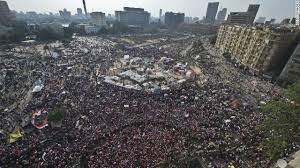
The Military Coup and Massacres in Egypt
During the transition from the toppled Mubarak regime and Mohamed Morsi’s inauguration, the Supreme Council of the Armed Forces (SCAF) military leadership imposed an undemocratic constitution on Egypt that did not allow for censuring or removing a president whom the majority of people wanted replaced
Following the election of Morsi, hopes were high that post-Mubarak Egypt would establish democracy and lift the economy. After a disastrous year in office, millions were angered and they turned out on June 30 demanding Morsi’s resignation.
The SCAF seized the opportunity to initiate a coup and arrested Morsi. They are running Egypt despite the appointment
of a president and prime minister. It is General Abdel Fattah al-Sisi who makes the proclamations and has the power.
In early July, the SCAF massacred over 50 protesting members of the Muslim Brotherhood during their sit-in. General al-Sisi then called for massive demonstrations to support his initiation of a war on terror, a war on the Muslim Brotherhood, a bloody campaign of repression, and a return to the Mubarak era status quo. On July 27, scores of Islamist protestors were killed by government security men.
On July 29, the interim prime minister was given the power to place the country in a state of emergency and to initiate a crackdown on not just “terrorists” but religious and secular activism of all kinds. In addition, the interior ministry announced the resurrection of several police units responsible for some of the most egregious human rights violations including secret detentions, torture, and extrajudicial killings.
While taking no political position on the Muslim Brotherhood, we condemn the killings by the military regime of Muslim Brotherhood supporters and the pre-emptive arrests of their leaders. We oppose the crackdown on protests and dissidents. We oppose the scapegoating of Palestinians, the destroying of the tunnels to Gaza, and the closing down of the border crossing at Rafah.
The SCAF represents the same powers that have controlled Egypt and repressed its people for decades with a military trained by and beholden to the Pentagon. We do not believe that a military government will bring democracy or act in the economic, political and social interests of Egyptians suffering from severe austerity measures. Anticipating from past actions, the repressive force now directed against the Brotherhood will be turned on trade unions and other popular movements and organizations.
  • UNAC opposes all U.S. aid to military dictatorships and repressive regimes in Egypt, Israel, Bahrain, Yemen and Saudi Arabia.
  • We call for the immediate end of shipments of weapons and crowd control equipment to Egypt and an end to the U.S. government’s annual $1.3 billion in military aid to the Egyptian military.
8/9/13
Lynne Stewart Needs Our Help
8/9/13
Compassionate Release Denied BUT ALL Is Not Lost. ACT NOW!
Dear Friends of Lynne Stewart,
Today, Judge John Koeltl DENIED Lynne Stewart's petition for compassionate release. But he left the door open for another decision.
Citing the "law" that requires the Bureau of Prisons to first make a recommendation to the Judge for Compassionate Release Koeltl wrote:
"The petitioner has appropriately submitted a renewed motion for compassionate release to the BOP, and the court is prepared to give prompt and sympathetic consideration to any motion by the BOP that seeks compassionate release. But the current application seeking to circumvent a motion by the BOP is without merit and is DENIED."
Koeltl is fully aware of Lynne's dire medical situation. Her attorneys have submitted statements by prison doctors stating that Lynne has less than 18 months to live. Other submissions by independent doctors have estimated Lynne's prognosis at six months! Koeltl has all this information before him.
His decision appears to signal to the BOP that he is prepared to grant compassionate release in accord with the law and with Lynne's medical condition.
The focus must now shift to a massive campaign to press the BOP as well as Attorney General Eric Holder and President Omama to meet their legal responsibilities and recommend compassionate release now.
Lynne's new petition is now before the BOP. Contact the BOP now as follows.
In solidarity,
Jeff Mackler, West Coast Coordinator, Lynne Stewart Defense Committee
Ralph Poynter states it all: The struggle for every second of Lynne's life continues with full force. Lynne is urging all her supporters and defenders of human and democratic rights everywhere to vigorously renew their letters to BOP director. Write to him or call as follows:
Mr. Charles E. Samuels, Jr., Director, Federal Bureau of Prisons, 320 First Street, NW Washington, DC 20534 Re: Lynne Stewart, #53504-054 Compassionate Release ~ or CALL: 202-307-3250/202-307-3062
http://lynnestewart.org/

KEEP THE PRESSURE ON: Lynne has filed a SECOND request for Compassionate Release, so please continue to get signatures on the petition at http://lynnestewart.org/
WATCH today's Democracy Now segment with Ralph Poynter speaking on Lynne Stewart: http://www.democracynow.org/2013/8/8/i_do_not_want_to_die Amy Goodman will give a brief update on the case tomorrow, Friday Aug 9 on DN.
All Out for August 24 and 28
Saturday, August 24, 2013. Rally at the Lincoln Memorial at 8 am and march to the King Memorial.
UNAC has endorsed the events around the 50th anniversary of the 1963 March on Washington where Martin Luther King gave his historic, “I have a dream speech.” Martin Luther King understood the connection between civil rights and peace and came out strongly against the Vietnam War. Please join UNAC at this march. We will send out more details where UNAC supporters and peace activists can meet.
For more information: http://nationalactionnetwork.net/
August 28
The actual anniversary of the historic march is Wednesday, August 28. On that day rallies will be organized around the country. UNAC has endorsed these actions. Please plan to join one of the rallies being planned or plan one in your area. These actions are being called around the demands of :
STOP THE WAR ON YOUTH OF COLOR
JUSTICE FOR TRAYVON MARTIN –JAIL ZIMMERMAN!
OVERTURN ‘STAND YOUR GROUND’ LAWS!
JOBS& EDUCATION
NOT MASS INCARCERATION!
END RACIAL PROFILING OF ALL FORMS!
STOP RACIST POLICE TERROR INCLUDING STOP-AND-FRISK!
IMMIGRANT RIGHTS NOW
STOP DEPORTATIONS!
A LIVING WAGE AND UNION RIGHTS
FOR LOW-WAGE AND ALL WORKERS!


To remove yourself from the UNAC listserv, please send an email to: UNAC-unsubscribe@lists.riseup.net
To add yourself to the UNAC listserv, please send an email to: UNAC-subscribe@lists.riseup.net