Saturday, January 04, 2014

***The Life And Times Of Michael Philip Marlin, Private Investigator- A Piece Of Work 


From The Pen Of Frank Jackman-with kudos to Raymond Chandler 


Those who have been following this series about the exploits of the famous Ocean City (located just south of Los Angeles then now incorporated into the county) private detective Michael Philip Marlin (hereafter just Marlin the way everybody, except a few lady friends who called him Philip and his late mother who called him Michael Philip, called him when he became famous after the Galton case out on the coast) and his contemporaries in the private detection business like Freddy Vance, Charles Nicolas (okay, okay Clara too), Sam Archer, Miles Spade, Johnny Spain, know that he related many of these stories to his son, Tyrone Fallon, in the late 1950s and early 1960s. Tyrone later, in the 1970s, related these stories at his request to the journalist Joshua Lawrence Breslin who uncovered the relationship, a friend of my boyhood friend, Peter Paul Markin, who in turn related them to me over several weeks in the late 1980s. Despite that circuitous route I believe that I have been faithful to what Marlin presented to his son. In any case I take full responsibility for what follows.        

*******

Yah, that Teddy Landers was a piece of work alright, a guy from Yonkers or some place near New York City, he was always changing up what town he was from but he was always from the tough end sections of those towns, so he had to be tough, city street smarts tough. A guy, a film director, you know, Robert Ashland, yes, that Robert Ashland, the one who did The Choice, Close Call, and Cry, The City and a bunch of other tough guy films and grabbed a fistful of awards too, wanted to do a film adaptation of Teddy’s life. The brash kid growing up in troubled circumstances before the war, the heroic war record including stints as a “pre-mature anti-fascist” fighting in one of the International Brigades in Spain and later as a commando and SS prisoner in the war, war wounds, hanging around Vegas with war buddies, now connected war buddies who used him as a mule to launder money down Mexico way, then landing square on his feet marrying money, serious money, when he bedded and wedded the wild child Sarah Wyatt all wrapped around a good-looking guy whose war wounds only enhanced those good looks. There was talk, serious talk of Brando or Newman as the lead, and Audrey Hepburn as Sarah. There was even, at Teddy’s insistence, a walk-on part for Marlin as Teddy’s new found side-kick and confidante about two- thirds of the way through the film to show what a regular guy he was, you know, mixing with tough guys and holding his own in the city’s plebeian bars. The money, the backing was there, an outline of a script was there, this was no come-on like a lot of Hollywood film ideas that wind up out on some back lot floor gathering dust. So, yes, Ashland wanted to do the film, needed to after a couple of crash and burn non-descript items that did not increase that fistful of awards on his fireplace. That is he wanted to do that film until one night Teddy took off, took off with a small suitcase and a satchel full of cash (cocaine too but the amount was unknown was never known so let’s just stick with that bucket of cash) and left no forwarding address, left a lot of people in the lurch including one Michael Philip Marlin. 

Yah, Teddy Landers who also knew all the angels, good and bad liking the bad if he was to call a preference, knew some French women in Europe after the war who taught his some interesting sex tips that stood him in good stead when he found Hollywood, and later found the decadent Sarah. Knew, knew well, half the hookers, call girls, street tricks and courtesans in Vegas before he split to the coast (and, yes, there were, are, courtesan in bright light neon Vegas but you won’t see them in the tourist brochures, you have to be connected, very connected to even know that such sexual delights could be found there, otherwise make your choice from the hookers, call girls and tricks. Knew some savage junkie women in London who put him onto the whole black market set-up for a few bindles of junk, H, you know heroin, and then left them flat. Knew a Yonkers girl too back when he was just brash who wouldn’t tumble, wouldn’t give him what he wanted, and so he blew her off and who later was shot by her angry husband but every day (according to Marlin) he kicked himself for doing so. But good girl or bad girl he attracted the angels like moths to the light.

He knew all the angles too, had run a “clip” gang (you know kids, and it was only kids no serious professional would risk his career for a few baubles worth jack, hitting jewelry, department , and record stores and grabbing everything not nailed down then selling it cheap, maybe called “five-finger discount” around your way. Hell, I did it myself for a while around my old hometown) and one night pulled a “robbery” grabbing all the cash in the kitty to take some twist somewhere. Strictly kids’ stuff though, a little ejack-rolling of drunks, midnight auto stuff, light drug dealing, until Europe, Europe and black markets and dough (remember he stiffed those street hooker London bindle freaks). Europe and war buddy connections that would pan out when he blew Yonkers and headed west for a change of scenery.   

So Teddy knew how to cut corners on both, knew how to use his attraction for women, certain kinds of women with a wild streak, a desire to take a step over the edge and see what that side looked like, and decidedly not goody women, not at least since that first long flickered out flame back in his boyish days and knew too, by training if not by instinct how to fend for himself, how to make the other guy take the fall, knew how to grab the money and run, knew also you needed protectors in this wicked old world and was not choosey about who that was, know who to cut those corners more than one way too as Marlin found out, found out, later. And Marlin joined the line, the long line of gals and guys, high class dames, high-class call girls, high-end rollers and low-down gangsters, who got used by Teddy, got used and still liked the guy, or at least wished him no harm.

Marlin had met him in a bar, Shorty’s, the original Shorty’s over off Wiltshire just short of the Los Angeles line in Ocean City  to set your geography straight, although most of the clientele in those days came from the city, down the street from his apartment building. Shorty’s the bar that he had make famous, or infamous as the case may be depending on whether you like the coppers to see public justice done or are rooting for the guys like Marlin who for cheap dough, a few knocks on the head or a stray bullet chase after windmills,  in the Baxter case. The bizarre one that you might have heard of where an old time Los Angeles king hell fixer, Richard Baxter,  took a fall, a fatal fall, all because a guy got shot by another guy right in Shorty’s over a decade before, just before the war in Europe got up a head of steam. Shorty, now a prosperous owner of several watering holes, including the Club Arriba over on Central Avenue in the city, once he knew whose palms to grease and who to seek “protection” from, liked Marlin’s presence as a crowd-drawer and for the favor his drinks were on the house. Marlin, in the chips or not, never turned down a drink, scotch especially, from friend or foe so the place was his regular hang-out

It had been a slow Monday late afternoon when Teddy  walked in, sat down beside Marlin, and ordered a scotch bright, scotch, high-end MacDonald Brother scotch in his case, with a kick of Bacardi, a drink that the guys who had come back from overseas brought back with them. More importantly that was Marlin’s drink of choice at that moment (although he had been too old to serve in World War II he had seen service with the American Expeditionary Force in World War I and had picked up the scotch bright taste from some ex-soldiers who hung around the Kit-Kat Club, a big hang-out for homecoming West Coast ex-soldiers, sailors and marines). He off-handedly commented on their similar tastes and Teddy told him about how he had acquired the taste in London during the war. Teddy, a friendly guy anyway as long as he was not crossed, not looking for something from somebody and got turned down or was in his cups was in a talkative mood, and maybe sensed that Marlin was a guy who he could talk to and he continued on, ordering another scotch bright, and one for Marlin too.

And so Teddy and Marlin talked, talked about the drink and its origins, talked about the bewildering variety and types of scotch whiskeys from the Highlands, talked about the late war and the wounds that Teddy had sustained which were still visible in the light although fading, talked about the craziness of Los Angeles lately although Marlin could tell Teddy was neither native nor had he gone native getting a deep tan, wearing sporty clothes and generally acting like he didn’t have a care in the world, talked about the scads of kids coming to Ocean City to surf, surf for chrissakes, the hard boys from the valley who were driving their soup-up hot rods up and down the Pacific Coast Highway like they owned it and the Okies and Arkies coming out of the woodwork once they heard that California was a Garden of Eden, talked about the big migrations from the east  after the war that had stretched the place to the limit and they were still coming, and about this and that, guy stuff, manly guy stuff.

Every few days, maybe every week or so, they would run into each other at Shorty’s, Teddy always parking his ride, his shining dark green Jaguar courtesy of wife Laura (who insisted that the old Hudson that he had been driving around in when they met, and which he had tenderly kept in top condition, was too plebeian, and what would the help say if he was driving a car they might own so he grabbed the most expensive damn automobile he could find and, damn, she didn’t flinch), right out in front helter-skelter depending on how heavily he had been drinking, and discuss stuff, guy stuff, mostly. Teddy doing the talking, fast-talking with a little edge, with a little larceny, wise-guy, angle-cutting edge to it, and Marlin served as the listening post. Eventually he would have Teddy over to his place after the bar closed for a nightcap, many nights for Teddy to sleep it off on Marlin’s couch as well.

A lot of what Teddy would talk about was how tough it was being married for the past five years to money, big money, married to the Wyatt fortune, or part of it, the Laura Wyatt part of it. That was old California money, old meaning built by grabbing water rights back in the 1920s, getting in on the ground floor of the oil boom around the LaBrea tar pits and whatever else old Leslie Wyatt could grab that was not tied down. This Wyatt a real bastard Marlin had heard but a real lamb to his kids, especially Laura who early on was wild, just as wild as plenty of money would go. Teddy could take the money part, take it easily with both hands out having grown up poor, dirt poor in Yonkers before the war. But the way they, Laura, the old man, and their Mayfair swell friends made him feel like cheap street left ashes in his mouth. That was one angle he had not figured out he told Marlin one drunken night, not yet.

Worse this Laura was nothing but a tramp picking up every fly-by-night guy she took a momentary fancy too, bringing him home, or rather to her “guest house” away from their main home, their mansion where she might be holed up for a few days before coming up for air (that place bought, every tile and nail bought, by Leslie Wyatt when Laura purred in his ear that they needed suitable digs for entertaining, and she had had the guest house built once she told Teddy that she needed her “own space”). Hell, Teddy would say, after he had had his seventh drink, maybe more, that he really should have had no kick about Laura’s style since he had met her at one of her Malibu parties which he crashed with a friend and he had spent his own few days in her “guest house” at the old man’s mansion. After they came up for air a few days thereafter they were married, a lark for her, she said all her friends were married and she should be too. Christ, now that he thought about it, although it easy street and shiny objects for him, it still bothered him, bothered him that she was so open like only the rich could be with her minute affairs. And so Teddy, Teddy the trophy war-hero (he had been a “premature anti-fascist” fighting in the Spanish Civil War in an International Brigade unit although more for the three squares and some dough than any political allegiance and later as a volunteer commando with the British when Europe heated up, and where he was severely wounded on a secret mission) began to fall off the leash.

Teddy the reclamation project too (Laura made it clear she was taking a poor kid from the streets and giving him dough, a car and some manners, public manners anyway), began to lead his own life, began to play around, play around with a loose country club set woman or two who was dissatisfied with her husband or who just liked to play around in that insular little world of 1950s Malibu, Malibu before all the riff-raff and hang- ten surfers came through. Thereafter he began to drink heavily (and grab a few lines of off-hand cocaine if it was laying around), began to drink himself into a stupor to ease the pain, the pain of his youthful wants, his very real war wounds, and his store –bought social wounds. After a while, after a few months of talk, couches, and drunks Marlin considered Terry a friend, a rare distinction for a lone- wolf private detective. And Teddy considered Marlin a friend too.

So it was no big deal when Teddy came up to Marlin’s apartment one midnight several months after they met, drunk, frazzled, a little shaky and asked Marlin to drive him to Mexico, dusty, tin cup, anything goes, anything goes if you have the dough, anything, Tijuana, faux Mexico Tijuana, just over the border, to think things out, undisclosed things. Teddy in high dudgeon wanted no questions asked and once Marlin accepted that condition, actually had thought nothing of the request except the direction, the trip down south was unusual, previous requests had been to places north of L.A. to see some woman (his latest one, whom Marlin had not met, lived up in Malibu in the same colony as the Lander’s estate) or to drive him home, he bought the ticket and gave him that ride.

A fateful ride that would cost Marlin a few days in the slammer for aiding a felon after the fact since what Teddy  was thinking things out about down in sweaty, sunny Mexico was the brutal murder of his wife. Laura was found naked in her guest house, battered, blood all over the place, by one of her maids the next morning and who immediately reported the discovery to the sheriff’s office. Once the coppers tied Marlin to Teddy’s disappearance they pounced on him, and it wasn’t hard because Marlin had not tried to hide his tracks, all he had asked of Teddy was to say to him nothing, nothing at all about what bothered him once he agreed to take him south sensing something very illegal was afoot although he thought Teddy was running from his gangster war buddies, or some busted drug deal he was acting as intermediary for. The coppers gave it to Marlin strong, gave him the full-press third-degree under the bright lights, all night, the whole good cop, bad cop routine, the confess and we’ll go easy on you, have a cigarette and think it over, like he was that easy to turn over. Yah, all the little tricks they liked to play, things they liked to do that they have seen on television or in some old time film noir, maybe a B-Robert Ashland film, things they liked to do anytime they got a private dick in their clutches. Especially Marlin who had twisted their noses on the Sternwood case (the time he rounded up Eddie Miles, the big gangster, and put a big bow around his neck to help an old man rest in peace a little after his daughters went wild on him) and the Trepper case(where he exposed a murderous psychopathic crooked cop hung up on a redhead, a married redhead who had a funny habit of cheating on him, the cop not the husband), made them look foolish, a few years before.

Then just as quickly Marlin was sprung from jail without an explanation. No, that is not right, there was no more case since Teddy had saved everybody a lot of trouble and committed suicide, leaving an incriminating note. So long Teddy, end of story. No, no again, Marlin was not buying the whole set-up both because he did not believe that Teddy could have brutally murdered his wife no matter how much he hated her tramp ways and her snobbery and that high-end life they led and because Teddy just didn’t seem the suicide type, didn’t appear that distraught when he left him off at the border. Marlin figured that he could not have stayed in his chosen profession very long if he was not able to take the measure of a man, could not size him up, could not have a grip on what made him tick, and what didn’t. No, with all his sorrows, all his hurts, all his baggage from his youth Teddy was made of tougher stuff.

But there was nothing Marlin could do about checking further having been warned off the case by Laura’s father who wanted the thing closed, closed tight, so he could maintain his privacy, keep the case off the front page so that his country club set would have nothing to titter about behind his back. Told all this not directly by the old man, the help was not handled that way in that orbit, but by Wyatt’s lawyer, naturally. And since the old man drew a lot of water downtown he was prepared to make life tough for one Michael Philip Marlin.

Had been warned off too by a couple of Teddy’s old friends and war buddies, Mendy and Randy (no last names but Vegas-connected and thus connected enough for Marlin), whom Teddy had worked for before he hit pay-dirt with Laura and who were also then very prominent mobsters with connections back East. They three while playing heroic commandos also took care of their respective number ones by working the black markets of half the countries in Europe. Skills that were useful at home when the hard boys of New York and later, the West Coast when operations shifted there took notice. Not heeding such warnings from hard guys, guys who had cut their teeth in the cutthroat black markets of wartime Europe, were in on the ground floor when the fight over who, or who would not, run Vegas, and who would think nothing of sending some, what did Mendy call him, oh yeah, some two-bit gumshoe, down some secluded ravine face down was not good for business.

And then there were the cops, the cops responding to pressure from downtown (who were responding to pressure from the old man and his crowded court of cronies), their own dislike for Marlin and his profession, and their own sense of power who said in no uncertain terms the case was shut, shut tight. So although Teddy’s fate gnawed at him Marlin backed off, backed off for a while, although not because some high-priced lawyer, some two-bit soft guy Vegas hoods, or some on- the- take cops said to but because he was broke and needed to make some dough, needed to make office and room rent.

With Teddy still in the back of his mind Marlin grabbed his next case, the Waits case, the case of a famous abusive drunken pot-boiler historical novel writer, Roger Waits. Everybody, even Marlin, had heard of Waits of course, the sword and busted bodice novel guy whose books you would see at the check-out counters at supermarkets and who sex-hungry housewives read to while away those lonely hours out in suburbia, out in Levittown, out in Irvine. He had gone missing for a week or more and his wife, Eileen, was desperately trying to find him and bring him back to their oceanfront Malibu home.

Here is where Teddy, or rather Marlin’s stand-up shut- up guy defense of Teddy, got him the job since Mrs. Waits had read about Marlin in the newspapers when he was in custody as a material witness and grabbing the third degree and decided he was the man to find her errant husband. Marlin finally seeing some dough, easy dough, on the horizon and the back of his landlords’ heads took the case and in a short time was able to find old Roger holed up trying to dry out (again) in a sanatorium. Marlin brought him home to his ever-loving wife and that was that. End of story.

No, again no, Roger had taken a liking to Marlin, wanted to hire him to protect him against his demons, real and imagined, but Marlin said no deal. He was not a baby-sitter, or man-servant, which is what was required. What might have changed his mind, if anything, though was this Eileen Waits, Roger’s trophy wife, whose slim figure, faraway blue eyes, wistful expression, and slight whiff of perfume, gardenia something, had him thinking about silky sheets and sultry bedroom afternoons. But that was not to be, although not for his lack of trying, giving her very definite signals. What happened to forestall that possibility was not that not long after he had gotten Roger home, dried out for a while, he started drinking again, and started to be haunted by his demons. One day Roger in some drunken rage, or drunken stupor, shot himself, committed suicide. Marlin wasn’t buying that one either since Waits, whatever his writer’s block, whatever feelings he had that he was washed up, a has been, was not a suicide guy. Marlin now had to dig into this one if for no other reason than surrounded by two suicides in short order he had to get out from under the tag of a guy to not be around if you cared about your health, or your life.

Things were a mess until Marlin stepped back and put a couple things together. First off the Waits knew the Wyatts, father and daughters, travelled in some of the same circles out in Malibu, and had been to some of the same charity events and the like. That information came out by accident when the cops were investigating Roger’s suicide. Without too much trouble he also found out that Laura Wyatt had numbered Roger Waits as one of her trophies. And that set up everything else once Roger’s houseboy gave Marlin enough information about Mrs. Waits and her strange nocturnal habits, her vague longing for some soldier boy first love long gone that she had married before Roger habits. Not so long gone though since that soldier boy she pined away for was one Teddy Landers (although they had been married with him using a different name in London during the war).

Eileen Waits enraged that the tramp Laura had taken her first man, long thought to be dead after some secret raid in Norway, enraged that he had become nothing but a degenerate kept pet by Laura and enraged that she had also taken her second man and flouted that fact making no attempt to conceal the affair or their guest house love-making murdered both of them. Although no jury would had convicted her even if the D.A. decided to try the case. A beautiful, disturbed (and wealthy) widow was not the kind of murder case that would sail in celebrity-conscious Los Angeles in the hush-hush 1950s. And that case would not be tried because Laura’s father, that couple of Vegas-connected hoods, and the on-the-take cops had closed the case previously, closed it up tight. And that is the end of the story.

Well not quite. Something still did not add up, especially the role of those two hoods, war buddies or not, going way out of their way to shut the case down, to warn Marlin off. So he again stepped back and what he figured out was that no way, no way on this good green earth did Teddy Landers die in Mexico. The whole thing was fixed, fixed by Terry and the boys. And the way Marlin found that out was simple, simplicity itself, Landers, disguised as a Mexican, showed up at his door one day and flaunted that hard fact in Marlin's face. Then he walked away. And Marlin for his own reasons, for an old friendship gone awry, let him. Yeah, that Teddy Landers was a piece of work. End of story.

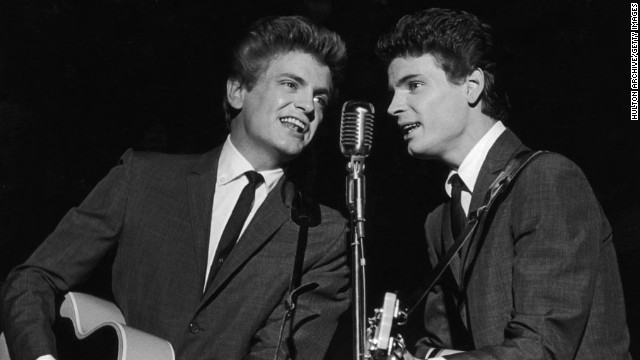
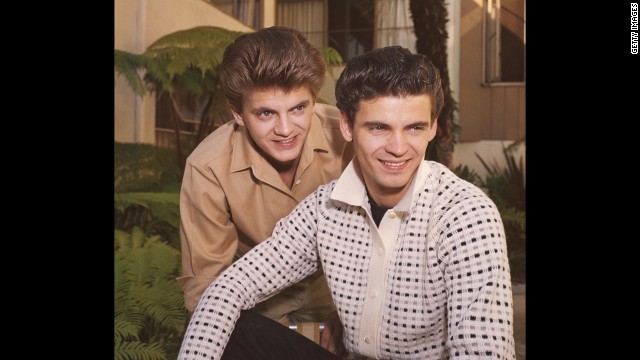
***Singer Phil Everly -- half of legendary Everly Brothers -- dies


[Markin:  I know  I took a lotta, lotta grief in my junior days from the girls because I did not like the Everly Brothers. Much preferring classic Elvis (1956 and before), Jerry Lee Lewis, Chuck Berry and Bo Diddley]  

By Greg Botelho and Todd Leopold, CNN
updated 4:09 PM EST, Sat January 4, 2014

Singer<a href='http://www.cnn.com/2014/01/03/showbiz/singer-phil-everly-dies/index.html?hpt=hp_t1' target='_blank'> Phil Everly</a> -- one half of the groundbreaking, smooth-sounding, record-setting duo the Everly Brothers -- has died, a hospital spokeswoman said. He was 74. Singer Phil Everly -- one half of the groundbreaking, smooth-sounding, record-setting duo the Everly Brothers -- has died, a hospital spokeswoman said. He was 74.
(CNN) -- Singer Phil Everly -- one half of the groundbreaking, smooth-sounding, record-setting duo, the Everly Brothers -- has died, a hospital spokeswoman said.
He was 74.
 
Patricia Aidem, a spokeswoman at Providence St. Joseph Medical Center in Burbank, confirmed Everly's death on Friday, but could not provide additional details, citing the family's request.
During the late 1950s and early 1960s, Phil Everly and his brother, Don (now 76), ranked among the elite in the music world by virtue of their pitch-perfect harmonies and emotive lyrics.
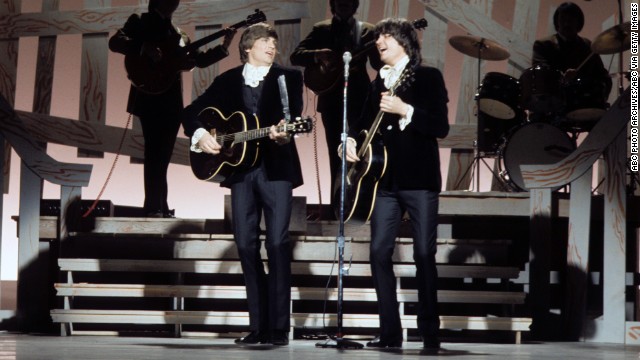
 
Singer Phil Everly dies at 74
 
Rolling Stone labeled the Everly Brothers "the most important vocal duo in rock," having influenced the Beatles, the Beach Boys, Simon & Garfunkel and many other acts.
Along the way, they notched 35 Top 100 songs -- more than any other vocal pair.
 
The Everly Brothers' sound -- with Don's lower register generally ringing in perfect thirds with Phil's higher voice -- was the backbone of dozens of hits.
 
The two began as songwriters before signing a deal in 1957 with Cadence Records. They became international sensations over the next five years with tunes such as "Bye Bye Love," "Wake Up Little Susie," "When Will I Be Loved" and "All I Have to Do Is Dream." In terms of record sales, their chief rivals during this stretch were Elvis Presley and Pat Boone.
 
Their style -- a product of their blend of rock 'n' roll with Appalachian folk, bluegrass and other genres more closely aligned to their Kentucky roots -- helped them earn inductions in both the Rock and Roll Hall of Fame and the Country Music Hall of Fame.
 
"The amount of music that can be directly traced to the Everly Brothers is incredible," wrote one admirer on Twitter. "Thanks, Phil...and 'Bye Bye.'"
 
Phil and Don were born in the business, the offspring of country and western singers Margaret and Ike Everly.
 
The Everlys sang with their parents in live shows and on the radio. In the mid-'50s, while still teenagers, they moved to Nashville to be songwriters. In 1957, they found a Felice and Boudleaux Bryant song, "Bye Bye Love."
 
According to "The Rolling Stone Encyclopedia of Rock & Roll," 30 acts had rejected the song, but the Everlys -- with the key guitar contributions of Chet Atkins, who played on many of their hits -- took the song to No. 2 on the pop charts.
 
"They added Bo Diddley riffs, teenage anxieties and sharkskin suits but -- for all that -- the core of their sound remained country brother harmony," read their bio on the Country Music Hall of Fame's website.
 
After averaging a Top 10 hit every four months over the next few years, the Everly Brothers inked a 10-year pact with Warner Brothers (which now is part of Time Warner, like CNN) in 1960. More success followed -- including "Cathy's Clown," which the duo wrote -- and they stayed particularly popular in Britain.
 
"Bye Bye Love" was "the first thing that really killed me," Paul Simon once recalled. He called Art Garfunkel immediately upon hearing the song, according to a Simon biography, and the two set to work on their own act.
 
The Everlys also served to bond the nascent Beatles.
 
Upon hearing "All I Have to Do Is Dream" in 1958, the young group -- which had just added George Harrison to a lineup that included John Lennon and Paul McCartney -- couldn't wait to cover it.
"When we first heard it, it blew us away," McCartney said in Mark Lewisohn's new Beatles biography, "Tune In."
 
By the 1970s, the pair was performing in a band that also included legends Warren Zevon and Waddy Wachtel. But their time together came to a sudden end in 1973, when Phil stormed off the stage during a show in California.
 
The brothers reunited on stage and in the studio 10 years later, leading to more albums, including "EB 84" (including the McCartney-written "On the Wings of a Nightingale") and "Born Yesterday."
Their remaining years were highlights by occasional shows, hall of fame inductions and various other honors, including a Grammy Lifetime Achievement Award in 1997.
HONOR THE THREE L’S-LENIN, LUXEMBURG, LIEBKNECHT-Honor An Historic Leader Of The Russian Revolution-Leon Trotsky

 
 EVERY JANUARY WE HONOR LENIN OF RUSSIA, ROSA LUXEMBURG OF POLAND, AND KARL LIEBKNECHT OF GERMANY AS THREE LEADERS OF THE INTERNATIONAL WORKING CLASS MOVEMENT. DURING THE MONTH WE ALSO HONOR OTHER HISTORIC LEADERS AS WELL ON THIS SITE.

BOOK REVIEW

THIS IS A REVIEW OF LEON TROTSKY’S HISTORY OF THE RUSSIAN REVOLUTION, ORIGINALLY WRITTEN IN 1930-32, (EDITION USED HERE-THREE VOLUMES, PATHFINDER PRESS, NEW YORK, 1980) BY AN UNREPENTANT DEFENDER OF THE OCTOBER REVOLUTION OF 1917. HERE’S WHY.

Leon Trotsky’s History of the Russian Revolution is partisan history at its best. One does not and should not, at least in this day in age, ask historians to be ‘objective’. One simply asks that the historian present his or her narrative and analysis and get out of the way. Trotsky meets that criterion. Furthermore, in Trotsky’s case there is nothing like having a central actor in the drama he is narrating, who can also write brilliantly and wittily, give his interpretation of the important events and undercurrents swirling around Russia in 1917.

If you are looking for a general history of the revolution or want an analysis of what the revolution meant for the fate of various nations after World War I or its affect on world geopolitics look elsewhere. E.H. Carr’s History of the Russian Revolution offers an excellent multi-volume set that tells that story through the 1920’s. Or if you want to know what the various parliamentary leaders, both bourgeois and Soviet, were thinking and doing from a moderately leftist viewpoint read Sukhanov’s Notes on the Russian Revolution. For a more journalistic account John Reed’s classic Ten Days That Shook the World is invaluable. Trotsky covers some of this material as well. However, if additionally, you want to get a feel for the molecular process of the Russian Revolution in its ebbs and flows down at the base in the masses where the revolution was made Trotsky’s is the book for you.

The life of Leon Trotsky is intimately intertwined with the rise and decline of the Russian Revolution in the first part of the 20th century. As a young man, like an extraordinary number of talented Russian youth, he entered the revolutionary struggle against Czarism in the late 1890’s. Shortly thereafter he embraced what became a lifelong devotion to a Marxist political perspective. However, except for the period of the 1905 Revolution when Trotsky was Chairman of the Petrograd Soviet and later in 1912 when he tried to unite all the Russian Social Democratic forces in an ill-fated unity conference, which goes down in history as the ‘August Bloc’, he was essentially a free lancer in the international socialist movement. At that time Trotsky saw the Bolsheviks as “sectarians” as it was not clear to him time that for socialist revolution to be successful the reformist and revolutionary wings of the movement had to be organizationally split. With the coming of World War I Trotsky drew closer to Bolshevik positions but did not actually join the party until the summer of 1917 when he entered the Central Committee after the fusion of his organization, the Inter-District Organization, and the Bolsheviks. This act represented an important and decisive switch in his understanding of the necessity of a revolutionary workers party to lead the socialist revolution.

As Trotsky himself noted, although he was a late-comer to the concept of a Bolshevik Party that delay only instilled in him a greater understanding of the need for a vanguard revolutionary workers party to lead the revolutionary struggles. This understanding underlined his political analysis throughout the rest of his career as a Soviet official and as the leader of the struggle of the Left Opposition against the Stalinist degeneration of the Russian Revolution. After his defeat at the hands of Stalin and his henchmen Trotsky wrote these three volumes in exile in Turkey from 1930 to 1932. At that time Trotsky was not only trying to draw the lessons of the Revolution from an historian’s perspective but to teach new cadre the necessary lessons of that struggle as he tried first reform the Bolshevik Party and the Communist International and then later, after that position became politically untenable , to form a new, revolutionary Fourth International. Trotsky was still fighting from this perspective in defense of the gains of the Russian Revolution when a Stalinist agent cut him down. Thus, without doubt, beyond a keen historian’s eye for detail and anecdote, Trotsky’s political insights developed over long experience give his volumes an invaluable added dimension not found in other sources on the Russian Revolution.

As a result of the Bolshevik seizure of power the so-called Russian Question was the central question for world politics throughout most of the 20th century. That central question ended (or left center stage, to be more precise) with the demise of the Soviet Union in the early 1990’s. However, there are still lessons, and certainly not all of them negative, to be learned from the experience of the Russian Revolution. Today, an understanding of this experience is a task for the natural audience for this book, the young alienated radicals of Western society. For the remainder of this review I will try to point out some issues raised by Trotsky which remain relevant today.

The central preoccupation of Trotsky’s volumes reviewed here and of his later political career concerns the problem of the crisis of revolutionary leadership of the international labor movement and its national components. That problem can be stated as the gap between the already existing objective conditions necessary for beginning socialist construction based on the current level of capitalist development and the immaturity or lack of revolutionary leadership to overthrow the old order. From the European Revolutions of 1848 on, not excepting the heroic Paris Commune, until his time the only successful working class revolution had been in led by the Bolsheviks in Russia in 1917. Why? Anarchists may look back to the Paris Commune or forward to the Spanish Civil War in 1936 for solace but the plain fact is that absent a revolutionary party those struggles were defeated without establishing the prerequisites for socialism. History has indicated that a revolutionary party that has assimilated the lessons of the past and is rooted in the working class, allied with and leading the plebeian masses in its wake, is the only way to bring the socialist program to fruition. That hard truth shines through Trotsky’s three volumes. Unfortunately, this is still the central problem confronting the international labor movement today.

Trotsky makes an interesting note that despite the popular conception at the time, reinforced since by several historians, the February overthrow of the Czarist regime was not as spontaneous as one would have been led to believe in the confusion of the times. He noted that the Russian revolutionary movement had been in existence for many decades before that time, that the revolution of 1905 had been a dress rehearsal for 1917 and that before the World War temporarily halted its progress another revolutionary period was on the rise. If there had been no such experiences then those who argue for spontaneity would have grounds to stand on. The most telling point is that the outbreak occurred in Petrograd, not exactly unknown ground for revolutionary activities. Moreover, contrary to the worshipers of so-called spontaneity, this argues most strongly for a revolutionary workers party to be in place in order to affect the direction of the revolution from the beginning.

All revolutions, and the Russian Revolution is no exception, after the first flush of victory over the overthrown old regime, face attempts by the more moderate revolutionary elements to suppress counterposed class aspirations, in the interest of unity of the various classes that made the initial revolution. Thus, we see in the English Revolution of the 17th century a temporary truce between the rising bourgeoisie and the yeoman farmers and pious urban artisans who formed the backbone of Cromwell’s New Model Army. In the Great French Revolution of the 18th century the struggle from the beginning depended mainly on the support of the lower urban plebian classes. Later other classes, particularly the peasantry through their parties, which had previously remained passive enter the arena and try to place a break on revolutionary developments.

Their revolutionary goals having been achieved in the initial overturn- for them the revolution is over. Those elements most commonly attempt to rule by way of some form of People’s Front government. This is a common term of art in Marxist terminology to represent a trans-class formation of working class and capitalist parties which have ultimately counterposed interests. The Russian Revolution also suffered under a Popular Front period under various combinations and guises supported by ostensible socialists, the Mensheviks and Social Revolutionaries, from February to October. One of the keys to Bolshevik success in October was that, with the arrival of Lenin from exile in April, the Bolsheviks shifted their strategy and tactics to a position of political opposition to the parties of the popular front. Later history has shown us in Spain in the 1930’s and more recently in Chile in the 1970’s how deadly support to such popular front formations can be for revolutionaries and the masses influenced by them. The various parliamentary popular fronts in France, Italy and elsewhere show the limitations in another less dramatic but no less dangerous fashion. In short, political support for Popular Fronts means the derailment of the revolution or worst. This is a hard lesson, paid for in blood, that all manner of reformist socialists try deflect or trivialize in pursuit of being at one with the ‘masses’. Witness today’s efforts, on much lesser scale, by ostensible socialists to get all people of ‘good will, etc.’, including liberal and not so liberal Democrats under the same tent in the opposition to the American invasion of Iraq.

One of Trotsky’s great skills as a historian is the ability to graphically demonstrate that within the general revolutionary flow there are ebbs and flows that either speed up the revolutionary process or slow it down. This is the fate of all revolutions and in the case of failed revolutions can determine the political landscape for generations. The first definitive such event in the Russian Revolution occurred in the so-called "April Days" after it became clear that the then presently constituted Provisional Government intended to continue participation on the Allied side in World War I and retain the territorial aspirations of the Czarist government in other guises. This led the vanguard of the Petrograd working class to make a premature attempt to bring down that government. However, the vanguard was isolated and did not have the authority needed to be successful at that time. The most that could be done was the elimination of the more egregious ministers. Part of the problem here is that no party, unlike the Bolsheviks in the events of the "July Days" has enough authority to hold the militants back, or try to. Theses events only underscore, in contrast to the anarchist position, the need for an organized revolutionary party to check such premature impulses. Even then, the Bolsheviks in July took the full brunt of the reaction by the government with the jailing of their leaders and suppression of their newspapers supported wholeheartedly by the Mensheviks and Social Revolutionary Parties.


The Bolsheviks were probably the most revolutionary party in the history of revolutions. They certainly were the most consciously revolutionary in their commitment to political program, organizational form and organizational practices. Notwithstanding this, before the arrival in Petrograd of Lenin from exile the Bolshevik forces on the ground were, to put it mildly, floundering in their attitude toward political developments, especially their position on so-called critical support to the Provisional Government (read, Popular Front). Hence, in the middle of a revolutionary upsurge it was necessary to politically rearm the party. This political rearmament was necessary to expand the party’s concept of when and what forces would lead the current revolutionary upsurge. In short, mainly through Lenin’s intervention, the Party needed to revamp its old theory of "the democratic dictatorship of the working class and the peasantry" to the new conditions which placed the socialist program i.e. the dictatorship of the proletariat on the immediate agenda. Informally, the Bolsheviks, or rather Lenin individually, came to the same conclusions that Trotsky had analyzed in his theory of Permanent Revolution prior to the Revolution of 1905. This reorientation was not done without a struggle in the party against those forces who did not want to separate with the reformist wing of the Russian workers and peasant parties, mainly the Mensheviks and the Social Revolutionaries.

This should be a sobering warning to those who argue, mainly from an anarchist or anarcho-syndicalist position, that a revolutionary party is not necessary. The dilemma of correctly aligning strategy and tactics even with a truly revolutionary party can be problematic. The tragic outcome in Spain in the 1930’s abetted by the confusion on this issue by the Party of Marxist Unification (POUM) and the Durrutti-led left anarchists, the most honestly revolutionary organizations at the time, painfully underscores this point. This is why Trotsky came over to the Bolsheviks and why he drew that lesson on the organization question very sharply for the rest of his political career.


The old-fashioned, poorly trained, inadequately led peasant-based Russian Army took a real beating at the hands of the more modern, mechanized and disciplined German armies on the Eastern Front in World War I. The Russian Army, furthermore, was at the point of disintegration just prior to the February Revolution. Nevertheless, the desperate effort on the part of the peasant soldier, essentially declassed from his traditional role on the land by the military mobilization, was decisive in overthrowing the monarchy. Key peasant reserve units placed in urban garrisons, and thus in contact with the energized workers, participated in the struggle to end the war and get back to the take the land while they were still alive. Thus from February on, the peasant army through coercion or through inertia was no longer a reliable vehicle for any of the various combinations of provisional governmental ministries to use. In the Army’s final flare-up in defense, or in any case at least remaining neutral, of placing all power into Soviet hands it acted as a reserve, an important one, but nevertheless a reserve. Only later when the Whites in the Civil War came to try to take the land did the peasant soldier again exhibit a willingness to fight and die. Such circumstances as a vast peasant war are not a part of today’s revolutionary strategy, at least in advanced capitalist society. In fact, today only under exceptional conditions would a revolutionary socialist party support, much less advocate the popular Bolshevik slogan-‘land to the tiller’ to resolve the agrarian question. The need to split the armed forces, however, remains.

Not all revolutions exhibit the massive breakdown in discipline that occurred in the Russian army- the armed organ that defends any state- but it played an exceptional role here. However, in order for a revolution to be successful it is almost universally true that the existing governmental authority can no longer rely on normal troop discipline. If this did not ocassionally occur revolution generally would be impossible as untrained plebeians are no match for trained soldiers. Moreover, the Russian peasant army reserves were exceptional in that they responded to the general democratic demand for "land to the tiller" that the Bolsheviks were the only party to endorse and, moreover, were willing to carry out to the end. In the normal course of events the peasant, as a peasant on the land, cannot lead a modern revolution in even a marginally developed industrial state. It has more often been the bulwark for reaction; witness its role in the Paris Commune and Bulgaria in 1923, for examples, more than it has been a reliable ally of the urban masses. However, World War I put the peasant youth of Russia in uniform and gave them discipline, for a time at least, that they would not have otherwise had to play even a a subordinate role in the revolution. Later revolutions based on peasant armies, such as China, Cuba and Vietnam, confirm this notion that only exceptional circumstances, mainly as part of a military formation, permit the peasantry a progressive role in a modern revolution.


Trotsky is politically merciless toward the Menshevik and Social Revolutionary leaderships that provided the crucial support for the Provisional Governments between February and October in their various guises and through their various crises. Part of the support of these parties for the Provisional Government stemmed from their joint perspectives that the current revolution was a limited bourgeois one and so therefore they could no go further than the decrepit bourgeoisie of Russia was willing to go. Given its relationships with foreign capital that was not very far. Let us face it, these allegedly socialist organizations in the period from February to October betrayed the interest of their ranks on the question of immediate peace, of the redistribution of the land, and a democratic representative government.

This is particularly true after their clamor for the start of the ill-fated summer offensive on the Eastern Front and their evasive refusal to convene a Constituent Assembly to ratify the redistribution of the land. One can chart the slow but then rapid rise of Bolsheviks influence in places when they did not really exist when the Mensheviks and Social Revolutionaries, formerly the influential parties of those areas, moved to the right. All those workers, peasants, soldiers, whatever political organizations they adhered to formally, who wanted to make a socialist revolution naturally gravitated to the Bolsheviks. Such movement to the left by the masses is always the case in times of crisis in a period of revolutionary upswing. The point is to channel that energy for the seizure of power.

The ‘August Days’ when the ex-Czarist General Kornilov attempted a counterrevolutionary coup and Kerensky, head of the Provisional Government, in desperation asked the Bolsheviks to use their influence to get the Kronstadt sailors to defend that government points to the ingenuity of the Bolshevik strategy. A point that has been much misunderstood since then, sometimes willfully, by many leftist groups is the Bolshevik tactic of military support- without giving political support- to bourgeois democratic forces in the struggle against right wing forces ready to overthrow democracy. The Bolsheviks gave Kerensky military support while at the same time politically agitating, particularly in the Soviets and within the garrison, to overthrow the Provisional Government.

Today, an approximation of this position would take the form of not supporting capitalist war budgets, parliamentary votes of no confidence, independent extra-parliamentary agitation and action, etc. Granted this principled policy on the part of the Bolsheviks is a very subtle maneuver but it is miles away from giving blanket military and political support to forces that you will eventually have to overthrow. The Spanish revolutionaries in the 1930’s, even the most honest grouped in the Party of Marxist Unification (POUM) learned this lesson the hard way when that party, despite its equivocal political attitude toward the popular front, was suppressed and the leadership jailed by the Negrin government despite having military units at the front in the fight against Franco.

As I write this review we are in the fourth year of the American-led Iraq war. For those who opposed that war from the beginning or have come to oppose it the victory of the Bolshevik Revolution shows the way to really end a fruitless and devastating war. In the final analysis if one really wants to end an imperialist war one has to overthrow the imperialist powers. This is a hard truth that most of even the best of today’s anti-war activists have been unable to grasp. It is not enough to plead, petition or come out in massive numbers to ask politely that the government stop its obvious irrational behavior. Those efforts are helpful for organizing the opposition but not to end the conflict on just terms. The Bolsheviks latched onto and unleashed the greatest anti-war movement in history to overthrow a government which was still committed to the Allied war effort against all reason. After taking power in the name of the Soviets, in which it had a majority, the Bolsheviks in one of its first acts pulled Russia out of the war. History provides no other way for us to stop imperialist war. Learn this lesson.

The Soviets, or workers councils, which sprang up first in the Revolution of 1905 and then almost automatically were resurrected after the February 1917 overturn of the monarchy, are merely a convenient and appropriate organization form for the structure of workers power. Communists and other pro-Communist militants, including this writer, have at times made a fetish of this organizational form because of its success in history. As an antidote to such fetishism a good way to look at this form is to note, as Trotsky did, that a Soviet led by Mensheviks and Social Revolutionaries does not lead to the seizure of power. That tells the tale. This is why Lenin, in the summer of 1917, was looking to the factory committees as an alternative to jump-start the second phase of the revolution.

Contrary to the anarchist notion of merely local federated forms of organization or no organization, national Soviets are the necessary form of government in the post- seizure of power period. However, they may not be adequate for the task of seizing power. Each revolution necessarily develops its own forms of organization. In the Paris Commune of 1871 the Central Committee of the National Guard was the logical locus of governmental power. In the Spanish Civil War of 1936 the Central Committee of the Anti-Fascist Militias and the factory committees could have provided such a focus. Enough said.

For obvious tactical reasons it is better for a revolutionary party to take power in the name of a pan-class organization, like the Soviets, than in the name of a single party like the Bolsheviks. This brings up an interesting point because, as Trotsky notes, Lenin was willing to take power in the name of the party if conditions warranted it. Under the circumstances I believe that the Bolsheviks could have taken it in their own name but, and here I agree with Trotsky, that it would have been harder for them to keep it. Moreover, they had the majority in the All Russian Soviet and so it would be inexplicable if they took power solely in their own name. That, after a short and unsuccessful alliance with the Left Social Revolutionary Party in government, it came down to a single party does not negate this conclusion. Naturally, a pro-Soviet multi-party system where conflicting ideas of social organization along socialist lines can compete is the best situation. However, history is a cruel taskmaster at times. That, moreover, as the scholars say, is beyond the scope this review and the subject for further discussion.

The question of whether to seize power is a practical one for which no hard and fast rules apply. An exception is that it important to have the masses ready to go when the decision is made. In fact, it is probably not a bad idea to have the masses a little overeager to insurrect. One mistaken assumption, however, is that power can be taken at any time in a revolutionary period. As the events of the Russian Revolution demonstrate this is not true because the failure to have a revolutionary party ready to roll means that there is a fairly short window of opportunity. In Trotsky’s analysis this can come down to a period of days. In the actual case of Russia he postulated that that time was probably between late September and December. That analysis seems reasonable. In any case, one must have a feel for timing in revolution as well as in any other form of politics. The roll call of unsuccessful socialist revolutions in the 20th century in Germany, Hungary, Finland, Bulgaria, Spain, etc. only painfully highlights this point.

Many historians and political commentators have declared the Bolshevik seizure of power in October a coup d’etat. That is facile commentary. If one wants to do harm to the notion of a coup d’etat in the classic sense of a closed military conspiracy a la Blanqui this cannot stand up to examination. First, the Bolsheviks were an urban civilian party with at best tenuous ties to military knowledge and resources. Even simple military operations like the famous bank expropriations after the 1905 Revolution were mainly botched and gave them nothing but headaches with the leadership of the pre- World War I international social democracy. Secondly, and decisively, Bolshevik influence over the garrison in Petrograd and eventually elsewhere precluded such a necessity. Although, as Trotsky noted, conspiracy is an element of any insurrection this was in fact an ‘open’ conspiracy that even the Kerensky government had to realize was taking place. The Bolsheviks relied on the masses just as we should.

With almost a century of hindsight and knowing what we know now it is easy to see that the slender social basis for the establishment of Soviet power by the Bolsheviks in Russia was bound to create problems. Absent international working class revolution, particularly in Germany, which the Bolsheviks factored into their decisions to seize power, meant, of necessity, that there were going to be deformations even under a healthy workers regime. One, as we have painfully found out, cannot after all build socialism in one country. Nevertheless this begs the question whether at the time the Bolsheviks should have taken power. A quick look at the history of revolutions clearly points out those opportunities are infrequent. You do not get that many opportunities to seize power and try to change world history for the better so you best take advantage of the opportunities when they present themselves.

As mentioned above, revolutionary history is mainly a chronicle of failed revolutionary opportunities. No, the hell with all that. Take working class power when you can and let the devil take the hinder post. Let us learn more than previous generations of revolutionaries, but be ready. This is one of the political textbooks you need to read if you want to change the world. Read it.


***Out In The 1950s B-Film Noir Night- Jules Dassin’s Thieves' Highway


DVD Review

From The Pen Of Frank Jackman

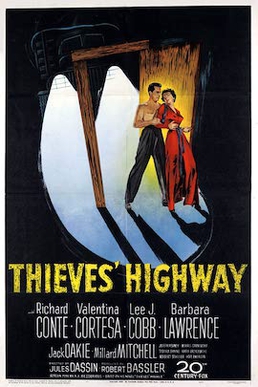
Thieves' Highway, starring Richard Conte, Lee J Cobb, Valentina Cortes, directed by Jules Dassin, 1949

 No question back in the late 1940s, and now too for that matter, the plight of the independent owner-operated trucker was tough. Long hours, high fuel prices, stale coffee and cakes, all made worst if one was dependent on the weather or delivered perishable time-sensitive commodities. That is why in the 1930s and 1940s leftist truckers from Minneapolis and guys like Jimmy Hoffa (the father) tried to organize these types into the Teamsters’ Union. Not everybody got the message or had the opportunity to join as was the case with the trucker, Nick (played by Richard Conte), out in the Frisco town area in the film under review, Jules Dassin’s Thieves' Highway.               

The plotline is simplicity itself (the real plus here is the photography and the role of the vibrant streetwalker Rica, played by Valentina Cortese). Nick returned from war expected to settle down to a white picket fence existence with his fiancée. Problem is that Nick’s father, a farmer, was a victim of a cockroach capitalist produce market honcho, Mike (played by Lee J. Cobb), who crippled him up. Nick  vowed to make things right against this bad guy. And after a series of up and downs; selling produce at a good price: shacking up with a streetwalker with a heart of gold; being robbed on Mike’s orders of the proceeds, being dumped by his white picket fence-loving fiancée; and, finally giving Mike his just rewards he does avenge the family honor. And then sets up house with the streetwalker with the heart of gold (maybe not white picket but a house) as they trail off into the sunset together.
   
***The Roots Is The Toots- The Music That Got Them Through The Great Depression And World War II…


… it wasn’t always about the fight to beat the rent-collector for another week to keep a roof over your head, it wasn’t always about the indignity of standing in soup-lines when one was willing and able to work, it wasn’t always about some big world historic struggle to gain dignity, and it wasn’t always about a guy’s number coming up, a girl seeing him off at the station before he was gathered up in some god- forsaken troop transport to face, to face whatever was coming, and the waiting. Sure a lot of it was, most of it, but the multifarious varieties of human experience, human experience close to the nub, did not take a holiday just because the economy tanked or the world was facing the night of the long knives. What did she know of class struggles and long knives all she knew was her man was gone, gone away and she was blue, blue as a woman could be and still stand. What did she know of too much production and not enough demand when all she knew was that her man, her only man, had gone, gone and left her with no dough, and no way to get dough. What did she know of world historic monsters when her man has beat it and left her flat, maybe gone back to his other woman, or maybe some new young thing. Yeah, what did she know except the damn man-wanting blues, the baddest blues around, Yeah, what did she know…    

Friday, January 03, 2014

***IMPORTANT MUMIA ABU JAMAL UPDATE-FREE MUMIA


Click below to link to the Partisan Defense Committee Web site.
 
Commentary
 
The legendary social commentator and stand up comic Lenny Bruce, no stranger to the American ‘justice’ system himself, once reportedly said that in the Halls of Justice the only justice is in the halls. The truth of that statement came home on Thursday March 27, 2008 as a panel of the federal Third Circuit Court of Appeals voted two to one to uphold Mumia’s conviction.
 
The only question left is that of resentencing- the death penalty or, perhaps worst, life in prison without parole. I have not yet read the decision but we are now a long way away from the possibility of a retrial-the narrow legal basis for even appealing in the legal system in the first place. Know this- in the end it will be in the streets and factories through the efforts of the international labor movement and other progressive forces that Mumia will be freed. That is the only way, have no illusions otherwise, whatever the next legal steps might be.


***Songs To While The Time By- The Roots Is The Toots-


A YouTube clip to give some flavor to this subject.

Over the past several years I have been running an occasional series in this space of songs, mainly political protest songs, you know The Internationale, Union Maid, Which Side Are You On, Viva La Quince Brigada, Universal Soldier, and such entitled Songs To While The Class Struggle By. This series which could include some protest songs as well is centered on roots music as it has come down the ages and formed the core of the American songbook. You will find the odd, the eccentric, the forebears of later musical trends, and the just plain amusing here. Listen up-Peter Paul Markin


***Songs To While Away The Class Struggle By-

Peter Paul Markin comment December 2013:

A while back, maybe a few years ago, I started a series presented under the headline Songs To While Away The Class Struggle By where I posted some songs that I thought would get us through the “dog days” of the struggle for our socialist future. Posted at a time when it was touch and go whether there would be some kind of uprising against the economic royalists (chastised under the popular sobriquet “the one-percent”) who had just dealt the world a blow to the head through their economic machinations. Subsequently while there were momentary uprisings the response from the American and world working classes has if anything entrenched those interest. So as the dog days continue I have resumed the series. I do not vouch for the political thrust of the songs selected; for the most part they are done by pacifists, social democrats, hell, even just plain old ordinary democrats. And, occasionally, a communist, although hard communist musicians have historically been scarce on the ground. Thus, here we have a regular "popular front" on the music scene. While this kind of formation would mean political death for any serious revolutionary upheaval and would not be acceptable for our political prospects, it will suffice for our purposes here. Markin.

**********

WE WANT THE WORLD AND WE WANT IT NOW!

From The Pen Of Joshua Lawrence Breslin

My old friend from the summer of love 1967 days, Peter Paul Markin, always used to make a point of answering, or rather arguing with anybody who tried to tell him back in the day that “music was the revolution.”  Meaning, of course that contrary to the proponents (including many mutual friends who acted out on that idea and got burned by the flame) that eight or ten Give Peace A Chance, Kumbaya, Woodstock songs would not do the trick, would not change this nasty, brutish, old short-life world into the garden, into some pre-lapsian Eden. Meaning that the gathering of youth nation unto itself out in places like Woodstock, Golden Gate Park, Monterrey, hell, the Boston Common, or even once word trickled down, Olde Saco Park, would not feed on itself and grow to such a critical mass that the enemies of good, kindness, and leave us alone would sulk off somewhere, defeated or at least defanged.

Many a night, many a dope-blistered night before some seawall ocean front Pacific Coast campfire I would listen to Markin blast forth against that stuff, against that silliness. As for me, I was too into the moment, too into finding weed, hemp, mary jane and some fetching women to share it with to get caught up in some nebulous ideological struggle. It was only later, after the music died, after rock and roll turned in on itself, turned into some exotic fad of the exiles on Main Street that I began to think through the implications of what Markin, and the guys on the other side, were arguing about.

Now it makes perfect sense that music or any mere cultural expression would be unable to carry enough weight to turn us back to the garden. Although I guess that I would err on the side of the angels and at least wish they could have carried the day against the monsters of the American imperium we confronted back in the day.                 

Thinking about what a big deal was made of such arguments recently (arguments carried deep into the night, deep in smoke dream nights, and sometimes as the blue –pink dawn came rising to smite our dreams) I thought back to my own musical appreciations. In my jaded youth I developed an ear for roots music, whether I was conscious of that fact or not. Perhaps it initially started as a reaction to my parents’ music, the music that got them through the Great Depression of the1930s and later waiting for other shoe to drop (either in Normandy or at home waiting in Olde Saco), and that became a habit, a wafting through the radio of my childhood home habit. You know who I mean Frank (Sinatra for the heathens), Harry James, the Andrews Sisters, Peggy Lee, Doris Day and the like. Or, maybe, and this is something that I have come closer to believing was the catalyst, my father’s very real roots in the Saturday night mountain barn dance, fiddles blazing, music of his growing up poor down in Appalachia.   

The origin of that roots music first centered on the blues, country and city with the likes of Son House , Skip James, Mississippi John Hurt, Muddy Waters, Howlin’ Wolf and Elmore James, then early rock and roll, you know the rockabillies and R&B crowd, Elvis, Jerry Lee, Chuck, Roy, Big Joe and Ike, and later, with the folk revival of the early 1960’s, folk music, especially the protest to high heaven sort, Bob Dylan, Dave Von Ronk, Joan Baez, etc. As I said I have often wondered about the source of this interest.

I am, and have always been a city boy, and an Eastern city boy at that. Meaning rootless or not meaningfully or consciously rooted in any of the niches mentioned above. Nevertheless, over time I have come to appreciate many more forms of roots music than in my youth. Cajun, Tex-Mex, old time dust bowl ballads a la Woody Guthrie, cowboy stuff with the likes of Bob Wills and Milton Brown, Carter Family-etched mountain music (paying final conscious tribute to the mountain DNA in my bone) and so on.

And all those genres are easily classified as roots music but I recall one time driving Markin crazy, driving him to closet me with the “music is the revolution” heads when I mentioned in passing that the Doors, then in their high holy mantra shamanic phase epitomized roots music. That hurt, a momentary hurt then, but thinking about it more recently Markin was totally off base in his remarks.

The Doors are roots music? Well, yes, in the sense that one of the branches of rock and roll derived from early rhythm and blues and in the special case of Jim Morrison, leader of the Doors, the attempt to musically explore the shamanic elements in the Western American Native- American culture that drove the beat of many of his trance-like songs like The End. More than one rock critic, professional rock critic, has argued that on their good nights when the dope and booze were flowing, Morrison was in high trance, and they were fired up the Doors were the best rock and roll band ever created. Those critics will get no argument here, and it is not a far stretch to classify their efforts as in the great American roots tradition.  I argued then and will argue here almost fifty years later when that original statement of mine was more prophetic the Doors put together all the stuff rock critics in one hundred years will be dusting off when they want to examine what it was like when men (and women, think Bonnie Raitt, Wanda Jackson, et. al) played rock and roll for keeps.

So where does Jim Morrison fit in an icon of the 1960s if he was not some new age latter day cultural Lenin/Trotsky. Jim was part of the trinity – Morrison, Janis Joplin, and Jimi Hendrix who lived fast, lived way too fast, and died young. The slogan of the day (or hour) - Drugs, sex, and rock and roll. And we liked that idea however you wanted to mix it up. Then.

Their deaths were part of the price we felt we had to pay if we were going to be free. And be creative. Even the most political among us, including Markin in his higher moments, felt those cultural winds blowing across the continent and counted those who espoused this alternative vision as part of the chosen. The righteous headed to the “promise land.” Unfortunately those who believed that we could have a far-reaching positive cultural change via music or “dropping out” without a huge societal political change proved to be wrong long ago. But, these were still our people.

Know this as well if you are keeping score. Whatever excesses were committed by the generation of ’68, and there were many, were mainly made out of ignorance and foolishness. Our opponents, exemplified by one Richard Milhous Nixon, President of the United States and common criminal, spent every day of their lives as a matter of conscious, deliberate policy raining hell down on the peoples of the world, the minorities in this country, and anyone else who got in their way. Forty plus years of “cultural wars” in revenge by his protégés, hangers-on and their descendants has been a heavy price to pay for our youthful errors. And Markin will surely endorse this sentiment. Enough.
********