This space is dedicated to the proposition that we need to know the history of the struggles on the left and of earlier progressive movements here and world-wide. If we can learn from the mistakes made in the past (as well as what went right) we can move forward in the future to create a more just and equitable society. We will be reviewing books, CDs, and movies we believe everyone needs to read, hear and look at as well as making commentary from time to time. Greg Green, site manager
Sunday, January 05, 2014
From The American Left History Blog Archives(2008) - On American Political Discourse - A MODEST PROPOSAL-RECRUIT, RUN INDEPENDENT LABOR MILITANTS FOR THE 2014 ELECTIONS (Updated)
Markin comment:
In 2007-2008 I, in vain, attempted to put some energy into analyzing the blossoming American presidential campaign since it was to be, as advertised at least, a watershed election, for women, blacks, old white anglos, latinos, youth, etc. In the event I had to abandon the efforts in about May of 2008 when it became obvious, in my face obvious, that the election would be a watershed only for those who really believed that it would be a watershed election. The four years of the Obama presidency, the 2012 American presidential election campaign, and world politics have only confirmed in my eyes that that abandonment was essentially the right decision at the right time. In short, let the well- paid bourgeois commentators go on and on with their twitter. I, we, had (have) better things to do like fighting against the permanent wars, the permanent war economies, the struggle for more and better jobs, and for a workers party that fights for a workers government . More than enough to do, right? Still a look back at some of the stuff I wrote then does not have a bad feel to it. Read on.
************
1. FIGHT FOR THE IMMEDIATE AND UNCONDITIONAL WITHDRAWAL OF U.S. TROOPS FROM THE MIDDLE EAST NOW (OR BETTER YET, YESTERDAY)! U.S. HANDS OFF THE WORLD! VOTE NO ON THE WAR BUDGET!
The quagmire in Iraq, Afghanistan and elsewhere in the Middle East (Palestine, Iran, Syria you name it is the fault line of American politics today. Every bourgeois politician has to have his or her feet put to the fire on this one. Not on some flimsy ‘sense of the Congress’ softball motion for withdrawal next, year, in two years, or (my favorite) when the situation is stable. Moreover, on the parliamentary level the only real vote that matters is the vote on the war budget. All the rest is fluff. Militants should make a point of trying to enter Congressional contests where there are so-called anti-war Democrats or Republicans (an oxymoron, I believe) running to make that programmatic contrast vivid.
But, one might argue, that would split the ‘progressive’ forces. Grow up, please! That argument has grown stale since it was first put forth in the ‘popular front’ days of the 1930’s. If you want to end the war fight for this no funding position on the war budget. Otherwise the same people (yah, those progressive Democrats) who unanimously voted for the last war budget get a free ride on the cheap. By rights this is our issue. Let us take it back.
2. FIGHT FOR A LIVING WAGE AND WORKING CONDITIONS-UNIVERSAL FREE HEALTH CARE FOR ALL.
It is a ‘no-brainer’ that no individual, much less families, can live on the minimum wage of $7/hr. (or proposed $10/hr). What planet do these politicians live on? We need an immediate fight for a living wage, full employment and decent working conditions. We need universal free health care for all. End of story. The organized labor movement must get off its knees and fight to organize Wal-Mart and the South. A boycott of Wal-Mart is not enough. A successful organizing drive will, like in the 1930’s, go a long ay to turning the conditions of labor around.
3. FIGHT THE ATTACKS ON THE ENLIGHTENMENT.
Down with the Death Penalty! Full Citizenship Rights for All Immigrants who make it here! Stop the Deportations! For the Separation of Church and State! Defend abortion rights! Down with ant-same sex marriage legislation! Full public funding of education! Stop the ‘war on drugs’, basically a war on blacks and minority youth-decriminalize drugs! Defend political prisoners! This list of demands hardly exhausts the “culture war” issues we defend. It is hard to believe that in the year 2013 over 200 years after the American Revolution and the French Revolution we are fighting desperately to preserve many of the same principles that militants fought for in those revolutions. But, so be it.
4. FIGHT FOR A WORKERS PARTY.
The Donkeys, Elephants and Greens have had their chance. Now is the time to fight for our own party and for the interests of our own class, the working class. Any campaigns by independent labor militants must highlight this point. And any campaigns can also become the nucleus of a workers party network until we get strong enough to form at least a small party. None of these other parties, and I mean none, are working in the interests of working people and their allies. The following great lesson of politic today must be hammered home. Break with the Democrats, Republicans and Greens!
5. FIGHT FOR A WORKERS AND XYZ GOVERNMENT.
THIS IS THE DEMAND THAT SEPARATES THE MILITANTS FROM THE FAINT-HEARTED REFORMISTS.
We need our own form of government. In the old days the bourgeois republic was a progressive form of government. Not so any more. That form of government ran out of steam about one hundred years ago. We need a Workers Republic. We need a government based on workers councils with a ministry (I do not dare say commissariat in case any stray anarchists are still reading this) responsible to it. Let us face it if we really want to get any of the good and necessary things listed above accomplished we are not going to get it with the current form of government.
Why the XYZ part? What does that mean? No, it is not part of an algebra lesson. What it reflects is that while society is made up mainly of workers (of one sort or another) there are other classes (and parts of classes) in society that we seek as allies and could benefit from a workers government. Examples- small independent contractors, intellectuals, the dwindling number of small farmers, and some professionals like dentists. Yah, I like the idea of a workers and dentists government. The point is you have got to fight for it.
Obviously any campaign based on this program will be an exemplary propaganda campaign for the foreseeable future. But we have to start now. Continuing to support or not challenging the bourgeois parties does us no good now. That is for sure. While bourgeois electoral laws do not favor independent candidacies write-in campaigns are possible. ROLL UP YOUR SHEEVES! GET THOSE PETITIONS SIGNED! PRINT OUT THE LEAFLETS! PAINT THOSE BANNERS! GET READY TO SHAKE HANDS AND KISS BABIES
***Free The Cuban Five- Ahora!-In Defense Of The Cuban Revolution
The following is being passed on from the Partisan Defense Committee (2008). Please note the link to the National Committee to Free the Five below to find more information about the Cuban Five. As always here is a case where defense of the Cuban revolution begins concretely with the defense of the Five- Ahora!
The Cuban Five have now been incarcerated for almost ten years. Three Cuban citizens and two U.S. citizens who infiltrated and monitored violent anti-communist exile groups in Florida in order to stop terrorist attacks against Cuba, these men were arrested in 1998 under the Clinton administration on bogus charges of conspiracy to commit espionage and murder, as well as lesser charges like failing to register as agents of a foreign power. After being tried in Miami, a den of counterrevolutionary gusano (worm) activities, Gerardo Hernandez was sentenced to two life terms plus 15 years; Antonio Guerrero and Ram6n Labanino to life plus ten and 18 years, respectively; Fernando Gonzalez to 19 years; and Rene Gonzalez to 15 years. They are held in federal maximum security prisons, separated by hundreds of miles from loved ones, their lawyers and each other. As Marxists, we demand immediate freedom for the Cuban Five, whose heroic actions were in defense of the Cuban Revolution against U.S. imperialism and its counterrevolutionary agents.
From the CIA-backed invasion at the Bay of Pigs in 1961, to the repeated attempts on Fidel Castro's life, to the ongoing starvation embargo, the U.S. imperialists, under both Democratic and Republican administrations, have never ceased in their drive to overthrow the Cuban Revolution. In 2002, Ana Belen Montes, a Defense Intelligence Agency officer, was sentenced to 25 years for passing military information to the Cuban government.
In their drive to restore capitalism in Cuba, the U.S. rulers have trained terrorists like Orlando Bosch and Luis Posada Carriles, who engineered the 1976 bombing of a Cubana airliner that killed 73 people. In the 1990s, as the Cuban government began to promote tourism, gusano groups launched a campaign of bombings that targeted hotels and airport buses in an attempt to cripple the economy. Posada has admitted to masterminding bombings of tourist spots in Havana in 1997 that killed an Italian businessman. We say: Send Posada and Bosch back to Cuba to be tried by their victims!
It was in the context of such terrorist activity that gusano activities were being monitored by the Cuban Five, three of whom were veterans of Cuba's military campaign in Angola that in the 1970s and '80s fought the U.S.-sponsored invasion by the South African apartheid regime. In June 1998, the Cuban government shared its intelligence on gusano terrorist activity with the FBI. In September of that year, the FBI arrested the Cubans instead of the CIA's "ex"-employees.
The government built its case on "conspiracy to commit espionage" charges, conspiracy charges being the hallmark of political witchhunts when the government has no evidence that an actual crime has been committed. Months after their arrest, "conspiracy to commit murder" was tacked on to the charges against Gerardo Hernandez in connection with the deaths of four pilots from the Brothers to the Rescue gusano outfit. The latter were shot down by the Cuban air force in 1996 after repeatedly and provocatively flying into Cuban airspace in a brazen challenge to the country's air defenses.
Held in Miami, the trial was engulfed in anti-communist hysteria and intimidation of anyone not toeing the gusano line on Cuba. The judge refused five defense requests for a change of venue. During jury selection, potential jurors asked to be excused, fearing the consequences of rendering an "unsatisfactory" verdict. The impaneled jurors' license plates appeared on nightly news broadcasts. The prosecution claimed that Guerrero, who worked as a janitor at the Boca Chica Naval Air Station in Key West, had endangered secret U.S. military plans by watching aircraft take off and land in training exercises. As Guerrero's lawyer pointed out, the information he gathered "could've been published in the Miami Herald." So inflamed was the atmosphere that the jury even convicted Hernandez of conspiracy murder charges that the prosecution itself had already concluded would be an "insurmountable hurdle" to prove!
In 2005, a three-judge panel of the Eleventh Circuit Court of Appeals in Atlanta threw out the 2001 convictions and ordered a new trial in a new venue because of the "pervasive community prejudice" in Miami. The Justice Department under Alberto Gonzales appealed for a rehearing by the full court, which reinstated the convictions in August 2006. Last August, another three-judge panel heard oral arguments in the case that this time focused on the bogus murder and espionage charges and the gross prosecutorial misconduct.
The brutality these five men endure in prison is designed to break them and echoes the treatment of other class-war prisoners like Leonard Peltier and Mumia Abu-Jamal. Before their trial even started, the Cuban Five spent 17 months in solitary. Between their convictions in June and their sentencing in December 2001, they spent 48 days in the hole. In 2003 as they worked on their first appeal, they were sent to solitary and denied communication with the outside world, even their lawyers.
Every family visit involves an arduous and arbitrary visa process. Sometimes a relative waits out the precious time they are allotted and never gets to see their loved one. Adriana Perez, wife of Gerardo Hernandez, has been repeatedly denied a visa. Olga Salanueva, wife of Rene Gonzalez, was deported on phony spy charges in 2000.
In combatting the degenerate end-products of a decaying capitalism, the Cuban Five have performed a service not only in defense of Cuba but for working people throughout the hemisphere and around the world. Free the Cuban Five! Defend the Cuban Revolution
***Damn It- Free Leonard Peltier Now-He Must Not Die In Jail!
Click below to link to Leonard Peltier Defense Committee site. http://www.leonardpeltier.net/ Commentary This entry is passed on from the Partisan Defense Committee. I need add little except to say that this man, a natural leader of the American Indian Movement (AIM), should never have spent a day in jail. Free him now. "We, along with millions of others, do not believe that Leonard Peltier should have been incarcerated at all. We demand his unconditional release from prison."
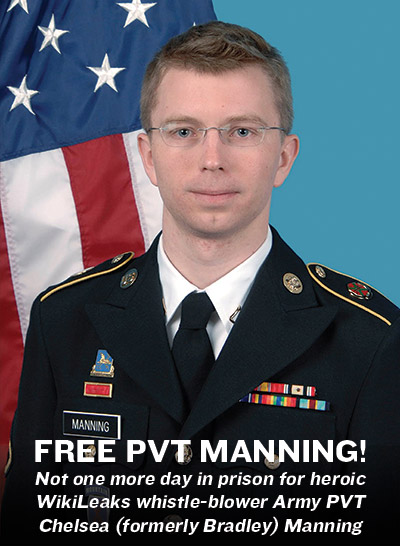
President Obama, Pardon Pvt. Manning
Because the public deserves the truth and whistle-blowers deserve protection.
We are military veterans, journalists, educators, homemakers, lawyers, students, and citizens.
We ask you to consider the facts and free US Army Pvt. Chelsea (formerly Bradley) Manning.
As an Intelligence Analyst stationed in Iraq, Pvt. Manning had access to some of America’s dirtiest secrets—crimes such as torture, illegal surveillance, and corruption—often committed in our name.
Manning acted on conscience alone, with selfless courage and conviction, and gave these secrets to us, the public.
“I believed that if the general public had access to the information contained within the[Iraq and Afghan War Logs] this could spark a domestic debate on the role of the military and our foreign policy,”
Manning explained to the military court. “I wanted the American public to know that not everyone in Iraq and Afghanistan were targets that needed to be neutralized, but rather people who were struggling to live in the pressure cooker environment of what we call asymmetric warfare.”
Journalists used these documents to uncover many startling truths. We learned:
• Donald Rumsfeld and General Petraeus helped support torture in Iraq.
• Deliberate civilian killings by U.S. forces in Iraq and Afghanistan went unpunished.
• Thousands of civilian casualties were never acknowledged publicly.
• Most Guantanamo detainees were innocent.
For service on behalf of an informed democracy, Manning was sentenced by military judge Colonel Denise Lind to a devastating 35 years in prison.
Government secrecy has grown exponentially during the past decade, but more secrecy does not make us safer when it fosters unaccountability.
Pvt. Manning was convicted of Espionage Act charges for providing WikiLeaks with this information, butthe prosecutors noted that they would have done the same had the information been given to The New York Times. Prosecutors did not show that enemies used this information against the US, or that the releases resulted in any casualties.
Pvt. Manning has already been punished, even in violation of military law.
She has been:
• Held in confinement since May 29, 2010.
• Subjected to illegal punishment amounting to torture for nearly nine months at Quantico Marine Base, Virginia, in violation of the Uniform Code of Military Justice (UCMJ), Article 13—facts confirmed by both the United Nation’s lead investigator on torture and military judge Col. Lind.
• Denied a speedy trial in violation of UCMJ, Article 10, having been imprisoned for over three years before trial.
• Denied anything resembling a fair trial when prosecutors were allowed to change the charge sheet to match evidence presented, and enter new evidence, after closing arguments.
Pvt. Manning believed you, Mr. President, when you came into office promising the most transparent administration in history, and that you would protect whistle-blowers. We urge you to start upholding those promises, beginning with this American prisoner of conscience.
We urge you to grant Pvt. Manning’s petition for a Presidential Pardon.
FIRST& LAST NAME _____________________________________________________________
STREET ADDRESS _____________________________________________________________
CITY, STATE & ZIP _____________________________________________________________
Please return to: For more information: www.privatemanning.org
Private Manning Support Network, c/o Courage to Resist, 484 Lake Park Ave #41, Oakland CA 94610
Note that this image is PVT Manning’s preferred photo.
Seven Ways To Support Freedom For Chelsea Manning- President Obama Pardon Chelsea Manning Now!
Note that this image is PVT Manning’s preferred photo.
The Struggle Continues …
Seven Ways To Support Heroic Wikileaks Whistle-Blower Chelsea Manning
*Call (202) 685-2900- Major General Jeffery S. Buchanan is the Convening Authority for Private Manning’s court- martial, which means that he has the authority to decrease the sentence imposed no matter what the judge handed down. Ask General Buchanan to use his authority to reduce the draconian 35 year sentence handed down by Judge Lind.
Please help us reach all these important contacts: Adrienne Combs, Deputy Officer Public Affairs (202) 685-2900adrienne.m.combs.civ@mail.mil
Col. Michelle Martin-Hing, Public Affairs Officer (202) 685-4899michelle.l.martinhing.mil@mail.mil The Public Affairs Office fax #: 202-685-0706
The Public Affairs Office is required to report up the chain of command the number of calls they receive on a particular issue, so please help us flood the office with support for our heroic whistleblower today!
*Sign the public petition to President Obama – Sign online or print and share PDF petitionPlease sign the petition on the reverse side of this letter, “President Obama, Pardon Pvt. Manning,” and make copies to share with friends and family!
You can also call (Comments”202-456-1111), write The White House, 1600 Pennsylvania Avenue NW, Washington, DC 20500, e-mail-(http://www.whitehouse.gov’contact/submitquestions-and comments) to demand that President Obama use his constitutional power under Article II, Section II to pardon Private Manning now.
*Start a stand -out, weekly, bi-weekly, monthly, in your town square to publicize the pardon and clemency campaigns. Contact the Private Manning SupportNetwork for help with materials and organizing tips http://www.bradleymanning.org/
*Contribute to the Private Manning Defense Fund- now that the trial has finished funds are urgently needed for pardon campaign and for future military and civilian court appeals. The hard fact of the American legal system, military of civilian, is the more funds available the better the defense, especially in political prisoner cases like Private Manning’s. The government had unlimited financial and personnel resources to prosecute Private Manning at trial. And used them as it will on any future legal proceedings. So help out with whatever you can spare. For link go to http://www.bradleymanning.org/
*Write letters of solidarity to Private Manning while she is serving her sentence. She wishes to be addressed as Chelsea and have feminine pronouns used when referring to her. Private Manning’s mailing address: Bradley E. Manning, 89289, 1300 N. Warehouse Road, Fort Leavenworth, Kansas 66027-2304. You must use Bradley on the address envelope.
Private Manning cannot receive stamps or money in any form. Photos must be on copy paper. Along with “contraband,” “inflammatory material” is not allowed. Six page maximum.
*Call: (913) 758-3600-Write to:Col. Sioban Ledwith, Commander U.S. Detention Barracks 1301 N Warehouse Rd Ft. Leavenworth KS 66027-Tell them: “Transgender rights are human rights! Respect Private Manning’s identity by acknowledging the name ‘Chelsea Manning’ whenever possible, including in mail addressed to her, and by allowing her access to appropriate medical treatment for gender dysphoria, including hormone replacement therapy (HRT).” (for more details-http://markinbookreview.blogspot.com/2013/11/respecting-chelseas-identity-is-this.html#!/2013/11/respecting-chelseas-identity-is-this.html
Send The Following Message (Or Write Your Own) To The President In Support Of A Pardon For Private Manning
To: President Barack Obama White House 1600 Pennsylvania Avenue Washington, D.C. 20500
The draconian 35 years sentence handed down by a military judge, Colonel Lind, on August 21, 2013 to Private Manning (Chelsea formerly known as Bradley) has outraged many citizens including me. Under Article II, Section II of the U.S. Constitution the President of the United States had the authority to grant pardons to those who fall under federal jurisdiction. Some of the reasons for my request include:
*that Private Manning was held for nearly a year in abusive solitary confinement at the Marine base at Quantico, Virginia, which the UN rapporteur in his findings has called “cruel, inhuman, and degrading”
*that the media had been continually blocked from transcripts and documents related to the trial and that it has only been through the efforts of Private Manning’s supporters that any transcripts exist.
*that under the UCMJ a soldier has the right to a speedy trial and that it was unconscionable and unconstitutional to wait 3 years before starting the court martial.
*that absolutely no one was harmed by the release of documents that exposed war crimes, unnecessary secrecy and disturbing foreign policy.
*that Private Manning is a hero who did the right thing when she revealed truth about wars that had been based on lies.
I urge you to use your authority under the Constitution to right the wrongs done to Private Manning – Enough is enough!
City / Town/State/Zip Code_________________________________________
Note that this image is PVT Manning’s preferred photo.
**************
Saturday, January 04, 2014
From The Marxist Archives -The Revolutionary History Journal-The Fourth International in France: from the POI to the PC1 ...as usual the French section of the FI as the political epicenter of that organization was at the center of the turmoil about reconfiguring groups in the wake of the military defeat of the FI during this period.
Click below to link to the Revolutionary History Journal index.
This is an excellent documentary source for today’s leftist militants to “discover” the work of our forebears, particularly the bewildering myriad of tendencies which have historically flown under the flag of the great Russian revolutionary, Leon Trotsky and his Fourth International, whether one agrees with their programs or not. But also other laborite, semi-anarchist, ant-Stalinist and just plain garden-variety old school social democrat groupings and individual pro-socialist proponents.
Some, maybe most of the material presented here, cast as weak-kneed programs for struggle in many cases tend to be anti-Leninist as screened through the Stalinist monstrosities and/or support groups and individuals who have no intention of making a revolution. Or in the case of examining past revolutionary efforts either declare that no revolutionary possibilities existed (most notably Germany in 1923) or alibi, there is no other word for it, those who failed to make a revolution when it was possible.
The Spanish Civil War can serve as something of litmus test for this latter proposition, most infamously around attitudes toward the Party Of Marxist Unification's (POUM) role in not keeping step with revolutionary developments there, especially the Barcelona days in 1937 and by acting as political lawyers for every non-revolutionary impulse of those forebears. While we all honor the memory of the POUM militants, according to even Trotsky the most honest band of militants in Spain then, and decry the murder of their leader, Andreas Nin, by the bloody Stalinists they were rudderless in the storm of revolution. But those present political disagreements do not negate the value of researching the POUM’s (and others) work, work moreover done under the pressure of revolutionary times. Hopefully we will do better when our time comes.
Finally, I place some material in this space which may be of interest to the radical public that I do not necessarily agree with or support. Off hand, as I have mentioned before, I think it would be easier, infinitely easier, to fight for the socialist revolution straight up than some of the “remedies” provided by the commentators in these entries from the Revolutionary History journal in which they have post hoc attempted to rehabilitate some pretty hoary politics and politicians, most notably August Thalheimer and Paul Levy of the early post Liebknecht-Luxemburg German Communist Party. But part of that struggle for the socialist revolution is to sort out the “real” stuff from the fluff as we struggle for that more just world that animates our efforts. So read, learn, and try to figure out the wheat from the chaff. ********
A Constant Opportunism
The Fourth International in France:from the POI to the PC1
We reprint the following excerpt as a contrast to the summary of the
activity of the French Trotskyists during the War provided by the account by
Rodolphe Prager. It represents the view of the largest of the French Trotskyist
organisations today, but which only consisted of some seven members during the
first part of the Second World War.
After some years on the Central Committee of the POI, the official
section of the Fourth International in France, the Romanian militant Barta
(David Korner) decided that the French Trotskyist movement was incapable of
breaking with its petit-bourgeois class composition and practices and of
building an organisation of disciplined revolutionaries within the working
class, and set up a new organisation in October 1939, which later became the
Union Communiste. It turned its entire energies to the factories, where it
distributed its bulletin, La Lutte des Classes regularly from
October 1942 onwards. By April 1947 it was so well established that it led an
important strike in Renault, which resulted in the expulsion of the Communist
Party from the government when it failed to control it. By the 1960s it was
distributing regular bulletins in dozens of factories as well as publishing a
weekly newspaper, Voix Ouvrière (later Lutte
Ouvrière). It played a most important part in the leadership of the
strike of the French railway workers in 1987.
The extract below is translated from Les problemes du parti mondial
de la Révolution et la Reconstruction de la IVe Internationale,
Exposé du Cercle Leon Trotsky, 28 February 1966, pp.5-11, the
full text of which was first published in English by Richard Stephenson in
Documents on the History of the Fourth International No.1, Problems of
the World Party of the Revolution and the Reconstruction of the Fourth
International, London 1977. The full text of La Verité
from which these extracts are taken can be consulted in La Verité
1940-1944. Journal trotskyste clandestin sous l’Occupation nazie,
edited by J.M. Brabant, M. Dreyfus and J. Pluet, Paris, 1978, and, by contrast,
the bulletin of the Union Communiste during the same period in La Lutte
des Classes: Numéros clandestins de l’Occupation, Paris 1971.
But it is not for pleasure that we remain outside this organisation and that
we had refused, at the unification of the French Trotskyist groups in February
1944, to place ourselves within the PCI that had just been born, nor was it, as
these comrades accused us of at the time, a case of manufacturing divergences to
justify our ‘autonomy’. It was for precise political reasons that we will return
to today.
First of all, some comrades may be amazed that we should go back so far. This
refers simply to the fact that our analysis begins from the foundation of the
Fourth International and ends towards the 1950s, whereas other comrades take the
period 1952-53 as a basis for analysis. For us, at that time the Fourth
International had ceased to exist for some years as an organisation of the
revolutionary vanguard.
When our comrades left the POI (French section of the Fourth International)
in 1939, they wanted to distinguish themselves from an opportunist organisation.
As far as they were concerned it was a matter of cutting themselves off from a
petit bourgeois milieu whose practices were Social Democrat and not Communist.
But at the time it was a matter of a critique of the French section and not of
the totality of the organisations of the Fourth International.
The declaration of war saw the complete collapse of the French organisation
of the Fourth International. Little prepared for clandestinity, a large number
of militants found themselves in prison. The organisation dismantled itself.
In June 1940 the great majority of the elements of the Fourth International,
grouped in the Comités francais pour une IVe Internationale completely
abandoned the internationalist position in favour of a ‘common front with all
the French-thinking elements’ and projected the creation of committees of
‘national vigilance’. In the Bulletin du Comité pour la IVe
Internationale No.2 (20 September 1940) these comrades brought out the
report adopted unanimously by the Central Committee of the Comité pour la
IVe Internationale. Here are some extracts from it:
The French bourgeoisie has rushed into a blind alley. To save itself from
revolution, it threw itself into Hitler’s arms. To save itself from this hold,
it has only to throw itself into the arms of the revolution. We are not saying
that it will do so cheerfully, nor that the faction of the bourgeoisie capable
of playing this game is the most important: the majority of the bourgeoisie
secretly awaits its salvation from England, a large minority awaits it from
Hitler. It is to the “French” faction of the bourgeoisie that we hold out our
hand …
However our policy on this plane must above all be orientated to that faction
of the bourgeoisie that above all wants to be French, which feels that
it can only look for its salvation from the popular masses, that is capable of
giving rise to a petit bourgeois nationalist movement, capable of playing the
card of the revolution (from right or from left, or eventually from right and
from left).
We must be the defenders of the wealth accumulated by generations of the
peasants and workers of France. We must also be the defenders of the magnificent
contribution of French writers and scholars to the intellectual heritage of
humanity, defenders of the great revolutionary and Socialist traditions of
France.
Committees of National Vigilance
It is necessary to create organs of national struggle. The Committees of
National Vigilance could either be permanent organisms or – and this form
corresponds more to the necessities of the national struggle at the present
necessarily illegal stage – could be temporary organisms …
Some slogans: the number of national slogans is infinite. We will only try
here to highlight some of them:
'Down with the pillage of French wealth!
The corn that French peasants have raised, the milk of the cows they reared;
the machines without which our workers will be without work and without bread;
the laboratory apparatus created by the genius of our scholars, all this wealth
must remain in France …
Withdraw the German money! The French people wishes to create by its work
real wealth, and not to be cast into the misery of inflation …
And during the war, La Verité, which successively entitled
itself a Bolshevik-Leninist organ, a revolutionary Communist organ, the Central
Organ of the French Committees for the Fourth International and the Organ of the
POI, poured out nationalist prose in the name of Trotskyism, took up the slogans
of the Committees of National Vigilance, and proposed an alliance of all the
parties that wanted to defend the masses. Here, taking as examples, are some
extracts from La Verité:
La Verité No.2 (15 September 1940)
The Grain Office forecasts that 60 per cent of the French cereal harvest will
go off to Germany. And the government says nothing. Is this in
agreement with Hitler to starve the French? Brother peasant, oppose passive
resistance to requisitions, sell your corn only to make bread for the women and
children of France.
La Verité No.8 (1 January 1941)
All those who struggle against the oppressor and who are not workers must
understand that the support of working class forces is necessary for the success
of the national liberation struggle; that they must be assured of a labour law
that will interest them in the defence and rebirth of the fatherland of which
they make up the strength.
What must the National Union be?
500,000 English engineers are asking for the linking of their wages to the
cost of living. They are pointing out that the price of food products has
doubled without a corresponding increase in wages. In satisfying this just
demand the English government is beginning to realise a real national solidarity
against German imperialism, by dividing the weight equally between the different
classes of the country and by defending the interests of the English
workers.
La Verité No. 11 (1 April 1941 )
We know like our predecessors of 1871 that we had to take up arms for the
national independence that was betrayed by the bourgeoisie …
These are no longer internationalist positions, this is nothing to do with
Trotskyism.
The unification of the different Trotskyist groups (POI, CCI, October Group)
took place at the beginning of 1944. The sponge was lightly passed over the
chauvinist positions of 1940; all was forgotten; even better, they had always
been right. In a common POI-CCI bulletin of July 1943, it is possible to read
substantially that the POI had only committed the fault of using certain
dangerous expressions in La Verité; the fundamental position
was not only correct but perspicacious, for the POI had foreseen from 1940 the
transformation of the national movement into a class movement.
Thus complete betrayal of internationalism is qualified as “dangerous
expressions”. This is a delicate euphemism that unfortunately conceals something
far more, for these comrades wrote in the unity declaration that appeared in
La Verité on 25 March 1944 that since the beginning of the war:
“These organisations had developed in consequence an international policy and
activity” and furthermore; “At this decisive moment the Fourth International is
regrouping its forces and correcting its faults by means of a Bolshevik
critique.” The text simply makes allusion to “some episodic faults of this or
that grouping”.
When in 1944 the French section of the Fourth International not only refused
to recognise its errors but pretended that it had followed a correct line, it
was evident that this section had nothing Trotskyist about it. As it was often
to do later, the French section invented a whole theoretical arsenal to justify
an opportunist practice: a national movement was spoken about in 1940-in the
twentieth century in an imperialist country – in which two distinct resistances
were discovered, one bourgeois and the other worker. This is what was written by
our comrades in February 1944:
To be able – in a text explaining the official position – to transform the
betrayal of the Fourth International movement into a fairy, tale of Bolshevik
foresight (apart from “some errors“) the ideological level of the POI must be
pretty low.
The pretexts invoked in a Stalinist manner by the POI must be rejected with
disgust, whereby they blame their own faults on the masses. From this point of
view it is typical that the POI-CCM organisations should attribute the collapse
of the organisations of the Fourth International in France to the outbreak of
the war, which had isolated the vanguard from the masses. Any
revolutionary who did his job during the ‘Phoney War’ knows that this is pure
fantasy; on the contrary, never had contact with the working masses been more
easy (and not only with the working masses), never had the masses been more
disposed to accept revolutionary propaganda …
This attitude of the French section shows that in the political sphere (the
events of 1939) as well as in that of principles (refusal of self-criticism, and
self-justification at any price), opportunism reigned as master in its own
house. For as far as we are concerned, it is not a case of refusing to unite
under the pretext that the French section had made mistakes and grave faults.
But a certain number of the militants of this Section recognised these errors
but refused to admit to them in order not to injure the fusion. This attitude
showed that this organisation had nothing Bolshevik about it, and that it was no
longer the vanguard that Trotsky had wished to forge. And when after the war the
Fourth International approved of the policy of the French section it was clear
that it also was opportunist.
When the war ended, the French section was going to continue its politics. It
was characterised on the domestic plane by tail-ending vis à vis the PCF. In the
referendum of 21 October 1945 the PCI appealed for a ‘YES’ vote so that the
Assembly would be a Constituent one. It launched an appeal to the Socialist
Party and the Communist Party to form committees to defend the Constituent
Assembly, and it demanded that the delegates should he elected and revocable at
any time. It wanted to ‘sovietise’ more or less the bourgeois Constituent. Then
it practised a policy of a left critique of the PCF, but absolutely not a
revolutionary critique. From the most notorious nationalism, the PCI fell into
the most vapid electoralism. This, incidentally, didn't prevent these comrades
from regretting some months later “the persistence of parliamentary prejudices
amongst the masses”.
And in the constitutional referendum of May 1946, the PC1 once again made a
bloc with the so-called workers’ parties in voting ‘YES’ to the
constitution.
And their argument was, to say the least, strange. In fact, you could read in
La Verité of 28 April 1946:
The Constituent sanctified compensation of big businessmen for firms
nationalised and maintained imperialist exploitation of the colonial peoples. It
recognised as inviolable the private property of the
exploiters.
But it was necessary to vote ‘YES’ to prevent the triumph of reaction:
La Verité No. 120 (May 1946):
Since the MRP has made a bloc with the bourgeois parties against the
‘workers’ parties by calling for a ‘NO’ vote in the referendum, it is necessary
to form a bloc with the latter to call for a ‘YES’ vote to prevent the
plebiscite for or against the PCF-PS from turning to their
advantage.
In the foreign sphere the same phenomenon of tail-ending Stalinism can be
witnessed not only on the part of the French section but of the whole
International. The International as a whole was seized with it, and the image of
the French section was only a faithful reflection of other sections.
If the April 1946 Conference of the Fourth International called for the
“immediate withdrawal of the forces of occupation” (USA-France-Britain, as
regards Germany), it also refused the amendment of the British section asking
for the withdrawal of Russian troops from the territories that they occupied
(IVe Internationale, December 1946).
***The Life And Times Of Michael Philip
Marlin, Private Investigator- A Piece Of
Work
From
The Pen Of Frank Jackman-with kudos to Raymond Chandler
Those
who have been following this series about the exploits of the famous Ocean City
(located just south of Los Angeles then now incorporated into the county)
private detective Michael Philip Marlin (hereafter just Marlin the way
everybody, except a few lady friends who called him Philip and his late mother
who called him Michael Philip, called him when he became famous after the
Galton case out on the coast) and his contemporaries in the private detection
business like Freddy Vance, Charles Nicolas (okay, okay Clara too), Sam Archer,
Miles Spade, Johnny Spain, know that he related many of these stories to his
son, Tyrone Fallon, in the late 1950s and early 1960s. Tyrone later, in the
1970s, related these stories at his request to the journalist Joshua Lawrence
Breslin who uncovered the relationship, a friend of my boyhood friend, Peter
Paul Markin, who in turn related them to me over several weeks in the late
1980s. Despite that circuitous route I believe that I have been faithful to
what Marlin presented to his son. In any case I take full responsibility for
what follows.
*******
Yah, that Teddy Landers was a piece
of work alright, a guy from Yonkers or some place near New York City, he was
always changing up what town he was from but he was always from the tough end
sections of those towns, so he had to be tough, city street smarts tough. A
guy, a film director, you know, Robert Ashland, yes, that Robert Ashland, the
one who did The Choice, Close Call,
and Cry, The City and a bunch of
other tough guy films and grabbed a fistful of awards too, wanted to do a film
adaptation of Teddy’s life. The brash kid growing up in troubled circumstances
before the war, the heroic war record including stints as a “pre-mature
anti-fascist” fighting in one of the International Brigades in Spain and later
as a commando and SS prisoner in the war, war wounds, hanging around Vegas with
war buddies, now connected war buddies who used him as a mule to launder money
down Mexico way, then landing square on his feet marrying money, serious money,
when he bedded and wedded the wild child Sarah Wyatt all wrapped around a
good-looking guy whose war wounds only enhanced those good looks. There was
talk, serious talk of Brando or Newman as the lead, and Audrey Hepburn as
Sarah. There was even, at Teddy’s insistence, a walk-on part for Marlin as
Teddy’s new found side-kick and confidante about two- thirds of the way through
the film to show what a regular guy he was, you know, mixing with tough guys and
holding his own in the city’s plebeian bars. The money, the backing was there,
an outline of a script was there, this was no come-on like a lot of Hollywood
film ideas that wind up out on some back lot floor gathering dust. So, yes,
Ashland wanted to do the film, needed to after a couple of crash and burn
non-descript items that did not increase that fistful of awards on his
fireplace. That is he wanted to do that film until one night Teddy took off,
took off with a small suitcase and a satchel full of cash (cocaine too but the
amount was unknown was never known so let’s just stick with that bucket of
cash) and left no forwarding address, left a lot of people in the lurch
including one Michael Philip Marlin.
Yah, Teddy Landers who also knew all
the angels, good and bad liking the bad if he was to call a preference, knew
some French women in Europe after the war who taught his some interesting sex
tips that stood him in good stead when he found Hollywood, and later found the
decadent Sarah. Knew, knew well, half the hookers, call girls, street tricks
and courtesans in Vegas before he split to the coast (and, yes, there were,
are, courtesan in bright light neon Vegas but you won’t see them in the tourist
brochures, you have to be connected, very connected to even know that such
sexual delights could be found there, otherwise make your choice from the
hookers, call girls and tricks. Knew some savage junkie women in London who put
him onto the whole black market set-up for a few bindles of junk, H, you know
heroin, and then left them flat. Knew a Yonkers girl too back when he was just
brash who wouldn’t tumble, wouldn’t give him what he wanted, and so he blew her
off and who later was shot by her angry husband but every day (according to
Marlin) he kicked himself for doing so. But good girl or bad girl he attracted
the angels like moths to the light.
He knew all the angles too, had run
a “clip” gang (you know kids, and it was only kids no serious professional
would risk his career for a few baubles worth jack, hitting jewelry, department
, and record stores and grabbing everything not nailed down then selling it
cheap, maybe called “five-finger discount” around your way. Hell, I did it
myself for a while around my old hometown) and one night pulled a “robbery” grabbing
all the cash in the kitty to take some twist somewhere. Strictly kids’ stuff
though, a little ejack-rolling of drunks, midnight auto stuff, light drug
dealing, until Europe, Europe and black markets and dough (remember he stiffed
those street hooker London bindle freaks). Europe and war buddy connections
that would pan out when he blew Yonkers and headed west for a change of
scenery.
So Teddy knew how to cut corners on
both, knew how to use his attraction for women, certain kinds of women with a
wild streak, a desire to take a step over the edge and see what that side
looked like, and decidedly not goody women, not at least since that first long
flickered out flame back in his boyish days and knew too, by training if not by
instinct how to fend for himself, how to make the other guy take the fall, knew
how to grab the money and run, knew also you needed protectors in this wicked
old world and was not choosey about who that was, know who to cut those corners
more than one way too as Marlin found out, found out, later. And Marlin joined
the line, the long line of gals and guys, high class dames, high-class call
girls, high-end rollers and low-down gangsters, who got used by Teddy, got used
and still liked the guy, or at least wished him no harm.
Marlin had met him in a bar,
Shorty’s, the original Shorty’s over off Wiltshire just short of the Los
Angeles line in Ocean Cityto set your
geography straight, although most of the clientele in those days came from the
city, down the street from his apartment building. Shorty’s the bar that he had
make famous, or infamous as the case may be depending on whether you like the
coppers to see public justice done or are rooting for the guys like Marlin who
for cheap dough, a few knocks on the head or a stray bullet chase after
windmills, in the Baxter case. The
bizarre one that you might have heard of where an old time Los Angeles king
hell fixer, Richard Baxter, took a fall,
a fatal fall, all because a guy got shot by another guy right in Shorty’s over
a decade before, just before the war in Europe got up a head of steam. Shorty,
now a prosperous owner of several watering holes, including the Club Arriba
over on Central Avenue in the city, once he knew whose palms to grease and who
to seek “protection” from, liked Marlin’s presence as a crowd-drawer and for
the favor his drinks were on the house. Marlin, in the chips or not, never
turned down a drink, scotch especially, from friend or foe so the place was his
regular hang-out
It had been a slow Monday late
afternoon when Teddy walked in, sat down
beside Marlin, and ordered a scotch bright, scotch, high-end MacDonald Brother scotch
in his case, with a kick of Bacardi, a drink that the guys who had come back
from overseas brought back with them. More importantly that was Marlin’s drink
of choice at that moment (although he had been too old to serve in World War II
he had seen service with the American Expeditionary Force in World War I and
had picked up the scotch bright taste from some ex-soldiers who hung around the
Kit-Kat Club, a big hang-out for homecoming West Coast ex-soldiers, sailors and
marines). He off-handedly commented on their similar tastes and Teddy told him
about how he had acquired the taste in London during the war. Teddy, a friendly
guy anyway as long as he was not crossed, not looking for something from
somebody and got turned down or was in his cups was in a talkative mood, and
maybe sensed that Marlin was a guy who he could talk to and he continued on,
ordering another scotch bright, and one for Marlin too.
And so Teddy and Marlin talked,
talked about the drink and its origins, talked about the bewildering variety
and types of scotch whiskeys from the Highlands, talked about the late war and
the wounds that Teddy had sustained which were still visible in the light
although fading, talked about the craziness of Los Angeles lately although Marlin
could tell Teddy was neither native nor had he gone native getting a deep tan,
wearing sporty clothes and generally acting like he didn’t have a care in the
world, talked about the scads of kids coming to Ocean City to surf, surf for
chrissakes, the hard boys from the valley who were driving their soup-up hot rods
up and down the Pacific Coast Highway like they owned it and the Okies and
Arkies coming out of the woodwork once they heard that California was a Garden
of Eden, talked about the big migrations from the east after the war that had stretched the place to
the limit and they were still coming, and about this and that, guy stuff, manly
guy stuff.
Every few days, maybe every week or
so, they would run into each other at Shorty’s, Teddy always parking his ride,
his shining dark green Jaguar courtesy of wife Laura (who insisted that the old
Hudson that he had been driving around in when they met, and which he had
tenderly kept in top condition, was too plebeian, and what would the help say
if he was driving a car they might own so he grabbed the most expensive damn
automobile he could find and, damn, she didn’t flinch), right out in front
helter-skelter depending on how heavily he had been drinking, and discuss
stuff, guy stuff, mostly. Teddy doing the talking, fast-talking with a little
edge, with a little larceny, wise-guy, angle-cutting edge to it, and Marlin
served as the listening post. Eventually he would have Teddy over to his place
after the bar closed for a nightcap, many nights for Teddy to sleep it off on
Marlin’s couch as well.
A lot of what Teddy would talk about
was how tough it was being married for the past five years to money, big money,
married to the Wyatt fortune, or part of it, the Laura Wyatt part of it. That
was old California money, old meaning built by grabbing water rights back in the
1920s, getting in on the ground floor of the oil boom around the LaBrea tar
pits and whatever else old Leslie Wyatt could grab that was not tied down. This
Wyatt a real bastard Marlin had heard but a real lamb to his kids, especially
Laura who early on was wild, just as wild as plenty of money would go. Teddy
could take the money part, take it easily with both hands out having grown up
poor, dirt poor in Yonkers before the war. But the way they, Laura, the old
man, and their Mayfair swell friends made him feel like cheap street left ashes
in his mouth. That was one angle he had not figured out he told Marlin one
drunken night, not yet.
Worse this Laura was nothing but a
tramp picking up every fly-by-night guy she took a momentary fancy too,
bringing him home, or rather to her “guest house” away from their main home,
their mansion where she might be holed up for a few days before coming up for
air (that place bought, every tile and nail bought, by Leslie Wyatt when Laura
purred in his ear that they needed suitable digs for entertaining, and she had
had the guest house built once she told Teddy that she needed her “own space”).
Hell, Teddy would say, after he had had his seventh drink, maybe more, that he
really should have had no kick about Laura’s style since he had met her at one
of her Malibu parties which he crashed with a friend and he had spent his own
few days in her “guest house” at the old man’s mansion. After they came up for
air a few days thereafter they were married, a lark for her, she said all her
friends were married and she should be too. Christ, now that he thought about
it, although it easy street and shiny objects for him, it still bothered him,
bothered him that she was so open like only the rich could be with her minute
affairs. And so Teddy, Teddy the trophy war-hero (he had been a “premature
anti-fascist” fighting in the Spanish Civil War in an International Brigade unit
although more for the three squares and some dough than any political
allegiance and later as a volunteer commando with the British when Europe
heated up, and where he was severely wounded on a secret mission) began to fall
off the leash.
Teddy the reclamation project too
(Laura made it clear she was taking a poor kid from the streets and giving him
dough, a car and some manners, public manners anyway), began to lead his own
life, began to play around, play around with a loose country club set woman or two
who was dissatisfied with her husband or who just liked to play around in that
insular little world of 1950s Malibu, Malibu before all the riff-raff and hang-
ten surfers came through. Thereafter he began to drink heavily (and grab a few
lines of off-hand cocaine if it was laying around), began to drink himself into
a stupor to ease the pain, the pain of his youthful wants, his very real war
wounds, and his store –bought social wounds. After a while, after a few months
of talk, couches, and drunks Marlin considered Terry a friend, a rare
distinction for a lone- wolf private detective. And Teddy considered Marlin a
friend too.
So it was no big deal when Teddy
came up to Marlin’s apartment one midnight several months after they met,
drunk, frazzled, a little shaky and asked Marlin to drive him to Mexico, dusty,
tin cup, anything goes, anything goes if you have the dough, anything, Tijuana,
faux Mexico Tijuana, just over the
border, to think things out, undisclosed things. Teddy in high dudgeon wanted
no questions asked and once Marlin accepted that condition, actually had
thought nothing of the request except the direction, the trip down south was
unusual, previous requests had been to places north of L.A. to see some woman (his
latest one, whom Marlin had not met, lived up in Malibu in the same colony as
the Lander’s estate) or to drive him home, he bought the ticket and gave him
that ride.
A fateful ride that would cost Marlin
a few days in the slammer for aiding a felon after the fact since what Teddy was thinking things out about down in sweaty,
sunny Mexico was the brutal murder of his wife. Laura was found naked in her
guest house, battered, blood all over the place, by one of her maids the next
morning and who immediately reported the discovery to the sheriff’s office. Once
the coppers tied Marlin to Teddy’s disappearance they pounced on him, and it
wasn’t hard because Marlin had not tried to hide his tracks, all he had asked
of Teddy was to say to him nothing, nothing at all about what bothered him once
he agreed to take him south sensing something very illegal was afoot although
he thought Teddy was running from his gangster war buddies, or some busted drug
deal he was acting as intermediary for. The coppers gave it to Marlin strong,
gave him the full-press third-degree under the bright lights, all night, the
whole good cop, bad cop routine, the confess and we’ll go easy on you, have a
cigarette and think it over, like he was that easy to turn over. Yah, all the
little tricks they liked to play, things they liked to do that they have seen
on television or in some old time film noir, maybe a B-Robert Ashland film,
things they liked to do anytime they got a private dick in their clutches.
Especially Marlin who had twisted their noses on the Sternwood case (the time
he rounded up Eddie Miles, the big gangster, and put a big bow around his neck
to help an old man rest in peace a little after his daughters went wild on him)
and the Trepper case(where he exposed a murderous psychopathic crooked cop hung
up on a redhead, a married redhead who had a funny habit of cheating on him,
the cop not the husband), made them look foolish, a few years before.
Then just as quickly Marlin was
sprung from jail without an explanation. No, that is not right, there was no
more case since Teddy had saved everybody a lot of trouble and committed
suicide, leaving an incriminating note. So long Teddy, end of story. No, no
again, Marlin was not buying the whole set-up both because he did not believe
that Teddy could have brutally murdered his wife no matter how much he hated
her tramp ways and her snobbery and that high-end life they led and because Teddy
just didn’t seem the suicide type, didn’t appear that distraught when he left
him off at the border. Marlin figured that he could not have stayed in his chosen
profession very long if he was not able to take the measure of a man, could not
size him up, could not have a grip on what made him tick, and what didn’t. No,
with all his sorrows, all his hurts, all his baggage from his youth Teddy was
made of tougher stuff.
But there was nothing Marlin could
do about checking further having been warned off the case by Laura’s father who
wanted the thing closed, closed tight, so he could maintain his privacy, keep
the case off the front page so that his country club set would have nothing to
titter about behind his back. Told all this not directly by the old man, the
help was not handled that way in that orbit, but by Wyatt’s lawyer, naturally.
And since the old man drew a lot of water downtown he was prepared to make life
tough for one Michael Philip Marlin.
Had been warned off too by a couple
of Teddy’s old friends and war buddies, Mendy and Randy (no last names but
Vegas-connected and thus connected enough for Marlin), whom Teddy had worked
for before he hit pay-dirt with Laura and who were also then very prominent
mobsters with connections back East. They three while playing heroic commandos
also took care of their respective number ones by working the black markets of
half the countries in Europe. Skills that were useful at home when the hard
boys of New York and later, the West Coast when operations shifted there took
notice. Not heeding such warnings from hard guys, guys who had cut their teeth
in the cutthroat black markets of wartime Europe, were in on the ground floor
when the fight over who, or who would not, run Vegas, and who would think
nothing of sending some, what did Mendy call him, oh yeah, some two-bit
gumshoe, down some secluded ravine face down was not good for business.
And then there were the cops, the
cops responding to pressure from downtown (who were responding to pressure from
the old man and his crowded court of cronies), their own dislike for Marlin and
his profession, and their own sense of power who said in no uncertain terms the
case was shut, shut tight. So although Teddy’s fate gnawed at him Marlin backed
off, backed off for a while, although not because some high-priced lawyer, some
two-bit soft guy Vegas hoods, or some on- the- take cops said to but because he
was broke and needed to make some dough, needed to make office and room rent.
With Teddy still in the back of his
mind Marlin grabbed his next case, the Waits case, the case of a famous abusive
drunken pot-boiler historical novel writer, Roger Waits. Everybody, even
Marlin, had heard of Waits of course, the sword and busted bodice novel guy
whose books you would see at the check-out counters at supermarkets and who
sex-hungry housewives read to while away those lonely hours out in suburbia,
out in Levittown, out in Irvine. He had gone missing for a week or more and his
wife, Eileen, was desperately trying to find him and bring him back to their
oceanfront Malibu home.
Here is where Teddy, or rather
Marlin’s stand-up shut- up guy defense of Teddy, got him the job since Mrs.
Waits had read about Marlin in the newspapers when he was in custody as a
material witness and grabbing the third degree and decided he was the man to find
her errant husband. Marlin finally seeing some dough, easy dough, on the
horizon and the back of his landlords’ heads took the case and in a short time
was able to find old Roger holed up trying to dry out (again) in a sanatorium.
Marlin brought him home to his ever-loving wife and that was that. End of
story.
No, again no, Roger had taken a
liking to Marlin, wanted to hire him to protect him against his demons, real
and imagined, but Marlin said no deal. He was not a baby-sitter, or
man-servant, which is what was required. What might have changed his mind, if
anything, though was this Eileen Waits, Roger’s trophy wife, whose slim figure,
faraway blue eyes, wistful expression, and slight whiff of perfume, gardenia
something, had him thinking about silky sheets and sultry bedroom afternoons.
But that was not to be, although not for his lack of trying, giving her very
definite signals. What happened to forestall that possibility was not that not
long after he had gotten Roger home, dried out for a while, he started drinking
again, and started to be haunted by his demons. One day Roger in some drunken
rage, or drunken stupor, shot himself, committed suicide. Marlin wasn’t buying
that one either since Waits, whatever his writer’s block, whatever feelings he had
that he was washed up, a has been, was not a suicide guy. Marlin now had to dig
into this one if for no other reason than surrounded by two suicides in short
order he had to get out from under the tag of a guy to not be around if you
cared about your health, or your life.
Things were a mess until Marlin
stepped back and put a couple things together. First off the Waits knew the
Wyatts, father and daughters, travelled in some of the same circles out in
Malibu, and had been to some of the same charity events and the like. That
information came out by accident when the cops were investigating Roger’s
suicide. Without too much trouble he also found out that Laura Wyatt had
numbered Roger Waits as one of her trophies. And that set up everything else
once Roger’s houseboy gave Marlin enough information about Mrs. Waits and her
strange nocturnal habits, her vague longing for some soldier boy first love
long gone that she had married before Roger habits. Not so long gone though
since that soldier boy she pined away for was one Teddy Landers (although they
had been married with him using a different name in London during the war).
Eileen Waits enraged that the tramp
Laura had taken her first man, long thought to be dead after some secret raid
in Norway, enraged that he had become nothing but a degenerate kept pet by
Laura and enraged that she had also taken her second man and flouted that fact
making no attempt to conceal the affair or their guest house love-making
murdered both of them. Although no jury would had convicted her even if the
D.A. decided to try the case. A beautiful, disturbed (and wealthy) widow was
not the kind of murder case that would sail in celebrity-conscious Los Angeles
in the hush-hush 1950s. And that case would not be tried because Laura’s father,
that couple of Vegas-connected hoods, and the on-the-take cops had closed the
case previously, closed it up tight. And that is the end of the story.
Well not quite. Something still did not add up, especially
the role of those two hoods, war buddies or not, going way out of their way to
shut the case down, to warn Marlin off. So he again stepped back and what he
figured out was that no way, no way on this good green earth did Teddy Landers
die in Mexico. The whole thing was fixed, fixed by Terry and the boys. And the
way Marlin found that out was simple, simplicity itself, Landers, disguised as
a Mexican, showed up at his door one day and flaunted that hard fact in
Marlin's face. Then he walked away. And Marlin for his own reasons, for an old
friendship gone awry, let him. Yeah, that Teddy Landers was a piece of work.
End of story.