Damage Control over NSA Revelations
Spying, Repression, War: Pillars of Capitalist Rule
Workers Vanguard No. 1037 | 10 January 2014 |
Damage Control over NSA Revelations
Spying, Repression, War: Pillars of Capitalist Rule
In a special Christmas message broadcast on British television, National Security Agency (NSA) whistle-blower Edward Snowden warned of the dangers posed by mass surveillance: “A child born today will grow up with no conception of privacy at all. They’ll never know what it means to have a private moment to themselves—an unrecorded, unanalyzed thought.” A global spying apparatus assembled by the U.S. government can now sweep up the telephone, Internet and location records of whole populations and easily defeat the most common communications encryption methods, as is known the world over thanks to Snowden. With video cameras also dotting city streets and drones preparing to swarm the skies, the capitalist rulers are determined to make personal privacy a relic of a bygone age.
With each new document released by Snowden further exposing U.S. imperialism’s dark underbelly, Washington has suffered no shortage of embarrassment. So much so that some in the government, beginning with the head of the NSA task force assessing the impact of the leaks, have floated the possibility of granting Snowden amnesty in order to stanch the flow of revelations. Various bourgeois commentators, rankled by the trampling on their rights but not wanting the spymasters to lose more face, have picked up this theme. Thus a recent New York Times (1 January) editorial declared: “It is time for the United States to offer Mr. Snowden a plea bargain or some form of clemency that would allow him to return home.” The government itself continues to treat Snowden as a traitor who deserves to feel the full wrath of bourgeois justice. As Marxist opponents of the capitalist-imperialist order, we say: Drop all charges against Edward Snowden!
A debate within the government is also unfolding over how precisely to carry out damage control and package the snooping to make it more palatable to the public. Congress, which the NSA recently all but admitted is also subject to its surveillance, now has dueling comprehensive bills on the floor. One, dubbed the Freedom Act, is designed to restrict the NSA program that collects and stores records of virtually all telephone calls made in the country. The other would approve it in its current form. The same sides were drawn in competing federal court decisions last month. One judge concluded that the program is likely unconstitutional and “almost Orwellian” in scope. Eleven days later, another judge gave his enthusiastic stamp of approval, observing: “This blunt tool only works because it collects everything.”
Meanwhile, a panel convened by the president issued a report with 46 recommendations to make the eavesdroppers at least appear more accountable. Evidently with tongue in cheek, Obama commented: “There are ways we can do this potentially that give people greater assurance that there are checks and balances, sufficient oversight and transparency.” Left unsaid was his role in more deeply enshrouding the Bush-era surveillance programs in secrecy. From the time he first assumed office, Obama publicly embraced the Patriot Act provision that was the legal basis of the phone “metadata” program, fully aware that the NSA was violating existing procedures for the program laid out by the rubber-stamp secret court ostensibly overseeing it.
Regarding reform packages, such as the Freedom Act, that seek to put some limits on mass surveillance, we wrote in “Spying and Lying in the Belly of the Beast” (WV No. 1034, 15 November 2013): “It would be welcome if such efforts created some speed bumps for the agents of U.S. imperialism. It would be foolish to believe that reforms will ever significantly impede the imperialists’ spying on whomever they want whenever they want.”
The Freedom Act sponsors and other bourgeois reformers are cleaning up after the likes of Director of National Intelligence James Clapper. Early last year, Clapper denied under oath that the NSA was stockpiling data on Americans, only to have Snowden prove him a liar. Public mistrust deepened when Clapper subsequently explained that the statement was the “least untruthful” he could make. Subterfuge is, of course, in the nature of spying. But note that in this case the target is not a foreign power. In capitalist society, where a tiny minority of the population lives off the labor of the working class, the rulers will always resort to spying, lying and violence to keep the vast majority down.
The history of U.S. government spying and repression as a handmaiden to its imperialist wars abroad was the topic of forum presentations by Spartacist League spokesman Alison Spencer held in October and November in New York City, Paris and London. The following article is based on those talks.
* * *
When the New York Spartacist League asked me to give this talk, it looked like the U.S. government was going to slam missiles into Syria at any moment, continuing the terror and destruction for which it is known worldwide. A funny thing happened to Obama on the road to Damascus—certainly not a conversion, but a collision with an unexpected obstacle.
A war-weary population that had elected Obama as an ostensible peace candidate was not supportive of attacking Syria. The ruling class was divided, with a majority of Congress undecided or opposed, and even Washington’s British poodle had slipped the leash and refused to heel. The so-called socialist government of France, the former colonial overlord of Syria, was unique among the European powers in calling for support to planned U.S. airstrikes. Capitalist Russia was, of course, a significant obstacle, and Putin was able to forestall U.S. airstrikes in exchange for UN weapons inspectors stripping Syria of chemical and other weapons. This part of the story is not over, and we recall the UN’s role in setting Iraq up for the U.S. imperialist kill.
We oppose both sides in the conflict in Syria: the butcher Assad as well as the motley opposition, which is a patchwork of Islamist and secular forces backed by other states in the region. The overriding threat to working people in the region and around the world would be the direct intervention by U.S. imperialism. That is why we say: U.S. get your bloody hands off the world! If the U.S. goes in, we will seek to win workers and antiwar youth to defend Syria, primarily through class struggle and political agitation at home. We vigorously oppose the starvation sanctions the U.S. has implemented against Syria and Iran.
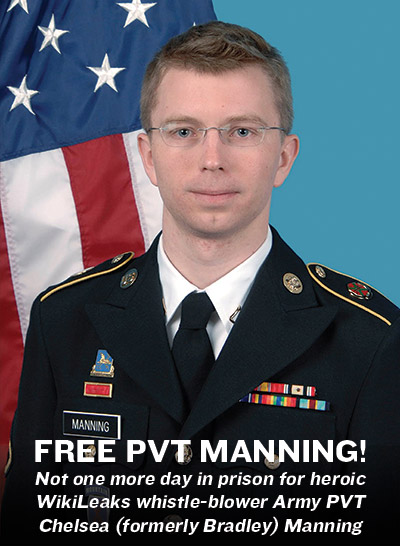
The focus of this talk is the domestic developments, their history and what can be done to advance opposition to U.S. terror abroad and repression at home. The discontent over bombing Syria is a small, notable crack in the domestic political consensus that has allowed U.S. imperialism to ride roughshod all over the world since the “war on terror” was launched in the aftermath of the September 11, 2001 attacks on the Pentagon and World Trade Center. Private Manning, who revealed the mundane and sensational workings of U.S. imperialism in Iraq, Afghanistan and worldwide and is now languishing in Leavenworth prison, deserves some thanks for this development. Edward Snowden, who revealed the vast surveillance state run by the National Security Agency (NSA) and is now living in Russia, deserves some thanks for this. And Julian Assange, whose independent news organization, WikiLeaks, published the bombshells released by Manning, and who is still sheltered from U.S. prosecution in the Ecuadorian Embassy in London, deserves some thanks for this, too.
Their revelations lifted the hem on the cloak of democracy and revealed the normal murderous and repressive workings of the American government. The beginning of wisdom for people troubled by the revelations of what the U.S. is doing at home and abroad is to understand that it is not our government. It is the government representing the interests of the capitalist ruling class. The government pretends to be neutral and to rule on behalf of “equality of all citizens.” But the American capitalist state, whatever form its government may take and no matter which of the two major capitalist parties (Democrat or Republican) rules, is a machine for the repression of one class by another. As the leader of the Russian workers revolution, V.I. Lenin, wrote: “Democracy...serves the bourgeoisie as a screen to conceal their domination and as a means of deceiving the people...in practice ‘democracy’ sometimes stands for the dictatorship of the bourgeoisie, sometimes for the impotent reformism of the petty bourgeoisie who submit to that dictatorship” (The Proletarian Revolution and the Renegade Kautsky, 1918).
There is a thick fog of “impotent reformism” obscuring clear vision of the significance of the information leaked by Manning and Snowden. The prevailing view among liberals and reformists is that Obama’s war on whistle-blowers has gone too far, that it mars the image of U.S. “democracy” worldwide, makes a mockery of the “war on terror” and makes life uncomfortable. But fundamentally, these social democrats and liberals want their civil liberties and their witchhunts, too, because they share the Obama administration’s aim of defending the interests of American imperialism.
The liberals’ class allegiance blinds them to the simple fact that the spy agencies’ central purpose is to do the dirty work that goes on behind the scenes of the “normal” administrative mechanisms of bourgeois democracy—the surveillance, burglaries, black-bag jobs, infiltration and tricks by agents provocateurs, extraordinary renditions, torture and murder. A whole system of class exploitation—and in this country racial oppression—that is maintained through state repression is not going to come crashing down or be fundamentally reformed by blowing whistles or through Congressional cosmetic reforms behind which the state continues its murderous work. Nothing less than victorious socialist revolution can abolish capitalism’s secret police and their deadly “dirty tricks.”
Manning’s Prosecution and Freedom of the Press
I was present in the military courtroom throughout the first week of the court-martial of Private Manning, then known as Bradley Manning, and covered the trial for Workers Vanguard [see WV Nos. 1026 and 1028, 14 June and 9 August 2013]. An army intelligence analyst in Iraq, Manning had access to the records of the U.S. wars in Iraq and Afghanistan and diplomatic cables. Every helicopter flight, every drone dispatched, every combat exchange, every encounter with civilians and prisoners is recorded in “significant activity” reports. These “SigActs” in Army-talk are the war logs of U.S. military atrocities—the documentary evidence of the frame-ups of civilian dissidents as “terrorists,” the abuse of prisoners and the subjugation of the peoples of Iraq and Afghanistan under U.S. military occupations.
Most infamous was the video discovered by Manning of a U.S. Apache helicopter gunship firing on unarmed civilians, killing several, including two Reuters journalists. The diplomatic cables Manning released revealed the workings of U.S. imperialism, from the most routine capitalist exploitation to the most grisly terror and bizarre plots: how the United States blocked raising the minimum wage in Haiti, the poorest nation in the Western hemisphere; how the FBI trained torturers for the Mubarak regime in Egypt; how Hillary Clinton authorized the theft of the UN Secretary-General’s DNA—seriously! When it comes to depravity, do not underestimate the creativity of the American ruling class.
Manning was naive and enlisted with the U.S. Army because he believed the patriotic lies about keeping the world safe for democracy. When he saw what the U.S. was actually doing, he gathered irrefutable evidence and tried to give it to the “respectable” press. Manning’s intent was to put the government under public scrutiny and spark public debate to change U.S. policy. But the utterly craven New York Times and Washington Post found these cables and war logs too hot to handle, so Manning submitted the trove of documents to WikiLeaks. Betrayed by Adrian Lamo, who finked to the Feds, Manning was arrested and held in pretrial detention for more than three years in conditions even the UN’s own special rapporteur on torture called cruel and inhuman punishment: solitary confinement, stripped naked, taunted, put on suicide watch (that’s where they drive you to the brink of suicide and watch). Manning was then sentenced in a court-martial to 35 years.
Manning was charged with “aiding the enemy,” an offense that can carry the death penalty. The prosecution argued that by communicating with you, the public, via WikiLeaks, Manning released information that could have been read by “enemies” of the U.S. Although the military judge ruled that the prosecution did not prove this charge, the precedent was set that publishing could be a serious criminal offense because anyone, including declared or undeclared present or future enemies, might benefit directly or indirectly from information published in any newspaper. Although “aiding the enemy” is a charge under the Uniform Code of Military Justice, it can apply to any person. Meanwhile, who is the enemy? The Pentagon insists that it’s a secret—as if the people being bombed in Afghanistan, targeted by drones in Pakistan or tortured by U.S. soldiers in Iraq don’t already know the U.S. is waging war against them.
The “war on terror” was launched as a rationale for the occupations of Afghanistan and Iraq and in order to escalate government secrecy and repression at home. “Terrorism” and “national security” are trump cards to override all democratic rights, civil liberties and proletarian rights—gains wrested through labor and social struggles. There are no declared battlefields in the “war on terror,” but they are everywhere, including the cellphone in your pocket. This is not a war in any traditional sense but a pretext to promulgate unfettered terror and destruction abroad in pursuit of profit, in pursuit of oil, in pursuit of U.S. global domination over its imperialist rivals.
The U.S. government has created its own security nightmare for the ruling class through the metastatic spread of its security apparatus in the wake of 9/11. Almost everyone is spied on now without even the pretext of suspicion of criminality. The government has “back doors” to grab your telecommunications, your banking and medical records, your photos, your email, your texts. It takes vast armies of employees with digital trowels to move the crap around the Augean stables of classified intelligence created by the government. How much information is classified? That’s a secret. How many security clearances? That’s secret. Why was surveillance authorized, when and by whom? That’s secret, too.
Manning’s prosecution is a watershed case for so-called freedom of the press. I can tell you from being in the courtroom that Julian Assange and WikiLeaks were effectively the co-accused in this show trial, named so often by the prosecution that you expected Assange to be sitting at the defense table. But the prosecution’s ultimate target is you. The government goes after the truth-tellers and the few journalists with the guts to publish because they want to restrict what you read, the better to seek to bind you to the ignorant belief in American bourgeois democracy as a force for good in the world.
Targeting Labor, Blacks, the Left
After conviction and sentencing at the trial, which was held at Fort Meade, where the NSA is headquartered, Bradley Manning announced that she wants to live as a woman and be called Chelsea. She is now undergoing undoubtedly gruesome psychological testing and a period the prison authorities call indoctrination in the all-male military wing of Leavenworth prison, where she has requested hormone treatments. Lurid and scurrilous attacks in the press can’t bury her under a mountain of lies. She has a mind as strong as a steel trap and did what she did out of an unusual moral courage and sense of history. She told the government informant who betrayed her that she was going to release the evidence of the horrible things the U.S. was doing because “I feel, for some bizarre reason, it might actually change something.”
It did. It motivated a young man named Edward Snowden to come forward and reveal that everyone’s telecommunications are vacuumed up by the NSA’s PRISM Internet surveillance program. The government’s most secret spy agency (“No Such Agency”) does this in cahoots with the titans of the big telecommunications businesses: Microsoft, Google, YouTube, Facebook, Yahoo, Skype, Apple. Further leaks by Snowden showed the NSA’s sophisticated “social media” software to link people. It is the digital equivalent of the McCarthyite House Un-American Activities Committee (HUAC) gone high-tech and global. Only now the government doesn’t need a crude bully like Senator Joe McCarthy to terrorize people in courtrooms to name names and answer “are you now or have you ever been...?” They simply grab the names of everyone you associate with and what you do and when you do it through pervasive spying.
How does this work? Let’s say that New York City transit workers organize for a strike. A union leader calls the stewards, they call their co-workers, maybe their supporters in a Spartacus Youth Club strike support committee, a press contact or two, and of course everyone calls Gene, labor coordinator for the Partisan Defense Committee. All this “metadata”—who you call, when you call, who else they call, where they are located—becomes a huge trove of information for the government to keep for a crackdown in the future, whenever it becomes convenient for them to label action taken by working people a “conspiracy” that “threatens national security.”
It’s not hypothetical. Look at what happened on the West Coast to the ILWU longshore union, which was an early target of the Bush administration’s campaign for “national unity” against “terrorism.” In the 2002 ILWU contract negotiations, the Homeland Security chief told the union president that a strike would “threaten national security.” Bush threatened to bring in federal troops and Navy scabs in the event of a strike. This is a living illustration of a crucial point: the so-called “war on terror” is ultimately a war on the labor movement, black people and all the exploited and oppressed.
We know the latest news about pervasive government spying because Edward Snowden contacted a brave and technically savvy journalist and filmmaker, Laura Poitras. She has been uncovering and writing about U.S. surveillance for many years. The government put her on a “watch list” six years ago, a list that is now estimated to have about a million names. Every time she flew in or out of the country, the government would harass her, seize her notes and electronics. She has written to Congressmen and filed Freedom of Information Act (FOIA) requests to find out why she was put on a watch list and, surprise, has not received the courtesy of a reply. In an interview with the New York Times, she asked: “When did that universe begin, that people are put on a list and are never told and are stopped for six years?”
Now, her question troubled me because she’s a bright and capable woman but evidently has no sense of history. “When did that universe begin?” I thought, “Didn’t your mother ever tell you that everyone who fights the government is on a list? Did you never hear of Joseph McCarthy? About Julius and Ethel Rosenberg?” That someone so bright and capable could be shocked to be on a list shows the impact of amnesia and oblivion as deliberate government policy. The history of labor and class struggles, the histories of our heroes and martyrs, is deliberately wiped out in order to perpetuate injustices today.
So my answer to Laura Poitras is that this “universe,” where one is put on a list and not told why, began with the origins of private property and the state, with the advent of a ruling class that exists off the exploitation and subjugation of others. The pervasive historical ignorance today is a product of the post-Soviet period we live in. The imperialist victors write the history and consciously endeavor to wipe collective memories clear of the dearly acquired lessons of past social and class struggles. Every fighter for social change in this country has been on a list. And in this capitalist country founded on black chattel slavery, a special place is reserved on government watch lists for fighters for racial equality, from Denmark Vesey and John Brown to Martin Luther King Jr., Malcolm X, and Mumia Abu-Jamal. Reds in particular upset the order of this country—capital on top of labor and white on top of black—by fighting to unite the working class through integrated class struggle.
The Espionage Act and the War Against Bolshevism
Manning was prosecuted under the 1917 Espionage Act. Manning was nobody’s spy. In fact, the Espionage Act has always been used to criminalize dissent and repress labor and leftist opposition to the United States government during wartime. Its earliest victims, in September 1917, were Wobblies, members of the Industrial Workers of the World, whose offices were raided across the country. Their union newspapers and property were destroyed, and many left-wing labor organizers were arrested and sentenced to lengthy prison terms.
World War I was also the midwife to revolution, and America was particularly haunted by the one unfolding in Russia in 1917, even before the workers seized state power under the leadership of Lenin and Trotsky’s Bolshevik Party. A radical journal, The Masses, covered the events and the unprecedented horror of the war. In its August 1917 issue, John Reed wrote an article, “Knit a Straight-Jacket for Your Soldier Boy,” that described how the ghoulish, gruesome reality of a war that President Woodrow Wilson claimed was the road to eternal peace was literally driving soldiers out of their minds. John Reed was charged under the Espionage Act for this article, in which he did not write a single word in opposition to the U.S. government—the article was entirely excerpted from a New York Tribune report cataloguing the alarming growth of mental illness in the armed services. Similarly, Manning did not write a single word against the government but merely publicized the government’s own reports on its nefarious doings.
The editor of The Masses, Max Eastman, stated in his closing argument that the charge of conspiracy had not been proven, merely that all the defendants believed in the philosophy of socialism. And he went on to say that the socialists believe that “true liberty is not guaranteed to a citizen merely by the possession of the right to vote. They think that democracy will begin when the people rule in industry as well as in politics.” I find that a particularly good expression of what we mean by our fight for a workers state based on collectivized property, administered by working people in control of an egalitarian, socialist planned economy.
The first trial ended in a hung jury, so the Feds tried them again. Right outside the courtroom, a band played “The Star-Spangled Banner” as war hawks sold Liberty Bonds. By this time, some of the defendants had succumbed to the strong current of patriotic opinion in WWI. The Masses’ business manager, Merrill Rogers, had become pro-war and was so eager to show that during the second trial that he jumped to his feet to salute the flag in the courtroom each time the band outside played the national anthem. After the fourth disruption, the judge banned jumping up to salute the flag in his courtroom—this in a trial for sedition.
Although the government lost the court case against The Masses, it succeeded in destroying the radical newspaper by pulling its mailing permit. When the September issue went to press, the Post Office refused to mail it on the grounds that the magazine had skipped an issue—that is, the August issue the Feds had seized! As John Reed wrote in the September issue, in an article ironically titled “One Solid Month of Liberty”: “All of which goes to prove that in America law is merely the instrument for good or evil of the most powerful interest, and there are no Constitutional safeguards worth the powder to blow them to hell.” John Reed went on to write a gripping eyewitness account of the October 1917 Russian Revolution, Ten Days That Shook the World, and became a founding member of the American Communist Party.
The Bolshevik Revolution struck terror in the hearts of U.S. lawmakers. The backdrop to President Wilson’s prattling about “democracy” was murderous race-hate terror and union-busting at home. In 1917, white mob violence claimed the lives of hundreds of black people in East St. Louis. Striking miners in Arizona were beaten and imprisoned. Even their lawyer was locked up, just as with Lynne Stewart, who is dying in prison today for defending a client the U.S. government deemed a threat. In November 1919, Attorney General A. Mitchell Palmer sought deportation of thousands of foreign-born workers, claiming that there were “thousands of aliens…direct allies of Trotsky”! In just one year, between 1919 and 1920, some 1,400 people were arrested under sedition laws. Hundreds were convicted and imprisoned; thousands of foreign-born radicals were deported.
The corollary to American imperialist domination of the world was the political imperative to equate radical dissent with treason. And it still is.
Anti-Communist Repression Under FDR
People typically associate McCarthyism and the anti-Communist witchhunt with the 1950s, an era of fear and social conformity. In fact, the McCarthyite repression was prepared years earlier under the liberal darling Franklin Delano Roosevelt with the creation in 1938 of HUAC, led by Congressman Martin Dies. After the onset of World War II in September 1939, HUAC gained traction and conducted hearings on hundreds of organizations, newspapers and trade unions with alleged Communist ties. This is what some historians have called “the little Red Scare”—just a dress rehearsal for the later McCarthy hearings. Under Roosevelt, J. Edgar Hoover launched the FBI’s index file system of people deemed a threat who could be detained indefinitely.
Our direct political forebears in the Socialist Workers Party (SWP) were on that list and were as well the first victims of the 1940 Smith Act. The SWP opposed World War II as an interimperialist war in which workers had no stake except to defend the Soviet Union. The party engaged in no acts of sabotage in the Army or elsewhere and did not advocate, as we do not advocate, the overthrow of the government by force. James P. Cannon’s trial testimony, published as Socialism on Trial, retains its utility today as an exposition of basic Marxism against capitalist state repression.
The allegation that Marxists advocate the violent overthrow of the U.S. government has always been a pretext for repression against leftists. In fact, Marxists have no abstract position on violence per se. In fact, the capitalist government is not “overthrown” violently or nonviolently. The historical probability is that in a revolutionary situation there may well be little government to “overthrow,” and surely not this government in its present form. Not even the tsar’s deadly secret police, the Okhrana, could save an outmoded repressive regime from being swept aside by the working people when they were politically conscious and organized around their own interests in the Russian Revolution. Victor Serge wrote in What Every Radical Should Know About State Repression that all that was required at that point was a good push of a broom.
We recognize that the ruling class will use the machinery of its state to violently repress those it perceives as opponents or threats to its rule. In response to that, we Marxists are not pacifists but recognize the necessity of self-defense of the working people. We are not conspiratorial putschists; indeed, nothing could be more open than a Marxist party whose success in winning the majority of the working people to understand the necessity of organizing in their own independent class interests is entirely dependent on the broadest propagandizing of our views. These are some of the lessons to be learned from Cannon’s testimony in Minneapolis. The significance of the Smith Act prosecutions included establishing the precedent that no actions were required to prove wrongdoing. Merely words, even thoughts, could cost an opponent of the government his or her liberty.
The background to the state repression was that the Trotskyists had led a citywide general strike in Minneapolis in 1934 and had won a huge battle to organize the truckers into Teamsters Local 574. J. Edgar Hoover claimed that the SWP’s opposition to the war and its prominence in the leadership of a union smack at the center of the nation’s transportation network posed a domestic security risk. So they were put on a list and government spies and informants inside the union got busy with dirty work. Prime targets of government spying included not only SWP leaders like Cannon but also union members who had formed the Union Defense Guard, a group of 600 armed union men organized in 1938 to defend their union from violent attacks by the fascist Silver Shirts. So the Smith Act that was allegedly enacted to go after Nazi sympathizers in the U.S. was used first to go after union militants who had stopped the fascists and had won a big working-class organizing victory that redounded around the country.
A man named Daniel Tobin led the International Brotherhood of Teamsters at the time. Tobin actively sought the intervention of the FBI into his own union to clean out the reds. In so doing, he merely called in a favor from the president of the United States, Franklin Roosevelt. They were close friends, a relationship cemented during Tobin’s service as chairman of the Labor Division of the Democratic Party during two of FDR’s presidential campaigns. The price to be paid for this labor anti-Communism was high. Solidarity within the labor movement was thrown back, gains won against the employers through the great 1934 general strike were threatened, and the confidence of workers to organize and speak out was shaken through the use of informants and state prosecution.
This illustrates the role of the union bureaucracy and how in subordinating labor to the Democrats (and Republicans) it injures the whole of the working people. Having paved the way for government intervention in the union, the pro-capitalist Teamsters bureaucracy itself became, much later, the target of government union-busting under the RICO anti-racketeering laws. And in a twisted irony, this time it was unprincipled, self-proclaimed leftists who invited the government in to drive out the allegedly mob-allied bureaucrats. The state was only too happy to oblige—clean out the reds one decade, then at some point clean out the business unionists at the behest of leftists. As the executive of the capitalist class, the government’s interest is to bust unions in order to drive down wages, boost profits and divide the working class.
The Stalinist Communist Party (CP) criminally supported the Smith Act prosecutions of the Trotskyists and union militants in Minneapolis. This unprincipled subservience to the capitalist state did not spare them from prosecution shortly thereafter, and we Trotskyists of course defended them. The state is not neutral, and we do not appeal to it to act as the arbitrator for disputes within the workers movement and the left. We do not use the state to go after our political competitors in the workers movement. We oppose government intervention in the unions. Labor must clean up its own house.
The Cold War Witchhunt
Government spying and repression escalated apace with expanding U.S. involvement in WWII. Shortly after the U.S. entered the Pacific arena after the bombing of Pearl Harbor, FDR issued Executive Order 9066, asserting presidential authority to remove persons of Japanese descent from the entire West Coast to remote, barren detention camps. The report justifying the internment stated: “The Japanese race is an enemy race…. The very fact that no sabotage has taken place to date is a disturbing and confirming indication that such action will be taken.” This Executive Order was not revoked until 1976. Detention of people deemed enemies by reason of national origin or descent is the policy of the Obama administration today. At the end of August, as Obama prepared to slam missiles into Syria, the FBI stepped up its surveillance of Syrians inside the U.S., dragging people in for “questioning” on suspicion of nothing except their national origin, religion or descent.
Continuing in FDR’s footsteps, Harry Truman ordered atomic bombs dropped on Hiroshima and Nagasaki in August 1945, an unparalleled war crime. The Truman Doctrine became the carte blanche for U.S. military intervention around the globe, reverberating in the actions and declarations of the Obama White House today.
Meanwhile, Hitlerite fascism was destroyed in World War II by the Soviet Red Army. As the end of the war became a race to Berlin, the Cold War effectively began. The U.S. and its allies, like Britain and the Vatican, swept up every Nazi war criminal and scientist they could grab, got them to safety through a channel appropriately called the Rat Line, and put them to work in American spy agencies and military programs. Latin American death squads were trained by ex-Nazis under the aegis of the CIA; the U.S. rocket program was developed. And it didn’t stop there. Henri Alleg, a French-Algerian Communist who fought alongside the Algerians in their struggle for independence from French imperialism, revealed that French torturers in the Algerian war were borrowed by the U.S. to serve as teachers in the Army’s infamous School of the Americas.
The Cold War on the domestic front under Truman included instituting a loyalty oath for government employees. Labor was crippled by the Taft-Hartley Act, which outlawed secondary strikes and barred Communists from union office. The 1950 McCarran Act legitimized FBI record-keeping on “subversives”—hundreds of thousands of people were put on lists to be watched and detained in times deemed national emergencies. Liberal Democrat Hubert Humphrey amended the McCarran Act to set up concentration camps for “subversives” in the U.S. and sponsored the 1954 Communist Control Act that made membership in the CP a crime.
The point of the Cold War witchhunt and repression was to coerce the entire population into ideological conformity. The government’s bloody signature of those years was the 19 June 1953 execution of Julius and Ethel Rosenberg—two Jewish Communists who were guilty of nothing except defending the Soviet Union.
The struggle for black freedom is largely what cracked that Cold War consensus. Not only the civil rights movement but also the Black Power movement, and of course the social revolution in Vietnam, which defeated U.S. imperialism on the battlefield, changed the political climate. The movements for women’s rights and gay rights were also part of that unique period of volatile social struggle. But fundamentally, social change was driven by the fight for black equality. Interestingly, this period of social struggle also gave rise to the Freedom of Information Act, which promised people the right to know if the government was spying on them. If you’ve seen an FOIA file, however, you know how partial this gain is and how the government gets around it. With black magic marker. Good luck reading a document that is almost entirely blacked out.
Defending Marxists’ Right to Organize
The government did not roll over and stop spying on people. It just became more covert and deadly with a program called COINTELPRO, short for Counter-Intelligence Program. Originally launched in 1956 to disrupt the Communist Party, it was expanded in the 1960s to target the Black Panther Party, the Socialist Workers Party, the Spartacist League and others. The U.S. government killed 38 members of the Black Panther Party through COINTELPRO. Some, like Geronimo Pratt and later Mumia Abu-Jamal, were framed up for crimes they did not commit and sentenced to decades behind bars.
In the late 1970s, the Spartacist League learned that we were on the government’s list of subversive organizations, known as the ADEX file. The FBI lyingly claimed that it had abolished this hit list of individuals and organizations, but in fact it just concealed it more deeply. In 1983 the FBI issued new “Domestic Security/Terrorism Guidelines” that equated Marxist political opposition to the government with criminal terrorism and recycled the timeworn claim that we were not openly, but therefore presumably covertly, for the “violent overthrow of the government.” In refuting that charge, we replied that the capitalist state defends an entirely unjust system that oppresses the majority through force and violence.
It’s this government that massively incarcerates more of the population, especially black men, than any other government on earth. It’s this government that in one day of bombing Iraq destroyed the accomplishments and culture of millennia of human civilization. It’s this government that throttles men, women and children in Cuba and North Korea with blockades. It’s this government whose military carpet bombed Vietnam and reinforces the neocolonial subjugation of masses of working people throughout Latin America, Asia and Africa. It is this government in this so-called democracy that has even rolled back the Voting Rights Act, disenfranchising many black people again.
We fought the FBI’s deadly surveillance and targeting of us with every legal, moral and political resource at our disposal—as we have fought every lying allegation of violence or terrorism—because our party and our comrades matter to us and to society. We make a difference in initiating massive labor and minority mobilizations to stop the KKK, in mobilizing an early and unique union-centered protest in defense of immigrants and against the Patriot Act. We struggled to forge a revolutionary leadership—the subjective factor—in the fight against capitalist counterrevolution in the former Soviet Union and East Germany; the kind of leadership needed in the coming battles in the remaining deformed workers states.
Now, we didn’t win all those struggles, obviously, but we seek to be a factor and influence the outcome of the fight in the interests of the international working class. Today, this is above all a programmatic struggle: We fight to keep authentic Marxism alive through our literature and organization in a period in which it is largely considered irrelevant because of the collapse of the Soviet Union and the mistaken identification of communism with Stalinism. This propagandistic work may strike you as having more in common with librarianship than terrorism, but as Lenin said, drawing on Marx and Engels, without revolutionary theory there can be no revolutionary movement. So program comes first. Besides, the FBI has it in for librarians, too, and claims under the Patriot Act the right to seize the records of what books you borrow.
We sued the FBI in 1983 and won. Our legal brief outlined the history of covert and systematic disruption aimed at destroying the Spartacist League’s predecessors and the SL itself. We called the new Domestic Security/Terrorism Guidelines “McCarthyism with a drawn gun.” In pursuit of our own legality and freedom, we struck a blow against the government’s crusade to criminalize all dissent. We said at the time that this victory was significant, that it placed a legal hurdle in front of the government’s present and future attempts to repress the SL. But we had no illusions that the government would stop its surveillance or dirty tricks, which are an inherent part of the arsenal of repression of labor by capital.
The point of punishing Chelsea Manning, the point of punishing Lynne Stewart, the point of a worldwide manhunt for Snowden and Assange is to pummel all of you to accept unbridled government repression as normal. And under Obama’s National Defense Authorization Act, indeed any one of you can be put in indefinite military detention. So I wondered while preparing this talk, in light of what has been recently revealed about what U.S. imperialism is doing at home and abroad, why do intelligent people believe in the proven lie of bourgeois democracy? Why do they think communism, which has not yet been achieved, is dead?
In wrestling for an answer, I found a good one by James P. Cannon. This unjust system doesn’t keep on running by itself. It is actively propped up by its agents within the workers movement. Cannon said:
“This game of confusing and misrepresenting has been facilitated for the capitalists, and aided to a considerable extent, by the Social Democrats and the labor bureaucracy, who are themselves privileged beneficiaries of the American system, and who give a socialist and labor coloring to the defense of American ‘democracy.’ In addition to all that, we have to recognize that in this country, more than any other in the world, the tremendous pressures of imperialist prosperity and power and the witch-hunt persecution, have deeply affected the thinking of many people who call themselves radicals or ex-radicals. These powerful pressures have brought many of them to a reconciliation with capitalist society and to the defense of capitalist democracy, if not as a paradise at least as a lesser evil, and the best that can be hoped for.”
— “Socialism and Democracy,” International Socialist Review (Fall 1957)
On Daniel Ellsberg and Soviet Spies
Cannon was speaking of an earlier generation of reformist leftists in and around the Communist Party, which betrayed the working class with its program of class collaboration, its policy of tailing the “progressive” bourgeoisie. Today’s liberal politicians and ideologues and their left supporters (e.g., the International Socialist Organization, Workers World Party) and of course the union officialdom pursue class collaboration and peddle illusions in the first black president. They thereby thwart the possibility of effectively mobilizing the labor movement in its own defense through independent political organization and mobilization against government repression, and through strikes (remember them?) in defense of their own class interests.
Daniel Ellsberg—the 82-year-old granddaddy of whistle-blowers who leaked the Pentagon Papers to the New York Times and revealed what the U.S. was doing in Vietnam—and others are apoplectic that their cherished capitalist government is acting as badly as the repressive Stalinist regimes that ruled over the degenerated and deformed workers states in the Soviet Union and East and Central Europe. Alluding to the East German state spy agency, Ellsberg wrote that Snowden is “saving us from The United Stasi of America.” This argument is an attack of verbal poison gas, and Spartacist weapons inspectors are required to save you and innocent children from brain damage.
Let’s begin with one of the first acts of the fledgling Soviet government—product of the world’s first and only proletarian socialist revolution—which was to publish and tear up the previous governments’ secret international treaties, to tear, as Lenin said, “the veil of mystery from foreign policy in a revolutionary manner.” He wrote that “this is of cardinal importance, for on it depends the question of peace, the life and death of tens of millions of people.”
The Soviet Union in Lenin’s time also spied in defense of the workers state, and we hail that. We have no abstract position against spying per se; it depends which class is spying on whom and for what purpose. Even after the degeneration of the Russian Revolution, there were dedicated revolutionary militants who served as Soviet spies. There were also sadistic assassins who could have served equally well for imperialist spy agencies. This spread itself indicates the dual nature of the parasitic Stalinist bureaucracy that defended its own privileges while also defending, in a deformed and partial way, the proletarian property base on which its power rested.
The workers revolution that was made in Russia was not made solely for Russia. It was conceived of and achieved as the opening shot of a struggle for world socialist revolution. But it was not extended internationally, largely but not solely due to a failure of leadership. The cost for delay in international extension of the revolution was high, measured not only in failed revolutions in Germany and later the rise of fascism but also in the monstrous growth of a repressive bureaucracy led by Stalin in the Soviet Union. But the essential material gains of the revolution—the establishment of a workers state that had overthrown private property and established a planned economy—remained.
We Trotskyists, who were the first and foremost victims of Stalinist repression, including the murder of Leon Trotsky himself by a Stalinist agent, fought for the unconditional military defense of the workers state against imperialist attack and internal counterrevolution. Trotskyists also fought for a workers political revolution to oust the bureaucracy and restore workers democracy in the Soviet Union and mobilize the resources of that huge conquest—the Soviet workers state—in the service of the working class internationally.
Stalin and his heirs pursued a policy of “peaceful coexistence” with U.S. imperialism, selling out revolutions internationally. This appeasement of capitalist rule led ultimately to counterrevolution in the Soviet Union and across East Europe and East Germany. So in a sense, my answer to Daniel Ellsberg is that the worst crimes of the Stalinist bureaucrats were not their bloody spying and repression against their own population but that they sold out to the capitalist West that Ellsberg and the liberals defend! They gave away the gains workers had wrested through socialist revolution and turned the former workers states into potholes of capitalist exploitation, fascist violence and hideous oppression of women and minorities.
And with regard to the Soviet secret police, we Trotskyists, whose comrades were victims of Stalinist repression, will point out that some extraordinary individuals went into the spy service to defend the Soviet Union. In the period of World War II, heroic Soviet spies created a Red Orchestra of radio operators, the so-called pianists, who broadcast vital information from within the Nazi Third Reich. And it wasn’t just Soviets who were inspired to defend the Russian Revolution. There were also master spies like Richard Sorge and Hotsumi Ozaki in Japan and Kim Philby and his circle of Communists within British intelligence. When one of Philby’s comrades was briefed by British intelligence before being stationed in Washington, he was warned that Americans get very hot about communism, black people and homosexuality. The spy reportedly replied, “What you mean is that I shouldn’t make a pass at Paul Robeson?” In one wisecrack, a witty Soviet spy captured something essential about the ideological glue that holds this country together.
I want to conclude with a word on the press. The role of the capitalist media in the Chelsea Manning case—initially refusing to print the Afghan and Iraq war logs and diplomatic cables, all but ignoring the pretrial detention under torturous conditions, playing up every prosecution lie and sowing contempt for Manning with creepy articles about her background and private life—this all had an impact on the case and exemplifies the role of the media under capitalism to support the interests of the ruling class. If you do not yet have a subscription to Workers Vanguard, then I will sarcastically observe that your FBI file looks suspiciously skinny. So subscribe now, in self-defense and to educate yourself and to support the international struggles we engage in and write about.
************
President Obama, Pardon Pvt. Manning
Because the public deserves the truth and whistle-blowers deserve protection.
We are military veterans, journalists, educators, homemakers, lawyers, students, and citizens.
We ask you to consider the facts and free US Army Pvt. Chelsea (formerly Bradley) Manning.
As an Intelligence Analyst stationed in Iraq, Pvt. Manning had access to some of America’s dirtiest secrets—crimes such as torture, illegal surveillance, and corruption—often committed in our name.
Manning acted on conscience alone, with selfless courage and conviction, and gave these secrets to us, the public.
“I believed that if the general public had access to the information contained within the[Iraq and Afghan War Logs] this could spark a domestic debate on the role of the military and our foreign policy,”
Manning explained to the military court. “I wanted the American public to know that not everyone in Iraq and Afghanistan were targets that needed to be neutralized, but rather people who were struggling to live in the pressure cooker environment of what we call asymmetric warfare.”
Journalists used these documents to uncover many startling truths. We learned:
• Donald Rumsfeld and General Petraeus helped support torture in Iraq.
• Deliberate civilian killings by U.S. forces in Iraq and Afghanistan went unpunished.
• Thousands of civilian casualties were never acknowledged publicly.
• Most Guantanamo detainees were innocent.
For service on behalf of an informed democracy, Manning was sentenced by military judge Colonel Denise Lind to a devastating 35 years in prison.
Government secrecy has grown exponentially during the past decade, but more secrecy does not make us safer when it fosters unaccountability.
Pvt. Manning was convicted of Espionage Act charges for providing WikiLeaks with this information, but the prosecutors noted that they would have done the same had the information been given to The New York Times. Prosecutors did not show that enemies used this information against the US, or that the releases resulted in any casualties.
Pvt. Manning has already been punished, even in violation of military law.
She has been:
• Held in confinement since May 29, 2010.
• Subjected to illegal punishment amounting to torture for nearly nine months at Quantico Marine Base, Virginia, in violation of the Uniform Code of Military Justice (UCMJ), Article 13—facts confirmed by both the United Nation’s lead investigator on torture and military judge Col. Lind.
• Denied a speedy trial in violation of UCMJ, Article 10, having been imprisoned for over three years before trial.
• Denied anything resembling a fair trial when prosecutors were allowed to change the charge sheet to match evidence presented, and enter new evidence, after closing arguments.
Pvt. Manning believed you, Mr. President, when you came into office promising the most transparent administration in history, and that you would protect whistle-blowers. We urge you to start upholding those promises, beginning with this American prisoner of conscience.
We urge you to grant Pvt. Manning’s petition for a Presidential Pardon.
FIRST& LAST NAME _____________________________________________________________
STREET ADDRESS _____________________________________________________________
CITY, STATE & ZIP _____________________________________________________________
EMAIL& PHONE _____________________________________________________________
Please return to: For more information: www.privatemanning.org
Private Manning Support Network, c/o Courage to Resist, 484 Lake Park Ave #41, Oakland CA 94610