Tuesday, February 25, 2014

Out In The Black Liberation Night- The Black Panthers And The Struggle For The Ten-Point Program-The Complete Stories


Eleven-One-In the Beginning

…they came out of the hard okie/arkie white trash Hell’s Angels- dominated mean streets of Oakland, Oakland out in sunny California at the end of the American continental line. The place where the staccato faux -Spanish style (speaking unknowingly of earlier conquistador invasions) was to close out dreams, dreams of plenty, dreams of an ocean’s worth of good times. They came out of the cop-infested army of occupation on those dark 1960s negro streets (the streets that they wanted to make black, proud black, devouring old Spanish negro alien word, and deed). They came out of the mid-1960s hard reality that while their brothers and sisters in Selma, Montgomery, Lake Charles, Albany (GA), Greenwood, and all points south, south of the American slick democracy had gained something, something worth fighting (and dying) for that they, Oakland, Watts, Harlem, Cleveland, Newark, and all points North and West, north and west of American slick democracy, had been left behind. That they too had to face down their own copper nightmare, their own ghetto-imposed wanting habits nightmare, wanting some decent sweat-less non-grinding job, wanting their own cozy bungalow (white picket fence optional in the laid-back Frisco Bay night), wanting their own take a vacation out in the high Sierras, wanting above all to stop being cop looked at every time they went onto the white streets of town, hell the black streets too, and to get rid of their own subtle (and maybe not so subtle when they started to rile up the okies and arkies) Mister James Crow.

And so they, okay, okay, Huey and Bobby they, started putting together a little group, a little group of students and the young bucks from the ‘hood (neighborhood , okay, but who else would you expect to start stuff like that, insurrection kind of stuff, out in sunny blood-stained California, even a California by that freaking fog-bound bay ), corner boys really, under a simple proposition-voting and the such might have been okay in that all point south night down in America but in land’s end that didn’t mean jack. What meant jack was to get that damn down presser man, the guys in blues, the almost totally white guys in blue off their backs, and let the brothers and sisters breath. And so they, black proud, and black smart, decided after looking at history a little, fog-bound black history as fogged as that rusted colored golden gate bridge once Mister Whitey got through with it, that the only time that Mister Whitey paid attention was when proud black warrior-savants pressed the issue, defended themselves against that slave market and jim crow night. And so they looked to the mighty 200,000 strong of the Union black army, and the mighty southern struggle Robert F. Williams over across the land in Monroe, North Carolina just a few years back and said enough. So they righteously armed themselves. And said in some small recess of the brain they knew that this too was worth dying for.

Ten Point Program[edit]

The original "Ten Point Program" from October, 1966 was as follows:[43][44]
1. We want freedom. We want power to determine the destiny of our black Community.
We believe that black people will not be free until we are able to determine our destiny.
2. We want full employment for our people.
We believe that the federal government is responsible and obligated to give every man employment or a guaranteed income. We believe that if the white American businessmen will not give full employment, then the means of production should be taken from the businessmen and placed in the community so that the people of the community can organize and employ all of its people and give a high standard of living.
3. We want an end to the robbery by the white man of our black Community.
We believe that this racist government has robbed us and now we are demanding the overdue debt of forty acres and two mules. Forty acres and two mules was promised 100 years ago as restitution for slave labor and mass murder of black people. We will accept the payment as currency which will be distributed to our many communities. The Germans are now aiding the Jews in Israel for the genocide of the Jewish people. The Germans murdered six million Jews. The American racist has taken part in the slaughter of over 50 million black people; therefore, we feel that this is a modest demand that we make.
4. We want decent housing, fit for shelter of human beings.
We believe that if the white landlords will not give decent housing to our black community, then the housing and the land should be made into cooperatives so that our community, with government aid, can build and make decent housing for its people.
5. We want education for our people that exposes the true nature of this decadent American society. We want education that teaches us our true history and our role in the present-day society.
We believe in an educational system that will give to our people a knowledge of self. If a man does not have knowledge of himself and his position in society and the world, then he has little chance to relate to anything else.
6. We want all black men to be exempt from military service.
We believe that black people should not be forced to fight in the military service to defend a racist government that does not protect us. We will not fight and kill other people of color in the world who, like black people, are being victimized by the white racist government of America. We will protect ourselves from the force and violence of the racist police and the racist military, by whatever means necessary.
7. We want an immediate end to POLICE BRUTALITY and MURDER of black people.
We believe we can end police brutality in our black community by organizing black self-defense groups that are dedicated to defending our black community from racist police oppression and brutality. The Second Amendment to the Constitution of the United States gives a right to bear arms. We therefore believe that all black people should arm themselves for self defense.
8. We want freedom for all black men held in federal, state, county and city prisons and jails.
We believe that all black people should be released from the many jails and prisons because they have not received a fair and impartial trial.
9. We want all black people when brought to trial to be tried in court by a jury of their peer group or people from their black communities, as defined by the Constitution of the United States.
We believe that the courts should follow the United States Constitution so that black people will receive fair trials. The 14th Amendment of the U.S. Constitution gives a man a right to be tried by his peer group. A peer is a person from a similar economic, social, religious, geographical, environmental, historical and racial background. To do this the court will be forced to select a jury from the black community from which the black defendant came. We have been, and are being tried by all-white juries that have no understanding of the "average reasoning man" of the black community.
10. We want land, bread, housing, education, clothing, justice and peace. And as our major political objective, a United Nations-supervised plebiscite to be held throughout the black colony in which only black colonial subjects will be allowed to participate for the purpose of determining the will of black people as to their national destiny.
When in the course of human events, it becomes necessary for one people to dissolve the political bands which have connected them with another, and to assume, among the powers of the earth, the separate and equal station to which the laws of nature and nature's God entitle them, a decent respect to the opinions of mankind requires that they should declare the causes which impel them to the separation.
We hold these truths to be self evident, that all men are created equal; that they are endowed by their Creator with certain unalienable rights; that among these are life, liberty, and the pursuit of happiness. That, to secure these rights, governments are instituted among men, deriving their just powers from the consent of the governed; that, whenever any form of government becomes destructive of these ends, it is the right of the people to alter or to abolish it, and to institute a new government, laying its foundation on such principles, and organizing its powers in such form, as to them shall seem most likely to effect their safety and happiness. Prudence, indeed, will dictate that governments long established should not be changed for light and transient causes; and accordingly, all experience hath shown, that mankind are more disposed to suffer, while evils are sufferable, than to right themselves by abolishing the forms to which they are accustomed. But, when a long train of abuses and usurpations, pursuing invariable the same object, evinces a design to reduce them under absolute despotism, it is their right, it is their duty, to throw off such government, and to provide new guards for their future security.
 
From The Marxist Archives -The Revolutionary History Journal-Some Stages of the Revolution in the South of Vietnam(1947)

Book Review

Year One of the Russian Revolution-Victor Serge
I have read several books on subjects related to the Russian Revolution by Victor Serge and find that he is a well-informed insider on this subject although the novel rather than history writing is his stronger form of expressing his views. This book can be profitably read in conjunction with other better written left-wing interpretations of this period. Sukhanov's Notes on the Russian Revolution (for the February period), Leon Trotsky's History of the Russian Revolution and John Reed's Ten Days that Shook the World come to mind.

The task Serge sets himself here is to look at the dramatic and eventually fateful events of first year of the Russian Revolution. Those included the Bolshevik seizure of power, the dispersal of the Constituent Assembly and the struggle by the Bolsheviks against other left-wing tendencies in defining Soviet state policy, the fight to end Russian participation in World War I culminating in the humiliating Brest-Litovsk treaty with Germany and, most importantly, the beginnings of Civil War against the Whites. In short, he investigates all the issues that will ultimately undermine and cause the degeneration of what was the first successful socialist seizure of state power in history.

Serge's history is partisan history in the best sense of the word. It is rather silly at this late date to argue that historians must be detached from the subject of their investigations. All one asks is that a historian gets the facts for his or her analysis straight. And try to stay out of the way. Serge passes this test. Serge worked under the assumption that the strategic theory of the Bolshevik leaders Lenin and Trotsky was valid. That premise stated Russia as the weakest link in the capitalist system could act as the catalyst for revolution in the West and therefore shorten its road to socialism. The failure of that Western revolution, the subsequent hostile encirclement by the Western powers and the inevitable degeneration implicit in a revolution in an economically undeveloped country left to its own resources underlies the structure of his argument.

The Russian revolution of October 1917 was the defining event for the international labor movement during most of the 20th century. Serious militants and left -wing organizations took their stand based on their position on the so-called Russian Question. At that time the level of political class-consciousness in the international labor movement was quite high. Such consciousness does not exist today where the socialist program is seen as Utopian. However, notwithstanding the demise of the Soviet state in 1991-92 and the essential elimination of the specific Russian Question as a factor in world politics anyone who wants learn some lessons from the heroic period of the Russian Revolution will find this book an informative place to start.


Click below to link to the Revolutionary History Journal index.

http://www.marxists.org/history/etol/revhist/backissu.htm


Peter Paul Markin comment on this series:

This is an excellent documentary source for today’s leftist militants to “discover” the work of our forebears, particularly the bewildering myriad of tendencies which have historically flown under the flag of the great Russian revolutionary, Leon Trotsky and his Fourth International, whether one agrees with their programs or not. But also other laborite, semi-anarchist, ant-Stalinist and just plain garden-variety old school social democrat groupings and individual pro-socialist proponents.

Some, maybe most of the material presented here, cast as weak-kneed programs for struggle in many cases tend to be anti-Leninist as screened through the Stalinist monstrosities and/or support groups and individuals who have no intention of making a revolution. Or in the case of examining past revolutionary efforts either declare that no revolutionary possibilities existed (most notably Germany in 1923) or alibi, there is no other word for it, those who failed to make a revolution when it was possible.

The Spanish Civil War can serve as something of litmus test for this latter proposition, most infamously around attitudes toward the Party Of Marxist Unification's (POUM) role in not keeping step with revolutionary developments there, especially the Barcelona days in 1937 and by acting as political lawyers for every non-revolutionary impulse of those forebears. While we all honor the memory of the POUM militants, according to even Trotsky the most honest band of militants in Spain then, and decry the murder of their leader, Andreas Nin, by the bloody Stalinists they were rudderless in the storm of revolution. But those present political disagreements do not negate the value of researching the POUM’s (and others) work, work moreover done under the pressure of revolutionary times. Hopefully we will do better when our time comes.

Finally, I place some material in this space which may be of interest to the radical public that I do not necessarily agree with or support. Off hand, as I have mentioned before, I think it would be easier, infinitely easier, to fight for the socialist revolution straight up than some of the “remedies” provided by the commentators in these entries from the Revolutionary History journal in which they have post hoc attempted to rehabilitate some pretty hoary politics and politicians, most notably August Thalheimer and Paul Levy of the early post Liebknecht-Luxemburg German Communist Party. But part of that struggle for the socialist revolution is to sort out the “real” stuff from the fluff as we struggle for that more just world that animates our efforts. So read, learn, and try to figure out the
wheat from the chaff. 

******** 

Some Stages of the Revolution in the South of Vietnam

The following is a translation of an article, Quelques etapes de la revolution au Nam-Bo du Vietnam, which appeared in Quatrième International, September/October 1947, of which a version appeared in instalments in the Militant (USA), 18 and 23 February and 1, 8 and 15 March 1948. A full translation subsequently appeared in Workers Press, 10 and 17 January 1987, and was reprinted in Vietnam and Trotskyism, a Communist League pamphlet, Australia 1987, pp.61-72. As this book is now out of print, it is this version that is reproduced below.
The author, writing under the thinly disguised pseudonym of ‘Lucien’, was one of the leading members of the International Communist League, and had been one of the militants of the pre-war October group who had been arrested and tried, as recounted in Ngo Van Xuyet's outline above.

The War and the Revolutionary Crisis

At 9am on 16 August 1945, news of the final defeat of Japanese imperialism was announced throughout the countries of Indochina. The following day, the Japanese general staff announced that it was handing over civil administration to the indigenous peoples.
According to the terms of the statement, Japanese imperialism surrendered all power to the legal governments of the various countries that constituted Indochina: Vietnam, Cambodia and Laos. These peoples, the statement added, were from now on independent, with the right to self-determination.
Several hours after this news had broken throughout Vietnam, from the north to the south, from town to country, from factory to street, from one family to another, a social storm arose with the power to overturn everything and smash anything.
Men and women of all ages, regardless of their political persuasion, poured into the streets in surging waves, shouting cries of hatred mingled with joy; together they swore to fight to the last drop of their blood for the complete liberation of their country.
On 19 August, the workers of the Ban Co district of Saigon were the first to move into action and set up the first popular committee in the south. Some went out into the streets with army rifles they had stolen from the Japanese and hidden away for months. Others carried pistols of various and dubious origins.
Those who had no firearms carried daggers or bamboo pikes. With their blue caps with red stars on their heads, and their weapons on their shoulders, they formed armed detachments, marching together through the streets, in groups of 50, 100 or 200.
They paraded in military formation, singing the revolutionary anthem, then shouting with a voice that pierced the sky: “Rather death than slavery! Defend the people’s power!”
On the morning of 20 August, throughout the Saigon-Cholon region, hundreds of Vanguard Youth Committees declared before their flag their willingness to die for freedom. Phu Nhuan district, the largest working class district in the city, elected its popular committee, proclaimed the complete abolition of the former regime, and proclaimed that from then on, 10 a.m. on 20 August 1945, only this Committee would be considered the legal power in the district.
During the following days, mass organisations of many social and political tendencies mushroomed, and it was impossible to keep track of their numerical strength and the extent of their activities.
From 19 August onwards, the word went around the capital that there were peasant uprisings in the provinces. Armed demonstrations and terrorist acts struck mortal terror into the bourgeoisie and the feudalists.
On 19 August, the peasants of Sadec province ransacked about 10 magnificent villas belonging to their landlords. At the same time they burned down a large number of granaries full of rice.
Many dignitaries and officials were arrested by the peasants, and a number of them were shot on the spot. While members of the rural police were drowned by the revolutionary masses, former officials of the French and Japanese governments, who had all been declared enemies of the people, saw all their possessions go up in flames. In the course of a few days in Long Xuyen, an entirely rural province, 200 dignitaries and rural policemen were stabbed to death.
From the middle of August, the revolutionary peasants in central Vietnam began to drive out the royalist-imperialist mandarins, and seized control of the organs of local government by armed force. During the same period, well-equipped armed detachments of peasants launched surprise attacks on Japanese military posts, capturing arms and ammunition.
From the second week of August onwards, the landowners of north Vietnam suffered the same fate as their brothers in the south. In a number of villages, granaries, villas and land were confiscated ‘arbitrarily’ for the benefit of the Popular Committees.
Big landowners and former officials were brought before popular tribunals, where they were tried publicly by the villagers. Several hundred former faithful servants of France and the Japanese general staff were beheaded in a few days.

The Reactionary Parties and the UNF

Faced with the revolutionary situation that was in full upsurge throughout the country, the leaders of the bourgeois and feudalist parties known as Cao-daists and Hoa Hao-ists or Nationalists were unable to find any force either on the right or on the left that could save their country, as they saw it, from the sword of the threatening revolution.
On 18 August, these groups of political nonentities called a joint meeting, at which they decided unanimously to set up a political front that then became known as the United National Front.
The day after reaching this political agreement, this bourgeois-feudalist bloc issued a joint declaration calling on the people to take part in a demonstration organised under the leadership of this Front, at Gam on 21 August in Saigon’s Norodom Square, to celebrate national independence. Who were these political parties?
The Cao-dai party: in reality this was only a semi-political religious organisation, based on a motley collection of mystical ideas. Essentially its purpose was to assist the French government in slaughtering the revolutionary peasants who followed the Communist movement in Cochin-China in the period of 1930 to 1941.
But when French imperialism signed its military and economic capitulation to Japanese militarism in 1941, the Cao-dai party turned its back on its former French patron in order to play the role of political double agent for the Japanese general staff.
However, with the coup of 9 March 1945, by which Japanese militarism ousted the French colonial government, this party’s position changed completely. Whilst its leaders preached loyalty to the emperor of Japan, its followers rose in revolt throughout the country, trampling God and landed property underfoot.
The second religious sect, the Hoa Hao party, which brought together more than a million poor and middle peasants, played a no less important role in support of the Japanese army. Hoa Hao-ism differed from Cao-daism in that it sought to unite politically urban workers and rural proletarians, but on the basis of a total rejection of the class struggle. What the former and the latter parties have in common is that they are both instruments in the service of foreign imperialism, and are both violently opposed to social revolution.
The National Independence Party, the acknowledged instrument of the national bourgeoisie, was essentially composed of petit-bourgeois intellectuals (academics, engineers, journalists, lawyers and former French government officials) and was totally devoid of theoretical and political principles. In reality, it was no more than a group of socially degenerate careerists and speculators.
During the years of revolutionary upsurge, the leaders of this party did nothing to conceal their reactionary attitude, and always placed themselves in the camp of the imperialist bourgeoisie. Today these petit-bourgeois take advantage of the absence of workers’ parties in the political arena, and impose their bogus patriotic sentiments to confuse the revolutionary masses.

Encyclopedia of Trotskyism On-Line: Revolutionary History

The Party of the Fourth International and the Events of 21 August 1945

From 1939 to 1944 no revolutionary communist voice was to be heard among the masses. Hundreds of militants of the two parties (the La Lutte group and the LCI) fighting under the banner of the Fourth International, had been deported, exiled or jailed, and quite a few had disappeared into prisons and concentration camps.
But towards the end of 1944 the Trotskyist movement became active again. At first the LCI, reconstituted in Saigon in August 1944, brought together only a few tens of members, among them five founding members of the Trotskyist movement who had each experienced at least 12 years of revolutionary struggle. To this number were added a few experienced comrades sent by the section in the north.
After the Japanese coup of 9 March 1945, the LCI lost no time in issuing a manifesto calling on the revolutionary masses of Saigon to prepare politically for a revolution in the very near future:
The imminent defeat of Japanese imperialism will launch the Indochinese people on to the road of national liberation. The bourgeois and feudalists, who today are the cowardly servants of the Japanese general staff, will likewise serve the Allied imperialist states.
The petit-bourgeois nationalists with their adventurism will also be incapable of leading the people to revolutionary victory. Only the working class, fighting independently under the flag of the Fourth International, will be able to accomplish the task of leading the revolution.
The Stalinists of the Third International have already abandoned the working class in order to rally wretchedly to the ‘democratic’ imperialists. They have betrayed the peasants and no longer mention the agrarian question. If today they march with the foreign capitalists, then in the coming period they will assist the indigenous exploiting classes to crush the revolutionary people.
Workers and Peasants! Gather under the banner of the party of the Fourth International!
(Manifesto of 24 March 1945)
At Gam on 21 August more than 300,000 men and women, grouped in columns, thronged Saigon’s Norodom Boulevard. Banners and placards blossomed above this human sea.
The Cao-daist and Hoa Hao-ist peasants formed a column 10,000 strong, with the monarchist banner at its head. In opposition to the reactionary nationalist parties, the LCI boldly unfurled its huge flag of the Fourth International, three metres long and two metres wide.
Carried by the worker C, an old Bolshevik-Leninist, the flag was a proud beacon of revolutionary strength, and attracted the lively attention of hundreds of thousands of slaves, who had been duped for many years by the exploiters of their country.
Revolutionary slogans were inscribed in huge letters on a series of huge placards and banners that waved above our heads: “Down with imperialism! Long Live the World Revolution! Long Live the Workers’ and Peasants’ Front! Popular Committees everywhere! For a People’ Assembly! For the arming of the people! Nationalise the factories under workers’ control! For a workers’ and peasants’ government!”
Thousands of workers who had been leaderless, dispersed and demoralised during the war years, had never lost their memory of the revolutionary movement. From the first moment when the flag of the Fourth International and the slogans of the revolutionary proletariat appeared, they spontaneously recovered their political consciousness and felt their revolutionary faith reviving.
They embraced each other for joy in the midst of the crowd, and they competed for the right to carry this placard or that flag. Workers arrived in waves, greeting each other with the clenched fist salute, and declared themselves ready to fight with their vanguard party. Within a few hours, the workers who gathered under the leadership of a few tens of Trotskyists numbered more than 30,000.
Terrified by the violence of the revolutionary masses, the bourgeois could only grit their teeth: they were politically paralysed, and obliged to leave the field clear for the activities of the Trotskyists. While the masses marched through the streets, the militants of the LCI tirelessly put forward their policies at open air meetings.
For their part, the peasants, marching separately behind reactionary leaders, listened attentively to our speeches on the national and peasant problems.
Disregarding the political discipline imposed by their parties, they enthusiastically applauded every time the flag of the Fourth International was carried past. Inspired by the Trotskyist slogans, workers and peasants looked to each other as friends.

Encyclopedia of Trotskyism On-Line: Revolutionary History

The Evolution of the Balance of Political Forces after 21 August

After the military defeat of Japanese imperialism the bourgeois and feudalist parties had fallen into hopeless disarray, and had no idea how to put an end to the ‘anarchist’ terror. These political nonentities had tried to deceive the masses once again with the setting up of the United National Front, but when they had taken stock of the situation they felt more isolated than ever.
Within a few days there emerged, in addition to these nationalist parties, about 50 other separate petit-bourgeois political groupings, each with its own headquarters and military leaders. The bourgeois and petit-bourgeois disagreed and were divided amongst themselves to the extent that the political unity of the ruling classes crumbled irretrievably. From only a few members at the beginning of 1945, the LCI saw its forces increase by the end of the August of the same year to 200, each of whom played a definite part in the revolutionary mass organisations. After the success of 21 August, the Trotskyists greatly increased their political influence, and formed, in relation to the bourgeois parties, an important political force that, at the time, was a formidable revolutionary pole of attraction.
On 23 August the LCI unfurled its huge red flag outside its headquarters, thus legitimising its political power in the face of reaction. The LCI had its own printing shops and press, and every three hours its political directives were sent among the people in the form of communiqués.
In addition to its political preparations, the LCI were actively engaged in the formation of military cadres, which was considered to be the burning question of the hour in relation to the arming of the people and the carrying out of the historical tasks of the party in the approaching decisive period.

The Vietminh Coup d’état and the Stalinist Reaction

During the war, the Indochinese Stalinists had become docile servants of the Allied imperialists. On 23 August, the leader of the southern Vietnamese Stalinists, Tran Van Giau, notorious above all for his anti-Trotskyism, admitted cynically in the proclamation of the Vietminh front of which he was General Secretary: “For five years we have fought at the side of the democratic Allies ...”
In fact, after the defeat of Japanese imperialism, the Vietminh (the Stalinist party in disguise) put themselves forward to the bourgeois nationalist parties as an authority sanctioned by the Allied imperialists.
For their part, however, the revolutionary masses saw in the Stalinist party a force capable of leading them on the road of anti-imperialist revolution. Under these historical conditions, the Stalinist party rose spontaneously above the social conflict and thus established a bonapartist dictatorship.
At a meeting of the United National Front on the evening of 22 August, Tran Van Giau, with the support of the former head of the Japanese police, Huynh Van Phuong, ordered the leaders of the self-styled pro-Japanese parties to relinquish completely their official positions in the administration, which were to devolve upon the Vietminh, the ‘official representatives of the Allies’. “Your role is now finished,” concluded Tran Van Giau, “hand over to us!”
The leaders of the pro-Japanese parties bowed their heads in submission and affirmed their loyalty to the Vietminh front. A day later, the UNF issued a statement proclaiming its own dissolution and the adherence of all the nationalist parties to the Vietminh front.
On 25 August at Sam all governmental posts were occupied by the leaders of the Vietminh front without the knowledge of the people. The transfer of power was carried out quietly, behind the backs of the whole population.
The Vietminh took power with the ruling classes and the whole of the state apparatus behind it. Nevertheless, 24 hours after the accession to power of the Vietminh, Tran Van Giau cynically proclaimed that the “revolution” carried out by his party was truly “democratic” and that there had been “no spilling of blood” (sic).
This was nothing but a lie: this was not a revolution at all, just a coup d’état carried out with the support of all the exploiting classes and behind the backs of the revolutionary masses.

The Events of 25 August

The LCI had marched with the masses on the demonstration of 21 August organised by the bourgeois National Front. It was impossible for the LCI not to take part in the demonstration of 25 August, even though it had been organised by the Vietminh who, from the moment they came to power, sought to gauge the depth of the likely political and moral reaction of the revolutionary masses.
All social classes participated in this huge demonstration. The number of demonstrators, who arrived from every corner of western Nam Bo, amounted to more than a million. Compared with the first demonstration, the political complexion of the second was expressed with much greater clarity and in much greater depth.
There must have been as many as 30 political organisations of various tendencies that turned up in full strength. Of these the Stalinist Vietminh and the Communists of the Fourth International were the most significant.
The class struggle had reached such a pitch that even the police, the loyal instrument of the bourgeois state, had split into two opposing political camps. The first, led by the two former chiefs of the Japanese police, Huynh Van Phuong and Ho Vinh Ky, marched under the banner of the Fourth International; they called themselves ‘assault police’. The second, more numerous camp, influenced by the Stalinists, gathered under the banner of the Vietminh.
The number of workers marching with the LCI was reduced to 2000 on this occasion, as opposed to 30 000 on the 21st. This was not accidental, as this time most workers felt obliged to march with their trade unions.
In spite of its numerical weakness, the LCI still remained a political force to be reckoned with on the demonstration. On the strength of its clear and truly revolutionary slogans it attracted to its ranks all the best elements of the working class. Hundreds and thousands of workers and peasants constantly and loudly applauded the slogans “Land to the peasants! Factories to the workers!”
Faced with the stand taken by the LCI militants, the Stalinist leaders could only grit their teeth, and had no idea of what to do in the face of the increasing excitement of the revolutionary masses.

The Stalinist Counter-revolution

Faithful to its revolutionary programme, the LCI remained politically independent of the Vietminh front, whilst constantly insisting on the necessity of pursuing the tactic a tactic of the anti-imperialist United Front, in accordance with which the LCI marched separately from, but fought together with, all popular organisations against foreign imperialism. The LCI never stopped explaining in its leaflets and its press that the Vietminh was a form of bourgeois coalition in which the Stalinists played a key political role
Whereas the Stalinists originally maintained in their propaganda that the democratic republic had already been established, we, the Internationalist Communists, told the masses that the revolution had not yet been made.
While the Stalinists shouted: “All power to the Vietminh!”, we replied: “All power to the popular committees!” Two days after his coup d’état, the Stalinist Minister of the Interior, Nguyen Van Tao, threatened the Trotskyists in the following terms:
Those who incite the peasants to seize landed property will be severely and mercilessly punished. We have not yet made the Communist revolution that will solve the agrarian problem. This government is only a democratic government. Therefore it is not up to it to carry out such a task. Our government, I repeat, is a bourgeois democratic government, even though the Communists are the ones actually in power.
The day after this leader of Vietnamese Stalinism had made this statement, the entire Stalinist press viciously attacked the Trotskyists, accusing them of trying to stir up trouble and provoke social unrest.
Day in and day out, Dr Phan Ng, Thach, a faithful lieutenant of Tran Van Giau, and a whole band of bureaucrat lackeys of the Stalinist government, constantly insisted to the people, through the press and radio, that the national independence of Vietnam was only a matter of diplomatic negotiations with the Commission of the imperialist Allies.
“Those”, said Tran Van Giau on September, “who incite the people to take up arms will be regarded as saboteurs and provocateurs, as enemies of national independence. Our democratic freedom will be granted and guaranteed by the democratic Allies.”

The Events of 2 September

At noon on 1 September, the Nam B0 government propaganda commission drove around Saigon-Cholon calling on the population to take part in the ceremony in honour of the Allied Commission that was to arrive in Saigon on the evening of 2 September.
The members of the propaganda commission insisted again that the country’s independence depended entirely on the will of the Allied Commission, which therefore meant, claimed the government, that the population had to observe perfect law and order. The people took the government at its word.
At 4 p.m. the following day, more than 400,000 people, men and women, young and old, marched peacefully past Saigon Cathedral in massed columns, armed with bamboo pikes and waving placards and banners above their heads. Suddenly, from high up on the church, a burst machine gun and pistol fire was shot into the peaceful and defenceless crowd. About 40 marchers were killed and about 150 were wounded.
Loud cries went up: “The French are shooting!” Maddened with fury, the demonstrators forced the church door, climbed to the roof and searched every nook and cranny that might hide their criminal enemies.

Facing the Common Enemy

The events of the evening of 2 September produced an unheard-of turmoil in the hearts of the people in Saigon. It had been proved that the government was incapable of defending the country, and even more so of leading it to real independence.
From then on it was rumoured around the city that French imperialism would probably be helped by the Allied forces to reconquer its colony soon, and slaughter the revolutionary people. It was a matter of life and death.
On 4 September the LCI Central Committee made an urgent appeal to the people for the revolutionary defence of national independence. In particular, it said, in the following clear Bolshevik terms:
We, the international communists, have no illusions at all that the Vietminh government, with its policy of class collaboration, will be capable of fighting the imperialist invasion in the days to come. Nevertheless, if the government declares itself prepared to defend national independence and to safeguard the people’s liberties, we shall not hesitate to assist and to support it with all physical means in the revolutionary struggle.
But to this end, we are entitled repeat again that we shall strictly maintain the complete independence of our party in relation to the government and to all other parties, for it is on this political independence that the whole existence of a party calling itself Bolshevik-Lenin depends.
(LCI statement of 4 September).
 
Encyclopedia of Trotskyism On-Line: Revolutionary History

The Popular Committees and the Massacre of the Trotskyist Militants

In the south of Vietnam (Nam Bo) more than 150 Popular Committees were set up in three weeks under the influence of the LCI. One hundred of those in Saigon-Cholon were mainly working class.
A provisional Central Committee, the highest body of the Popular Committees, consisting at first of nine members and later of 15, had been formed after 21 August, and its independent headquarters were guarded by armed workers. That was where popular delegates of various political tendencies came to discuss and study the problems of the revolution.
On 26 August the delegates of the people of Saigon-Cholon, gathered together in general assembly, decided on their common programme which can be summed up as follows:
1. Recognising that the Indochinese revolution is an anti-imperialist revolution, we insist that the national bourgeoisie will be completely incapable of playing the role of revolutionary vanguard, and that only the popular alliance of industrial workers and rural toilers will be able to free the nation from. the domination of foreign capitalists.
2. The Popular Committees are the most concrete expression of the alliance of the revolutionary classes. They therefore proclaim the necessity for bringing together the proletariat and the peasantry under the leadership of the Popular Committees.
3. In relation to the bourgeois government and all political parties, the Popular Committees will maintain complete political independence.
4. The Popular Committees recognise only the Central Committee, elected on the principle of democratic centralism, their highest body.
5. The Popular Committees recognise that they alone are the real basis of the power of the revolutionary people. Th, highest authority will be the national assembly of delegates from all Popular Committees, which will take place in Saigon in the near future.
6. The Popular Committees insist the necessity for creating a single revolutionary front against imperialism, by categorically denounce all acts, from whatever quarter, that seek to sabotage the freedom of action of the working class and the popular masses.
(Resolution of the assembly of the popular delegates of the district [place name illegible in original]
Conferences were organised regularly at the headquarters of the Popular Committees at which participants were able to express their political position with the greatest of freedom.
The LCI led the revolutionary masses through the Popular Committees. It was due to these that it succeeded to a large extent in politicising the most advanced layers of the revolutionary masses.
For the first time in the history of the Indochinese revolution the LCI, in spite of its numerical weakness, carried out a great historical task, namely, the setting up of Popular Committees, or Soviets.
The defeat of Trotskyism in Indochina by the counter-revolutionary Stalinist bureaucracy will never wipe out the correctness of putting Trotsky's theory of permanent revolution into practice in Indochina.
Once the question of armed struggle against the imperialist invasion had been posed at the beginning of September, the Popular Committees played an extremely important role in making the political and material preparations. Hundreds of committee members came to the Central Committee with many valuable proposals, about which the bourgeois governmental and military leaders hardly ever found out anything.
The workers of the Ban Co district and of Phu Nhuan proposed at the conference of 4 September to expropriate all imperialist enterprises and turn them into war factories. Others suggested that we should turn the Bank of Indochina building into a fortress that would be very resistant to bombardment by enemy ships in the ports. Many very important revolutionary proposals were put forward and studied.
The Popular Committee movement posed an increasing threat to the Stalinist government, which was also the target of constant criticism from the bourgeois parties who accused it of impotence in internal affairs, that is, in repressing the revolutionary masses.
On 6 September the government launched a vicious attack on the Trotskyists, accusing them of being responsible for unrest and provocations. The entire Stalinist press went into action against the Trotskyists in an attempt to divert the people from the imminent danger of imperialist invasion.
On 7 September Tran Van Giau gave the order to disarm all non-governmental organisations. The decree stated: “Those who call the people to arms and above all to fight against the imperialist Allies will be considered provocateurs and saboteurs.”
On 10 September British troops disembarked at Saigon, while successive waves of French aircraft flew over the city. Faced with the approaching danger, the LCI put all its efforts into preparing the masses for taking up the imminent armed struggle, in spite of all the slanders and threats from the Stalinist government.
On 12 September, the Popular Committees and the LCI issued a joint statement openly denouncing the political treachery of the Stalinist government in its capitulation in the face of the threat from the British general staff. The turmoil of the masses grew every day.
At 4.30 p.m. on 14 September the Stalinist chief of police, Duong Bach Mai, sent an armed detachment to surround the headquarters of the Popular Committees when the assembly was in full session.
We conducted ourselves as true revolutionary militants. We allowed ourselves to be arrested without violent resistance to the police, even though we outnumbered them and were all well armed. They took away our machine guns and pistols, and ransacked our headquarters, smashing furniture, tearing up our flags, stealing the typewriters and burning all our papers.
This was a defeat for Trotskyism in a two-fold sense: physical extermination of the vanguard of the revolutionary proletariat, and the handing over of the people of Indochina to ‘democratic’ imperialism.
Having carried out this operation, Tran Van Giau, with the agreement of the government in the north, ordered the systematic killing of all Trotskyist elements in the country. Tran Van Thach, Ta Thu Thau, Phan Van Hum and dozens of other revolutionary militants were murdered in circumstances that, to this day, have not been property established.
The two former chiefs of the Japanese police, the accomplices of Tran Van Giau in the carrying out of the Vietminh coup d“état, were also killed, having been accused of Trotskyism.
For sympathising with Trotskyism, the woman doctor Ho Vinh Ky, a former member of the government, was shot together with the leaders of the La Lutte group by one of Tran Van Giau’s agents. Our three most dedicated comrades, Le Ngoc, a member of the Central Committee, Nguyen Van Ky, an engineering worker and trade union leader, and Nguyen Huong, a young Trotskyist and fighter in the workers’ militia, were murdered by a Stalinist police chief in July 1946.
Lu Sanh Hanh

Updated by ETOL: 18.7.2003
RainbowTimes
 
the best Lesbian, Gay, Bisexual & Transgender Newspaper in New England

It's That Time Of Year -Again 


TRT Editor | Jan 09, 2014 | Comments 1


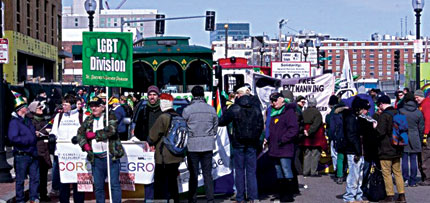
Boston St. Patrick’s Peace Parade participants lining up before parade. 
Photo: TRT Archives

By: Chuck Colbert*/ TRT Reporter—

BOSTON, Mass.—When Irish eyes are smiling, the world is bright and gay, or so go lyrics of the popular song. Except, historically, on St. Patrick’s Day in South Boston, where openly gay groups are still not permitted to participate.

For several years, the parade organizers—Allied War Veterans Council—emboldened by a 1995 U.S. Supreme Court ruling, have denied marching permission for LGBT and peace veterans groups as a matter of First Amendment, free-speech rights. However, serious efforts are underway to change that.

“This is the year we all should put pressure on politicians,” said Pat Scanlon, Vietnam veteran and coordinator of Veterans for Peace, Chapter 9, Smedley D. Butler Brigade, an organization banned from marching in the South Boston parade for several years.

Scanlon pointed to changing demographics of South Boston and a new mayor as hopeful signs the peace veterans contingent will be able to march, along with openly LGBT groups. Back in September 2013, Veterans for Peace applied to Allied War Veterans, but by December 9, 2013, when the peace-vet organization had not received a reply, Scanlon sent a follow up letter. 

“When Massachusetts is, in so many ways, a beacon of inclusion for the LGBTQ community, it is disappointing to see parade organizers continue to cultivate a climate of rejection and exclusion.” —Kara Coredini, MassEquality Director.

“The exclusion of Veterans for Peace, the LGBT community, and other peace organizations, from participating [in the parade] should come to an end,” Scanlon wrote. “It is time that there be one parade that is open, inclusive and welcoming to any group wishing to celebrate this very special day. It is Saint Patrick’s Day, a celebration of the patron saint of Ireland and Saint Patrick was a man of peace.”

Scanlon’s letter pointed not only to changing attitudes toward LGBT people in society at large, but also to cultural and social changes within South Boston.

“Many members of the LGBT community currently live, work and worship” in the neighborhood, he wrote.

In fact, two parades have trekked through the streets of South Boston since 2010 when the peace veterans first applied but were rejected. Scanlon said parade organizers used not wanting the word “peace” connected to the word “veteran” as reason enough to ban the group from marching. Last year, when the Veterans for Peace organized the second march, which took place one hour after the main event and was separated by Boston city street sweepers, the parade had more than 2,000 participants. Those who marched with the St. Patrick’s Peace Parade included six bands, trolleys, duck boats, floats, and the like—all organized into eight separate divisions under the categories of veterans, peace, LGBT, religious, environmental, labor, political, social, and economic justice.

Born on St. Patrick’s Day, Scanlon, 66, a straight Irish American who grew up Catholic in Philadelphia and attended parochial schools for 19 years, explained his motivation.

“This is an injustice,” Scanlon said. “An injustice against one is an injustice against all, and in one of the most progressive cities in the country, if not the world, to have this injustice taking place should not be tolerable.”

The father of a gay son, Scanlon does not mince words in calling out the ban on LGBT groups. 

“It’s homophobic,” he said, referring to the attitude of parade organizers. “It’s exclusion. It’s hatred. That’s what all this is about.”

In addition to applying to the Allied War Veterans Council, Scanlon said his parade group has also asked the City of Boston for its own parade permit with a 12 p.m. kick-off time, one hour before Allied War Veterans’ start time.

Michael Dowling, 59, a gay resident of South Boston for 35 years and president of the South Boston Association of Non-Profits, is taking another approach. He said the community-based non-profit association has applied to the Allied War Veterans, proposing “an inclusive unit called ‘We are South Boston.’” The application, he explained, contains “really strong, inclusive language, including LGBT language with signs that would identify participants in the parade.”

Dowling said he takes issue with Scanlon’s outsider approach.

“The efforts of Pat Scanlon have helped perpetuate the hardships of the neighborhood and how it is portrayed,” Dowling said.

He went on to explain why.

“Because when [Scanlon] calls the neighborhood bigoted and homophobic, he riles up those hatreds that are still there, and makes it more difficult for people to be out, and makes it more difficult for people to work here,” said Dowling. “So it sets us back.”

But Scanlon takes issue with Dowling’s suggestion of such name calling. The South Boston neighborhood is not the problem, said Scanlon, explaining, “The attitudes of the residents of South Boston have changed dramatically in the last 20 years.” It’s the Allied War Veterans who hold bigoted and homophobic attitudes, he said.

At the same time, both Scanlon and Dowling said they believe South Boston has indeed changed significantly in the last two decades.

“Everything in South Boston has changed,” said Scanlon. “The neighborhood has changed, the politics have changed, the culture has changed, and [Catholic] churches have closed. The only thing that has not changed is the attitude of the six guys who run the parade. That too will change.”

Dowling agreed with the changing demographics and attitudes, citing local civic groups that are inclusive of LGBT people, namely One Southie and The New Southie, both of which have Facebook pages, and the West Broadway Citizens group, which Dowling said consists predominantly of gay men who live on that thoroughfare. Dowling said South Boston Association of Non Profits is working with the neighborhood-based civic and social groups, among others, to gain permission to march.

Like Scanlon, Dowling is also seeking to gain support for their respective approaches from elected officials, including state Senator Linda Dorcena of the First Suffolk District and state Representative Nick Collins of the Fourth Suffolk District, both Democrats. South Boston falls within their respective legislative districts. Both Scanlon and Dowling have also contacted Boston’s new mayor, Martin J. Walsh, and District Two City Councilor Bill Linehan, a lifelong South Boston resident, in hopes that they can broker a deal or solution to the standoff. Linehan was also elected president of city council in early January. Scanlon has also written to the Boston Police Department and penned an open letter to residents of the city.

Dowling said he is hopeful that the neighborhood insider’s approach is the way out of the gay-ban situation, a way for the Allied War Veterans and everybody to move forward. Back in the early 90s when an openly gay group—The Irish American Gay, Lesbian, and Bisexual Group of Boston (GLIB)—marched in the parade, Dowling paid a steep price for supporting the gay group. Along the parade route, he handed out pink roses to gay, lesbian, and bisexual marchers. 

“Every window in my house was broken,” Dowling said.He added, consequently, that he had every good reason “to beat up on the neighborhood.”“But I have chosen to replace hatred of our community with service to that community,” Dowling explained.

A painter and noted artist, Dowling founded Medicine Wheels Production as a South Boston-based nonprofit organization in 2000. Its mission is “to transform communities from the inside out” through “the healing and transcendent power of public art.” Medicine Wheel’s signature event is on World AIDS Day. Another focus addresses youth drug abuse and teen suicide.

Neither Veterans for Peace nor South Boston Association of Non Profits have heard back yet from parade organizers. Both Dowling and Scanlon said they are preparing strategies if their applications are rejected. Undoubtedly, the issue will find its way to the office of Mayor Walsh, who told a reporter during the mayoral election last fall, “What needs to happen,” is a private “conversation” away from the media’s glare, with “organizers of the parade.”

“As mayor, I will sit down with them and work out a compromise so that people can feel like they can march in the parade,” Walsh explained. “This parade should be inclusive, and that goes for every other parade marching on public streets.”

Meanwhile, MassEquality, the statewide grassroots organization, has also applied to march.

“We will continue to apply every year until MassEquality is permitted to march,” said Kara S. Coredini, executive director.

Like the other two groups, MassEquality has not yet heard back from parade organizers on the status of its application. However, the parade is not among MassEquality’s highest priorities. 

Neither Veterans for Peace nor South Boston Association of Non Profits have heard back yet from parade organizers.

“The LGBTQ community in Massachusetts faces many issues more urgent than the ability to participate in a parade—youth homelessness, bullying, anti-transgender discrimination, HIV/AIDS, elder abuse, and more,” Coredini explained. “But public rejection by an established cultural institution like the St. Patrick’s Day Parade is significant in that it’s emblematic of the more life-altering rejection our community members face every day. When Massachusetts is, in so many ways, a beacon of inclusion for the LGBTQ community, it is disappointing to see parade organizers continue to cultivate a climate of rejection and exclusion. At the heart of MassEquality’s work electing pro-LGBTQ champions and advancing pro-LGBTQ legislation is changing attitudes, and each day because of that work we come closer to the day when this parade will be opened to all.”

This year’s St. Patrick Day Parade is scheduled for Sunday, March 16._______

*Chuck Colbert marched in the 1992 and 1993 South Boston St. Patrick’s Day Parade as one of 25 participants in the Irish American Gay, Lesbian, and Bisexual Group of Boston.

On Augustus Saint-Gaudens’ Memorial To Colonel Robert Gould Shaw And The Massachusetts Fifty-Fourth Regiment (Volunteers) –Take Four   
 

From The Pen Of Frank Jackman

…he had walked pass that blessed then defaced, muddied, unattended frieze across the street from the State House on Beacon Street in Boston it seemed like half his now graying life. Anytime he had cadged a hooky day from high school back in the early 1960s in order to head into downtown Boston and check out the day life on the Common, grab an off-beat movie at the many big house theaters on lower Washington Street to kill a couple of hours, or just hang out with the beats, beaten, and the bowed, would circle up around Beacon Street after emerging from the Park Street subway station (sometimes up Tremont then to Beacon). Walked around just to get a “feel” for his city, his mother’s birth city, the city of his birth, on humid summer days, leaves falling orange/red/yellow/autumn days, bleak snow-bound winter lights days, and rebirth green spring days. Walked head down right by the seemingly obscure defaced and unrepaired marble. Walked by thinking of his big world existential problems too intense to worry about faded pasts, or old time hokey glories.   

Later, mid-1960s later, when he went to school, a two-year school at first since that playing hooky to be one with the beaten brethren on the Common had caught up with him come graduation time and then transferred to Suffolk University in that same downtown Boston and had to work trucks down toward Congress Street to make his daily meat he would pass the memorial on his way to school and occasionally when he was second man on the trucks. Still later, after a stint in Uncle’s bloody, bloodied defeated Vietnam army at a time when he had developed a bad habit of expecting the world to owe him a living for his meager service and he lived on the hill (Beacon Hill) with some rarified suburban girl from Long Island who footed the bill (or rather some New Jack City banker Daddy) in sullen splendor (until she in her turn married some junior up and coming stockbroker) his studied neglect continued.

Yes he had passed it, that subtle stark monument to past fights, to fights worth fighting, like it was just another in a long line of historic ornaments in a town filled with memorials to its ancient arrival long continental history. You know bloody battle number one here against some heathen force, bloody battle number two there against the damn redcoats, a pigeon-bedecked statute of some fire-breathing Puritan divine casting out heathens here or some furious bearded abolitionist turning up the heat there, some battle-hardened general leaning Grant-like there, some corruption-filled over-fed civic leader in full three piece suit regalia here. Yes, the town was a breathing tribute to all that went down in the cold times American East when west, real west, was someplace around the Hudson River and white man European dreams were of making it along the Eastern seaboard and not having to trek inland luckless to face the unknown, natural or man-make.  

Had thoughtlessly briskly blinkered past that perfect pre-historic monument to some pretty important history going on right before his eyes down in bloody Birmingham/Selma/Greensboro/Philadelphia (MS that is)/Montgomery/Oxford (MS again) and one thousand other later to be  storied locales after the dust cleared (and the fight reined in). He had been attuned to all that although only touched the fringe of the crest when some army brothers, some Harlem brothers spoke of creating a new nation all shiny and black. Yet with all that civil rights let-them-vote-sent-books-to Alabama-ride-the-freedom-bus he was clueless to that aspect of his history. Clueless (and no high school history class, at least the days he attended, ever mentioned such things) to those places, Fort Wagner above all, where his people, his black proud Massachusetts 54th (and later 55th) had made righteous stands for freedom, had filled the sable ranks, had arms in hand confirmed the worst planter’s John Brown-benighted nightmare, had bled rivers of blood and  inelegantly sweated buckets of sweat, had trooped down to their citadel, Charleston, singing marching songs, and had not waited, no, no more wait, on some benevolent white man to do the work of freedom.

Then one cloudy day, not a 1960s day but much later after the image of the shiny black nation faded and long after he had gotten over the need to feel the world owed him a living for his meager service and for his skin, he happened to notice some work being done in the area around the monument while walking toward Park Street Station and a ride to the suburbs. That suburban ride came with its own psychic price but that is for another day as this day was a day for heroic remembrances not the stuff of benighted life. So he walked toward the site and asked about what was going on, why all the furious activity. Restoration they called it, bringing the dead back to life he thought.

Suddenly the sun glistened though a cloud and he noticed something on the then partly repaired frieze, a figure of a man. An old man trooper, an old pappy they called them back in the neighborhood back in the day, ancient bearded to almost be able to see the grey flecks sprinkled in that Jehovah nest, bed-rolled, knap-sacked, rifle-shouldered, marching in step just in front and to the left (from a front view of the scene) of a white officer on horse (whom he would find out later was the Colonel Shaw who was buried with his black brethren in  knighted dignity in some ashy pit in front of bloodied Fort Wagner). He stopped in his tracks as he realized that old soldier looked very much like his paternal grandfather, the father of his own rolling-stone father who had taken off for parts unknown and left him and his mother to the tender mercies when he was about seven. That bearded old man, grey-flecked, had (along with his grandmother) saved him from gathering a storm in the streets with the lure of the corner boy life. He had come north from sharecropper Mississippi, Mister James Crow’s Mississippi the worst kind), had taken up the shoemaker’s trade when that flourished in the town, had raised as best he could his five sons and two daughters (only his rolling-stone father a misstep) and raised hell when he could about the de facto segregation he faced every day. Had thus shouldered some serious if not heroic activities, had made up for some father sins.  

He was befuddled by the old greybeard at first since as a veteran of the Vietnam War he knew that no old pappy guys were filling the ranks of the American army in his time and so that old pappy figure perked his interest. Maybe he was kindred, but more importantly what drove the old-timer to put harm’s way between himself and his old long gone world. One day he went to the Boston Public Library over in Copley Square and found a book that dealt with the history of what he had found out that cloudy day was a memorial to the heroic Massachusetts 54th Regiment, all volunteers, all black ranks, and all white officers raised right there in Boston. (Mostly all freedman too since old Johnny Reb was putting a summary death penalty on any former slave, anything black that he captured.)

His interest perked he sought to find out who was the model for that old pappy soldier. Had he a history, some story to tell. He never did find out if there was a real live model but he liked to think that old pappy had escaped from some desperate Tidewater plantation, maybe led others out of bondage, had followed the northern star, had made something of himself, learned a respectable trade, maybe a shoemaker like grandpa, and had prospered. Then when Frederick Douglass or one of those hot-tempered abolitionist orators raised the call to sable arms he had laid down his tools and joined up.  Joined up amid ancient memories of kin in Pharaoh’s thrall and had not waited, said no, no more wait, on some benevolent white man to do the work of bloody freedom...


February 26, 2014:
A Day of Outrage and Remembrance
for Trayvon Martin and Jordan Davis


Locations at www.stopmassincarceration.net
Facebook event
Hoodies Up!
Targets Up!
Fists Raised!
We’re Standing Up!
No More Murder of Black Youth!
February 26, two years since the modern day lynching of Trayvon Martin, eleven days after a Florida court refused to convict racist Michael Dunn for the murder of Jordan Davis. Wherever you are, put on your hoodies, get people together, print out these targets, and gather at the seats of power and influence or go to the public square.  Stand together in silence, hoodies up, fists raised, holding targets. Be part of creating a powerful visual image and stand of defiance that goes out around the world.

On Wednesday, February 26, join with people in your city or town. Put on a Hoodie for Trayvon, hold a target with the message of “No More” for Jordan and all the Black and Latino youth who this system views as suspects. Defiantly represent that we refuse to accept a target being put on the back of every Black youth in this country, we refuse to accept the declaration that Black people have no rights that white people are bound to respect. 

February 26, make a difference. This action can break the paralysis by being the first national action against the mistrial of the murderer of young Jordan Davis and linking this outrage to the fight for justice for Trayvon. Be a part of puncturing the lie that there is nothing we can do -- that we must accept this nightmare. Join with hundreds nationwide standing up to the murder of Black youth declaring that we are determined to stop it. 

Don’t let your action be a secret from the world at large.  Take pictures of yourselves, post them https://www.facebook.com/stopmassincarcerationnetwork and send them to stopmassincarceration@gmail.com and spread them everywhere.

VIDEO: Dr. Cornel West & Carl Dix say "Hoodies Up! Times Up! We're Standing Up.  NO MORE Murder of Our Youth!"
More information at: Stop Mass Incarceration Network 347-979-SMIN (7646) * stopmassincarceration@gmail.com * stopmassincarceration.net and on Facebook & Twitter

Now at springdaysofdroneaction.org:
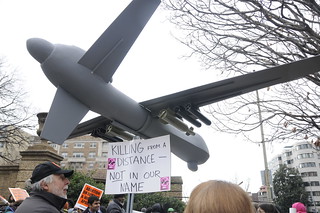
Drone Protest
An international call for Spring Days of Action – 2014, a coordinated campaign in April and May to:
End Drone Killing, Drone Surveillance and Global Militarization

LIST YOUR ACTION HERE. | ADD YOUR NAME HERE.
Share this message:
Tweet Facebook
VIDEO: Dr. Cornel West & Carl Dix say "Hoodies Up! Times Up! We're Standing Up.  NO MORE Murder of Our Youth!"
Jamel from Stop Mass Incarceration Network and Revolution Club NYC on: Is it a generational thing? What is the situation of the youth? Why do we need to act on Feb. 26? Click here for audio.
Stop Mass Incarceration
Debra Sweet, Director, The World Can't Wait