This space is dedicated to the proposition that we need to know the history of the struggles on the left and of earlier progressive movements here and world-wide. If we can learn from the mistakes made in the past (as well as what went right) we can move forward in the future to create a more just and equitable society. We will be reviewing books, CDs, and movies we believe everyone needs to read, hear and look at as well as making commentary from time to time. Greg Green, site manager
Monday, August 04, 2014
Defend The Palestinian People! No U.S. Aid To Israel
From The Archives Of Women And Revolution
Markin comment:
The following is a set of archival issues of Women and Revolution that may have some historical interest for old "new leftists", perhaps, and well as for younger militants interested in various cultural and social questions that intersect the class struggle. Or for those just interested in a Marxist position on a series of social questions that are thrust upon us by the vagaries of bourgeois society. I will be posting articles from the back issues ofWomen and Revolution during Women's History Month in March and periodically throughout the year.
Markin comment on founding member James P. Cannon and the early American Communist Party taken from a book review, James P. Cannon and the Early American Communist Party, on the “American Left History” blog:
If you are interested in the history of the American Left or are a militant trying to understand some of the past mistakes of our history and want to know some of the problems that confronted the early American Communist Party and some of the key personalities, including James Cannon, who formed that party this book is for you.
At the beginning of the 21st century after the demise of the Soviet Union and the apparent ‘death of communism’ it may seem fantastic and utopian to today’s militants that early in the 20th century many anarchist, socialist, syndicalist and other working class militants of this country coalesced to form an American Communist Party. For the most part, these militants honestly did so in order to organize an American socialist revolution patterned on and influenced by the Russian October Revolution of 1917. James P. Cannon represents one of the important individuals and faction leaders in that effort and was in the thick of the battle as a central leader of the Party in this period. Whatever his political mistakes at the time, or later, one could certainly use such a militant leader today. His mistakes were the mistakes of a man looking for a revolutionary path.
For those not familiar with this period a helpful introduction by the editors gives an analysis of the important fights which occurred inside the party. That overview highlights some of the now more obscure personalities (a helpful biographical glossary is provided), where they stood on the issues and insights into the significance of the crucial early fights in the party.
These include questions which are still relevant today; a legal vs. an underground party; the proper attitude toward parliamentary politics; support to third- party bourgeois candidates;trade union policy; class-war prisoner defense as well as how to rein in the intense internal struggle of the various factions for organizational control of the party. This makes it somewhat easier for those not well-versed in the intricacies of the political disputes which wracked the early American party to understand how these questions tended to pull it in on itself. In many ways, given the undisputed rise of American imperialism in the immediate aftermath of World War I, this is a story of the ‘dog days’ of the party. Unfortunately, that rise combined with the international ramifications of the internal disputes in the Russian Communist Party and in the Communist International shipwrecked the party as a revolutionary party toward the end of this period.
In the introduction the editors motivate the purpose for the publication of the book by stating the Cannon was the finest Communist leader that America had ever produced. This an intriguing question. The editors trace their political lineage back to Cannon’s leadership of the early Communist Party and later after his expulsion to the Trotskyist Socialist Workers Party so their perspective is obvious. What does the documentation provided here show? I would argue that the period under study represented Cannon’s apprenticeship. Although the hothouse politics of the early party clarified some of the issues of revolutionary strategy for him I believe that it was not until he linked up with Trotsky in the late 1920’s that he became the kind of leader who could lead a revolution. Of course, since Cannon never got a serious opportunity to lead revolutionary struggles in America this is mainly reduced to speculation on my part. Later books written by him make the case better. One thing is sure- in his prime he had the instincts to want to lead a revolution.
As an addition to the historical record of this period this book is a very good companion to the two-volume set by Theodore Draper - The Roots of American Communism and Soviet Russia and American Communism- the definitive study on the early history of the American Communist Party. It is also a useful companion to Cannon’s own The First Ten Years of American Communism. I would add that this is something of a labor of love on the part of the editors. This book was published at a time when the demise of the former Soviet Union and Eastern Europe was in full swing and anything related to Communist studies was deeply discounted. Nevertheless, for better or worse, the American Communist Party (and its offshoots) needs to be studied as an ultimately flawed example of a party that failed in its mission to create a radical version of society in America. Now is the time to study this history.
The Latest From The Rag Blog-A Voice Of The Old New Left
Click below to link to The Rag Blog
http://www.theragblog.com/
Peter Paul Markin comment:
When we were young, meaning those of us who were militant leftist baby-boomers from what I now call the “Generation Of ‘68”, we would chuckle/gasp/shriek in horror when some Old Leftists tried to tell us a few of the ABCs of radical politics. Those scorned old leftists, mainly old Stalinist Communist Party hangers-on or moribund Trotskyist Socialist Workers Party members who had come of political age in the 1930s and 1940s had nothing to tell us young stalwart in-your-face- rebels who were going to re-invent the world, re-invent it without the hurts and sorrows accumulated from millennia of previous struggles to push the rock up the hill of human progress.
Well, we fell significantly short of that aim, had that Promethean rock come speeding down over our heads. Today I am still not sure whether in retrospect those scorned Old Leftists of old had anything going but all I know is we are now cast in somewhat the same light. We are now the Old New Leftists. Problem is that unlike our 1960s generation, warts and all, there is no sizable younger crowd of young stalwart in-your-face-rebels to thumb their noses up at us. And there should be. That has not stopped many old radicals, many who have not succumbed to old age and hubris, from trying to be heard. And the place they have congregated, for better or worse, at least from what I can see is at this site.
So I find this The Rag Blog website very useful to monitor for the latest in what is happening with past tense radical activists and activities. Anybody, with some kind of name, and who is still around from the 1960s has found a home here. The remembrances and recollections are helpful for today’s activists. Strangely the politics are almost non-existent, as least any that would help today, except to kind of retroactively “bless” those old-time New Left politics that did nothing (well, almost nothing) but get us on the losing end of the class (and cultural) wars of the last forty plus years. Still this is a must read blog for today’s left-wing militants.
A Markin disclaimer:
I place some material in this space which may be of interest to the radical public that I do not necessarily agree with or support. Sometimes I will comment on my disagreements and sometimes I will just let the author/writer shoot him or herself in the foot without note. Off hand, as I have mentioned before in other contexts, I think it would be easier, infinitely easier, to fight for the socialist revolution straight up than some of the “remedies” provided by the commentators in the entries on this website. But part of that struggle for the socialist revolution is to sort out the “real” stuff from the fluff as we struggle for that more just world that animates our efforts. Read on.
It is a grave error to attack Jews anywhere based on the actions of the Israeli government.
Protest in Lyon, France, July 16, 2014, against Israel’s bombing of Gaza. Demonstrations in Europe, especially in France, are becoming increasingly anti-Semitic. Photo by AFT.
By David McReynolds | The Rag Blog | July 20, 2014
In recent days there has been a flurry of anti-Semitic outbursts in France and elsewhere, clearly triggered by Israel’s military actions against the Palestinians in Gaza. I’m depressed enough about the whole situation that I have not yet written my own views on the tragedy of Gaza, but it is crucial that no one, anywhere in the world, should take out on a local Jewish community center or synagogue their justified anger against the Israeli regime.
Many Jews outside of Israel do support the Israeli actions, and many have openly opposed those actions. Indeed, some of the leading and sharpest critics of Israel have come from the Jewish community. Continue reading →
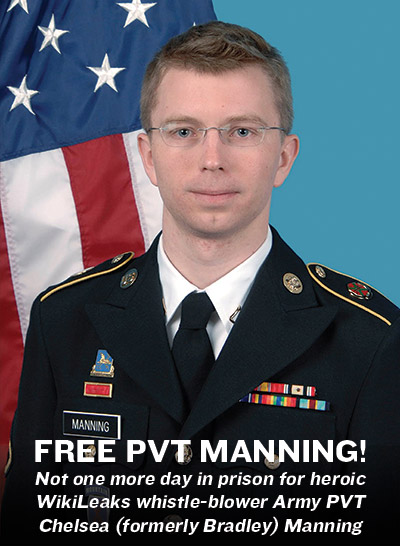
You can also call (Comments”202-456-1111), write The White House, 1600 Pennsylvania Avenue NW, Washington, DC 20500, e-mail-(http://www.whitehouse.gov’contact/submitquestions-and comments) to demand that President Obama use his constitutional power under Article II, Section II to pardon Private Manning now.
*Start a stand -out, weekly, bi-weekly, monthly, in your town square to publicize the pardon and clemency campaigns. Contact the Private Manning SupportNetwork for help with materials and organizing tips http://www.bradleymanning.org/
*Contribute to the Private Manning Defense Fund- now that the trial has finished funds are urgently needed for pardon campaign and for future military and civilian court appeals. The hard fact of the American legal system, military of civilian, is the more funds available the better the defense, especially in political prisoner cases like Private Manning’s. The government had unlimited financial and personnel resources to prosecute Private Manning at trial. And used them as it will on any future legal proceedings. So help out with whatever you can spare. For link go to http://www.bradleymanning.org/
*Write letters of solidarity to Private Manning while she is serving her sentence. She wishes to be addressed as Chelsea and have feminine pronouns used when referring to her. Private Manning’s mailing address: Bradley E. Manning, 89289, 1300 N. Warehouse Road, Fort Leavenworth, Kansas 66027-2304. You must use Bradley on the address envelope.
Private Manning cannot receive stamps or money in any form. Photos must be on copy paper. Along with “contraband,” “inflammatory material” is not allowed. Six page maximum.
*Call: (913) 758-3600-Write to:Col. Sioban Ledwith, Commander U.S. Detention Barracks 1301 N Warehouse Rd Ft. Leavenworth KS 66027-Tell them: “Transgender rights are human rights! Respect Private Manning’s identity by acknowledging the name ‘Chelsea Manning’ whenever possible, including in mail addressed to her, and by allowing her access to appropriate medical treatment for gender dysphoria, including hormone replacement therapy (HRT).” (for more details-http://markinbookreview.blogspot.com/2013/11/respecting-chelseas-identity-is-this.html#!/2013/11/respecting-chelseas-identity-is-this.html *******
As The 100th Anniversary Of The Beginning of World War I (Remember The War To End All Wars) Starts ... Some Remembrances-August 4, 1914 German Social-Democrats Support The Kaiser's War Budget -The Great Working- Class Betrayal
Markin comment on the meaning of August 4th for
the revolutionary socialist movement:
As we take note of, or better and more
useful, etch into our political calculations the great betrayal of the German
Social-Democracy in voting for the Kaiser’s war budget on this day we should
after 100 years have no illusions about the nature of the leadership of that
great working-class organization. Those who were close to the scene, those in
the left-wing of the party and who had been most vocal about opposition with the
war clouds looming all through the early part of the 20th century, the
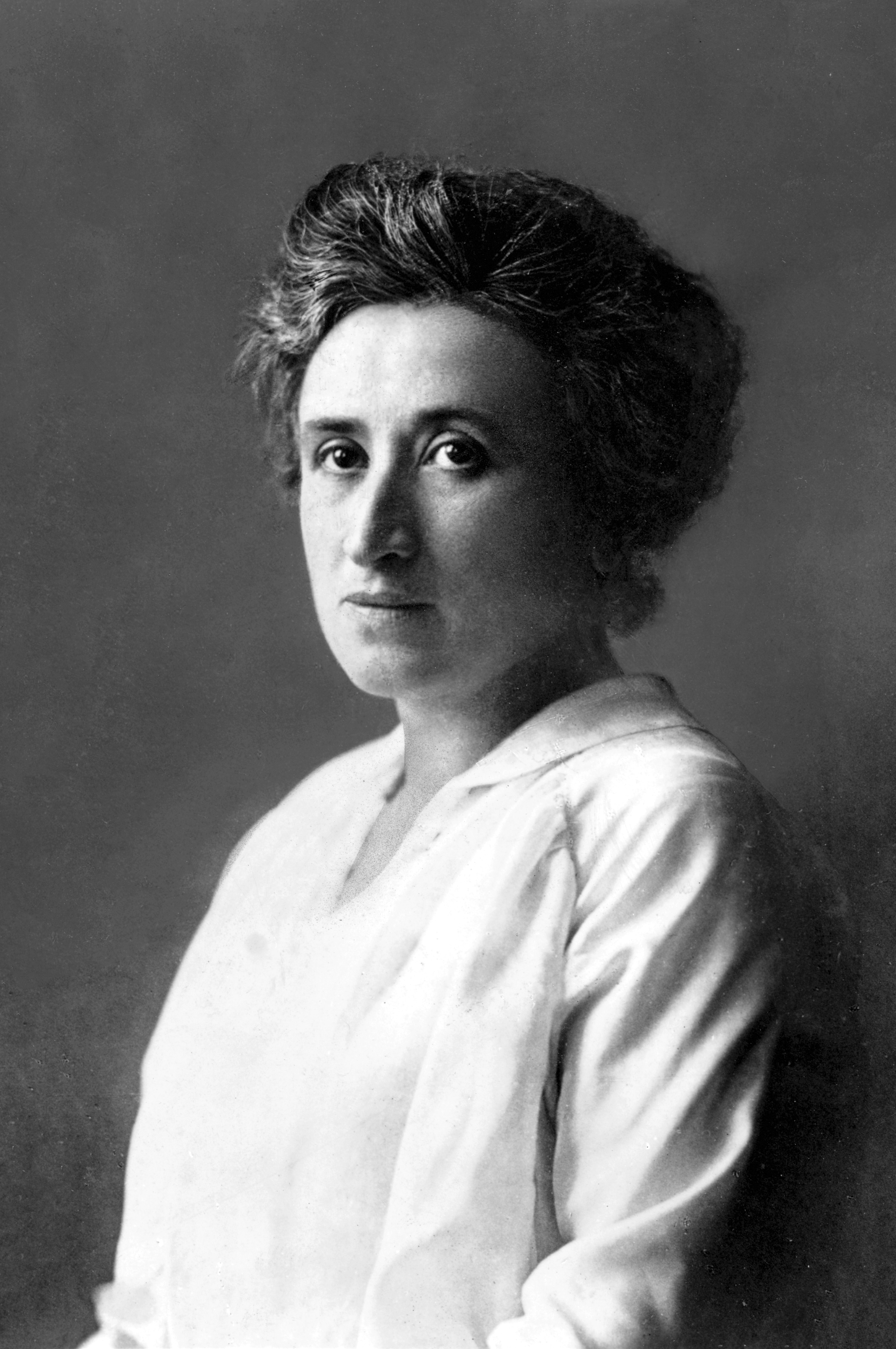
likes of Karl Liebknecht and Rosa Luxemburg, had been waging a rear-guard
action for years against the tendency of the party leadership to fudge on the
German war issue.
Whether Liebknecht and Luxemburg, like
Lenin, Trotsky and many other international socialists who looked to the German
party, Marx and Engels’ own party, were shocked into disbelief by the
leadership’s action is hard to know at this remove but what should be clear to
left-wing militants today is that they stayed in the official party far too
long once the ramifications of August 4th became clear and as the
war dragged on. Liebknecht and Luxemburg were, no question, personally heroic
when they formed the anti-war opposition within the party as the official leadership
continued to press for support of the never-ending war budget requests. What they
did not do and a matter which has been the subject of some debate over the
years was break off from the official party soon enough and subsequently the
Independent Socialists to which they adhered when working within the official party
became a moot question.
As the palpable anti-war resistance
grew among important segments of the German working-class (those not dragooned
into the army for the trenches on the various fronts) those militants, even if
originally a small independent group they could have posed a clear pole of attraction
for those militants looking for a way to oppose the war and prepare for the social
revolution. Sometimes, as the Bolshevik experiences during that same period
show, you have to fight against the stream. Fight hard. Enough said.
*********
From Leon Trotsky's War and the International
CHAPTER VII
THE COLLAPSE OF THE INTERNATIONAL
AT their Convention in Paris two weeks before the outbreak of the catastrophe, the French Socialists insisted on pledging all branches of the International to revolutionary action in case of a mobilization. They were ihinking chiefly of the German Social Democracy. The radicalism of the French Socialists in matters of foreign policy was rooted not so much in international as national interests. The events of the War have now definitely confirmed what was clear o many then. What the French Socialist Party desired from the sister party in Germany was a certain guarantee for the inviolability of France. They believed that only by thus insuring themselves with the German proletanat could they finally free their own hands for a decisive conilict with national militarism.
The German Social Democracy, for their part, flatly refused to make any such pledge. Bebel showed that if the Socialist parties signed the French resolution, that would not necessarily enable them to keep their pledge when the decisive moment came. Now there is little room for doubt that Bebel was right. As events have repeatedly proved, a period of mobilization almost completely cripples the Socialist Party, or at least precludes the possibility of decisive moves. Once mobilization is declared, the Social Democracy finds itself face to face with the concentrated power of the government, which is supported by a powerful military apparatus that is ready to crush all obstacles in its path and has the unqualified cooperation of all bourgeois parties and institutions.
And of no less importance is the fact that mobilization wakes up and brings to their feet those elements of the people whose social significance is slight and who play little or no political part in tirnes of peace. Hundreds of thousands, nay millions of petty hand-workers, of hobo-proletarians (the riff-raff of the workers), of small farmers and agricultural labourers are drawn into the ranks of the army and put into a uniform, in which each one of these men stands for just as much as the class-conscious workingman. They and their families are forcibly torn from their dull unthinking indifference and given an interest in the fate of their country. Mobilization and the declaration of war awaken fresh expectations in these circles whom our agitation practically does not reach and whom, under ordinary circumstances, it will never enlist. Confused hopes of a change in present conditions, of a change for the better, fill the hearts of these masses dragged out of the apathy of misery and servitude. The same thing happens as at the beginning of a revolution, but with one all-important difference. A revolution links these newly aroused elements with the revolutionary class, but war links them – with the government and the army! In the one case all the unsatisfied needs, all the accumulated suffering, all the hopes and longings find their expression in revolutionary enthusiasm; in the other case these same social emotions temporarily take the form of patriotic intoxication. Wide circles of the working class, even among those touched with Socialism, are carried along in the same current.
The advance guard of the Social Democracy feels it is in the minority; its organizations, in order to complete the organization of the army, are wrecked. Under such conditions there can be no thought of a revolutionary move on the part of the Party. And all this is quite independent of whether the people look upon a particularly war with favour or disfavour. In spite of the colonial character of the Russo-Japanese war and its unpopularity in Russia, the first half year of it nearly smothered the revolutionary movement. Consequently it is quite clear that, with the best intentions in the world, the Socialist parties cannot pledge themselves to obstructionist action at the time of mobilization, at a time, that is, when Socialism is more than ever politically isolated.
And therefore there is nothing particularly unexpected or discouraging in the fact that the working-class parties did not oppose military mobilization with their own revolutionary mobilization. Had the Socialists limited themselves to expressing condemnation of the present War, had they declined all responsibility for it and refused the vote of confidence in their governments as well as the vote for the war credits, they would have done their duty at the time. They would have taken up a position of waiting, the oppositional character of which would have been perfectly clear to the government as well as to the people. Further action would have been determined by the march of events and by those changes which the events of a war must produce on the people’s consciousness. The ties binding the International together would have been preserved, the banner of Socialism would have been unstained. Although weakened for the moment, the Social Democracy would have preserved a free hand for a decisive interference in affairs as soon as the change in the feelings of the working masses came about. And it is safe to assert that whatever influence the Social Democracy might have lost by such an attitude at the begnining of the War, it would have regained several times over once the inevitable turn in public sentiment had come about.
But if this did not happen, if the signal for war mobilization was also the signal for the fall of the International, if the national labour parties fell in line with their governments and the armies without a single protest, then there must be deep causes for it common to the entire International. It would be futile to seek these causes in the mistakes of individuals, in the narrowness of leaders and party committees. They must be sought in the conditions of the epoch in which the Socialist International first came into being and developed. Not that the unreliability of the leaders or the bewildered incompetence of the Executive Committee should ever be justified. By no means. But these are not fundamental factors. These must be sought in the historical conditions of an entire epoch. For it is not a question and we must be very straightforward with ourselves about this – of any particular mistake, not of any opportunist steps, not of any awkward statements in the various parliaments, not of the vote for the budget cast by the Social Democrats of the Grand Duchy of Baden [35], not of individual experiments of French ministerialism, not of the making or unmaking of this or that Socialist career. It is nothing less than the complete failure of the International in the most responsible historical epoch, for which all the previous achievements of Socialism can be considered merely as a preparation.
A review of historical events will reveal a number of facts and symptoms that should have aroused disquiet as to the depth and solidarity of Internationalism in the labour movement.
I am not referring to the Austrian Social Democracy. In vain did the Russian and Serbian Socialists look for clippings from articles on world politics in the Wiener Arbeiter-Zeitung that they could use for Russian and Serbian workingmen without having to blush for the International. One of the most striking tendencies of this journal always was the defence of Austro-German imperialism not only against the outside enemy but also against the internal enemy – and the Vorwaerts was one of the internal enemies. There is no irony in saying that in the present crisis of the International the Wiener Arbeiter-Zeitung remained truest to its past.
French Socialism reveals two extremes – an ardent patriotism, on the one hand, not free from enmity of Germany; on the other hand, the most vivid anti-patriotism of the Hervé type, which, as experience teaches, readily turns into the very opposite.
As for England, Hyndman’s Tory-tinged patriotism, supplementing his sectarian radicalism, has often caused the International political difficulties.
It was in far less degree that nationalistic symptoms could be detected in the German Social Democracy. To be sure, the opportunism of the South Germans grew up out of the soil of particularism, which was German nationalism in octavo form. But the South Germans were rightly considered the politically unimportant rear-guard of the party. Bebel’s promise to shoulder his gun in case of danger did not meet with a single-hearted reception. And when Noske repeated Bebel’s expression, he was sharply attacked in the party press. On the whole the German Social Democracy adhered more stricly to the line of internationalism than any other of the old Socialist Parties. But for that very reason it made the sharpest break with its past. To judge by the formal announcemnets of the party and the articles in the Socialist press, there is no connection between the Yesterday and Today of German Socialism.
But it is clear that such a catastrophe could not have occurred had not the conditions for it been prepared in previous times. The fact that two young parties, the Russian and ther Servbian, remained true to their international duties is by no means a confirmation of the Philistine philosophy, according to which loyalty to principle is a natural expression of immaturity. Yet this fact leads us to seek the causes of the collapse of the Second International in the very conditions of its development that least influenced its younger members.
Sunday, August 03, 2014
Amnesty
renews call on govt to grant Manning clemency
On July 30th, one of the world’s most important human rights organizations,
Amnesty International condemned the US government’s blatant
over-prosecution and hypocrisy in its handling of Chelsea Manning’s
case: "The US government must grant Chelsea Manning
clemency, order her immediate release, and implement a thorough and
impartial investigation into the crimes she uncovered. After being convicted of 20 separate charges Chelsea Manning was
sentenced to 35 years in prison, much longer than other members of the military
convicted of charges such as murder, rape and war crimes. Before her conviction, Chelsea Manning had already been held for
three years in pre-trial detention, including 11 months in conditions
which the UN Special Rapporteur on Torture described as cruel and
inhumane…"
By CLARK STOECKLEY Preface by JULIAN ASSANGE Published by OR
Books
Drawing and writing in real time from inside the courtroom, artist and
WikiLeaks activist Clark Stoeckley documented the court martial of Chelsea
Manning in his book, The United States vs. Pvt Chelsea Manning.
Stoeckley’s graphic account features sketches paired with transcipts of the
proceedings.
With your support, Manning's legal appeals can help preserve democracy
In his recent statement, Daniel
Ellsberg explains the significance of Chelsea Manning's upcoming legal
appeals and how you can help: "I have been waiting forty years for a legal process to at long last
prove the unconstitutionality of the Espionage Act as applied to
whistle-blowers (the Supreme Court has never yet addressed this
issue). This appeals process can accomplish that, and it can reduce
Chelsea’s sentence by decades. But unfortunately, without your help
today it will not happen." In the last month, we've raised $43,000 of our $100,000
goal! We need to raise $57,000 by September 1st to ensure that Chelsea’s
team have the resources to fully fight this stage of the appeals
process.
In The 74th Anniversary Year Of The Assassination Of Great Russian Revolutionary Leon Trotsky A Tribute- DEFEATED, BUT UNBOWED-THE WRITINGS OF LEON TROTSKY, 1929-1940
BOOK REVIEW
If you are interested in the history of the International Left in the first half of the 20th century or are a militant trying to understand some of the past lessons of our history concerning the communist response to various social and labor questions this book is for you. I have reviewed elsewhere Trotsky’s writings published under the title The Left Opposition, 1923-1929 (in three volumes) dealing with Trotsky’s internal political struggles for power inside the Russian Communist Party (and by extension, the political struggles inside the Communist International) in order to save the Russian Revolution. This book is part of a continuing series of volumes in English of his writings from his various points of external exile from 1929 up until his death in 1940. These volumes were published by the organization that James P. Cannon, early American Communist Party and later Trotskyist leader founded, the Socialist Workers Party, during the 1970’s and 1980’s. (Cannon’s writings in support of Trotsky’s work are reviewed elsewhere in this space). Look in the archives in this space for other related reviews on and by this important world communist leader.
To set the framework for these reviews I will give a little personal, political and organizational sketch of the period under discussion. After that I will highlight some of the writings from each volume that are of continuing interest. Reviewing such compilations is a little hard to get a handle on as compared to single subject volumes of Trotsky’s writing but, hopefully, they will give the reader a sense of the range of this important revolutionary’s writings.
After the political defeat of the various Trotsky-led Left Oppositions 1923 to 1929 by Stalin and his state and party bureaucracy he nevertheless found it far too dangerous to keep Trotsky in Moscow. He therefore had Trotsky placed in internal exile at Ata Alma in the Soviet Far East in 1928. Even that turned out to be too much for Stalin’s tastes and in 1929 he arranged for the external exile of Trotsky to Turkey. Although Stalin probably rued the day that he did it this exile was the first of a number of places which Trotsky found himself in external exile. Other places included, France, Norway and, finally, Mexico where he was assassinated by a Stalinist agent in 1940. As these volumes, and many others from this period attest to, Trotsky continued to write on behalf of a revolutionary perspective. Damn, did he write. Some, including a few of his biographers, have argued that he should have given up the struggle, retired to who knows where, and acted the role of proper bourgeois writer or professor. Please! These volumes scream out against such a fate, despite the long odds against him and his efforts on behalf of international socialist revolution. Remember this is a revolutionary who had been through more exiles and prisons than one can count easily, held various positions of power and authority in the Soviet state and given the vicissitudes of his life could reasonably expect to return to power with a new revolutionary upsurge. Personally, I think Trotsky liked and was driven harder by the long odds.
The political prospects for socialist revolution in the period under discussion are, to say the least, rather bleak, or ultimately turned out that way. The post-World War I revolutionary upsurge has dissipated leaving Soviet Russia isolated. Various other promising revolutionary situations, most notably the aborted German revolution of 1923 that would have gone a long way to saving the Russian Revolution, had come to naught. In the period under discussion there is a real sense of defensiveness about the prospects for revolutionary change. The specter of fascism loomed heavily and we know at what cost to the international working class. The capitulation to fascism by the German Communist and Social Democratic Parties in 1933, the defeat of the heroic Austrian working class in 1934, the defeat in Spain in 1939, and the outlines of the impending Second World War colored all political prospects, not the least Trotsky’s.
Organizationally, Trotsky developed two tactical orientations. The first was a continuation of the policy of the Left Opposition during the 1920’s. The International Left Opposition as it cohered in 1930 still acted as an external and unjustly expelled faction of the official Communist parties and of the Communist International and oriented itself to winning militants from those organizations. After the debacle in Germany in 1933 a call for new national parties and a new, fourth, international became the organizational focus. Many of the volumes here contain letters, circulars, and manifestos around these orientations. The daunting struggle to create an international cadre and to gain some sort of mass base animate many of the writings collected in this series. Many of these pieces show Trotsky’s unbending determination to make a breakthrough. That these effort were, ultimately, militarily defeated during the course of World War Two does not take away from the grandeur of the efforts. Hats off to Leon Trotsky.
*************
In Honor Of Leon Trotsky On The 74th Anniversary
Of His Death- To Those Born After-Ivan Smirnov’s Journey
From The Pen Of Frank Jackman
Ivan Smirnov came out of old Odessa town, came out of the
Ukraine (not just plain Ukraine like now but “the” then), the good black earth
breadbasket of Russian Empire, well before the turn of the 20th
century (having started life on some Mister’s farm begotten by illiterate
peasant parents who were not sure whether it was 1880 or 1881) although he was
strictly a 20th century man by habits and inclinations. Those habits
included a love of reading, a love of the hard-pressed peoples facing the
jack-boot (like his parents) under the Czar’s vicious rule, an abiding hatred
for that same Czar, a hunger to see the world or to see something more than
wheat fields, and a love of politics, what little expression that love could
take.
Of course Ivan Smirnov, a giant of a man, well over six
feet, well-build with the Russian dark eyes and hair to match, when he came of
age also loved good food when he had the money for such luxuries, loved to
drink shots of straight vodka in competition with his pals, and loved women,
and women loved him. It is those appetites in need of whetting that consumed
his young manhood, his time in Odessa before he signed on to the Czar’s navy to
see the world, or at leastbrush the
dust of Odessa off his shoes as the old saying went. Those loves trumped for a
time his people love, his love of liberty but as we follow Ivan on his travels
we will come to collide more and more with those larger loves.
So as we pick up the Ivan Smirnov story he was no kid, had
been around the block a few times. Had taken his knocks on the land of his
parents (really Mister’s land once the taxes, rents, and dues were taken out)
when he tried to organize, well, not really organize but just put a petition to
Mister which was rejected out of hand and which forced him off the land. Forced
him off under threat to his life. He never forgot that slight, never. Never
forgot it was Mister and his kind that took him away from home, split his family
up. So off he went to the city, and from there to the Black Sea Fleet and
adventure, or rather tedium mixed with adventure and plenty of time to read. He
also learned up close the why and wherefores of modern warfare, modern naval
warfare. Knew too that come some minor confrontation the Czar’s navy was
cooked.As things worked out Ivan had been
in the Russian fleet that got its ass kicked by the Japanese in 1904 (he never
called them “Nips” like lots of his crewmates did not after that beating they
took that did not have to happen if the damn Czar’s naval officers had been
anything but lackeys and anything but overconfident that they could beat the
Johnny-come-lately Japanese in the naval war game). And so Ivan came of war age
and political age all at once.
More importantly he had transferred into in the Baltic fleet
when the revolution of 1905 came thundering over their heads and each man, each
sailor, each officer had to choice sides. He had gone with rebels and while he
did not face the fate of his comrades on the Potemkin his naval career was over. That was where his love of
reading from an early age came in, came and made him aware of the boiling kettle
of political groupings trying to save Russia or to save what some class or part
of a class had an interest in. He knew, knew from his dismal experience on the
land, that Mister fully intended to keep what was his come hell or high water.
He also knew that Mister’s people, the peasantry like his family would have a
very hard time, a very hard time indeed bucking Mister’s interests and proclaiming
their own right to the land all by themselves. Hadn’t he also been burned, been
hunted over a simple petition. So he from the first dismissed the Social
Revolutionary factions and gave some thought to joining the Social Democrats.
Of
course being Russians who would argue over anything from how many angels could
fit on the head of a needle to theories of capitalist surplus value the party
organization had split into two factions (maybe more when the dust settled).
When word came back from Europe he had sided with the Mensheviks and their more
realistic approach to what was possible for Russia in the early 20th
century. That basic idea of a democratic republic was the central notion that Ivan
Smirnov held for a while, a long while and which he took in with him once things
got hot in Saint Petersburg in January of 1905.
***As The 50th Anniversary Year Of The High School Class Of 1964 Rolls Along… “Forever Young” (Magical Realism 101)
From The Pen Of Frank Jackman
…an old man bundled up against the December weathers begins to run, no, better, jog/shuffle along the Causeway end of Adamsville Beach (by the CVS, formerly the First National, if you have not been in the old town in a while, the old town being North Adamsville not too far outside of Boston if you want to know), huffing and puffing, head down and this day full of thoughts triggered by his up-coming 50th anniversary class reunion (although this sketch is more generic). Thinking just then of the irony of running along a section of his old high school cross-country course and thinking as he moved along of those mist of times Adamsville Beach days when he longingly looked out at the sea, its mucks, its marshes, hell, even it fetid smells and mephitic stinks, as if it could solve some riddle of existence. Thinking too as he trudged along of times when he was young and flexible and if not fast then able to run the distance in about half the time it would take him on this day (his fast running friend back then, Brad Badger, said he had "the slows," well okay Brad had a point).
As he settled into a pace he began thinking about hanging out around places, places like Harry’s Variety over on Sagamore trying to cadge pin-ball games from the rough and tumble corner boys; hanging out at Salducci’s Pizza Parlor begging girls to play some latest song on the jukebox; and, hanging out on sweaty summer nights on the front steps of North, no money in pocket, with that same Brad Badger, also penniless, speaking of dreams, small dreams of escape and big puffed-ball cloud dreams of success.
Remembering, an old man’s harmless flash remembering, ofstanding in corridors between classes day-dreaming of, well, you know, certain now nameless girls and of giving furtive glances to a few which they totally ignored. But that was another story. And remembrances too of sitting in classes, maybe some dank seventh period study hall, wondering about what would happen Friday night when he and his corner boys cruised Adamsville Beach (HoJo’s a must stop on hot summer nights, make his cherry vanilla), the Southern Artery (Marley’s, Pisa’s Tower of Pizza, Adventure Car-Hop, not the real names but memory fails) , and in a pinch going “up the Downs” to Doc’s Drugstore, looking, looking for adventure, looking for some magic formula to wipe away the teen angst and alienation blues that crept up on him more than was good for him...
...an old woman (Jesus, better not say that, make that a mature woman) also bundled up against the December weathers, begins to walk, haltingly, but with head up (proper posture just like her mother taught her long ago), along Adamsville Beach from the Adams Shore end (around what is now Creely Park named after some fallen Marine) thinking thoughts triggered by her up-coming 50th class reunion as well. Thinking thoughts about old flames and what had happened to them (and creeping in thoughts about that first kiss sitting in the back seat of her girlfriend's boyfriend's car with him, some old flame now un-nameable, at this very beach and about, she blushed as she thought of it, that first French kiss and how she felt awkward about it).
Later in her walk thoughts flashed by, funny thoughts, emerged about all the lies she told about those same steamy nights just to keep up with the other girls at talkfest time -the mandatory Monday morning before school girls '"lav" talkfest , boys had theirs' too she found out from a later flame after high school. Laughing now but then not knowing until much later that the other girls too were lying just to keep up with her. And of all the committees she had been on; dance committee, North Star, Magnet, whatever would keep her busy and make her a social butterfly. Then a mishmash of thoughts flooded her mind as she passed Kent Park near the now vanished bowling alleys of the girls’ bowling team and wondering, now wondering, why they kept the boys’ team separate; of reading in that cranky old Thomas Crane Public Library up the Square where she first learned to love books and saw them as a way to make a success of herself and had done so; and, of hot sweltering summer afternoons with the girls down at the beach trying to look, what did Harry call it, “beautiful” for the guys.
Somewhere between the Adamsville Yacht Club and the North Adamsville Boat Club the old man and the mature woman crossed paths. He, she, they gave a quick nod of generational solidarity to each other and both thought they knew the other from some place but couldn’t quite place where. After they passed each other the old man’s pace quickened for a moment as he heard some phantom starter’s gun sounding the last lap and the mature woman’s walk became less halting as she thought once again about that first kiss (whether it was the French kiss that stirred her we will leave to the reader’s imagination) as each reflected back to a time when the world was fresh and all those puffed-cloud dreams of youth lay ahead of them.
Forever Young-lyrics by Bob Dylan
May God bless and keep you always May your wishes all come true May you always do for others And let others do for you May you build a ladder to the stars And climb on every rung May you stay forever young Forever young, forever young May you stay forever young
May you grow up to be righteous May you grow up to be true May you always know the truth And see the lights surrounding you May you always be courageous Stand upright and be strong May you stay forever young Forever young, forever young May you stay forever young
May your hands always be busy May your feet always be swift May you have a strong foundation When the winds of changes shift May your heart always be joyful May your song always be sung May you stay forever young Forever young, forever young May you stay forever young






 In his recent statement, Daniel
Ellsberg explains the significance of Chelsea Manning's upcoming legal
appeals and how you can help:
In his recent statement, Daniel
Ellsberg explains the significance of Chelsea Manning's upcoming legal
appeals and how you can help: