Tuesday, January 13, 2015

From The Abraham Lincoln Brigade Archive Website- The Alba Blog


Click below to link to the Abraham Lincoln Brigade Archive blog page for all kinds of interesting information about that important historic grouping in the International Brigades that fought for our side, the side of the people in the Spanish Civil War, 1936-39.

http://www.albavolunteer.org/category/blog/

Markin comment:

This blog had gotten my attention for two reasons: those rank and filers who fought to defend democracy, fight the fascists and fight for socialism in Spain for the most part, political opponents or not, were kindred spirits; and, those with first-hand knowledge of those times over seventy years ago are dwindling down to a precious few and so we had better listen to their stories while they are around to tell it. Viva La Quince Brigada!  
*******
BOOK REVIEW

THE SPANISH REVOLUTION, 1931-39, LEON TROTSKY, PATHFINDER PRESS, NEW YORK, 1973

THE CRISIS OF REVOLUTIONARY LEADERSHIP
AS WE APPROACH THE 70TH ANNIVERSARY OF THE BEGINNING OF THE SPANISH CIVIL WAR MILITANTS NEED TO LEARN THE LESSONS FOR THE DEFEAT OF THAT REVOLUTION.
I have been interested, as a pro-Republican partisan, in the Spanish Civil War since I was a teenager. What initially perked my interest, and remains of interest, is the passionate struggle of the Spanish working class to create its own political organization of society, its leadership of the struggle against Spanish fascism and the romance surrounding the entry of the International Brigades, particularly the American Abraham Lincoln Battalion of the 15th Brigade, into the struggle.

Underlying my interests has always been a nagging question of how that struggle could have been won by the working class. The Spanish proletariat certainly was capable of both heroic action and the ability to create organizations that reflected its own class interests i.e. the worker militias and factory committees. Of all modern working class revolutions after the Russian revolution Spain showed the most promise of success. Bolshevik leader Leon Trotsky noted that the political class consciousness of the Spanish proletariat at that time was higher than that of the Russian proletariat in 1917. Yet it failed in Spain. Trotsky's writings on this period represent a provocative and thoughtful approach to an understanding of the causes of that failure. Moreover, with all proper historical proportions considered, his analysis has continuing value as the international working class struggles against the seemingly one-sided class war being waged by the international bourgeoisie today.

The Spanish Civil War of 1936-1939 has been the subject of innumerable works from every possible political and military perspective possible. A fair number of such treatises, especially from those responsible for the military and political policies on the Republican side, are merely alibis for the disastrous policies that led to defeat. Trotsky's complication of articles, letters, pamphlets, etc. which make up the volume reviewed here is an exception. Trotsky was actively trying to intervene in the unfolding events in order to present a program of socialist revolution that most of the active forces on the Republican side were fighting, or believed they were fighting for. Thus, Trotsky's analysis brings a breath of fresh air to the historical debate. That in the end Trotsky could not organize the necessary cadres to carry out his program or meaningfully impact the unfolding events in Spain is one of the ultimate tragedies of that revolution. Nevertheless, Trotsky had a damn good idea of what forces were acting as a roadblock to revolution. He also had a strategic conception of the road to victory. And that most definitely was not through the Popular Front.

The central question Trotsky addresses throughout the whole period under review here was the crisis of revolutionary leadership of the proletarian forces. That premise entailed, in short, a view that the objective conditions for the success of a socialist program for society had ripened. Nevertheless, until that time, despite several revolutionary upheavals elsewhere, the international working class had not been successful anywhere except in backward Russia. Trotsky thus argued that it was necessary to focus on the question of forging the missing element of revolutionary leadership that would assure victory or at least put up a fight to the finish.

This underlying premise was the continuation of an analysis that Trotsky developed in earnest in his struggle to fight the Stalinist degeneration of the Russian Revolution in the mid-1920's. The need to learn the lessons of the Russian Revolution and to extend that revolution internationally was thus not a merely a theoretical question for Trotsky. Spain, moreover, represented a struggle where the best of the various leftist forces were in confusion about how to move forward. Those forces could have profitably heeded Trotsky's advice. I further note that the question of the crisis of revolutionary leadership still remains to be resolved by the international working class.

Trotsky's polemics in this volume are highlighted by the article ‘The Lessons of Spain-Last Warning’, his definitive assessment of the Spanish situation in the wake of the defeat of the Barcelona uprising in May 1937. Those polemics center on the failure of the Party of Marxist Unification (hereafter, POUM) to provide revolutionary leadership. That party, partially created by cadre formerly associated with Trotsky in the Spanish Left Opposition, failed on virtually every count. Those conscious mistakes included, but were not limited to, the creation of an unprincipled bloc between the former Left Oppositionists and the former Right Oppositionists (Bukharinites) of Maurin to form the POUM in 1935; political support to the Popular Front including entry into the government coalition by its leader; creation of its own small trade union federation instead of entry in the anarchist led-CNT; creation of its own militia units reflecting a hands-off attitude toward political struggle with other parties; and, fatally, an at best equivocal role in the Barcelona uprising of 1937.

Trotsky had no illusions about the roadblock to revolution of the policies carried out by the old-time Anarchist, Socialist and Communist Parties. Unfortunately the POUM did. Moreover, despite being the most honest revolutionary party in Spain it failed to keep up an intransigent struggle to push the revolution forward. The Trotsky - Andreas Nin (key leader of the POUM and former Left Oppositionist) correspondence in the Appendix makes that problem painfully clear.

The most compelling example of this failure - As a result of the failure of the Communist Party of Germany to oppose the rise of Hitler in 1933 and the subsequent decapitation and the defeat of the Austrian working class in 1934 the European workers, especially the younger workers, of the traditional Socialist Parties started to move left. Trotsky observed this situation and told his supporters to intersect that development by an entry, called the ‘French turn’, into those parties. Nin and the Spanish Left Opposition, and later the POUM failed to do that. As a result the Socialist Party youth were recruited to the Communist Party en masse. This accretion formed the basic for its expansion as a party and the key cadre of its notorious security apparatus that would, after the Barcelona uprising, suppress the more left ward organizations. For more such examples of the results of the crisis of leadership in the Spanish Revolution read this book.

Revised-June 19, 2006


"Viva La Quince Brigada"- The Abraham Lincoln Battalion In The Spanish Civil War (2006)
BOOK REVIEW

THE ODYSSEY OF THE ABRAHAM LINCOLN BRIGADE: AMERICANS IN THE SPANISH CIVIL WAR, Peter N. Carroll, Stanford University Press, Stanford, California, 1994.

AS WE HEAD INTO THE 70TH ANNIVERSARY IN JULY OF THE BEGINNING OF THE SPANISH CIVIL WAR MILITANTS NEED TO STUDY THIS IMPORTANT EVENT OF INTERNATIONAL WORKING CLASS HISTORY. THE WRITER WILL BE REVIEWING AND COMMENTING ON SEVERAL ASPECTS OF THAT FIGHT FOR MILITANTS TODAY.


I have been interested, as a pro-Republican partisan, in the Spanish Civil War of 1936-39 since I was a teenager. My first term paper was on this subject. What initially perked my interest, and remains of interest, is the passionate struggle of the Spanish working class to create its own political organization of society, its leadership of the struggle against Spanish fascism and the romance surrounding the entry of the International Brigades, particularly the American Abraham Lincoln Battalion of the 15th Brigade, into the struggle.

Underlying my interests has always been a nagging question of how that struggle could have been won by the working class. The Spanish proletariat certainly was capable of both heroic action and the ability to create organizations that reflected its own class interests i.e. the worker militias and factory committees. Of all modern working class uprisings after the Russian revolution Spain showed the most promise of success. Russian Bolshevik leader Leon Trotsky noted in one of his writings on Spain that the Spanish proletariat at the start of its revolutionary period had a higher political consciousness than the Russian proletariat in 1917. That calls into question the strategies put forth by the parties of the Popular Front, including the Spanish Communist Party- defeat Franco first, and then make the social transformation of society. Mr. Carroll’s book while not directly addressing that issue nevertheless demonstrates through the story of the Abraham Lincoln Battalion how the foreign policy of the Soviet Union and through it the policy of the Communist International in calling for international brigades to fight in Spain aided in the defeat of that promising revolution.

Mr. Carroll chronicles anecdotally how individual militants were recruited, transported, fought and died as ‘premature anti-fascists’ in that struggle. No militant today, or ever, can deny the heroic qualities of the volunteers and their commitment to defeat fascism- the number one issue for militants of that generation-despite the fatal policy of the the various party leaderships. Such individuals were desperately needed then, as now, if revolutionary struggle is to succeed. However, to truly honor their sacrifice we must learn the lessons of that defeat through mistaken strategy as we fight today. Interestingly, as chronicled here, and elsewhere in the memoirs of some veterans, many of the surviving militants of that struggle continued to believe that it was necessary to defeat Franco first, and then fight for socialism. This was most dramatically evoked by the Lincolns' negative response to the Barcelona uprising of 1937-the last time a flat out fight for leadership of the revolution could have galvanized the demoralized workers and peasants for a desperate struggle against Franco.

Probably the most important part of Mr. Carroll’s book is tracing the trials and tribulations of the volunteers after their withdrawal from Spain in late 1938. Their organization-the Veterans of the Abraham Lincoln Brigade- was constantly harassed and monitored by the United States government for many years as a Communist 'front' group. Individuals also faced prosecution and discrimination for their past association with the Brigades. He also traces the aging and death of that cadre. In short, this book is a labor of love for the subjects of his treatment. Whatever else this writer certainly does not disagree with that purpose. If you want to read about what a heroic part of the vanguard of the international working class looked like in the 1930’s, look here. Viva la Quince Brigada!!
 **
Free All Our Class-War Brother And Sister Political Prisoners Now-The Cause That Passes Through The Prisons  


The Latest From The Partisan Defense Committee Website-


James P.Cannon (center)-Founding leader of The International Labor Defense- a model for labor defense work in the 1920s and 1930s.

Click below to link to the Partisan Defense Committee website.

http://www.partisandefense.org/

Reposted from the American Left History blog, dated December 1, 2010, updated December 2014.

Markin comment:

I like to think of myself as a long-time fervent supporter of the Partisan Defense Committee, an organization committed to social and political defense cases and causes in the interests of the international working class. Cases from early on in the 1970s when the organization was founded and the committee defended the Black Panthers who were being targeted by every police agency that had an say in the matter, the almost abandoned by the left Weather Underground (in its various incantations) and Chilean miners in the wake of the Pinochet coup there in 1973 up to more recent times with the Mumia death penalty case, defense of the Occupy movement and the NATO three, and defense of the heroic Wiki-leaks whistle-blower Chelsea Manning (formerly Bradley).

Moreover the PDC is an organization committed, at this time of the year, to raising funds to support the class-war prisoners’ stipend program through the annual Holiday Appeal drive. Unfortunately having to raise these funds in support of political prisoners for many years now, too many years, as the American and international capitalist class and their hangers-on have declared relentless war, recently a very one-sided war, against those who would cry out against the monster. Attempting to silence voices from zealous lawyers like Lynne Stewart, articulate death-row prisoners like Mumia and the late Tookie Williams, anti-fascist street fighters like the Tingsley Five to black liberation fighters like the Assata Shakur, the Omaha Three and the Angola Three and who ended up on the wrong side of a cop and state vendetta and anti-imperialist fighters like the working-class based Ohio Seven and student-based Weather Underground who took Che Guevara’s admonition to wage battle inside the “belly of the beast” seriously. Others, other militant labor and social liberation fighters as well, too numerous to mention here but remembered.

Normally I do not need any prompting in the matter. This year tough I read the 25th Anniversary Appeal article in Workers Vanguard No. 969 where I was startled to note how many of the names, organizations, and political philosophies mentioned there hark back to my own radical coming of age, and the need for class-struggle defense of all our political prisoners in the late 1960s (although I may not have used that exact term at the time).

That recognition included names like black liberation fighter George Jackson’s present class-war prisoner Hugo Pinell’s San Quentin Six comrade; the Black Panthers in their better days, the days when the American state really was out to kill or detain every last supporter, and in the days when we needed, desperately needed, to fight for their defense in places from Oakland to New Haven,  as represented by two of the Omaha Three (Poindexter and wa Langa), in their younger days; the struggle, the fierce struggle, against the death penalty as represented in Mumia’s case today (also Black Panther-connected); the Ohio 7 and the Weather Underground who, rightly or wrongly, were committed to building a second front against American imperialism, and who most of the left, the respectable left, abandoned; and, of course, Leonard Peltier and the Native American struggles from Pine Ridge to the Southwest. It has been a long time and victories few. I could go on but you get the point.

That point also includes the hard fact that we have paid a high price, a very high price, for not winning back in the late 1960s and early 1970s when we last had this capitalist imperialist society on the ropes. Maybe it was political immaturity, maybe it was cranky theory, maybe it was elitism, hell, maybe it was just old-fashioned hubris but we let them off the hook. And have had to fight forty years of rear-guard “culture wars” since just to keep from falling further behind.

And the class-war prisoners, our class-war prisoners, have had to face their “justice” and their prisons. Many, too many for most of that time. That lesson should be etched in the memory of every pro-working class militant today. And this, as well, as a quick glance at the news these days should make every liberation fighter realize; the difference between being on one side of that prison wall and the other is a very close thing when the bourgeois decides to pull the hammer down. The support of class-war prisoners is thus not charity, as International Labor Defense founder James P. Cannon noted back in the 1920s, but a duty of those fighters outside the walls. Today I do my duty, and gladly. I urge others to do the same now at the holidays and throughout the year. The class-war prisoners must not stand alone. 

*Free The Last of the Ohio Seven-They Must Not Die In Jail

COMMENTARY

ONE OF THE OHIO SEVEN -RICHARD WILLIAMS- RECENTLY DIED IN PRISON (2006). THAT LEAVES JAAN LAAMAN AND TOM MANNING STILL IN PRISON. IT IS AN URGENT DUTY FOR THE INTERNATIONAL LABOR MOVEMENT AND OTHERS TO RAISE THE CALL FOR THEIR FREEDOM. FREE ALL CLASS WAR PRISONERS.


Free the last of the Seven. Below is a commentary written in 2006 arguing for their freedom.

The Ohio Seven, like many other subjective revolutionaries, coming out of the turbulent anti-Vietnam War and anti-imperialist movements, were committed to social change. The different is that this organization included mainly working class militants, some of whose political consciousness was formed by participation as soldiers in the Vietnam War itself. Various members were convicted for carrying out robberies, apparently to raise money for their struggles, and bombings of imperialist targets. Without going into their particular personal and political biographies I note that these were the kind of subjective revolutionaries that must be recruited to a working class vanguard party if there ever is to be a chance of bringing off a socialist revolution. In the absence of a viable revolutionary labor party in the 1970’s and 1980’s the politics of the Ohio Seven, like the Black Panthers and the Weathermen, were borne of despair at the immensity of the task and also by desperation to do something concrete in aid of the Vietnamese Revolution and other Third World struggles . Their actions in trying to open up a second front militarily in the United States in aid of Third World struggles without a mass base proved to be mistaken but, as the Partisan Defense Committee which I support has noted, their actions were no crime in the eyes of the international working class.

The lack of a revolutionary vanguard to attract such working class elements away from adventurism is rendered even more tragic in the case of the Ohio Seven. Leon Trotsky, a leader with Lenin of the Russian Revolution of 1917, noted in a political obituary for his fallen comrade and fellow Left Oppositionist Kote Tsintadze that the West has not produced such fighters as Kote. Kote, who went through all the phases of struggle for the Russian Revolution, including imprisonment and exile under both the Czar and Stalin benefited from solidarity in a mass revolutionary vanguard party to sustain him through the hard times. What a revolutionary party could have done with the evident capacity and continuing commitment of subjective revolutionaries like the Ohio Seven poses that question point blank. This is the central problem and task of cadre development in the West in resolving the crisis of revolutionary leadership.

Finally, I would like to note that except for the Partisan Defense Committee and their own defense organizations – the Ohio 7 Defense Committee and the Jaan Laaman Defense Fund- the Ohio Seven have long ago been abandoned by those New Left elements and others, who as noted, at one time had very similar politics. At least part of this can be attributed to the rightward drift to liberal pacifist politics by many of them, but some must be attributed to class. Although the Ohio Seven were not our people- they are our people. All honor to them. As James P Cannon, a founding leader of the International Labor Defense, forerunner of the Partisan Defense Committee, pointed out long ago –Solidarity with class war prisoners is not charity- it is a duty. Their fight is our fight! LET US DO OUR DUTY HERE. RAISE THE CALL FOR THE FREEDOM OF LAAMAN AND MANNING. MAKE MOTIONS OF SOLIDARITY IN YOUR POLITICAL ORGANIZATION, SCHOOL OR UNION.

YOU CAN GOOGLE THE ORGANIZATIONS MENTIONED ABOVE- THE PARTISAN DEFENSE COMMITTEE- THE OHIO 7 DEFENSE COMMITTEE- THE JAAN LAAMAN DEFENSE FUND.

 **
HONOR THE THREE L’S-LENIN, LUXEMBURG, LIEBKNECHT-HONOR ROSA LUXEMBURG-THE ROSE OF THE REVOLUTION


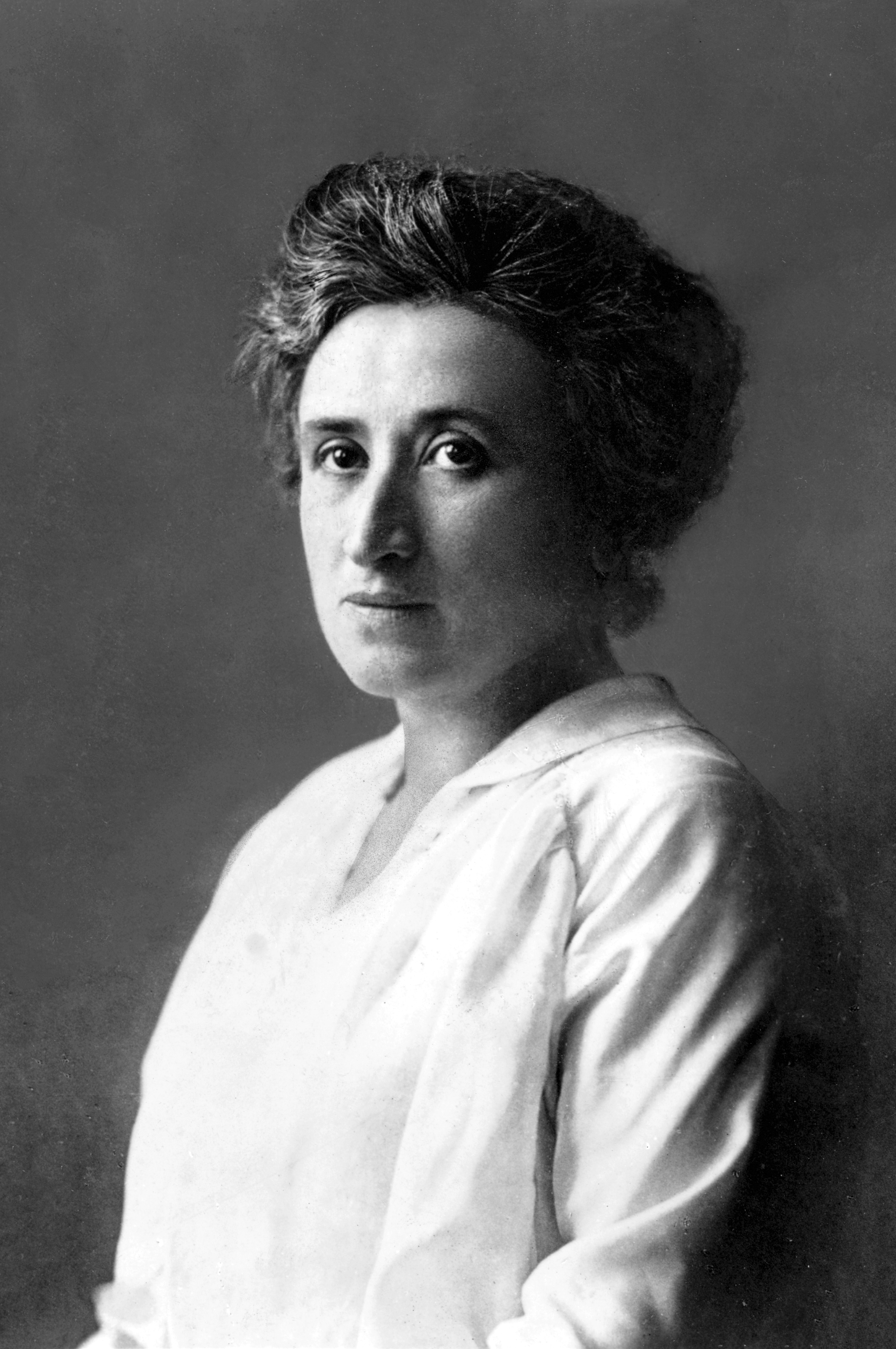
 Every January leftists honor three revolutionaries who died in that month, V.I. Lenin of Russia in 1924, Karl Liebknecht of Germany and Rosa Luxemburg of Poland in 1919 murdered after leading the defeated Spartacist uprising in Berlin. Lenin needs no special commendation.  I will make my political points about the heroic Karl Liebknecht and his parliamentary fight against the German war budget in World War I in this space tomorrow so I would like to make some points here about the life of Rosa Luxemburg. These comments come at a time when the question of a woman President is the buzz in the political atmosphere in the United States in the lead up to the upcoming 2016 elections. Rosa, who died almost a century ago, puts all such pretenders to so-called ‘progressive’ political leadership in the shade.   
The early Marxist movement, like virtually all progressive political movements in the past, was heavily dominated by men. I say this as a statement of fact and not as something that was necessarily intentional or good. It is only fairly late in the 20th century that the political emancipation of women, mainly through the granting of the vote earlier in the century, led to mass participation of women in politics as voters or politicians. Although, socialists, particularly revolutionary socialists, have placed the social, political and economic emancipation of women at the center of their various programs from the early days that fact had been honored more in the breech than the observance.

All of this is by way of saying that the political career of the physically frail but intellectually robust Rosa Luxemburg was all the more remarkable because she had the capacity to hold her own politically and theoretically with the male leadership of the international social democratic movement in the pre-World War I period. While the writings of the likes of then leading German Social Democratic theoretician Karl Kautsky are safely left in the basket Rosa’s writings today still retain a freshness, insightfulness and vigor that anti-imperialist militants can benefit from by reading. Her book Accumulation of Capital , whatever its shortfalls alone would place her in the select company of important Marxist thinkers.
But Rosa Luxemburg was more than a Marxist thinker. She was also deeply involved in the daily political struggles pushing for left-wing solutions. Yes, the more bureaucratic types, comfortable in their party and trade union niches, hated her for it (and she, in turn, hated them) but she fought hard for her positions on an anti-class collaborationist, anti-militarist and anti-imperialist left-wing of the International of the social democratic movement throughout this period. And she did this not merely as an adjunct leader of a women’s section of a social democratic party but as a fully established leader of left-wing men and women, as a fully socialist leader. One of the interesting facts about her life is how little she wrote on the women question as a separate issue from the broader socialist question of the emancipation of women. Militant leftist, socialist and feminist women today take note.

One of the easy ways for leftists, particularly later leftists influenced by Stalinist ideology, to denigrate the importance of Rosa Luxemburg’s thought and theoretical contributions to Marxism was to write her off as too soft on the question of the necessity of a hard vanguard revolutionary organization to lead the socialist revolution. Underpinning that theme was the accusation that she relied too much on the spontaneous upsurge of the masses as a corrective to the lack of hard organization or the impediments that  reformist socialist elements threw up to derail the revolutionary process. A close examination of her own organization, The Socialist Party of the Kingdom of Poland and Lithuania, shows that this was not the case; this was a small replica of a Bolshevik-type organization. That organization, moreover, made several important political blocs with the Bolsheviks in the aftermath of the defeat of the Russian revolution of 1905. Yes, there were political differences between the organizations, particularly over the critical question for both the Polish and Russian parties of the correct approach to the right of national self-determination, but the need for a hard organization does not appear to be one of them.

Furthermore, no less a stalwart Bolshevik revolutionary than Leon Trotsky, writing in her defense in the 1930’s, dismissed charges of Rosa’s supposed ‘spontaneous uprising’ fetish as so much hot air. Her tragic fate, murdered with the complicity of her former Social Democratic comrades, after the defeated Spartacist uprising in Berlin in 1919 (at the same time as her comrade, Karl Liebknecht), had causes related to the smallness of the group, its  political immaturity and indecisiveness than in its spontaneousness. If one is to accuse Rosa Luxemburg of any political mistake it is in not pulling the Spartacist group out of Kautsky’s Independent Social Democrats (itself a split from the main Social Democratic party during the war, over the war issue) sooner than late 1918. However, as the future history of the communist movement would painfully demonstrate revolutionaries have to take advantage of the revolutionary opportunities that come their way, even if not the most opportune or of their own making.
All of the above controversies aside, let me be clear, Rosa Luxemburg did not then need nor does she now need a certificate of revolutionary good conduct from today’s leftists, from any  reader of this space or from this writer. For her revolutionary opposition to World War I when it counted, at a time when many supposed socialists had capitulated to their respective ruling classes including her comrades in the German Social Democratic Party, she holds a place of honor. Today, as we face the endless wars of imperialist intervention in the Middle East and elsewhere in Iraq we could use a few more Rosas, and a few less tepid, timid parliamentary opponents.  For this revolutionary opposition she went to jail like her comrade Karl Liebknecht. For revolutionaries it goes with the territory. And in jail she wrote, she always wrote, about the fight against the ongoing imperialist war (especially in the Junius pamphlets about the need for a Third International).  Yes, Rosa was at her post then. And she died at her post later in the Spartacist fight doing her internationalist duty trying to lead the German socialist revolution the success of which would have  gone a long way to saving the Russian Revolution. This is a woman leader I could follow who, moreover, places today’s bourgeois women parliamentary politicians in the shade. As the political atmosphere gets heated up over the next couple years, remember what a real fighting revolutionary woman politician looked like. Remember Rosa Luxemburg, the Rose of the Revolution.      

As The 100th Anniversary Of The First Year Of World War I (Remember The War To End All Wars) Continues ... Some Remembrances-Writers’ Corner  

In say 1912, 1913, hell, even the beginning of 1914, the first few months anyway, before the war clouds got a full head of steam in the summer they all profusely professed their unmitigated horror at the thought of war, thought of the old way of doing business in the world. Yes the artists of every school but the Cubist/Fauvists/Futurists and  Surrealists or those who would come to speak for those movements, those who saw the disjointedness of modern industrial society and put the pieces to paint, sculptors who put twisted pieces of metal juxtaposed to each other saw that building a mighty machine from which you had to run created many problems; writers of serious history books proving that, according to their Whiggish theory of progress,  humankind had moved beyond war as an instrument of policy and the diplomats and high and mighty would put the brakes on in time, not realizing that they were all squabbling cousins; writers of serious and not so serious novels drenched in platitudes and hidden gabezo love affairs put paid to that notion in their sweet nothing words that man and woman had too much to do, too much sex to harness to denigrate themselves by crying the warrior’s cry and by having half-virgin, neat trick, maidens strewing flowers on the bloodlust streets; musicians whose muse spoke of delicate tempos and sweet muted violin concertos, not the stress and strife of the tattoos of war marches with their tinny conceits; and poets, ah, those constricted poets who bleed the moon of its amber swearing, swearing on a stack of seven sealed bibles, that they would go to the hells before touching the hair of another man. They all professed loudly (and those few who did not profess, could not profess because they were happily getting their blood rising, kept their own consul until the summer), that come the war drums they would resist the siren call, would stick to their Whiggish, Futurist, Constructionist, Cubist worlds and blast the war-makers to hell in quotes, words, chords, clanged metal, and pretty pastels. They would stay the course.  

And then the war drums intensified, the people, their clients, patrons and buyers, cried out their lusts and they, they made of ordinary human clay as it turned out, poets, artists, sculptors, writers, serious and not, musicians went to the trenches to die deathless deaths in their thousands for, well, for humankind, of course, their always fate  ….            


Ernest Hemingway and Other Novelists on Their World War I Experiences

This year marks both the 100th anniversary of the beginning of the First World War and the 115th birthday of Ernest Hemingway. Hemingway eschewed college to drive an ambulance for the Red Cross on the Italian Front, and his experiences would go on to influence his work, most notably his 1929 novel A Farewell to Arms. Seeing as today is Hemingway’s birthday, and we’re a week away from the 100th anniversary of the start of the First World War, here’s a look at how he and other authors involved in the fighting saw The Great War and its aftermath.

EH 2723P
Ernest Hemingway
Hemingway said the war was, “the most colossal, murderous, mismanaged butchery that has ever taken place on earth. Any writer who said otherwise lied, So the writers either wrote propaganda, shut up, or fought.”
In Boston Friday January 16, 2014- Support The Pakistani People's  Resistance To The Taliban

Frank Jackman comment;

The Obama government (and other imperial powers and their hangers-on) have their way of fighting the ISIS-Taliban-Al Queda menace Islamic fundamentalist threat to the world-bombs, drones, more bombs, and increased troops on the ground while propping up governments, or agencies within the government, like the Pakistani with aid and other resources while some of those agencies protect these vicious enemies of the peoples of the world. The following is one event where average citizens of the world can show solidarity with those in and from Pakistan who are fighting the menace right on their doorstep. Stand in solidarity with the benighted peoples of Pakistan.         

 
Desperately Seeking Revolutionary Intellectuals-Then, And Now


From The Pen Of Frank Jackman

Several years ago, I guess about three years now, in the aftermath of the demise of the Occupy movement with the shutting down of its campsites across the country (and the world) I wrote a short piece centered on the need for revolutionary intellectuals to take their rightful place on the left, on the people’s side, and to stop sitting on the academic sidelines (or wherever they were hiding out). One of the reasons for that piece was that in the aftermath of the demise of the Occupy movement a certain stock-taking was in order. A stock-taking at first centered on those young radical and revolutionaries that I ran into in the various campsites and on the flash mob marches who were disoriented and discouraged when their utopian dreams went up in smoke without a murmur of regret from the masses. Now a few years later it is apparent that they have, mostly, moved back to the traditional political ways of operating or have not quite finished licking their wounds.

Although I initially addressed my remarks to the activists still busy I also had in mind those intellectuals who had a radical streak but who then hovered on the sidelines and were not sure what to make of the whole experiment although some things seemed very positive like the initial camp comradery. In short, those who would come by on Sunday and take a lot of photographs and write a couple of lines but held back. Now in 2014 it is clear as day that the old economic order (capitalism if you were not quite sure what to name it) that we were fitfully protesting against (especially the banks who led the way downhill) has survived another threat to its dominance. The old political order, the way of doing political business now clearly being defended by one Barack Obama with might and main is still intact. The needs of working people although now widely discussed (the increasing gap between the rich, really the very rich, and the poor, endlessly lamented and then forgotten, the student debt death trap, and the lingering sense that most of us will never get very far ahead in this wicked old world especially compared to previous generations) have not been ameliorated. All of this calls for intellectuals with any activist spark to come forth and help analyze and plan how the masses are to survive, how a new social order can be brought forth. Nobody said, or says, that it will be easy but this is the plea. I have reposted the original piece with some editing to bring it up to date.          

*******

No, this is not a Personals section ad, although it qualifies as a Help Wanted ad in a sense. On a number of occasions over past several years, in reviewing books especially those by James P. Cannon, a founding member of the American Communist Party and the founder of the Socialist Workers Party in America, I have mentioned that building off of the work of the classical Marxists, including that of Marx and Engels themselves, and later that of Lenin and Trotsky the critical problem before the international working class in the early part of the 20th century was the question of creating a revolutionary leadership to lead imminent uprisings. Armed with Lenin’s work on the theory of the imperialist nature of the epoch and the party question and Trotsky’s on the questions of permanent revolution and revolutionary timing the tasks for revolutionaries were more than adequately defined. A century later with some tweaking, unfortunately, those same theories and the same need for organization are still on the agenda although, as Trotsky once said, the conditions are overripe for the overthrow of capitalism as it has long ago outlived its progressive character in leading humankind forward.   

The conclusion that I originally drew from that observation was that the revolutionary socialist movement was not as desperately in need of theoreticians and intellectuals as previously (although having them, and plenty of them, especially those who can write, is always a good thing). It needed leaders steeped in those theories and with a capacity to lead revolutions. We needed a few good day-to-day practical leaders, guys like Cannon, like Debs from the old Socialist Party, like Ruthenberg from the early Communist Party, to lead the fight for state power.

In that regard I have always held up, for the early part of the 20th century, the name Karl Liebknecht the martyred German Communist co-leader (along with Rosa Luxemburg) of the aborted Spartacist uprising of 1919 as such an example. He led the anti-war movement in Germany by refusing to vote for the Kaiser’s war budgets, found himself in jail as a result, but also had tremendous authority among the left-wing German workers when that mattered. In contrast the subsequent leadership of the German Communists in the 1920’s Paul Levi, Henrich Brandler and Ernest Thaelmann did not meet those qualifications. For later periods I have, as mentioned previously, held up the name James P. Cannon, founder of the American Socialist Workers Party (to name only the organization that he was most closely associated with), as a model. Not so Communist Party leaders like William Z. Foster and Earl Browder (to speak nothing of Gus Hall from our generation) or Max Shachtman in his later years after he broke with Cannon and the SWP. That basically carries us to somewhere around the middle of the 20th century. Since I have spent a fair amount of time lately going back to try to draw the lessons of our movement I have also had occasion to think, or rather to rethink my original argument on the need for revolutionary intellectuals. I find that position stands in need of some amendment now.

Let’s be clear here about our needs. The traditional Marxist idea that in order to break the logjam impeding humankind’s development the international working class must rule is still on the historic agenda. The Leninist notions that, since the early part of the 20th century, we have been in the imperialist era and that a ‘hard’ cadre revolutionary party is necessary to lead the struggle to take state power are also in play. Moreover, the Trotskyist understanding that in countries of belated development the working class is the only agency objectively capable of leading those societies to the tasks traditionally associated with the bourgeois revolution continues to hold true. That said, rather than some tweaking, we are seriously in need of revolutionary intellectuals who can bring these understandings into the 21st century.

It is almost a political truism that each generation will find its own ways to cope with the political tasks that confront it. The international working class movement is no exception in that regard. Moreover, although the general outlines of Marxist theory mentioned above hold true such tasks as the updating of the theory of imperialism to take into account the qualitative leap in its globalization is necessary (as is, as an adjunct to that, the significance of the gigantic increases in the size of the ‘third world’ proletariat). Also in need of freshening up is work on the contours of revolutionary political organization in the age of high speed communications, the increased weight that non-working class specific questions play in world politics (the national question which if anything has had a dramatic uptick since the demise of the Soviet Union), religion (the almost universal trend for the extremes of religious expression to rear their ugly heads which needs to be combated), special racial and gender oppressions, and various other tasks that earlier generations had taken for granted or had not needed to consider. All this moreover has to be done in a political environment that sees Marxism, communism, even garden variety reform socialism as failed experiments. To address all the foregoing issues is where my call for a new crop of revolutionary intellectuals comes from.

Since the mid- 20th century we have had no lack of practical revolutionary leaders of one sort or another - one thinks of Fidel Castro, Che Guevara and even Mao in his less rabid moments. We have witnessed any number of national liberation struggles, a few attempts at political revolution against Stalinism, a few military victories against imperialism, notably the Vietnamese struggle. But mainly this has been an epoch of defeats for the international working class. Moreover, we have not even come close to developing theoretical leaders of the statue of Lenin or Trotsky.

As a case in point, recently I made some commentary about the theory of student power in the 1960’s and its eventual refutation by the May 1968 General Strike lead by the working class in France. One of the leading lights for the idea that students were the “new” working class or a “new” vanguard was one Ernest Mandel. Mandel held himself out to be an orthodox Marxist (and Trotskyist, to boot) but that did not stop him from, periodically, perhaps daily, changing the focus of his work away from the idea of the centrality of the working class in social struggle an idea that goes back to the days of Marx himself.

And Mandel, a brilliant well-spoken erudite scholar probably was not the worst of the lot. The problem is that he was the problem with his impressionistic theories based on, frankly, opportunistic impulses. Another example, from that same period, was the idea of Professor Regis Debray (in the service of Fidel at the time ) that guerrilla foci out in the hills were the way forward ( a codification of the experience of the Cuban Revolution for which many subjective revolutionary paid dearly with their lives). Or the anti-Marxist Maoist notion that the countryside would defeat the cities that flamed the imagination of many Western radicals in the late 1960s. I could go on with more examples but they only lead to one conclusion- we are, among other things, in a theoretical trough. The late Mandel’s students from the 1960s have long gone on to academia and the professions (and not an inconsiderable few in governmental harness-how the righteous have fallen). Debray’s guerilla foci have long ago buried their dead and gone back to the cities. The “cities” of the world now including to a great extent China had broken the third world countryside. This, my friends, is why today I have my Help Wanted sign out. Any takers?
***********


Monday, January 12, 2015

HONOR THE THREE L’S-LENIN, LUXEMBURG, LIEBKNECHT-Honor The Historic Leader Of The German Spartacists-Karl Liebknecht  


EVERY JANUARY WE HONOR LENIN OF RUSSIA, ROSA LUXEMBURG OF POLAND, AND KARL LIEBKNECHT OF GERMANY AS THREE LEADERS OF THE INTERNATIONAL WORKING CLASS MOVEMENT.

Karl Liebknecht Thumbnail Biography

The son of Wilhelm Liebknecht, one of the founders of the SPD, Karl Liebknecht trained to be a lawyer and defended many Social Democrats in political trials. He was also a leading figure in the socialist youth movement and thus became a leading figure in the struggle against militarism.
As a deputy in the Reichstag he was one of the first SPD representatives to break party discipline and vote against war credits in December 1914. He became a figurehead for the struggle against the war. His opposition was so successful that his parliamentary immunity was removed and he was imprisoned.

Freed by the November revolution he immediately threw himself into the struggle and became with Rosa Luxemburg one of the founders of the new Communist Party (KPD). Along with Luxemburg he was murdered by military officers with the tacit approval of the leaders of the SPD after the suppression of the so-called “Spartacist Uprising” in January 1919.
**************
Markin comment:

Karl Liebknecht- A Model Anti-Warrior
This comment was originally  written in 2006 in the American Left History blog but the main points hold true today:

I recently (2006) have received a comment from someone whom I took earnestly to be perplexed by a section of a commentary that I had written where I stated that the minimum necessary for any anti-war politician was to vote against the Iraq war budget in a principled manner. Not the way former Democratic presidential candidate Massachusetts Senator John Kerry’s (and others) dipsy-doodled votes for and against various war budgetary requests in 2004. And certainly not the other variations on this theme performed recently by aspiring Democratic presidential candidates Senators Obama and Clinton in the lead-up to 2008. Nor, for that matter, the way of those who oppose the Iraq war budget but have no problems if those funds were diverted to wars in Afghanistan, Iran , North Korea, China or their favorite ‘evil state’ of the month. What really drew the commenter up short was that I stated this was only the beginning of political wisdom and then proceeded to explain that even that would not be enough to render the politician political support if his or her other politics were weak.  The commenter then plaintively begged me to describe what kind of politician would qualify for such support. Although I have noted elsewhere that some politicians, Democratic Congressman James McGovern of Massachusetts and presidential candidate Democratic Congressman Dennis Kucinich stand out from the pack, the real anti-war hero on principle we should look at is long dead-Karl Liebknecht, the German Social-Democratic leader from World War I. Wherever anyone fights against unjust wars Liebknecht’s spirit hovers over those efforts. Here is what I had to say in part about that revolutionary politician:   
"…I do not believe we are lacking in physical courage. What has declined is political courage, and this seems in irreversible decline on the part of parliamentary politicians. That said, I want to finish up with a woefully inadequate political appreciation of Karl Liebknecht, member of the German Social Democratic faction in the Reichstag in the early 1900’s. Karl was also a son of Wilhelm Liebknecht, who had been a friend of Karl Marx and founder of the German Social Democratic Party in the 1860’s. On August 4, 1914, at the start of World War I the German Social Democratic Party voted YES on the war budget of the Kaiser against all its previous historic positions on German militarism. This vote was rightly seen as a betrayal of socialist principles. Due to a policy of parliamentary solidarity Karl Liebknecht also voted for this budget, or at least felt he had to go along with his faction. Shortly thereafter, he broke ranks and voted NO against the war appropriations. As pointed out below Karl Liebknecht did much more than that to oppose the German side in the First World War. That, my friends, is the kind of politician I can support. As for the rest-hold their feet to the fire.

"One of the problems with being the son of a famous politician is that as founder of the early German Social Democratic Party Wilhelm Liebknecht's son much was expected of Karl, especially on the question of leading the German working class against German militarism. Wilhelm had done a prison term (with August Bebel) for opposition to the Franco-Prussian War. As for Karl I have always admired that famous picture of him walking across the Potsdam Plaza in uniform, subject to imprisonment after loss of his parliamentary immunity, with briefcase under arm ready to go in and do battle with the parliamentary cretins of the Social Democratic Party over support for the war budget. (That photograph can be Googled.) That is the kind of leadership cadre we desperately need now. REMEMBER HIS FAMOUS SLOGANS- "HE MAIN ENEMY IS AT HOME’-‘NOT ONE PENNY, NOT ONE PERSON (updated by writer) FOR THE WAR." Wilhelm would have been proud.
Karl Marx On The American Civil War  


Markin comment:

I am always amazed when I run into some younger leftists, or even older radicals who may have not read much Marx and Engels, and find that they are surprised, very surprised to see that Marx and Engels were avid partisans of the Abraham Lincoln-led Union side in the American Civil War. In the age of advanced imperialism, of which the United States is currently the prime example, and villain, we are almost always negative about capitalism’s role in world politics. And are always harping on the need to overthrow the system in order to bring forth a new socialist reconstruction of society. Thus one could be excused for forgetting that at earlier points in history capitalism played a progressive role. A role that Marx, Engels, Lenin, Trotsky and other leading Marxists, if not applauded, then at least understood represented human progress. Of course, one does not expect everyone to be a historical materialist and therefore know that in the Marxist scheme of things both the struggle to bring America under a unitary state that would create a national capitalist market by virtue of a Union victory and the historically more important struggle to abolish slavery that turned out to a necessary outcome of that Union struggle were progressive in our eyes. Read on.
*********
Articles by Karl Marx in Die Presse 1862

The English Press and the Fall of New Orleans

--------------------------------------------------------------------------------

Source: MECW Volume 19, p. 199;
Written: on May 16, 1862;
First published: in Die Presse, May 20, 1862.


--------------------------------------------------------------------------------

London, May 16
On the arrival of the first rumours of the fall of New Orleans, The Times, The Herald, The Standard, The Morning Post, The Daily Telegraph, and other English “sympathisers” with the Southern “nigger-drivers” proved strategically, tactically, philologically, exegetically, politically, morally and fortificationally that the rumour was one of the “canards” which Reuter, Havas, Wolff and their understrappers so often let fly. The natural means of defence of New Orleans, it was said, had been augmented not only by newly constructed forts, but by submarine infernal machines of every sort and ironclad gunboats. Then there was the Spartan character of the citizens of New Orleans and their deadly hatred of Lincoln’s mercenaries. Finally, was it not at New Orleans that England suffered the defeat that brought her second war against the United States (1812 to 1814) to an ignominious end? Consequently, there was no reason to doubt that New Orleans would immortalise itself as a second Saragossa or a Moscow of the “South”. Besides, it harboured 15,000 bales of cotton, with which it could so easily have kindled an inextinguishable fire to destroy itself, quite apart from the fact that in 1814 the duly damped cotton bales proved more indestructible by cannon fire than the earthworks of Sevastopol. It was therefore as clear as daylight that the fall of New Orleans was a case of the familiar Yankee bragging.

When the first rumours were confirmed two days later by steamers arriving from New York, the bulk of the English Ispro-slavery press persisted in its scepticism. The Evening Standard, especially, was so positive in its unbelief that in the same number it published a first leader which proved the Crescent City’s impregnability in black and white, whilst its latest news” announced the impregnable city’s fall in large type. The Times, however, which has always held discretion for the better part of valour, veered round. It still doubted, but, at the same time, it made ready for every eventuality, since New Orleans was a city of “rowdies” and not of heroes. On this occasion, The Times was right. New Orleans is a settlement of the dregs of the French bohème, in the true sense of the word, a French convict colony -and never, with the changes of time, has it belied its origin. Only, The Times came Post festum to this pretty widespread realisation.

Finally, however, the fait accompli struck even the blindest Thomas. What was to be done? The English pro-slavery press now proves that the fall of New Orleans means a gain for the Confederates and a defeat for the Federals.

The fall of New Orleans allowed General Lovell to reinforce Beauregard’s army with his troops; Beauregard was all the more in need of reinforcements, since 160,000 men (surely an exaggeration!) were said to have been concentrated on his front by Halleck and, on the other hand, General Mitchel had cut Beauregard’s communications with the East by breaking the railway connection between Memphis and Chattanooga, that is, with Richmond, Charleston and Savannah. After his communications had been cut (which we indicated as a necessary strategical move long before the battle of Corinth), Beauregard had no longer any railway connections from Corinth, save those with Mobile and New Orleans. After New Orleans had fallen and he was only left with the single railway to Mobile to rely on, he naturally could no longer procure the necessary provisions for his troops. He therefore fell back on Tupelo and, in the estimation of the English p ro-slavery press, his provisioning capacity has, of course, been increased by the entry of Lovell’s troops!

On the other hand, the same oracles remark, the yellow fever will take a heavy toll of the Federals in New Orleans and, finally, if the city itself is no Moscow, is not its mayor a a Brutus? Only read (cf. New York”) his melodramatically valorous epistle to Commodore Farragut, “Brave words, Sir, brave words!” But hard words break no bones.

The press organs of the Southern slaveholders, however, do not construe the fall of New Orleans so optimistically as their English comforters. This will be seen from the following extracts:

The Richmond Dispatch says:

‘What has become of the ironclad gunboats, the Mississippi and the Louisiana, from which we expected the salvation of the Crescent City? In respect of their effect on the foe, these ships might just as well have been ships of glass. It is useless do deny that the fall of New Orleans is a heavy blow. The Confederate government is thereby cut off from West Louisiana, Texas, Missouri and Arkansas.”

The Norfolk Day Book observes:

“This is the most serious reverse since the beginning of the war. It augurs privations and want for all classes of society and, what is worse, it threatens our army supplies.”

The Atlantic Intelligencer laments:

“We expected that the outcome would be different. The approach of the enemy was no surprise attack; it has long been foreseen, and we had been promised that, should he even pass by Fort Jackson, fearful artillery, contrivances would force him to withdraw or ensure his annihilation. In all this, we have deceived ourselves, as on every occasion when the defences were supposed to guarantee the safety of a place or town. It appears that modern inventions have destroyed the defensive capacity of fortification. Ironclad gunboats destroy them or sail past then) unceremoniously. Memphis, we fear, will share the fate of New Orleans. Would it not be folly to deceive ourselves with hope?”

Finally, the Petersburg Express:

“The capture of New Orleans by the Federals is the most extraordinary and fateful event of the whole war.”

From The Archives Of  Women And Revolution


Markin comment:

The following is a set of archival issues of Women and Revolution that may have some historical interest for old "new leftists", perhaps, and well as for younger militants interested in various cultural and social questions that intersect the class struggle. Or for those just interested in a Marxist position on a series of social questions that are thrust upon us by the vagaries of bourgeois society. I will be posting articles from the back issues of  Women and Revolution during Women's History Month in March and periodically throughout the year.

Women and Revolution-1971-1980, Volumes 1-20  


http://www.marxists.org/history/etol/newspape/w&r/WR_001_1971.pdf

As The 100th Anniversary Of The First Year Of World War I (Remember The War To End All Wars) Continues ... Some Remembrances-Writers’ Corner  

In say 1912, 1913, hell, even the beginning of 1914, the first few months anyway, before the war clouds got a full head of steam in the summer they all profusely professed their unmitigated horror at the thought of war, thought of the old way of doing business in the world. Yes the artists of every school but the Cubist/Fauvists/Futurists and  Surrealists or those who would come to speak for those movements, those who saw the disjointedness of modern industrial society and put the pieces to paint, sculptors who put twisted pieces of metal juxtaposed to each other saw that building a mighty machine from which you had to run created many problems; writers of serious history books proving that, according to their Whiggish theory of progress,  humankind had moved beyond war as an instrument of policy and the diplomats and high and mighty would put the brakes on in time, not realizing that they were all squabbling cousins; writers of serious and not so serious novels drenched in platitudes and hidden gabezo love affairs put paid to that notion in their sweet nothing words that man and woman had too much to do, too much sex to harness to denigrate themselves by crying the warrior’s cry and by having half-virgin, neat trick, maidens strewing flowers on the bloodlust streets; musicians whose muse spoke of delicate tempos and sweet muted violin concertos, not the stress and strife of the tattoos of war marches with their tinny conceits; and poets, ah, those constricted poets who bleed the moon of its amber swearing, swearing on a stack of seven sealed bibles, that they would go to the hells before touching the hair of another man. They all professed loudly (and those few who did not profess, could not profess because they were happily getting their blood rising, kept their own consul until the summer), that come the war drums they would resist the siren call, would stick to their Whiggish, Futurist, Constructionist, Cubist worlds and blast the war-makers to hell in quotes, words, chords, clanged metal, and pretty pastels. They would stay the course.  

And then the war drums intensified, the people, their clients, patrons and buyers, cried out their lusts and they, they made of ordinary human clay as it turned out, poets, artists, sculptors, writers, serious and not, musicians went to the trenches to die deathless deaths in their thousands for, well, for humankind, of course, their always fate  ….            


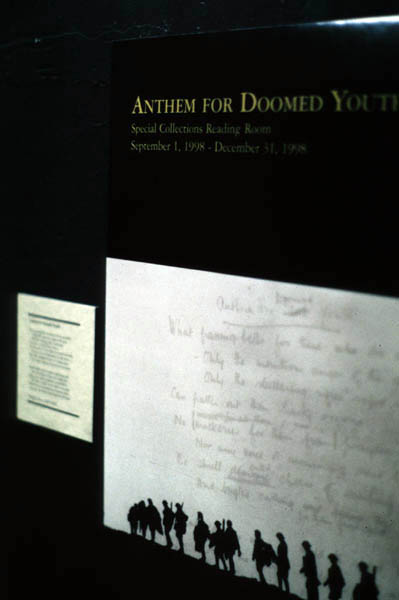
Anthem for Doomed Youth

Writers and Literature of The Great War, 1914-1918
An exhibit commemorating the 80th anniversary of the Armistice, November 11, 1918
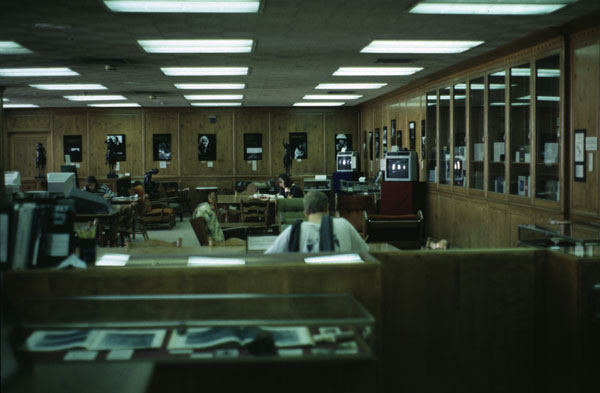
Special Collections Reading Room
Harold B. Lee Library
Brigham Young University
September 1, 1998 - December 31, 1998
(The exhibit was extended a second semester to April 28th, 1999.)

Written and mounted by Robert S. Means, English and American Literature Librarian
On June 28, 1914, Gavrilo Princip, a radical Serbian student, assassinated the Archduke of Austria-Hungary, Francis Ferdinand, and his wife Sophie. This single, amateurish stunt for Serbian independence, coupled with arrogant foreign relations and entangling alliances, would, within a month, draw the western world into the most cruel, catastrophic war it had ever known. The First World War arrived at the climax of an era of unprecedented growth and achievement in Europe, shattering people's faith in king and country, and putting the lie to the popular notion that man and society had been progressing and improving right in step with the giant strides of the industrial revolution.
While the world's cavalry polished its boots, prepared chargers and lances, and planned on being home in time for Christmas, all the new mechanical might of modern industry was being massed at the disposal of the Central and Allied Powers -- most of whose leaders had no idea how to use it, or what to expect if they did. In more ways than one, this was a war waged in the laboratory. Four years, and nine million violent deaths and mutilations later, the results of the experiment were in: the war had won. The image is from Edmund Blunden who said, contemplating the first day of the Battle of the Somme, "by the end of the day both sides had seen, in a sad scrawl of broken earth and murdered men, the answer to the question. No road. No thoroughfare. Neither race had won, nor could win, the War. The War had won, and would go on winning" (Fussell, 13).
This was total war. This time everyone would be affected: laborers, tradesmen, public school boys, Oxbridge graduates, and women. Men from small villages formed up into "Pal's Battalions" only to be wiped out together, leaving their hometowns stunned and empty (seeObserve the Sons of Ulster Marching Towards the Somme and War Game). Meanwhile the great men of the day also sent their sons off to the great adventure, only to lose them forever: Rudyard Kipling, Arthur Conan Doyle, and Prime Minster Harold Asquith all lost sons in the war (see My Boy Jack).
Initially, the war was not called the First World War, for no one could believe that there would ever be another war after this one. It was "the War to End All Wars," "the Great War." Unfortunately, the Great War became the prototype, ushering in the 20th Century, and establishing the now familiar model of mechanized war and mass suffering that still plagues us at the end of the century. At the end of the Great War, what seemed to be a restoration of peace and the balance of power, in fact bred a legacy of bitterness between the former enemies that eventually lead to an even worse Second World War only twenty years later. The Great War was a fissure that wrecked forever the continuity of progress, and changed everything in the West: in addition to nine million lives extinguished, the war exhausted treasuries and bankrupted both winners and losers; in the war's climate of suffering and despair, revolutions toppled venerable monarchies and brought Communism to Russia, and Nazism to Germany. Even the arts would never be the same. As Philip Larkin wrote, "Never such innocence again."
The world before 1914 spoke a different, decidedly old-fashioned language (see Paul Fussell's "Table of Equivalents" in his book The Great War and Modern Memory) born of their Victorian/Edwardian upbringing. This earnest innocence, or fated naivete if you wish, was both their curse (see Keith Douglas' poem "Sportsmen" and a snippet on Englishmen from Wyndham Lewis' BLAST), and their cachet (see Song of Tiadatha). For the generation who fought it, the Great War was at once their defining moment and their worst disaster. As Siegfried Sassoon said "to me, the War was inevitable and justifiable. Courage remained a virtue. And that exploitation of courage, if I may be allowed to say a thing so obvious, was the essential tragedy of the War, which, as everyone now agrees, was a crime against humanity."
This exhibit of literature from the Great War commemorates the 80th anniversary of the Armistice that ended the war on November 11, 1918, and is dedicated to all who suffered in the Great War of 1914-1918. It is, as Robert Graves' poem, "The Patchwork Quilt," a hodgepodge. But as David Jones said in the preface to In Parenthesis (speaking of the Welshmen he served with, and borrowing a quotation from Michael Drayton): "if I have not done right by [them], the want is in my ability, not in my love" (xv). And so, having said all that, I especially dedicate this exhibit to that generation of peculiar Georgian gentleman: earnest, ardent, plucky, keen, staunch, gallant -- in other words, doomed -- who fought more than simply the war, the filth, the rats and lice; who also wrestled with an inadequately prepared language in order to leave us a new literature, a record of what it was like to step into the trenches of the 20th Century:
"Gentlemen, when the barrage lifts."


To maintain a manageable scope, this exhibit does not include a detailed history of the war, nor is it meant to be an in-depth critical study of Great War literature (to access the exhibit's historical and background materials, please click here). The exhibit focuses on writers and literature of the war. The writers are mainly British junior officers. Many major poets (Edmund Blunden, for example) are under represented, while many lesser-known poets (for example, Ewart Alan Mackintosh) have been included and even highlighted. Ultimately, this is an exhibit of the Harold B. Lee Library's collection of Great War literature, and one sentimentally and idiosyncratically arranged to suit one man's ignorant self-indulgence.
I'd like to thank Scott Duvall, Chair of Special Collections, and his staff and students for their help and support. Robert Espinosa, Scott Eldredge, and the staff of the Imaging Center -- especially Jared Ottley who created the Web-page for the vitual tour (which includes many items, photos, and added explanations for which there weren't room in the physical exhibit), and Galen Montague who designed the exhibit posters. Roy Daniel made the AV portion work. And Randy Olsen came through with the money. An additional word about acknowledgments. This site has been constructed with no financial purpose, or ulterior motive whatsoever, but only to preserve the experience of the physical exhibit and the memory of Armistice. The virtual exhibit is free to anyone who wants to browse it, just as it was when it existed as a physical exhibit in the Lee Library. The materials are all owned by the Lee Library (with the exception of a few items, so noted, that have been freely loaned to the exhibit). The reproduced photographs are all from books owned by the library (with some few exceptions as already mentioned above), and every attempt has been made to attribute them to the books in which they were published, and (if possible) to the collections or archives which hold the original. I offer them in this virtual exhibit, just as I did in the physical exhibit, to illustrate and enhance the visitor's understanding of the war and the literature written by its participants, and denounce any attempt to use these images for commercial gain without first having obtained written permission from the collection which holds the original. This site is copyrighted by Brigham Young University, which offers these materials from its collection to its patrons, free of charge, for personal education and enrichment. The text of this virtual exhibit was written by me, I took the photographs of the exhibit and its environs, and I assume full responsibility for its content. I have endeavored to properly attribute every reproduced poem and photograph in the exhibit. Unfortunately, some errors may have crept in, and some omissions may later be revealed. I welcome corrections (which I will immediately make) and invite you to contact me at the Lee Library: robert_means@byu.edu