Thursday, January 15, 2015


Free Albert Woodfox!

The Angola 3:Black Panthers and the Last Slave Plantation
[see video Who Are the Angola 3?]
Showing Thursday, January 15, in Cambridge
[please download & distribute flyer]
This film tells the gripping story of Robert King , Herman Wallace and Albert Woodfox, men who have endured solitary confinement longer than any known living prisoner in the United States. Politicized through contact with the Black Panther Party while inside Louisiana s prisons, they formed one of the only prison Panther chapters in history and worked to organize other prisoners into a movement for the right to live like human beings. This film explores their extraordinary struggle for justice while incarcerated in Angola, a former slave plantation where institutionalized rape and murder made it known as one of the most brutal and racist prisons in the United States.

In a partial victory, the courts exonerated Robert King of the original charges and released him in 2001.

[Herman Wallace, dying of liver cancer, was released on October 2nd and died on October 4th, 2013. Albert Woodfox has now endured as a political prisoner in solitary confinement for over 42 years.]
The Angola 3 is dedicated to the Anarchist Black Cross who have been fighting for the freedom of political prisoners and the abolition of prisons around the world for over 100 years.
Narrated by Mumia Abu-Jamal, The Angola 3 features interviews with former Panthers, political prisoners and revolutionaries, including the Angola 3 themselves, and Bo Brown, Geronimo (ji Jaga) Pratt, Malik Rahim, Yuri Kochiyama, David Hilliard, Rod Coronado, Noelle Hanrahan, Kiilu Nyasha, Marion Brown, Luis Talamantez, Gail Shaw and many others.

"on April 23, 1976, the Church Committee released its Final Staff Report on the FBI and CIA's rampant domestic illegalities which included a chapter entitled 'The FBI's Covert Action Plan to Destroy the Black Panther Party.' " ~ G. Flint Taylor

"Even 15 days in solitary confinement constitutes torture or cruel, inhuman or degrading treatment or punishment, and 15 days is the limit after which irreversible harmful psychological effects can occur. However, many prisoners in the United States have been isolated for far longer."  ~Juan Mendez, UN Special Rapporteur on torture and other cruel treatment

"The goal of the government was to get all the leaders of the Black Panther Party in jail so that they could be killed systematically through prison violence, and that way they could stop what was a very powerful and evolving movement." ~James Cromwell

When/where
doors open 6:40; film starts promptly 7pm
243 Broadway, Cambridge - corner of Broadway and Windsor,
entrance on Windsor
rule19.org/videos

Please join us for a stimulating night out; bring your friends!
free film & free door prizes[donations are encouraged]feel free to bring your own snacks and soft drinks - no alcohol allowed
"You can't legislate good will - that comes through education." ~ Malcolm X

UPandOUT film series - see rule19.org/videos

Why should YOU care? It's YOUR money that pays for US/Israeli wars - on Iraq, Afghanistan, Iran, Palestine, Libya. Syria, Iran, So America, etc etc - for billionaire bailouts, for ever more ubiquitous US prisons, for the loss of liberty and civil rights...


Massachusetts Peace Action
Foreign Policy for All Workshop Schedule
Cambridge: Tuesday, January 20, 6:30 pm, Central Square Library, 45 Pearl St, Lewis Room.  Cosponsored with Cambridge United for Justice with Peace
Ipswich (North Shore): Wednesday, January 21, 7-9pm, House of Peace, 1 High St.  Cosponsored with North Shore Coalition for Peace & Justice
Fall River (Southeast Mass.) Thursday, January 29, 6-8 pm, Fall River Public Library, 104 North Main St
Worcester: Saturday, January 31, noon to 4pm, Clark University, 950 Main St., room TBA; cosponsored with Clark University Peace Studies
Watertown (West Suburban): Sunday, February 1, 5:00 pm, Grace Vision Church, 80 Mt Auburn St. Cosponsored with Watertown Citizens for Peace, Justice & Environment
Dear Al,
 
What is the Foreign Policy for All? 
 
Massachusetts Peace Action and our allies are holding a series of discussion workshops across Massachusetts in Winter 2015 for our members and partners to come together and discuss the fundamental problems of American foreign policy and what a new approach would look like.

Sign up here to attend any of the remaining workshops!

Led by members of the Foreign Policy for All working group, the workshops will include a short slide presentation and ample time for discussion on:

- What’s wrong with U.S. foreign policy?

- What are the values that should guide our foreign policy?

- What are the key issues and priorites that should be addressed?

- Action steps: What it would take to get there from here? What are the obstacles? What actions are the people in the room prepared to take to join us in our efforts?

Participants can read the Foreign Policy for All working paper or the shorter Foreign Policy for All At a Glance before or after the workshop.   Feedback collected will be used to improve the working paper.  

Rev Osagyefo Sekou and Rep Dennis KucinichThe Foreign Policy for All, incorporating your ideas, will come before Massachusetts Peace Action’s annual meeting on February 7, 2015 for discussion and further input.  Rev. Osagyefo Sekou and Rep. Dennis Kucinich will be the keynote speakers.
For more information, email info@masspeaceaction.org or phone 617-354-2169. 
Cole Harrison Yours for peace and justice,
Cole Harrison
Executive Director

P.S. Don't forget to Sign up ahead of time!

Join Massachusetts Peace Action - or renew your membership today!  
Dues are $40/year for an individual, $65 for a family, or $10 for student/unemployed/low income.  Members vote for leadership and endorsements, receive newsletters and discounts on event admissions.  Donate now and you will be a member in good standing through December 2015! Your financial support makes this work possible!
PayPal - The safer, easier way to pay online!
Massachusetts Peace Action, 11 Garden St., Cambridge, MA 02138
617-354-2169  • info@masspeaceaction.org • Follow us on Facebook or Twitter
Click here to unsubscribe
empowered by Salsa

CIW list header

Big, big news out of the Fair Food Nation…
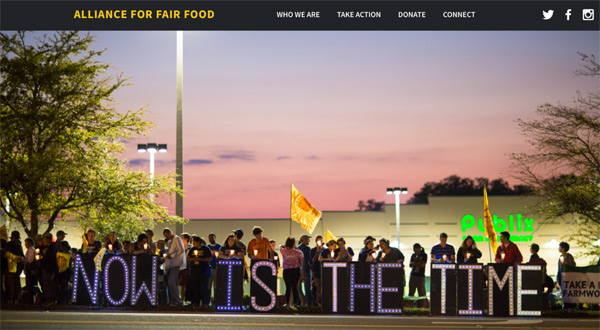
Youth, faith, food movement allies come together under a single flag, form the new Alliance for Fair Food!
aff1
Student/Farmworker Alliance, Interfaith Action and Just Harvest USA unite in one vibrant, diverse ally network ready for the next phase in the fight for Fair Food
The Alliance for Fair Food is back and better than ever!  But before we tell you about this exciting new development in the Fair Food movement, let’s first take a quick look back at its roots.
“There is today a human rights crisis in the fields…”

For longtime members of the Fair Food Nation, the Alliance for Fair Food (AFF) is a distant memory from the early, hopeful days of the movement.  Not long after the Taco Bell victory, in the midst of the McDonald’s campaign that followed, a growing list of organizations, individuals, and institutions began to coalesce around their support for the Campaign for Fair Food.  At that time, workers in Immokalee and their allies realized that something new and important was happening, that what had started as a one-off boycott was becoming a movement.  
That movement was founded on certain fundamental rights — the right to work free of sexual harassment and modern slavery, the right to fair wages, the right complain without fear of retaliation, the right to have a voice in the decisions that shape your workplace and your life — and the first iteration of the AFF was formed as a body through which like-minded organizations could formally endorse those rights for farmworkers and the Campaign for Fair Food.  
Beginning with the words, “There is, today, a human rights crisis in Florida’s fields…,” the declaration announcing the formation of the original AFF on March 8, 2006 was unequivocal...
 
In Boston Friday January 16, 2014- Support The Pakistani People's  Resistance To The Taliban

Frank Jackman comment;

The Obama government (and other imperial powers and their hangers-on) have their way of fighting the ISIS-Taliban-Al Queda menace Islamic fundamentalist threat to the world-bombs, drones, more bombs, and increased troops on the ground while propping up governments, or agencies within the government, like the Pakistani with aid and other resources while some of those agencies protect these vicious enemies of the peoples of the world. The following is one event where average citizens of the world can show solidarity with those in and from Pakistan who are fighting the menace right on their doorstep. Stand in solidarity with the benighted peoples of Pakistan.         

 
When Be-Bop Bopped In The Doo Wop Night-With The Classics Til Then In Mind


Til Then Lyrics

doo-doo-doom) (doo-doo-doom) (doo-doo-doom)
(rep-reddah-rep)
(doo-doo-doom) (doo-doo-doom) (doo-doo-doom)
(rep-reddah-rep)

[Intro continues behind each verse]

Till then, my darling, please wait for me
Till then, no matter when it may be
One day I know I'll be home again
Please wait (till) till then

Our dreams will live though we are apart
Our love will always stay in our hearts
Till then, when of the world will be free
Please wait for me

Although there are oceans we must cross and mountains that we must climb
I know every gain must have a loss, so pray that our loss is nothing but time

Till then, we'll dream of what there will be
Till then, we'll call on each memory
Till then, when I will hold you again
Please wait till then (ooh)

Sure I have plenty to say about early rock ‘n’ roll, now called the classic rock period in the musicology hall of fame. Yeah, I know I have already talked some ears off, maybe yours, about how hard-pressed Mississippi plantation workers (semi-slaves the way the pay-out came down at the  end of the year) gathered around on some sweaty Saturday night to hear Big Bill, Big Jack, Big Little, or Big somebody belt the blues out of some whiskey bottle in some broken down juke joint, and left enough of an impression that that dark boy in the corner, kind of shy but very inquisitive about that beat took it north-ward and put it in an electric outlet and you could see the audience, the woman audience part, swaying that sway that meant they got it, got that rif (and maybe said thanks that shy young brother in their own swaying way). I know too that I have left some ears kind of staggered after mouthing off about who Jesse Lee and Billy Bob, a couple of plain ordinary good old boys maybe heard a far off echo of that electrified music and started riff-ing on their own in places like Memphis and Mobile waiting to be discovered as the next be-bop daddy musical white negro (Norman Mailer’s term, hipster term, not mine but it fits) all young and hungry, ready to play for free, or nickels just to get out of the small town Saturday night and jump. 

So yeah I have talked some, some about the big broad trends coming out of the mid-century muck (mid-20th century just so you know) and within that say I have spent a little time, not enough, considering its effect on us on the doo-wop branch of the genre. Part of the reason for the “not enough,” once I thought about it was that obviously back in those mid-1950s jail-breakout days I did not (and I do not believe that any other eleven and twelve-year olds did either), distinguish between let’s say rockabilly-back-beat-drive rock, black-based rock centered on a heavy rhythm and blues backdrop, and the almost instrument-less (or maybe a soft piano or guitar backdrop) group harmonics that drove doo-wop. Even now that stuff is better left to the aficionados and musical intelligentsia, the guys who make dough putting the stuff in some boxed-in historical perspective. 

All I knew, all any of us knew when our knees started to tremble, maybe wobble is better, to the new beat that came out of some Mother Africa from whence we came, was that it was not my parents’ mannered Tin Pan Alley by-the-numbers music, not close. Get this too as a selling point it did not hurt that they, those same parents, got nervous, very nervous, anytime it was played out loud in their presence. Forever “turn it down” (or father “turn the damn thing down”) raced along with each song. Fortunately, some sainted, sanctified, techno-guru developed the iPod of that primitive era; the battery-driven transistor radio. No big deal, technology-wise by today’s standards, but get this you could place it near your ear and have your own private out loud without parental scuffling in the background. Yes, sainted, sanctified techno-guru. No question.

What doo-wop did though down in our old-time working-class housing projects neighborhood, and again it was not so much by revelation as by trial and error, is allow us to be in tune with the music of our generation without having to spend a lot of money on instruments or a studio or anything like that. Strictly built for po’ boys like us. First of all where the hell would we have gotten the dough, when we were stretched grabbing nickels and dimes, stealing really okay, from Ma’s pocketbook just to keep the juke-box at Sandy’s Diner going, for such things when papas were out of work, or were one step away, and there was “max daddy” trouble just keeping the wolves from the door. Bills and repo men the bane of every family’s existence. (Worse, worse though when papas could not take it anymore and just split, long-gone daddy split with or without some barroom frill or got nasty drunk with the paycheck and left Ma with empty Friday night envelopes and nothing to stave off the collectors.)

Sure, some kids, some kids like my corner boy elementary school boyhood friend Billy, William James Bradley, were crazy to put together cover bands with electric guitars (rented occasionally), and dreams. Or maybe go wild with a school piano a la Jerry Lee Lewis, Little Richard, or Fats Domino but those were maniac aficionados. I remember one time Billy was so hopped up on the fame game that in the height of the Elvis craze when all us other boys were busy growing side-burns and perfecting our sneers (sneers meant for some young thing, in our neighborhood and in that time meaning stick girls who had not gotten their forms yet, to wipe off into the sunset) he tried to hop on the Bo Diddley bandwagon. Hop on that bandwagon until one cruel school talent show night he learned the hard facts of the racial divide in a northern white housing project by one of the older boy rednecks and returned to Elvis-land with the rest of us. Billy, never say die Billy, also trying to break out with a Bill Haley and the Comets routine which worked okay around the neighborhood where all the girls went nuts but got him nowhere when a regional new talent show came through town and he was all geared up to win except the suit jacket his mother had jerry-rigged for the occasion fell apart about half way through his performance. Yeah, Billy had it bad.

Even Billy though, when the deal went down, especially after hearing Frankie Lymon and The Teenagers was mad to do the doo-wop and make his fame and fortune on the cheap. (No need for instruments, cheapjack jackets or racial taunts.) The cover art on a doo wop compilation I once reviewed in an old time rock and roll series made that poor boy and girl point beautifully. No not some Karl Marx brotherhood of man thing or Adams Smith all ships rising if one guy rises. Nothing that heavy, please. The cover showed a group of young black kids, black guys, young guys who looked “from hunger” too like us and who looked like they were doing their doo wop on some big city street corner (maybe Brooklyn, maybe the old days Bronx, maybe uptown Harlem Saturday night). And that made sense reflecting the New York City-derived birth of doo-wop and that the majority of doo-wop groups that we heard on the AM transistor sister radio were black. But the city, the poor sections of the city, white or black, was not the only place where moneyless guys and gals were harmonizing, hoping, hoping maybe beyond hope, to be discovered and make more than just a 1950s musical jail-breakout of their lives. Moreover, this cover art I speak of also showed, and showed vividly, what a lot of us guys were trying to do-impress girls, impress them on the cheap with some harmonies and moonlight and maybe a little side chatter too (and maybe visa-a-versa for girl doo-woppers but they can tell their own stories).

Yes, truth to tell, it was about impressing girls that drove many of us, Billy included, Christ maybe Billy most of all, to mix and match harmonies. And you know you did too (except remember girls just switch around what I just said). Yah, four or five guys just hanging around the back door of the old South Adamsville Elementary School on hot summer nights, nothing better to do, no dough to do things, maybe a little feisty because of that, and started up a few tunes. Junior corner boys with no corner because, well, because true corner-dom required a drugstore, a mom and pop variety store, or maybe if you were lucky a pizza parlor to be real corner boys and we did not have such institutions within five miles of our isolated peninsula projects. Billy, who actually did have some vocal musical talent (he did a very servable Bo Diddley although no way did he have that Afro-Carib beat down being as I later tried to figure out just a tad too white to have immersed his soul in that milieu and also did, if not a son of Bill Haley act if you don’t count the clothes flying off, then close very good job), usually sang lead, and the rest of us, well, doo-wopped. (Sha-sha-do-be-doo, okay just in case you thought I was kidding.) We knew nothing of keys and pauses, of time, notes, or reading music we just improvised. Worked on stuff kind of by osmosis or something and over the course of a summer we started to jell a little (And to keep in that jell mood I kept my changing to a teen-ager, slightly off-key voice on the low, on the very low.)

Whether we did it well or poorly, guess what, as the hot sun day turned into humid night, and the old sun went down just over the hills, first a couple of girls, then a couple more, and then a whole bevy (nice word, right?) of them came and got kind of swoony and moony. And swoony and moony was just fine. And we all innocent, innocent dream, innocent when we dreamed, make our virginal moves. But, mainly, we doo-wopped in the be-bop mid-1950s night. And a few of the songs previously mentioned in that reviewed CD compilation could be heard in that airless night. The stick outs: Deserie, The Charts; Baby Blue, The Echoes; Till Then, The Classics; Tonight (Could Be The Night), The Velvets. And of course Why Do Fools Fall In Love although Billy did not make any mistake this time since he had seen Frankie and his boys on American Bandstand  and so did no imitation.

As for the girls as summer turned to school times on certain humid hot late August nights you could hear a mix and match of young male and female voices like they too had imbibed Billy’s dream, had seen that fame and fortune coming their way and they wanted in on it, if for no other reason than to get out of the projects. Or maybe I dwell too much, after the fact project too much, and they just wanted to bathe in the jail-break night we all knew was coming with the new rock dispensation.

Yah, I know everybody wants to know what happened to Billy since the name does not instantly come to mind when one thinks of the legends of classic rock, or doo wop bop. Well, Billy was wired for that success that always eluded him and after a while, after a few too many failures, bad moves or poor judgment he lost interest in being the president of rock and roll and turned to a life of small-time crime (even there he could not breakthrough since that life was just as “rigged” as everything else if you were not connected), got caught a few times and then I lost contact where he was and what he was doing. Whatever it was he still made many a project kid, including this kid, feel good for a couple of summers crooning out the tunes and bringing the girls around. Thanks Billy, thanks a lot.     

Yah, bop the doo wop

***Sitting On The Rim Of The World- With The Son Of The Neon Wilderness Nelson Algren In Mind-Take Four


From The Pen Of Frank Jackman

He wrote of small-voiced people, mostly people who had started out in the world with small voices, small voices which never got louder, never were heard over the rumble of the subway, working stiffs and their women, sometimes their kids, their kids growing up like weeds, who turned out to be disappointments but what could expect more from the progeny of small-voiced people, guys who sat around gin mills all night (maybe all day too I knew a few who inhabited the Dublin Grille in my old hometown of North Adamsville, another town filled with small-voice people). Never wrote, or wrote much, about big-voiced people who tumbled down to the sound of rumble subway stops out their doors, people who fell off the rim of the world from some high place due to their hubris, their addictions, their outrageous wanting habits never sated before the fall (not some edenic fall but just a worldly fall that once it happened the world moved on and ignored). Wrote of the desperately lonely, a man talking to himself on some forsaken park bench the only voice, not a big voice but a voice that had to be reckoned with, of the stuffed cop swaggering his billy club menacingly to him move on, or else, a woman, unhappy in love, hell maybe jilted at the altar, sitting alone like some Apple Annie in that one Ladies Invited tavern on the corner, the one just off Division where she had met that man the first time and meets all men now, all men with the price of a drink, no more. Yeah, a big old world filled with the lonely hearing only their own heartbeats, heard no other heartbeats as they waited out their days. What did Eliot call it, oh yeah, measured out their lives in coffee spoons. Wrote of alienated people too, not the Chicago intellectuals who were forever belly-aching about the de-humanization of man, about how we had built a mechanical world from which we had to run but the common clay, the ones who manned the conveyor belts, ran the damn rumbling subways, shoveled the snow, hell, shoveled shit day and night. Wrote of the night people, of the ones who would show up after midnight in some police precinct line-up, the winos, the jack-rollers, the drifters, the grifters, the midnight sifters, maybe a hooker who had not paid the paddy and thus was subject to the grill. Wrote of the  people who inhabit the Nighthawk Diner (artist Edward Hopper’s all shape angles, all dim lights outside, bright fluorescent no privacy, no hiding lights inside, all the lonely people eating their midnight hamburgers fresh off the greased grill, another grill that forlorn hooker knew well, or Tom Waits’ rummies, bummies, stumblers, street-walkers looking for respect all shadows left behind, take your pick), the restless, the sleepless, the shiftless, those who worked the late shift, those who drew the late shift of life, those who worked better under the cover of night in the dark alleyways and sullen doorways.

He wrote big time, big words, about the small-voiced people, big words for people who spoke in small words, spoke small words about small dreams, or no dreams, spoke only of the moment, the eternal moment. The next fix, how to get it, the next drink, how to get it, the next bet, how to con the barkeeper to put him on the sheet, the next john, how to take him, the next rent due, how to avoid the dun and who after all had time for anything beyond that one moment. Waiting eternally waiting to get well, waiting for the fixer man to walk up the stairs and get you well, well beyond what any doctor could prescript, better than any priest could absolve, to get some kicks. (Needle, whiskey, sex although that was far down the list by the time that needle was needed or that shot of low-shelf whiskey drove you to your need, again.) Waiting for the fixer man, waiting for the fixer man to fix what ailed them. Not for him the small voice pleasant Midwestern farmers providing breadbaskets to the world talking to kindred about prices of wheat and corn, the prosperous small town drugstore owners filling official drug prescriptions and selling the under-aged liquor as medicine or whatever the traffic would bear, or of Miss Millie’s beauty salon where the blue-haired ladies get ready for battle and gossip about how Mister so and so had an affair with Miss so and so from the office and how will Mildred who of course they would never tell do when the whole thing goes public (although one suspects that he could have written that stuff, written and hacked away his talent)who in the pull and push of the writing profession they had (have) their muses. Nor was he inclined to push the air out of the small town banker seeking a bigger voice (calling in checks at a moment’s notice), the newspaper publisher seeking to control the voices or the alderman or his or her equivalent who had their own apparatuses for getting their small voices heard (although again one suspects he could have, if so inclined, shilled for that set). No, he, Nelson Algren, he, to give him a name took dead aim at the refuge of society, the lumpen as he put it in the title of one short story, those sitting on the rim of the world.

And he did good, did good by his art, did good by his honest snarly look at the underside of society, and, damn, by making us think about that quarter turn of fate that separated the prosperous farmer (assuming as we must that he, secretly, was not short-weighting the world), the drugstore owner (assuming as we must that he, secretly, was not dispensing his wares, his potent drugs, out the back door to a craving market) , Miss Millie (assuming as we must that she, secretly, was not running a call girl service on the side), the banker (assuming as we must that he, maybe secretly maybe not, was not gouging rack rents and usurious interest), the newspaper editor (assuming as we must that he, very publicly, in fact was printing all the news fit to print), and the politician (assuming as we must that he, secretly, was not bought and paid for by all of the above, or others) from the denizens of his mean streets. The mean city streets, mainly of Chicago, but that is just detail, just names of streets and sections of town to balance his work where his characters eked out an existence, well, anyway they could, some to turn up face down in some muddy ravine, under some railroad trestle, in some dime flop house, other to sort of amble along in the urban wilderness purgatory.

Brother Algren gave us characters to chew on, plenty of characters, mostly men, mostly desperate (in the very broadest sense of that word), mostly with some jones to work off, mostly with some fixer man in the background to wreak havoc too. He gave us two classics of the seamy side genre, one, the misbegotten Frankie Machine, the man with the golden arm, the man with the chip on his shoulder, the mid-century(20th century, okay) man ill at ease in his world, ill at ease with the world and looking, looking for some relief, some kicks in that mid-century parlance, and, two, that hungry boy, that denizen of the great white trash night, Dove Linkhorn, who, perhaps more than Frankie spoke to that mid-century angst, spoke to that world gone wrong, for those who had just come up, come up for some place where time stood still to gain succor in the urban swirl, to feast at the table, come up from the back forty lots, the prairie golden harvest wheat fields, the Ozarks, all swamps and ooze, mountain wind hills and hollows, the infested bayous and were ready to howl, howl at the moon to get attention.

I remember reading somewhere, and I have forgotten where now, that someone had noted that Nelson Algren’s writing on Dove Linkhorn’s roots was the most evocative piece on the meaning of the okie–arkie out migration segment of that mid-century America ever written, the tale of the wandering boys, the railroad riders, the jungle camp jumpers, the skid row derelicts. Hell, call it by its right name, the white trash, that lumpen mush. And he or she was right, of course, after I went back and re-read that first section of Walk On The Wild Side where the Linkhorn genealogy back unto the transport ships that brought the first crop of that ilk from thrown out Europe are explored. All the pig thieves, cattle-rustlers, poachers, highwaymen, the -what did some sociologist call them?, oh yeah, “the master-less men,” those who could not or would not be tamed by the on-rushing wheels of free-form capitalism as the system relentlessly picked up steam, the whole damn lot transported. And good riddance.

The population of California after World War II was filled to the brim with such types, the feckless “hot rod” boys, boys mostly too young to have been though the bloodbaths of Europe and Asia building some powerful road machines out of baling wire and not much else, speeding up and down those ocean-flecked highways looking for the heart of Saturday night, looking for kicks just like those Chicago free-flow junkies, those twisted New Orleans whoremasters. Wandering hells angels riding two by two (four by four if they felt like it and who was to stop them) creating havoc for the good citizens of those small towns they descended on, descended on unannounced (and unwelcomed by those same good citizens). In and out of jail, Q, Folsom, not for stealing pigs now, but armed robberies or some egregious felony, but kindred to those lost boys kicked out of Europe long ago. Corner boys, tee-shirted, black leather jacket against cold nights, hanging out with time on their hands and permanent smirks, permanent hurts, permanent hatreds, paid to that Algren observation. All the kindred of the cutthroat world, or better “cut your throat” world, that Dove drifted into was just a microcosm of that small-voiced world.

He spoke of cities, even when his characters came fresh off the farm, abandoned for the bright lights of the city and useless to that short-weighting farmer who now is a prosperous sort, making serious dough as the breadbasket to the world. They, the off-hand hot rod king, the easy hell rider, the shiftless corner boy, had no existence, no outlets for their anger and angst, in small towns and hamlets for their vices, or their virtues, too small, too small for the kicks they were looking for. They needed the anonymous city rooming house, the cold-water flat, the skid- row flop house, the ten- cent beer hall, hell, the railroad jungle, any place where they could just let go with their addictions, their anxieties, and their hunger without having to explain, endlessly explain themselves, always, always a tough task for the small-voiced of this wicked old world. They identified with cities, with city 24/7/365 lights, with Algren’s blessed neon lights, city traffic (of all kinds), squalor, cops on the take, cops not on the take, plebeian entertainments, sweat, a little dried blood, marked veins, reefer madness, swilled drinks, white towers, all night diners (see it always comes back to that lonely, alienated Nighthawk Diner just ask Waits), the early editions (for race results, the number, who got dead that day, the stuff of that world), a true vision of Edward Hopper’s Nighthawk for a candid world.

He spoke of jazz and the blues, as if all the hell in this wicked old world could be held off for a minute while that sound sifted thought the night fog air reaching the rooming house, the flop, the ravine, the beer hall as it drifted out to the river and drowned. Music not upfront but as a backdrop to while the steamy summer nights away, and maybe the frigid lake front winter too. Strangely, or maybe not so strangely, he spoke of a small-voiced white world, residents of white slums and pursuers of white- etched dreams and only stick character blacks but his beat, his writing rhythm made no sense without the heat of Trouble In Mind or that cool blast of Charlie Parker, Miles, Dizzie be-bopping, made absolutely no sense, and so it went.

He spoke of love too. Not big flamed love, big heroes taking big falls for some hopeless romance like in olden times but squeezed love, love squeezed out of a spoon, maybe, but love in all its raw places. A guy turning his woman into a whore to feed his endless habit love, and her into a junkie love. A woman taking her man through cold turkey love. A man letting his woman go love, ditto woman her man when the deal went wrong. When the next best thing came by. Not pretty love all wrapped in a bow, but love nevertheless. And sometimes in this perverse old world the love a man has for a woman when, failing cold turkey, he goes to get the fixer man and that fixer man get his woman well, almost saintly and sacramental. Brothers and sisters just read The Last Carousel if you want to know about love. Hard, hard love. Yah, Nelson Algren knew how to give voice, no holds barred, to the small-voiced people.

Wednesday, January 14, 2015

Out In Jukebox Night-With Ben E. King's Spanish Harlem In Mind
 
 
Spanish Harlem
 
 
There is a rose in Spanish Harlem
A red rose up in Spanish Harlem
It is the special one, it's never seen the sun
It only comes out when the moon is on the run
And all the stars are gleaming
It's growing in the street
Right up through the concrete
But soft and sweet and dreaming
There is a rose in Spanish Harlem
A red rose up in Spanish Harlem
With eyes as black as coal
That looks down in my soul
And starts a fire there and then I lose control
I have to beg your pardon
I'm going to pick that rose
And watch her as she grows in my garden
I'm going to pick that rose
And watch her as she grows in my garden
La la la, la la la, la la la la
(There is a rose in Spanish Harlem)
La la la, la la la, la la la la
(There is a rose in Spanish Harlem)
 
Sometimes it is hard to figure out why a certain memory draws certain other memories out although today, musically, which is what I want to talk about, just flipping to YouTube and its cross-references makes that statement more explicable since one is almost automatically bombarded with about seven million songs with some memory meaning. Meaning maybe a memory of that first record hop at school, elementary school in the 1950s, just by the reference. Or that first time you noticed that girls were, well, kind of interesting or at least approachable at some basement family room “petting” party. (The first “private” time when adults may be hovering around unseen but when they are persona non grata with the confines of the party room and a time when lights low or out the first “feels” occurred however innocent or bewildering for either sex. That basement family room also serving as fall-out shelter, fully-stocked, if the Russkies decided to blow one by us.) Better just a little time later, although time seemed then to drag infinitely by and you tried to hurry it up then, when you started dreaming about that brunette on television (you can fill in your own color preference) swaying back and forth provocatively, provocatively in your mind anyway, just for you after rushing home after school to watch American Bandstand. Or later when the hormones really kicked in that first night time junior high school dance with her, the her with the faraway eyes whose bubble soap (or maybe some “stolen” scent from the top of mother’s dresser) drove you crazy. Yeah, I like the latter better since that scenario would mean that she was provocatively trying to drive you crazy with her amateur womanly wiles. Moving on to that first double-date night down by the seashore watching the “submarine races” and you copped a “feel” (for those who did not have a seashore to go down to in order to look for those locally famous submarines at midnight, sorry, but okay so maybe at a drive-in movie, or that spot out by the dam or up in the foreboding hills known strictly as a lovers’ lane). Then before you know it you had graduated high school and the memories got fonder but faded with time until you got to the 2000s night and you woke up in a sweat thinking about that girl with the faraway eyes and that damn bubble soap smell that filled your nostrils (and wondering, wondering did she really have the cunning to steal that mother’s scent right off the top of her dresser). 
Recently I have, seemingly endlessly, gone back to my early musical roots, my memory roots, in reviewing various commercial compilations of classic rock series that goes under the general title Rock ‘n’ Roll Will Never Die. That classic rock designation signifying the “golden age of rock,” the time of some Les Paul guitar zip rocket 88 Ike Turner, zap finger-snapping the big man flapping shake, rattle and roll Big Joe Turner, from long side-burned, sexy-eyed (yeah guys can say that now about guys without blushing), sneering one night of sin hunger Elvis, from sweet little sixteen Mister’s girl hunger telling Beethoven his time had passed Chuck Berry, from the back of a flatbed truck  double girl hunger high school confidential Jerry Lee, the time of the original jail break-out and not the smoother later patched-up stuff-ouch!. While time and ear have eroded the sparkle of some of the lesser tunes (and lesser singers like blueberry hill Fats and he/she good golly Little Richard) it still seems obvious that those years, say 1955-62, really did form the musical jail break-out for my generation, the generation of ’68, who had just started to tune into music.
We had our own little world, or as some hip sociologist trying to explain that Zeitgeist today might say, our own sub-group cultural expression. I have already talked about such notable phenomena as the pre-chain convenience store mom and pop corner variety store corner boy hangout with the tee-shirted, engineered-booted, cigarette (naturally unfiltered, not some “faggy” (yeah, that’s what we said then and what did we know about such things, such same-sex things that were whispered then and are now laughingly out in the open, anyway) Kents, Winstons or Marboros but real coffin nails Luckies, Camels, or Pall Malls) hanging from the sullen lips, Coke, big sized glass Coke bottle at the side, pinball wizard guys thing. Complete with foxy tight cashmere-sweaterd girls hanging off every bump and grind of that twisted machine. And, of course, about the pizza parlor, you name it House of Pizza, Marios’s, Mama Mia’s,  juke-box coin-devouring, playing some “hot” song for the nth time that night, hold the onions on that order please as I might get lucky tonight, dreamy girl coming in the door thing. Another of course, the soda fountain, and…ditto, dreamy girl coming through the door thing, merely to share a sundae, please. Ditto for the teen dance club, keep the kids off the streets even if we parents hate their damn rock music, the now eternal hope dreamy girl coming in the door, save the last dance for me thing (and where Mister Ben E. King at some point was “walking with the king” to get us close on his la la la’s in Spanish Harlem.
Whee! That’s maybe enough memory lane stuff for a lifetime, especially for those with weak hearts. But, no, your intrepid messenger feels the need to go back again and take a little different look at that be-bop jukebox Saturday night scene as it unfolded in the early 1960s. Hey, you could have found the old jukebox in lots of places in those days. Bowling alleys, drugstores, pizza parlors, drive-in restaurants, and as had been shown in the cover art on one of that rock and roll series CDs I reviewed also at the daytime beach. While boy or girl watching. Basically any place where kids were hot for some special song and wanted to play it until the cows came home. And had the coins to satisfy their hunger.
A lot of it was to kill time waiting for this or that, although the basic reason was these were all places where you could show off your stuff, and maybe, strike up a conversation with someone who attracted your attention as they came in the door. The cover artwork on that daytime beach scene, for example, showed a dreamy girl waiting for her platters (vinyl records, okay, check on it) to work their way up the mechanism that took them from the stack and laid them out on the player. And tee-shirted sullen guy (could have been you, right?) just hanging around the machine waiting for just such a well-shaped brunette (or blond, but I favored brunettes in those days, and still do if anybody is asking), maybe chatting idly was worth at least a date or, more often, a telephone number to call. Not after nine at night though or before eight because that was when she was talking to her boyfriend. Jesus. But lucky guy, maybe.
But here is where the real skill came in, and where that white-tee-shirted guy on the cover seemed to be clueless. Just hanging casually around the old box, especially on a no, or low, dough day waiting on a twist (one of about a dozen slang words for girl in our old working-class neighborhood usually made up by or learned from corner boy leader Frankie Riley who had a thing for old time detective novels and films where he would pick them up) to come by and put her quarter in (giving three or five selections depending what kind of place the jukebox was located in) talking, usually to girlfriends, as she made those selections. Usually the first couple were easy, some old boyfriend memory, or some wistful tryst remembrance, but then she got contemplative, or fidgety, over what to pick next.
Then you made your move-“Have you heard Spanish Harlem. NO! Well, you just have to hear that thing and it will cheer you right up. Or some such line. Of course, you wanted to hear the damn thing. But see, a song like that (as opposed to Chuck Berry’s Sweet Little Rock and Roller, let’s say) showed you were a sensitive guy, and maybe worth talking to... for just a minute, I got to get back to my girlfriends, etc., etc. Oh, jukebox you baby. And guess what. On that self-same jukebox you were very, very likely to hear some of the following songs. Here’s the list and there are some stick-outs (and a few that worked some of that “magic” just mentioned above on tough nights):
 1)My Boyfriend's Back (it seemed that every good-looking girl had some hidden boyfriend stashed away for just that occasion when you got too close and she sprung the hurting news on you without grace)- The Angels; 2)Nadine (Is It You?)(anything by Chuck by definition then, or by the various hot licks he laid down on his guitar spoke of sex, back seat of the car sex which was just fine then when you were young and agile)- Chuck Berry; 3)Spanish Harlem(I have already pointed out the central importance of this song come late night school dance night when you want that she you were eyeing all evening to slow dance with you on that last chance to dance, thanks Brother King) - Ben E. King; 4)Come & Get These Memories(Well, it is not dancing in the streets but Martha and the girls had that Motown sound down) - Martha & the Vandellas 5 )Little Latin Lupe Lu (every guy, at least every guy I knew, wondered about that Latin girl thing from these guys like maybe we missed something)- The Righteous Brothers; 6)It's Gonna Work Out Fine(Yeah, I know Ike was not nature’s noble man but they rocked on this one with that drop dead guitar work of Ike’s) - Ike & Tina Turner; 7)When We Get Married (after a bunch of busted marriages, a few off-hand affairs that didn’t work out and a few things that did that kid’s rush to the aisle seems kind of wishful thinking now)- The Dreamlovers; 8)Dear Lady Twist – (Brother Bonds saved more two-left feet guys in this universe than you could shake a stick with his twist mania where you could look pretty good all tangled up)-Gary "U.S." Bonds; 9)If You Gotta Make a Fool of Somebody( the national anthem for guys who did not get to dance that last chance dance, damn, after eyeing her all evening until your eyeballs got sore)- James Ray; and  10) I Count the Tears (a great backup just in case Spanish Harlem was already played or the record was worn out from play or the guy running the record-player had absolutely no sense of what a high energy, high hormonal count teenage crowd wanted to hear late at night)- The Drifters.
The Latest From The Partisan Defense Committee Website-


James P.Cannon (center)-Founding leader of The International Labor Defense- a model for labor defense work in the 1920s and 1930s.

Click below to link to the Partisan Defense Committee website.

http://www.partisandefense.org/

Reposted from the American Left History blog, dated December 1, 2010, updated December 2014.

Markin comment:

I like to think of myself as a long-time fervent supporter of the Partisan Defense Committee, an organization committed to social and political defense cases and causes in the interests of the international working class. Cases from early on in the 1970s when the organization was founded and the committee defended the Black Panthers who were being targeted by every police agency that had an say in the matter, the almost abandoned by the left Weather Underground (in its various incantations) and Chilean miners in the wake of the Pinochet coup there in 1973 up to more recent times with the Mumia death penalty case, defense of the Occupy movement and the NATO three, and defense of the heroic Wiki-leaks whistle-blower Chelsea Manning (formerly Bradley).

Moreover the PDC is an organization committed, at this time of the year, to raising funds to support the class-war prisoners’ stipend program through the annual Holiday Appeal drive. Unfortunately having to raise these funds in support of political prisoners for many years now, too many years, as the American and international capitalist class and their hangers-on have declared relentless war, recently a very one-sided war, against those who would cry out against the monster. Attempting to silence voices from zealous lawyers like Lynne Stewart, articulate death-row prisoners like Mumia and the late Tookie Williams, anti-fascist street fighters like the Tingsley Five to black liberation fighters like the Assata Shakur, the Omaha Three and the Angola Three and who ended up on the wrong side of a cop and state vendetta and anti-imperialist fighters like the working-class based Ohio Seven and student-based Weather Underground who took Che Guevara’s admonition to wage battle inside the “belly of the beast” seriously. Others, other militant labor and social liberation fighters as well, too numerous to mention here but remembered.

Normally I do not need any prompting in the matter. This year tough I read the 25th Anniversary Appeal article in Workers Vanguard No. 969 where I was startled to note how many of the names, organizations, and political philosophies mentioned there hark back to my own radical coming of age, and the need for class-struggle defense of all our political prisoners in the late 1960s (although I may not have used that exact term at the time).

That recognition included names like black liberation fighter George Jackson’s present class-war prisoner Hugo Pinell’s San Quentin Six comrade; the Black Panthers in their better days, the days when the American state really was out to kill or detain every last supporter, and in the days when we needed, desperately needed, to fight for their defense in places from Oakland to New Haven,  as represented by two of the Omaha Three (Poindexter and wa Langa), in their younger days; the struggle, the fierce struggle, against the death penalty as represented in Mumia’s case today (also Black Panther-connected); the Ohio 7 and the Weather Underground who, rightly or wrongly, were committed to building a second front against American imperialism, and who most of the left, the respectable left, abandoned; and, of course, Leonard Peltier and the Native American struggles from Pine Ridge to the Southwest. It has been a long time and victories few. I could go on but you get the point.

That point also includes the hard fact that we have paid a high price, a very high price, for not winning back in the late 1960s and early 1970s when we last had this capitalist imperialist society on the ropes. Maybe it was political immaturity, maybe it was cranky theory, maybe it was elitism, hell, maybe it was just old-fashioned hubris but we let them off the hook. And have had to fight forty years of rear-guard “culture wars” since just to keep from falling further behind.

And the class-war prisoners, our class-war prisoners, have had to face their “justice” and their prisons. Many, too many for most of that time. That lesson should be etched in the memory of every pro-working class militant today. And this, as well, as a quick glance at the news these days should make every liberation fighter realize; the difference between being on one side of that prison wall and the other is a very close thing when the bourgeois decides to pull the hammer down. The support of class-war prisoners is thus not charity, as International Labor Defense founder James P. Cannon noted back in the 1920s, but a duty of those fighters outside the walls. Today I do my duty, and gladly. I urge others to do the same now at the holidays and throughout the year. The class-war prisoners must not stand alone. 

*Free The Last of the Ohio Seven-They Must Not Die In Jail

COMMENTARY

ONE OF THE OHIO SEVEN -RICHARD WILLIAMS- RECENTLY DIED IN PRISON (2006). THAT LEAVES JAAN LAAMAN AND TOM MANNING STILL IN PRISON. IT IS AN URGENT DUTY FOR THE INTERNATIONAL LABOR MOVEMENT AND OTHERS TO RAISE THE CALL FOR THEIR FREEDOM. FREE ALL CLASS WAR PRISONERS.


Free the last of the Seven. Below is a commentary written in 2006 arguing for their freedom.

The Ohio Seven, like many other subjective revolutionaries, coming out of the turbulent anti-Vietnam War and anti-imperialist movements, were committed to social change. The different is that this organization included mainly working class militants, some of whose political consciousness was formed by participation as soldiers in the Vietnam War itself. Various members were convicted for carrying out robberies, apparently to raise money for their struggles, and bombings of imperialist targets. Without going into their particular personal and political biographies I note that these were the kind of subjective revolutionaries that must be recruited to a working class vanguard party if there ever is to be a chance of bringing off a socialist revolution. In the absence of a viable revolutionary labor party in the 1970’s and 1980’s the politics of the Ohio Seven, like the Black Panthers and the Weathermen, were borne of despair at the immensity of the task and also by desperation to do something concrete in aid of the Vietnamese Revolution and other Third World struggles . Their actions in trying to open up a second front militarily in the United States in aid of Third World struggles without a mass base proved to be mistaken but, as the Partisan Defense Committee which I support has noted, their actions were no crime in the eyes of the international working class.

The lack of a revolutionary vanguard to attract such working class elements away from adventurism is rendered even more tragic in the case of the Ohio Seven. Leon Trotsky, a leader with Lenin of the Russian Revolution of 1917, noted in a political obituary for his fallen comrade and fellow Left Oppositionist Kote Tsintadze that the West has not produced such fighters as Kote. Kote, who went through all the phases of struggle for the Russian Revolution, including imprisonment and exile under both the Czar and Stalin benefited from solidarity in a mass revolutionary vanguard party to sustain him through the hard times. What a revolutionary party could have done with the evident capacity and continuing commitment of subjective revolutionaries like the Ohio Seven poses that question point blank. This is the central problem and task of cadre development in the West in resolving the crisis of revolutionary leadership.

Finally, I would like to note that except for the Partisan Defense Committee and their own defense organizations – the Ohio 7 Defense Committee and the Jaan Laaman Defense Fund- the Ohio Seven have long ago been abandoned by those New Left elements and others, who as noted, at one time had very similar politics. At least part of this can be attributed to the rightward drift to liberal pacifist politics by many of them, but some must be attributed to class. Although the Ohio Seven were not our people- they are our people. All honor to them. As James P Cannon, a founding leader of the International Labor Defense, forerunner of the Partisan Defense Committee, pointed out long ago –Solidarity with class war prisoners is not charity- it is a duty. Their fight is our fight! LET US DO OUR DUTY HERE. RAISE THE CALL FOR THE FREEDOM OF LAAMAN AND MANNING. MAKE MOTIONS OF SOLIDARITY IN YOUR POLITICAL ORGANIZATION, SCHOOL OR UNION.

YOU CAN GOOGLE THE ORGANIZATIONS MENTIONED ABOVE- THE PARTISAN DEFENSE COMMITTEE- THE OHIO 7 DEFENSE COMMITTEE- THE JAAN LAAMAN DEFENSE FUND.