| ||||||||
| ||||||||
| ||||||||
|
Sunday, April 26, 2015


In
Honor Of The 99th Anniversary Of The Irish Easter Uprising,
1916-Sean Flynn’s Fight-Take One
A
word on the Easter Uprising
In the old Irish working-class
neighborhoods where I grew up the aborted Easter Uprising of 1916 was spoken of
in mythical hushed reverent tones as the key symbol of the modern Irish
liberation struggle from bloody England. The event itself provoked such
memories of heroic “boyos” (and “girlos”
not acknowledged) fighting to the end against great odds that a careful
analysis of what could, and could not be, learned from the mistakes made at the
time entered my head. That was then though in the glare of boyhood
infatuations. Now is the time for a more sober assessment.
The easy part of analyzing the Irish
Easter Uprising of 1916 is first and foremost the knowledge, in retrospect, that
it was not widely supported by people in Ireland, especially by the “shawlies”
in Dublin and the cities who received their sons’ military pay from the
Imperial British Army for service in the bloody trenches of Europe which
sustained them throughout the war. That factor and the relative ease with which
the uprising had been militarily defeated by the British forces send in main
force to crush it lead easily to the conclusion that the adventure was doomed
to failure. Still easier is to criticize the timing and the strategy and
tactics of the planned action and of the various actors, particularly in the
leadership’s underestimating the British Empire’s frenzy to crush any
opposition to its main task of victory in World War I. (Although, I think that frenzy
on Mother England’s part would be a point in the uprising’s favor under the
theory that England’s [or fill in the blank of your favorite later national
liberation struggle] woes were Ireland’s [or fill in the blank ditto on the
your favorite oppressed peoples struggle] opportunities.
The hard part is to draw any
positive lessons of that national liberation struggle experience for the
future. If nothing else remember this though, and unfortunately the Irish
national liberation fighters (and other national liberation fighters later,
including later Irish revolutionaries) failed to take this into account in
their military calculations, the British (or fill in the blank) were savagely committed
to defeating the uprising including burning that colonial country to the ground
if need be in order to maintain control. In the final analysis, it was not part
of their metropolitan homeland, so the hell with it. Needless to say, cowardly British
Labor’s position was almost a carbon copy of His Imperial Majesty’s. Labor
Party leader Arthur Henderson could barely contain himself when informed that
James Connolly had been executed. That should, even today, make every British
militant blush with shame. Unfortunately, the demand for British militants and
others today is the same as then if somewhat attenuated- All British Troops
Out of Ireland.
In various readings on national
liberation struggles I have come across a theory that the Easter Uprising was
the first socialist revolution in Europe, predating the Bolshevik Revolution by
over a year. Unfortunately, there is little truth to that idea. Of the
Uprising’s leaders only James Connolly was devoted to the socialist cause.
Moreover, while the Irish Volunteers and the Irish Citizen Army were
prototypical models for urban- led national liberation forces such
organizations, as we have witnessed in later history, are not inherently
socialistic. The dominant mood among the leadership was in favor of political
independence and/or fighting for a return to a separate traditional Irish
cultural hegemony. (“Let poets rule the land”).
As outlined in the famous
Proclamation of the Republic posted on the General Post Office in Dublin,
Easter Monday, 1916 the goal of the leadership appeared to be something on the
order of a society like those fought for in the European Revolutions of 1848, a
left bourgeois republic. A formation on the order of the Paris Commune of 1871 where
the working class momentarily took power or the Soviet Commune of 1917 which
lasted for a longer period did not figure in the political calculations at that
time. As noted above, James Connolly clearly was skeptical of his erstwhile
comrades on the subject of the nature of the future state and apparently was
prepared for an ensuing class struggle following the establishment of a
republic.
That does not mean that revolutionary socialists could not
support such an uprising. On the contrary, Lenin, who was an admirer of
Connolly for his anti-war stance in World War I, and Trotsky stoutly defended
the uprising against those who derided the Easter rising for involving
bourgeois elements. Participation by bourgeois and petty bourgeois elements is
in the nature of a national liberation struggle. The key, which must be learned
by militants today, is who leads the national liberation struggle and on what
program. As both Lenin and Trotsky made clear later in their own experiences in
Russia revolutionary socialists have to lead other disaffected elements of
society to overthrow the existing order. There is no other way in a heterogeneous
class-divided society. Moreover, in Ireland, the anti-imperialist nature of the
action against British imperialism during wartime on the socialist principle
that the defeat of your own imperialist overlord in war as a way to open the
road to the class struggle merited support on that basis alone. Chocky Ar La.
**************
Here
is a little commemorative piece based on the exploits of Frankie Riley from the
old neighborhood grand-uncle’s, Sean Flynn, who gave a good account of himself when
the time for fighting came:
Sean Flynn had a smile, an ironic smile, on his
usually sullen face after he had just read William Butler Yeats’ latest poetic
offering on behalf of the heroic Irish freedom-fighters of that glorious few
days in April of 1916, Easter,1916. Mind you ordinarily Sean Flynn had no truck
with the outpourings of the bloody Anglo-Irish, those who had been oppressing
the Irish, his Irish, since Cromwell’s time, and before. Yeats was different,
had a sense of the tragic past etched in the heart of every kindred even though
some times when Yeats wrote his mystical hysterical stuff like the Second Coming that left him cold. But
the Easter poem was different, was different in its utter solemnity and respect
and also utterly difference in that it heralded the new day coming-the time of
the terrible beauty born. And with those words on his lips Sean went into deep
remembering of those 1916 days when he fought along with the others, many now
gone, in that forlorn General Post Office. (Sean, by the way, while not a poet
in the land of poets could declaim with the best of them and that sonorous
skill had gotten him into many a maiden’s bed, a few married women’s too.)
He remembered back to the time when the late lamented
martyred Jimmy Connolly (not everybody called him, was allowed to call him,
“Jimmy” only those who had gone through some battles with him could) first made
the call to form the Irish Citizens’ Army to defend that terrible strike back
in 1914 or so (after Jim Larkin left for parts unknown when the word got out
the bloody British wanted his hide) and he had snuck into the ranks although
only fifteen. Had snuck in for being a little tall for his age and snuck in
because his brother, Seamus, had been a stalwart in that strike. Yes, if
anybody was asking, that Army was made up of working-men and only working men
until the hard battles of Easter forced a reorganization with the remnants of
the Irish Volunteers. Jimmy said every working man under his command had to be
a little vigilant about working with the poets and dreamers, the petty
bourgeois nationalists he called them who made up the Volunteer units and who would
still have them eating potatoes and stepping out on the bogs if they had
control. Still Jimmy said that there were too few in Ireland just then, just
before the big war in Europe flamed out of control in 1914, to not unite where
they could be united with those who fiercely resisted the encroachments of John
Bull’s tyranny. And in the event Jimmy had been right, had called the tune
well, except Sean still did not feel that those poets and dreamers “boyos”
could be trusted now with independent now a sure thing.
Sean remembered how proud he was to go out on those
very bogs that he hated, hated thinking about how every bloody Englishman with
two pence called him and his “the bogs,” to their faces in order to surreptitiously
march and drill for the big day that would be coming, the day when Ireland
would be free to breath its own air, make its own mistakes. So he marched,
although he hated to march and was constantly out of step. And so he learned
how to hold a rifle, although he was shy around weapons, was not comfortable
with the idea of killing a man, even a bloody Englishman (although when the
time came he gave a good account of himself, as good as any man there). And so
he thrilled when at pub all the lasses, although militia membership was a
secret, an open secret, would gather round him and well, flirt with him (and
let him have his way with them) and totally ignore any Irishman who was not
true to the cause. Ah, those were the days but Sean also remembered how he
longed to get into action, longed to have that showdown he had been prepared
for when that bloody war in Europe broke out and it looked like Ireland would
never be free…
Saturday, April 25, 2015
Songwriters' Corner- Spain 1936- The
Irish Connection -Viva La Quince Brigada
In Honor Of The 99th
Anniversary Of the Easter Uprising
A
word on the Easter Uprising
In the old Irish working-class
neighborhoods where I grew up the aborted Easter Uprising of 1916 was spoken of
in mythical hushed reverent tones as the key symbol of the modern Irish
liberation struggle from bloody England. The event itself provoked such
memories of heroic “boyos” (and “girlos”
not acknowledged) fighting to the end against great odds that a careful
analysis of what could, and could not be, learned from the mistakes made at the
time entered my head. That was then though in the glare of boyhood
infatuations. Now is the time for a more sober assessment.
The easy part of analyzing the Irish
Easter Uprising of 1916 is first and foremost the knowledge, in retrospect,
that it was not widely supported by people in Ireland, especially by the
“shawlies” in Dublin and the cities who received their sons’ military pay from
the Imperial British Army for service in the bloody trenches of Europe which
sustained them throughout the war. That factor and the relative ease with which
the uprising had been militarily defeated by the British forces send in main
force to crush it lead easily to the conclusion that the adventure was doomed
to failure. Still easier is to criticize the timing and the strategy and
tactics of the planned action and of the various actors, particularly in the
leadership’s underestimating the British Empire’s frenzy to crush any opposition
to its main task of victory in World War I. (Although, I think that frenzy on
Mother England’s part would be a point in the uprising’s favor under the theory
that England’s [or fill in the blank of your favorite later national liberation
struggle] woes were Ireland’s [or fill in the blank ditto on the your favorite
oppressed peoples struggle] opportunities.
The hard part is to draw any
positive lessons of that national liberation struggle experience for the
future. If nothing else remember this though, and unfortunately the Irish
national liberation fighters (and other national liberation fighters later,
including later Irish revolutionaries) failed to take this into account in
their military calculations, the British (or fill in the blank) were savagely committed
to defeating the uprising including burning that colonial country to the ground
if need be in order to maintain control. In the final analysis, it was not part
of their metropolitan homeland, so the hell with it. Needless to say, cowardly British
Labor’s position was almost a carbon copy of His Imperial Majesty’s. Labor
Party leader Arthur Henderson could barely contain himself when informed that
James Connolly had been executed. That should, even today, make every British
militant blush with shame. Unfortunately, the demand for British militants and
others today is the same as then if somewhat attenuated- All British Troops
Out of Ireland.
In various readings on national
liberation struggles I have come across a theory that the Easter Uprising was
the first socialist revolution in Europe, predating the Bolshevik Revolution by
over a year. Unfortunately, there is little truth to that idea. Of the
Uprising’s leaders only James Connolly was devoted to the socialist cause.
Moreover, while the Irish Volunteers and the Irish Citizen Army were
prototypical models for urban- led national liberation forces such
organizations, as we have witnessed in later history, are not inherently
socialistic. The dominant mood among the leadership was in favor of political
independence and/or fighting for a return to a separate traditional Irish
cultural hegemony. (“Let poets rule the land”).
As outlined in the famous
Proclamation of the Republic posted on the General Post Office in Dublin,
Easter Monday, 1916 the goal of the leadership appeared to be something on the
order of a society like those fought for in the European Revolutions of 1848, a
left bourgeois republic. A formation on the order of the Paris Commune of 1871 where
the working class momentarily took power or the Soviet Commune of 1917 which
lasted for a longer period did not figure in the political calculations at that
time. As noted above, James Connolly clearly was skeptical of his erstwhile
comrades on the subject of the nature of the future state and apparently was
prepared for an ensuing class struggle following the establishment of a
republic.
That does not mean that revolutionary socialists could not
support such an uprising. On the contrary, Lenin, who was an admirer of
Connolly for his anti-war stance in World War I, and Trotsky stoutly defended
the uprising against those who derided the Easter rising for involving
bourgeois elements. Participation by bourgeois and petty bourgeois elements is
in the nature of a national liberation struggle. The key, which must be learned
by militants today, is who leads the national liberation struggle and on what
program. As both Lenin and Trotsky made clear later in their own experiences in
Russia revolutionary socialists have to lead other disaffected elements of
society to overthrow the existing order. There is no other way in a
heterogeneous class-divided society. Moreover, in Ireland, the anti-imperialist
nature of the action against British imperialism during wartime on the
socialist principle that the defeat of your own imperialist overlord in war as
a way to open the road to the class struggle merited support on that basis
alone. Chocky Ar La.
Peter Paul Markin Commentary
I have spilled no small amount of
ink, and gladly, writing about the heroic military role of those Americans who
fought in the American-led Abraham Lincoln Battalion of 15th International
Brigade during the Spanish Civil War. The song "Viva La Quince
Brigada" can apply to those of other nationalities who fought bravely for
the Republican side in that conflict. Here's a take from the Irish perspective.
Note the name Frank Ryan included here, a real hero of that operation.
Viva La Quince Brigada
(Christy Moore)
(Christy Moore)
Ten years before I saw the light of
morning
A comradeship of heroes was laid.
From every corner of the world came
sailing
The Fifteenth International Brigade.
They came to stand beside the
Spanish people.
To try and stem the rising Fascist
tide
Franco's allies were the powerful
and wealthy,
Frank Ryan's men came from the other
side.
Even the olives were bleeding
As the battle for Madrid it
thundered on.
Truth and love against the force af
evil,
Brotherhood against the Fascist
clan.
Vive La Quince Brigada!
"No Paseran" the pledge
that made them fight.
"Adelante" was the cry
around the hillside.
Let us all remember them tonight.
Bob Hillard was a Church of Ireland
pastor;
From Killarney across the Pyrenees
ho came.
From Derry came a brave young
Christian Brother.
Side by side they fought and died in
Spain.
Tommy Woods, aged seventeen, died in
Cordoba.
With Na Fianna he learned to hold
his gun.
From Dublin to the Villa del Rio
Where he fought and died beneath the
Spanish sun.
Many Irishmen heard the call of
Franco.
Joined Hitler and Mussolini too.
Propaganda from the pulpit and newspapers
Helped O'Duffy to enlist his crew.
The word came from Maynooth:
'Support the Fascists.'
The men of cloth failed yet again
When the bishops blessed the
blueshirts in Dun Laoghaire
As they sailed beneath the swastika
to Spain.
This song is a tribute to Frank
Ryan.
Kit Conway and Dinny Coady too.
Peter Daly, Charlie Regan and Hugh
Bonar.
Though many died I can but name a
few.
Danny Doyle, Blaser-Brown and
Charlie Donnelly.
Liam Tumilson and Jim Straney from
the Falls.
Jack Nally, Tommy Patton and Frank Conroy,
Jim Foley, Tony Fox and Dick
O'Neill.
Written in 1983
Copyright Christy Moore
apr97
Here are a couple more Yeats
classics.
THE SECOND COMING
by: W. B. Yeats (1865-1939)
by: W. B. Yeats (1865-1939)
TURNING and turning in the widening
gyre
The falcon cannot hear the falconer;
Things fall apart; the centre cannot
hold;
Mere anarchy is loosed upon the
world,
The blood-dimmed tide is loosed, and
everywhere
The ceremony of innocence is
drowned;
The best lack all conviction, while
the worst
Are full of passionate intensity.
Surely some revelation is at hand;
Surely the Second Coming is at hand.
The Second Coming! Hardly are those
words out
When a vast image out of Spiritus
Mundi
Troubles my sight: somewhere in the
sands of the desert
A shape with lion body and the head
of a man,
A gaze blank and pitiless as the
sun,
Is moving its slow thighs, while all
about it
Reel shadows of the indignant desert
birds.
The darkness drops again; but now I
know
That twenty centuries of stony sleep
Were vexed to nightmare by a rocking
cradle,
And what rough beast, its hour come
round at last,
Slouches towards Bethlehem to be
born?
"The Second Coming" is
reprinted from Michael Robartes and the Dancer. W.B. Yeats. New York:
Macmillan, 1921.
ON A POLITICAL PRISONER
by: W. B. Yeats (1865-1939)
HE that but little patience knew,
From childhood on, had now so much
A grey gull lost its fear and flew
Down to her cell and there alit,
And there endured her fingers' touch
And from her fingers ate its bit.
Did she in touching that lone wing
Recall the years before her mind
Became a bitter, an abstract thing,
Her thought some popular enmity:
Blind and leader of the blind
Drinking the foul ditch where they
lie?
When long ago I saw her ride
Under Ben Bulben to the meet,
The beauty of her country-side
With all youth's lonely wildness
stirred,
She seemed to have grown clean and
sweet
Like any rock-bred, sea-borne bird:
Sea-borne, or balanced in the air
When first it sprang out of the nest
Upon some lofty rock to stare
Upon the cloudy canopy,
While under its storm-beaten breast
Cried out the hollows of the sea.
"On a Political Prisoner" is reprinted from
Michael Robartes and the Dancer. W.B. Yeats. New York: Macmillan, 1921.
As The 100th
Anniversary Of The First Year Of World War I (Remember The War To End All Wars)
Continues ... Some Remembrances-Artists’ Corner- Wyndham Lewis
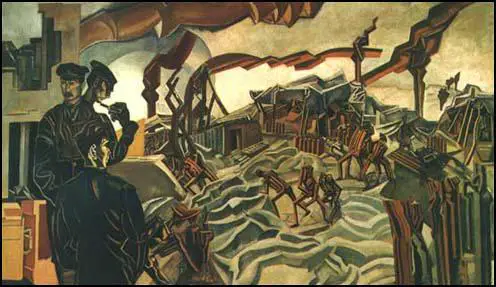
In say 1912, 1913,
hell, even the beginning of 1914, the first few months anyway, before the war
clouds got a full head of steam in the summer they all profusely professed
their unmitigated horror at the thought of war, thought of the old way of doing
business in the world. Yes the artists of every school the Cubist/Fauvists/Futurists/Constructivists,
Surrealists or those who would come to speak for those movements (hell even the
Academy spoke the pious words when there was sunny weather), those who saw the
disjointedness of modern industrial society and put the pieces to paint,
sculptors who put twisted pieces of metal juxtaposed to each other saw that
building a mighty machine from which you had to run created many problems;
writers of serious history books proving that, according to their Whiggish
theory of progress, humankind had moved
beyond war as an instrument of policy and the diplomats and high and mighty
would put the brakes on in time, not realizing that they were all squabbling
cousins; writers of serious and not so serious novels drenched in platitudes
and hidden gazebo love affairs put paid to that notion in their sweet nothing
words that man and woman had too much to do, too much sex to harness to
denigrate themselves by crying the warrior’s cry and by having half-virgin,
neat trick, maidens strewing flowers on the bloodlust streets; musicians whose
muse spoke of delicate tempos and sweet muted violin concertos, not the stress
and strife of the tattoos of war marches with their tinny conceits; and poets,
ah, those constricted poets who bleed the moon of its amber swearing, swearing
on a stack of seven sealed bibles, that they would go to the hells before
touching the hair of another man, putting another man to ground or lying their
own heads down for some imperial mission. They all professed loudly (and those
few who did not profess, could not profess because they were happily getting
their blood rising, kept their own consul until the summer), that come the war
drums they would resist the siren call, would stick to their Whiggish,
Futurist, Constructionist, Cubist worlds and blast the war-makers to hell in
quotes, words, chords, clanged metal, and pretty pastels. They would stay the
course.
And then the war
drums intensified, the people, their clients, patrons and buyers, cried out
their lusts and they, they made of ordinary human clay as it turned out, poets,
beautiful poets like Wilfred Owens who would sicken of war before he passed
leaving a beautiful damnation on war, its psychoses, and broken bones and
dreams, and the idiots who brought humankind to such a fate, like e. e.
cummings who drove through sheer hell in those rickety ambulances floors
sprayed with blood, man blood, angers, anguishes and more sets of broken bones,
and broken dreams, like Rupert Brooke all manly and old school give and go, as
they marched in formation leaving the ports and then mowed down like freshly
mown grass in their thousands as the charge call came and they rested, a lot of
them, in those freshly mown grasses, like Robert Graves all grave all
sputtering in his words confused about what had happened, suppressing, always
suppressing that instinct to cry out against the hatred night, like old school,
old Thomas Hardy writing beautiful old English pastoral sentiments before the
war and then full-blown into imperium’s service, no questions asked old England
right or wrong, like old stuffed shirt himself T.S. Eliot speaking of hollow
loves, hollow men, wastelands, and such in the high club rooms on the home
front, and like old brother Yeats speaking of terrible beauties born in the
colonies and maybe at the home front too as long as Eliot does not miss his high
tea. Jesus what a blasted night that Great War time was.
And do not forget
when the war drums intensified, and the people, their clients, patrons and
buyers, cried out their lusts and they, they, other creative souls made of
ordinary human clay as it turned out
And then the war
drums intensified, the people, their clients, patrons and buyers, cried out
their lusts and they, they made of ordinary human clay as it turned out,
artists, beautiful artists like Fernand Leger who could no longer push the
envelope of representative art because it had been twisted by the rubble of
war, by the crashing big guns, by the hubris of commanders and commanded and he
turned to new form, tubes, cubes, prisms, anything but battered humankind in
its every rusts and lusts, all bright and intersecting once he got the mustard
gas out of his system, once he had done his patria duty, like speaking of
mustard gas old worn out John Singer Sargent of the three name WASPs forgetting
Boston Brahmin society ladies in decollage, forgetting ancient world religious
murals hanging atop Boston museum and spewing trench warfare and the blind
leading the blind out of no man’s land, out of the devil’s claws, like Umberto
Boccioni, all swirls, curves, dashes, and dangling guns as the endless charges
endlessly charge, like Gustav Klimt and his endlessly detailed gold dust
opulent Asiatic dreams filled with lovely matrons and high symbolism and
blessed Eve women to fill the night, Adam’s night after they fled the garden,
like Joan Miro and his infernal boxes, circles, spats, eyes, dibs, dabs,
vaginas, and blots forever suspended in deep space for a candid world to fret
through, fret through a long career, and like poor maddened rising like a
phoenix in the Spartacist uprising George Grosz puncturing the nasty
bourgeoisie, the big bourgeoisie the ones with the real dough and their overfed
dreams stuffed with sausage, and from the bloated military and their fat-assed
generals stuff with howitzers and rocket shells, like Picasso, yeah, Picasso
taking the shape out of recognized human existence and reconfiguring the forms,
the mesh of form to fit the new hard order, like, Braque, if only because if
you put the yolk on Picasso you have to tie him to the tether too.
And do not forget
when the war drums intensified, and the people, their clients, patrons and
buyers, cried out their lusts and they, they, other creative souls made of
ordinary human clay as it turned out sculptors, writers, serious and not,
musicians went to the trenches to die deathless deaths in their thousands for,
well, for humankind, of course, their always fate ….
Where Have All The Flowers Gone- With Legendary Folk-Singer Pete Seeger In Mind

A while back, a few months ago now I think I mentioned in a sketch about how I came to learn about the music of Woody Guthrie I noted that it was hard to pin just exactly when I first heard his music since it pre-dated my coming to the folk minute of the 1960s where the name Woody Guthrie had been imprinted on lots of work by the then “new breed” protest/social commentary troubadour folk singers like Bob Dylan (who actually spent time in Woody’s hospital room with him when he first came East from Hibbing out of Dinktown in Minneapolis and wrote an early paean called Song To Woody on his first or second album), Ramblin’ Jack Elliott (who made a very nice career out of being a true Woody acolyte and had expected Dylan who had subsequently moved on, moved very far on to more lyrical work), and Stubby Tatum (probably the truest acolyte since he was instrumental in putting a lot of Woody’s unpublished poems and art work out for public inspection and specialized in Woody songs, first around Harvard Square and then wherever he could get a gig, which to say the least were not among the most well know or well thought out of Woody’s works. After some thought I pinpointed the first time I heard a Woody song to a seventh grade music class, Mr. Dasher’s class whom we innocently then called Dasher the Flasher just for rhyming purposes but which with today’s sensibilities about the young would not play very well and would probably have him up before some board of inquiry just because a bunch of moody, alienated hormonally-crazed seventh graders were into a rhyming fad that lasted until the next fad a few weeks or months, when he in an effort to have us appreciate various genre of the world music songbook made us learn Woody’s This Land Is Your Land. Little did we know until a few years later when some former student confronted him about why we were made to learn all those silly songs he made us memorize and he told that student that he had done so in order to, fruitlessly as it turned out, break us from our undying devotion to rock and roll, you know, Elvis, Chuck, Jerry Lee, Wanda, Brenda, Bo, Buddy, the Big Bopper and every single doo wop group, male or female. If anybody wants to create a board of inquiry over that Mister Dasher indiscretion complete with a jury of still irate rock and roll will never die-ers you have my support.
In thinking about Woody the obvious subsequent question of when I first heard the late Pete Seeger sing, a man who acted as the transmission belt between generations, I came up against that same quandary since I know I didn’t associate him with the first time, the first wave of performers, I heard as I connected with the emerging folk minute of the early 1960s. That folk minute start which I do clearly remember the details of got going one Sunday night when tired of the vanilla rock and roll music that was being play in the fall of 1962 on the Boston stations I began flipping the small dial on my transistor radio settling in on this startling gravelly voice which sounded like some old-time mountain man, some old time Jehovah cometh Calvinist avenging angel, singing Come All You Fair And Tender Ladies (who turned out to be folk historian and seminal folk revival figure Dave Von Ronk, who as far as I know later from his politics had no particular religious bent,if any, but who sure sounded like he was heralding the second coming. I listened to a few more songs on what turned out to be a folk music program put on every Sunday evening between seven and nine at the request of some college kids in the area who were going crazy for roots music according to the DJ.
After thinking about it for a while I realized that I had heard Pete not in solo performance but when he was with The Weavers and they made a hit out of the old Lead Belly tune, Good Night, Irene (a song that in the true oral tradition has many versions and depending on the pedigree fewer or more verses, Lead Belly’s being comparatively short). In those days, in the early 1950s I think, The Weavers were trying to break into the popular music sphere and were proceeding very well until the Cold War night descended upon them and they, or individual members including Pete were tarred with the red scare brush.
Still you cannot keep a good man down, a man with a flame-throwing banjo, with folk music DNA in his blood since he was the son of the well-known folk musicologist Charles Seeger who along with the father and son Lomaxes did so much to record the old time roots music out on location in the hills and hollows of the South, and with something to say to those who were interested in looking back into the roots of American music before it got commercialized (although now much of that early commercial music makes up the key folk anthology put together by Harry Smith and which every self-respecting folkie performer in the early 1960s treated like a bible. Pete put a lot of it together, a lot of interests. Got the young interested in going back to the time when old cowboys would sing themselves to sleep around the camp fire out in the prairies, when sweat hard-working black share-croppers and plantation workers down South would get out a Saturday jug and head to the juke joint to chase the blues away, and when the people of the hills and hollows down in Appalachia would Saturday night get out the jug and run over to Bill Preston’s old seen better days red-painted barn and dance that last dance waltz to that weeping mountain fiddle.
Stuff like that, lots of stuff like that to fill out the American songbook. But Pete also put his pen to paper to write some searing contemporary lyrics just like those “new breed” protest folk singers he helped nurture and probably the most famous to come out of that period, asking a very good question then, a question still be asked if more desperately than even then, Where Have All The Flowers Gone. Now a new generation looks like it too is ready to pick up the torch after the long “night of the long knives” we have faced since those days.
Subscribe to:
Posts (Atom)