Tuesday, April 28, 2015


On The 40th Anniversary Of The Fall Of Saigon (Ho Chi Minh City)-Vietnam At The End- The American End- An Insider’s Story- Frank Snepp’s “Decent Interval”- A Book Review


Book Review

Decent Interval: An Insider’s Account Of Saigon’s Indecent End Told By The CIA’s Chief Strategy Analyst In Vietnam, Frank Snepp, Random House, New York, 1977

Sometimes a picture is in fact better than one thousand words. In this case the famous, or infamous depending on one’s view, photograph of the last American “refugees” being evacuated from the American Embassy in Saigon (now, mercifully, Ho Chi Minh City) tells more about that episode of American imperial hubris that most books. Still, as is the case with this little gem of a book, ex- CIA man Frank Snepp’s insider account of that fall from the American side, it is nice to have some serious analytical companionship to that photo. Moreover, a book that gives numerous details about what happened to who in those last days in a little over five hundred pages. Naming names about who the good guys and bad guys really were (from the American imperial perspective. Especially now, as two or three later generations only see Vietnam through the hoary eyes of old veterans, both military and radical anti-war, from that period like me (a veteran in both senses) to tell the tale.

Naturally, a longtime CIA man who in a fit of his own hubris decided, in effect, to blow the whistle on the American fiasco, has got his own axes to grind, and his own agenda for doing so. Bearing that in mind this is a fascinating look at that last period of American involvement in Vietnam from just after the 1973 cease-fire went into place until that last day of April in 1975 when the red flag flew over Saigon after a thirty plus year struggle for national liberation. For most Americans the period after the withdrawal of the last large contingents of U.S. troops from combat in 1972 kind of put paid to that failed experiment in “nation-building”-American-style.

For the rest of us who wished to see the national liberation struggle victorious we only had a slight glimmer that sometime was afoot until fairly late- say the beginning of 1975, although the rumor mill was running earlier. So Mr. Snepp’s book is invaluable to fill in the blanks for what the U.S., the South Vietnamese and the North Vietnamese were doing, or not doing.

Snepp’s lively account, naturally, centers on the American experience and within that experience the conduct of the last ambassador to Saigon, Graham Martin. Snepp spares no words to go after Martin’s perfidious and maniacal role, especially in the very, very last days when the North Vietnamese were sweeping almost unopposed into Saigon. But there is more, failures of intelligence, some expected, others just plain wrong, some missteps about intentions, some grand-standing and some pure-grade rancid anti-communist that fueled much of the scene.

And, of course, no story of American military involvement any place is complete without plenty of material about, well the money. From Thieu’s military needs (and those of his extensive entourage) to the American military (and their insatiable need for military hardware), to various American administrations and their goals just follow the money trail and you won’t be far off the scent. And then that famous, or infamous, photograph of that helicopter exit from the roof of the American Embassy in just a nick of time makes much more sense. Nice work, Frank Snepp. The whistleblower’s art is not appreciated but always needed. Just ask heroic convicted whistle-blower Private Chelsea Manning or exiled Edward Snowden.

In Honor Of The 99th Anniversary Of The Irish Easter Uprising, 1916-Sean Flynn’s Fight-Take Three  


A word on the Easter Uprising


In the old Irish working-class neighborhoods where I grew up the aborted Easter Uprising of 1916 was spoken of in mythical hushed reverent tones as the key symbol of the modern Irish liberation struggle from bloody England. The event itself provoked such memories of heroic “boyos”  (and “girlos” not acknowledged) fighting to the end against great odds that a careful analysis of what could, and could not be, learned from the mistakes made at the time entered my head. That was then though in the glare of boyhood infatuations. Now is the time for a more sober assessment. 


The easy part of analyzing the Irish Easter Uprising of 1916 is first and foremost the knowledge, in retrospect, that it was not widely supported by people in Ireland, especially by the “shawlies” in Dublin and the cities who received their sons’ military pay from the Imperial British Army for service in the bloody trenches of Europe which sustained them throughout the war. That factor and the relative ease with which the uprising had been militarily defeated by the British forces send in main force to crush it lead easily to the conclusion that the adventure was doomed to failure. Still easier is to criticize the timing and the strategy and tactics of the planned action and of the various actors, particularly in the leadership’s underestimating the British Empire’s frenzy to crush any opposition to its main task of victory in World War I. (Although, I think that frenzy on Mother England’s part would be a point in the uprising’s favor under the theory that England’s [or fill in the blank of your favorite later national liberation struggle] woes were Ireland’s [or fill in the blank ditto on the your favorite oppressed peoples struggle] opportunities.


The hard part is to draw any positive lessons of that national liberation struggle experience for the future. If nothing else remember this though, and unfortunately the Irish national liberation fighters (and other national liberation fighters later, including later Irish revolutionaries) failed to take this into account in their military calculations, the British (or fill in the blank) were savagely committed to defeating the uprising including burning that colonial country to the ground if need be in order to maintain control. In the final analysis, it was not part of their metropolitan homeland, so the hell with it. Needless to say, cowardly British Labor’s position was almost a carbon copy of His Imperial Majesty’s. Labor Party leader Arthur Henderson could barely contain himself when informed that James Connolly had been executed. That should, even today, make every British militant blush with shame. Unfortunately, the demand for British militants and others today is the same as then if somewhat attenuated- All British Troops Out of Ireland.

In various readings on national liberation struggles I have come across a theory that the Easter Uprising was the first socialist revolution in Europe, predating the Bolshevik Revolution by over a year. Unfortunately, there is little truth to that idea. Of the Uprising’s leaders only James Connolly was devoted to the socialist cause. Moreover, while the Irish Volunteers and the Irish Citizen Army were prototypical models for urban- led national liberation forces such organizations, as we have witnessed in later history, are not inherently socialistic. The dominant mood among the leadership was in favor of political independence and/or fighting for a return to a separate traditional Irish cultural hegemony. (“Let poets rule the land”).

As outlined in the famous Proclamation of the Republic posted on the General Post Office in Dublin, Easter Monday, 1916 the goal of the leadership appeared to be something on the order of a society like those fought for in the European Revolutions of 1848, a left bourgeois republic. A formation on the order of the Paris Commune of 1871 where the working class momentarily took power or the Soviet Commune of 1917 which lasted for a longer period did not figure in the political calculations at that time. As noted above, James Connolly clearly was skeptical of his erstwhile comrades on the subject of the nature of the future state and apparently was prepared for an ensuing class struggle following the establishment of a republic.

That does not mean that revolutionary socialists could not support such an uprising. On the contrary, Lenin, who was an admirer of Connolly for his anti-war stance in World War I, and Trotsky stoutly defended the uprising against those who derided the Easter rising for involving bourgeois elements. Participation by bourgeois and petty bourgeois elements is in the nature of a national liberation struggle. The key, which must be learned by militants today, is who leads the national liberation struggle and on what program. As both Lenin and Trotsky made clear later in their own experiences in Russia revolutionary socialists have to lead other disaffected elements of society to overthrow the existing order. There is no other way in a heterogeneous class-divided society. Moreover, in Ireland, the anti-imperialist nature of the action against British imperialism during wartime on the socialist principle that the defeat of your own imperialist overlord in war as a way to open the road to the class struggle merited support on that basis alone. Chocky Ar La.

********

Here is a little commemorative piece based on the exploits of Frankie Riley from the old neighborhood grand-uncle’s, Sean Flynn, who gave a good account of himself when the time for fighting came:


Sean Flynn could still taste that acrid smell of smoke in his lungs long after the last flicker of battle, long after they had known that they had made major miscalculations about the enemy, about the savagery of dear Mother England when she wanted to keep her little child Ireland close to her bosom. He remembered the hard fighting, the loses of game comrades when the British pulled the hammer down, while the Dublin crowds in particular, watched in stony silence (or maybe and this is the insidious nature of the oppressor, the effect the oppressor has on the psyche of the oppressed, with some secret desire to see the “boyos” lose and return to normalcy). He would never forget his own flight to the north where he hid out for many days until the coast was clear. That escape had been a close thing since he had carried a small wound from the rear-guard fight around their, the British, General Post Office in Dublin (he would never call that institution, even after independence anything but their building). And he would never forget the lessons that he had learned about what a serious struggle for national liberation entailed.

Mostly though, and that smoke in his lungs was constant reminder, he would always remember how the bloody British, the most civilized nation on Earth to hear the paid historians tell the story, thought nothing of burning down their jewel colonial capital city to the ground rather than to let Ireland breath free and make its own mistakes. That had been the major error in the thinking of the various leader even of the lost lamented martyr James Connolly; thinking that the English in the throes of war in Europe would not scramble whatever was necessary to suppress the uprising including that needless burning of the town. Surely there had been other miscalculations and mistakes; not having a coordinated plan, not abandoning the uprising temporarily when a serious consensus could not be met on the timing of the rising; of going with a few, too few, men expecting the population to rise up once the spark had been ignited, various tactical military blunders which only added to the tragic outcome and so on. But in the end the biggest mistake was to underestimate the capacity of the British to display the same kind of savagery and stupidity as they had in trench-filled Europe or in previous places of native uprisings in Africa, Asia and India.

Just then though Sean, a little cough in his throat, maybe really a lump, thought about the brave lads that he had fought with then who had gone to meet their maker, including his older brother Seamus who snuck him into the Citizens’ Army to begin with when he was just a lad. There was Ian O’Riley who fell early to an advanced British guard when they tried to storm the front door by force, Seamus Barry killed by a sniper’s bullet, stout-hearted Liam Murphy who faced down a British patrol and paid with his life for that deed, and of course, his old friend Bucko Bailey who stayed behind drawing fire as the last remnant, including one Sean Flynn, made their passage out of the firestorm that had become Dublin. But most of all his missed the “Chief,” James Connolly, who, wounded and all, was strapped to a chair and executed by those bloody British bastards. They would long rue the day when they let Connolly near lethal weapons which he learned how to handle when he was in their Army as a lad, and they would longer still rue the day when they shot a brave man like a dog. Chocky Ar La.   
President Obama Pardon Chelsea Manning Now!-The Struggle Continues ….We Will Not Leave Our Sister Behind-A Personal Letter From The Pen Of Chelsea Manning From Fort Leavenworth 


The Dark Night Of Revenge-Ray Milland’s Hostile Witness


DVD Review

From The Pen Of Frank Jackman

Hostile Witness, starring and directed by Ray Milland, 1968

You know you always hear stories, or at least in the old days in the corner boy society I belong around in high school you heard stories, about guys who had been sent to stir, you know prison, by some happenstance of their making who swore on seven bibles, maybe more, that they would get even with the guys, mainly the cops, prosecuting attorney, and judge who put them in the slammer. That search for revenge would help them while away the hours but in the actual case they usually let it go. Either that or their scheme was so hare-brained that if it had been executed they would be once again whiling away the hours in some cellblock.  But not all of them let it go or had such hare-brained schemes, take John Naylor in the film under review, Ray Milland’s Hostile Witness, who almost, and remember that word almost, got away with murder in his vengeful scheme.

Simon Crawford, Queen’s Councilor, in other words a lawyer in England, played by Ray Milland, had like a lot of up and coming lawyers started out in the prosecutor’s office and in the course of events would have put more than a few bad guys away, a few seeking revenge for their incarceration too. Same with judges, maybe more so if they handed out a harsh sentence. Like I said plenty of guys whiled away their prison time plotting in excruciating detail their revenge. And John Naylor who was put in gaol (jail) by Simon and Justice Matthews planned and plotted a lot better than most. See he was in his revenge for the long haul so when he got out he gain employee in the law offices of one Simon Crawford. His idea was to study the man and when he had an opportunity he would pounce. After years of waiting he got his opportunity when Simon’s young daughter was run over and mortally wounded by a hit and run driving identified only as an older man. Simon was ready to move heaven and hell to find that bastard who took his main reason for existence away.

That is when John was able to pounce. Justice Matthews by then was an old man and the idea was put in Simon’s mind that Matthews had been the hit and run driver. And presto one fine night Justice Matthews was found dead, found murdered most foul and on that same night in that same neighborhood one Simon Crawford was found on the ground by a neighbor conked on the head. It didn’t take much for the coppers to put two and two together and come up Simon, Simon murder one. It figured, right. So Simon was going to the big house, maybe step off on some high hung gallows for the crime. But wait a minute. Hold on. Simon was not built like that although a lot of evidence pointed his way. Naturally in trying to find the real criminal Simon honed in on the idea that it had been an inside job, had been done with close knowledge of his movements, and so guess who got to take the rap. And now dear John Naylor will have plenty of time to figure out his next revenge. But that last time was a close thing. Just ask Simon Crawford.      

 
Sat, Apr 11, 2015 03:40 PM
Chelsea Manning Support Network
Chelsea's Cosmo interview and "Thank You!" to supporters
Is this email not displaying correctly?
View it in your browser.
 

Chelsea: "I'm so thankful for all your support!"

Thanks to supporters like you, Wikileaks whistleblower Chelsea Manning has received over 17,000 letters and messages of support while in prison!
This outpouring of support is due in part to the Write for Rights campaign of leading human rights organization Amnesty International.
Amnesty International has shared Chelsea Manning’s thank you note to them- and to all her supporters who have taken action:
I wanted to thank all of you so very much for your actions of support and solidarity.
I understand that over 200,000 actions were taken – that’s absolutely incredible!
...My days here are busy and very routine. I work at a vocational wood shop during the week – about the same number of hours as a full-time job. I am taking college correspondence courses for a bachelor’s degree...
Click here to read more of Chelsea Manning's thank you!
With Warm Regards,

Cosmopolitan interview with Chelsea Manning

The April issue of Cosmopolitan magazine featured an interview with Chelsea Manning, reflecting on her life now and before prison.
With Cosmopolitan's circulation above 3 million, Chelsea's story will have the potential to reach and inspire new young audiences.
Chelsea shares about an emotional turning point for her, her time in Iraq:
Dealing with reams and reams of emails, memos, and reports of people dying around me every day — to the point it becomes just a statistic to many people — made me realize just how short and precious our lives really are.
I could’ve been killed at any moment too. We all can, really. So what better day to start being ourselves than today, right? Yeah, it sounds tacky, but it’s absolutely true.
Click here to read more of Chelsea Manning's Cosmo interview!

Chelsea can continue to be a powerful voice for reform, but we need your help to make that happen. Help us support Chelsea in prison, maximize her voice in the media, continue public education, fund her legal appeals team, and build a powerful movement for presidential pardon.

> > > Please donate today! < < <


"May Day" is celebrated around the world as International Worker's Day to honor the struggle for workers rights. 
 
On May 1st, 1886, and in the days that followed, Chicago police opened fire, attacking thousands of workers on strike. Every year since, workers across the globe have stood together to unite all of our struggles – an injury to one, is an injury to all!
 
This Friday, May 1st, 2015 we hope to get as many different campaigns, groups of people and organizations as possible out on the streets in defense of workers rights!
 
There is no doubt, this winter was one of the more politically active seasons we have seen in Boston.  We've seen large actions supporting Black Lives Matter, No Olympics campaigns and the continued struggle for $15 an hour. May Day is about bringing these causes together under the banner of Solidarity. Whether the ruling class is oppressing workers or using the police to disenfranchise whole races of people, 
 
May Day is our day to stand together and announce in celebration; "Enough is Enough."
 
 
Join Us this Friday, May 1, 2015 

12PM       Rally on the Boston Commons
2PM         March to Haymarket Station


After the march to Haymarket, join the BMDC & get on the #111 bus to Chelsea! 
4pm        Gather at Chelsea City Hall 
4:30pm   March from Chelsea to Everett 
5:30pm   Rally at Glendale Park, Everett 

We hope to see you out in the trenches on May Day and please pass this along to friends as well!  

Solidaridad,

The Boston May Day Committee
 
For more information and to get involved:

617 922-5744 | 857 334-5084
info@bostonmayday.org 
 
Facebook event for May Day 2015 - Be sure to hit "join!" |  Download the flyer Here

Monday, April 27, 2015

The Ink Spots - To Each His Own 1946


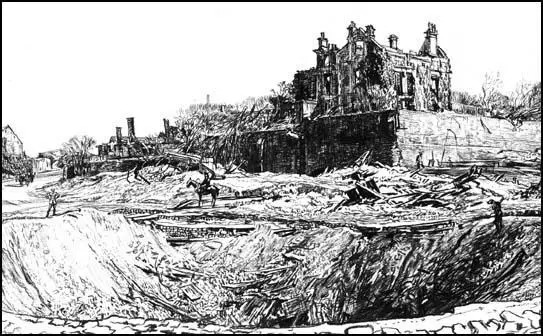
As The 100th Anniversary Of The First Year Of World War I (Remember The War To End All Wars) Continues ... Some Remembrances-Artists’ Corner-Muirhead Bone 
 
Muirhead Bone, The Great Crater (1917)

In say 1912, 1913, hell, even the beginning of 1914, the first few months anyway, before the war clouds got a full head of steam in the summer they all profusely professed their unmitigated horror at the thought of war, thought of the old way of doing business in the world. Yes the artists of every school the Cubist/Fauvists/Futurists/Constructivists, Surrealists or those who would come to speak for those movements (hell even the Academy spoke the pious words when there was sunny weather), those who saw the disjointedness of modern industrial society and put the pieces to paint, sculptors who put twisted pieces of metal juxtaposed to each other saw that building a mighty machine from which you had to run created many problems; writers of serious history books proving that, according to their Whiggish theory of progress,  humankind had moved beyond war as an instrument of policy and the diplomats and high and mighty would put the brakes on in time, not realizing that they were all squabbling cousins; writers of serious and not so serious novels drenched in platitudes and hidden gazebo love affairs put paid to that notion in their sweet nothing words that man and woman had too much to do, too much sex to harness to denigrate themselves by crying the warrior’s cry and by having half-virgin, neat trick, maidens strewing flowers on the bloodlust streets; musicians whose muse spoke of delicate tempos and sweet muted violin concertos, not the stress and strife of the tattoos of war marches with their tinny conceits; and poets, ah, those constricted poets who bleed the moon of its amber swearing, swearing on a stack of seven sealed bibles, that they would go to the hells before touching the hair of another man, putting another man to ground or lying their own heads down for some imperial mission. They all professed loudly (and those few who did not profess, could not profess because they were happily getting their blood rising, kept their own consul until the summer), that come the war drums they would resist the siren call, would stick to their Whiggish, Futurist, Constructionist, Cubist worlds and blast the war-makers to hell in quotes, words, chords, clanged metal, and pretty pastels. They would stay the course. 

And then the war drums intensified, the people, their clients, patrons and buyers, cried out their lusts and they, they made of ordinary human clay as it turned out, poets, beautiful poets like Wilfred Owens who would sicken of war before he passed leaving a beautiful damnation on war, its psychoses, and broken bones and dreams, and the idiots who brought humankind to such a fate, like e. e. cummings who drove through sheer hell in those rickety ambulances floors sprayed with blood, man blood, angers, anguishes and more sets of broken bones, and broken dreams, like Rupert Brooke all manly and old school give and go, as they marched in formation leaving the ports and then mowed down like freshly mown grass in their thousands as the charge call came and they rested, a lot of them, in those freshly mown grasses, like Robert Graves all grave all sputtering in his words confused about what had happened, suppressing, always suppressing that instinct to cry out against the hatred night, like old school, old Thomas Hardy writing beautiful old English pastoral sentiments before the war and then full-blown into imperium’s service, no questions asked old England right or wrong, like old stuffed shirt himself T.S. Eliot speaking of hollow loves, hollow men, wastelands, and such in the high club rooms on the home front, and like old brother Yeats speaking of terrible beauties born in the colonies and maybe at the home front too as long as Eliot does not miss his high tea. Jesus what a blasted night that Great War time was.  

And do not forget when the war drums intensified, and the people, their clients, patrons and buyers, cried out their lusts and they, they, other creative souls made of ordinary human clay as it turned out

And then the war drums intensified, the people, their clients, patrons and buyers, cried out their lusts and they, they made of ordinary human clay as it turned out, artists, beautiful artists like Fernand Leger who could no longer push the envelope of representative art because it had been twisted by the rubble of war, by the crashing big guns, by the hubris of commanders and commanded and he turned to new form, tubes, cubes, prisms, anything but battered humankind in its every rusts and lusts, all bright and intersecting once he got the mustard gas out of his system, once he had done his patria duty, like speaking of mustard gas old worn out John Singer Sargent of the three name WASPs forgetting Boston Brahmin society ladies in decollage, forgetting ancient world religious murals hanging atop Boston museum and spewing trench warfare and the blind leading the blind out of no man’s land, out of the devil’s claws, like Umberto Boccioni, all swirls, curves, dashes, and dangling guns as the endless charges endlessly charge, like Gustav Klimt and his endlessly detailed gold dust opulent Asiatic dreams filled with lovely matrons and high symbolism and blessed Eve women to fill the night, Adam’s night after they fled the garden, like Joan Miro and his infernal boxes, circles, spats, eyes, dibs, dabs, vaginas, and blots forever suspended in deep space for a candid world to fret through, fret through a long career, and like poor maddened rising like a phoenix in the Spartacist uprising George Grosz puncturing the nasty bourgeoisie, the big bourgeoisie the ones with the real dough and their overfed dreams stuffed with sausage, and from the bloated military and their fat-assed generals stuff with howitzers and rocket shells, like Picasso, yeah, Picasso taking the shape out of recognized human existence and reconfiguring the forms, the mesh of form to fit the new hard order, like, Braque, if only because if you put the yolk on Picasso you have to tie him to the tether too.          

And do not forget when the war drums intensified, and the people, their clients, patrons and buyers, cried out their lusts and they, they, other creative souls made of ordinary human clay as it turned out sculptors, writers, serious and not, musicians went to the trenches to die deathless deaths in their thousands for, well, for humankind, of course, their always fate ….           

URGENT: Calls Again Needed to Save Mumia's Life!

Stop the attempted murder of Mumia through medical neglect!

Keep the pressure on!


Please call these numbers and any other numbers you have for the Prison and the Governor. (Dialling code from UK for the USA is 001.  Pennsylvania is five hours behind London.)
John Wetzel
Secretary, Department of Corrections
ra-crpadocsecretary@pa.gov
717-728-4109
717-728-4178 Fax

1920 Technology Pkwy, Mechanicsburg PA 17050
John Kerestes
Superintendent SCI Mahanoy 570-773-2158 x8102
570-783-2008 Fax
301 Morea  Road, Frackville
PA 17932
Tom Wolf
PA Governor
717-787-2500

governor@PA.gov
508 Main Capitol Building, Harrisburg PA 17120
Susan McNaughton
Public Information Office
PA DOC Press secretary:
717-728-4025 smcnaughton@pa.gov
 
Mumia's Condition Grave
Take Action NOW!
Mumia On April 24, 2015
On Friday, April 24, Mumia Abu-Jamal was visited by his wife, Wadiya Jamal, who reported that his condition has worsened.
She saw him again on April 25 and he appeared even more gravely ill.  Everyone is asked to call the prison and the Pennsylvania Department of Corrections immediately.
Please continue to call on throughout this week.
Mumia was released from the prison infirmary three days ago even though he was in no condition to be in general population. His request to be seen by independent medical specialists was denied by the PA Department of Corrections. Yet he is in need of 24-hour care and supervision. He is too weak and in this state he may not be able ask for help.
Please call the numbers listed.  Along with Mumia's name his prison number is AM 8335.  Call local news sources in your area that would report on this crisis. Share this email with your contact lists. Get out the information via any social media you use especially Facebook and Twitter using the hashtag #MumiaMustLive.
Demand that prison officials call Mumia’s wife and his lawyer Bret Grote to discuss his condition. Demand that Mumia Abu-Jamal see a competent doctor of his choice immediately, that he be taken to the hospital for emergency care and not be left to go into a diabetic coma.
It is clear that Pennsylvania prison officials are intent on carrying out their plans to murder Mumia through medical neglect. This situation is urgent.  Every call matters.  Every action matters.  Call your friends, your neighbours. We must speak out now before it’s too late.


Save the Date - UNAC National Conference, May 8 - 10, 2015


From The Pen Of American Communist Party Founder And Trotskyist Leader James P. Cannon


Click below to link to the “James P. Cannon Internet Archives.”

http://www.marxists.org/archive/cannon/works/index.htm
*************

Markin comment on founding member James P. Cannon and the early American Communist Party taken from a book review, James P. Cannon and the Early American Communist Party, on the “American Left History” blog:

If you are interested in the history of the American Left or are a militant trying to understand some of the past mistakes of our history and want to know some of the problems that confronted the early American Communist Party and some of the key personalities, including James Cannon, who formed that party this book is for you.

At the beginning of the 21st century after the demise of the Soviet Union and the apparent ‘death of communism’ it may seem fantastic and utopian to today’s militants that early in the 20th century many anarchist, socialist, syndicalist and other working class militants of this country coalesced to form an American Communist Party. For the most part, these militants honestly did so in order to organize an American socialist revolution patterned on and influenced by the Russian October Revolution of 1917. James P. Cannon represents one of the important individuals and faction leaders in that effort and was in the thick of the battle as a central leader of the Party in this period. Whatever his political mistakes at the time, or later, one could certainly use such a militant leader today. His mistakes were the mistakes of a man looking for a revolutionary path.

For those not familiar with this period a helpful introduction by the editors gives an analysis of the important fights which occurred inside the party. That overview highlights some of the now more obscure personalities (a helpful biographical glossary is provided), where they stood on the issues and insights into the significance of the crucial early fights in the party.

These include questions which are still relevant today; a legal vs. an underground party; the proper attitude toward parliamentary politics; support to third- party bourgeois candidates;trade union policy; class-war prisoner defense as well as how to rein in the intense internal struggle of the various factions for organizational control of the party. This makes it somewhat easier for those not well-versed in the intricacies of the political disputes which wracked the early American party to understand how these questions tended to pull it in on itself. In many ways, given the undisputed rise of American imperialism in the immediate aftermath of World War I, this is a story of the ‘dog days’ of the party. Unfortunately, that rise combined with the international ramifications of the internal disputes in the Russian Communist Party and in the Communist International shipwrecked the party as a revolutionary party toward the end of this period.

In the introduction the editors motivate the purpose for the publication of the book by stating the Cannon was the finest Communist leader that America had ever produced. This an intriguing question. The editors trace their political lineage back to Cannon’s leadership of the early Communist Party and later after his expulsion to the Trotskyist Socialist Workers Party so their perspective is obvious. What does the documentation provided here show? I would argue that the period under study represented Cannon’s apprenticeship. Although the hothouse politics of the early party clarified some of the issues of revolutionary strategy for him I believe that it was not until he linked up with Trotsky in the late 1920’s that he became the kind of leader who could lead a revolution. Of course, since Cannon never got a serious opportunity to lead revolutionary struggles in America this is mainly reduced to speculation on my part. Later books written by him make the case better. One thing is sure- in his prime he had the instincts to want to lead a revolution.

As an addition to the historical record of this period this book is a very good companion to the two-volume set by Theodore Draper - The Roots of American Communism and Soviet Russia and American Communism- the definitive study on the early history of the American Communist Party. It is also a useful companion to Cannon’s own The First Ten Years of American Communism. I would add that this is something of a labor of love on the part of the editors. This book was published at a time when the demise of the former Soviet Union and Eastern Europe was in full swing and anything related to Communist studies was deeply discounted. Nevertheless, for better or worse, the American Communist Party (and its offshoots) needs to be studied as an ultimately flawed example of a party that failed in its mission to create a radical version of society in America. Now is the time to study this history.
*********

BOOK REVIEW

NOTEBOOK OF AN AGITATOR- JAMES P. CANNON, PATHFINDER PRESS, NEW YORK, 1971


If you are interested in the history of the American Left or are a militant trying to understand some of the past lessons of our history concerning the socialist response to various social and labor questions this book is for you. This book is part of a continuing series of the writings of James P. Cannon that was published by the organization he founded, the Socialist Workers Party, in the 1970’s. Look in this space for other related reviews of this series of documents on and by an important American Communist.

In the introduction the editors motivate the purpose for the publication of the book by stating the Cannon was the finest Communist leader that America had ever produced. This an intriguing question. The editors trace their political lineage back to Cannon’s leadership of the early Communist Party and later after his expulsion to the Trotskyist Socialist Workers Party so their perspective is obvious. What does the documentation provided here show? This certainly is the period of Cannon’s political maturation, especially after his long collaboration working with Trotsky. The period under discussion- from the 1920’s when he was a leader of the American Communist Party to the red-baiting years after World War II- started with his leadership of the fight against the degeneration of the Russian Revolution and then later against those who no longer wanted to defend the gains of the Russian Revolution despite the Stalinist degeneration of that revolution. Cannon won his spurs in those fights and in his struggle to orient those organizations toward a revolutionary path. One thing is sure- in his prime which includes this period- Cannon had the instincts to want to lead a revolution and had the evident capacity to do so. That he never had an opportunity to lead a revolution is his personal tragedy and ours as well.

I note here that among socialists, particularly the non-Stalinist socialists of those days, there was controversy on what to do and, more importantly, what forces socialists should support. If you want to find a more profound response initiated by revolutionary socialists to the social and labor problems of those days than is evident in today’s leftist responses to such issues Cannon’s writings here will assist you. I draw your attention to the early part of the book when Cannon led the Communist-initiated International Labor Defense (ILD), most famously around the fight to save the anarchists Sacco and Vanzetti here in Massachusetts. That campaign put the Communist Party on the map for many workers and others unfamiliar with the party’s work. For my perspective the early class-war prisoner defense work was exemplary.

The issue of class-war prisoners is one that is close to my heart. I support the work of the Partisan Defense Committee, Box 99 Canal Street Station, New York, N.Y 10013, an organization which traces its roots and policy to Cannon’s ILD. That policy is based on an old labor slogan- ‘An injury to one is an injury to all’ therefore I would like to write a few words here on Cannon’s conception of the nature of the work. As noted above, Cannon (along with Max Shachtman and Martin Abern and Cannon’s long time companion Rose Karsner who would later be expelled from American Communist Party for Trotskyism with him and who helped him form what would eventually become the Socialist Workers Party) was assigned by the party in 1925 to set up the American section of the International Red Aid known here as the International Labor Defense.

It is important to note here that Cannon’s selection as leader of the ILD was insisted on by the Industrial Workers of the World (IWW) because of his pre-war association with that organization and with the prodding of “Big Bill’ Haywood, the famous labor organizer exiled in Moscow. Since many of the militants still languishing in prison were anarchists or syndicalists the selection of Cannon was important. The ILD’s most famous early case was that of the heroic anarchist workers, Sacco and Vanzetti. The lessons learned in that campaign show the way forward in class-war prisoner defense.

I believe that it was Trotsky who noted that, except in the immediate pre-revolutionary and revolutionary periods, the tasks of militants revolve around the struggle to win democratic and other partial demands. The case of class-war legal defense falls in that category with the added impetus of getting the prisoners back into the class struggle as quickly as possible. The task then is to get them out of prison by mass action for their release. Without going into the details of the Sacco and Vanzetti case the two workers had been awaiting execution for a number of years and had been languishing in jail. As is the nature of death penalty cases various appeals on various grounds were tried and failed and they were then in imminent danger of execution.

Other forces outside the labor movement were also interested in the Sacco and Vanzetti case based on obtaining clemency, reduction of their sentences to life imprisonment or a new trial. The ILD’s position was to try to win their release by mass action- demonstrations, strikes and other forms of mass mobilization. This strategy obviously also included, in a subordinate position, any legal strategies that might be helpful to win their freedom. In this effort the stated goal of the organization was to organize non-sectarian class defense but also not to rely on the legal system alone portraying it as a simple miscarriage of justice. The organization publicized the case worldwide, held conferences, demonstrations and strikes on behalf of Sacco and Vanzetti. Although the campaign was not successful and the pair were executed in 1927 it stands as a model for class war prisoner defense. Needless to say, the names Sacco and Vanzetti continue to be honored to this day wherever militants fight against this system.

I also suggest a close look at Cannon’s articles in the early 1950’s. Some of them are solely of historical interest around the effects of the red purges on the organized labor movement at the start of the Cold War. Others, however, around health insurance, labor standards, the role of the media and the separation of church and state read as if they were written in 2014 That’s a sorry statement to have to make any way one looks at it.