Wednesday, April 29, 2015


As The 100th Anniversary Of The First Year Of World War I (Remember The War To End All Wars) Continues ... Some Remembrances-Artists’ Corner-John Lavery
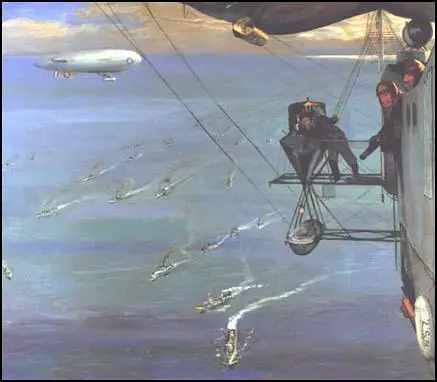
 
Sir John Lavery, A Convoy, North Sea (1918) 

In say 1912, 1913, hell, even the beginning of 1914, the first few months anyway, before the war clouds got a full head of steam in the summer they all profusely professed their unmitigated horror at the thought of war, thought of the old way of doing business in the world. Yes the artists of every school the Cubist/Fauvists/Futurists/Constructivists, Surrealists or those who would come to speak for those movements (hell even the Academy spoke the pious words when there was sunny weather), those who saw the disjointedness of modern industrial society and put the pieces to paint, sculptors who put twisted pieces of metal juxtaposed to each other saw that building a mighty machine from which you had to run created many problems; writers of serious history books proving that, according to their Whiggish theory of progress,  humankind had moved beyond war as an instrument of policy and the diplomats and high and mighty would put the brakes on in time, not realizing that they were all squabbling cousins; writers of serious and not so serious novels drenched in platitudes and hidden gazebo love affairs put paid to that notion in their sweet nothing words that man and woman had too much to do, too much sex to harness to denigrate themselves by crying the warrior’s cry and by having half-virgin, neat trick, maidens strewing flowers on the bloodlust streets; musicians whose muse spoke of delicate tempos and sweet muted violin concertos, not the stress and strife of the tattoos of war marches with their tinny conceits; and poets, ah, those constricted poets who bleed the moon of its amber swearing, swearing on a stack of seven sealed bibles, that they would go to the hells before touching the hair of another man, putting another man to ground or lying their own heads down for some imperial mission. They all professed loudly (and those few who did not profess, could not profess because they were happily getting their blood rising, kept their own consul until the summer), that come the war drums they would resist the siren call, would stick to their Whiggish, Futurist, Constructionist, Cubist worlds and blast the war-makers to hell in quotes, words, chords, clanged metal, and pretty pastels. They would stay the course. 

And then the war drums intensified, the people, their clients, patrons and buyers, cried out their lusts and they, they made of ordinary human clay as it turned out, poets, beautiful poets like Wilfred Owens who would sicken of war before he passed leaving a beautiful damnation on war, its psychoses, and broken bones and dreams, and the idiots who brought humankind to such a fate, like e. e. cummings who drove through sheer hell in those rickety ambulances floors sprayed with blood, man blood, angers, anguishes and more sets of broken bones, and broken dreams, like Rupert Brooke all manly and old school give and go, as they marched in formation leaving the ports and then mowed down like freshly mown grass in their thousands as the charge call came and they rested, a lot of them, in those freshly mown grasses, like Robert Graves all grave all sputtering in his words confused about what had happened, suppressing, always suppressing that instinct to cry out against the hatred night, like old school, old Thomas Hardy writing beautiful old English pastoral sentiments before the war and then full-blown into imperium’s service, no questions asked old England right or wrong, like old stuffed shirt himself T.S. Eliot speaking of hollow loves, hollow men, wastelands, and such in the high club rooms on the home front, and like old brother Yeats speaking of terrible beauties born in the colonies and maybe at the home front too as long as Eliot does not miss his high tea. Jesus what a blasted night that Great War time was.  

And do not forget when the war drums intensified, and the people, their clients, patrons and buyers, cried out their lusts and they, they, other creative souls made of ordinary human clay as it turned out

And then the war drums intensified, the people, their clients, patrons and buyers, cried out their lusts and they, they made of ordinary human clay as it turned out, artists, beautiful artists like Fernand Leger who could no longer push the envelope of representative art because it had been twisted by the rubble of war, by the crashing big guns, by the hubris of commanders and commanded and he turned to new form, tubes, cubes, prisms, anything but battered humankind in its every rusts and lusts, all bright and intersecting once he got the mustard gas out of his system, once he had done his patria duty, like speaking of mustard gas old worn out John Singer Sargent of the three name WASPs forgetting Boston Brahmin society ladies in decollage, forgetting ancient world religious murals hanging atop Boston museum and spewing trench warfare and the blind leading the blind out of no man’s land, out of the devil’s claws, like Umberto Boccioni, all swirls, curves, dashes, and dangling guns as the endless charges endlessly charge, like Gustav Klimt and his endlessly detailed gold dust opulent Asiatic dreams filled with lovely matrons and high symbolism and blessed Eve women to fill the night, Adam’s night after they fled the garden, like Joan Miro and his infernal boxes, circles, spats, eyes, dibs, dabs, vaginas, and blots forever suspended in deep space for a candid world to fret through, fret through a long career, and like poor maddened rising like a phoenix in the Spartacist uprising George Grosz puncturing the nasty bourgeoisie, the big bourgeoisie the ones with the real dough and their overfed dreams stuffed with sausage, and from the bloated military and their fat-assed generals stuff with howitzers and rocket shells, like Picasso, yeah, Picasso taking the shape out of recognized human existence and reconfiguring the forms, the mesh of form to fit the new hard order, like, Braque, if only because if you put the yolk on Picasso you have to tie him to the tether too.          

And do not forget when the war drums intensified, and the people, their clients, patrons and buyers, cried out their lusts and they, they, other creative souls made of ordinary human clay as it turned out sculptors, writers, serious and not, musicians went to the trenches to die deathless deaths in their thousands for, well, for humankind, of course, their always fate ….           
at 6:00pm
1 Schroeder Plaza, Boston, MA 02120

Stand in solidarity with the protesters and people of Baltimore in demanding the immediate indictments of the police who killed Freddie Gray. We demand the immediate release of all jailed protesters and the dropping of all charges against them. We demand an immediate end to the state of emergency and curfew of residents.

The government the media and other naysayers would put the onus of the destruction of property and violence on the backs of the protesters when in fact what has caused this disturbance is the years and decades of brutality and neglect against the people of this region. Until the government does something to address the wonton violence and impunity by the hands of the police against the people of this region what is happening Baltimore today is inevitable.

What is happening in Baltimore could happen anywhere. Justice denied is an act of war against the population and now the people have had enough and they are standing up and fighting back. Every lover of democracy and freedom must join this call. Join us in solidarity with Baltimore in front of the Boston Police headquarters for a rally and speakout as we demand:

Indict the police that killed Freddie Gray now!
Release the jailed protesters now!
Drop the charges against the protesters now!
End the state of emergency and curfew now!


--
Hello Smedley,
You are invited to the following event:
Residual Fundraising Workshop
divider
Event to be held at the following time, date, and location:
Wednesday, May 6, 2015 from 10:30 AM to 11:30 PM (EDT)
175 William F McClellan Hwy
East Boston, MA 02128

View Map
Share this event:
Facebook Twitter LinkedIn
divider
Come learn about an innovative way for nonprofit organizations to receive a consistent, reliable monthly income that can support your missions and grow their reach. This is not a typical fundraising program, instead of working hard on a fundraiser only to raise money one donation at a time, your organization can continue to earn money every month. If you represent a foundation, a parent...


Share this event on Facebook and Twitter

We hope you can make it!

Cheers,
VPurpose Team
eventbrite

This invitation was sent to info@massvfp.org by VPurpose Team the organizer. To stop receiving invitations from this organizer, you can unsubscribe.
Eventbrite | 155 5th St | San Francisco, CA 94103
Eventbrite


URGENT: Calls Again Needed to Save Mumia's Life!

Stop the attempted murder of Mumia through medical neglect!

Keep the pressure on!


Please call these numbers and any other numbers you have for the Prison and the Governor. (Dialling code from UK for the USA is 001.  Pennsylvania is five hours behind London.)
John Wetzel
Secretary, Department of Corrections
ra-crpadocsecretary@pa.gov
717-728-4109
717-728-4178 Fax

1920 Technology Pkwy, Mechanicsburg PA 17050
John Kerestes
Superintendent SCI Mahanoy 570-773-2158 x8102
570-783-2008 Fax
301 Morea  Road, Frackville
PA 17932
Tom Wolf
PA Governor
717-787-2500

governor@PA.gov
508 Main Capitol Building, Harrisburg PA 17120
Susan McNaughton
Public Information Office
PA DOC Press secretary:
717-728-4025 smcnaughton@pa.gov
 
Mumia's Condition Grave
Take Action NOW!
Mumia On April 24, 2015
On Friday, April 24, Mumia Abu-Jamal was visited by his wife, Wadiya Jamal, who reported that his condition has worsened.
She saw him again on April 25 and he appeared even more gravely ill.  Everyone is asked to call the prison and the Pennsylvania Department of Corrections immediately.
Please continue to call on throughout this week.
Mumia was released from the prison infirmary three days ago even though he was in no condition to be in general population. His request to be seen by independent medical specialists was denied by the PA Department of Corrections. Yet he is in need of 24-hour care and supervision. He is too weak and in this state he may not be able ask for help.
Please call the numbers listed.  Along with Mumia's name his prison number is AM 8335.  Call local news sources in your area that would report on this crisis. Share this email with your contact lists. Get out the information via any social media you use especially Facebook and Twitter using the hashtag #MumiaMustLive.
Demand that prison officials call Mumia’s wife and his lawyer Bret Grote to discuss his condition. Demand that Mumia Abu-Jamal see a competent doctor of his choice immediately, that he be taken to the hospital for emergency care and not be left to go into a diabetic coma.
It is clear that Pennsylvania prison officials are intent on carrying out their plans to murder Mumia through medical neglect. This situation is urgent.  Every call matters.  Every action matters.  Call your friends, your neighbours. We must speak out now before it’s too late.


From The Pages Of The Communist International- In Honor Of The 96th Anniversary Of The Founding Of The Communist International (1919) -Desperately Seeking Revolutionary Intellectuals-Now, And Then


Click below to link to the Communist International Internet Archives"

http://www.marxists.org/history/international/comintern/index.htm

Markin comment from the American Left History blog (2007):

BOOK REVIEW

‘LEFT-WING’ COMMUNISM-AN INFANTILE DISORDER, V.I. LENIN, UNIVERSITY PRESS OF THE PACIFIC, CALIFORNIA, 2001

An underlying premise of the Lenin-led Bolshevik Revolution in Russia in 1917 was that success there would be the first episode in a world-wide socialist revolution. While a specific timetable was not placed on the order of the day the early Bolshevik leaders, principally Lenin and Trotsky, both assumed that those events would occur in the immediate post-World War I period, or shortly thereafter. Alas, such was not the case, although not from lack of trying on the part of an internationalist-minded section of the Bolshevik leadership.

Another underlying premise, developed by the Leninists as part of their opposition to the imperialist First World War, was the need for a new revolutionary labor international to replace the compromised and moribund Socialist International (also known as the Second International) which had turned out to be useless as an instrument for revolution or even of opposition to the European war. The Bolsheviks took that step after seizing power and established the Communist International (also known as the Comintern or Third International) in 1919. As part of the process of arming that international with a revolutionary strategy (and practice) Lenin produced this polemic to address certain confusions, some willful, that had arisen in the European left and also attempted to instill some of the hard-learned lessons of the Russian revolutionary experience in them.

The Russian Revolution, and after it the Comintern in the early heroic days, for the most part, drew the best and most militant layers of the working-class and radical intellectuals to their defense. However, that is not the same as drawing experienced Bolsheviks to that defense. Many militants were anti-parliamentarian or anti-electoral in principle after the sorry experiences with the European social democracy. Others wanted to emulate the old heroic days of the Bolshevik underground party or create a minority, exclusive conspiratorial party.

Still others wanted to abandon the reformist bureaucratically-led trade unions to their then current leaderships, and so on. Lenin’s polemic, and it nothing but a flat-out polemic against all kinds of misconceptions of the Bolshevik experience, cut across these erroneous ideas like a knife. His literary style may not appeal to today’s audience but the political message still has considerable application today. At the time that it was written no less a figure than James P. Cannon, a central leader of the American Communist Party, credited the pamphlet with straightening out that badly confused movement (Indeed, it seems every possible political problem Lenin argued against in that pamphlet had some following in the American Party-in triplicate!). That alone makes it worth a look at.

I would like to highlight one point made by Lenin that has currency for leftists today, particularly American leftists. At the time it was written many (most) of the communist organizations adhering to the Comintern were little more than propaganda groups (including the American party). Lenin suggested one of the ways to break out of that isolation was a tactic of critical support to the still large and influential social-democratic organizations at election time. In his apt expression- to support those organizations "like a rope supports a hanging man".

However, as part of my political experiences in America around election time I have run into any number of ‘socialists’ and ‘communists’ who have turned Lenin’s concept on its head. How? By arguing that militants needed to ‘critically support’ the Democratic Party (who else, right?) as an application of the Leninist criterion for critical support. No, a thousand times no. Lenin’s specific example was the reformist British Labor Party, a party at that time (and to a lesser extent today) solidly based on the trade unions- organizations of the working class and no other. The Democratic Party in America was then, is now, and will always be a capitalist party. Yes, the labor bureaucrats and ordinary workers support it, finance it, drool over it but in no way is it a labor party. That is the class difference which even sincere militants have broken their teeth on for at least the last seventy years. And that, dear reader, is another reason why it worthwhile to take a peek at this book.


Desperately Seeking Revolutionary Intellectuals-Now, And Then

Commentary

No, this is not a Personals section ad, although it qualifies as a Help Wanted ad in a sense. On a number of occasions over past several years, in reviewing books especially those by James P. Cannon the founder of The Socialist Workers Party in America, I have mentioned that building off of the work of the classical Marxists, including that of Marx and Engels themselves, and later that of Lenin and Trotsky the critical problem before the international working class in the early part of the 20th century was the question of creating a revolutionary leadership to lead imminent uprisings. Armed with Lenin’s work on the theory of the imperialist nature of the epoch and the party question and Trotsky’s on the questions of permanent revolution and revolutionary timing the tasks for revolutionaries were more than adequately defined.

The conclusion that I drew from that observation was that the revolutionary socialist movement was not as desperately in need of theoreticians and intellectuals as previously (although having them is always a good thing). It needed leaders steeped in those theories and with a capacity to lead revolutions. We needed a few good day-to-day practical leaders to lead the fight for state power.

In that regard I have always held up, for the early part of the 20th century, the name Karl Liebknecht the martyred German Communist co-leader (along with Rosa Luxemburg) of the aborted Spartacist uprising of 1919 as such an example. In contrast the subsequent leadership of the German Communists in the 1920’s Paul Levi, Henrich Brandler and Ernest Thaelmann did not meet those qualifications. For later periods I have held up the name James P. Cannon, founder of the American Socialist Workers Party (to name only the organization that he was most closely associated with), as a model. That basically carries us to somewhere around the middle of the 20th century. Since I have spend a fair amount of time lately going back to try to draw the lessons of our movement I have also had occasion to think, or rather to rethink my original argument on the need for revolutionary intellectuals. That position stands in need of some amendment now.

Let’s be clear here about our needs. The traditional Marxist idea that in order to break the logjam impeding humankind’s development the international working class must rule is still on the historic agenda. The Leninist notions that, since the early part of the 20th century, we have been in the imperialist era and that a ‘hard’ cadre revolutionary party is necessary to take state power are also in play. Moreover, the Trotskyist understanding that in countries of belated development the working class is the only agency objectively capable of leading those societies to the tasks traditionally associated with the bourgeois revolution continues to hold true. That said, we are seriously in need of revolutionary intellectuals who can bring these understandings into the 21st century.


It is almost a political truism that each generation will find its own ways to cope with the political tasks that confront it. The international working class movement is no exception in that regard. Moreover, although the general outlines of Marxist theory mentioned above hold true such tasks as the updating of the theory of imperialism to take into account the qualitative leap in its globalization is necessary (as is, as an adjunct to that, the significance of the gigantic increases in the size of the ‘third world’ proletariat). Also in need of freshening up is work on the contours of revolutionary political organization in the age of high speed communications, the increased weight that non-working class specific questions play in world politics (the national question, religion, special racial and gender oppressions) and various other tasks that earlier generations had taken for granted or had not needed to consider. All this moreover has to be done in a political environment that sees Marxism, communism, even garden variety reform socialism as failed experiments. To address all the foregoing issues is where my call for a new crop of revolutionary intellectuals comes from.

Since the mid- 20th century we have had no lack of practical revolutionary leaders of one sort or another - one thinks of Fidel Castro, Che Guevara and even Mao in his less rabid moments. We have witnessed any number of national liberation struggles, a few attempts at political revolution against Stalinism, a few military victories against imperialism, notably the Vietnamese struggle. But mainly this has been an epoch of defeats for the international working class. Moreover, we have not even come close to developing theoretical leaders of the statue of Lenin or Trotsky.

As a case in point, recently I made some commentary about the theory of student power in the 1960’s and its eventual refutation by the May 1968 General Strike lead by the working class in France. One of the leading lights for the idea that students were the ‘new’ working class or a ‘new’ vanguard was one Ernest Mandel. Mandel held himself out to be an orthodox Marxist (and Trotskyist, to boot) but that did not stop him from, periodically, perhaps daily, changing the focus of his work away from the idea of the centrality of the working class in social struggle an ideas that goes back to the days of Marx himself.

And Mandel, a brilliant well-spoken erudite scholar probably was not the worst of the lot. The problem is that he was the problem with his impressionistic theories based on , frankly, opportunistic impulses. Another example, from that same period, was the idea of Professor Regis Debray ( in the service of Fidel at the time ) that guerrilla foci out in the hills were the way forward ( a codification of the experience of the Cuban Revolution for which many subjective revolutionary paid dearly with their lives). Or the anti-Marxist Maoist notion that the countryside would defeat the cities that flamed the imagination of many Western radicals in the late 1960’s. I could go on with more examples but they only lead to one conclusion- we are, among other things, in a theoretical trough. This, my friends, is why today I have my Help Wanted sign out. Any takers?
Hello antiwar friends of UNAC and Supporters of the UNAC Conference,

Stop the Wars at Home and Abroad, May 8-10, Seacaucus, NJ  (UNACconference2015.org).


Our national conference is developing nicely with an exciting and Impressive array of speakers, panels and workshops.  Be sure to see the latest details on the conference website.


We believe this national gathering of activists from a wide range of antiwar and social justice movements is not only timely, but critical to movement building in the U.S. today.  It has been a long time since a conference of this scope has been held.  While the U.S. government and military is busily expanding its wars for profit, at home, Washington is targeting communities of color, voting rights, women’s rights, unions, while militarizing the police and enforcing the surveillance state.


By uniting all the struggles at home and abroad, we will connect activists from different movements to forge a common understanding and unity of purpose.  As we know through experience, we can’t rely on elections as the vehicle for peace and social change.


Change can happen, but only if we join together as a mighty force and take action

The conference looks good on paper but we will only be effective if large number of activists attend.  That is why we need your help and participation.


This is what we ask you to do:

  1. Come to the conference.  Register now (whether you are able to pay now or not).  Presenters are asked to register as well.  If you can’t attend, please make a donation so that we can subsidize those who need financial help.
  2. Publicize the conference widely among your associates and organizations.  Ask your organizations to endorse and build the conference.  Organize transportation and subsidies.
  3. Put an ad in the Conference Journal.  (Details on the website.)  Add your name to the list of supporters.
  4. Join UNAC and support our coalition efforts.  There is a form to fill out on the UNAC website (UNACpeace.org) or write to us at UNACpeace@gmail.com.

(If you would like to help in the organizing of the conference and learn more about UNAC’s current activities, you are invited to join the UNAC Coordinating Committee conference call on Sunday, March 29, 7:30.  Let us know if we should send you the call-in numbers.


Marilyn Levin and Joe Lombardo

Co-Coordinators


Join Hatem Abudayyeh, Susan Abulhawa, Pam Africa, Abayomi Azikiwe, Ajamu Baraka, Media Benjamin, The Cuban 5, Lamis Deek, Steve Downs, Bernadette Ellorin, Glenn Ford, Sara Flounders, Bruce Gagnon, Teresa Gutierrez, Lawrence Hamm, Chris Hedges, Joe Iosbaker, Charles Jenkins, Antonia Juhasz, Chuck Kaufman, Kathy Kelly, Jeff Mackler, Christine Marie, Ray McGovern, Cynthia McKinney, Michael McPhearson, Malik Mujahid, Lucy Pagoada, Lynn Stewart, David Swanson, Clarence Thomas, Ann Wright, Kevin Zeese & many more at ...


A national conference to connect all the issues:

“Stop the Wars at Home & Abroad!”
(to register now, click the link below)

The United National Antiwar Coalition (UNAC) invites you to attend the “Stop the Wars at Home & Abroad!” conference, to be held May 8-10, 2015, in Secaucus, N.J, just outside New York City.

More and more, we can see how all the problems of the world are connected. The trillions of dollars being spent on wars-for-profit abroad could be used here at home to rebuild our cities, educate our youth, employ our jobless, repair damage to the environment – and try to make up for the endless suffering the Pentagon is inflicting on people around the world, most of them people of color, the vast majority of whom have nothing to do with threatening us or anyone else.

Some of the connections are even more striking. Some of the very same kinds of military equipment used in Iraq was seen this past summer on the streets of Ferguson, Mo. Surveillance drones developed for use by the military are now being used by domestic police departments. The endless “war on terror” is being used to justify taking away our civil liberties here at home. Wars for oil in the Middle East keep fossil fuels flowing, accelerating the climate change that threatens all humanity.

This conference will be an opportunity to meet and network with activists from across the country and learn about the many struggles going on today, both at home and around the world. Speakers with decades of experience will be joined by members of the new generations of activists who are bringing fresh energy and ideas into the movement. Together, we will learn from and inspire each other.

Most conferences cost many hundreds of dollars to attend, but UNAC organizers are doing their best to keep this one affordable for young activists and working people. Don’t miss this unique opportunity to expand your knowledge, make many new progressive friends and build the movement for fundamental social change. 

 
Stop the Wars at Home & Abroad!
For more information and to register for the conference, see: 

To place an ad in the conference journal, see:
 
UNITED NATIONAL ANTIWAR COALITION (UNAC)
P.O. Box 123, Delmar, NY 12054  ●  Ph:  518-227-6947
Email:  UNACpeace@gmail.com  ●  Web:  www.UNACpeace.org

To view this email in your browser, please go to: http://nepajac.org/blast.html


On The 40th Anniversary Of The Fall Of Saigon (Ho Chi Minh City)-Vietnam At The End- Yet Another Time To Try Men's Souls- The Detroit Vietnam Winter Soldier Investigations-1971


From The Pen Of Frank Jackman

Sometimes a picture is in fact better than one thousand words. In this case the famous, or infamous depending on one’s view, photograph of the last American “refugees” being evacuated by helicopter from the American Embassy rooftop in Saigon (now, mercifully, Ho Chi Minh City) tells more about that episode of American imperial hubris that most books. That clinging mass of blurry figures dragging, fighting, pushing to get that last out before the NVA swooped down in a flash and closed down the old shop. Books that spent thousands of words talking about “domino theories, red menaces, communist hegemony, and sticking it to the Soviets by a little proxy war in far off rice fields.

Recently I reviewed Frank Snepp’s book about Vietnam at the end of the war, Indecent Interval , where I noted “as is the case with this little gem of a book, ex- CIA man Frank Snepp’s insider account of that fall from the American side, it is nice to have some serious analytical companionship to that photo [helicopter rescues off the Embassy rooftop].  Moreover, a book that gives numerous details about what happened to who in those last days in a little over five hundred pages. Naming names about who the good guys and bad guys really were (from the American imperial perspective). Especially now, as two or three later generations only see Vietnam through the hoary eyes of old veterans, both military and radical anti-war, from that period like me (a veteran in both senses) to tell the tale.”

And such histories, memoirs and remembrances help to get a fix on that Vietnam episode in the lives of many of the young in that time. Sometimes though the story of war, about what happened before the whole edifice came crashing down, can be told another way, in a more personal way. Who knows in one hundred years the book below may present the more important story.

Yet Another Time To Try Men's Souls- The Detroit Winter Soldier Investigations-1971

DVD Review

Winter Soldier, various soldier witnesses, Winterfest Productions, 1972

I am rather fond of invoking, especially in writing of the American Revolution that we have just again celebrated, Tom Paine’s little propaganda piece in defense of that revolution which hails the winter soldiers of 1776 for staying at their posts when others either ran away or became faint-hearted at the prospects of defeating the bloody English. It is those efforts by those long ago winter soldiers that other leftists and I have honored in the past and continue to honor today. We will leave the hollow holiday rhetoric and mindless flag waving to the sunshine patriots. Needless to say, given the title of the film under review, I am not the only one who appreciates that description and the producers here, I believe, have caught the essence of the spirit of those long ago winter soldiers in this documentary about the rank and file soldier-driven investigation in 1971 into the atrocities and horrors produced by the American military in the Vietnam War.

It is an old hoary truism, if not now something of a cliché, that war does not bring out humankind’s nobler instincts. For a very recent example one need look no further back than at the newspaper headlines of the past few years concerning various atrocities and acts of torture committed by the American military in Iraq and Afghanistan. However, Iraq and Afghanistan are hardly the first time that the American military has been exposed acting in less than its self-proclaimed ‘agent of liberation’ role in its various imperial adventures. If one rolls the film of history back to the last generation, for those who have forgotten or were not around, Vietnam presents that same story. As against prior wars two things made awareness that something had gone horribly wrong possible in Vietnam. First, Vietnam was the first televised war and at some point it became impossible for the military to hide everything that it was doing. Secondly, a small critical mass of American military personnel, mainly those rank and file personnel who actually carried out military policy, wanted to clear the air of their complicity in that policy.

Needless to say, an investigation into atrocities and torture is not something that the American military establishment wished to have aired in public (and as the fate of this film indicates raised hell to successfully keep it out of the major media markets of the time). That establishment was much more comfortable with internal governmental investigations or whitewashes of their actions as occurred, ultimately, in the case of My Lai. However the traumatic reaction of a significant element of the rank and file soldiery in Vietnam caused this 'unofficial' investigation to take place. For those who grew up, like this reviewer, believing something of Lincoln’s expression that the American democratic experience was the ‘last, best hope for mankind’ this was not pretty viewing. For one, also like the reviewer, who was a soldier during the Vietnam War period and who had friends and ‘buddies’ just like those that populate this documentary AND DID SOME OF THE SAME THINGS it was doubly hard. But, dear reader, for the most part what the citizen-soldiers- our brothers, sons and other relatives- have to say here needed to be said.

Naturally in a documentary that films an investigation into atrocities, torture and military standard operating procedure (SOP) during the Vietnam War the interviewees are going to be a little more articulate, a little more remorseful and a lot more angry than the average soldier who went through Vietnam came home and tried to forget the experience. These soldiers had an agenda- and that agenda was to get their buddies- the troops still in Vietnam- home. Nevertheless one must be impressed by the way they expressed themselves –sometimes haltingly, sometimes inarticulately, sometimes from some depth that we have no understanding of. Moreover, their testimony has the ring of truth. Not the SOP military truth but this truth- humankind has a long way to go before it can, without embarrassment, use the word civilized to describe itself. No, my friends, these were not our soldiers but, they were our people-these were the winter soldiers of the Vietnam War.

On The 40th Anniversary Of The Fall Of Saigon (Ho Chi Minh City)-Vietnam At The End-An Uncounted Causality Of War- The Never-Ending Vietnam War Story


From The Pen Of Frank Jackman

Sometimes a picture is in fact better than one thousand words. In this case the famous, or infamous depending on one’s view, photograph of the last American “refugees” being evacuated from the American Embassy in Saigon (now, mercifully, Ho Chi Minh City) tells more about that episode of American imperial hubris that most books. Recently I reviewed Frank Snepp’s book about Vietnam at the end of the war, Indecent Interval , where I noted “as is the case with this little gem of a book, ex- CIA man Frank Snepp’s insider account of that fall from the American side, it is nice to have some serious analytical companionship to that photo. Moreover, a book that gives numerous details about what happened to who in those last days in a little over five hundred pages. Naming names about who the good guys and bad guys really were (from the American imperial perspective). Especially now, as two or three later generations only see Vietnam through the hoary eyes of old veterans, both military and radical anti-war, from that period like me (a veteran in both senses) to tell the tale.”

And such histories, memoirs and remembrances help to get a fix on that Vietnam episode in the lives of many of the young in that time. Sometimes though the story of war, about what happened before the whole edifice came crashing down, can be told another way, in a more personal way. Who knows in one hundred years the story below may be the more important story.

THERE IS NO WALL IN WASHINGTON FOR KENNY-BUT, MAYBE THERE SHOULD BE

This space is usually devoted to ‘high’ politics and the personal is usually limited to some experience of mine that has a direct political point. Sometimes, however, a story is so compelling and makes the point in such a poignant manner that no political palaver is necessary. Let me tell the tale.

Recently I returned, while on some unrelated business, to the neighborhood where I grew up. The neighborhood is one of those old working class neighborhoods where the houses are small, cramped and seedy, the leavings of those who have moved on to bigger and better things. The neighborhood nevertheless reflected the desire of the working poor in the 1950's, my parents and others, to own their own homes and not be shunted off to decrepit apartments or dilapidated housing projects, the fate of those just below them on the social ladder. While there I happened upon an old neighbor who recognized me despite the fact that I had not seen her for at least thirty years. Since she had grown up and lived there continuously, taking over the family house, I inquired about the fate of various people that I had grown up with. She, as is usually the case in such circumstances, had a wealth of information but one story in particular cut me to the quick. I asked about a boy named Kenny who was a couple of years younger than I was but who I was very close to until my teenage years. Kenny used to tag along with my crowd until, as teenagers will do, we made it clear that he was no longer welcome being ‘too young’ to hang around with us older boys. Sound familiar?

The long and the short of it is that he found other friends of his own age to hang with, one in particular, from down the street named Jimmy. I had only a nodding acquaintance with both thereafter. As happened more often than not during the 1960’s in working class neighborhoods all over the country, especially with kids who were not academically inclined, when Jimmy came of age he faced the draft or the alternative of ‘volunteering’ for military service. He enlisted. Kenny for a number of valid medical reasons was 4-F (unqualified for military service). Of course, you know what is coming. Jimmy was sent to Vietnam where he was killed in 1968 at the age of 20. His name is one of the 58,000 plus that are etched on that Vietnam Memorial Wall in Washington. His story ends there. Unfortunately, Kenny’s just begins.

Kenny took Jimmy’s death hard. Harder than one can even imagine. The early details are rather sketchy but they may have involved drug use. The overt manifestations were acts of petty crime and then anti-social acts like pulling fire alarms and walking naked down the street. At some point he was diagnosed as schizophrenic. I make no pretense of having adequate knowledge about the causes of mental illnesses but someone I trust has told me that such a traumatic event as Jimmy’s death can trigger the condition in young adults. In any case, the institutionalizations inevitably began. And later the halfway houses and all the other forms of control for those who cannot survive on the mean streets of the world on their own. Apparently, with drugs and therapy, there were periods of calm but for over three decades poor Kenny struggled with his inner demons. In the end the demons won and he died a few years ago while in a mental hospital.

Certainly not a happy story. Perhaps, aside from the specific details, not even an unusual one in modern times. Nevertheless I now count Kenny as one of the uncounted casualties of war. Along with those physically wounded soldiers who can back from Vietnam service unable to cope with their own demons and sought solace in drugs and alcohol. And those who for other reasons could no adjust and found themselves on the streets, in the half way shelters or the V. A. hospitals. And also those grieving parents and other loved ones whose lives were shattered and broken by the loss of their children. There is no wall in Washington for them. But, maybe there should be. As for poor Kenny from the old neighborhood. Rest in Peace.


"May Day" is celebrated around the world as International Worker's Day to honor the struggle for workers rights. 
 
On May 1st, 1886, and in the days that followed, Chicago police opened fire, attacking thousands of workers on strike. Every year since, workers across the globe have stood together to unite all of our struggles – an injury to one, is an injury to all!
 
This Friday, May 1st, 2015 we hope to get as many different campaigns, groups of people and organizations as possible out on the streets in defense of workers rights!
 
There is no doubt, this winter was one of the more politically active seasons we have seen in Boston.  We've seen large actions supporting Black Lives Matter, No Olympics campaigns and the continued struggle for $15 an hour. May Day is about bringing these causes together under the banner of Solidarity. Whether the ruling class is oppressing workers or using the police to disenfranchise whole races of people, 
 
May Day is our day to stand together and announce in celebration; "Enough is Enough."
 
 
Join Us this Friday, May 1, 2015 

12PM       Rally on the Boston Commons
2PM         March to Haymarket Station


After the march to Haymarket, join the BMDC & get on the #111 bus to Chelsea! 
4pm        Gather at Chelsea City Hall 
4:30pm   March from Chelsea to Everett 
5:30pm   Rally at Glendale Park, Everett 

We hope to see you out in the trenches on May Day and please pass this along to friends as well!  

Solidaridad,

The Boston May Day Committee
 
For more information and to get involved:

617 922-5744 | 857 334-5084
info@bostonmayday.org 
 
Facebook event for May Day 2015 - Be sure to hit "join!" |  Download the flyer Here