Sunday, December 27, 2015

Veterans For Peace Weekly E-Letter-Agent Orange


Friday, December 18, 2015

40 Years On, the Vietnam War Continues for Victims of Agent Orange

This week, VFP Executive Director, Michael T. McPhearson and VFP Agent Orange Coordinator, Paul Cox and others are in Washington D.C. to stand with families of Agent Orange victims.  Advisory board member, Marjorie Cohn, wrote about the victims and the introduction of H.R. 2114 bill in an article entitled, 40 Years on, the Vietnam War Continues for Victims of Agent Orange.
Representatives of the Vietnam Association for the Victims of Agent Orange/Dioxin (VAVA) have arrived in the U.S. to mark the official launch of H.R. 2114 on Thursday. VAVA is an organization of more than 365,000 Agent Orange victims and activists that works to achieve justice for the victims throughout the world.
Back to Top

VFP Delegation Returns From Jeju-Okinawa


The delegation traveled to Jeju Island, Korea and Okinawa, Japan to stand with local movements opposing U.S. bases in their communities.  A party was given in their honor with beer, food, traditional music and dancing.  Some of the younger ones got up and showed how they've contemporized the traditional culture.
Photo Albums (courtesy of Ellen Davidson):
Jeju Island 12-3-15               Okinawa 12-11-15
Jeju Island 12-4-15               Okinawal 12-13-15
Jeju Island 12-5-15               Okinawa 12-14-15
Jeju Island 12-6-15
             Back to Top

Memorial - Father Thomas Weise, Jr.


Veteran Member
VFP Alaska Chapter 100

Obituary


Back to Top


Federal Budget Update!

The House and Senate have passed the budget bill and the President is expected to sign it soon.  We gained a few important wins, much remains that puts billions into unnecessary military spending. 

Here is a summary:

Thanks in large part to grassroots pressure, the bill does NOT include:
  • anti-refugee riders
  • defunding Planned Parenthood
  • taking the teeth out of Dodd-Frank Wall Street reform
  • dismantling environmental regulations
Back to Top


Travel Opportunities for Activists


Female Roommate Needed for January Cuba Trip
A respected Peace Activist and VFP member is seeking a Female roommate for our Jan 22-29 tour of Cuba. http://cubaexplorer.com/tours/jrjan/

If interested, please contact Jim Ryerson Immediately.

jim@travelingman.net
323-436-5223

We will lead one final tour to the island in March 2016.

Here is the March itinerary. http://cubaexplorer.com/tours/jrv/
We take just 15 people, providing an intimate chance to get to know the Cuban people and our fellow veterans Our tours are led by VFP member and Cuban documentary film maker Jim Ryerson, who has been to the island more than 25 times.

jim@travelingman.net
323-436-5223

Location Sponsored by Dates Contact
Cuba Code Pink
Feb 2016
Visit the Code Pink website
Việt Nam Việt Nam's  Hoa Binh (Peace) Chapter 160
Mar 14- 30, 2016
For more information, please email Nadya Williams
Cuba Code Pink
May 2016
Visit the Code Pink website
Palestine Interfaith Peacebuilders
May 21 - Jun 1 2016
For more information email esiegel@ifpb.org
Columbia Witness for Peace
Jul 20-30, 2016
For more information email or call:  Patrick Bonner:  323-563-7940  pkbonner@earthlink.net
Palestine Interfaith Peacebuilders
Jul
16- 29 2016
For more information email esiegel@ifpb.org
Palestine Interfaith Peacebuilders
Oct   24-Nov     6
2016
For more information email esiegel@ifpb.org

Back to Top


In This Issue:

40 Years on, the Vietnam War Continues for Victims of Agent Orange

VFP Delegation Returns From Jeju-Okininwa

Memorial - Father Thomas Weise, Jr.

Federal Budget Update!

Travel Opportunities for Activists

Female roommate needed for January Cuba trip

Consider a Lifetime Membership in VFP

We Need Your Story of Why You Are a Veteran For Peace!

Breaking Bread in Kabul

VFP 2016 Annual Spring Tour to Viet Nam

Last E-news of 2015!

Save the Dates:  Upcoming VFP Endorsed Actions/Events


Consider a VFP Lifetime Membership

If you are not a LIFETIME member, please consider becoming one. Perhaps you have a deserving member in your chapter, a family member, or a veteran who is not yet a member whom you would like to honor with a LIFETIME membership. As LIFETIME members we are bound together with the 30-year history of VFP and to LIFETIME members who have gone before us and those yet to come.
Signup Online for a Lifetime Membership
If you need additional information, contact Doug Zachary by email doug@veteransforpeace.org or by phone (Home 512-549-3530 or Cell 512-629-3812) for more information.

We Need Your Story of Why You Are a Veteran For Peace!

The personal story of a Veterans For Peace member is the most powerful tool we have to educate others on the reality of war.
If you are a current member, help us by sending:
  • Why you are part of VFP, written in first person
  • About 200 words
  • A photo of yourself (minimum 200 pixels)

Breaking Bread in Kabul

Reflections from Kathy Kelly:
Here in Kabul, over breakfast with Afghan Peace Volunteers, (APVs), we easily recalled key elements of the conflict resolution and peer mediation “train the trainers” workshops that Ellis Brooks, with Voices for Creative Nonviolence-UK, had facilitated a week ago.
Peer mediators make “promises” before beginning a session: We won’t tell you what to do, we won’t take sides, and we won’t talk about this session with anyone outside of our room. While pouring tea and breaking bread, we recalled the hand signals Ellis gave us to help remember each promise.  <More>

VFP 2016 Annual Spring Tour to Viet Nam

Dates of travel:  March 14 -30, 2016
Each year since 2012, members of Việt Nam's Hoa Binh (Peace) Chapter 160 of Veterans For Peace invite up to 20 veterans, non-veterans, spouses & peace activists to come to Việt Nam for an insider's 2-week tour. The Hoa Binh chapter is the first & only overseas VFP chapter of American veterans living in Việt Nam!

The mission of the tour is to address the legacies of America’s war, as well as visit a beautiful country & form lasting ties of friendship & peace. 

For more information, email Nadya Williams @ nadyanomad@gmail.com

Last E-news of 2015!

The next scheduled E-news will be sent on Friday, January 8, 2016.  Watch your mailbox, for other exciting updates from the national office.

Save the Dates:  Upcoming VFP Endorsed Actions/Events

Dec 24 - Anniversary of Christmas Truce of 1914
Jan 18, 2016 - MLK Day
Mar 27- April 2, 2016 - Shut Down Creech AFB
Apr 15 - GDAMS (Global Day Against Military Spending)

Apr 22 - Earth Day

May 14-21, 2016 - Sam's 5th Annual Ride for Peace, Raleigh, NC to Washington, DC
May 30 — Memorial Day (Observed)
Aug 11-15, 2016 - VFP Annual Convention at Clark Kerr campus of University of California Berkeley, CA
Sep 21—International Day of Peace

Nov 11 - Armistice Day


Did you know?

In 2010,  VFP  participated  at  U.S. Social  Forum  in  Detriot  with  10,000+  activists.    A group  of  VFP  members  and  supporters  hung  a  large  banner  on  the  abandoned  Eddystone  Hotel  to  highlight  the effect of war spending on American cities.


Veterans For Peace, 1404 N. Broadway, St. Louis, MO 63102


Veterans For Peace appreciates your tax-exempt donations.


We also encourage you to join our ranks.


Footer

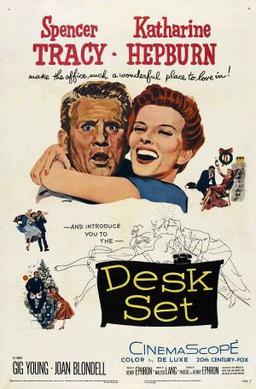
Before The Age of The Internet There Was…Katherine Hepburn and Spencer Tracey’s Desk Set


Before The Age of The Internet There Was…Katherine Hepburn and Spencer Tracey’s Desk Set


DVD Review

From The Pen Of Sam Lowell

 Desk Set, starring Katherine Hepburn, Spencer Tracey, 1957  


Yes, to answer the question posed by the title of this sketch, before the Internet, before the whole web of now baffling sets of social networking and media outlets to while away the hours there was, well, a love story involving computers, and their uses back in the day, back in the 1950s days when one computer was housed in a whole room of some dimensions. Hard as it is to believe now that you can get a million times more information off of your smart phone than the humongous machines were capable of producing back in the 1950s this whole modern “information superhighway” superstructure posed certain questions then continue to haunt us today. That is the subtext to the film under review, Desk Set, the sophisticated romantic comedy starring the famous Hollywood acting couple Katherine Hepburn and Spencer Tracey.     

Ironically the story line of this film is set in the New York network broadcasting industry at a time when that medium, when conventional television, was “king of the hill” and which is now embattled with about six million other ways of getting information available at the click of a button. But like all business enterprises then and now, the bottom line was, and is, to get the biggest profits the most effective and cost-productive way possible. Enter automation, enter the replacement of the human factor with the efficiencies of the machine. Sound familiar? The way this one plays out is that Sam (played by Tracey), a crackerjack engineer who helped create the then first word in computers, was hired by the broadcast company to streamline its operations with the new machines (then mainly produced when they were of monstrous size by IBM) and one of the first targets was the research department headed by crackerjack head researcher Bunny (played by Hepburn and where the scriptwriters got the name Bunny for the very proper Miss H can only be accounted for by the old Wasp network of Sunnys, Bunnys, Muffys in horse country places or at institutions like Bryn Mawr). Thus the battle is joined.               

Sam and Bunny do their dance, the dance around the subtext message at first about the uses of computers to streamline the research work process which had Bunny and her co-workers (three very smart women who nevertheless in the 1950s wound up as clerks in the research department rather than upstairs running things in the executive suites) worried about their jobs, and rightly so. That worry gets resolved rather simply when the obvious truth about information machines (then, now it might be a bit more problematic)-they are only as good as the humans who put the information in and analyze it meant they would  have more work to do rather than less and would have a higher rate of productivity to satisfy that bottom line. (That same condition applies today although on a global basis begging the question of who will be doing that more productive work-some Seven Sisters graduate or some up and coming smart woman in Mumbai.)     

Nice theme but let’s get back to reality for after all whether using computers or books as the subtext Hollywood is looking for a romantic resolution to a romantic comedy and while we can love our modern technology the fate of the computer is not going to fill seats in a movie theater. But the love triangle pitch certainly will. Bunny was, well, hung up on this guy, Mike, who was on his way up in the company but who couldn’t commit to a serious relationship (a serious relationship meaning one that ended in marriage) until Sam came on the scene and started making Bunny think twice about her status as Mike’s easy thing, as his dishrag. Naturally despite all the travails with the computers gumming up the works and the situation with Mike Bunny and Sam wound up as an “item” of gossip for the water cooler break crowd. See 1950s Hollywood didn’t let us down.  

Once Again On The 1960s Folk Minute-The Cambridge Club 47 Scene

Once Again On The 1960s Folk Minute-The Cambridge Club 47 Scene


Joshua Breslin, Carver down in the wilds of Southeastern Massachusetts cranberry bog country born, had certainly not been the only one who had recently taken a nose-dive turn back in time to that unique moment from the very late 1950s, say 1958, 1959 when be-bop jazz (you know Dizzy, the late Bird, the mad man Monk the guys who bopped swing-a-ling for “cool” high white note searches on the instruments) “beatnik” complete with beret and bop-a-long banter and everybody from suburban land was clad in black, who knows maybe black underwear too something the corner boys in front of Jimmy Jack’s Diner salaciously contemplated about the female side, was giving way to earnest “folkie” (and no alluring black but flannel shirts, unisex blue jeans and unisex sandals leaving nothing in particular to the fervent corner boy imagination) in the clubs that mattered around the Village (the Gaslight, Geddes Folk City, half the joints on Bleecker Street), Harvard Square (Club Blue, the place for serious cheap dates since for the price of coffees and pastries for two you could linger on, Café Blanc, the place for serious dates since they had a five dollar minimum, Club 47, the latter a place where serious folkies and serious folk musicians hung out) and North Beach (Club Ernie’s, The Hungry Eye, all a step behind the folk surge since you would still find a jazz-poetry mix longer than in the Eastern towns) to the mid-1960s when folk music had its minute as a popular genre. Even guys like Sam Eaton, Sam Lowell, Jack Callahan and Bart Webber, who only abided the music back in the day, now too, because the other guys droned on and on about it under the influence of Peter Markin a guy Josh had met  in the summer of love, 1967 were diving in too. Diving into the music which beside first love rock and roll got them through the teenage night.

The best way to describe that turn from b-bop beat to earnest folkie, is by way of a short comment by the late folk historian Dave Von Ronk which summed up the turn nicely. Earlier in that period, especially the period after Allen Ginsburg’s Howl out in the Frisco poetry slam blew the roof off modernist poetry with his talk of melted modern minds, hipsters, negro streets, the fight against Moloch and Jack Kerouac’s On The Road in a fruitless search for the father he and Neal Cassady never knew had the Army-Navy surplus stores cleaning out their rucksack inventories, when “beat poets” held sway and folkies were hired to clear the room between readings he would have been thrown in the streets to beg for his supper if his graven voice and quirky folk songs did not empty the place, and he did (any serious look at some of his earliest compositions will tell in a moment why, and why the cross-over from beat to folkie by the former crowd never really happened. But then the sea-change happened, tastes changed and the search for roots was on, and Von Ronk would be doing three full sets a night and checking every folk anthology he could lay his hands on (including naturally Harry Smith’s legendary efforts and the Lomaxes and Seegers too) and misty musty record store recordings to get enough material.

People may dispute the end-point of that folk minute like they do about the question of when the turn the world upside down counter-cultural 1960s ended as a “youth nation” phenomenon but clearly with the advent of acid-etched rock (acid as in LSD, blotter, electric kool aid acid test not some battery stuff ) by 1967-68 the searching for and reviving of the folk roots that had driven many aficionados to the obscure archives like Harry Smith’s anthology, the recording of the Lomaxes, Seegers and that crowd had passed.

As an anecdote, one that Josh would use whenever the subject of his own sea-change back to rock and roll came up, in support of that acid-etched dateline that is the period when Josh stopped taking his “dates” to the formerly ubiquitous home away from home coffeehouses which had sustained him through many a dark home life night in high school and later when he escaped home in college, cheap poor boy college student dates to the Harvard Square coffeehouses where for the price of a couple of cups of coffee, expresso then a favorite since you could sip it slowly and make it last for the duration and rather exotic since it was percolated in a strange copper-plated coffee-maker, a shared pastry of unknown quality, and maybe a couple of dollars admission charge or for the “basket” that was the life-support of the performers you could hear up and coming talent working out their kinks, and took them instead to the open-air fashion statement rock concerts that were abounding around the town. The shift also entailed a certain change in fashion from those earnest flannel shirts, denims, lacy blouses and sandals to day-glo tie-dye shirts, bell-bottomed denims, granny dresses, and mountain boots or Chuck Taylor sneakers. Oh yeah, and the decibel level of the music got higher, much higher and the lyrics talked not of ancient mountain sorrows, thwarted triangle love, or down-hearted blues over something that was on your mind but to alice-in-wonderland and white rabbit dreams, carnal nightmares, yellow submarines, satanic majesties, and wooden ships on the water.             


Some fifty years out others in Josh-like fits of nostalgia and maybe to sum up a life’s work there have been two recent documentaries concerning the most famous Harvard Square coffeehouse of them all, the Club 47 (which still exists under the name of the non-profit Club Passim which traces its genealogy to that legendary Mount Auburn Street spot in a similar small venue near the Harvard Co-Op Bookstore off of Church Street).


One of the documentaries put out a few years ago (see above) traces the general evolution of that club in its prime when the likes of Bob Dylan, Joan Baez, Tom Rush, Eric Von Schmidt, the members of the Jim Kweskin Jug Band (the forming of jug bands, a popular musical form including a seemingly infinite number of bands with the name Sheik in them, going back to the early 20th century itself a part of the roots revival guys like Josh were in thrall to), and many others sharpened up their acts there. The other documentary, No Regrets (title taken from one of his most famous songs) which Josh reviewed for one of the blogs, The American Folk Minute, to which he has contributed to over the years is a biopic centered on the fifty plus years in folk music of Tom Rush. Both those visual references got Josh thinking about how that folk scene, or better, the Harvard Square coffeehouse scene kept Josh from going off the rails, although that was a close thing.        


Like about a billion kids before and after Josh in his coming of age in the early 1960s went through the usual bouts of teenage angst and alienation aided and abetted by growing up “from hunger” among the very lowest rung of the working poor with all the pathologies associated with survival down at the base of society where the bonds of human solidarity are often times very attenuated. All of this “wisdom” complete with appropriate “learned” jargon, of course figured out, told about, made many mistakes to gain, came later, much later because at the time Josh was just feeling rotten about his life and how the hell he got placed in a world which he had not created (re-enforced when questioned by one Delores Breslin with Prescott Breslin as a behind-the scenes back-up about his various doings) and no likely possibilities of having a say what with the world stacked against him, his place in the sun (and not that “safe” white collar civil service job that Delores saw as the epitome of upward mobility for her brood), and how he didn’t have a say in what was going on. Then through one source or another mainly by the accident of tuning in his life-saver transistor radio, which for once he successfully badgered to get from Delores and Prescott one Christmas by threatening murder and mayhem if he didn’t when all his corner boys at Jimmy Jack’s Diner had them, on one Sunday night to listen to a favorite rock and roll DJ that he could receive on that night from Chicago he found a folk music program that sounded interesting (it turned out to be the Dick Summer show on WBZ, a DJ who is featured in the Tom Rush documentary) and he was hooked by the different songs played, some mountain music, some jug, some country blues, some protest songs. Each week Dick Summer would announce who was playing where for the week and he kept mentioning various locations, including the Club 47, in Harvard Square. Josh was intrigued, wanted to go if only he could find a kindred for a date and if he could scratch up some dough. Neither easy tasks for a guy in high teen alienation mode.           


One Saturday afternoon Josh made connections to get to a Red Line subway stop which was the quickest way for him to get to Harvard Square (and was also the last stop on that line then) and walked around the Square looking into the various clubs and coffeehouses that had been mentioned by Summer and a few more as well. You could hardly walk a block without running into one or the other. Of course during the day all people were doing was sitting around drinking coffee and reading, maybe playing chess, or as he found out later huddled in small group corners working on their music (or poetry which also still had some sway as a tail end of the “beat” scene) so he didn’t that day get the full sense of what was going on. A few weeks later, having been “hipped” to the way things worked, meaning that as long as you had coffee or something in front of you in most places you were cool Josh always chronically low on funds took a date, a cheap date naturally, to the Club Blue where you did not pay admission but where Eric Von Schmidt was to play. Josh had heard his Joshua Gone Barbados covered by Tom Rush on Dick Summer’s show and he had flipped out so he was eager to hear him. So for the price of, Josh thought, two coffees each, a stretched-out shared brownie and two subway fares they had a good time, an excellent time (although that particular young woman and Josh would not go on much beyond that first date since she was looking for a guy who had more dough to spend on her, and maybe a “boss” car too).


Josh would go over to Harvard Square many weekend nights in those days, including sneaking out of the house a few time late at night and heading over since in those days the Red Line subway ran all night. That was his home away from home not only for cheap date nights depending on the girl he was interested in but when the storms gathered at the house about his doing, or not doing, this or that, stuff like that when his mother pulled the hammer down. If Josh had a few dollars make by caddying for the Mayfair swells at the Carver Country Club, a private club a few miles from his house he would pony up the admission, or two admissions if he was lucky, to hear Joan Baez or her sister Mimi with her husband Richard Farina, maybe Eric Von Schmidt, Tom Paxton when he was in town at the 47. If he was broke he would do his alternative, take the subway but rather than go to a club he would hang out all night at the famous Harvard Square Hayes-Bickford just up the steps from the subway stop exit. That was a wild scene made up of winos, grifters, con men, guys and gals working off barroom drunks, crazies, and… almost every time out there would be folk-singers or poets, some known to him, others from cheap street who soon faded into the dust, in little clusters, coffee mugs filled, singing or speaking low, keeping the folk tradition alive, keeping the faith that a new wind was coming across the land and they, Josh, wanted to catch it. Wasn’t that a time.          

Saturday, December 26, 2015

Remembrances Of Things Past-With Jeff Higgin’s Class Of 1964 In Mind


Remembrances Of Things Past-With Jeff Higgins’ Class Of 1964 In Mind


From The Pen Of Bart Webber


There was always something, some damn thing to remind Jeff Higgins, Class of 1964, a fateful year in his life and not just because that was the year that he graduated from North Quincy High School down in the Southeastern corner of Massachusetts. He had recently (2014, and if you did the math you would know that represented the fiftieth anniversary of the his graduation) gone through something of a serious traumatic experience which left him numb every time something came up about that year, some remembrance. If you knew Jeff, with his three divorces and several affairs along with scads of children and grandchildren now from the marriages not the affairs, you would know that it was about a woman, always about a woman, he eternally afflicted as old as he was.


About a woman this time, this eternal time  named Elizabeth Drury (not Liz or Betty no way she was not anything but a proper Elizabeth-type, who held maybe Queen Elizabeth I as her model, even in high school) whom he had had a brief puff of air affair with in that same 2014 but which had seemingly vanished in his dust of memory until he went up in the attic to clean up some stuff, get rid of most of it in anticipation of selling his house and moving to a more manageable condo, down-sizing they call it in the real estate trade, and found a faded tattered copy of his class’ remembrance card. You know those time vault cards that card companies like Hallmark, the source of this one, put out so that people, or this case the whole class by some tabulations, can put down favorite films, people, records, who was President, and other momentous events from some important year like a graduation to be looked at in later years and ahhed over. That yellowed sheet brought back not just memories of that faded long ago year but of Elizabeth in the not so faded past. So, yes, it was always some damn thing.      


But maybe we had better take you back to the beginning, back to how 1964 and Elizabeth Drury had been giving one Jeffery Higgins late of North Quincy nothing but pains. Jeff had been for many, many years agnostic about attending class reunions, had early on after graduation decided that he needed to show his back to the whole high school experience and to the town. A lot of that teenage angst having to do with his humble beginnings as a son of a “bogger,” a father who worked in the cranberry bogs when there was work for which the town was then famous and which represented the low-end of North Quincy society. The low-end which others in the town including his fellow classmates in high school who were as socially class conscious as any Mayfair swells made him feel like a nobody and a nothing for no known reason except that he was the son of a bogger which after all he could not help. (Of course those social exclusions played themselves out under the veil of his not dressing cool, living off the leavings of his older brothers, living off of Bargain Center rejected materials not even cool when purchased, you know, white shirts with stripes when that was not cool, black chinos with cuffs like some farmer, ditto, dinky Thom McAn shoes with buckles for Chrissake, just as his younger brothers lived off his in that tight budget world of the desperate working poor, of his not having money for dates even with fellow bogger’s daughters, and hanging corner dough-less, girl-less corners with fellow odd-ball bogger outcasts). So Jeff had no trouble drifting away from that milieu, had no trouble putting dust on his shoes to get out and head west when the doings out west were drawing every iterant youth to the flame, to the summers of love.


And there things stood in Jeff’s North Quincy consciousness for many years until maybe 2012, 2013 when very conscious that a hallmark 50th class reunion would be in the works and with more time on his hands as he had cut back on the day to day operation of his small law practice in Cambridge he decided that he would check out the preparations, and perhaps offer his help to organize the event. He had received notification of his class’ fortieth reunion (which he had dismissed out of hand only wondering how the reunion committee had gotten his address for while he was not hiding from anything he was also not out there publicly since he did not have clients other than other lawyers whom he wrote motions, briefs, appeals and the like for, until he realized that as a member of the Massachusetts bar he would have that kind of information on his bar profile page) so via the marvels of modern day technology through the Internet he was able to get hold of Donna Marlowe (married name Rossi) who had set up a Facebook page to advertise the event.


That connection led to Jeff drafting himself onto the reunion committee and lead directly to the big bang of pain that he would subsequently feel. Naturally in a world filled with social media and networking those from the class who either knew Donna or the other members of the committee or were Internet savvy joined the class’ Facebook page and then were directed to a class website (as he found out later his generation unlike later ones was on the borderline of entering the “information superhighway” and so not all classmates, those still alive anyway, were savvy that way). On that website set up by tech savvy Donna (she had worked in the computer industry at IBM during her working career) each classmate who joined the site had the ability to put up a personal profile next to their class photograph like many other such sites and that is where Sam saw Elizabeth Drury’s profile and a flood of memories and blushes.            


In high school Jeff had been smitten by Elizabeth, daughter of a couple of school teachers who worked in Marshfield and therefore stationed well above the boggery of the town. But in things of the heart things like class distinctions, especially in democratically-etched America, are forgotten and sometime make one foolhardy. That had almost happened to Jeff, except his corner boy Jack Callahan put him wise. Jeff and Elizabeth had several classes together senior year and sat across from each other in English class and since both loved literature and were school-recognized as such they had certain interests in common. So they talked, talked in what Jeff thought was very friendly and somewhat flirty manner (or as he thought later after the flame had burned out maybe he just hoped that was the case) and he formed an intention to ask her out even if only to Doc’s Drugstore for an after school soda and a listen to the latest platters on Doc’s jukebox which had all the good stuff that kids were dancing to in those days. He figured from there he could work up to a real date. But sometimes the bumps and bruises of the bogger life left a little sense and so before making attempts at such a conquest Jeff consulted with Jack Callahan to see if Elizabeth was “spoken for” (Jeff’s term if you can believe that). See Jack, a star football player even if a bogger’s son got something of an exemption from the rigid routine of the social structure of the Senior class just by being able to run through defensive lines on any given granite grey autumn afternoon and had excellent “intelligence” on the whole school system’s social network, in other words who was, or was not, spoken for. (By the way that “grapevine” any high school grapevine, maybe middle school too would put the poor technicians at the CIA and the spooks at NSA to shame with the accuracy of the information. It had to be that resourceful otherwise fists would fly.) The word on Elizabeth, forget it, off-limits, an “ice queen.” So Jeff saved himself plenty of anguish and he moved on with his small little high school life.


Seeing her name and profile though that many years later made him curious, made him wonder what had happened to her and since he was now “single” he decided he would write her a private e-mail to her profile page something which the website was set up to perform and which the reunion committee was recommending alumnus to do. That “single” a condition that he now considered the best course after three shifts of alimony, child support and college tuitions made him realize that it was infinitely cheaper to just live with a woman and be done with it. Jeff wrote a short message asking whether she remembered him and she replied that she very well did remember him and their “great” (her term) conversations about Thomas Hardy, Ernest Hemingway and Edith Wharton. That short message and reply “sparked” something and they began a flurry of e-mails giving outlines of their subsequent history, including the still important one to Sam whether she was “spoken for.” She was not having had two divorces although no kids in her career as a professor at the State University. Somehow these messages led Jeff to tell her about his talk with Jack Callahan. And she laughed not at the “intelligence” which was correct but not for the reasons that Jack gave (her father was an abusive “asshole,” her term for her standoffishness and reputation as an “ice queen”). She laughed because despite her being flirty, at least that was what she thought she was attempting to do because she certainly was interested when they would talk Jeff had never asked her out and then one day just stopped talking to her for no known reason. Damn.                    


They say, or at least Thomas Wolfe did in the title of one of his novels-you can’t go home again but neither Jeff nor Elizabeth after that last exchange of e-mails about the fateful missing chance would heed the message. They decided to meet in Cambridge one night to see if that unspoken truth had any substance. They did meet, got along great, had many stories to exchange and it turned out many of the same interests (except golf a sport which relaxed Jeff when he was all wound up but which Elizabeth’s second husband had tried to teach her to no avail). And so their little affair started, started with great big bursts of flames but wound up after a few months smoldering out and being blown away like so much dust in the wind once Elizabeth started talking about marriage. Jeff was willing to listen to living together but his own strange marital orbit had made him very strongly again any more marriages. So this pair could not go home again, not at all, and after some acrimonious moments they parted.           


Jeff knew that was the best course, knew he had to break it off but it still hurt enough that any reference to 1964 made him sad. As he took a look at the sentiment expressed in that tattered yellowed document he had a moment reprieve as he ahh-ed over the information presented. Had he really forgotten that there was not Vice-Presidential succession then when Lyndon Johnson became President after the assassination of home state Irish Jack Kennedy. That My Fair Lady was popular then as now. That the Beatles had appeared on Ed Sullivan’s Show and done a film, that Chapel of Love had been a hit that year as well. That 1964 was the year the Mustang that he would have died for came out into the world. That gas was only about thirty cent a gallon, and that another Elizabeth, Elizabeth Taylor, married one Richard Burton for the first time (although not the last). And on the note he put the yellowed tattered document in the tr

Free Herman Bell-Free All The Class- War Prisoners

Free Herman Bell-Free All The Class- War Prisoners


John Brown’s Body Lies A Moldering In The Grave-With The Massachusetts 54th Black Volunteer Regiment In Mind

John Brown’s Body Lies A Moldering In The Grave-With The Massachusetts 54th Black Volunteer Regiment In Mind.


Every time I pass the frieze honoring the heroic Massachusetts 54th Black Volunteer Regiment across from the State House on Beacon Street in Boston, a unit that fought in the American Civil War, a war which we have just finished commemorating the 150th anniversary of its formal ending (April 1865) I am struck by one figure who I will discuss in a minute. For those who do not know the 54th Regiment the unit had been recruited and made up of all volunteers, former slaves, freedmen, maybe a current fugitive slave snuck in there, those were such times for such unheralded personal valor, the recruitment a task that the great abolitionist Frederick Douglass, himself an ex-slave had been central in promoting (including two of his sons). All knew, or soon became aware that if they did not fight to the finish they would not be treated as prisoners of war but captured chattel subject to re-enslavement or death.  The regiment fought with ferocious valor before Fort Wagner down in South Carolina and other hot spots where an armed black man, in uniform or out, brought red flashes of deep venom, if venom is red, but hellfire hatred in any case to the Southern plantation owners and their hangers-on (that armed black men acting in self-defense of themselves and theirs still bringing hellfire hatred among some whites to this day, no question).

I almost automatically focus in on that old hard-bitten grizzled erect bearded soldier who is just beneath the head of the horse being ridden by Colonel Robert Gould Shaw, the white commander of the regiment who from a family of ardent abolitionists fell with his men before Fort Wagner and was buried with them, an honor. (See above) I do not know the details of the model Saint-Gauden’s used when he worked that section (I am sure that specific information can be found although it is not necessary to this sketch) but as I grow older I appreciate that old man soldier even more, as old men are supposed to leave the arduous duty of fighting for just causes, arms in hand, to the young.
I like to think that that old grizzled brother who aside from color looks like me when he heard the call from Massachusetts wherever he was, maybe had read about the plea in some abolitionist newspaper, had maybe even gotten the message from Frederick Douglass himself through his newspaper, The North Star, calling Sable Brother to Arms or on out the stump once Lincoln unleashed him to recruit his black brothers for whatever reason although depleting Union ranks reduced by bloody fight after bloody fight as is the nature of civil war when the societal norms are broken  as was at least one cause, he picked up stakes leaving some small farm or trade and family behind and volunteered forthwith. Maybe he had been born, like Douglass, in slavery and somehow, manumission, flight, something, following the Northern Star, got to the North. Maybe learned a skill, a useful skill, got a little education to be able to read and write and advance himself and had in his own way prospered.
But something was gnawing at him, something about the times, something about tow-headed white farm boys, all awkward and ignorant from the heartland of the Midwest, sullen Irish and other ethnic immigrants from the cities where it turned out the streets were not paved with gold and so took the bounty for Army duty, took some draft-dodger’s place for pay, hell, even high-blown Harvard boys were being armed to defend the Union (and the endless names of the fallen and endless battles sites on Memorial Hall at Harvard a graphic testament to that solemn sense of duty then. And more frequently as the days and months passed about the increasing number of white folk who hated, hated with a red-hot passion, slavery and if that passion meant anything what was he a strong black man going to do about it, do about breaking the hundreds of years chains. Maybe he still had kindred under the yolk down South in some sweated plantation, poorly fed, ill-treated, left to fester and die when not productive anymore, the women, young and old subject to Mister’s lustful appetites and he had to do something.
Then the call came, Governor Andrews of Massachusetts was raising a “sable” armed regiment (Douglass’ word) to be headed by a volunteer Harvard boy urged on by his high abolitionist parents, Colonel Shaw, the question of black military leadership of their own to be left to another day, another day long in the future as it turned out but what was he to know of that, and he shut down his small shop or farm, said good-bye to kin and neighbors and went to Boston to join freedom’s fight. I wonder if my old bearded soldier fell before Fort Wagner fight down in heated rebel country, or maybe fell in some other engagement less famous but just as important to the concept of disciplined armed black men fighting freedom’s fight. I like to think thought that the grizzled old man used every bit of wit and skill he had and survived to march into Charleston, South Carolina, the fire-breathing heart of the Confederacy, then subdued at the end of war with his fellows in the 54th stepping off to the tune of John Brown’s Body Lies A-Moldering In The Grave. A fitting tribute to Captain Brown and his band of brother, black and white, at Harper’s Ferry fight and to an old grizzled bearded man’s honor.             

From The Abraham Lincoln Brigade Archive Website- The Alba

From The Abraham Lincoln Brigade Archive Website- The Alba
Blog


Click below to link to the Abraham Lincoln Brigade Archive blog page for all kinds of interesting information about that important historic grouping in the International Brigades that fought for our side, the side of the people in the Spanish Civil War, 1936-39.


http://www.albavolunteer.org/category/blog/


As everybody probably knows by now who has following this blog for a time Ralph Morris and I, Sam Eaton, met down in Washington, D.C. on May Day 1971 on the football field at then RFK Stadium while being held by the D.C. police (although Ralph was picked off by a National Guard soldier who transferred him to D.C. hands as the division of labor played out that day) for having tried to shut down the government if it did not shut down the war, that war being the Vietnam War that tore our generation, our nation asunder. I had gone down to Washington that weekend before May Day with a group of radicals from Cambridge who were part of an larger affinity group which had planned to “capture” the White House and Ralph had joined a group of anti-war Vietnam veterans who had planned to surround the Pentagon, a less exciting but more possible task.

Inevitably we had been arrested well before achieving either of our objectives along with thousands of others who were outraged by that endless war and committed to shutting it down, shutting it down some damn way so don’t smirk when you read this (“endless war,” sound familiar?). Ralph had noticed me wearing a button on my shirt indicating that I was a supporter of Vietnam Veterans Against the War (VVAW) and had asked me if I had served in Vietnam. Having been exempted from military service by a hardship deferment due to my being the sole surviving supporter of my mother and four much younger sisters after my father had died of a massive heart attack in 1965 I rather sheepishly told Ralph the story of how my best buddy, my closest “corner boy,” Jeff Mullins, had been blown away in some God forsaken village up in the Central Highlands of Vietnam and that had spurred me who had been really indifferent to the war before to get involved as an anti-war activist a couple of years before doing civil disobedience actions leading up to the big action in D.C. in 1971. Ralph that afternoon (and late into the night since we wound up being held for three days before we figured that some side exits were unguarded and scooted out of the place) had told me his story of how he had come out of the Army after serving eighteen months with a unit up in that same Central Highlands where Jeff had been blown away and had been so angry at the government for making him and his Army buddies what he called “animals” that on discharge he had lined up with VVAW (through a fellow soldier in him in whom he had kept in touch with while stationed at Fort Devens in Massachusetts before he time was up).

After many hours of talking and getting a feel for each other we thereafter joined forces, did a number of actions later over the next couple of years until the high tide of the 1960s ebbed and faded. We have remained friends throughout, although some years sporadically,   and up until 2003 with the big invasion of Iraq would “do our duty” when some anti-war or social justice issue hit us between the eyes. Since then we have been on a steady diet of fighting the endless wars the last two American governments have immersed the country in without being any closer to the end than when we started.    

After May Day 1971, and for a while after the high tide ebbed through about 1976 I think (and Ralph thinks that is about the right time frame as well) he and I would attend various study groups run by radicals and “reds” to find out about the earlier history of the left-wing movement in America and internationally to see if we could learn any lessons that might help us in our social struggles. The whole summer of 1972 was spent in one such group when I was living in a commune in Cambridge and invited Ralph to stay with me and get involved in one of the “red collective” study groups that were sprouting up then as people despaired over the old strategies and tactics that had ground us to a standstill.

One of the big events that we studied which held us in thrall, especially since neither of us were history buffs or knew much from our high school history classes was the fierce battle between the fascists and republicans in the Spanish Civil War of the late 1930s. Particularly the exploits of the International Brigades and the Abraham Lincoln Battalion of the 15th Brigade that fought valiantly if forlornly on the Republican side. Many a night we would ask ourselves the question of whether we would have fought, fought honorably in Spain (assuming that the Stalinists who controlled entry, controlled the “politically reliable elements” that they vetted into the Abraham Lincoln would have let us in). We hoped we would have. As Ralph and I have been fighting the good fight against the endless wars this time around (everyone will agree that over a dozen years and counting with no end in sight qualifies for such a designation) we have taken advantage of the Internet to see what other organizations and individuals have been up to. One day when I was Googling I came up upon this Abraham Lincoln Brigade website and was intrigued by its offerings. I made some comments about it and about Spain in the 1930s on the site. Here is what I had to say (I wrote this but Ralph put in his fair share of ideas so it is a two person commentary):            

This blog had gotten my attention for two reasons: those rank and filers who fought to defend democracy, fight the fascists and fight for socialism in Spain for the most part, political opponents or not, were kindred spirits; and, those with first-hand knowledge of those times over seventy years ago are dwindling down to a precious few and so we had better listen to their stories while they are around to tell it. Viva La Quince Brigada!  

*******

I have been interested, as a pro-Republican partisan, in the Spanish Civil War since I was in my twenties. What initially perked my interest, and remains of interest, is the passionate struggle of the Spanish working class to create its own political organization of society, its leadership of the struggle against Spanish fascism and the romance surrounding the entry of the International Brigades, particularly the American Abraham Lincoln Battalion of the 15th Brigade, into the struggle.

Underlying my interests has always been a nagging question of how that struggle could have been won by the working class. The Spanish proletariat (okay, okay working class) certainly was capable of both heroic action and the ability to create organizations that reflected its own class interests i.e. the worker militias and factory committees. Of all modern working class revolutions after the Russian revolution of 1917 Spain showed the most promise of success. Bolshevik leader Leon Trotsky who had helped lead the successful October revolution and then led the military fight to defend the gains against the Whites arms in hands noted that the political class consciousness of the Spanish proletariat at that time was higher than that of the Russian proletariat in 1917. Yet it failed in Spain. Trotsky's writings on this period represent a provocative and thoughtful approach to an understanding of the causes of that failure. Moreover, with all proper historical proportions considered, his analysis has continuing value as the international working class struggles against the seemingly one-sided class war being waged by the international bourgeoisie today.

The Spanish Civil War of 1936-1939 has been the subject of innumerable works from every possible political and military perspective possible. A fair number of such treatises, especially from those responsible for the military and political policies on the Republican side, are merely alibis for the disastrous policies that led to defeat. Trotsky's complication of articles, letters, pamphlets, etc. which were made into a volume for publication is an exception. Trotsky was actively trying to intervene in the unfolding events in order to present a program of socialist revolution that most of the active forces on the Republican side were fighting, or believed they were fighting for. Thus, Trotsky's analysis brings a breath of fresh air to the historical debate. That in the end Trotsky could not organize the necessary cadres to carry out his program or meaningfully impact the unfolding events in Spain is one of the ultimate tragedies of that revolution. Nevertheless, Trotsky had a damn good idea of what forces were acting as a roadblock to revolution. He also had a strategic conception of the road to victory. And that most definitely was not through the Popular Front.

The central question Trotsky addresses throughout the whole period under review here was the crisis of revolutionary leadership of the proletarian forces. That premise entailed, in short, a view that the objective conditions for the success of a socialist program for society had ripened. Nevertheless, until that time, despite several revolutionary upheavals elsewhere, the international working class had not been successful anywhere except in backward Russia. Trotsky thus argued that it was necessary to focus on the question of forging the missing element of revolutionary leadership that would assure victory or at least put up a fight to the finish.

This underlying premise was the continuation of an analysis that Trotsky developed in earnest in his struggle to fight the Stalinist degeneration of the Russian Revolution in the mid-1920's. The need to learn the lessons of the Russian Revolution and to extend that revolution internationally was thus not a merely a theoretical question for Trotsky. Spain, moreover, represented a struggle where the best of the various leftist forces were in confusion about how to move forward. Those forces could have profitably heeded Trotsky's advice. I further note that the question of the crisis of revolutionary leadership still remains to be resolved by the international working class.

Trotsky's polemics in that volume are highlighted by the article ‘The Lessons of Spain-Last Warning’, his definitive assessment of the Spanish situation in the wake of the defeat of the Barcelona uprising in May 1937. Those polemics center on the failure of the Party of Marxist Unification (hereafter, POUM) to provide revolutionary leadership. That party, partially created by cadre formerly associated with Trotsky in the Spanish Left Opposition, failed on virtually every count. Those conscious mistakes included, but were not limited to, the creation of an unprincipled bloc between the former Left Oppositionists and the former Right Oppositionists (Bukharinites) of Maurin to form the POUM an organization which almost consciously limited itself to organizing in vanguard Catalonia in 1935; political support to the Popular Front including entry into the government coalition by its leader; creation of its own small trade union federation instead of entry in the anarchist led-CNT; creation of its own militia units reflecting a hands-off attitude toward political struggle with other parties; and, fatally, an at best equivocal role in the Barcelona uprising of 1937.

Trotsky had no illusions about the roadblock to revolution of the policies carried out by the old-time Anarchist, Socialist and Communist Parties. Unfortunately the POUM did. Moreover, despite being the most honest revolutionary party in Spain it failed to keep up an intransigent struggle to push the revolution forward. The Trotsky - Andreas Nin (key leader of the POUM and former Left Oppositionist) correspondence in the Appendix makes that problem painfully clear.

The most compelling example of this failure - As a result of the failure of the Communist Party of Germany to oppose the rise of Hitler in 1933 and the subsequent decapitation and the defeat of the Austrian working class in 1934 the European workers, especially the younger workers, of the traditional Socialist Parties started to move left. Trotsky observed this situation and told his supporters to intersect that development by an entry, called the ‘French turn,’ into those parties. Nin and the Spanish Left Opposition, and later the POUM failed to do that. As a result the Socialist Party youth were recruited to the Communist Party en masse. This accretion formed the basis for its expansion as a party and the key cadre of its notorious security apparatus that would, after the Barcelona uprising, suppress the more left-wing organizations like the POUM, the left-anarchists around Durrutti and so on. For more such examples of the results of the crisis of leadership in the Spanish Revolution read this book which is available on-line at the Leon Trotsky Archives section of the Marxist Internet Archives for the year 1939.

"Viva La Quince Brigada"- The Abraham Lincoln Battalion In The Spanish Civil War (2006)


BOOK REVIEW

THE ODYSSEY OF THE ABRAHAM LINCOLN BRIGADE: AMERICANS IN THE SPANISH CIVIL WAR, Peter N. Carroll, Stanford University Press, Stanford, California, 1994.
I have been interested, as a pro-Republican partisan, in the Spanish Civil War of 1936-39 since I was in my twenties. My first paper for a study group presentation sponsored by one of the “red collectives” that were sprouting forth in the early 1970s as disoriented and disheartened radicals and “reds” were seriously and studiously searching for ways to fight the American monster government after years of failure was on this subject. What initially perked my interest, and remains of interest, is the passionate struggle of the Spanish working class to create its own political organization of society, its leadership of the struggle against Spanish fascism and the romance surrounding the entry of the International Brigades, particularly the American Abraham Lincoln Battalion of the 15th Brigade, into the struggle.

Underlying my interests has always been a nagging question of how that struggle could have been won by the working class. The Spanish proletariat certainly was capable of both heroic action and the ability to create organizations that reflected its own class interests i.e. the worker militias and factory committees. Of all modern working class uprisings after the Russian revolution Spain showed the most promise of success. Russian Bolshevik leader Leon Trotsky noted in one of his writings on Spain that the Spanish proletariat at the start of its revolutionary period had a higher political consciousness than the Russian proletariat in 1917. That calls into question the strategies put forth by the parties of the Popular Front, including the Spanish Communist Party- defeat Franco first, and then make the social transformation of society. Mr. Carroll’s book while not directly addressing that issue nevertheless demonstrates through the story of the Abraham Lincoln Battalion how the foreign policy of the Soviet Union and through it the policy of the Communist International in calling for international brigades to fight in Spain aided in the defeat of that promising revolution.

Mr. Carroll chronicles anecdotally how individual militants were recruited, transported, fought and died as ‘premature anti-fascists’ in that struggle. No militant today, or ever, can deny the heroic qualities of the volunteers and their commitment to defeat fascism- the number one issue for militants of that generation-despite the fatal policy of the various party leaderships. Such individuals were desperately needed then, as now, if revolutionary struggle is to succeed. However, to truly honor their sacrifice we must learn the lessons of that defeat through mistaken strategy as we fight today. Interestingly, as chronicled here, and elsewhere in the memoirs of some veterans, many of the surviving militants of that struggle continued to believe that it was necessary to defeat Franco first, and then fight for socialism. This was most dramatically evoked by the Lincolns' negative response to the Barcelona uprising of 1937-the last time a flat out fight for leadership of the revolution could have galvanized the demoralized workers and peasants for a desperate struggle against Franco.

Probably the most important part of Mr. Carroll’s book is tracing the trials and tribulations of the volunteers after their withdrawal from Spain in late 1938. Their organization-the Veterans of the Abraham Lincoln Brigade- was constantly harassed and monitored by the United States government for many years as a Communist “front” group. Individuals also faced prosecution and discrimination for their past association with the Brigades. He also traces the aging and death of that cadre. In short, this book is a labor of love for the subjects of his treatment. Whatever else this writer certainly does not disagree with that purpose. If you want to read about what a heroic part of the vanguard of the international working class looked like in the 1930’s, look here. Viva la Quince Brigada!!