Wednesday, January 04, 2017

*****In The Time Of The 1960s Folk Minute- With Tom Rush’s No Regrets In Mind


*****In The Time Of The 1960s Folk Minute- With Tom Rush’s No Regrets In Mind 


I know your leavin's too long over due
For far too long I've had nothing new to show to you
Goodbye dry eyes I watched your plane fade off west of the moon
It felt so strange to walk away alone

No regrets
No tears goodbye
Don't want you back
We'd only cry again
Say goodbye again

The hours that were yours echo like empty rooms
Thoughts we used to share I now keep alone
I woke last night and spoke to you
Not thinkin' you were gone
It felt so strange to lie awake alone

No regrets
No tears goodbye
Don't want you back
We'd only cry again
Say goodbye again

Our friends have tried to turn my nights to day
Strange faces in your place can't keep the ghosts away
Just beyond the darkest hour, just behind the dawn
It feels so strange to lead my life alone

No regrets
No tears goodbye
Don't want you back
We'd only cry again
Say goodbye again


From The Pen Of Zack James 

A few years ago, maybe more like a decade or so, in an earlier 1960s folk minute nostalgia incantation fit Sam Eaton, who will be described further below, had thought he had finally worked out in his head what that folk moment had meant in the great musical arc of his life. Had counted up, had taken up and put value on its graces, did the great subtractions on its disappointments, that lack of beat that he had been spoon fed on in his head having heard maybe in the womb the sweats of some backbeat that sounded an awful lot like a band of the devil’s angels giving battle to the heavens, and got his head around, his expression, its clasps with certain young women, some absolute folkie women met in the Harvard Squares of the heated horny sex night and loves too not always with folkie women but just the muck of growing up and taking what came his way. So he had taken a back-flip, his expression, when he was required not out of his own volition like that great prairie fire burning before about why he felt after all these years that he needed to go back to what after all was a very small part of his life now that he was reaching four score and seventy, going back over the terrain of a small part of the musics that he had cultivated since early childhood.

Some of those musics from his parents’ slogging through the Great Depression and World War II be-bop swing big band Saturday night get your dancing slippers imposed on his tender back of brain not to be revived and revisited until many years later when he had heard some ancient Benny Goodman be-bop clarinet backing up a sultry-voiced Peggy Lee getting all in a silky sweat rage because her man like a million others was not a do right man but had been chasing her best friend the next best thing when he got his wanting habit on and Peggy turned ice queen when he ran out of dough after shooting craps against the dealer and decided he had been wrong to dismiss such music out of hand. Some of the music along the edges of his coming from that edgy feeling he got when he heard the classic rock that just creeped into his pre-teen brain and lingered there unrequited until he found out what in that beat spoke to his primordial instincts, what caused his feverish nights of wonder, of what made him tick, of what he had missed.

Folk, the folk minute he deeply imbibed for that minute, at least the exciting part of the minute when he heard, finally heard, something that did not make him want to puke every time he turned on the radio, put his ill-gotten coins, grabbed from mother’s pocketbook laying there in wait for his greedy hands or through some con, some cheapjack con he pulled on some younger kids in Jimmy Jakes’ Diner jukebox to impress a few of the girls in town who were not hung up on Fabian or Bobby, heard something very new in his life and so different from the other musics that he had grown up with that he grabbed the sound with both hands. He thought that sweating a decade ago where he done a few small pieces to satisfy his literary sense of things and put them in a desk drawer yellow, fray and gather dust until he passed on and somebody put the paper in a wastebasket for the rubbish men, thought he had ended those thoughts, closed out the chapter. Recently though he did another series of short citizen-journalist sketches of scenes from that period for various folk music related blogs and social media outlets. Sam had done that series at the request of his old time friend, Bart Webber, who will also be described in more detail below, from Carver, an old working-class town about thirty miles south of Boston which at the time was the cranberry capital of the world or close to it, and close enough to have been washed by the folk minute that sprouted forth in Harvard Square and Beacon Hill in Boston.

Sam and Bart who in their respective youths had been very close, had been corner boys together when that social category meant something, meant something about extreme teen alienation and angst combined with serious poverty, dirt poor poverty as in hand-me-down older brother clothes, as in no family car for long periods between old wreak of cars, of many surly peanut butter and jelly sandwiches, many Spam suppers, all fashioned to make these young men forever talking about big break-outs, about getting something for them and theirs but also for big candy-ased dreams too all put paid to, as one would expect of sons of “boggers,” those who cared for and harvested those world famous  cranberries, but also close because that was the way that corner boys were then, “having each other’s backs” was the term they used which confused even the best of the social scientists who investigated the phenomenon when that corner boy life meant juvenile delinquency, meant some unfathomed anger, some lack of socialization, some throwback to primeval muds, to some rising of the unkempt heathens they were payed to watch out for. Meant as well worry to those in power who were trying to weld society as one piece of steel to fight the internal and external red scare Cold War fight.

Like a lot of high school friends the cement that bound them in high school, that alienation, that comradery, those best left unsaid larcenous moments, the “midnight creeps” in Bart’s words when somebody asked him later what had made him and the corner boys put their reputations at risk for such small gain, a fact which also played a part in that “having each other’s back” broke apart once they graduated, or rather in their case once they had sowed their wild oats in the 1960s, those wild oats at the time meaning “drugs, sex, and rock and roll” combined with drifting the hitchhike road west in what one of their number, the late Pete Markin, called the search for the great blue-pink American West night.

Sam had stayed out in the West longer before he drifted back East to go to law school and pursue a professional career. Bart had returned earlier, had gotten married to his high school sweetheart and had started up and run a small successful specialty print shop based on the silk-screening tee-shirt and poster craze in Carver. They would run into each other occasionally when Sam came to town but for about twenty years they had not seen each other as both were busy raising families, working and travelling in different circles. One night though when Sam had been sitting in Jimmy Jakes’ Diner over on Spring Street in Carver having a late dinner by himself after having come to town to attend the funeral of a family member Bart had walked in and they then renewed their old relationship, decided that some spark from high school still held them together if nothing else that they both had been deeply formed, still held to those old corner boy habits toward life whatever successes they had subsequently enjoyed.

Along the way to solidifying there new relationship they would alternate meetings, some in Carver, some in Boston or Cambridge where Sam lived. On a recent trip to Boston to meet Sam at the Red Hat at the bottom of Beacon Hill Bart had walked pass Joy Street which triggered memories of the time in high school when he and his date who name he could not remember but she was a cousin of Sam’s “hot” date, Melinda Loring, who they went to school with and whom Sam was crazy to impress even though Melinda was not the daughter of a “bogger” but of school teachers and so from among the town’s better element and he was constantly on eggshells that she would toss him aside once she had figured out he was just another Fast Eddie corner boy trying to get into her pants, had taken them on a cheap date to the Oar and Anchor coffeehouse which stood at the corner of Joy and Cambridge Street to hear Lenny Lane who was an up and coming folk singer whom Sam had met on one of his clandestine midnight trips to Harvard Square on the Redline subway to hang out at the Hayes-Bickford.

That cheap part of the cheap date thing was important since Bart and Sam were as usual from hunger on money in the days when around Carver, probably around the world, guys paid expenses on dates, girls just looked beautiful or if not beautiful glad to not be forever hanging around the midnight telephone waiting for some two-timing guy to call them up for a date, and so short of just hanging at the Hayes for free watching weirdoes, con men, whores plying their trade, drunks, winos and occasional put upon artists, poets, writes and folk-singers perfecting their acts on the cheap, for the price of a couple of cups of coffee, a shared pastry and a couple of bucks in the “basket” for the performer you could get away with a lot especially when Bart was doing Sam a favor with that cousin (and worse could have gotten in trouble if Besty Binstock, his high school sweetheart. found out he was two-timing her although the two-timing involved the possibility of some off-hand sex with that cousin who was supposed to be “easy” but that in another story although come to think of it the situation could serve as another  prime example of “having each other’s back” when one of them was up against it).

Bart remembered that he had been very uncomfortable that night since he had had some feelings of guilt about two-timing (and lying to) Betsy starting out, had had trouble talking about anything in common, school, sports, the weather, with that cousin since she said she was doing Melinda a favor in order that she could go to Boston with Sam which Melinda’s mother would have balked at if she had told her they were going into Boston alone, going into Boston with a “bogger” alone. Moreover she knew nothing, cared nothing for folk music, didn’t even know what it was, said she had never heard of the thing, was fixated on Bobby Vee, dreamy guys, or something like that. What made that date worse was that Bart too then could hardly bear the sound of folk music, said repeatedly that the stuff was all dreary and involved weird stuff like murder and mayhem done on the banks of rivers, in back alleys, on darkened highways just because some woman would not come across, Jesus, strangely thwarted love reminding him of Sam’s forlorn quest for Melinda which seemed like some princess and pauper never the twain shall meet outcome, or hick stuff about home sweet home down in some shanty town in some desolate cabin without lights or water which sounded worse than Boggertown, singing high holy Jehovah stuff that made him wince, and of the hills and hollows in some misbegotten mountains made his teeth grind. So not a good mix, although it did turn out that the cousin was “easy,” did think he was dreamy enough to have sex with (with their clothes mostly on which was how more than one quicky one night stand wound up down by the boathouse near the Charles River after they had split from Sam and Melinda after the coffeehouse closed and that helped but had been the result of no help from the folk music they half-listened but more some dope that she had in her pocketbook after she passed had a joint around to get things going.            

After telling Sam about his recollections of Joy Street and that cousin, whose name was Judy Dennison Sam told him and who Sam had gone out with and agreed was a little sex kitten once she was stoned Bart started asking some questions about folk music. Sam said he was not finished with that Judy story, told Bart that fling was after the thing with Melinda had passed due not to class distinctions but to that hard fact that she was saving “it” for marriage, and had been very glad that he had that run and was not sorry he did. Bart started in again and asked Sam a million questions about various folk-singers and what had happened to them, were they still playing, still alive since Sam although he did not have the same keen interest of his youthful folk minute still kept small tabs on the scene, the now small scene through his long-time companion, Laura Perkins whom he met one night at the CafĂ© Nana several years before when Tom Tremble was playing there after Sam had not heard him in about forty years. The reason for Bart’s interest given that above he had said that the genre made his teeth grind was that after that night with Judy Bart did go on other double dates with Sam and Melinda, and later Suzanne when she was Sam’s next flame and a real folkie, to folk places and while he still would grind his teeth at some of the stuff did develop more tolerance for the genre, especially if the date Sam set up was a real foxy folkie girl (thinking on it now he couldn’t believe how unfaithful he had been to Betsy in those days but she too was saving “it” for marriage and some of those young women were very willing and had apartment or dorm rooms too).

The upshot of all of Bart’s questions was that Sam found that he was not really except for Tom Tremble who had lost his sweet baby James voice, forgot lyrics and had “mailed it in” that night he had met Laura and was cold “stonewalled” by the audience but possibly motivated by that old folkie feeling, or maybe just feeling sorry for a guy who had a big local following back in the day when the “basket” went around everybody put some dough in, Sam and Laura included, and a couple of other guys up on what had happened to the old-time folkies since for years he had merely listened on radio station WCAS and when that station went under WUMB out of U/Mass-Boston or listened to records, tapes or CDs. (Sam got big points from Laura that first night when he panned Tom, who Laura had never heard before being enough younger not to have been bitten by the folk minute craze and she agreed that Tom had “mailed it in”.) Since he was not all that familiar with what had happened to most of them he thereafter did some research, asked Laura some questions to lead the way and wound up writings that series of sketches. One series entitled Not Bob Dylan about the fate of prominent male folk-singers was a direct result of the Sam and Bart conversation. Here’s what he had to say about Tom Rush who back in the day he knew best from hanging around the old Club 47 on Mount Auburn Street:     

“…Other than enigmatic Bob Dylan who is the iconic never-ending tour male performer most people would still associate with that folk minute period they would draw a blank on a list of others who also were aspiring to make names for themselves in the folk milieu. I am not talking about guys like Lenny Lane who had one hit and then went back to graduate school in biology when he couldn’t get another contract, when his well ran dry, or like Tom Tremble who had a big local following around the old Club Nana when it was on Mount Auburn Street in Cambridge not where it is now on Brattle Street but who did mainly covers and just never broke out or Mike Weddle who had good looks, a good stage presence, had the young women going crazy but who just walked away one day when some good looking woman from Radcliffe came hither and he “sold out” to her father’s stockbroking business.

I’m talking about people like Tom Rush from New Hampshire who lit up the firmament around Cambridge via the Harvard campus folk music station, Dave Von Ronk the cantankerous folk historian and musician who knew more about what happened in the early, early days in the Village at the point where “beat” poetry was becoming passe and folk was moving in to fill in the gap, Phil Ochs who had probably the deepest political sensibilities of the lot and wrote some of the stronger narrative folk protest songs, Richard Farina who represented that “live fast” edge that we were bequeathed by the “beats” and who tumbled down the hill on a motorcycle, and Jesse Collin Young who probably wrote along with Eric Andersen and Jesse Winchester the most pre-flower child lyrics mid-1960s hippie explosion before folk got amplified of the bunch.

My friend Bart had just seen a fragile seeming, froggy-voiced Bob Dylan in one of stages of his apparently never-ending concerts tours up in Maine and had been shaken by the sight and had wondered about the fate of other such folk performers. That request turned into a series of reviews of male folk-singers entitled Not Bob Dylan (and after that, also at Bart’s request, a series entitled Not Joan Baez based on some of the same premises except on the distaff side (nice word, right, you know golden-voiced Judy Collins and her sweet songs of lost, Carolyn Hester and her elegant rendition of Walt Whitman’s Oh Captain, My Captain, Joan’s sister Mimi Farina forever linked with Richard and sorrows, and Malvina Reynolds who could write a song on the wing, fast okay, and based as well on the mass media having back then declared that pair the “king and queen” of the burgeoning folk music minute scene).

That first series (as had the second) had asked two central questions-why did those male folk singers not challenge Dylan who as I noted the media of the day had crowned king of the folk minute for supremacy in the smoky coffeehouse night (then, now the few remaining are mercifully smoke-free although then I smoked as heavily as any guy who though such behavior was, ah, manly and a way to seen “cool” to the young women, why else would we have done such a crazy to the health thing if not to impress some certain she)  and, if they had not passed on and unfortunately a number have a few more since that series as well most notably Phil Ochs of suicide early, Dave Von Ronk of hubris and Jesse Winchester of his battle lost over time had come, were they still working the smoke-free church basement, homemade cookies and coffee circuit that constitutes the remnant of that folk minute even in the old hotbeds like Cambridge and Boston. (What I call the U/U circuit since while other church venues are part of the mix you can usually bet safely that if an event is scheduled it will be at a U/U church which is worthy of a little sketch of its own sometime in order to trace the folk minute after the fanfare had died down and as a tribute to those big-hearted souls at radio stations like WCAS and WUMB and in places like Club Passim whose efforts have kept the thing going in order to try to pass it on to the younger generations now that demographics are catching up with the folkies from the 1960s heyday). Moreover, were they still singing and song-writing, that pairing of singer and writer having been becoming more prevalent, especially in the folk milieu in the wake of Bob Dylan’s word explosions back then. The days when the ground was shifting under the Tin Pan Alley Cole Porter/Irving Berlin/ Jerome Kern kingdom.   

Here is the general format I used in that series for asking and answering those two questions which still apply today if one is hell-bent on figuring out the characters who rose and fell during that time: 

“If I were to ask someone, in the year 2005 as I have done periodically both before and after, to name a male folk singer from the 1960s I would assume that if I were to get any answer to that question that the name would be Bob Dylan. That “getting any answer” prompted by the increasing non-recognition of the folk genre by anybody under say forty, except those few kids who somehow “found” their parents’ stash of Vanguard records (for example, there were other folk labels including, importantly, Columbia Records which pushed the likes of Dylan and John Hammond forward) just as some in an earlier Pete Seeger/Weavers/Leadbelly/ Josh White/Woody Guthrie records in our parents’ stashes. Today’s kids mainly influenced by hip-hop, techno-music and just straight popular music.

And that Dylan pick would be a good and appropriate choice. One can endlessly dispute whether or not Dylan was (or wanted to be since he clearly had tired of the role, or seemed to by about 1966 when he for all intents and purposes “retired” for a while prompted by a serious motorcycle accident and other incidents) the voice of the Generation of ’68 (so named for the fateful events of that watershed year, especially the Democratic Convention in America in the summer of that year when the old-guard pulled the hammer down and in Paris where the smell of revolution was palpably in the air for the first time since about World War II, when those, including me, who tried to “turn the world upside down” to make it more livable began to feel that the movement was reaching some ebb tide) but in terms of longevity and productivity, the never-ending touring until this day and releasing of X amount of bootleg recordings, the copyrighting of every variation of every song, including traditional songs, he ever covered and the squelching of the part of the work that he has control over on YouTube he fits the bill as a known quality. However, there were a slew of other male folk singers who tried to find their niche in the folk milieu and who, like Dylan, today continue to produce work and to perform. The artist under review, Tom Rush, is one such singer/songwriter.”

“The following is a question that I have been posing in reviewing the work of a number of male folk singers from the 1960s and it is certainly an appropriate question to ask of Tom Rush as well. Did they aspire to be the “king” of the genre? I do not know if Tom Rush, like his contemporary Bob Dylan, started out wanting to be the king of the hill among male folk singers but he certainly had some things going for him. A decent acoustic guitar but a very interesting (and strong baritone) voice to fit the lyrics of love, hope, and longing that he was singing about at the time, particularly the No Regrets/Rockport Sunday combination which along with Wasn’t That A Mighty Storm and Joshua Gone Barbados were staples early on. During much of this period along with his own songs he was covering other artists, particularly Joni Mitchell and her Urge For Going and The Circle Game, so it is not clear to me that he had that same Dylan drive by let’s say 1968.

I just mentioned that he covered Joni Mitchell in this period. A very nice version of Urge For Going that captures the wintry, got to get out of here, imaginary that Joni was trying to evoke about things back in her Canadian homeland. And the timelessness and great lyrical sense of his No Regrets, as the Generation of ’68 sees another generational cycle starting, as is apparent now if it was not then. The covers of fellow Cambridge folk scene fixture Eric Von Schmidt on Joshua Gone Barbados and Galveston Flood are well done. As is the cover of Bukka White’s Panama Limited (although you really have to see or hear old Bukka flailing away on his old beat up National guitar to get the real thing on YouTube).”

Whether Tom Rush had the fire back then is a mute question now although in watching the documentary, No Regrets, in which he tells us about his life from childhood to the very recent past (2014) at some point he did lose the flaming “burn down the building fire,” just got tired of the road like many, many other performers and became a top-notch record producer, a “gentleman farmer,” and returned to the stage occasionally, most dramatically with his annual show Tom Rush-The Club 47 Tradition Continues held at Symphony Hall in Boston each winter. And in this documentary appropriately done under the sign of “no regrets” which tells Tom’s take on much that happened then he takes a turn, an important oral tradition turn, as folk historian. 

He takes us, even those of us who were in the whirl of some of it back then to those key moments when we were looking for something rooted, something that would make us pop in the red scare Cold War night of the early 1960s. Needless to say the legendary Club 47 in Cambridge gets plenty of attention as does his own fitful start in getting his material recorded, or rather fitful starts, mainly walking around to every possible venue in town to get backing for record production the key to getting heard by a wider audience via the radio and to become part of the increasing number of folk music-oriented programs, the continuing struggle to this day from what he had to say once you are not a gold-studded fixture.

“Other coffeehouses and other performers of the time, especially Eric Von Schmidt, another performer with a ton of talent and song-writing ability who had been on the scene very, very early on who eventually decided that his artistic career took first place, get a nod of recognition.  As does the role of key radio folk DJ Dick Summer in show-casing new work (and the folk show, picked up accidently one Sunday night when I was frustrated with the so-called rock and roll on the local AM rock station and flipped the dial of my transistor radio and heard a different sound, the sound of Dave Von Ronk, where I started to pick up my life-long folk “habit”).

So if you want to remember those days when you sought refuse in the coffeehouses and church basements, sought a “cheap” date night (for the price of a couple of cups of coffee sipped slowly in front of you and your date, a shared pastry and maybe a few bucks admission or tossed into the passed-around “basket” you got away easy and if she liked the sound too, who knows what else) or, ouch, want to know why your parents are still playing Joshua’s Gone Barbados on the record player as you go out the door Saturday night to your own adventures watch this documentary and find out what happened to one Not Bob Dylan when the folk world went under.   


An Encore -Eddie Daley’s Big Score –With Paul Newman and Robert Redford’s The Sting In Mind

An Encore -Eddie Daley’s Big Score –With Paul Newman and Robert Redford’s The Sting In Mind


A Sketch From The Pen Of Frank Jackman


Eddie Daley, Edward James Daley, to the 1940s slapdash Dorchester triple-decker tenements within earshot of the rattling Redline subway born, dreamed, dreamed big dreams, ever since he was knee-high to a grasshopper as the old time used-up now corny expression had it, of making the big score, making easy street, and in the process leaving behind a legend that guys, corner boy guys and grifters would talk about long after he was gone. Talk about in reverent hushed whispers about the guy, Eddie Daley, thereafter to be dubbed the “king of the grifters” who pulled the biggest con that there ever was, and walked away from it free as a bird. Not all big scores, cons, even if consummated, had that final part, that walk away free part, just ask the shade of Frankie Finn who pulled the big Shiloh Fur scam worth two million easy (a lot of money back in the 1950s even when split four ways and a fifth cut for the fence plus his expenses although that sum just walking around money today), pulled it off with just four guys, a good number for the haul, but who “forgot” that he was dealing with one “Rocket Kid,” Johnny Silver, in his entourage who after the heist put two between the eyes of his three confederates, figuring one is easier to count than four no matter than two of the guys were his long time corner boys. The Rocket Kid, Johnny, was subsequently “hit” by one of Buddy Boyle’s boys, everybody though Rolling Rex Buddy’s main contract man did the deed since he had not been seen around for a while, when he tried to fence the stuff since Buddy was the front money man on that caper and Frankie Finn’s cousin to boot. Buddy already rolling in dough had his own way of figuring one is easier to count when he was the one. So that walking away free part was no small part of the leaving a legend behind scenario.

Eddie’s dream might seem strange to the squares, to those who live life on the square, wake up and do the nine to five bit, or whatever the time bit these days with flexible hours, take two weeks’ vacation in Maine in the summer, raise and put three kids through college at great expense and get a gold watch or a pat on the back when they are turned out to pasture. Yeah, that dream definitely might seem odd to those who have never been from hunger, not just “wants” hunger like a million guys have, maybe more, but no food on the table hunger when the old man drank away the week’s paycheck at the Dublin Grille or hand-me-down clothes from older brothers in style or not hunger that ate deeply into every way that Eddie thought about things from very early on. Those who never worried about big scores, or cons since they had it coming in whatever they had to put out in expenses would never figure Eddie’s dreams out.

See Eddie was a what they called, called back in the old days, back in the 1930s, and still called them back in Eddie’s coming of age time in the 1960s when he came of age in that Dorchester section of Boston where he triple decker tenement grew up a natural-born grifter. When Eddie first heard that word used, strangely after he had already done his first con and somebody on the corner, that hang out corner being Mel’s Variety on Neponset Avenue near the Fields Corner subway stop, called him a born “grifter” he faked it and said yeah and then next day went to the library and looked it up in the dictionary and came up with this-“A grifter is someone who swindles you through deception or fraud. Synonyms include fraudster, con artist, cheater, confidence man, scammer, hustler, swindler, etc.”

Eddie smiled the smile of the just on that one. Yeah, a grifter, is a guy like him who figured some angles, any angles, a guy who did this and that, did the best he could without working some nine to five hump job. [Here is a practical corner boy, not Mel’s but Jack Slack’s bowling alleys corner down in Carver about thirty miles south of Dorchester but still in “from hunger” land definition- “A grifter to fill in the gaps for the unknowing and clueless was a guy, sometimes a dame, although usually where there was a dame involved she was a roper especially if the mark was hopped up on some sex thing, who spent his eternal life figuring how to go from point A to point B, and point A was wanting dough and point B was getting it by any means necessary but mainly by stealth. By the way do not discount women in the grifter society one of the best who ever lived was a gal who went by the name Delores Del Rio, named herself after the 1940s movie star, who took some duke over in Europe for a cool two million in jewelry after she got him all jammed up and picked him clean leaving him with some fake jewels worth about six dollars in Woolworth’s, beautiful.]

So Eddie started figuring the angles very early on, very early on indeed and would regale, if that is the right word for it, the corner boys in front of Mel’s Variety Store on Neponset Avenue with tales of his daring do once he started hanging out there when he began high school at Dot High. Of course that was all kids’ stuff, baubles and beads stuff, since nobody expected a kid to have the talents for grifting right out of the box (having the heart, the “from hunger” wanting habits heart was a separate and maybe more pressing question) but there are certain guys, certain Eddie guys, who cling to those dreams pretty hard and give themselves a workout getting in shape.

From what one guy, Southie Slim, one of the Mel’s corner boys before he moved on to other stuff told me Eddie started pretty early, started simply conning other kids out of their milk money in elementary school over at the Monroe Trotter School. Here is the skinny on that first round according to Slim who got caught out himself before he picked up the grifter life for a while until he found out dealing high-grade dope to the Beacon Hill crowd was a great deal more profitable, and socially smart too once you added in willing women. Eddie somehow had picked up some dice, yeah, a pair and he would bet other kids, boys or girls it did not matter, their milk money on the results. Of course he somehow had “loaded” them so he would win. Now that was a fairly easy thing but here is where Eddie learned his craft. To keep play going he would let the other kids win occasionally, just enough to keep them interested rather than be a greed-head like big bully Matty Dugan down at my elementary school, Myles Standish, down in Carver who just strong-armed a kid a day for his (or her, it did not matter) milk money. But the real tip he picked up young as he was that as long as kids, people, think they can  “pick you clean” you will always have a willing pool of suckers, of people to swindle, small or large but think large.            

One night, one slow Friday night years later after he had settled deeply into the routine of the life, Eddie was cutting up touches about his old days while smoothing down high-shelf scotch (a no-no when you are on the hustle by the way save that for slow Friday nights when you are cutting up old touches Eddie said), about how he moved up after that dice thing ran its course as all such scams do if for no other reason that the grifter gets tired of the play, and he related what happened after that first scam when he got to the Curley Junior High School. Here is how it went, the basic outline since Eddie was kind of cagey about some of the details like the guys he was talking to that night were going to run right out and pull the scam themselves. Eddie basically ran a pyramid scheme on his fellow students. He conned the kids into giving him their money by saying he knew a guy, a friend of his older brother, Lawrence, who worked as a stable boy at the track and who knew when the fix was on in a race and who could place bets for him and get some bucks fast. Eddie convinced a couple of guys that if they put all their dough together they could buy a ticket and make some easy dough. And it worked for a while since Eddie in his devilish way paid off the guys with his own dough. Each guy getting maybe a buck which to a “from hunger” kid was a big deal. Word got out and soon plenty of kids, even girls were looking to get in on easy street. And so he would dole out some more dough. Then he pulled the plug, told everybody that he was going in for a big score that he was going to put twenty dollars on a sure thing that the stable boy had tipped him to. In the event he actually got about thirty five dollars collected altogether. Of course the horse ran out, never came close so all was lost. Hey, wait a minute have you been listening? Eddie didn’t know any stable boy, didn’t make any bet, so minus his seed money expenses he cleared twenty-five bucks. Here is what Eddie learned though know the “clients” (Eddie’s word) who you are dealing with and don’t be too greedy. He did that same small con for a couple of years and it worked like magic, got him his money for the jukebox at Jimmy Jack’s Diner on Gallivan Boulevard and movie money too. Small con wisdom but still wisdom.

Eddie as he got older, got into high school, got hanging around with his corner boys at Mel’s, got restless, always had that idea in back of his mind that he would pull a big score if he learned all the tricks of the trade, if he could get onto something big. For a while in high school it looked like he was on the fast track, he learned how to work the charity circuit for walking daddy (his term) walking around money using the old homeless but proud gag that those private charity donors love that he picked up one day when he was playing hooky from school and ran into an old con man, Railroad Bill, on a bench at Boston Common near the Park Street Station who gave him the tip. Eddie would laugh at how easy it was to pull off walking into let’s say the United Methodist Church Social Services office up on Beacon Street dressed in his very real hand-me- downs and unshaven making him look older but not too old (meaning the old telltale sign that the guy had been “on the bum” too long to be proud and work his way out of his current jam) going through his rough things but wanting to get back on track if he only had a the price of a week’s rent in one of the rooming houses that dotted the other side of the hill then (a few still there even today, significantly fewer though). That was good for ten or twenty at a time although the down side of that caper was that you could only use it once, maybe twice. The upside was that there were numerous private social service agencies like that looking for somebody “worthy” to give the dough to.  

 With that walking around money Eddie would work a variation of his kids’ stuff milk money run, he would sell lottery tickets (in the days before the state got its greasy hands into that racket), for different charities, say he was raising it for blind kids or to send kids to summer camp. Offer as prizes radios, televisions, maybe a record player, stuff like that which people wouldn’t mind spending a dollar or “three for five dollars” on to help some crippled-up kids, give them fresh air, or some other small break or something. So he would grab the dough and then have one or more of his corner boys rip off what was needed over at Lechmere Sales or someplace like that (usually using at first “Five Fingers” Riley or “Rat” Malone who started that racket early once they figured out that if you were fearless in grabbing stuff nobody was going to catch you, and that worked for a long time until they “graduated” to armed robberies and did consecutive nickels, dimes and quarters in various Massachusetts state pens).

See nobody gave a good damn if the charity he was hustling for ever got the dough all they knew was that for a buck, or three for five, they had a chance for their own television, radio, or record player important to hard-pressed high school kids who would not have those items otherwise. Needless to say the corner boys he used were good and he paid them off well like he should to keep them in line, another lesson learned, and so he honed his skills.

When Eddie graduated from high school and was to face the workaday world though he panicked a bit, decided that he needed to move up a step if he was going to avoid the fate of his belabored father, belabored by drink, yes, but also hard work on the docks, not always steady and with a brood of kids and a nagging wife to contend with. If the nine-to-five was not for Eddie neither was staying down in the depths either. (A history teacher had mentioned one time in class that all of her charges should seek to move up the latter of society at least one jump ahead of their parents and that kind of stuck with him.) So he started going into downtown Boston, started hanging around the Commons regularly unlike in high school where he would go just when playing hooky but really to blow off steam when something exploded at home in that damn crowded apartment, started to listen to guys to see if they had any ideas like that time “Railroad Bill” gave him the scoop on the private charity gag, had been on easy street at one time. He didn’t bother with the eternal winos and junkies for they had nothing to say that he could use but to guys and there always were guys who maybe had been on the hustle and got waylaid, or just got old in a young man’s racket and so maybe had some words to share. And before he knew it he met Sidewalk Sam and Bright Boy Benny a couple of guys who told him about old time scams, about how guys survived by their wits in the hard-ass Depression days. And come some old Friday night, a slow girl-less Friday usually, Eddie would hold forth about what he had learned in the world, learned from Sidewalk and Bright Boy.

Here, for example, is what he told the boys one Friday night, one “Five-Fingers” Malone-less Friday night marking the first time he got bagged for doing a robbery, unarmed that time, of a gas station and was doing a six month stretch at Deer Island, which will give you an idea of where Eddie was heading, a story of a scam that seemed impossible to pull off given what they were trying to do. Unless you knew how very greedy some guys, even smart guys were. Let’s call it the wallet switch, an old scam that Eddie would perform a couple of times later, successfully. You need two guys for this, at least. In this case two used to be “from hunger” Great Depression grifters Denver Slim and Gash Lavin. And you must know your mark’s movements pretty well and whether they have dough on them, a more usual circumstance than you might think back then than now that we are in this age of the ATM and cashable credit cards among those a shade to the left of the law (and a whole new Eddie-less generation tech- savvy grifters with their dreams, and stories they are telling their confederates on slow Friday nights). I won’t go into the preliminaries about setting the mark up, but they knew their guy, knew his movements and knew what he was carrying, so just rest assured that Denver and Gash had seeded their mark. Well actually Denver had seeded the mark, one Ricardo “Slice” Russo (you figure out the why of that moniker, okay), who was the bag man for Lou Thorpe’s numbers racket in New York City, yes the Lou Thorpe who ran wild back in the day and made a splash in Vegas to top off his career but this is earlier when he was greedier than Midas and so was particularly susceptible to any scheme that put money in his waiting hands.

Once a week Slice headed for Chicago on the midnight train to pay off Lou’s confederates there (at the high end of the rackets there are always confederates to pay off, cops too so it is just part of the overhead to keep on the streets. Guys down the bottom of the food chain don’t have such financial worries they are too busy keeping one eye out for looming John Law.)

Now bag men are pretty low in the food chain of any criminal enterprise but are like Eddie and every other Eddie-like dreamer also groomed on the con, on easy street dreams. What Denver did was to ask Slice, whom he cornered by evoking “Shark” Mahoney’s name, a mutual acquaintance, as he was heading to the station on the way to Chicago to drop off three thousand to a guy, “Bones” Kelly, also known to both men, on Division Street in that city for him. That money had been placed in a wallet, a black leather wallet similar to the one Slice was carrying the twenty thousand pay-off in, and when Slice got to Chi town he gave the wallet to the Division Street guy, to Kelly, the one with three thousand in it, three thousand in counterfeit money as Kelly later found out. See Slice had figured that doing Denver’s delivery was like finding money on the ground especially when he thought up the fake dough angle. So tough luck, Denver. Worse though, worse for Slice anyway, the mob’s wallet also had twenty thousand in counterfeit money when he delivered the wallet to an office in the Loop.

What had happened was that Gash had been on that train, had in the course of bumping into Slice switched wallets and got off in Cleveland leaving Slice to his troubles. But here is what you have to know, know about the mob. They thought Slice, a troublesome bag man and so an easy fall guy was pulling a fast one on them when he explained what he thought had happened and he wound up in the Illinois River face down before anybody investigated anything. Beautiful work by Denver and Gash who headed out West for a while just to be on the safe side but also know this-if you are running on the high side expect some blow-back, nasty blow-back if you don’t walk away clean. Just ask Slice

One night, another of those aimless nights when there was no action, or maybe Eddie was cooling out from a con, a wise move since overdoing the con scene leads inevitably to trouble, usually fist, gun or John Law trouble, he told the guys a story, a story about the granddaddy of all the scores, a haul of almost half a million back in the 1930s when half a million was not just walking around money like it is today. A story that Nutsy Callahan, another one of the Great Depression guys he would listen to over on the Commons told him about one afternoon after he had played out some luscious honey over on Tremont Street who had “curled his toes” and he was a bit too restless to head home (Eddie wasn’t much for girlfriends or serious female company on his way up and maybe it was better for him to just catch a quick “curl the toes” on an off-afternoon with some passing fancy because no question women are far tougher to deal with that the hardest scam). The way Nutsy told the story implied that he might have been in on the caper, although like all good grifters, grafters, percentage guys, and midnight sifters, he would put the account in the third person just in case the statute of limitations had not run out on whatever the offenses were, or, more likely, some pissed off Capo or his descendants were still looking to take some shots at guys who pulled such scams.

Nutsy had told Eddie a few lesser scams that he had been involved in and Eddie told a few lies of his own but the important thing for Eddie, or rather Eddie’s future was that he was looking to break out of the penny-ante grifts and ride easy street so he was looking for ideas, long ago ideas really because just maybe with a duke here and a juke there the thing could be played again. Eddie didn’t bother to tell Nutsy that for Nutsy would probably not have told the story or as likely dismiss Eddie’s chances out of hand. So Nutsy told the story and Eddie’s eyes went bonkers over the whole set-up.

This one involved “Top Hat” Hogan so named for the simple fact that as long as anybody had known him, or could remember, he always wore a fancy day top hat although rarely, very rarely, with any accompanying evening clothes. Some of his girl friends said he wore the damn thing when he was in bed with them and that was just fine because Top Hat was a walking daddy when it came to loving his women. Top Hat had been widely assumed to have been the brains behind the Silver Smith Fur scam, the Morgan Bank scam and the Golden Gate Mine dust-up which people talked about almost until the war (World War II if you are counting). So Top Hat under any circumstances was a number one grifter who any guy with any dough, any serious dough, had better check up on to see if Top Hat had been in the vicinity if he wanted to keep said cash. The other key guy, and the reason Top Hat, who had been semi-retired at the time of this caper and rightfully so having run the rack already, was a raw kid, a kid with promise but not much else then, was “Jet” Jenkins. And the reason that Top Hat even considered teaming up with a raw kid like Jet, was that he was the son of Happy Heddy Jenkins, a fancy woman who had “curled his toes” back in his younger days. Heddy had had some good days and bad days but one of the bad days had been meeting up with the famous gambler, Black Bart Benson, one of the great flim-flam, flim-flam meaning simply a cheater without mercy and guys, leg-breakers if anybody had a problem with that, poker players of the day.

Old Bart had nevertheless had run into a streak of bad luck at cards which even cheaters face at times, had borrowed and lost almost a one hundred thousand dollars from Heddy (who ran on the best, friendliest, and easiest to enter if you had the money whorehouses in Chicago). Somehow things had taken a turn for the worst after Black Bart left Heddy high and dry and she was back on cheap street trying to raise a helter-skelter growing boy with short funds. Not so Black Bart who had cheated his way to a million dollar bonanza when his luck changed. (That cheating not known, obviously, to the guys taking the beating at the card table but Heddy knew her Bart and imparted that wisdom onto her son.) When Heddy sent Jet to see if Bart would ante up the cash he had borrowed from her he dismissed Jet with a flick of his hand, and after a serious beating by one of his leg-breakers had him dumped him in some back alley in Altoona one night. Bart had, with a laugh, as his boys administered that beating, told Jet that he should sue him in court to get his money back as he wasn’t in the mood to give some bent whore dough that she had gotten from her whorehouse dollies. So Heddy, so Jet, and after hearing about what Bart had called Heddy, so Top Hat were primed for revenge. But more than revenge because that is easy, kids’ stuff, but to send Bart back to cheap street hustling winos with three-card Monte tricks or stuff like that.

The key to understanding Black Bart was that like a lot of con artists, no, most con artists, no, make that all con artists, is that beside being easy prey to any scam especially a scam that plays to their greed they always assume that they are smarter than whoever is making the proposition and can double-back on it to their profit. Top Hat had easy pickings when he ran across guys like Bart. Here is the way that Top Hat worked his magic, although when Nutsy finished telling Eddie the lay Eddie thought the venture had too many moving parts, too many guys in on the score once Black Bart was brought down.

It went like this. “Buggy” Bannon knew Black Bart, knew he was always interested in an easy score so Buggy put the word in Bart’s ear about some silver and gold mining stock that was about to go through the roof once the worst parts of the Depression were over. So Buggy, who had worked with Top Hat on the Silver Smith scam and so was trustworthy, or as trustworthy as any guy working on a scam can be introduced Top Hat to Bart as a chief stockbroker for Merrill Lynch. Then Top Hat went through the traces, got Bart hooked in with the knowledge about the gold and silver stock. Of course Top Hat had had “Horseless” Harry sent up a nice brochure in color all about the various possibilities of the mining stock and Bart got interested, saw quick dollar signs. Of course even an over-the-top greedy guy like Bart had to see some real stuff, some real stockbroker operation, so Top Hat had rented out space in a building in the financial district and created out of sheer nothing a stock market room complete with ticker-tape, running around employees (all grifters from out west so that Bart would not recognize them) or and investors milling around.

That was the part that Eddie thought was over the top, the too many moving parts aspect, but in any case it all looked good to Bart. Here is the carrot Top Hat told Bart to invest a few thousand to see how it went. And so Bart did, bringing to the stock room five thousand in cash as all con artists did then in the days before working kited checks and credit cards and stuff like that opened out new ways to bilk people, including smart guys. A few days later Top Hat delivers ten thousand to Bart, all fresh dough, and so they are off to the races because now he sees that this thing could make him really rich. Of course Top Hat knowing that you have to bring a guy, a sucker along, knowing you needed to whet his appetite had just added five of his own money to Bart’s to bring in the bonanza (writing it off as overhead just like any other legal or illegal operation).

Bart, although no fool and who still had some suspicions, was no question hooked though as Top Hat fed him another stock tip and told him he should let the ten thousand ride, which he did. About a week later Top Hat delivers twenty-two thousand to Bart and he was really hooked, really wants to put more money down. Especially when that twenty-two went to fifty grand a few weeks later. Bart said to Top Hat that it was like finding money on the street. Then Top Hat really got to him, let him know that in South Africa, a known gold, silver and diamond mother lode to everybody in those days that a new field was within days of being explored and discovered and that Bart should be ready to go big and get in on the ground floor. Here is the beauty of the thing though. The financial pages were almost in a conspiracy with Top Hat because they were also projecting some speculation about new minefields. One day Top Hat told Bart to get all the cash he could gather because that South African stock, low, very low at the time would be going through the roof once the discovery was confirmed. So a few days later Bart brought a suitcase filled with cash, about a million maybe a little less, and pushed it over to Top Hat. Top Hat went to the cashier (“Hangman” Henry of all people) and brought back a receipt to Bart.

Now you can figure out the rest. A few days later news of that new minefield did come in and that stock did rise although in a world filled with gold and silver with nobody to buy stuff yet not as much as you would have expected but still a good take. Bart then called Top Hat to tell him to cash in. No answer at Top Hat’s number. Bart then went to the stock exchange room to find nothing but a “for rent” sign on the doors. As for Top Hat and Jet well they were on the train back to New York with that one hundred grand for Heddy and a twinkle came into Top Hat’s eyes about those old days when she “curled his toes,” and might again. Beautiful.

That story etched in his brain Eddie Daley started putting together a few ideas in his head, getting on the phone to a few guys (fewer than Top Hat had in his operation), and started making some dough connections for financing. Out in the grifter night they still talk about Eddie Daley, whereabouts unknown, “king of the grifters” after he took Vince Edwards the big book operator for about a million and a quarter in cold hard cash. You now know the back story on that one.  

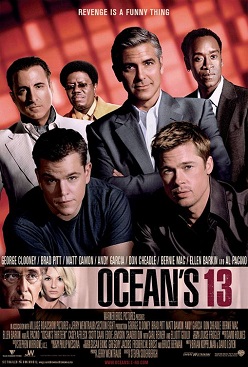
Ocean In The Desert, Redux-Redux -George Clooney And Brad Pitt’s Ocean’s Thirteen (2007)-A Film Review

Ocean In The Desert, Redux-Redux -George Clooney And Brad Pitt’s Ocean’s Thirteen (2007)-A Film Review


DVD Review

By Sam Lowell

Ocean’s Thirteen, starring George Clooney, Brad Pitt, A Pacino, Elliott Gould, Andy Garcia, 2007 

Recently I noted in a review of what amounted in the end to the first film in the Ocean trilogy and what might serve as a reason for its popularity that everybody loves a con, loves a con artist at least since old Herman Melville made a big literary deal out of such characters in his 19th century novel The Confidence Man. I was also careful to mention that statement that everybody loves a con, a con artist as long as that personage is conning somebody else and not one’s good self-or one’s own. I also said that an appreciation of a con, and of a master con artist goes down much better if the con is on some super-rich guy or gal who made his or her dough by walking over a pile of people, hell, maybe a pile of corpses. That latter premise is what made George Clooney’s remake of the 1960s Frank Sinatra-led classic con story Ocean’s Eleven so satisfying and perhaps with a little less satisfaction since this road had already been travelled this third film in the trilogy, Ocean’s Thirteen

Here’s the “skinny” on the con in this final con of the series. Reuben Tiskoff, played by Elliott Gould, who fronted Danny Ocean, played by George Clooney, dough in the original caper, the dough for the big caper against his nemesis Terry Benedict, played by Andy Garcia, has been stiffed yet again by a partner who wanted to grab all the greed dough and glory for himself. (Reuben’s track record making me wonder how he survived in Vegas for two minutes and had not been ground to dust for coffee and cakes long ago in the dog eat dog gaming world.) This time Reuben took the hit from Willie Bank, played by Al Pacino (playing his usual gruff stage persona), who owned a sting of five star hotel-casinos around the world (five diamond-literarily a fact which helps push the plot along which) and wanted no partner’s to hog his glory as he opened a high-end resort in Vega. 
I mentioned in the review of Ocean’s Eleven  that in the old days if you wanted to run a scam you brought in a bunch of heavy yeggs and mugs and strong-armed your way around the caper. Not these high tech days. Now you need tech savvy guys with brains and cunning (and a little old time off-hand muscle never hurts). The caper here depends on trying to financially ruin Bank and therefore handing over his operation to his board leaving him flat-footed. On the side also take a few hundred million by stealing his precious five star diamond collection from his previous hotelier efforts. The deal here is to rig all the games in the casino so that the high end rollers take Bank’s shirt off his back. Without them returning to inevitably lose their dough the next minute (remember the first rule of gaming-the house in the end always wins). How to do that. Easy-simulate an earthquake which will have the customers-high- end or low fleeing like rats for the exits.

Danny has a pretty good revenge idea working here this time (and don’t forget the added theft of the diamonds which is the crew’s service charge-fair enough, right).Except the big time high tech drilling machine that was to be used to create the earthquake broke down. While Danny and the boys are good they don’t have enough dough to get a new one. Enter one Terry Benedict (another guy whose ability to survive in Vegas   I wonder about), you remember Terry, played by Andy Garcia, the “mark” in the big casino heist of the proceeds of three casinos-his. He fronts the dough for a cut of the “profits” since he and Bank had a falling out earlier in their careers.  So the “job” got done on old Bank, he lost control of his casino-hotel, lost his five star ratings and his nice diamond collection. This third film had the weakest plot line so it was just as well that the director called it quits at a trilogy. Yeah, but revenge is sweet and I cried not one tear for this palooka Bank. Of course Danny and his crew were not targeting me-or mine.         


Tuesday, January 03, 2017

Scenes In Search Of The Blue-Pink Great American West Night-Scenes In Search Of The Blue-Pink Great American West Night

Scenes In Search Of The Blue-Pink Great American West Night-Scenes In Search Of The Blue-Pink Great American West Night

Scene Two: Hayes-Bickford Breakout -October 1962


Here I am again sitting, 3 o’clock in the morning sitting, bleary-eyed, slightly distracted after mulling over the back and forth of the twelve hundredth run-in (nice way to put it, right?) with Ma that has driven me out into this chilly October 1962 early morning. And where do I find myself sitting at this time of morning? Tired, but excitedly expectant, on an uncomfortable, unpadded bench seat on this rolling old clickity-clack monster of a Red Line subway car as it now waggles its way out past Kendall Station on its way to Central Square and then to the end of the line, Harvard Square. My hangout, my muse home, my night home, at least my weekend night home, my place to make sense of the world in a world that doesn’t make much sense, at least not enough much sense. Sanctuary, Harvard Square Hayes-Bickford sanctuary, misbegotten teenage boy sanctuary, recognized by international law, recognized by canon law, or not.


That beef with Ma, that really unnumbered beef, forget about the 1200 I said before, that was just a guess, has driven me to take an “all-nighter” trip away from the travails of the old home town, North Adamsville, across Boston to the never-closed Hayes-Bickford cafeteria that beckons just as you get up the stairs from the Harvard subway tunnel. Damn, let me just get this off my chest and then I can tell the rest of the story. Ma said X, I pleaded for Y (hell this homestead civil war lent itself righteously to a nice algebraic formulation. You can use it too, no charge). Unbeknownst to me Y did not exist in Ma’s universe. Ever. Sound familiar? Sure, but I had to get it off my chest.


After putting on my uniform, my Harvard Square “cool” uniform: over-sized flannel brownish plaid shirt, belt-less black cuff-less chino pants, black Chuck Taylor logo-ed Converse sneakers, a now ratty old windbreaker won in a Fourth of July distance race a few years back when I really was nothing but a wet-behind-the ears kid to ward off the chill, and, and the absolutely required midnight sunglasses to hide those bleary eyes from a peeking world I was ready to go. To face the unlighted night, and fight against the dawn’s rising for another day. Oh ya, I forgot, I had to sneak out of the house stealthily, run like some crazed broken-field football player down the back of the property, and, after catching my breathe, walk a couple of miles over bridge and nasty, hostile (hostile if anyone was out, and anyone was sniping for a misbegotten teenage boy, for any purpose good or evil) Dorchester streets to get to the Fields Corner subway stop. The local Eastern Mass. bus had stopped its always erratic service hours ago, and, any way, I usually would rather walk than wait, wait my youth away, for those buses to amble along our way with their byzantine schedules.


Right now though I am thinking, as those subway car wheels rattle beneath my feet, who knows, really, how or why it starts, that wanderlust start, that strange feeling in the pit of your stomach that you have to move on, or out, or up or you will explode, except you also know, or you damn well come to know that it eats away at a man, or a woman for that matter, in different ways. Maybe way back, way back in the cradle it was that first sense that there was more to the world that the four corners of that baby world existence and that if you could just, could just get over that little, little side board there might be something better, much better over the horizon. But, frankly that just seems like too much of a literary stretch even for me, moody teenage boy that I am, to swallow so let’s just say that it started once I knew that the ocean was a way to get away, if you needed to get away. But see I didn’t figure than one out for myself even, old Kenny from the old neighborhood in third grade is the one who got me hip to that, and then Johnny James and his brother filled in the rest of the blanks and so then I was sea-worthy, dream sea-worthy anyway.


But, honestly, that sea dream stuff can only be music for the future because right now I am stuck, although I do not always feel stuck about it, trying to figure my way out of high school world, or at least figure out the raging things that I want to do after high school that fill up my daydream time (study hall time, if you really want to know). Of course, as well, that part about the ocean just mentioned, well there was a literal part to the proposition since ocean-at-my-back (sometimes right at my back) New England homestead meant unless I wanted to take an ill-advised turn at piracy or high-seas hijacking or some such thing east that meant I had to head west. Right now west though is Harvard Square, its doings and not doings, it trumpet call to words, and sounds, and actions in the October Friday night all-night storm brewing.


The train now rounds the squeaky-sounding bend out of Central Square and stops at the station. So now I leave my pensive seat and stand waiting, waiting for the driver to release the pressure to let the sliding train door open, getting ready to jump off the old subway, two-steps-at-a-time my way up the two flights of stairs and head for mecca to see if things jump for me tonight. The doors open at last. Up the two-stepped stairs I go, get to the surface and confront the old double-glassed Hayes door entrance and survey the vast table-filled room that at this hour has a few night owl stranglers spotted throughout the place.


You know the old Hayes-Bickford, or one of them, if you live in Boston, or New York City, or a few other places on the East Coast, don’t you? Put your tray on the metal slider (hey, I don’t know what you call that slider thing, okay) and cruise down the line from item to item behind the glass-enclosed bins of, mostly, steamy food, if you are looking for fast service, for a quick between doing things, pressing things, meal. Steamed and breaded everything from breakfast to lunch to dinner anytime topped off by dishwater quality coffee (refills on demand, if you feel lucky). But this is not the place to bring your date, certainly not your first date, except maybe for a quick cup of that coffee before going to some event, or home. What this is, really, is a place where you can hang out, and hang out with comfort, because nobody, nobody at all, is going to ask you to leave, at least if you act half-way human. And that is what this place is really about, the humans in all their human conditions doing human things, alien to you or not, that you see floating by you, as you take a seat at one of the one-size-fits all wooden tables with those red vinyl seat-covered chairs replete with paper place settings, a few off-hand eating utensils and the usual obligatory array of condiments to help get down the food and drink offered here.


Let me describe who is here at this hour on an early Saturday morning in October 1962. I will not vouch for other times, or other days, but I know Friday and Saturday nights a little so I can say something about them. Of course there is the last drink at the last open barroom crowd, said bar already well-closed in bluelaw Massachusetts, trying to get sober enough by eating a little food to traverse the road home. Good luck. Needless to say eating food in an all-night cafeteria, any all-night cafeteria, means only one thing-the person is so caught up in a booze frenzy that he (mainly) or she (very occasionally) is desperate for anything to hang the name food on to. Frankly, except for the obligatory hard-dollar coffee-steamed to its essence, then through some mystical alchemic process re-beaned, and served in heavy ceramic mugs that keep in the warmth to keep the eyes open the food here is strictly for the, well, the desperate, drunk or sober.

I might mention a little more about the food as I go along but it is strictly to add color to this little story. Maybe, maybe it will add color to the story but this is mainly about the “literary” life at the old Hayes and the quest for the blue-pink night not the cuisine so don’t hold me to it.

Here is the kicker though; there are a few, mercifully few this night, old winos, habitual drunks, and street vagabonds (I am being polite here) who are nuzzling their food, for real. This is the way that you can tell the "last drink" boys, the hail fellows well met, who are just out on the town and who probably go to one of the ten zillion colleges in the area and are drawn like moths (and like wayward high schools kids, including this writer) to the magic name, Harvard Square. They just pick at their food. Those other guys (again, mainly, guys) those habituals and professional waywards work at it like it is their last chance for salvation.


Harvard Square, bright lights, dead of nights, see the sights. That vision is nothing but a commercial, a commercial magnet for every young (and old) hustler within fifty miles of the place to come and display their “acumen”. Their hustle. Three card Monte, quick-change artistry, bait and hook, a little jack-rolling, fake dope-plying, lifting an off-hand wallet, the whole gamut of hustler con lore. On any given Harvard Square weekend night there have got to be more young, naĂŻve, starry-eyed kids hanging out trying to be cool, but really, like me, just learning the ropes of life than you could shake a stick at to set a hustler’s heart, if he (mainly) or she (sometimes) had a heart.


I’ll tell you about a quick con that got me easy in a second but right now let me tell you that at this hour I can see a few con artists just now resting up after a hard night’s work around a couple of tables, comparing notes (or, more likely, trying to con each other, there is no honor among thieves in this little night world. Go to it, boys). As to the con that got me, hey it was simple, a guy, an older guy, a twenty-five year old or something like that guy, came up to me while I was talking to a friend and said did I (we) want to get some booze. Sober, sixteen years old, and thrill-seeking I said sure (drinking booze is the coin of the realm for thrills these days, among high school kids that I know, maybe the older set, those college guys, are, I hear, experimenting with drugs but if so it is very on the QT).


He said name your poison, I did, and then he “suggested” a little something for himself. Sure, whatever is right. I gave him the money and he returned a few minutes later with a small bag with the top of a liquor bottle hanging out. He split. We went off to a private area around Harvard Yard (Phillips Brook House, I think) and got ready to have our first serious taste of booze, and maybe get rum brave enough to pick up some girls. Naturally, the bottle was a booze bottle alright but it had been opened (how long before is anyone’s guess) and filled with water. Sucker, right. Now the only reason that I am mentioning this story right here is that the guy who pulled this con is sitting, sitting like the King of Siam, just a few tables away from where I am sitting. The lesson learned for the road, for the future road that beckons: don’t accept packages from strangers without inspecting them and watch out for cons, right? No, hell no. The lesson is this: sure don’t fall for wise guy tricks but the big thing is to shake it off, forget about it if you see the con artist again. You are way to cool to let him (or occasionally her) think that they have conned you. Out loud, anyway.


But wait, I am not here at almost four o’clock in the Hayes-Bickford morning, the Harvard Square Hayes-Bickford morning, to talk about the decor, the food if that is what it is, about the clientele, humble, slick, or otherwise. I am here looking for “talent”, literary talent that is. See, I have been here enough, and have heard enough about the ”beats” (or rather pseudo-beats, or “late phase” beats at this time) and the “folkies” (music people breaking out of the Pop 40 music scene and going back to the roots of America music, way back) to know that a bunch of them, about six in all, right this minute are sitting in a far corner with a light drum tapping the beat listening to a guy in black pants(always de rigueur black), sneakers and a flannel shirt just like me reciting his latest poem. That possibility is what drove me here this night, and other nights as well. See the Hayes is known as the place where someone like Norman Mailer had his buttered toast after one of his “last drink” bouts. Or that Bob Dylan sat at that table, that table right over there, writing something on a napkin. Or some parallel poet to the one now wrapping up his seventy-seven verse imitation Allen Ginsberg's Howl master work went out to San Francisco and blew the lid off the town, the City Lights town, the literary town.


But I better, now that the six-ish dawn light is hovering, trying to break through the night wars, get my droopy body down those subway stairs pretty soon and back across town before anyone at home notices that I am missing. Still I will take the hard-bitten coffee, re-beaned and all, I will take the sleepy eyes that are starting to weigh down my face, I will even take the con artists and feisty drunks just so that I can be here when somebody’s search for the blue-pink great American West night, farther west than Harvard Square night, gets launched.

Ocean In The Desert Redux-George Clooney And Brad Pitt’s “Ocean’s Twelve” (2004)-A Film Review

Ocean In The Desert Redux-George Clooney And Brad Pitt’s “Ocean’s Twelve” (2004)-A Film Review 


DVD Review

By Sam Lowell

Ocean’s Twelve, starring George Clooney, Brad Pitt, Andy Garcia, Julia Roberts, 2004  

Recently in reviewing the original Ocean’s Eleven (not the original Frank Sinatra/Rat Pack one done in the early 1960s but the first in what would be a trilogy of George Clooney-Brad Pitt vehicles) I noted not without some blow-back probably from people who have been conned I mentioned the following which applies to the film under review here –the sequel Ocean’s Twelve:    

“Let’s face it everybody loves a con, loves a con artist at least since old Herman Melville made a big literary deal out of such characters in his 19th century novel The Confidence Man. Well everybody loves a con, a con artist as long as that personage is conning somebody else and not one’s good self. Better if the con is on some super-rich guy who made his dough by walking over a pile of people, hell, maybe a pile of corpses. And that latter premise is what makes George Clooney’s remake of the 1960s Frank Sinatra-led classic con story Ocean’s Eleven.” That rather obviously sound reasoning gets another work-out in this sequel where the original crew plus Tess, played by Julia Roberts, who makes the twelve of the title.  

Here’s how this version played out. Terry Benedict, played by Andy Garcia, a Las Vegas casino owner who was bulked out of $160 million dollars in the original Ocean Eleven caper did not get to own casinos by being conned by tricky con men, or so he thinks. Through his intelligence apparatus he finds all the gang members and gives them an ultimatum-return the dough plus about thirty million in interest since the caper occurred three years before his round-up-or else. Problem: these guys, these cons didn’t invest their ill-gotten gains in nice municipal bonds but spent it like, well, like drunken sailors. When they add up the tally they are about ninety-seven million short (that includes the interest as well). They are given two weeks by Terry to ante up or once again-or else.          

What to do? Well it won’t be by applying for bank loans or such but back to the old hunting grounds, back to the big time con. Their first caper backfired since the rare item they were after had already been filched. Somebody else was working the same street. Moreover a Europol detective Lahari, played by fetching Catherine Zeta-Jones, was hounding their footsteps as she pursued a thief whose moniker was The Night Fox an acolyte of master thief “LaMarca.” It was the Night Fox, a member of the aristocracy who had plenty of time on his hands who had beaten them to the rare document that would have gotten them well. The cocksure Night Fox challenges Danny and the boys to a match to see who was king of the con hill. Steal the then incredibly well-guarded Faberge Imperial Egg. The reward for his failure would be that he would pay out the ninety-seven million to Benedict (presumably from his household funds or walking around money).


The chase was on. Not to worry though Danny and the guys have this one mapped out to perfection-have got all the angles covered. In the old days this kind of caper depended on muscle and maybe a few inside job participants. Now it is all craft. The solo Night Fox figured after his assault on the museum where the egg was being shown that he had won. Sorry, not against Danny and the boys. Why? Well they had an inside advantage. They had made contact with LaMarc who gave them the details of when the egg was going to be in transit. Piece of cake. Terry Benedict take your dough and beat it. Along the way Rusty goes under the sheets with that Detective Lahiri who as it turned out was the long lost daughter of LaMarc. She crosses the line to his side. Must be in the genes. Not as good at the plot-line in the first one but okay.