Wednesday, December 06, 2017

Tomgram: Rajan Menon, How Trump Will Betray His Base


Tomgram: Rajan Menon, How Trump Will Betray His Base
If you want a gauge of the state of America, the country that put billionaire Donald Trump in the White House, consider this: the three richest Americans -- Bill Gates, Jeff Bezos, and Warren Buffett -- now have the wealth of the bottom half of the U.S. population, or 160 million Americans.  Or consider this: the 2016 Wall Street bonus pool, as former Labor Secretary Robert Reich pointed out recently, was larger than the yearly earnings of “all 3.3 million Americans working full time at or below the federal minimum wage of $7.25 an hour.”  And keep in mind that the Trump-Republican tax “reform” bill, if passed, will only make such figures more mind-boggling. It will assumedly send so much more money cascading upward that the copious funding of future 1% elections will be guaranteed for our “democratic” lifetimes.
And if anyone was in doubt about the nature of Donald Trump’s “populism,” he answered that question within weeks of his election when he began appointing the wealthiest cabinet in American history.  It was already clear by then who he really thought the “forgotten men and women of this country” were: former Goldman Sachs partners with at least a few hundred million dollars in their pockets.  In this new Gilded Age (in which, I suspect, disparities in wealth may actually become worse than in the nineteenth century version of the same), isn’t it time to stop talking about “trickle down economics” and come up with some new phrase?  Gusher economics?  We certainly need something that comes closer to capturing the realities of a moment in which, for instance, that tax bill will offer a staggering one-half of its cuts to the top 1% while, as Robert Borosage writes in the Nation, “raising taxes on families earning $10,000-$75,000 over the next decade” and even eliminating a tax credit that incentivizes employers to hire disabled veterans.
With that in mind, TomDispatch regular Rajan Menon takes a clear-eyed look at the populism of the Trumpian moment, the growing inequality that is increasingly the heart and soul of this society, and what is(n’t) being done about it. Tom
Twenty-First-Century American Populism 
Or Putting Your Mouth Where Your Money Isn’t 
By Rajan Menon
Among the stranger features of the 2016 election campaign was the success of Donald Trump, a creature of globalization, as an America First savior of the white working class. A candidate who amassed billions of dollars by playing globalization for all it was worth -- he manufactured clothes and accessories bearing his name in low-wage economies and invested in corporations eager to outsource -- won over millions of voters by promising to keep jobs here in the U.S.
Admittedly, only a third of his voters earned less than $50,000 a year and cultural and racial resentment, not just economic grievances, drove many of them to Trump.  Still, in an ever more economically unequal America, his populist economic message resonated. It helped him win the presidency by peeling off white working class votes in key regions, particularly the industrial Midwest. Now, he’s stuck with his populist narrative, and here’s the problem for him: it’s not likely to work -- not given the economic realities of this planet, not for long anyway.
Fading Economic Hegemony
In the Oval Office, as on the campaign trail, Trump’s refrain remains that the economic woes of American workers, including stagnant wages and job insecurity, are the fault of predatory Asian and Mexican exporters, aided and abetted by inept past presidents who inked lousy trade deals.  During campaign 2016, he promised to kick down doors abroad and force countries running surpluses, notably China, to buy more from the United States or face huge tariff hikes.  He railed against companies that relocate production abroad, depriving Americans of jobs.  
Trump's economic nationalism is, of course, a con job.  He did, however, effectively employ the demagogue’s artifice, which invariably lies in crafting simplistic answers to complicated questions and creating plausible scapegoats for complicated problems. In fact, workers in industries the United States dominated for decades are in distress because of irreversible historic changes and the absence, thanks to a staggeringly lopsided distribution of wealth and political power in America, of progressive policies that would better prepare them to cope with the changes that have occurred in the international economy.
But first, a little history.
For nearly three decades after World War II, the United States dominated the global marketplace in big-ticket industries like steel, automobiles, passenger aircraft, shipbuilding, and heavy machinery.  That hegemony was bound to fade.  As a start, America’s postwar economic primacy owed much to the ravages of that global conflict.  After all, the industrial bases of Japan and Germany lay in ruins.  Wartime allies Britain and France faced long, arduous recoveries.  But the economies of those industrialized, technologically advanced countries were bound to recover -- and by the mid-1970s they had.  By then, America’s near-monopoly was ending.
Between 1965 and 2010, the share of the national market held by America’s steelmakers and carmakers plunged from nearly 90% to 45%. By the 1970s, they were already complaining about an influx of “cheap imports” and lobbying Washington to enact countermeasures. Now regarded as the ultimate free trader, President Ronald Reagan would indeed oblige them.  In 1981, for instance, he limited Japanese automobile sales in the U.S., while hiking tariffstenfold on motorcycle imports to save Harley-Davidson.  European and Japanese steel companies would soon face similar restrictions.  
Seen in historical perspective, Washington’s reaction to trade competition was hardly unique.  Britain, too, had preached free trade during its economic heyday -- until, that is, its imperial predominance began to wane. In the nineteenth century, the zenith of British free trade cheerleading, the United States relied heavily on protectionism to ensure the growth of its nascent industrial base. As its economic power expanded, however, its own version of such cheerleading began.  Now, China is fast becoming an economic superpower. Unsurprisingly, at conclaves like the Davos World Economic Forum at the Asia-Pacific Economic Cooperation summit, President Xi Jinping is predictably starting to sound more like Adam Smith than Karl Marx, just as Donald Trump’s speeches during his November whirlwind trip through Asia are coming to resemble nineteenth-century American rationales for protectionism.
Since the 1970s, workers in places like Detroit, Bethlehem, and Peoria have faced another challenge: a range of new sources of competition, especially the “Asian tigers” like South Korea and Taiwan.  Once considered inferior, their products have by now become a hallmark of quality, making South Korean or Japanese cars, cellphones, computers, and television sets ubiquitous in this country. 
Now, China, which took the top spot in world trade from the U.S. in 2013, is poised to do what Japan, South Korea, and Taiwan already did here (cars included).  And India waits in the wings.
These historical trends suggest that President Trump’s protectionism is already doomed.  The point isn’t that international trade always benefits American workers; it doesn’t.  Trade, national or global, redistributes wealth, especially because the largest and most successful companies have long ceased to think in terms of national markets.  They set up shop wherever it’s most profitable, using complex global supply chains. When it comes to Apple’s iPhone, for instance, more than 200 suppliers worldwide provide parts for final assembly in China.  Good infrastructure and a workforce with skills that match corporate requirements matter.  Yet wage differentials aren’t irrelevant either; that’s partly why China, Mexico, and Vietnam have attracted massive amounts of job-creating investment -- and why India, too, has begun to do so.
The relevant question isn’t whether the global economy can be redesigned to protect American workers -- it can’t -- but what their government will do to help them to gain the skills needed to compete effectively in a rapidly changing marketplace.  Reforming public education might be a good place to start (but don’t look to Donald Trump to do it).  If American workers are to do better in the global marketplace, this country’s public schools must ensure that their students graduate with the math, science, and other skills needed to get decent jobs.  That, however, would mean attacking the inequality that’s increasingly been built into the public education system (as into so much else in this society).
Education: The Zip Code Premium
Horace Mann, the nineteenth-century American educator, referred to public schooling as “beyond all human devices... the great equalizer of the condition of men, the balance wheel of the social machinery.”  Since the early years of the republic, Americans have embraced the idea that schooling is critical in helping individuals realize their aspirations and in guaranteeing equality of opportunity.  In principle, there has been a consensus that economic circumstances beyond the control of children shouldn’t block their way into the future.  In practice, it’s been quite a different story, partially because of how public schools are funded.
Local property and business taxes are the largest source of support for them, so kids born into a community crammed with pricey homes and thriving businesses will attend well-funded public schools that attract good teachers with decent working conditions and salaries. Such students are more likely to have smaller classes, more guidance counselors, nurses, and psychologists, more computers per pupil, better textbooks and instructional equipment, richer curricula, and better libraries.
In addition to local taxes, which provide 45% of public school funds, state revenues provide another 46%, and federal assistance an additional 9%.  Some state governments also offer extra money to poorer school districts, but not enough to begin to close the gap with more affluent ones.  In any case, those funds have been falling since 2008. Additional federal support doesn’t come close to leveling the playing field
The United States is one of the few countries in the 35-member Organization for Economic Cooperation and Development (OECD), a grouping of wealthy nations, in which central government funding plays such a limited role in reducing disparities between schools.  In those countries, national budgets provide, on average, more than 50% of school funding.  
Public schools in affluent communities have another advantage.  Thanks to their incomes, professional qualifications, social networks, and experience, the parents of students in such schools are far more capable of raising private money to supplement school budgets, which means extra educational equipment and instructional materials, and more staff.   Most such private fundraising is done by parent-teacher associations (PTAs), which tend to be more active and more successful in affluent communities.  (Indeed, poor districts may lack PTAs altogether.)
Consider a typical California example.  In Hillsborough, where the median family income is $229,000, the school district raised an extra $1,500 per student; in Oakland, where median income was just under $58,000, it was only $100 per student.  Similarly, in wealthy northwest Washington, D.C., four elementary schools raised $300,000 apiece in one year, sums unthinkable for schools in Washington’s poorer communities like those east of the Anacostia River, where the median household income is $34,000.   Such differences are the norm nationally.
It’s true that PTA funding -- $245 million in 2010 (an increase of 300% since 1990) -- looks like a drop in the bucket compared to total government spending on kindergarten-through-12th-grade education ($603 billion in 2013).  That, however, misses the point, since the private funding is so concentrated in wealthy neighborhoods.  
Money can’t fix everything, but it counts for a lot in an ever more unequal society.  And there’s overwhelming evidence that the educational success gap between the wealthiest 10% of Americans and the rest has been growing for decades -- unevenly since the 1940s, at an accelerated rate since the 1970s, and by 30%-40% percent between 1991 and 2010. If you want graphic proof of how the income-achievement divide matters, it’s easy to find: students in schools with greater resources (including wealthy parents), for example, regularly do better in standardized tests and essentially any other metric of academic achievement.
And remember, student performance in high school increases the likelihood both of college attendance and success once there.  All of this indicates the obvious: that one way to improve the economic prospects of American workers would be to ensure that the public school system provides all students with the knowledge and skills needed to succeed in a global economy that privileges people who have solid technical know-how.  Channeling more funds to schools in poorer communities would, however, require sacrifices from the segments of society that our “populist” president really represents.  So perhaps you won’t be surprised to discover that, though Education Secretary Betsy DeVos favors“school choice,” neither she nor her boss seems to have the slightest interest in doing anything about the growing inequalities and inequities of public education, which Trump’s cherished “base” of working and lower-income people need the most. In fact, cuts in hiseducation budget total about $10 billion and target a raft of programs that help poor and working-class families.
Missing: Worker-Friendly Policies
Once employed, workers will face challenges throughout their lives that their parents, let alone grandparents, couldn’t have imagined.  No matter what Donald Trump does about trade pacts and tariffs, companies will continue to shift production overseas to stay ahead of their competitors, which means that well-paying manufacturing jobs in America will continue to disappear.  They will also export some of what they make abroad back to the United States, increasing job insecurity and driving down wages.  Trump’s rants won’t reverse this well-established trend.
Add in one more thing: automation, robotics, self-driving vehicles, artificial intelligence, and e-commerce will continue to reduce the role of human labor in the economy, even as they create new jobs with skill premiums.  Those with high-end jobs (banking, the law, scientific research, and medicine, among others) will, of course, continue to earn significant incomes, but workers without a college education in the service sector, which already accounts for nearly 80% of the country’s gross domestic product, will find it ever tougher to get higher-paying jobs with decent benefits.  This, in turn, means that they will have an even harder time saving for retirement, paying for their childrens’ educations, liquidating accumulated debts, or covering the cost of medical care.
So what to do? 
A progressive tax code that actually favored those in Trump’s base and others like them would be one way to start to rectify the situation, but that’s a pipedream in this era.  The two versions of the Trump-backed tax “reform” bill now in Congress tell us everything we need to know about who will gain and who will lose in his populist America.  They couldn’t be more wildly regressive. 
Take corporate taxes.  To skirt the present 35% tax on corporate income, American companies have stashed $2.6 trillion in overseas tax havens like Ireland, Luxembourg, Bermuda, and the Netherlands, among other places. If the tax bill passes, corporations will be able to bring that money home and pay only 12% in taxes on it, a bonanza for corporate America.  It’s been argued that such companies will then invest the repatriated funds here, creating new jobs, but the tax plan offers them absolutely no incentives to do so and imposes no penalties if they don’t.  Oh, and that proposed corporate tax cut will be permanent
More generally, the truly wealthy have particular reason to celebrate.  By 2024, the legislation eliminates the estate tax, which only they now pay.  Though it provides less than one percent of federal revenues, scrapping it would shrink those revenues by $269 billion over a decade. That exceeds the annual budgets of the Food and Drug Administration, the Environmental Protection Agency, and the Centers for Disease Control and Prevention combined. 
There’s more: 47% of the gains from the proposed tax cuts will benefit the wealthiest 1% of taxpayers, while the prospective bill won’t touch the biggest financial burden carried by young middle- and working-class Americans: college loans.  Student debt, which has ballooned by $833 billion since 2007, now totals $1.45 trillion.  (The average monthly payment: $351.)
Republican tax policies further skew wealth distribution toward the richest 0.1%.  Big tax cuts that favor this exclusive group are also likely to reduce government revenue, increasing the odds of further spending cuts to programs that benefit workers.  
Take job retraining. The United States currently devotes a pitiful 0.05% of its gross domestic product to worker retraining, ranking 21st out of 29 OECD countries for which data is available.  And prospective budget cuts suggest that there will be no improvement on this front (where the president has already proposed a 40% cut in funds).  The 21% cut planned for the Department of Labor will, for instance, slash several job training and employment assistance programs, affecting nearly three million people.  And here’s one for your no-good-deed-goes unpunished file: Trump plans to eliminate the Appalachian Regional Council (ARC), which since 1965 has provided job retraining to coalminers while reducing poverty and boosting high school graduation rates significantly.  Ninety-five percent of the counties the ARC covers voted for Trump.
It’s the same story when it comes to apprenticeships, widely and successfully subsidized in countries like Germany to create a skilled working class. By contrast, the United States now spends a paltry $95 million on such programs and while Trump has called for five million additional apprenticeships in the next five years, a tenfold increase, he’s suggested no additional funding for such a program.  Consider that the definition of not putting your money where your mouth is. 
A partnership among community colleges and companies, supplemented by federal funds, could create nationwide apprenticeship programs that would benefit workers and companies.  Furthermore, nearly 90% of those who complete apprenticeships not only land jobs but earn an average yearly salary of $50,000 -- nearly 12% above the national median wage. Two million American manufacturing jobs will remain unfilled during the next decade for want of adequately trained workers. 
Modernizing the nation’s decrepit infrastructure could create a range of new jobs (as it did in the New Deal era of the 1930s).  But the federal government’s supposed role in President Trump’s much-vaunted infrastructure “plan” to revamp the country’s disintegrating roads, rail lines, bridges, ports, dams, levees, and inland waterways is to “get out of the way”; it will, that is, be confining its contribution to the trillion-dollar plan to $137 billion (mainly in tax credits), though experts reckon that revamping the country’s infrastructure would actually require a $4 trillion investment over a decade.  Private investors will undoubtedly cherry-pick the most profitable projects and so will get a windfall from this tax subsidy.  American workers, not so much.  Sad! 
Fake Populism
Rising college costs, stagnant wages -- adjusted for inflation, hourly pay has increased a mere 0.2% annually over the past four decades -- and the weight of student debt will make it ever harder for Americans to upgrade their skills.  But when it comes to the working class he claims to care deeply about, Donald Trump’s deeds don’t go beyond symbolism -- publicizing his love for Big Macs and Kentucky Fried Chicken, engaging in bellicose bombast, trash-talking trade agreements, threatening to raise tariffs, and blaming undocumented immigrants for everything from crime to unemployment.  None of this will actually mitigate the challenges that confront workers, which will only grow in an America in which the top 0.1% have about as much wealth as the bottom 90%.  
As is always true when it comes to rulers with an autocratic bent, the question is: When will Trump’s base get wise to his populist charade?  When will the promises he continues to make, from a new deal with China to a new wall with Mexico, begin to ring hollow? Or will they?
Rajan Menon, a TomDispatch regular, is the Anne and Bernard Spitzer Professor of International Relations at the Powell School, City College of New York, and Senior Research Fellow at Columbia University’s Saltzman Institute of War and Peace Studies. He is the author, most recently, of The Conceit of Humanitarian Intervention.
Copyright 2017 Rajan Menon

America’s Military-Industrial Addiction


America’s Military-Industrial Addiction


Save
Polls show that Americans are tired of endless wars in faraway lands, but many cheer President Trump’s showering money on the Pentagon and its contractors, a paradox that President Eisenhower foresaw, writes JP Sottile.
By JP Sottile
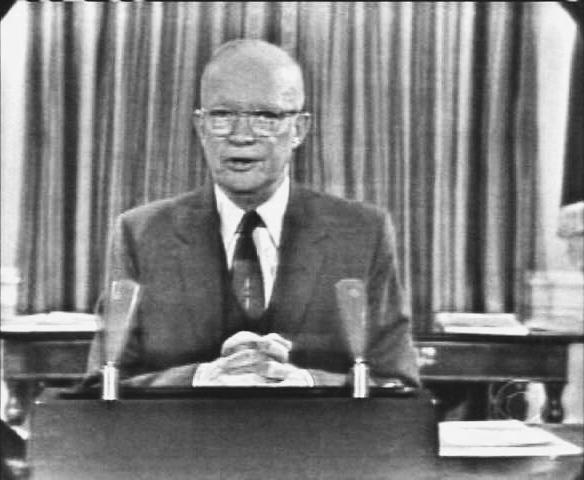
The Military-Industrial Complex has loomed over America ever since President Dwight D. Eisenhower warned of its growing influence during his prescient farewell address on Jan. 17, 1961. The Vietnam War followed shortly thereafter, and its bloody consequences cemented the image of the Military-Industrial Complex (MIC) as a faceless cadre of profit-seeking warmongers who’ve wrested control of the foreign policy. That was certainly borne out by the war’s utter senselessness … and by tales of profiteering by well-connected contractors like Brown & Root.

President Dwight Eisenhower delivering his farewell address on Jan. 17, 1961.
Over five decades, four major wars and a dozen-odd interventions later, we often talk about the Military-Industrial Complex as if we’re referring to a nefarious, flag-draped Death Star floating just beyond the reach of helpless Americans who’d generally prefer that war was not, as the great Gen. Smedley Darlington Butler aptly put it, little more than a money-making “racket.”
The feeling of powerlessness that the MIC engenders in “average Americans” makes a lot of sense if you just follow the money coming out of Capitol Hill. The Project on Government Oversight (POGO) tabulated all “defense-related spending” for both 2017 and 2018, and it hit nearly $1.1 trillion for each of the two years. The “defense-related” part is important because the annual National Defense Authorization Act, a.k.a. the defense budget, doesn’t fully account for all the various forms of national security spending that gets peppered around a half-dozen agencies.
It’s a phenomenon that noted Pentagon watchdog William Hartung has tracked for years. He recently dissected it into “no less than 10 categories of national security spending.” Amazingly only one of those is the actual Pentagon budget. The others include spending on wars, on homeland security, on military aid, on intelligence, on nukes, on recruitment, on veterans, on interest payments and on “other defense” — which includes “a number of flows of defense-related funding that go to agencies other than the Pentagon.”
Perhaps most amazingly, Hartung noted in TomDisptach that the inflation-adjusted “base” defense budgets of the last couple years is “higher than at the height of President Ronald Reagan’s massive buildup of the 1980s and is now nearing the post-World War II funding peak.” And that’s just the “base” budget, meaning the roughly $600 billion “defense-only” portion of the overall package. Like POGO, Hartung puts an annual price tag of nearly $1.1 trillion on the whole enchilada of military-related spending.
The MIC’s ‘Swamp Creatures’
To secure their share of this grandiloquent banquet, the defense industry’s lobbyists stampede Capitol Hill like well-heeled wildebeest, each jockeying for a plum position at the trough. This year, a robust collection of 208 defense companies spent $93,937,493 to deploy 728 “reported” lobbyists (apparently some go unreported) to feed this year’s trumped-up, $700 billion defense-only budget, according to OpenSecrets.org. Last year they spent $128,845,198 to secure their profitable pieces of the government pie.

The Pentagon, headquarters of the U.S. Defense Department, as viewed with the Potomac River and Washington, D.C., in the background. (Defense Department photo)
And this reliable yearly harvest, along with the revolving doors connecting defense contractors with Capitol Hill, K Street and the Pentagon, is why so many critics blame the masters of war behind the MIC for turning war into a cash machine.
But the cash machine is not confined to the Beltway. There are ATM branches around the country. Much in the way it lavishes Congress with lobbying largesse, the defense industry works hand-in-glove with the Pentagon to spread the appropriations around the nation. This “spread the wealth” strategy may be equally as important as the “inside the Beltway” lobbying that garners so much of our attention and disdain.
Just go to U.S. Department of Defense’s contract announcement webpage on any weekday to get a good sense of the “contracts valued at $7 million or more” that are “announced each business day at 5 p.m.” A recent survey of these “awards” found the usual suspects like Raytheon, Lockheed Martin and General Dynamics. The MIC was well-represented. But many millions of dollars were also “won” by companies most Americans have never heard of … like this sampling from one day at the end of October:
  • Longbow LLC, Orlando Florida, got $183,474,414 for radar electronic units with the stipulation that work will be performed in Orlando, Florida.
  • Gradkell Systems Inc., Huntsville, Alabama, got $75,000,000 for systems operations and maintenance at Fort Belvoir, Virginia
  • Dawson Federal Inc., San Antonio, Texas; and A&H-Ambica JV LLC, Livonia, Michigan; and Frontier Services Inc., Kansas City, Missouri, will share a $45,000,000 for repair and alternations for land ports of entry in North Dakota and Minnesota.
  • TRAX International Corp., Las Vegas, Nevada, got a $9,203,652 contract modification for non-personal test support services that will be performed in Yuma, Arizona, and Fort Greely, Alaska,
  • Railroad Construction Co. Inc., Paterson, New Jersey, got a $9,344,963 contract modification for base operations support services to be performed in Colts Neck, New Jersey.
  • Belleville Shoe Co., Belleville, Illinois, got $63,973,889 for hot-weather combat boots that will be made in Illinois.
  • American Apparel Inc., Selma, Alabama, got $48,411,186 for combat utility uniforms that will be made in Alabama.
  • National Industries for the Blind, Alexandria, Virginia, got a $12,884,595 contract modification to make and advanced combat helmet pad suspension system. The “locations of performance” are Virginia, Pennsylvania and North Carolina.
Sharing the Largesse
Clearly, the DoD is large enough, and smart enough, to award contracts to companies throughout the 50 states. Yes, it is a function of the sheer size or, more forebodingly, the utter “pervasiveness” of the military in American life. But it is also a strategy. And it’s a tactic readily apparent in a contract recently awarded to Raytheon.

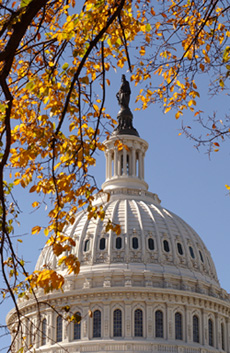
U.S. Capitol.
On Oct. 31, 2017, they got a $29,455,672 contract modification for missions systems equipment; computing environment hardware; and software research, test and development. The modification stipulates that the work will spread around the country to “Portsmouth, Rhode Island (46 percent); Tewksbury, Massachusetts (36 percent); Marlboro, Massachusetts (6 percent); Port Hueneme, California (5 percent); San Diego, California (4 percent); and Bath, Maine (3 percent).”
Frankly, it’s a brilliant move that began in the Cold War. The more Congressional districts that got defense dollars, the more votes the defense budget was likely to receive on Capitol Hill. Over time, it evolved into its own underlying rationale for the budget.
As veteran journalist William Greider wrote in the Aug. 16, 1984 issue of Rolling Stone, “The entire political system, including liberals as well as conservatives, is held hostage by the politics of defense spending. Even the most well intentioned are captive to it. And this is a fundamental reason why the Pentagon budget is irrationally bloated and why America is mobilizing for war in a time of peace.”
The peace-time mobilization Greider referred to was the Reagan build-up that, as William Hartung noted, is currently being surpassed by America’s “War on Terror” binge. Then, as now … the US was at peace at home, meddling around the world and running up a huge bill in the process. And then, as now … the spending seems unstoppable.
And as an unnamed “arms-control lobbyist” told Grieder, “It’s a fact of life. I don’t see how you can ask members of Congress to vote against their own districts. If I were a member of Congress, I might vote that way, too.”
Essentially, members of Congress act as secondary lobbyists for the defense industry by making sure their constituents have a vested interest in seeing the defense budget is both robust and untouchable. But they are not alone. Because the states also reap what the Pentagon sows … and, in the wake of the massive post-9/11 splurge, they’ve begun quantifying the impact of defense spending on their economies. It helps them make their specific case for keeping the spigot open.
Enter the National Conference of State Legislatures (NCSL), which notes, or touts, that the Department of Defense (DoD) “operates more than 420 military installations in the 50 states, the District of Columbia, Guam and Puerto Rico.” Additionally, the NCSL is understandably impressed by a DoD analysis that found the department’s “$408 billion on payroll and contracts in Fiscal Year 2015” translated into “approximately 2.3 percent of U.S. gross domestic product (GDP).”
And they’ve become a clearinghouse for state governments’ economic impact studies of defense spending. Here’s a sampling of recent data compiled on the NSCL website:
  • In 2015, for example, military installations in North Carolinasupported 578,000 jobs, $34 billion in personal income and $66 billion in gross state product. This amounts to roughly 10 percent of the state’s overall economy.
  • In 2014, Coloradolawmakers appropriated $300,000 in state funds to examine the comprehensive value of military activities across the state’s seven major installations. The state Department of Military and Veterans Affairs released its study in May 2015, reporting a total economic impact of $27 billion.
  • Kentuckyhas also taken steps to measure military activity, releasing its fifth study in June 2016. The military spent approximately $12 billion in Kentucky during 2014-15. With 38,700 active duty and civilian employees, military employment exceeds the next largest state employer by more than 21,000 jobs.
  • In Michigan, for example, defense spending in Fiscal Year 2014 supported 105,000 jobs, added more than $9 billion in gross state product and created nearly $10 billion in personal income. A 2016 study sponsored by the Michigan Defense Center presents a statewide strategy to preserve Army and Air National Guard facilities following a future Base Realignment and Closure (BRAC) round as well as to attract new missions. 
Electoral Impact
But that’s not all. According to the DoD study cited above, the biggest recipients of DoD dollars are (in order): Virginia, California, Texas, Maryland and Florida. And among the top 18 host states for military bases, electorally important states like California, Florida and Texas lead the nation.

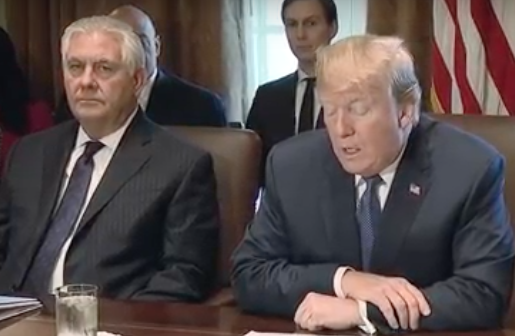
President Trump speaking at a Cabinet meeting on Nov. 1, 2017, with Secretary of State Rex Tillerson to Trump’s right and son-in-law Jared Kushner seated in the background. (Screen shot from whitehouse.gov)
And that’s the real rub … this has an electoral impact. Because the constituency for defense spending isn’t just the 1 percent percent of Americans who actively serve in the military or 7 percent of Americans who’ve served sometime in their lives, but it is also the millions of Americans who directly or indirectly make a living off of the “defense-related” largesse that passes through the Pentagon like grass through a goose.
It’s a dirty little secret that Donald Trump exploited throughout the 2016 presidential campaign. Somehow, he was able to criticize wasting money on foreign wars and the neoconservative interventionism of the Bushes, the neoliberal interventionism of Hillary Clinton, and, at the same time, moan endlessly about the “depleted” military despite “years of record-high spending.” He went on to promise a massive increase in the defense budget, a massive increase in naval construction and a huge nuclear arsenal.
And, much to the approval of many Americans, he’s delivered. A Morning Consult/Politico poll showed increased defense spending was the most popular among a variety of spending priorities presented to voters … even as voters express trepidation about the coming of another war. A pair of NBC News/Survey Monkey polls found that 76 percent of Americans are “worried” the United States “will become engaged in a major war in the next four years” and only 25 percent want America to become “more active” in world affairs.
More to the point, only 20 percent of Americans wanted to increase the troop level in Afghanistan after Trump’s stay-the-course speech in August, but Gallup’s three decade-long tracking poll found that the belief the U.S. spends “too little” on defense is at its highest point (37 percent) since it spiked after 9/11 (41 percent). The previous highpoint was 51 percent in 1981 when Ronald Reagan was elected in no small part on the promise of a major build-up.
So, if Americans generally don’t support wars or engagement in the world, why do they seem to reflexively support massive military budgets?
Frankly, look no further than Trump’s mantra of “jobs, jobs, jobs.” He says it when he lords over the sale of weapon systems to foreign powers or he visits a naval shipyard or goes to one of his post-election rallies to proclaim to “We’re building up our military like never before.” Frankly, he’s giving the people what they want. Although they may be war-weary, they’ve not tired of the dispersal system that Greider wrote about during Reagan’s big spree.
Ultimately, it means that the dreaded Military-Industrial Complex isn’t just a shadowy cabal manipulating policies against the will of the American people. Nor is the “racket” exclusive to an elite group of Deep State swamp things. Instead, the military and the vast economic network it feeds presents a far more “complex” issue that involves millions of self-interested Americans in much the way Eisenhower predicted, but few are willing to truly forsake.
JP Sottile is a freelance journalist, radio co-host, documentary filmmaker and former broadcast news producer in Washington, D.C. He blogs at Newsvandal.com or you can follow him on Twitter, http://twitter/newsvandal.

Boston-Resist Deportations - Chant Sheet

Resist Deportations - Chant Sheet
The people united,
will never be defeated

El pueblo unido,
jamas sera vencido

From Palestine to Mexico,
border walls have got to go!

Racist, Sexist, Anti-Gay,
Donald Trump go away!

Donald Trump you racist clown,
build a wall, we'll tear it down!

Hey, hey, ho, ho
Deportations have to go

What do we want,
Justice!
When do we want it
Now!


DACA folks are here to stay, 
We won't see them sent away!

They say Go back
We say Fight Back

Border walls are lethal
Refugees are people

We say Yes to education,
No to Walls and Deportation

Trump, escucha!
Estamos en la lucha

Aquí estamos
y No nos vamos
Si nos deportan
Nos regresamos
No Somos Uno
No Somos Cien
Somos Millones
Cuéntanos Bien!


Deal Them Off The Top, Brother, Deal Them Straight Off The Top--With Eric Holden’s “The Cincinnati Kid” In Mind

Deal Them Off The Top, Brother, Deal Them Straight Off The Top--With Eric Holden’s “The Cincinnati Kid” In Mind     


[Every once in a while a subject comes up, here gambling through the prism of  high stakes poker to be the top dog, that someone has written about previously, then gambling through the prism of high stakes pool to be the top dog, and did such a well thought of job at it that good sense requires that person to take a stab at the new subject which in this case is really a variation on the older subject-who and how to get to be number one, numbero uno, in your chosen profession when the guy at the top seems immovable, seems immortal. That was the case when Josh Breslin wrote when he was younger for the East Bay Eye in the late 1960s and which subsequently has been posted in this space with some additional editing about young, handsome and here is the fatal kicker impetuous “Fast Eddie” Felton’s rise in the world of cigarette-strewn and whiskey bottle smoky pool halls until he came up against the king of the hill a guy named Jackie “Tubby” Gleason and got his clock cleaned. Lost his angel girl too to some one-eyed pimp daddy whom she took around the world on the rebound once Fast Eddie had that “loser” tag tattooed on him, on his forehead although anybody even vaguely familiar with that sport didn’t need that identification mark to know he had tapped out, news in such circles moves fast. Yeah impetuous had to go against the tiger before he was ready, before he broke his “impetuous jones” lost everything until he faded and went back to cheap street just another guy hustling nickels and dimes from punk kid amateurs out in some Joe’s Pool Hall in Peoria who didn’t know he touched the big time before he became pimp meat.

So we, the soon to be retired administrator on this site, Pete Markin, and I, Greg Green, now the acting administrator to see how I like it and see if I can help reverse some narrowing of perspective on this site over the past several years when a lot of the action has centered on the turbulent 1960s and not much else, invited Josh to give us what film critic emeritus Sam Lowell loves to call the “skinny” on the biggest poker game, stud poker of course what else, that ever hit the wicked sun- drenched and fucking humid town of New Orleans back in the 1930s, the time of the great hunger among plenty of guys looking to be top dog on the sly. Just to set the stage this is a tale about the rise of another young, handsome and here is without making this thing a cautionary tale the fatal kicker impetuous in the world of stud poker, a guy named Steve McQueen although he went by a million names. I think Josh said at the time of this event Eric Holden, but everybody called him the Cincinnati Kid although as Josh mentioned this kid had never been to that Ohio River city, had never really been north of Memphis and probably couldn’t pinpoint the place if you gave him three chances for a buck.

The rise of the Kid until he hit the buzz saw of ancient Lance Robinson who like Tubby Gleason with Fast Eddie cleaned his clock and sent him back to cheap street to nurse his wounds is what interested Josh. Interested the same way young Eddie Felton interested him when he got the story from Georgie Boy Scott out in some sleazy back-water pool hall when Tubby Gleason finally cashed his check and Josh wanted to what had happened to guys who had taken a run at him when he was in his prime. So when we sent him on the trail after hearing that Lance Robinson had recently gone on to his just rewards as an ancient warrior king of the poker parlors he was almost as eager as when he first sniffed that cigarette-strewn whisky besotted pool hall back in his young reporting days (That changing of names by the way according to Josh pervasive in gambling circles since you never know when you have to skip town owing a million markers to some rough guys and have to head into a dive town where if you used your real name to grab a stake from the hotshot local amateurs they would tar and feather you-they would know how to do that little number no matter how bad they were at your profession.)-Greg Green]          

By Joshua Lawrence Breslin

I got this story straight from the “Shooter,” a guy whose real name or at least that is what I always knew him by when I got tipped that he was the guy to get whatever I needed to know about Lance and about his most famous challenger was Carl Malden. I had run into him around Jackson Square in New Orleans. Somebody from the now long faded Lafayette Hotel known more now for fast-hustling hookers paying room rent by the hour (or rather their Johns doing the honors) than poker-faced poker players had tipped me that Shooter might know where world historic defeated pool-player “Fast Eddie” Felton might be nursing his wounds and the Shooter told me that was old hat, Fast Eddie was working the steamboat tourist trade up and down the Mississippi since he got stripped naked by Tubby Gleason and was not story, zero in the pool hall world where it counted down in the human sink along with the whores, pimps and stone ass junkies. I got the Felton story almost despite the Shooter once he knew that I knew he, the Shooter, had taken his liberties like a lot of guys had with this kinky stone ass junkie Angelica who used to be Fast Eddie’s girl until he tanked out while she was riding high with Fast Eddie. I threatened Shooter with the hard ass fact that when I found Fast Eddie which I would do eventually I would lay that very juicy piece of information on him and the guy crumbled like a bent fender in the days when such things happened to fenders almost at the touch. (You already know from Greg Green’s thoughtful introduction that I did get the story, did get some awards for the piece, the coveted Globe for one, and that I did not tell Fast Eddie who had not aged gracefully what with a booze and jone habit stacked together that his angel girlfriend had taken Shooter around the world while Eddie was playing some rich Memphis banker downstairs in his hillside mansion. Fuck it he probably would not have cared one way or the other-yesterday’s news but Shooter was shaky to buy my line.)       

The story Shooter really wanted to tell was about a guy named Eric Holden, something like that who was the cat’s meow at poker, five card stud poker in case anybody was asking, the only kind, serious kind to get a man’s blood up and who knew Fast Eddie in passing since they both had hung out at Sam Levine’s pool hall over on the low rent end of Bourbon Street where the amateurs, the rising stars with no dough backing them up hung looking for attention and the guys on the run who kept a low profile in the smoking background. I don’t think from what I learned later that Eddie and Eric knew each all that well since they were running different sides of the street once this Eric figured he would end up in some back alley face down if he played any serious money pools but had this almost mathematically precise mind for stud poker (and nerves of steel a not unimportant attribute if you are going up against the king of the hill). The Shooter told a story about how Fast Eddie always the hustler told Eric that he would spot him three balls if he would “shoot pools” his favorite expression for a hundred bucks. Eric told him to fuck off that “it was not his game.” Yeah both young, from hunger, handsome, ladies handsome but both young men maybe a little bit too blue-eyed pretty boy for the serious aficionados of pool or poker and fatally flawed with those impetuous natures like they were gods, gods pure and simple.        

This Malden who got that Shooter moniker for always playing it straight, always telling the story true or as true as any guy who is around any gambling circles will tell the tale. This is the story of the rise and fall of his protégé, Eric, I will tell about how Eric  got his moniker in a minute and then if you have been around gambling circles you might recognize the name before he dropped down among the peons, con men and cutthroat artists back in the old days. Back in the hard-bitten wide open days after World War II where there was loose money around and plenty of hungry guys ready to scoop it up around drifter towns like New Orleans and a million other port cities. His protégé being none other than real name, fuck that Eric Holden con, Steve McQueen who always except when he was laying low in some dive town trying to work up a stake to get back in the action carried the moniker Cincinnati Kid. The Kid a real comer until one Lance Robinson took him gently to the cleaners and pushed him back to cheap street and the low rent dive town hustle. Happens every time to those impetuous fools.     

Before I retell the Shooter’s tale I had better give you his bone fides. Shooter like a lot of guys before World War II was pretty footloose, was from what later guys up my way in Olde Sacco in Maine would call “from hunger,” I know they were, I, was. Very early on he would hustle his friends for dimes and quarters playing card tricks to while away the time until he got his first stake. Maybe a hundred bucks which was real money then among the squares although before he hit bottom he was using hundred dollar bills as straws for his cocaine habit lines. He moved pretty quickly up the stud poker food chain, got a reputation as a tough guy to beat which is an excellent advertisement in that profession since it will draw all kind of guys to “prove” you are a one-shot wonder, just lucky with the rubes. Probably helped that build-up with about twenty shots of straight whisky. His aim all that time was to build a reputation in order to get a shot at the reigning king of the hill, guess who even back then, Lance Robinson. Well the long and short of it was that when that big match occurred in Memphis old King Lance kicked out the jams on the Shooter in less that twenty-four hours, something of a record in high stakes poker at the time among the top contenders.     

That experience left the Shooter very shaken, left him always working the percentages thereafter, win a little, lose a little, and keep your hand in until you find a guy who could beat this Lance. Now when the Shooter is telling me this story he is already an old man, is reliving some younger dreams about bringing the Kid along.  After his defeat at the hands of Lance the Shooter also began to toy with other gambling ventures which makes senses since win a little, lose a little makes for very tight budgets and screams from irate landlords and bill collectors. He took up horses, pool, and cock fights which is how his honey to be introduced in a minute got her sexual juices up watching those cocks go at it, strange bitch it seemed to me but the Shooter remained true blue to her even when she blew town on him the last time with a half a hundred thou. (On that barbarian cock fight stuff remember this is Louisiana, Cajun country where such “traditions” were still honored even though the sport was illegal in the state.)

Shooter would drift through the towns all up and down the Mississippi trying as he said “to do the best he could.” It was in Shreveport where he ran into the Kid the first time who was working in a pool hall. Shreveport is also where he met his first wife, this Maggie Ann, the cock fight frill, who was working in Madame LaRue’s whorehouse when he picked her out of the line-up and she took him around the world. This Maggie Ann is important to the story later when the big match comes around but every time the Shooter mentioned her name to me he added “that whore” so he was still hot under the collar about her whorish strutting ways even when they were married, maybe especially when they were married and he was out of town a lot trying hustle dough to keep her in clover. No dice in the end although not for the Shooter’s not trying since she led him a merry chase and that ain’t no lie.          

So the Shooter once the Kid hits New Orleans teams up with him, teaches him a few things and starts working to get him a bankroll in order to face down this Lance. Things were moving along well until the Kid ran into some country girl, Laura, whom the Kid always called Tuesday since that was the day that they met and he had had big night cleaning up five Gs off the big boys at the Lafayette Hotel weekly game, with blonde hair and doe-like eyes all blue and he fell, fell hard for her (this despite grabbing Maggie Ann’s free ass for getting his ashes hauled every time Shooter was out of town-and a couple of times when he was in town and Maggie Ann was testing her coquettish whorish ways to see if he would belt her one). Although Shooter didn’t know about the stuff between Maggie Ann and the Kid until she was ready to leave town and wanted to rub it in, rub salt in Shooter’s loveless wounds and told him every detail about every guy she had done, and a couple of girls too, told him she had blown all his friends for good measure, he knew that having a girl hanging over the Kid as he was trying to go for the brass ring was the kiss of death, would be an albatross around his neck. He wouldn’t listen, told Shooter he could beat Lance, beat the old man like a gong without working up a sweat. Almost broke the whole thing off when just before the big Lafayette Hotel game he snuck down to Cajun country to see this Tuesday and have some sex with her which would, no doubt in the Shooter’s mind, make him too loose, too unfocused on his mission.                

So the big day comes and everybody who is anybody around Louisiana gambling circles showed up for the Kid-Lance show-down. The Shooter could tell after about fifteen seconds that the Kid had had his way with this Tuesday and that his energies would be sapped. Jesus. Now the way these games, this high stakes stud poker works is a lot different from some back room at Mick’s gin mill where Mick has paid off the coppers for the amateurs to play for a few bucks and he gets a cut off the top for his services. They have certain protocol or they did until guys like Reno Red build a casino on up in the mountains just short of California and Bugsy Segal built Xanadu out in the Los Vegas deserts. A big game would take place in an up-scale hotel where the manager paid off the coppers to keep away and the gamblers would rent out a suite of rooms to do their business in.

High stakes stud poker was, is, played to the death, played until somebody cries “uncle” and can’t or won’t raise anymore dough to stay in the game. So the whole process can take hours, days and a suite with bedrooms and the like is a bare minimum requirement. Besides a high stakes game will draw many interested spectators to see if the champ will be dethroned but more likely to bet on the oncome, bet big. (One of the fastest pieces of action on the sidelines which would put those who bet today on each play in a football or basketball game to shame is to bet on every turn of the card for say $100 a shot-the money changes hands very quickly and somebody can get very rich very fast-or tap out the same way.

In the old days the once elegant now faded Lafayette Hotel down near the breakwaters of the Mississippi River was the stop for high rollers coming to play in New Orleans. Every half decent stud poker player dreamed of showing his (or occasionally her) stuff in those large well-provisioned rooms against all-comers. Up and coming guys would say “I’m heading to the Lafayette” even when they were stumbling around to get stakes to play in Riley’s Pub back room dollar limit games. That included the Kid when he was coming up, when the Shooter was bringing him along and wanted to entice him with that glitter. So the big game was played up in Suite 606, a suite specifically reserved for poker players who chipped into pay the freight, to pay the room rate.                    

Like I said these events would draw a crowd from all over, all over the East sometimes all the way up to Boston. I mentioned the side bettors but as well in most games others beside in this case the young Kid and the old Lance opted for a seat in the game to see if that day maybe their luck would change and they could by default become king of the hill. Such dreams keep certain men (and occasionally women) afloat in a tough and grimy world. This day would find a few guys who had been “gutted” somehow that inelegant word used to describe cutting up fish or livestock was the term of art for those thrown on the scrapheap by either the Kid or Lance. 

There was Pig, a low rent guy who made his money from chiseling cheapjack guys in those back alley games enough to grab a stake and take his chances. Pig that day very early on sweating like a pig would fall early since he always worried about whether his stake would last long enough. Lance made toast of him. There was Doc who kept his numbers book, his lined drawn tables which showed him the percentages with each upturned card. He faded without a whimper once his figures went south on him as they naturally would when one is betting on whether a guy is bluffing or really has that down card to complete some combination that looked promising. Gone.

Then there was “Yella,” a name from a term familiar in race-conscious New Orleans which meant that somewhere along the way he had white blood in him which made him acceptable in white society somewhat, that somewhat being good enough to get “gutted” by both the Kid and Lance at the poker table in his time. Although Doc and Pig were pretty non-descript second-rate actors in this game Yella had an interesting past having gone to New York City when he was younger and set the town on fire at the Cotton Club when he had his own jazz band back in the 1920s Age of Jazz that the writer F. Scott Fitzgerald endlessly wrote about and coined the term. A New Orleans guy like Louie Armstrong was just too black for the white upper-crust crowd which frequented that uptown Harlem establishment but Yella fit right in. Then the Great Depression set in and jazz and jazz bands took a back seat. When he saw the writing on the wall the resourceful Yella won a handful of dough in a game at the Plaza Hotel against a bunch of Mayfair swells and returned to New Orleans and first pimped on Bourbon Street and the teamed with Madame LaRue to set up a high end bordello complete with girls for every kind of taste from a trip around the world to a quick blow-job when the latter was kind of an exotic treat unlike later when high school girls were doing it as a rite of passage in some places to keep some car freak lover at bay down in some Squaw Rock lovers’ lane.  (As it turned out although nobody talked about it Yella had pimped for Maggie Ann when she first hit town from Podunk down in the bayou and he would later get Tuesday as a favor to the Kid going down that road although not before as he said “sampling the wares” in both cases.) Despite that interesting background when the deal went down Yella tapped out early. Gone too. 

Taking up the last seat, usually six was the maximum number at the table at any one time, was the Shooter who was in for a while as a player until things settled out and he just dealt them out, dealt them from the top. We know Shooter’s story or enough to get us by once we know that he had been “gutted” by the old man and once we know his trials and tribulations trying to keep Maggie Ann in style and away from every stray dog of a man who caught her eye. Tough work which made dealing high stakes poker games to get some dough like child’s play. Shooter would fold after the first day and so deep into the second day it was Lance against the Kid, one on one.

Of course these high stakes games, actually even those back room ones, had a certain rhythm, a certain protocol. One was since the games were long, could be days long, any player could call himself out for a while and not lose his play at the table. Another was that if a player tapped out he or she had half an hour to raise additional cash. For known players, markers, IOUs, were acceptable and many times the only way to keep players going until they had to lay low and pay some dough toward the markers was to take markers or they would be shut out of games. Players, if they agreed, could deal themselves if there was no back-up dealer available that any players trusted enough. The dealer could also call himself out and that is why in most games a back-up dealer was hanging around.

In this meet they back up was none other than Missouri Moll who just then had tapped out having had a bad run at blackjack. She like Yella was interesting being one of the few high stakes female players. They say Moll had gotten her start in the famous Mrs. McCabe’s whorehouse up in the Klondike, up in gold country before that panned out where the girls in that girl-starved country charged (or rather Mrs. McCabe charged) five hundred dollars cash or gold for their “favors,”  a quaint term of the times before World War II. This Mrs. McCabe (she was not married but having the Mrs. kept the men away from her door-mostly) is reputed to be the “inventor” of “going under the table,” of giving guys playing cards blowjobs, head, whatever you call oral sex in your neighborhood without having to leave the table to keep up their spirits so to speak (she did not do missionary sex just the blow-jobs although more than one guy would be willing to give her a fistful of gold when she was younger for the pleasure).

Whatever the truth of Mrs. McCabe’s invention Moll learned that little trick as she rose in the ranks of high stakes poker players. Any time she tapped out and needed to raise cash fast she would go to work (not always “under the table” giving new meaning to that expression but in an adjacent bedroom) and within a half hour would have five hundred or a thousand just like that. (Many guys would hope for her to tap out including Lance when he was younger just to keep their “spirits” up.). Now older and maybe wiser she was just backing up the action although she still had enough looks for the older guys to maybe take a run at her if she needed some dough.

Not all the action as I pointed out was around the table. Money is a magnet for the pure bettor and the interested parties with cash to wager on any outcomes. A couple of guys, Mack from Detroit (don’t ask for any other part of his moniker you might wind up floating down the Mississippi) and Ruby Red, can be seen here betting on every flip of the card, on every  hand just like today’s sports junkies   which as I mentioned before is a tough dollar, is very wearying. The guy though that is important to this part of the story is a guy named Varner, Jody Varner, who father Will left him 28,000 acres of the best bottom land in Mississippi and a company town to feed what he wanted to feed off of. This Jody Varner though was not present by happenstance but because he desperately wants to see Lance fall down. All I have to say is that he had been gutted by Lance and you by now know what the deal is. This Jody seems ready to go through Will’s lifetime of struggle fortune in as short a time as he could between his mulatto mistress and his sporting habits. (As an equal opportunity sexual partner he had his way with the very white Maggie Ann on more than one occasion and would later after the Kid’s fall have his way with that Tuesday when the Kid needed a stake and needed it quickly).

Jody wants Lance beaten so badly that he did not want to leave anything to chance. He has conned the Shooter who after-all only had his reputation for fair-dealing on the line to send a few off-hand high cards the Kid’s way. The Shooter balked but being vain about Maggie Ann and her tramp-like ways which were not generally known he succumbed when Jody told him he was going to send her back to some backwater whorehouse going down on Cajun boys if he did not do as told.

In the end it didn’t do Shooter any good since the Kid spotted what he was doing from the first hand he tried to do it. In the end it didn’t matter for Shooter either since that Maggie Ann ran off with some travelling salesman who promised her the world. More importantly in the end it didn’t matter as well since ancient Lance played the Kid like a fiddle. See the Kid never having played the old man and had only stories about how he gutted one guy or another the Kid had no clue, no clue at all about how Lance played out the play. About how without saying a word he would stand up and seem in pain over a back spasm. How he would after a couple of hours call for a rest while the Kid was hot and in the meantime went crazy waiting for Lance to return. Worse of all he was clueless when he mistook a few false hands that Lance let him win and left him suspecting Lance of senility. That was the real action leading up to the “kill”-that last hand when everything matter and the Kid was like putty in Lance’s hands.   

Even though the Kid gave Lance the battle of his life he forgot the first rule of high stakes stud poker when two or more savvy guys are playing. If a guy keeps calling and raising, calling and raising at thousand dollar increments then you best fold and wait for a change of luck because as sure as shooting a guy like Lance has the goods. When he throws a check for five thou and takes your marker it is way too late-you are a goner. The Kid found out $5000 in the hole hard way when Lance turned over a Jack to complete a flush. Yeah, back to cheap street until Lance retired or kicked the bucket. It would never happen. Maybe he should have checked out where Fast Eddie Felton was hanging and take him up on that three ball handicap for a hundred bucks because he was finished as a big daddy stud poker player now that everybody knew he could be rattled. The only thing for certain after the Kid fell down was that sweet girlfriend Tuesday was going to wear out a few beds and maybe her knees getting that dough for the Kid when Lance called in that marker. (Jody even before she and the Kid  left the room gave her his calling card and said he expected to see her soon-the bastard.)         


The Latest From The Museum Of Fine Arts In Boston-Takashi Murakami:Lineage Of Eccentrics

The Latest From The Museum Of Fine Arts In Boston-Takashi Murakami:Lineage Of Eccentrics


From United For Justice And Peace-No War With North Korea-Stop The Madness Now!

From United For Justice And Peace-No War With North Korea-Stop The Madness Now!