Sunday, December 10, 2017

From The Smedley Butler Brigade-Veterans For Peace-"Racketeers For Peace"

From The Smedley Butler Brigade-Veterans For Peace-"Racketeers For Peace" 


The "'racketeer" reference is from a statement by General Smedley Butler who after a lifetime of military service as a Marine from grunt to the highest levels of generalship concluded that "war is a racket"-you can find the rest of his statement with those words pominently in it at Wikipedia by Googling his name. 


                 RACKETEERS  FOR  PEACE
For Sev, Pat and Comrades
                      November 16, 2017

                                    I
Since Cain killed Abel countless years ago,
The world has suffered violence and war
As personal and national ego
Push us to murder and make fields of gore.

A second fundamental motive--fear,
Convinces us to fight in self-defense
When great, imagined menaces appear
To threaten us, with or without good evidence.

Demonic greed will often overrule
God-given reason, urge men to ignore
The Ten Commandments and the Golden Rule,
Especially with assists from Emperor.

Patriotism is a shibboleth
That leads poor sheep to slaughterhouse of war,
Whose wealthy stockholders, merchants of death,
Gain gold beyond the dreams of Caesar's whore.

Then countless brave benighted mothers' sons
And fathers' precious daughters fight and die,
Misguided myrmidons and amazons,
Whose needless deaths, most nations glorify.

Poor troops trapped in the labyrinth of war
May relish their adventure for a time,
Until they meet the raging Minotaur
Who murders even warriors in their prime.

That slaughterhouse, that labyrinth, impact
Millions of citizens, both near and far,
Who never plot or fear nor feel attacked
And want no part of useless, senseless war,

But suffer, nonetheless, the insane rage
That shatters lives and cities when it comes,
As mindless armies and armadas wage
War--paragon of pandemoniums.

                                  II
"War is a racket," Smedley Butler said:
"A few men profit while the many pay."
Their costs of business are the masses dead,
Maimed, grieving, homeless--worse in every way.

If General Butler could be here tonight,
He'd recognize and decorate his sons:
Veterans for Peace, determined to fight
The fatal folly of more bombs and guns.

We need to raise a racket for release
From deadly, bankrupting racket of war.
I cast my lot with you brave Vets for Peace,
Who've learned the hard way what's worth fighting for.

Two champions of peace for humankind--
Pat Scanlon, indefatigable man,
And Severyn Bruyn, inestimable mind--
Campaign for peace in every way they can.

These Veterans for Peace have gifts of Orpheus
To soothe the savage heart and pacify the mind:
Composer Sev, bold singer Pat, inspire us
To leave the bloody, so-called "arts of war" behind.

We comrades honor them as Racketeers
For Peace--the kind of citizens we need,
Who work to counter manufactured fears,
Defy the deadly enterprise of greed.

We strive with these prime paladins for peace,
Against the misled partisans of war,
To counter warmongers who want to fleece
The flock, and butcher some, to profit more.

We toast their leadership and zeal for peace,
The end of war´s destruction, death and grief.
Let patriotic theft and murder cease;
Unmask "heroic" war--killer and thief.

Congratulations, Sev, and kudos, Pat,
You guys, politically so incorrect!
May all, like you, heed Smedley's caveat:
The curse of war forevermore reject!

You led us in the church and in the streets,
Brave Racketeers for Peace who boldly say:
War victories are actually defeats.
There has to be….   Peace IS the better way!


 ©   Bob Wire 

French Rocker Johnny Halliday Passes At 74-Hail, Hail Rock and Roll-“The Greatest Rocker You Have Never Heard Of”

From The 2017 Archives- French Rocker Johnny Halliday Passes At 74-Hail, Hail Rock and Roll-“The Greatest Rocker You Have Never Heard Of”    


By Josh Breslin

[As of December 1, 2017 under the new regime of Greg Green, formerly of the on-line American Film Gazette website, brought in to shake things up a bit after a vote of no confidence in the previous site administrator Peter Markin was taken among all the writers at the request of some of the younger writers abetted by one key older writer, Sam Lowell, the habit of assigning writers to specific topics like film, books, political commentary, and culture is over. Also over is the designation of writers in this space, young or old, by job title like senior or associate. After a short-lived experiment designating everybody as “writer” seemingly in emulation of the French Revolution’s “citizen” or the Bolshevik Revolution’s “comrade” all posts will be “signed” with given names only. The Editorial Board]

*****

If you have read the above note you know that there has been great internal turmoil on this site of late with the “exile” to as of today an unknown place Allan Jackson (who used the moniker Peter Paul Markin on this site, a man he knew from high school and I knew from meeting out in the Summer of Love, 1967 San Francisco) the former site administrator, really managing editor and publisher combined. A commentary on a passing public figure, in this case legendary rocker, Johnny Halliday, the French “Elvis” of cancer at 74 would not normally be the place to bring up those squabbles however enlightening in other contexts. But as noted in the headline of this piece Johnny was according to more than one source “the greatest rocker that you have never heard of.”  At least in the English-speaking world that he was never able to break into.       

As I write this short tribute/commentary I have just noticed on the news feed that in Paris something like a million people have lined the streets of Paris, including every high-ranking dignitary and political of the past generation, to bid farewell to Johnny as the casket goes by. And every self-respecting French “Motorcycle Bill” as well so you can see that in France he was without any doubt he was beloved. The place where Johnny virtually unknown in America and the recently concluded internal strife at American Left History meet is what I want to mention since it was at least partially Allan’s stubbornness which if you check the archives makes not a single mention of Johnny despite the overwhelming space given to his, our growing up rock and roll music which has been given more than amble space. More than amble space for Anglo-American rock and roll but has given, had consciously given, short shrift to other rock and roll traditions, I guess you would call it “world music” traditions due entirely to the whims of Allan Jackman. (I would note here that I whole-heartedly supported Allan in the struggle against the “Young Turks” but he certainly was, is a man who had his short-comings including a certain narrowing of subject matter vision with age.)

As I have mentioned I have known Allan for a long time and up until a few years ago he acted much as he had when I first met him out in San Francisco those many years ago when we were all trying to turn the world upside down but then something changed, maybe like Zack James, one of the “Young Turks” noted, he just grew old (he is over seventy)-and cranky. He just wanted to withdraw back to that 1960s personal experience stuff and the hell with the rest of it. Part of the problem I think is that Allan finally realized that he would not outshine the long gone and still lamented despite his tragic and unnecessary fate Scribe’s star (the “real” Markin moniker). Even back in the day he was always in the shadow of Scribe, always a bit off-putting when around him. That is why the direct causes of his downfall, the eternal Dylan syndrome and the over-the-top stuff around the Summer of Love, loomed so large since he had somehow staked his whole reputation to finally best Scribe on those twice pillars. Twin pillars of sand.

Lest you think that I am getting off point here, not doing real justice to the late Johnny Halliday far from it. This fatal flaw stubbornness, obtuseness in Allan was always somewhere in the background. Where it came up in relationship to Johnny (and the whole emergence of “world music” in Johnny’s wake, or a strand of it anyway) was that narrow definition in his mind of rock and roll being in a time warp from about 1955 to 1965 and anything after or different did not exist. And in America with a slight tolerance for England. It might have been worse since he hated the Beatles (as in truth we all did mocking them as a modern day vaudeville act, what they call in England a music hall act except when they covered American rock and roll songs from the 1950s from guys like Chuck Berry) but loved the Stones to perdition since they cherished the blues root of rock as much as he did (under Scribe’s guidance I might add). Beyond that if you asked him to assign you say African drum music, or Latin America rhumbas, he would frown that imperial frown that said no dice, forget it, get out of town.       


But you see I, maybe alone in America, in critic circles anyway, knew Johnny Halliday as part of my growing up rock and roll immersion back in the 1960s during my high school days (Class of 1967). I grew up in Olde Saco in Maine, in French-Canadian come down form the farms in Quebec to the Maine and New Hampshire mill towns to find that pot of American streets gold through my mother (nee LeBlanc) so I spoke the patois growing up as much as English. Knew from cousins in Quebec this big Johnny Elvis-like sound coming from France-rock and roll in French forget the Maurice Chevalier chanson noise my mother loved. Belt out rock for bikers, babes and be-boppers to go crazy over. I tried more than a few times to get Allan interested in my doing stuff on Johnny over the years so that he could get a hearing in the English-speaking world. A little beachhead as Elvis, as the Stones found out would go a long way. So this site, Allan, must take their small part as millions of French people bid their Johnny adieu is why he is the greatest rocker you have never heard of. Meanwhile, RIP, Johnny, RIP.    

Free All The Political Prisoners-From Those Outside The Walls To Those Inside-Its The Same Struggle-Build The Resistance

Free All The Political Prisoners-From Those Outside The Walls To Those Inside-Its The Same Struggle-Build The Resistance   

This holiday time of year (and Political Prisoner Month each June as well) is when by traditions of solidarity and comradeship those of us who today stand outside the prison walls sent our best wishes from freedom to our class-war sisters and brothers inside the walls and redouble our efforts in that task.  

Don't forget Mumia, Leonard Peltier, Reality Leigh Winner, The Ohio 7's Tom Manning and Jaan Laaman and all those Black Panther and other black militants still be held in this country's prisons for  risking their necks for a better world for their people, for all people.


Artists’ Corner-Frank Stella And The Abstract Expressionist Movement

Artists’ Corner-Frank Stella And The Abstract Expressionist Movement


Thad Lyons comment: I was crazy for abstract art when I was a kid and that genre was fresh with guys like Jackson Pollack breaking through the last vestiges of representational art which dominated Western art for a few precious centuries. Then that movement kind of turned on itself, or maybe better, ran out of steam once one could not tell a piece of art work from the walls which surrounded the picture. Frank Stella put himself front and center of some new energies when he took that basically sound abstract art push away from representational art and brought back form, forms geometric and curvilinear to tell his stories in paint. Not all of it worked, some of it left the viewer bewildered but some of it pushed art forward when things looked tough.     


From The Marxist Archives-In Honor Of Martin Luther And The Protestant Reformation- "Historical Materialism and the Protestant Reformation"

From The Marxist Archives-In Honor Of Martin Luther And The Protestant Reformation- "Historical Materialism and the Protestant Reformation" 


Workers Vanguard No. 1123
1 December 2017
TROTSKY
LENIN
Historical Materialism and the Protestant Reformation
(Quote of the Week)
October 31 marked the 500th anniversary of the beginning of the Protestant Reformation when Martin Luther nailed his 95 Theses criticizing the Roman Catholic church to the door of the castle church in Wittenberg, Germany. Friedrich Engels explained that behind the cloak of religious ideology lay a clash of class interests between the rising bourgeoisie and the decaying feudal order that was more starkly shown in the 17th-century English Revolution led by Oliver Cromwell.
When Europe emerged from the Middle Ages, the rising middle class of the towns constituted its revolutionary element. It had conquered a recognised position within medieval feudal organisation, but this position, also, had become too narrow for its expansive power. The development of the middle class, the bourgeoisie, became incompatible with the maintenance of the feudal system; the feudal system, therefore, had to fall.
But the great international centre of feudalism was the Roman Catholic Church. It united the whole of feudalised Western Europe, in spite of all internal wars, into one grand political system, opposed as much to the schismatic Greeks as to the Mohammedan countries. It surrounded feudal institutions with the halo of divine consecration. It had organised its own hierarchy on the feudal model, and, lastly, it was itself by far the most powerful feudal lord, holding, as it did, full one-third of the soil of the Catholic world. Before profane feudalism could be successfully attacked in each country and in detail, this, its sacred central organisation, had to be destroyed....
The war-cry raised against the Church by Luther was responded to by two insurrections of a political nature: first, that of the lower nobility under Franz von Sickingen (1523), then the great Peasants’ War, 1525. Both were defeated, chiefly in consequence of the indecision of the parties most interested, the burghers of the towns—an indecision into the causes of which we cannot here enter. From that moment the struggle degenerated into a fight between the local princes and the central power, and ended by blotting out Germany for two hundred years, from the politically active nations of Europe. The Lutheran Reformation produced a new creed indeed, a religion adapted to absolute monarchy. No sooner were the peasants of North-East Germany converted to Lutheranism than they were from freemen reduced to serfs.
But where Luther failed, Calvin won the day. Calvin’s creed was one fit for the boldest of the bourgeoisie of his time. His predestination doctrine was the religious expression of the fact that in the commercial world of competition success or failure does not depend upon a man’s activity or cleverness, but upon circumstances uncontrollable by him. It is not of him that willeth or of him that runneth, but of the mercy of unknown superior economic powers; and this was especially true at a period of economic revolution, when all old commercial routes and centres were replaced by new ones, when India and America were opened to the world, and when even the most sacred economic articles of faith—the value of gold and silver—began to totter and to break down. Calvin’s church constitution was thoroughly democratic and republican; and where the kingdom of God was republicanised, could the kingdoms of this world remain subject to monarchs, bishops and lords? While German Lutheranism became a willing tool in the hands of princes, Calvinism founded a republic in Holland, and active republican parties in England, and, above all, Scotland.
In Calvinism, the second great bourgeois upheaval found its doctrine ready cut and dried. This upheaval took place in England. The middle class of the towns brought it on, and the yeomanry of the country districts fought it out. Curiously enough, in all the three great bourgeois risings, the peasantry furnishes the army that has to do the fighting; and the peasantry is just the class that, the victory once gained, is most surely ruined by the economic consequences of that victory.
—Friedrich Engels, Introduction to the 1892 English edition of Socialism: Utopian and Scientific (1880)

America’s Military-Industrial Addiction December 1, 2017

America’s Military-Industrial Addiction


Save
Polls show that Americans are tired of endless wars in faraway lands, but many cheer President Trump’s showering money on the Pentagon and its contractors, a paradox that President Eisenhower foresaw, writes JP Sottile.
By JP Sottile
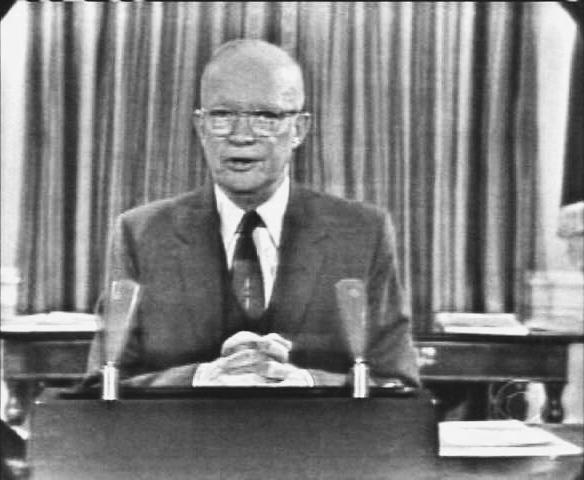
The Military-Industrial Complex has loomed over America ever since President Dwight D. Eisenhower warned of its growing influence during his prescient farewell address on Jan. 17, 1961. The Vietnam War followed shortly thereafter, and its bloody consequences cemented the image of the Military-Industrial Complex (MIC) as a faceless cadre of profit-seeking warmongers who’ve wrested control of the foreign policy. That was certainly borne out by the war’s utter senselessness … and by tales of profiteering by well-connected contractors like Brown & Root.

President Dwight Eisenhower delivering his farewell address on Jan. 17, 1961.
Over five decades, four major wars and a dozen-odd interventions later, we often talk about the Military-Industrial Complex as if we’re referring to a nefarious, flag-draped Death Star floating just beyond the reach of helpless Americans who’d generally prefer that war was not, as the great Gen. Smedley Darlington Butler aptly put it, little more than a money-making “racket.”
The feeling of powerlessness that the MIC engenders in “average Americans” makes a lot of sense if you just follow the money coming out of Capitol Hill. The Project on Government Oversight (POGO) tabulated all “defense-related spending” for both 2017 and 2018, and it hit nearly $1.1 trillion for each of the two years. The “defense-related” part is important because the annual National Defense Authorization Act, a.k.a. the defense budget, doesn’t fully account for all the various forms of national security spending that gets peppered around a half-dozen agencies.
It’s a phenomenon that noted Pentagon watchdog William Hartung has tracked for years. He recently dissected it into “no less than 10 categories of national security spending.” Amazingly only one of those is the actual Pentagon budget. The others include spending on wars, on homeland security, on military aid, on intelligence, on nukes, on recruitment, on veterans, on interest payments and on “other defense” — which includes “a number of flows of defense-related funding that go to agencies other than the Pentagon.”
Perhaps most amazingly, Hartung noted in TomDisptach that the inflation-adjusted “base” defense budgets of the last couple years is “higher than at the height of President Ronald Reagan’s massive buildup of the 1980s and is now nearing the post-World War II funding peak.” And that’s just the “base” budget, meaning the roughly $600 billion “defense-only” portion of the overall package. Like POGO, Hartung puts an annual price tag of nearly $1.1 trillion on the whole enchilada of military-related spending.
The MIC’s ‘Swamp Creatures’
To secure their share of this grandiloquent banquet, the defense industry’s lobbyists stampede Capitol Hill like well-heeled wildebeest, each jockeying for a plum position at the trough. This year, a robust collection of 208 defense companies spent $93,937,493 to deploy 728 “reported” lobbyists (apparently some go unreported) to feed this year’s trumped-up, $700 billion defense-only budget, according to OpenSecrets.org. Last year they spent $128,845,198 to secure their profitable pieces of the government pie.

The Pentagon, headquarters of the U.S. Defense Department, as viewed with the Potomac River and Washington, D.C., in the background. (Defense Department photo)
And this reliable yearly harvest, along with the revolving doors connecting defense contractors with Capitol Hill, K Street and the Pentagon, is why so many critics blame the masters of war behind the MIC for turning war into a cash machine.
But the cash machine is not confined to the Beltway. There are ATM branches around the country. Much in the way it lavishes Congress with lobbying largesse, the defense industry works hand-in-glove with the Pentagon to spread the appropriations around the nation. This “spread the wealth” strategy may be equally as important as the “inside the Beltway” lobbying that garners so much of our attention and disdain.
Just go to U.S. Department of Defense’s contract announcement webpage on any weekday to get a good sense of the “contracts valued at $7 million or more” that are “announced each business day at 5 p.m.” A recent survey of these “awards” found the usual suspects like Raytheon, Lockheed Martin and General Dynamics. The MIC was well-represented. But many millions of dollars were also “won” by companies most Americans have never heard of … like this sampling from one day at the end of October:
  • Longbow LLC, Orlando Florida, got $183,474,414 for radar electronic units with the stipulation that work will be performed in Orlando, Florida.
  • Gradkell Systems Inc., Huntsville, Alabama, got $75,000,000 for systems operations and maintenance at Fort Belvoir, Virginia
  • Dawson Federal Inc., San Antonio, Texas; and A&H-Ambica JV LLC, Livonia, Michigan; and Frontier Services Inc., Kansas City, Missouri, will share a $45,000,000 for repair and alternations for land ports of entry in North Dakota and Minnesota.
  • TRAX International Corp., Las Vegas, Nevada, got a $9,203,652 contract modification for non-personal test support services that will be performed in Yuma, Arizona, and Fort Greely, Alaska,
  • Railroad Construction Co. Inc., Paterson, New Jersey, got a $9,344,963 contract modification for base operations support services to be performed in Colts Neck, New Jersey.
  • Belleville Shoe Co., Belleville, Illinois, got $63,973,889 for hot-weather combat boots that will be made in Illinois.
  • American Apparel Inc., Selma, Alabama, got $48,411,186 for combat utility uniforms that will be made in Alabama.
  • National Industries for the Blind, Alexandria, Virginia, got a $12,884,595 contract modification to make and advanced combat helmet pad suspension system. The “locations of performance” are Virginia, Pennsylvania and North Carolina.
Sharing the Largesse
Clearly, the DoD is large enough, and smart enough, to award contracts to companies throughout the 50 states. Yes, it is a function of the sheer size or, more forebodingly, the utter “pervasiveness” of the military in American life. But it is also a strategy. And it’s a tactic readily apparent in a contract recently awarded to Raytheon.

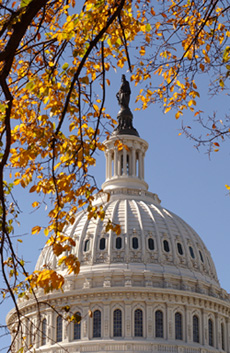
U.S. Capitol.
On Oct. 31, 2017, they got a $29,455,672 contract modification for missions systems equipment; computing environment hardware; and software research, test and development. The modification stipulates that the work will spread around the country to “Portsmouth, Rhode Island (46 percent); Tewksbury, Massachusetts (36 percent); Marlboro, Massachusetts (6 percent); Port Hueneme, California (5 percent); San Diego, California (4 percent); and Bath, Maine (3 percent).”
Frankly, it’s a brilliant move that began in the Cold War. The more Congressional districts that got defense dollars, the more votes the defense budget was likely to receive on Capitol Hill. Over time, it evolved into its own underlying rationale for the budget.
As veteran journalist William Greider wrote in the Aug. 16, 1984 issue of Rolling Stone, “The entire political system, including liberals as well as conservatives, is held hostage by the politics of defense spending. Even the most well intentioned are captive to it. And this is a fundamental reason why the Pentagon budget is irrationally bloated and why America is mobilizing for war in a time of peace.”
The peace-time mobilization Greider referred to was the Reagan build-up that, as William Hartung noted, is currently being surpassed by America’s “War on Terror” binge. Then, as now … the US was at peace at home, meddling around the world and running up a huge bill in the process. And then, as now … the spending seems unstoppable.
And as an unnamed “arms-control lobbyist” told Grieder, “It’s a fact of life. I don’t see how you can ask members of Congress to vote against their own districts. If I were a member of Congress, I might vote that way, too.”
Essentially, members of Congress act as secondary lobbyists for the defense industry by making sure their constituents have a vested interest in seeing the defense budget is both robust and untouchable. But they are not alone. Because the states also reap what the Pentagon sows … and, in the wake of the massive post-9/11 splurge, they’ve begun quantifying the impact of defense spending on their economies. It helps them make their specific case for keeping the spigot open.
Enter the National Conference of State Legislatures (NCSL), which notes, or touts, that the Department of Defense (DoD) “operates more than 420 military installations in the 50 states, the District of Columbia, Guam and Puerto Rico.” Additionally, the NCSL is understandably impressed by a DoD analysis that found the department’s “$408 billion on payroll and contracts in Fiscal Year 2015” translated into “approximately 2.3 percent of U.S. gross domestic product (GDP).”
And they’ve become a clearinghouse for state governments’ economic impact studies of defense spending. Here’s a sampling of recent data compiled on the NSCL website:
  • In 2015, for example, military installations in North Carolinasupported 578,000 jobs, $34 billion in personal income and $66 billion in gross state product. This amounts to roughly 10 percent of the state’s overall economy.
  • In 2014, Coloradolawmakers appropriated $300,000 in state funds to examine the comprehensive value of military activities across the state’s seven major installations. The state Department of Military and Veterans Affairs released its study in May 2015, reporting a total economic impact of $27 billion.
  • Kentuckyhas also taken steps to measure military activity, releasing its fifth study in June 2016. The military spent approximately $12 billion in Kentucky during 2014-15. With 38,700 active duty and civilian employees, military employment exceeds the next largest state employer by more than 21,000 jobs.
  • In Michigan, for example, defense spending in Fiscal Year 2014 supported 105,000 jobs, added more than $9 billion in gross state product and created nearly $10 billion in personal income. A 2016 study sponsored by the Michigan Defense Center presents a statewide strategy to preserve Army and Air National Guard facilities following a future Base Realignment and Closure (BRAC) round as well as to attract new missions. 
Electoral Impact
But that’s not all. According to the DoD study cited above, the biggest recipients of DoD dollars are (in order): Virginia, California, Texas, Maryland and Florida. And among the top 18 host states for military bases, electorally important states like California, Florida and Texas lead the nation.

President Trump speaking at a Cabinet meeting on Nov. 1, 2017, with Secretary of State Rex Tillerson to Trump’s right and son-in-law Jared Kushner seated in the background. (Screen shot from whitehouse.gov)
And that’s the real rub … this has an electoral impact. Because the constituency for defense spending isn’t just the 1 percent percent of Americans who actively serve in the military or 7 percent of Americans who’ve served sometime in their lives, but it is also the millions of Americans who directly or indirectly make a living off of the “defense-related” largesse that passes through the Pentagon like grass through a goose.
It’s a dirty little secret that Donald Trump exploited throughout the 2016 presidential campaign. Somehow, he was able to criticize wasting money on foreign wars and the neoconservative interventionism of the Bushes, the neoliberal interventionism of Hillary Clinton, and, at the same time, moan endlessly about the “depleted” military despite “years of record-high spending.” He went on to promise a massive increase in the defense budget, a massive increase in naval construction and a huge nuclear arsenal.
And, much to the approval of many Americans, he’s delivered. A Morning Consult/Politico poll showed increased defense spending was the most popular among a variety of spending priorities presented to voters … even as voters express trepidation about the coming of another war. A pair of NBC News/Survey Monkey polls found that 76 percent of Americans are “worried” the United States “will become engaged in a major war in the next four years” and only 25 percent want America to become “more active” in world affairs.
More to the point, only 20 percent of Americans wanted to increase the troop level in Afghanistan after Trump’s stay-the-course speech in August, but Gallup’s three decade-long tracking poll found that the belief the U.S. spends “too little” on defense is at its highest point (37 percent) since it spiked after 9/11 (41 percent). The previous highpoint was 51 percent in 1981 when Ronald Reagan was elected in no small part on the promise of a major build-up.
So, if Americans generally don’t support wars or engagement in the world, why do they seem to reflexively support massive military budgets?
Frankly, look no further than Trump’s mantra of “jobs, jobs, jobs.” He says it when he lords over the sale of weapon systems to foreign powers or he visits a naval shipyard or goes to one of his post-election rallies to proclaim to “We’re building up our military like never before.” Frankly, he’s giving the people what they want. Although they may be war-weary, they’ve not tired of the dispersal system that Greider wrote about during Reagan’s big spree.
Ultimately, it means that the dreaded Military-Industrial Complex isn’t just a shadowy cabal manipulating policies against the will of the American people. Nor is the “racket” exclusive to an elite group of Deep State swamp things. Instead, the military and the vast economic network it feeds presents a far more “complex” issue that involves millions of self-interested Americans in much the way Eisenhower predicted, but few are willing to truly forsake.
JP Sottile is a freelance journalist, radio co-host, documentary filmmaker and former broadcast news producer in Washington, D.C. He blogs at Newsvandal.com or you can follow him on Twitter, http://twitter/newsvandal.

Independence for Catalonia! Down With the EU! Spain Strangles Catalonia For Workers Republics!

Workers Vanguard No. 1121
3 November 2017
Independence for Catalonia! Down With the EU!
Spain Strangles Catalonia
For Workers Republics!
OCTOBER 30—Three days ago, the parliament of Catalonia voted to secede from Spain and establish an independent Catalan republic. Minutes later, the Spanish senate, dominated by the Castilian chauvinists of the right-wing Popular Party (PP) and of the social-democratic Spanish Socialist Workers Party (PSOE), voted to dissolve the Catalan parliament and depose the regional government.
Madrid is officially seizing control of Catalonia, including its finances, police force and major TV and radio stations under Article 155 of the Spanish constitution, which enables the rulers of the Spanish prison house of oppressed peoples to strip autonomous communities of their powers. It has also ordered new regional elections on December 21. Catalan pro-independence deputies, including President Carles Puigdemont (of the Partit Demòcrata Europeu Català, PDeCAT) and his vice president Oriol Junqueras (of the Esquerra Republicana, ERC) have been threatened with arrest for “rebellion,” for which they could spend as long as 30 years in prison. Two prominent leaders of independentiste groups, Jordi Sànchez of the Catalan National Assembly and Jordi Cuixart of Ã’mnium Cultural, were imprisoned on October 16 and face trial for sedition.
The Spanish state unleashed a wave of repression in late September in an attempt to suppress the October 1 Catalan independence referendum. Over two million people cast ballots, courageously defying the thousands of vicious Guardia Civil and Policía Nacional sent by Madrid. Ninety percent voted in favor of independence. Since then, Catalonia and its largest city, Barcelona, have been rocked by huge protests demanding an end to the repression and freedom for the imprisoned independence leaders. Several chauvinist protests have also taken place, led by the neo-Francoist PP, the right-wing Ciutadans and the social-democratic Partit dels Socialistes de Catalunya (PSC), in defense of the unity of monarchical, Castile-ruled capitalist Spain. It is in the interests of the working class throughout Spain and France to defend the oppressed Catalan people, whose nation straddles the Franco-Spanish border. Policía Nacional and Guardia Civil out of Catalonia! Free Cuixart, Sànchez and all pro-independence activists! Down with the monarchy! Defend Catalan independence!
Like Catalonia, the oppressed Basque nation in Euskal Herria (the Basque Country) stretches from Spain into France. For decades, the Basques have suffered deadly repression at the hands of both the Spanish and French governments. As proletarian revolutionary internationalists, we fight for the independence of the Basque Country and Catalonia, North and South—that is, against the capitalist rulers of both France and Spain. We seek to build Leninist-Trotskyist parties that support the just struggles of oppressed nations, which can be a lever to advance the revolutionary struggle of the proletariat against the capitalist rulers. Our program is for proletarian revolution, the seizure of power by the working class. For workers republics in Catalonia and the Basque Country as parts of a voluntary Socialist United States of Europe!
For the Catalan workers and poor, the struggle for national liberation is a component part of their struggle against exploitation. The potential power of the working class was demonstrated in a small but important way by the port workers in Barcelona and Tarragona, who refused to service the ships being used to house the Policía Nacional and Guardia Civil at the time of the referendum. But Catalan workers have not been mobilized as an independent force due to their wretched reformist misleaders, who, on the whole, refuse to fight for Catalan independence. For this reason, Catalan workers are dissolved into the mass movement, and pro-independence working-class militants have nowhere to look for their liberation except to the bourgeois nationalists. It is necessary to forge a revolutionary proletarian leadership that champions the struggle for national liberation.
No Illusions in the Catalan Bourgeoisie!
Amid fears that an independent Catalonia would be kicked out of the European Union (EU), a host of Catalan companies, including two large banks, CaixaBank and Banco Sabadell, promptly seized on Madrid’s offerings and opted to register their headquarters outside Catalonia. The Catalan bourgeoisie (represented prominently by the PDeCAT and its predecessors, as well as by the ERC) has sometimes used separatism as a bargaining chip in its dealings with Madrid. But the chauvinist, vindictive humiliations inflicted by the central government, as well as pressure from the Catalan masses, have pushed the political representatives of a section of the Catalan bourgeoisie into open defiance. Puigdemont postponed declaring independence after the October 1 referendum, and even offered to hold early regional elections if PP prime minister Mariano Rajoy would guarantee that Catalonia would retain its autonomous status. But the Castilian-chauvinist Rajoy and his cohorts would have nothing less than total capitulation. Thus, the Catalan government declared independence.
Madrid has made clear that it will go to any lengths to maintain the territorial integrity of Spain, while Catalonia lacks anything resembling a state of its own—centrally, armed forces—that could resist the Spanish state. The Catalan working class, meanwhile, has given no sign of significant independent motion. Under these circumstances, there is no hope of realizing Catalan independence now. Yet Catalonia remains in turmoil. With the immediate prospect of further repression and humiliation at the hands of the Castilian overlords, combined with the impotence of the Catalan bourgeoisie, further struggles are likely to erupt—the Catalan masses are in dire need of allies.
Such allies are to be found primarily in the proletariat of Spain and France. The Spanish and French bourgeoisies are both oppressing the Catalans and Basques and exploiting the working class as a whole. The breakup of the reactionary Spanish state would open the road for workers struggle against the capitalist rulers in Madrid. A relentless struggle must be waged against the chauvinism promoted by social democrats and the labor lieutenants of capital in the trade-union bureaucracies in order to win workers in the region to the fight for self-determination of the oppressed nations.
The struggle of the Catalan people has resonated across the border with Basques and Catalans living in France. Protests in support of Catalan independence have taken place in both the north and south of Euskal Herria. In an act of solidarity by Catalans in France, the ballots for the October 1 referendum were printed in Catalunya Nord and transported across the border.
Despite the Catalan government’s constant appeals, the rulers of the reactionary, imperialist EU have backed Madrid’s repression to the hilt, precisely because they know that a breakup of Spain portends a breakup of the EU. European Commission president Jean-Claude Juncker warned that “we need to avoid splits, because we already have enough splits and fractures,” and that the EU could not be made up of “95 different states.” The president of the European Parliament, Antonio Tajani, made it clear on October 22 that “no one is going to recognise Catalonia in Europe as an independent country.” The EU is an instrument for the imperialist powers of Europe, centrally Germany, to ratchet up the exploitation of the working people throughout Europe and to further impoverish weaker countries such as Greece and Portugal.
For Proletarian Political Independence!
The Rajoy government’s repression, supported by its lapdogs in the PSOE, has evoked memories of the dictatorship of Generalissimo Francisco Franco and its savage suppression of Basque, Catalan and Galician national rights. PP spokesman Pablo Casado didn’t hesitate to invoke this bloody history when he warned Puigdemont not to declare independence “because perhaps the person who makes the declaration will end up like the person who made the declaration 83 years ago.” This is a reference to Lluís Companys, the bourgeois-nationalist president of the Catalan Generalitat who was executed by a Francoist firing squad after the defeat of the Spanish Revolution. (See “Trotskyism vs. Popular Frontism in the Spanish Civil War,” Spartacist [English-language edition] No. 61, Spring 2009.)
The reality is that the repression being meted out today is fully in keeping with the legal framework of Spanish bourgeois democracy. The oppression of the Basque, Catalan and Galician nations was enshrined in the 1978 post-Franco constitution, which maintains that Spain cannot be divided. The two historic parties of the Spanish working class, the PSOE and the Communist Party (PCE), supported the formation of a monarchical state based on the denial of the right to self-determination of the oppressed nations of Spain and voted for the 1978 constitution.
The PSOE in government loyally served the king and fomented Castilian chauvinism for decades, notoriously setting up death squads to murder Basque independence fighters in the 1980s. For its own part, the PCE has also maintained its disgusting opposition to independence for the oppressed. The chauvinist misleaders of the CCOO and UGT union federations bear responsibility for the fact that workers in Catalonia and Spain have not come out as an organized force in defense of independence for Catalonia and the Basque Country.
The PSOE’s Catalan counterpart, the PSC, joined with Francoists and fascists in a reactionary demonstration in Barcelona on October 8 and October 29, under slogans such as “Catalonia is Spain.” Emboldened by Rajoy’s offensive, on October 27 fascists attacked the headquarters of Catalunya Ràdio as well as a Catalan cultural center and school in Barcelona. The fascists are a deadly danger to all workers, immigrants and oppressed minorities, and the working class must be mobilized to stop them.
With the PSOE heavily discredited among working people for having mercilessly administered EU-dictated austerity, the bourgeois Podemos party—which issued out of the 2011 petty-bourgeois Indignados movement—has taken up the task of refurbishing Spanish bourgeois democracy. Podemos has mobilized protests in opposition to Rajoy’s repression against Catalonia. But Podemos is firmly opposed to Catalan independence and merely provides brutal Castilian chauvinism with a “human face”: an October 23 letter to its membership decried any declaration of Catalan independence as “illegitimate.” Podemos advises the Spanish bourgeoisie to “ensure that Catalonia remains a part of Spain” with the carrot of greater democracy, rather than the stick of repression. Podemos has moved to strip the leadership of its Catalan organization (Podem) of its authority for not being hard enough against independence.
A more left-appearing Catalan bourgeois-nationalist party is the Candidatura d’Unitat Popular (CUP). Although the CUP claims to be socialist, in fact it is a party based on the petty bourgeoisie. It propped up the regional capitalist government for more than a year. The affiliate of the British Socialist Workers Party in Catalonia, En Lluita, liquidated completely into the CUP last year. These opportunists had no trouble simultaneously building the pro-independence CUP in Catalonia, while building the anti-independence Podemos in other parts of Spain, i.e., capitulating to one bourgeois nationalism or another.
No such confusion afflicts the fake-Trotskyist Internationalist Group (IG), which capitulates entirely to Castilian chauvinism. In their article “Defend the Right to Self-Determination and Independence for Catalonia” (September 2017) they do anything but defend Catalan independence. The IG denigrates the Catalan people’s just struggle for national liberation, sneering: “This is a nationalist movement led by the richest bourgeoisie in Spain” and “The impulse for independence comes above all from powerful sectors of the well-to-do Catalan bourgeoisie.” You’d think the IG had taken a page from the Francoist newspaper ABC, which wrote that the “Catalanist revolt against the state is a performance of the rich, by the rich and for the rich” (4 June).
These petty-bourgeois professors in the U.S. urged Catalans to battle their way to the polling stations on October 1—defying police truncheons, rubber bullets and tear gas—to “cast a blank ballot”! Dripping with contempt for the oppressed Catalans, the IG rants: “It’s not like some national liberation movement in a semi-colonial country.” The IG’s counterposition between national liberation struggles in the backward and advanced countries reveals their fundamentally Third World nationalist perspective. Further, the IG argues that Catalonia’s separation from Spain “could seriously undercut the potential for united struggle of the working class throughout the peninsula” (“Mass Resistance to Police Repression in Catalonia,” 4 October).
It is Madrid’s national oppression of Catalans, Basques and Galicians that has undercut the unity of the working classes in the artificial Spanish state. This unity can only be achieved by boldly championing the liberation of the oppressed nations—the opposite of the IG’s left-talking chauvinism, which blames the oppressed Catalans for dividing the working class, rather than the Castilian bourgeoisie and its reformist lackeys.
Bolshevik leader V.I. Lenin emphasized that achieving proletarian unity requires breaking the chains binding an oppressed nation to its oppressor. He used as an example Norway, which gained independence from Sweden following a 1905 referendum:
“The close alliance between the Norwegian and Swedish workers, their complete fraternal class solidarity, gained from the Swedish workers’ recognition of the right of the Norwegians to secede. This convinced the Norwegian workers that the Swedish workers were not infected with Swedish nationalism, and that they placed fraternity with the Norwegian proletarians above the privileges of the Swedish bourgeoisie and aristocracy. The dissolution of the ties imposed upon Norway by the monarchs of Europe and the Swedish aristocracy strengthened the ties between the Norwegian and Swedish workers.”
— “The Right of Nations to Self-Determination” (1914)
As explained in the current issue of our international theoretical journal, Spartacist (No. 65, Summer 2017), Lenin’s steadfast defense of the right of self-determination and implacable opposition to Great Russian chauvinism were crucial in forging the Bolshevik Party. It was Lenin’s revolutionary internationalist program that allowed the Bolsheviks to lead the working class to power 100 years ago. Today, the ICL upholds Leninism on the national question as part of our struggle for new October Revolutions.