Monday, April 09, 2018

The Average Joe Fall Guy Falls-With Kansas City Confidential In Mind
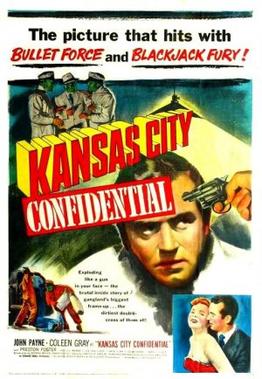
The Average Joe Fall Guy Falls-With Kansas City Confidential In Mind


By Bart Webber 


No question Joe Rolfe, formerly Joey Bops, was built for the frame, built for that frame to fit snuggly around his head. Not that Joe was stupid, far from it he had received his high school diploma and was in his first year of college when December 7, 1941 happened, when the world changed and he was all wrapped in the mess. Not that Joe wasn’t brave either since he received a couple of big military ribbons all shiny bright as a result of his service. And not that he wasn’t good-looking, good-looking to girls good-looking and so always had a girl on his arm in the old days before the war. Still when the deal went down Joey always seemed to be in the wrong place at the wrong time, always seemed to be the fall guy falling.

It had not always been like that. Before the war, during high school, during the days when he wore the moniker Joey Bops since he was crazy for swing music, you know Benny Goodman and Artie Shaw, guys like that, when he hung around with Frankie Riley, James Riordan, Lefty Kelly, and Rusty Shea in front of Harry’s Drugstore in Carterville, that’s out in “show me” Missouri, he could do no wrong. He and what did they call them then, oh yeah, the corner boys, led by the ingenious Frankie Riley, “Sparks” Riley, would carry out every midnight caper in search of loot that one could think of and never got in trouble with the law, any that would wind up on the books. Not even when the very, very suspicious Carterville police thought they had the lot of them nailed tight for the heist at the Lamar mansion. Yeah those were the days when even nice Catholic girls who went to church every Sunday and for the public record said their rosaries and swore they had a Bible between their knees at all other times would that previous Saturday night give up what they had had to give up, those sweet pussies, when they went out on a date with a Harry’s Drugstore corner boy they knew some nice jewelry or maybe some dough would go with the giving that sweet thing up. And good-looking Joey Bops got all he wanted, even from those Bible-worn girls, maybe especially from them.      

But the war, well, the war changed Joey Bops a lot, like I said, Joey had seen a lot of action in Europe, had gotten those medals, those well-earned medals, but he had lost a step, had lost the beat, maybe the be-bop beat of his youth, but most importantly the beat of how to beat the rap on some midnight adventure. Once he got home, after the fanfare was over and he went back to being just average Joey Rolfe citizen, after he decided all he saw and did in Europe made it kind of silly for him to go back to State U even though the newly enacted GI Bill would have pulled him through like it would many other ex-soldiers, he kind of lost his moorings and figured that he would go back to that sweet life of crime. Maybe it was because he went solo (the other corner boys had all dispersed, gone on, except Rusty Shea who was buried over in France during the war after being killed by a German mortar), maybe it was because he had lost the touch, maybe it was because he was crazy to hit a foolish gas station but Joey, Joey Bops of all people, got pegged for the robbery, armed robbery, when he tried to pull the caper just as a cop car was passing by Fred’s Esso station. So Joey got a nickel, did three and that was that.          

That was that until he got out, got his probation. Got himself into another town, got himself into the city, the big city, Kansas City, where he picked up a job delivering flowers, simple stuff, but one of the few jobs an ex-con on probation could get-driving a truck. But getting that job turned out to be the kiss of death for old Joey. See one of the delivery stops that he made was to Jones’ Funeral Home, not the one on Center Street in K.C. but over on Main, next to the First National Bank. One day while he was parked out front of Jones’ delivering a rack of roses for some departed soul next door the bank was being robbed in broad daylight by some guys in masks. They got away with half a million in cool hard cash (just walking around money today but then real dough). Got away clean in a sweet job. Naturally the coppers looking around saw Joey’s silly flower truck, checked it and him out, and once they found out that he was an ex-con and had served time they took him downtown (and they had contacted as well the Carterville cops who put the blast on him for all the crimes that they couldn’t prove he committed). There he stayed for a couple of weeks until the coppers found enough information about the robbery plan to know that he was not part of the caper and they had to let him go.

Here’s the lesson Joey learned though from that experience he was never going to be able to go straight if he didn’t find out who pulled the First National Bank caper. (Or if he decided to go crooked again he would always have that fall guy tag on him for any “cold cases” the cops caught nothing on and he would spent many nights before those stupid police lights blaring line-ups.)  So hunting down the guys who did the deed was his next “career.” His new reason to get up in the morning. For this he needed a little help, help from the only private detective that he could afford at the time, Philip Larkin. Phil had been a guy that he met in the Army overseas and they had been transported home on the troop ships together landing in New York Harbor, spent a few days getting drunk as skunks and laid seven different ways including Joe’s first blow job in a long time, since before the world when some of those Catholic girls in Carterville who didn’t want to “do the do” would piece a guy off with some head to save their reputations, as virgins and yet at the same time as willing to be frisky, and you can figure what that “frisky” part meant  as best you can. They then parted Joe to Carterville and the slammer and Phil up north to Riverdale in Massachusetts to join the cops.        

They had stayed in contact via the U.S. mails and Phil had gone out to the Missouri State pen a couple times to visit Joe after he got himself booted off the Riverdale cops for not going along with the cover-up of a vehicular homicide case involving one of the town’s Mr. Bigs. Those were the days when Phil was just starting out in the private detection business before the Altman case which put him in the local headlines for a while. That had been a whirlwind which soon faded and when Joe contacted Phil he was more than happy to help out an old buddy since he had been shuffling along doing key-hole peeping, getting the goods on adulterous guys or gals for their ever-loving spouses in order for those ever-loving spouses to take to court and get divorces and grab as much dough at the traffic would bear from their shamefully unfaithful spouses. Tough wormy work. That and hitting the bottle stashed conveniently in the bottom desk drawer of his dust-filled office a little too much while killing time between jobs.      

Here’s the stuff they don’t show or tell you on detective shows on television or in those glossy-covered crime detection novels where the P.I. always outsmarts the public cops. Even on the obvious cases like where the distraught wife has a smoking gun in her hand with three bullets gone into a philandering husband now dead who just so happens to have three bullets in his worthless body. Even they, the public cops, can figure that one out, as long as there are three bullets in the body. Less or more all bets are off.  But as a rule a private eye if he or she wants to have any career better either leave the serious crime detection to the public cops or report everything he or she finds out in a case they are handling involving crime to them. That had been Phil’s policy early on in his career and he kept his license no sweat because of that hard fact. What that sound policy had allowed Phil to do for Joe was to get access to the First National Bank job stuff the cops there in K.C. knew about via his connections with a couple of Riverdale detectives whom he had helped out a couple of times.    

Funny the layout of the K.C. job was simplicity itself and even Joe had wished he had thought of the plan rather than having been the fall guy falling. See the truck that delivered the bank its working money, say it  had a half million or so in the back for such deliveries, arrived at the about the same time as Joe made his fucking flower deliveries to the funeral parlor. What happened was that on the day of the armored bank truck robbery the robbers had a replica of the flower truck to throw the coppers off the scent. The robbers, four in all, all wearing Jimmy Cagney gangster masks, pulled the heist of the armored vehicle leaving two guards severely wounded (they would recover), and taking off for parts unknown in the fake flower truck. Leaving Joe the fucking fall guy of fall guys once the APB went out and his truck was the only one still in sight. With Phil’s information as a guide and stuff he had heard when the K.C. cops were giving him the “third degree” Joe figured to figure the whole scam out before he was done. Joe thanked Phil for his help and that is the last we will see of Phil in this caper because Joe couldn’t afford the twenty-five bucks a day, plus expenses, that Phil needed to stay on the case and Joe was itching to blam blam the bad hombres who put him in that tight spot on his own.        

Don’t let the fall guy Joe thing fool you too much, that probation straight and narrow  either since Joe who did his drinking at Matty’s Tavern a well know hang-out for hoods and other loose-livers was pretty well-connected to the underworld even if he had to in the over-world play the probation game. Matty, working the bar himself one night when Joe came, gave him the tip that was the first step in getting his handle on the guys who set the frame on him. One of the hoods, name undisclosed, that hung around Matty’s had told Matty that Zeke Zimmer, a low-life gambler who had owed him money, five Gs, had  blown town  after paying  him off, was headed south to sunny Mexico and the gambling joints there. This Zeke was a serious low-life who half the time didn’t have two dimes to rub together and when he did he bet them on the roulette wheel, the blackjack table, the ponies, or the queen of hearts so his having dough was the lead that got Joe going, had him heading down to Juarez and some Touch of Evil madness.  This tip was proof positive, as much proof positive as Joe needed to follow the trail south since it was much more than likely that Zeke had been in on the bank heist.   

Juarez was and still is a tough town to get anything out of, any kind of information about anything even directions to Rosa’s Cantina and that place to this day is still etched with a huge neon sign so you can see it almost from across the border in El Paso. Back in the 1950s it really was something out of Orson Welles’ Touch of Evil you could smell the corruption the minute you got over the international border, the minute you had to hand some foul-breathed Federale five dollars American to let you through without the usual hassle inspection, maybe planting some illegal drugs or other contraband on you if you didn’t fork over the fiver.  It got worst from there as every con man, hooker, drifter, and all the batos locos descended on your head looking for his or her piece. Joe, after spending an hour in Senorita Santa Maria’s whorehouse since he had not had a piece of a woman’s flesh for a while and the Senorita specialized in fresh young fluff from the country, made his way to Rosa’s Cantina where there was 24/7/365 casino action, action that an in the chips guy like Zeke would naturally gravitate toward to see how fast he could lose his shirt and begin his usual begging gringos for two dimes to rub together. 

Rosa’s like all such places in Juarez in those days was no place to be asking any questions about gringos with money to spend, maybe asking any questions at all so Joe just kind of plunked himself on a barstool, ordered some tequila, and waited until he spotted a low-rent gambler who fit the description given to him at Matty’s. The key piece of information Joe had received had been that Zeke always wore (except when it was in hock) a gold-plated onyx ring with a diamond stud set in the center which you could see from a distance. So Joe waited, waited a couple of hours getting a little blasted on that harsh high-shelf tequila he was ordering (and fending off the barmaids who were offering blow jobs over in a quiet corner if he would buy them a drink, yeah, Rosa’s was that kind of place, you could get anything there you wanted from sex to gold-plated dentures you just had to ask, no, just had to wait long enough and somebody would come by selling themselves or something).

Finally Zeke rolled in and headed to the blackjack table. Joe waited and watched looking for an opening to “talk” to Zeke. About two in the morning Zeke went outside for a breather, went out with a lot less dough that he had come in with. So when Joe approached him with the intend of collaring him to find out who and where the other guys were Zeke surprised him when he asked if he had five bucks he could lend him until “pay day.” Joe flagged Zeke off, gave him the fiver and then quick as a rabbit strong-armed Zeke and force-marched him to a quiet area where they could talk.

Zeke filled with anger, hubris, and morphine was ready to talk, or else as Joe made very clear. Joe was persuasive enough against this low-life punk that he found out that the other three guys were in Sonora further south and that Zeke was supposed to head there in a couple of days to meet up with them and divvy up the rest of the dough. Zeke even under extreme pressure from the gun that Joe had at his head could not come up with the names of the three other guys because they had all worn masks at all meetings and on the job. The only name Zeke knew was of the guy who planned the whole caper, a guy who called himself Mister Big, a lot of help that was. At the meeting in Sonora Zeke was to go to the El Dorado Cantina and present his calling card-a sad ass joker from a special deck of cards Mister Big gave each confederate.      

Joe convinced Zeke in the most dramatic way possible that he was going to Sonora with him and that dramatic encounter was enough for Zeke to see the light. The very next morning after some tacos and tomales one Joey Bops and one Zeke Zimmer were seen heading taking a dusty old bus headed south to Sonora. The ride down was uneventful except the endless dust, the locals with their Mexican luggage and their sweaty smells and goddam fowls brought along like children, and the story that Zeke, going slightly cold turkey from the morphine, had to tell.

Tell about how Mister Big put the whole production together. It was Mister Big who had figured out that the similar arrival times of the flower truck at the funeral home and the armored car at the bank gave a few minute opportunity to grab the cash and take off in a “fake” flower truck. They had practiced the route and run about twenty times before Mister Big told them they were ready. It was also Mister Big who thought of the idea of the masks so nobody could fink on the other guys to the coppers if caught and of laying off for a while before splitting up the big dough. It was his caper but they were to split four ways even, and that was why they each had a card from the special deck as identification. (Joe thought to himself knowing stoolies since he was about twelve years old Mister Big was smart enough to know guys like Zeke and the others who were probably dredged from the same barrel bottom would sell their mothers for five bucks and change if they were in a squeeze and were looking to get out from under some rap. This Mister Big would be a tough nut to crack.)

Arriving in the early morning in Sonora Joe checked into the Rio Grande Hotel, which unlike it high class sounding name was a flea-bag joint but which had the best bar in town, a bar that the touristas did not frequent and so adequate for Joe’s needs (naturally with Zeke as his boon roommate and drinking companion). The next morning, late, Joe left Zeke in the room, taking the added precaution of grabbing that joker as insurance for his survival and so that Zeke could not sneak away to grab his dough forgetting about his boon companion Joe and went down to the bar to grab a few quicks shots of tequila that he was getting to like very much. At the bar he noticed a gringa, a good-looking gringa, brunette, blue eyes, a little on the tall side, thin, nice shape, well-turned legs and wondered what she was doing in hot, sweaty dusty, Mexico. He walked over to her, asked her name, she answered Laura, asked her if she would like a drink, she accepted and then he asked her why she was down in dusty Sonora apparently by herself. Laura replied that she was down with her father who was there on business, she was bored and had decided that she would drink the morning away.

As it turned out this Laura, after a few more drinks, was in the time of her time, was looking for little sexual escapade to while away the hours while her father did his business. That was her story to Joey anyway. Joe obliged her, grabbed a bottle from off the bar and they went to her room. They stayed drunk and sexed-up for a couple of days as it turned out. Then coming out of his alcoholic and sex haze he remembered Zeke, told this Laura that he had to check into his own hotel to finish some business but would be back the next day. Naturally by the time Joe got back to his hotel Zeke was long gone. Joe decided that he would sleep for a while and then the next day head back to Laura’s place and figure out how to keep her in tow and go about the business of finding the bank robbers. 

Joe needn’t have been in any rush because by the time he got back to Laura’s room the next late morning he was met with a “welcoming” committee of four guys, three in Jimmy Cagney masks, Zeke, and of course Laura. What he had not known although he should have figured it out was that the father that Laura was down in Sonora on business with was none other than Mister Big. See the hood that had given Matty the information about Zeke up in K.C., later identified as Lefty Finley, a known pimp and bad guy to mess with, had been one of the robbers keeping an eye on Zeke who with his morphine habit was the “loose cannon” in the operation. All that special joker card stuff Zeke talked about to avoid stoolies by Mister Big in the end was so much razzle-dazzle for the paying public.   

Yeah Joe shouldn’t have been in any rush to see that Laura since a few days later he was found with two big bullets in his head in a dusty back road in Sonora with a joker in his coat pocket and some hundred dollar bills later identified as being from the robbery. Alongside him in that back alley were Zeke, Lefty and the other member of the gang, Bugs Malone, a known drug runner and another bad hombre. They also had special jokers and some hundred dollar bills in their coat pockets. End of case, end of case for the Sonora police, the Federales, since they chalked it up to some Mexican bad guys wasting some gringos trying to cut in on their play. The K.C. cops, having unloaded an unsolved bank robbery and four creeps wrote the whole thing down to what they knew they knew at first. Joe had been the Mister Big of the operation all along and had out-smarted himself somehow. A wise guy double-dipping on that fake flower truck stuff. The real Mister Big and his daughter, Laura, well they were never heard from again as far as anybody knew- if they had ever existed. Yeah, Joe Rolfe, Joey Bops, All-American fall guy falling the big fall.          

Out In The Be-Bop Drive-In Theater Night-Circa 2015-With Laura Perkins In Mind


Out In The Be-Bop Drive-In Theater Night-Circa 2015-With Laura Perkins In Mind 
From The Pen Of Bart Webber

Josh Breslin was a man, is a man of institutionalized memories. Part of that came, comes from his long ago minute career as a budding journalist in the alternative media world of the late 1960s and early 1970s when anyone with access to pen and press could, and did, print plenty of interesting material before the hammer fell down and that whole universe fell under the ebb tide of the big bad movement, the counter-revolution as one political wag called it, when the other side, symbolized by the master criminal Richard Milhous Nixon who also happened to be President of the United States, let the whirlwinds of reaction have a field day on our heads. (A couple of the journals that had weathered the storm that he had written for like Rolling Stone which is today just a glossy reprint of Vogue or Vanity Fair for the quasi-hip audience it appeals to in its articles and the consumer-driven advertisements it displays which pay the bill, hence the tiller’s placid reward, and the local Boston Phoenix which went belly up a few years ago after subsisting as a “hook-up” venue do not undermine that ebb tide understanding on the media front.)

Part of Josh’s respect for memory also came from his association with the long gone, long moaned over Pete Markin whom he had met out in San Francisco in the high tide summer of love, 1967 and who came to a bad end in the mid-1970s down in Sonora, Mexico after a high-end drug deal went down the wrong way and he wound up face down in a dusty back alley with a couple of slugs in the back of his head who always, always lived to have about two thousand juicy memory references handy on the off chance that, for example, somebody might quickly need to know Millard Fillmore’s standing among  American Presidents (just above Richard Nixon at last check) and the practice had rubbed off on him.
On a recent night that memory business got a full workout as Josh went back deep into his youth (and the youth of his lady friend, Laura Perkins, who is key to this particular memory flash) returning to the scene of many a youthful misadventure-the still functioning Olde Saco Drive-In up in Maine.              

Drive-In? Well, yes, for those who have only heard about this institution of the high golden age 1950s and 1960s automobile and have no personal knowledge that they really still exist in spots except in “generation of ’68’’ nostalgia movies like American Graffiti  the drive-in. Here’s the skinny (or if you are still in disbelief then go to Wikipedia and check the information out). Back when everybody was dying to have a car from old grand-pappies to barely sixteen year old boys (and it was mainly boys, girls were usually okay grabbing the family car for a night out with the girls, a night “cruising’ the boulevards looking for the heart of Saturday, looking for boys just as Josh and his crowd were “cruising” looking for girls or sitting, sitting in the front close to some hunk with a “boss” car and glad to be the subject of some salacious  Monday morning girls’ lav gossip) the whole axis of night-life changed once everybody realized that you were no longer tied to the house (or at most the neighborhood), were not tied to constantly eating at home, sleeping at home or watching the new-fangled television or go to the local box movie house. In a car-fixated time you could travel and stay in a motel overnight, you could eat, if you dared, at a drive-in restaurant or while away the evening in the snugness of your automobile at the drive-in theater. Hail god car.   

Of course while anybody, child or adult, could do all those things the drive-in movies became along with the drive-in restaurant one of the moments of the teen ritual, although we were all back then brought up on parents taking their children to the drive-in as an easy way to get out of the house what with a double-feature, a snack bar and a playground to entertain the kiddies. That kids’ stuff is just that. The teen drive-in movie scene is the stuff of nostalgia. Josh wasn’t sure when he stopped going to the drive-in except sometime in the 1970s, wasn’t sure when drive-ins kind of folded up and died away of hubris or indifference at some point that he did not remember (after in some cases serving up some soft-core porn to keep an audience) and wasn’t sure if they even existed anymore. Wasn’t sure that is until he was heading to Portland, Maine for a conference and decided to take Route One instead of U.S. 95 up from his home in Boston.

Now that was no random decision since  Josh had grown up in Olde Saco a few miles south of Portland and had been for a lot of reasons of late in an Olde Saco frame of mind after the passing of Rene Dubois his old high school classmate and runaround corner boy back then. As he worked his way up Route One when he got to Olde Saco he happened to look to the right and there kind of hidden from view was an ancient dilapidated crude handmade sign for the Olde Saco Drive-In and moreover that the place was still open for business. He did not have time to stop but that sign, that memory kind of festered in his mind for a few weeks until he decided to go spent a few days (along with Laura) up at an old friend’s house in Wells (an old friend of Markin’s really from North Adamsville down in Massachusetts where they had grown up which is how he had met Jimmy Jenkins the owner of the place back after the summer of love, 1967). One day Josh fervently asked Laura to “take the ticket, take the ride,” an expression that he used when he wanted them to do something out of the ordinary. And going to a drive-in, the Olde Saco Drive-In was not something that he had done in about forty years so he was really doing a memory stretch. Laura at first didn’t want to go, said she had no history and hence no memory for drive-ins since between her shoulder-to-the-wheel no-nonsense parents not being the drive-in movie types and living out in Podunk in upstate New York where she could not remember if there were drive-ins in the area Josh’s big deal was a deflated balloon to her. But she eventually relented after he promised her to do about fourteen different things from taking her to dinner, cleaning up a laundry list (her laundry list) of stuff, to cooking in return which he took as a fair bargain under the circumstances, so they were off.

Now this drive-in thing back in the day had a certain ritual to it, a Josh and his gang ritual anyway. He had already thought after seeing the old place about the travails of childhood when after a long shift at the MacAdams Textile Mill where his father, Prescott,  worked as a machinist before the mills that sustained the town headed south (first to American South then the world South to places like Indonesia and Singapore in search of that greedy increased profit wrought by cheaper wage packets), and Delores (nee LeBlanc and hence her hometown of Olde Saco one of the work stopping points heading south from native Quebec a generation or two before her own), his mother, both work weary would bundle up he and his four sisters and head to the “Olde Saco” for the night’s double feature, some illicit snacks (you were not supposed to bring your own foods in but what was to stop you and it would not be, despite five Breslin children howls, until he went there with his gang that he would learn of the delights at the snack bar-the buttered drenched slightly stale, maybe popped from the night before, popcorn, the fizz-less sodas sickenly sweetly syrup and caffeine clogged, the desiccated cardboard-like pizza light on cheese, sauce and flavor, the greasy grimy hamburgers only saved by slathered ketchups and mustard, no onions, no, onions if you wanted to go in to that good night with a certain she but more of that later, and the food-free, calorie free hot dogs in their grave-like mushy white flour enriched buns that would become his staple on drive-in nights, his sisters too from what they said, from what they said on their date nights if the guy wanted to get anywhere, anywhere at all with them, no cheapskates need apply their motto), and the playground conveniently located at the  end just below the movie screen where he and his sisters would climb the jungle jim, slide the slide, mangle the see-saw and seek heaven on the swings. Kindly childhood thoughts as almost all children would think (and later measured, nicely measured in his parents favor since they really did not have the surplus dough to spent on such “frills” when the rent was always behind and his mother made something of a secular rosary out of her weekly white envelopes on the kitchen table bill-paying chores always short, always damn short although that remembrance too late to do him, or them, any good since they had been estranged so long).

No, what drove Josh these days were the teenage drive-in movies where he had come of age in the Olde Saco night. Of course it started with larcenous intent (nice legal term courtesy of Sam Lowell, the lawyer friend of Markin also met after they headed back East together in the summer of love year 1967) when the late Rene Dubois, a year older than the rest of the guys since he had just come down from Quebec and was in a special language immersion class (although they didn’t call it that then but something like special needs, or for dumb kids or something) for a year before joining the regular class who got his driver’s license first and more importantly since he worked at La Croix’s Garage over on Main Street after school and on weekends his first car an old beat up ‘53 Chevy that he worked on to bring back to life (as he would do with a succession of cars up to a “boss” ’57 two-toned white and cherry red naturally Chevy that was nothing but a “babe” magnet and not just for teeny-bopper girls either). But before the girls started cluttering up Rene’s life (as they would through four freaking marriages, a bushel of kids, and a bevy of grandkids) he was the “max daddy” of the road taking his corner boys like Josh to the Olde Saco Drive-In.

Here is where the larceny comes in though. In those days admission was something like three dollars a head for the nightly double-feature (Josh urged that he not be quoted on that price for like lots of things these days that number seems to have come out of the mist of time and may be totally wrong but the price cheap anyway although not cheap enough for “from hunger” working class projects kids like him) so what they would do is pig-pile three or four guys in the big ass trunk (occasional sightings of 1950s automobile models still on the road and a recent visit to an automobile museum out in San Diego only confirmed to Josh what he remembered about how big the trunks were then, and how big bad ass the engines were too, and although today’s are quite a bit more efficient there was some psychological lift then in being seen in those big ass cars, certainly the girls would turn their heads something he had not seen anybody with today’s zip cars and minis), maybe depending on size a couple of guys in the rear seat wells so for about  six bucks (remember the guess-aspect please), the admission Rene and whoever was riding shot-gun paid (later correctly split up among the total number admitted since that was the whole point) half the freaking neighborhood got into the show for less than a dollar.

Now one might ask, aside from the silly question of the morality if not the legality of such moves whether the admission booth attendant would not get wise to the whole scene. What are you kidding this poor cluck probably got about a dollar an hour for his or her work and was not worried about playing “copper,” not when that person probably was running the same scam when he or she was going to the drive-in. The important thing is that later, later when it wasn’t about “from hunger” guys but meeting carloads of girls from the neighborhoods who were using the same “technique” sometimes Josh and the boys would con some poor girls into the trunk and since it was tight quarters “cop” a quick feel wherever that stray hand landed (the only really acceptable kind of “copping” when you thought about it) a quick feel and maybe get them “in the mood” for the fogged up window scene every guy dream of.  (Later Josh would tell one and all out in California he blushed more than the girls when he pulled that maneuver although he caught more than his fair share of “in the mood” girls, he was not known by the moniker the “Prince of Love” in the great summer of love night, circa 1967, for nothing).  

Josh laughed when he thought about that silly larceny and that “copping” kids’ stuff but later, come junior and senior years of high school the ritual became much more serious when three was a crowd time, when it was important to be able to separate out a bit and go to what was named the “sweat box” by the local guys, the place where the single guy with a single girl placed their automobile away from the prying carload of younger teen guys or girls and better still from prying eyes of young parents, grown suddenly old and responsible once the kids started coming, shielding their kids from the fogged bound cars at the back of the lot. The “sweat box” was the section where if one asked a quick question about the plot of the film one would get some strange answers while the parties were straightening out their clothes. Josh said if you really thought about it no parent would go within fifty yards of that “passion pit.”

Not all of Josh’s memories of the Olde Saco Drive-In were great big cream puff dreams. Later after the big “cultural revolution” that was the 1960s lost steam guys like Josh (and more dramatically the moaned for late Pete Markin) were left stranded for a while, lost their moorings. Like the time Josh was down on his own luck and forced to sneak back to Olde Saco and stay low for reasons that best not detain us here. Here’s how he told the story:

“Mimi Murphy knew two things, she needed to keep moving, and she was tired, tired as hell of moving, of the need, of the self-imposed need, to keep moving ever since that incident five years ago with her seems like an eternity ago sweet long gone motorcycle boy, Pretty James Preston. Poor Pretty James and his needs, no, his obsessions with that silly motorcycle, that English devil’s machine, that Vincent Black Lightning that caused him more anguish than she did. And she gave him plenty to think about as well before the end. How she tried to get him to settle down a little, just a little, but what was a sixteen old girl, pretty new to the love game, totally new, but not complaining to the sex game, and his little tricks to get her in the mood for that, and forget the settle down thing. Until the next time.

Maybe, if you were from around North Adamsville way, or maybe just Boston, you had heard about Pretty James, Pretty James Preston and his daring exploits back in about 1967 and 1968. Those got a lot of play in the newspapers for months before the end. Before that bank job, the one where as Pretty James used to say all the time, he cashed his check. Yes, the big Granite City National Bank branch in Braintree heist that he tried to pull all by himself, with Mimi as stooge look-out. She had set him up for that heist, or so she thought. No, she didn’t ask him to do it but she got him thinking, thinking about settling down just a little and he needed a big score, not the penny ante gas station and mom and pop variety store robberies that kept them in, as he also said, coffee and cakes but a big payday and then off to Mexico, maybe Sonora, and a buy into the respectable and growing drug trade.

And he almost, almost, got away clean that fatal day, that day when she stood across the street, a forty-five in her purse just in case he needed it for a final getaway. But he never made it out the door. Some rum brave security guard tried to uphold the honor of his profession and started shooting nicking Pretty James in the shoulder. Pretty James responded with a few quick blasts and felled the copper. That action though slowed down the escape enough for the real coppers to respond and blow Pretty James away. Dead, DOA, done. Her sweet boy Pretty James.
According to the newspapers a tall, slender red-headed girl about sixteen had been seen across the street from the bank just waiting, waiting according to the witness, nervously. The witness had turned her head when she heard the shots from the bank and when she looked back the red-headed girl was gone. And Mimi was gone, and long gone before the day was out. She grabbed the first bus out of Braintree headed to Boston where eventually she wound up holed up in a high-end whorehouse doing tricks to make some moving dough. And she had been moving ever since, moving and eternally hate moving. Now, for the past few months, she had been working nights as a cashier in the refreshment stand at the Olde Saco Drive-In Theater to get another stake to keep moving. She had been tempted, a couple of times, to do a little moon-lighting in a Portland whorehouse that a woman she had worked with at her last job, Fenner’s Department Store where she modeled clothes for the rich ladies, had told her about to get a quick stake but she was almost as eternally tired at that prospect as in moving once again.

Then one night Josh came in. Came in for popcorn and a Sprite she remembered, although she did not remember on that busy summer night what the charge was. He kind of looked her over quickly, very quickly but she was aware that he looked her over and, moreover, he was aware that she knew that he had looked her over. The look though was not the usual baby, baby come on look, but a thoughtful look like he could see that she had seen some woes and, well, what of it. Like maybe he specialized in fixing busted-up red-heads, or wanted to. She knew she wasn’t beautiful but she had a certain way about her that certain guys, guys from motorcycle wild boy Pretty James Boy to kind of bookish college guys like this one, wanted to get next to. If she let them. And she hadn’t, hadn’t not since Pretty James. But she confessed to herself, not without a girlish blush, that she had in the universe of looks and peeks that make up human experience looked him over too. And then passed to the next customer and his family of four burgeoning tray-full order of hot dogs, candy, popcorn and about six zillion drinks.

A couple of nights later, a slow night for it was misting out keeping away the summer vacation families that kept the drive-in hopping before each show and at intermission, a Thursday night usually slow anyway before the Friday change of the double-feature, Josh came in again at intermission. This time out of nowhere, without a second’s hesitation, she gave him a big smile when he came to the register with his now familiar popcorn and Sprite. He didn’t respond, or rather he did not respond right away because right behind him there were a couple of high school couples who could hardly wait to get their provisions and get back to their fogged-up car and keep it fogged up. They passed by him and hurried out the door.
Just then over the refreshment stand loudspeaker that played records as background music to keep the unruly crowds a little quiet while they waited for their hamburgers and hot dogs came the voice of Doris Troy singing her greatest hit, Just One Look. Then he broke into a smile, a big smile like he was thinking just that thought that very minute, looked up at the clock, looked again, and looked a third time without saying a word, She gave him a slight flirty smile and said eleven o’clock and at exactly eleven o’clock he was there to meet her. Maybe she thought as they went out the refreshment stand door she would not have to keep moving, eternally moving after all.
A couple of fretful months later one nigh Mimi slipped out the back door of her rooming house over on Atlantic Avenue and Josh never heard from her again. Josh figured that after telling him about Pretty James one lonesome whiskey-drinking night she had to move, keep moving tired or not.”
So not all the old time Olde Saco Drive-In dreams worked out. And in the big scheme of things in Josh’s life, some ups, some downs stirred memories, good or bad, of drive-in movie times would usually rate pretty far down on the list. But these semi-retired days Josh has had time to think about old time things. Like a lot of guys, gals too but he wouldn’t speak for them since he had only talked to his guys about those old days he wished to have a re-run on such things knowing full well that you “can’t go home again,” the past is dead and gone. Hell, didn’t he know that when he tried to rekindle some old high school friendships and wound up giving it up after he realized that time had swept whatever they all had in common away. Know too when he tried that last reconciliation with his family that it was too late. Hell even a simple thing like planning to go to class reunion got all balled up when some old flame, or kind of old flame, wanted to start something up again now that she was “single” (after three divorces) and Josh too (ditto on the divorces, the number as well). So he had had to nix that plan.     

And that is where Laura came in, Laura who had “saved” him from some tiresome lonely old age when they finally got together, finally figured they were “soulmates” as she called it (and he agreed).  See Josh figured some things maybe can’t be worked out from the past but something simple like a trip down memory lane at the Olde Saco Drive-In might be a kick. Like was mentioned before Laura was very cool to the idea but since they were staying nearby, the weather was warm and the double-bill (yeah, they kept the double-bill tradition alive) while not her usual arty films were probably passable flicks she finally agreed. So on a Wednesday night they drove the twenty miles or so up to Olde Saco from Wells with a certain amount of excitement now that they had decided to do the thing (Laura with her drive-in-less youth was now curious about the whole ritual).

When Josh drove up to the admissions booth he noticed that the old standard per carload idea was also still in effect, verifying what he had already told Laura about the old time larcenies. (By the way he can confirm that times had changed, that inflation had worked its ways in the forty or fifty years that have passed since now a carload was twenty dollars and that is a number that he had no trouble remembering since it was his treat.) As he passed his money along he kiddingly mentioned to the attendant that he had twelve people in the trunk but instead of some incomprehension on his part the kid told Josh that he had a few nights before had to check a couple of trunks and found them filled with teenagers. The tradition lives! (Although Josh felt some chagrin later over the kid playing “copper” on the deal).         

As Josh and Laura found a spot, a little out of the way since they had passed a number of carloads of families with kids not sitting in the cars like the old days but spread out in front of their spots with lawn chairs so they could have a little quiet. Josh remarked that except for some overgrown grass the place looked pretty much the same as in the old days with a few exceptions. First off there were no speakers, you know, the ones on the posts that you clipped to your slightly opened front door window (and half the time in your rush to get out of the place in less than an hour as the traffic jam began at the exit you forgot the damn thing and not a few would be down on the ground after a night’s work). Nowadays, as Laura noticed on the screen, you tuned into a numbered station on your car radio. Okay, progress can’t be stopped and those silly speakers were really a nuisance. Another thing was that the old time playground that he and his sisters played in as kids were gone, replaced by a couple more rows of car spots. The most striking thing though was, probably as a matter of saving dough, the refreshment stand area looked almost exactly as it had, except maybe a new coat of paint about ten years ago, when he spied Mimi behind the counter back in the 1970s with the same “menu.” (Don’t tell Laura, please don’t tell Laura that Josh had some pangs about Mimi on seeing that stand, okay).

Actually the most striking thing about the evening though was not the same old stand but that there was not a speck of an indication that the old “sweat box” section was still around. And it made sense when he and Laura were talking about the subject during intermission. Kids have about twenty other ways of entertaining themselves, are more committed to mall-rat-dom and other locales these days so things do move on. Josh had not expected any such replication although it would have heartened him if it had. It was okay and they had a nice evening.

Hey, what about the double-feature, what about the movies. Well, Josh said he was not sure but he thought one was a spy movie, something out of the Cold War, and the other was a flipped out romance. And he said Laura agreed. When he named the two titles though when I checked they had nothing to do with spies or romances, one was a star-wars type movie, the other a gangster movie. Yeah, some things never change at the drive-in, well almost never except Josh complained about how hard it was to maneuver these days with these damn bucket car seats and the console in the middle, and about how they forgot to bring paper towels to wipe off the fog from the windshields.           


Of The Caffe Lena And Stuff-Rosalie Sorrels’ "My Last Go Round"

Of The Caffe Lena And Stuff-Rosalie Sorrels’ "My Last Go Round"


CD Review

By Zack James

My Last Go Round, Rosalie Sorrels and friends, 2002 

My old high school friend, Lance Lawrence, who went every step of the way with me back in the 1960s into the Cambridge folk and coffeehouse scene since we lived in next town Arlington reminded me recently that we had spread our folk wings further than Cambridge and its rather boisterous scene. We had taken a few trips down to Mecca, to Greenwich Village in New York City and imbibed the full effect there. But the folk minute while it didn’t survive the British invasion and the rise of “acid” rock to grab young ears also had little outposts in places that one would not assume such music would have much play, at least back then. Lance and I had made a trip to Saratoga in those days to see a cousin of his who was going to Skidmore College. One Saturday night he took us to the Caffe Lena in that town, a small, a very small coffeehouse (still there unlike many other more famous venues which went under when the folk tide ebbed), run by a wild old woman, Lena, who single-handedly ran the place, kept the folk minute alive in that region, kept many a budding folkie from Arlo Guthrie to the McGarrigle Sisters going in tough times. It was there that we first saw that night Rosalie Sorrels singing up songs of protest and blues, singing some stuff by a guy named Bruce Phillips, later to be called more famously Utah Phillips.     

All of this a roundabout way of introducing the CD under review, My Last Go Round, a live album of her last public performance along with some of her friends at the Saunders Theater at Harvard in 2002 which Lance and I both attended with our wives who in their own ways had imbibed the folk minute in other locale (Ann Arbor and Berkeley). Rosalie had decided to give up the road, to stick closer to home, so had invited his friends from Caffe Lena and other roads to come and perform. Invited those who were still standing and who could make it. Unfortunately the legendary Dave Van Ronk one of the key figures in the budding folk movement in New York in the late 1950s who was supposed to perform had passed away a few weeks before (to be replaced by the still standing now David Bromberg) which placed a damper on the proceedings.             

It was at this performance that Lance and I (along with the our wives) first took stock than those who stood tall in that 1960s folk minute were starting to pass on and that we had better see performances of whoever was left standing as best we could. We additionally, as we sat in the Café Algiers on Brattle Street after the performance for a late night coffee and pastry (some things never change for that was the bill of fare in the old days when we, low on funds, gravitated to the coffeehouses for cheap dates in high school and college) got into an animated conversation about who did, and who did not, still have “it.” Have a spark of that old time ability to draw a crowd to them. David Bromberg did (and does after a fairly recent performance seen at a Boston venue where he blew the crowd away with his music and a very fine back-up band). And yes, very much yes, Rosalie Sorrels still had it that night at the Saunders Theater. Listen up.        


Can There Be Resistance If We Don't Support Resisters-From Courage To Resist-Free Reality Leigh Winner

Can There Be  Resistance If We Don't Support Resisters-From Courage To Resist-Free Reality Leigh Winner 


“Put Out The Fire In Your Head”- With Patti Griffin’s Not Alone In Mind

“Put Out The Fire In Your Head”- With Patti Griffin’s Not Alone In Mind 


By Bradley Fox, Junior

[Sometimes this generational divide between parent and child that occurs naturally once the younger generation comes of age and begins to make its own way, make its own mistakes, and have its own problems grappling with day to day life in a hectic, dangerous world can only be deciphered by someone from that generation. That is the case here with the story of Sam Lowell’s youngest son, Justin’s. Sam told me his side of the story, really his take on Justin’s story since Sam had had little directly to do with what got Justin into his difficulties. I tried to write it up as a cautionary tale of sorts to help inform Sam’s, my generation, the generation that the late Peter Markin, our mutual friend who passed on under mysterious circumstances down in Mexico after the 1960s had ebbed and we had lost the cultural battles, called the Generation of ’68  about what was troubling our children. I failed in that effort.

I told my son, Bradley, Junior (with Sam’s permission), who knew Justin when they were younger, the details to see if he could write something that would make sense to Sam and me about what makes their generation tick. As for the grandkids, forget it between the Internet and its subset social media and the trials and tribulations they confront in an extremely dangerous world going forward it would take, as young Bradley told me, the minds of Freud, Einstein, and Rapper Rocco combined to even know what subliminal language they were speaking. Here’s my Bradley’s take on the whole mess [BF, Senior]:      

Justin Lowell had been a late love child of Sam and his third wife since divorced, Rebecca, and as such, with eight years between him and the next youngest child, Brenda, and hence eight years of being the only child at home after she left for college, was pampered by her, cocooned Sam said.  And frankly had been by Sam as well although the number one thing all of his children from his three failed marriages said of him was that he was a good and generous father but he that was a distant figure always off doing some lawyerly business and not around enough to get rid of the that foggy picture of him. But enough of Sam Lowell’s failings since this is about how Justin navigated the world not Sam. 

Of course Justin had all the advantages that accrued to a financially successful small town lawyer’s son from living in a nice large house with his own room (and later own rooms since he took over Brenda’s as well), a good if not great college education (good since Justin was not a particularly studious type like myself and unlike Brenda who gained entrance to Harvard with no problem), and all the diversions that leafy suburban life in Riverdale could bring. All through high school at Riverdale High we were very close buddies so I knew a lot about his make-up, knew too that he resented his mother’s overweening attentions (and as already mentioned Sam’ distance which Justin called indifference unlike my father who went out of his way to be attentive and was a reason why we would spent much more time at my house than his). Many nights out with hot dates we would go wherever we went together, tried out and failed to make the championship Riverdale High School football team, things like that. Mostly though we talked serious stuff about dreams and what we would do when we flew the coop, when we had what Sam and my father always called when they got together and regaled us with their stories the “great jail-break.”          

Naturally after high school, members in good standing of the Riverdale High Class of 1992, when Justin went to State U and I went to NYU since I was desperate to live in New York City and breath the air there as part of my becoming a commercial artist we drew apart. Maybe we would call, see each other at Vinny’s Pizza in town and cut up old touches. That was mainly freshman year when everything was new and we were “free.” Then Justin kind of fell off my map as I got involved in some school projects and Justin from what he told me one time at Vinny’s got involved in the furious social life that dominates lots of school out in the boondocks and where kids are away from  home for the first time. That was when Justin, who had hated even the idea of liquor when we were in high school and wouldn’t speak me for a while after l got Kathy Callahan drunk (and horny you can figure the rest out yourselves) on a double date, started doing drugs. Started first I had heard on easy stuff marijuana to be sociable (Justin, me too, as much as we got along with girls were both kind of shy and inward at times which is probably why we gravitated toward each other beyond our fathers knowing each other since their youth) and bennies to stay up and study for those finals at the last moment. Later senior year I heard from Jack Jamison who had gone to high school with us and was also at State U Justin had graduated to cocaine, serious cocaine, serious enough to have to begin to do some small time dealing to keep up. He did graduate but it was a close thing, very close.         

After college Justin moved to Boston to take a job in a bank, work his way up in the banking industry to make lots of money. In any case in Boston is where he met Melissa, Melissa I won’t give her last name because now she is a big deal in the college administration of an Ivy League college. He met Melissa at the Wild Rose nightclub, the one just outside of Kenmore Square. Met here and quickly came under her spell (a lot of guys had, did, would do that before she was through). Melissa, not a beauty but fetching was one of those women who loved kicks, loved the attention her desire for kicks brought. Her kick at that time was heroin which some previous lover had turned her on to. She something of a manic-depressive as it turned out said grass, coke, pills didn’t do it for her, didn’t put out the fire in her head, the feeling that she could never get close to anybody. (Later it also turned out that she had been sexually abused by her drunken father and had had plenty of reason to want to put the fire out in her head.) She turned a very willing Justin to smack (it goes by several names, H, snow, the lid, sweet baby, and the like we will just call it smack). Se he had been having trouble adjusting to having to actually work his ass off to get ahead in the banking industry and he too needed something to put out the fire in his head.

Melissa, as far as anybody ever knew, never got seriously addicted to the smack, maybe cut it enough to keep from going to junkie heaven. Justin of course got himself a jones, a big sleep on his shoulders. He before too long got fired from his job, went on the bum, started muling down to sunny Mexico for the hard boys to maintain his habit, went back on the bum and finally got picked up by the cops on Commonwealth Avenue trying to break and enter some Mayfair swell condo. All he would tell them beside his name was that he “had to put the fire out in his head, needed to get well or he was going to jump into the Charles River. At that point, Sam, who was clueless about his son’s drug problems as most parents are until some tripwire turns the lights on had to come into the action, had to defend his youngest son on a damn B&E charge. Got him into a “detox” program too. Did what he could without recrimination, or just a little other than bewilderment that his son would succumb to drugs.                        

Well I wish that I could say that Justin turned it around after that first “detox,” effort but that was not the case. He went through programs for five years before he sobered up for good, or what Sam and Rebecca thought was for good. One night I was home to see my father and to attend our twentieth anniversary class reunion when I ran into Justin on the street who said he would rather not go to the reunion since he would have to explain too many things about his life. He suggested we go into Vinny’s a few blocks up the street and have a couple of slices of pizza and a soda for old times’ sake. We did so and while we were munching away Justin explained as best he could what had happened to him. He reminded me of that night senior year when we were sitting down by the river and he had told me how much he hated his father, hated Sam, since he was such a pious bastard, was almost non-existent in his life, yet tried to be cool about his own bogus jailbreak youth like they had changed the world, like his youthful coolness made everything alright. I had forgotten about that night, had had my own small (compared to him) troubles adjusting to my own father’s whims. Then Justin said he had spent all that time since that night trying to put out the fire in his head.           


Here comes the sad part, about a year later Justin met a woman, Selina, in Portsmouth, New Hampshire where he went to live to get a fresh start. They fell in love, planned to be married, and had made all the arrangements, the church, reception and all. The night before the wedding when he was out with some guys celebrating he went off the bus. Somehow he had made a connection, and before the night was over he was sitting in Prescott Park by himself as the cops came by based on a disturbance call yelling “I ‘ve got to put the fire in my head, I’ve got to put the fire in my head out.”                

*****When The Fight To Turn The World Upside Down Was In Full Flower- With The Doors The Unknown Soldier In Mind

*****When The Fight To Turn The World Upside Down Was In Full Flower- With The Doors The Unknown Soldier In Mind 

 
Wait until the war is over
And we're both a little older
The unknown soldier
Breakfast where the news is read
Television children fed
Unborn living, living, dead
Bullet strikes the helmet's head

And it's all over
For the unknown soldier
It's all over
For the unknown soldier

Hut, hut, hut ho hee up

Comp'nee, halt
Present, arms

Make a grave for the unknown soldier
Nestled in your hollow shoulder
The unknown soldier

Breakfast where the news is read
Television children fed
Bullet strikes the helmet's head

And, it's all over
The war is over
It's all over
War is over

Well, all over, baby
All over, baby
Oh, over, yeah
All over, baby
Ooh, ha, ha, all over
All over, baby
Oh, woah, yeah, all over
All over, heh


Songwriters
Robbie Krieger;John Densmore;Jim Morrison;Ray Manzarek

From The Pen of Zack James

There was no seamless thread that wrapped the counter-cultural dominated 1960s up tightly, wrapped it up neatly in a pretty bow all set for posterity except for the media types who lived day by day in those merciful times for scraps to feed the teletype hot wires and by on-the-make politicians who to this day attempt to make capital making sport of what in the final analysis was a half-thought out desire to create the “newer world” that some old-time English poet was harping about. That seamless thread business had been distracting Frank Jackman’s attention of late now that a new generation of media-types are at hand who want to refight that social battle and the politicians are whipping   up the raw meat good old boys and girls and the staid as well to provide the troops for that new battle against some phantom in their heads. Despite all the rhetoric, despite all the books written disclaiming any responsibility by those who led the march, despite all those who have now “seen the light” and have hopped back into the fold in academia and the professions (in fact that march back to what everybody used to call bourgeois society started the day after the whole movement ebbed or the day they got their doctorates or professional degrees) there was some question even in Franks’ own mind about whether “the movement” for all its high gloss publicity and whirlwind effect dominated the play as much as he and his kindred had thought then or can lay claim to these forty plus years later.
Place plenty of weight on Frank’s observation, maybe not to take to the bank but to have some knowledge about the limits to what a whole generation in all its diversity can claim as its own mark on society and history. Place plenty of weight for the very simple reason that he went through the whole thing in almost all of its contradictions. Had been raised under the star of parents who slogged through the Great Depression although that was a close thing, a very close thing for some like Frank’s parents who were desperately poor. His poor besotted mother having to leave home and head west looking, looking for whatever there was out there before coming back home with three dollars in hand, and maybe her virtue how can you ask that question of your mother when you wouldn’t think to look at her when young, later too, that she was capable of sex, not the sex you had at your pleasure with some sweet Maryjane. His father out of the Southern winds, out of tar-roof shack of a cabin, half naked, down in the coal-rich hills and hollows of Appalachia, the poorest of the poor, leaving that desperate place to seek something, some small fame that always eluded him. They together, collectively, slogged through the war, World War II, his father through Pacific fight, the most savage kind, had his fill of that damn island hopping and his mother waiting, fretfully waiting for the other shoe to drop, to hear her man had laid his head down for his country in some salted coral reef or atoll whatever they were. Get this though, gladly, gladly would lay that head down and she if it came right down to it would survive knowing he had laid that precious head down. That was the salts they were made of, the stuff this country was able to produce even if it had very little hand in forming such faithful servants so no one would, no one could deny their simple patriotism, or doubt that they would pass that feeling on to their progeny.
Made that progeny respect their music too, their misty, moody I’ll see you tomorrow, until we meet again, I’ll get by, if I didn’t care music, music fought and won with great purpose. But Frank balked, balked young as he was, with as little understanding as he had, the minute he heard some serious rhythm back-beat absent from that sugary palp his parents wanted to lay on him and he would, young as he was, stand up in his three brother shared room (when they were not around of course for they older “dug” Patti Page and Rosemary Clooney, stuff like that) and dance some phantom dance based on that beat he kept hearing in his head, and wondered whether anybody else heard what he heard (of course later when it was show and tell time in the 1960s that beat would be the thing that glued those who were kindred together, funny they were legion). Caught the tail end of the “beat” thing that those older brothers dismissed out of hand as faggy, as guys “light on their feet” and gals who seemed black-hearted blank and neurotic. But that was prelude, that, what did somebody in some sociology class call it, the predicate.                      
As the 1960s caught Frank by his throat, caught him in its maw as he liked to call it to swishy-dishy literary effect he got “religion” in about six different ways. Got grabbed  when the folk minute held sway, when guys like Bob Dylan and Dave Von Ronk and gals like Joan Baez preached “protest” to the hinterlands, reaching down to places like Frank’s Carver, nothing but a working poor town dependent on the ups and downs of the cranberry business. At one time the town was the cranberry capital of the world or close to it. That up and down business depending too on whether people were working and could afford to throw in cranberry sauce with their turkeys come Thanksgiving and Christmas or would be reduced to the eternal fallback beans and franks. But see Carver was close enough, thirty or forty miles south of Boston to Beacon Hill and Harvard Square to be splashed by that new sound and new way of going on dates too, going to coffeehouses or if times were tough just hang around the Harvard Square’s Hayes-Bickford watching with fascination the drunks, hipsters, dipsters, grifters, winos, hoboes, maybe  an odd whore drinking a cup of joe after some John split on her, but also guys and gals perfecting their acts as folk-singers, poets, artists and writers.
Grabbed on the basis of that protest music to the civil rights movement down South, putting Frank at odds with parents, neighbors and his corner boys around Jack Slack’s bowling alleys. Grabbed too the dope, the hope and every girl he could get his hands on, or get this to tell you about the times since he was at best an okay looking guy, they could get their hands on him, on those bedroom blue eyes of his they called it more times than not, that came with the great summers of love from about 1965 on.
Here’s where the contradictions started get all mixed up with things he had no control over, which he was defenseless against. So grabbed too that draft notice from his friends and neighbors at the Carver Draft Board and wound up a dog soldier in Vietnam for his efforts. Wound up on cheap street for a while when he came back unable to deal with the “real” world for a while. That failure to relate to the “real” world cost him his marriage, a conventional marriage to a young woman with conventional white picket fence, a little lawn, kids, and dogs dreams which only had happened because he was afraid that he would not come back from “Nam in one piece, would never get to marriage for what it was worth. Grabbed the streets for a while before he met a woman, a Quaker woman, who saved him, for a while until he went west with some of his corner boys who had also been washed by the great push. Did the whole on the road hitchhike trip, dope, did communes, did zodiacs of love, did lots of things until the hammer came down and the tide ebbed around the middle of the 1970s. So yeah Frank was almost like a bell-weather, no, a poster child for all that ailed society then, and for what needed to be fixed.      
That decade or so from about 1964 to about 1974 Frank decided as he got trapped in old time thoughts and as he related to his old friend Jack Callahan one night at his apartment in Cambridge as they passed a “joint” between them (some things die hard, or don’t die) was nevertheless beginning to look like a watershed time not just for the first wave immediate post-World War II baby-boomers like him, Jack, Frankie Riley, the late Peter Markin, Sam Lowell and a lot of other guys he passed the corner boy night with (the ones like him born immediately after the war as the troops came home, came off the transports, and guys and gals were all hopped up to start families, figure out how to finance that first white picket fence house and use the GI bill to get a little bit ahead in the world, at least get ahead of their parents’ dead-end great depression woes) who came of social and political age then washed clean by the new dispensation but for the country as a whole. More so since those of the so-called generation of ’68, so called by some wag who decided that the bookends of the rage of the American Democratic Convention in Chicago that year and the defeat of the revolutionary possibilities in France in May of that year signaled the beginning of the ebb tide for the whole thing, for those who are still up for a fight against the military monster who is still with us are continuing to fight a rearguard action to keep what little is left of accomplishments and the spirit of those time alive.
Thinking back a bit to that time, Frank as the dope kicked in, a thousand things, or it seemed like a thousand things, some things new in the social, economic, political or cultural forest came popping up out of nowhere in many cases, came together in pretty rapid succession to draw down in flames the dread red scare Cold War freezes of their  childhoods (that time always absurdly symbolically topped off by the sight of elementary school kids, them , crouched under some rickety old desk arms over their heads some air-raid drill practice time as if, as the residents of Hiroshima and Nagasaki who are still alive from that time can attest to, that would do the slightest bit of good if the “big one,” the nuclear bombs hit.
Yeah, the Cold War time too when what did they know except to keep their obedient heads down under their desks or face down on the floor when the periodic air-raid shelter tests were performed at school to see if they were ready to face the bleak future if they survived some ill-meant commie atomic blast. (Personally Frank remembered telling somebody then that he would, having seen newsreel footage of the bomb tests at Bikini, just as soon take his  chances above desk, thank you, for all the good the other maneuver would do them.)
For a while anyway Frank and the angel-saints were able to beat back that Cold War mentality, that cold-hearted angst, and calculated playing with the good green world, the world even if they had no say, zero, in creating what went on. Not so strangely, although maybe that is why people drifted away in droves once the old bourgeois order reasserted itself and pulled down the hammer, none of those who were caught up in the whirl thought it would be for only a while or at least thought it would fade so fast just as they thought, young and healthy as they were, that they would live forever. But if you, anybody when you really think about the matter, took a step back you could trace things a little, could make your own “live free” categories of the events that chipped away the ice of those dark nights.

Start in with the mid-1950s if you like, which is where Frank liked to start dating his own sense of the new breeze coming through although being a pre-teenager then he told Jack he would not have had sense enough to call it that, with the heat of the black struggle for some semblance of civil liberties down South in the fight for voter rights and the famous desegregation of buses in Montgomery and the painful desegregation of the schools in Little Rock (and some sense of greater  equality up North too as organizations like the NAACP and Urban League pushed an agenda for better education and housing). Also at that same time, and in gathering anecdotal evidence Frank had found that these too are a common lynchpin, the first break-out of music with the crowning of rock and roll as the wave of the future (black rhythm and blues, scat, rockabilly music all mixed up and all stirred up), and the “discovery” of teen alienation and angst exemplified by sullen movie star  James Dean, who lived fast, and died fast a metaphor that would work its way through youth culture over the next generation. (And throw in surly “wild one” movie star Marlon Brando in The Wild One and a brooding Montgomery Cliff in almost anything during those days, take The Misfits for one, to the mix of what they could relate to as icons of alienation and angst .)   
An odd-ball mix right there. Throw in, as well, although this was only at the end and only in very commercial form, the influence of the “beats,” the guys (and very few gals since that Jack Kerouac-Neal Cassady-William Burroughs-Allen Ginsberg mix was strictly a male bonding thing) who listened to the guys who blew the cool be-bop jazz and wrote up a storm based on that sound, declared a new sound, that you would hear around cafés even if you did not understand it unlike rock and roll, the guys who hitchhiked across the American landscape creating a wanderlust in all who had heard about their exploits, and, of course, the bingo bongo poetry that threw the old modernists like T.S. Eliot and Ezra Pound out with a bang.
Then start to throw in the struggles against the old authority in places like Frisco town where they practically ran the red-baiters in the HUAC out of town (what Frank, and some of his friends although not the Carver corner boys except Markin, would learn to call “bourgeois authority working hand in hand with the capitalists”), the old certitudes that had calmed their parents’ lives, made them reach out with both hands for the plenty in the “golden age of plenty.”
Of course the biggest event that opened the doors for liberals, radicals, hell, even thoughtful conservatives was the sweet breeze coming down the road from Boston with the election of Jack Kennedy. Ike, the harmless uncle, the kindly grandfather, was for parents Frank wanted guys who set the buzz going, let them think about getting some kicks out of life, that maybe with some thought they would survive, and if they didn’t at least we had the kicks.

That event opened up a new psyche, that it was okay to question authority, whatever the limitations and shortness of the Camelot times with the struggles against some hoary things like segregation, the death penalty, nuclear proliferation, the unevenness of social life which would get propelled later in the decade with fight for women’s liberation, gay liberation, and the fight against the draft, the damn war in Vietnam that drove a nail into the heart of Frank’s generation. A river of ideas, and a river of tears, have been, and can be, shed over that damn war, what it did to young people, those who fought, maybe especially those who fought as Frank got older and heard more stories about the guys who like him didn’t make it back to the “real” world after “Nam, didn’t have a sweet mother Quaker lady like Frank to save them, those guys you see downtown in front of the VA hospitals, and those who refused to, that lingers on behind the scenes even today.
There were more things, things like the “Pill” (and Frank would always kid Jack who was pretty shy talking about sex despite the fact that he and Chrissie, his high school sweetheart, had had four kids when he asked what pill if you need to know what pill and its purpose where have you been) that opened up a whole can of worms about what everyone was incessantly curious about and hormonally interested in doing something about, sex, sex beyond the missionary position of timeless legends, something very different if the dramatic increase in sales of the Kama Sutra meant anything, a newer sensibility in music with the arrival of the protest folk songs for a new generation which pushed the struggle and the organizing forward.
Cultural things too like the experimenting with about seven different kinds of dope previously the hidden preserve of “cool cat” blacks and white hipsters (stuff that they only knew negatively about, about staying away from, thru reefer madness propaganda, thru the banning of some drugs that were previously legal like sweet sister cocaine and taunt Nelson Algren hard life down at the base of society in films like The Man With The Golden Arm), the outbreak of name changes with everybody seemingly trying to reinvent themselves in name (Frank’s moniker at one time was Be-Bop Benny draw what you will out of that the idea being like among some hipster blacks, although with less reason, they wanted to get rid of their  slave names)  fashion (the old college plaid look fading in the face of World War II army surplus, feverish colors, and consciously mismatched outfits and affectation (“cool, man, cool” and “right on’ said it all). More social experiments gathering in the “nation” through rock concerts, now acid-etched, new living arrangements with the arrival of the urban and rural communes (including sleeping on more than one floor in more than one church or mission when on the road, or later on the bum). They all, if not all widespread, and not all successful as new lifestyles all got a fair workout during this period as well.    

Plenty of Frank’s kindred in retrospective would weigh the various combinations of events differently in figuring out how the uprising started just as plenty of them had their specific dates for when the tide began to ebb, when the mean-spirited and authoritarian began their successful counter-offensive that they still lived with for not taking the omens more seriously. (Frank’s ebb tide, as he had  described to Frankie Riley one time, was the events around May Day 1971 when they seriously tried, or thought they were seriously trying, to shut down the government in D.C. if it would no shut down the war and got nothing but billy-clubs, tear gas, beatings and mass arrests for their efforts. After those days Frank, and others, figured out the other side was more serious about preserving the old order than they were about creating the new and that they had better rethink how to slay the monster they were up against and act accordingly.)

Then Frank passed Jack a photograph that he had taken from a calendar put out by the New England Folk Song Society that his wife, Sarah, who worked to put the item out to raise funds for folk music preservation (see above) that acted as another catalyst for this his short screed, and which pictorially encapsulated a lot of what went then, a lot about “which side were you on” when the deal went down. This photograph Frank pointed out to Jack was almost impossible to imagine without some combination of that hell broth anti-war, anti-establishment, pro-“newer world” mix stirred up in the 1960s.
Three self-assured women (the “girls” of photograph a telltale sign of what society, even hip, progressive society thought about women in those slightly pre-women’s liberation time but they would learn the difference) comfortable with the loose and individualistic fashion statements of the day from floppy hats to granny dresses to bare legs, bare legs, Jesus, that alone would have shocked their girdled, silk stocking mothers, especially if those bare legs included wearing a mini-skirt (and mother dread thoughts about whether daughter knew about the pill, and heaven forbid if she was sexually active, a subject not for polite society, not for mother-daughter conversation, then she damn better well know, or else).
They are also uncomfortable about the damn Vietnam war, no, outraged is a better way to put the matter, that was eating up boyfriends, brothers, just friends, guys they knew in college or on the street who were facing heavy decisions about the draft, Canada exile, prison or succumbing to the worst choice, Frank’s choice if you could call his induction a choice what else could he have done gone to Canada, no,  military induction, at a heavy rate and they unlike their mothers who came through World War II waiting patiently and patriotically for their military heroes to come home, come home in one piece, have a very different sense of the heroic. A sense of the heroic going back to ancient times, Greek times anyway, when one group of women like their stay-at-home-waiting-for-the-other-shoe-to-drop World War II mothers demanded that their men come home carried on their shields if they had to rather than speak of defeat. Others, the ones that count here, refusing their potential soldier boys any favors, read sexual favors, okay, if they went off to war, providing a distant echo, a foundation to make their request stand on some authority, for these three women pictured there.
Frank wondered how many guys would confess to the lure of that enticement if they had refused induction. His own wife, quickly married at the time was if anything more gung-ho about stopping the red menace than his parents. Frank did not refuse induction for a whole bunch of reasons but then he did not have any girlfriends like that sweet mother Quaker woman later, who made that demand, his girl- friends early on, and not just his wife if anyway were as likely to want him to come back carried on a shield as those warrior-proud ancient Greek women. Too bad. But Frank said to Jack as Jack got up ready to head home to Hingham and Chrissie that he liked to think that today they could expect more women to be like the sisters above. Yeah, more, many more of the latter, please as Frank and his comrades in Veterans for Peace continue to struggle against the night-takers in the nightmare world of endless war.

“The Quality Of Mercy Is Not Strained”-Cary Grant, Jean Arthur and Ronald Colman’s Talk Of The Town” (1942)-A Film Review


“The Quality Of Mercy Is Not Strained”-Cary Grant, Jean Arthur and Ronald Colman’s Talk Of The Town” (1942)-A Film Review


DVD Review

By Bart Webber

Talk of the Town, starring Cary Grant, Jean Arthur, Ronald Colman, 1942

We, meaning those of us corner boys left from the old Acre working class neighborhood in North Adamsville still standing like Frank Jackman, Jack Callahan and Allan Jackson always talked the talk about a little rough justice in this wicked old world even in high school because when the economic pie was dealt out we sure as hell did get any of the stuff. Whatever gnawed at us it wasn’t always clear what we were trying to get from the lady with the scales (I refuse to say blind because while it may look good on statues it sure as hell isn’t her real condition favoring the Mayfair swells who could buy the justice-could buy the freaking statue too). I don’t know if it was from the law, from society or whatever but it gnawed at us and still does. That is why I grabbed the review of this film under review, the classic Talk of the Town because there is a very interesting tension between the theory of justice and what actually happens out on the streets, the place where we looked for justice in the old days-maybe now too.    

Let me tell you though I had to grab this one right from under Cary Grant-crazed Laura Perkins nose so I could make my points when all she would do is drool or whatever the minute the poor bastard comes on the screen all damned and framed, already to take the big step off if things go another way. There was talk too of Frankie Riley taking a shot at the film since he is a lawyer but I was able to convince Greg Green the guy who hands out the assignments that the points made in the film were too important to let a lawyer within fifty miles of the thing.

Here’s the play as Sam Lowell and now Laura Perkins has picked it up as well. Leopold, Jesus Leopold, Cary Grant’s role is a corner boy in his own right stirring up trouble and trying to get that rough justice that we were always short-end looking for. He has a huge frame built around him from one of the factory town big shots who calls the shots for burning down a factory with the foreman inside. Knowing he is cooked, literally if he stays in jail and let’s that funky lady do her thing he takes a powder, escapes that cellblock. Finds sanctuary in Nora, Miss Stiller’s house, the part played by Jean Arthur, which is to be rented to a big time dean of a law school on sabbatical and which she is preparing for his arrival. Nora and Leopold know each other from town and school where she teaches and he begs her for help, although not too hard in the end since his smooth manner and boyish charm, the qualities Laura Perkins goes crazy over. Won over or at least neutralized big time professor, played by old time matinee idol Ronald Colman, a Harvard Law School graduate, you know the law school where the classmate next to you, maybe you, might sit on the United States Supreme Court, now Scotus in twitter speak, some day, comes through the door all great at legal theory but a little short on that street justice, we, and Leopold, are always craving.

The play then turns to Leopold and Nora keeping him from the gallows and the good professor from turning this damn fugitive from justice in for his day in court. That tension finally gets resolved at least partially by the good professor winking at his theory a little and working as he should have from the get go like seven dervishes to prove Leopold innocent and that the town big wig is the criminal. Of course there has to be a bit of romance and romantic tension with two matinee idols on the bill but youth must be served and Leopold carries off the prize. Oh yeah to prove the quality of mercy is not strained Harvard boy gets that seat on Scotus-figures. Great film which won a fistful of awards.