Sunday, April 22, 2018

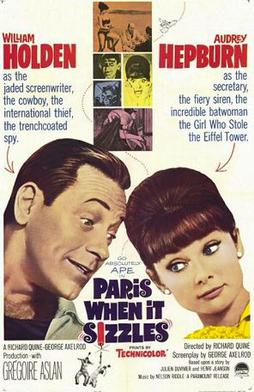
Scene One, Take Twenty-Two-Audrey Hepburn and William Holden’s “Paris When It Sizzles” (1952)-A Film Review

Scene One, Take Twenty-Two-Audrey Hepburn and William Holden’s “Paris When It Sizzles” (1952)-A Film Review


DVD Review

By Zack James

[As of December 1, 2017 under the new regime of Greg Green, formerly of the on-line American Film Gazette website, brought in to shake things up a bit after a vote of no confidence in the previous site administrator Peter Markin was taken among all the writers at the request of some of the younger writers abetted by one key older writer, Sam Lowell, the habit of assigning writers to specific topics like film, books, political commentary, and culture is over. Also over is the designation of writers in this space, young or old, by job title like senior or associate. After a short-lived experiment designating everybody as “writer” seemingly in emulation of the French Revolution’s “citizen” or the Bolshevik Revolution’s “comrade” all posts will be “signed” with given names only. The Editorial Board]


Paris When It Sizzles, starring Audrey Hepburn, William Holden, Noel Coward, 1952   

[Maybe there is something to this change of leadership on this site. I will not go through the details of the change-over from the now disappeared Allan Jackson, who went by the moniker Peter Paul Markin, to Greg Green since Josh Breslin in his introduction to a film review on the original version of The Front Page (dated December 15, 2017) went over that in detail including the how and why of that moniker choose by Mr. Jackson.  What I will say in the interest of transparency was that I was among the leaders of what became around the office known as the “Young Turks” who were in varying degrees fed up with Markin/Jackson’s concentration over the last year or so on the turbulent 1960s, the time of his coming of age and that of a number of the older writers dubbed “the old-timers” in the dispute rather than the wider look at politics, culture, society, history which was the original intention when this operation got up and running on-line some fifteen years ago.

What I will also say and leave it at that for now is that I am happy that I have been able to finally do a film review rather than being pigeon-holed solely doing book reviews. Markin/Jackson, strangely given his coming of age at a time when among certain elements, especially the young, increasing thwarted any attempts by any writers, young or old, to write outside their specialties and within those specialties to create ranks for example when I started here several years ago I was designated associate book critic and Frank Jackman had the senior position (everybody else then was a stringer, a free-lancer) and when he moved over to Senior Political Commentator I moved into his spot and Brad Fox and Lance Lawrence became associates. Greg has, after a short unsuccessful experiment designating everybody including himself as “writer,” changed to just using everybody’s name alone in their byline identification spot. Maybe when Jackson was younger he would have bought into that idea but not recently so early on I have tip my hat to Greg on this one. Zack]     

*********

I read somewhere or maybe some English literature professor in college mentioned it but when you break down every story it fits into one of about ten major themes, at least in Western literature. That same observation can be used to cover Hollywood films which after all are in their basic frameworks based on words, on written scripts except the few, very few directors who ad lib their efforts. Hollywood may follow that pattern but when it comes taking a look at itself as a cultural transmission belt it has had a love-hate relationship with films which deal with the film industry. The film under review Paris When It Sizzles (frankly an odd title although the action does take place in Paris although it could have been set anywhere the important thing being that it lampoons every Hollywood trope along the way and so maybe Hollywood where the long knives would be at the ready probably rightly should have been passed over.   

Follow me if you can. Boozy, lazy, out of ideas or having too many ideas screen-writer Richard Benson with a ton of films under his belt, played by William Holden. Holden last seen in this space as a screenwriter turned “kept pet, kept man, floating face down in silent screen seen better days mentally ill Norma Desmond’s high number Sunset Boulevard mansion swimming pool after she put the rooty-toot-toot to him when he tried to leave her is under the gun from his producer played by noted playwright Noel Coward to get on with a script he has been procrastinating about until almost the end of his contract. (That film where Holden was last seen Billy Wilder’s Sunset Boulevard not a paean to the industry that nurtured him either was an example of the hate part of the equation.) Enter Gaby, played by dewy-eyed, magic eyed fetching Audrey Hepburn who even younger guys like me have a crush on the minute they see her on screen and hope against hope of finding their own Ms. Hepburn lookalike, as a American ex-pat typist who is to do that duty while Benson rattles out the story-line before that two days ahead deadline.            

This is the beautiful part of the film (beyond some very funny and a few not so funny sent-ups of writers and the film industry) is that Benson with an assist or two by Gaby goes through every possible film genre once he/they establish the initial idea of having two young people meet in a production he has working- titled The Girl Who Stole the Eiffel Tower. They try the standard boy meets girl thing, suspense, intrigue, thriller, spy, horror, gangster, hell, even an old fashioned stand-by the barroom brawl before they are done. Here is the other beautiful part. This is really a story within a story, a boy meets girl story within a story since along the way, surprise, surprise one beat-up screen-writer and one typist fall head over heels in love. So maybe that thing I read or some English literature college professor was wrong, maybe there is only one major theme in Western literature and Hollywood-boy meets girl (and the modern same sex and transgender variation of late).              

(Thanks Greg for letting me spread my wings and I hope you assign me more film reviews. This is fun. Zack)
             

As We Pass The 1st Anniversary Of The “Cold” Civil War In America-A Tale Of Two Boston Resistance Events –Join The Resistance Now!

As We Pass The 1st Anniversary Of The “Cold” Civil War In America-A Tale Of Two Boston Resistance Events –Join The Resistance Now!

By Si Lannon

The headline to this piece is something of a misnomer as the “cold” civil war in America as I have been calling the great expanding divide between left and right, the oppressed and the oppressor (and its hangers-on including, unfortunately, a not insignificant segment of the oppressed), the haves and have nots and any other way to express the vast gulf, getting wider, between those siding with white rich man’s power and the rest of us, since this cold civil war has been building for a couple of decades at least. The Age of Trump which started officially one year ago though is a pretty good milestone to measure both how far we of the left, of the oppressed, have come and to measure the responses by the oppressed (the ones not hanging on to the white rich men) a year out in Year I of the Age of Trump Resistance.

Two local signposts, let me call them, stick out this weekend of January 20th. One, the Women’s Rally on Cambridge Common on the 20th organized to commemorate the anniversary of the historic Women’s mega-rally and march in Washington and it’s gigantic satellite event on Boston Common, The other a cultural/political event organized by Black Lives Matter and its allies held in the historic Arlington Street Universalist-Unitarian Church in Boston on the 21st.

Those two events which I attended in person in my capacity as a member Veterans Peace Action (VPA, an organization which my old friend Sam Lowell who will take the spotlight below got me involved in as fellow Vietnam War veterans) while they share some obvious over-lapping political perspectives to my mind represented two distinct poles of the resistance as it has evolved over the past several years.

No one, including I assume the organizers of the Women’s Rally, expected anything like the turnout for the 2017 Inaugural weekend event on the Boston Common or else they would have had the event on the Common so I did not expect a tremendous turnout. That event could not be duplicated and moreover over the year some of the anger over the Trump victory, etc. and maybe just plain horror and discouragement would have sapped some energies. However the several thousand who showed up represented a good turnout to my mind.

What I didn’t expect was the rather celebratory feeling that I got from the crowds as the poured into Cambridge Common from the nearby Harvard MBTA subway stop. I was positioned along with a number of my fellow VPAers as volunteers to insure the safety of the crowds and any threaten action by the Alt-Right who were said to be “organizing” a counter-rally at the Common as well. (In the event that small clot of people were isolated and protected by the Cambridge police without incident. We kept our side cool as well.)

That celebratory spirit, rather unwarranted given the defeats on our side over the previous year from Supreme Court justice to DACA to TPS to a million other injustices, flowed into the main thrust of the rally. Get Democrats, get women Democrats, elected to public office and “scare” the bejesus out of Donald J. Trump and his hangers-on. In other words the same old, same old strategy that the oppressed have been beaten down by for eons. Like things were dramatically better for those down at the base of society, down where everybody is “from hunger” with Democrats. Worse though than that pitch for the same old, same old was as the younger radicals say “who was not in the room, who had not been invited.” Who didn’t show up for the “lovefest” if it came to that. The representation on the speaker platform, always a key indicator of whose agenda and whose buttons are being pushed, looked like the old-time white middle-class feminist      cabal that has been herding these women-oriented political events for years to the exclusion on the many shades (and outlooks) of people of color. Not a good sign, not a good sign at all a year out when we are asking people in earnest to put their heads on the line for some serious social change.

Fast forward to the very next day at Arlington Street U-U Church in Boston where a Black Lives Matter event, co-sponsored by Veterans Peace Action, was held to a infinitely smaller crowd around black cultural expression and serious political perspectives. The cultural events were very fine, rap, music, poetry slam put on by skilled artists in those milieus. Interspersed in between those performances was very serious talk, egged on by the moderator, about future political perspectives, about the revolution, however anybody wanted to define that term, In short a far cry from what was being presented and “force-fed” in Cambridge the previous day.             

Now it has been a very long time since, except in closed circle socialist groups, that I have heard about the necessity of revolution (again whatever that might mean to the speaker), so it was like a breath of fresh air to hear such talk in Arlington Street Church, a place where legendary revolutionary abolitionist John Brown spoke, to drum up support for his Kansas expeditions and the later Harpers Ferry fights against slavery. Listening to the responses, as Sam Lowell who attended with me noted later, the missing links to the 1960s generation, to our generation, the last time a lot of people seriously used the word revolution, have left the younger activists in various states of confusion. That will be worked out in the struggle as long as people keep the perspective in mind. What bothered Sam, and me as well although I could not articulate it like him, were two points that seemed to have been given short shrift by the various talkers.

I was going to enumerate them but why don’t I let my recollection of what Sam said (edited by him before posting so very close to what he actually meant) to the gathering after listening to some things that as Fritz Taylor from the South, another VPAer and Vietnam vet used to say- “got stuck in his craw.” Sam had not intended to speak since he, we, thought the event was to be totally a cultural one so he kept it short but also to the point, to our collective agreement point:

“Hi, I am Sam Lowell for Veterans Peace Action (VPA), a co-sponsor of this great event. I didn’t expect to speak since I thought this would be solely a cultural event. But some comments here have got me thinking. First a quick bio point or two-like one of the sisters who performed I grew up in “the projects,” a totally white one, although still “the projects” with all the pathologies that entails and I have remained very close to those roots my whole life whatever successes I have had in breaking out of those beginnings. Early on, don’t ask me how or why, I came to admire John Brown, the white righteous avenging angel revolutionary abolitionist who fought slavery tooth and nail out in Kansas and later, more famously, at Harpers Ferry slave insurrection. He was, is, my hero, my muse if you can use such a term for avenging angels.      

A couple of points. One speaker mentioned a litany of oppressions which had to be eliminated by us, by society, by us as the most conscious of things like patriarchy, racism, classism, gender-sexual preference phobia for lack of a better term, a term that I could use anyway, capitalism and so on. What I have noticed though as people here have tried to struggle with all of that and come up with some kind of strategy is what Lenin, and others, have called imperialism, our American imperialism, which means against all the oppressed of the world we are “privileged” Americans privileged no matter what oppressions we face in this society.   

On this point I will bring back from the dead two important quotes from the legendary revolutionary Ernesto “Che” Guevara-“it is the duty of revolutionaries to make the revolution.” We cannot spent our precious lives “purifying” ourselves of all the oppressions and all the ways we, in turn act as oppressors, so we are “worthy” of the revolution while the world outside this room suffers from our wrong-headed sense of liberation struggle. Second “we who are in the heart of the beast,” who are in America have a special obligation to bring the monster down. To fight the fight now and to be there when the masses rise up in righteous indignation.    

Second and last point. One speaker a few minutes ago mentioned that it seemed impossible that we could win against, 
I assume she meant the American ruling class, through the route of violent revolution so she projected by non-violent alternative which seemed to my ears rather utopian. She mentioned that the other side, the ruling class, had the heavy military advantage and so that route was precluded. That statement showed a lack of “imagination” which is the theme of this event. No question right now an armed uprising would be ruthlessly crushed. But when the masses rise and are determined a funny thing happens at least if you read history. The military splits along officer and soldier lines, the fighters of the war, the grunts, either go over to the people or go home. The cops go into hiding. 


 I would use the example of the Vietnam War which a lot of Veterans Peace Action members are very familiar with. At some point around 1968, 1969 the troops, the grunts on the ground in Vietnam, hell, here at home too began to essentially “mutiny” against the war in fairly big numbers. That army became unreliable, was in many ways broken both by the futility of fighting a determined enemy and vocal opposition at home. And that was not even close to a revolutionary situation but will give you an idea what that situation would look like as the masses rise. If it ever happened where will you be? Thank you.        


Saturday, April 21, 2018

An Encore -In The Time Of Elvis' Time-One More Time Down 1950s Record Memory Lane

An Encore -In The Time Of Elvis' Time-One More Time Down 1950s Record Memory Lane


Sam Lowell, considered himself a corner boy from the time in the early 1960s when in the working-class neighborhoods of America were filled to the brim with such guys hanging out on the corners, in his case North Adamsville not far from urban Boston. Here is the progression not too atypical of corner boys with too little money and too much time on their hands which underscored the corner boy 1960s night plight (and which still plagues corner boys even though they no longer for the most part hang on corners but malls and other places where there are not any “No trespassing, police take notice” signs to harass young men still with not enough dough and too much time on their hands). If you grew up in the Acre, Sam’s growing up section of town you progressed from one place in elementary school, another in junior high school when corners and who was on what corner started to get sorted out in earnest, and high school where the corners were doled out hard as steel in high school.

Places like South Boston (an all Irish enclave then where even those who like Sam’s maternal grandparents had moved out of the enclave to an Irish neighborhood in North Adamsville were considered suspect, were looked at with jaundiced eye even by the relatives left behind), Main Street in Nashua (at the time a dying city what with the mills heading south to cheaper labor and eventually overseas and so a tough place to dream in), New Hampshire, 125th Street in high Harlem< New York City  (with all the excitement of jazz and be-bop but with all the high segregation of the South except for the formality of Mister James Crow’s laws),  any of a million spots on Six Mile Road in Detroit (never a place of dreams but of steady work in the golden age of the American automobile for those from Delta Mister James Crow black refugees to the Okie/Arkie white rabble coming out of the hills and dustbowls), the same on Division Street in Chi town (the beat street divide of many of Nelson Algren’s tales of drugs, urban lost-ness, and sullen back streets disappointments), the lower end of North Beach beyond where the “beats” of a few years before did their beat thing (the places where the longshoremen and waterfront workers did their heavy drinking after work and where the sailors off their Pacific ocean ships fought all- comers from the Artic to the Japan seas).


Jack Slack’s was the last port of call for the Acre crowd, for that motley collection of corner boys picked up and discarded along the way although the core of Frankie , Jack, Jimmy, Allan, Markin and Five-Fingers held throughout which had started at Doc’s Drugstore complete with sofa fountain and shiny glass penny candy-case to draw selections from after  school to energize up for the real world activities of kid-dom in elementary school, Miller’s Diner for the jukebox in junior high when they were just becoming aware of girls, maybe having to dance with them, and maybe trying to figure out, the eternal trying to figure out how to approach them without them giggling back and Salducci’s Pizza Parlor in early high school before the new owners decided that unlike Tonio, the previous owner who sold out to go back to Italy from when he came as a boy they did not want colorful rough-necked boys standing one knee against the wall in front of their family friendly establishment scaring the bejesus out of the important Friday and Saturday give Mom a break family trade.

That time, those early 1960s times for some reason known only to them, was time that you had best have had corner boy comrades when you hung out on date-less, girl-less, dough-less Friday and Saturday nights to have your back if trouble brewed (that “comrade” not a word to be used then in the tail end of the height of the red scare Cold War night not if you wanted knuckle sandwiches from the unthinking patriotic guys but that does convey the sense of “having your back” critical to your place in those woe begotten streets).


That corner boy business extended through the 1960s after high school for a couple of years when in addition to being a corner boy Sam became a “flower child” along with his long mourned and lamented friend the late Peter Paul Markin heading out west on the hitchhike roads when the world turned upside down later in the decade. (Markin who met a horrible end down in sunny Mexico after the fresh breeze of the 1960s turned in on itself and he got flat-footed by the backlash ebb tide riptide and could no longer hold back his “from hunger” wanting habits held in check through summers of love and a tight tour of Vietnam and made the fatal, very fatal, mistake of trying to broker an independent drug deal and got two slugs to the back of his head for the attempt.) Sam, now a sedate grandfatherly semi-retired lawyer filled with respectability and memories had to laugh about how much he of late had been thinking about the 1950s, about not just those corner boy days but about the music that drove every corner boy, including Markin, make that perhaps most of all Markin, to distraction as they tried to eke out a sound that they could call their own. A jailbreak sound that was not something their parents would approve of at a time when titanic generational battles were foaming at the mouth.

Thinking about the 1950s the times when he came of age, came of musical age, an age very mixed up with that corner boy comradery, that hanging at Doc’s and Miller’s Diner when he started noticing girls and their charms (amid the first blush of giggles which he soon figured out was their rational response to whatever was going on inside their bodies just like guys like Sam were going through in their bodies). Those first noticings started his life-long journey of trying to figure out what made them tick, what they wanted, wanted of him, from a girl-less family making everything that much harder. Noticing that they too hung around Miller’s in order to play that fantastic jukebox which had all the latest tunes and plenty of oldies too (oldies being let’s say we are talking about 1958 then maybe 1955 hits like Eddie, My Love, Rock Around The Clock, and Bo Diddley showing that teen time, youth time anyway is measured differently from old man lawyerly time, measured in days, weeks, months at the most-years were beyond the pale) drawing away from the music on his parents’ family living room radio and their cranky old record player music.

Music in the teen households emphatically not on Miller’s jukebox or there would have been a civil war no question, a civil war avoided in his own home after his parents had bought, to insure domestic peace and tranquility if he remembered correctly, his first transistor radio down at the now long gone Radio Shack store and he could sit up in his room and dream of whatever coming of age boys dreamed about, mainly how those last year’s bothersome girls became this year’s interesting objects of discussion (by the way in that small crowded upstairs bedroom, shared with his two brothers, he found out he could discover the beauty of the “hold up to your ear”  transistor radio and drown out the world of brotherly scuffings). 


More than that though, more than just thinking about the old days like every old guy probably does, even guys who had not been lawyers as a professional career, guys who you see sitting on park benches, a little disheveled, maybe some crumbs in their unkempt beards, feeding the birds and half-muttering to themselves about how when FDR was around everybody stood tall, every country bent it knees in homage to America, or else, or old bag ladies rummaging through trash barrels looking for long lost lovers or their faded beauty Sam had been purchasing compilations of what are commercially called “oldies but goodies” CDs. Doing so via the user-friendly confines of the Internet, at Amazon if you need a name like today anybody, except maybe three people up in heathen Alaska or the Artic,  doesn’t know that is the site to get such material these days instead of traipsing over half the East Coast trying to cadge a few examples from the dwindling oldies and used records emporia, and  purchasing several record compilations of the “best of” that period from a commercial distributor (and also keeping up to date on various versions of the songs on YouTube) and through his friend and old corner boy Frankie Riley been spilling plenty of cyber-ink on Frankie’s blog, In The Be-Bop ‘50s Night, going back to the now classic age of rock and roll.


Sam had to laugh about that situation back in the day as well since he had been well known back on the corner, back holding up the wall in front of Salducci’s Pizza Parlor, on many of those date-less, date-less because although he might have been an all “hail fellow, well met” hard-assed corner boy full of bluster and blah he was sister-less and hence baffled by girls and their ways and very shy around the question of asking for dates although he was quite willing to tell each and every girl who would listen to him about ten thousand fact on any of sixteen subjects, not excluding science, philosophy, and the poor fate of the Red Sox then. Although those ten thousand facts would come in handy when he got to college a couple of years later and he had girls hanging off the walls in debate class waiting for him to ask them out then those precious facts did not add up to a date by osmosis but rather incomprehension even by girls like Patty Lewis and Mary Shea who liked him and would have be glad if he asked them for a date without the ten thousand facts, thank you.

Here though is something about the mores of the time that young people today might not comprehend girls just waited for guys to make a move, or moved on to the next guy who would, especially if he had a boss ’55 Chevy, like Patty and Mary did. Also girl-less (already explained but here the question is having a serious girl and the just mentioned facts will hold here as well), and dough-less (self-explanatory in working-class North Adamsville, the sorry fate of the working poor, the marginally employed like his father, no money when the rent was due and Ma had not money for the damn rent collector much less discretionary money for dates with girls) on Friday and Saturday nights when he  proclaimed to all who would listen (mainly Frankie, Markin, Jimmy Jenkins, Jack Callahan, Kenny Hogan and Johnny “Thunder” Thornton and an occasional girl who all wondered what he was talking about) that “rock and roll will never die.”


Mainly, through the archival marvels of modern technology, pay-per-song, look on YouTube, check out Amazon Sam had been right, rock and roll had not died although it clearly no longer provided the same fuel for later generations more into hip-hop-ish, techno music, or edge city rock. But Sam always though it funny when kids, his grandkids, for example, heard (and saw) Elvis, all steamy, smoldering and swiveling in some film clip to make the older almost teenage girls among them almost react like the girls in his time did when they saw him on the Ed Sullivan Show and had half-formed girlish dreams about personally erasing that snarl from his face. Especially that flip clip of the prison number in Jailhouse Rock. Bo Diddley proclaiming to the whole wide world that he in fact had put the rock in rock and roll and who could dispute that claim when he went bonkers in some Afro-Carib number with that rectangular guitar. Say too Chuck Berry telling a candid world, a candid teenage world which after all was all that counted then, now too from what Sam had heard from his grandchildren, that Mister Beethoven from the old fogy music museum had better take himself and his cronies and move over because a new be-bop daddy, a new high sheriff was in town, was taking the reins, making the kids jump on jump street. Ditto curl-in-hair Buddy Holly pining away for his Peggy Sue.

Better, mad monk swamp rat Jerry Lee Lewis sitting, maybe standing for all Sam knew telling that same candid world that Chuck was putting on fire everybody had to do the high school hop bop, confidentially. And how about Wanda Jackson proclaiming that it was party time and an endless host of one hit wonders and wanna-bes they went crazy over. Yeah, those kids, those for example grandkids jumping around just like the young Sam who could not believe his ears when he had come of age and, yeah, jumping around for those same guys who formed his musical tastes back in the 1950s when he had come of age, musical age anyway. Jesus, Jesus too when he came of teenage age and all that meant of angst and alienation something no generation seems to be able to escape since the world had no less dangerous, no less incomprehensible today.


Sam had thought recently about going back to those various commercially-produced compilations put out by demographically savvy media companies that he had purchased on Amazon to cull out the better songs, some which he had on the tip of his tongue almost continuously since the 1950s (the Dubs Could This Be Magic the great last chance dance song that bailed him out of being shut out of more than one dance night although his partner’s feet borne the brunt of the battle, and the Teen Queens Eddie My Love, where Eddie took advantage of the girl and she was wondering, maybe still is, when he is coming back, a great love ‘em and leave ‘em song and the answer is still he’s never coming back, are two examples that quickly came to his mind). Others like Johnny Ace’s Pledging My Love or The Crows Oh-Gee though needed some coaxing by listening to the compilations to be remembered.


But Sam, old lawyerly Sam, had finally found a sure-fire method to aid in that memory coaxing. Just go back in memory’s mind and picture scenes from teenage days and figure the songs that went with such scenes (this is not confined to 1950s aficionados anybody can imagine their youth times and play). But even using that method Sam believed that he was cheating a little, harmlessly cheating but still cheating. When he (or anybody familiar with the times) looked at the artwork on most of the better 1950s CD compilations one could not help but notice the excellent artwork that highlights various institutions illustrated back then. The infamous drive-in movies where you gathered about six people (hopefully three couples but six anyway) and paid for two the other four either on the back seat floor or in the trunk. They always played music at intermission when that “youth nation” cohort gathered at the refreshment stand to grab inedible hot dogs, stale popcorn, or fizzled out sodas, although who cared, especially if that three couples thing was in play, and that scene had always been associated in Sam’s mind with Frankie Lyman and the Teenager’s Why Do Fools Fall In Love.


That is how Sam played the game. Two (or more) can play so he said he would just set the scenes and others could fill in their own musical selections. Here goes: the first stirrings of interest in the opposite sex at Doc’s Drugstore with his soda fountain AND jukebox; the drive-in restaurant with you and yours in the car, yours’ or father-borrowed for an end of the night bout with cardboard hamburgers, ultra-greasy french fries and diluted soda; the Spring Frolic Dance (or name your seasonal dance) your hands all sweaty, trying to disappear into the wall, waiting, waiting to perdition for that last dance so that you could ask that he or she that you had been eyeing all evening to dance that slow one  all dreamy; down at the beach on day one of out of school for the summer checking out the scene between the two boat clubs where all the guys and gals who counted hung out; the night before Thanksgiving football rally where he or she said they would be there, how about you; on poverty nights sitting up in your bedroom listening to edgy WMEX on your transistor radio away from prying adult eyes; another poverty night you and your boys, girls, boys and girls sitting in the family room spinning platters; that first sixth grade “petting” party (no more explanation needed, right); cruising Main Street with your boys or girls looking for, well, you figure it out listening to the radio in that “boss” Chevy, hopefully; and, sitting in the balcony “watching” the double feature at the Strand Theater on Saturday afternoon when you were younger and at night when older. Okay, Sam has given enough cues. Fill in the dots, oops, songs and add scenes too.                      


Yeah, Put Out That Fire In Your Head-With Patti Griffin’s Words From “You Are Not Alone” In Mind

Yeah, Put Out That Fire In Your Head-With Patti Griffin’s Words From “You Are Not Alone” In Mind   


By Fritz Taylor 

Sam Lowell was a queer duck, an odd-ball kind of guy who couldn’t stop keeping his head from exploding with about seventeen ideas at once and the determination to do all seventeen come hell or high water. And not seventeen things like mowing the lawn or taking out the rubbish but what he called “projects” which in Sam’s case meant political projects and writings and other things along that line. Yeah, couldn’t put out “the fire in his head” the way he told it to his long-time companion, Laura Perkins, one night at supper after she had confronted him with the fact, and not for the first time, that he was getting more irritable, was more often short with her of late, had seemed distant, had seemed to be drifting into some bad place, a place where he was not at peace with himself. That not “at peace” with himself an expression that Laura had coined that night to express the way that she saw his current demeanor. That would be the expression he would use in his group therapy group to describe his condition when it met later that week. 

He would almost shout out the words in despair when the moderator-psychologist asked him pointedly whether he felt at peace with himself at that moment and he pointed responded immediately that he was not. Maybe it was at that point, more probably though that night when Laura confronted him with his own mirror-self that told Sam his was one troubled man.  
Yea, it was that seventeen things in order and full steam ahead that got him in trouble on more than on occasion. The need to do so the real villain of the piece. See Sam had just turned seventy and so he should have been trying to slow down, slow down enough to not try to keep doing those seventeen things like he had when he was twenty or thirty but no he was not organically capable of doing so , at least until the other shoe dropped. Dropped hard.      

It was that “other shoe” dropping that made him take stock of his situation, although it had been too little too late. One afternoon a few days after that stormy group therapy session he laid down on his bed to just think through what was driving him to distraction, driving that fury inside him that would not let him be, as he tried to put out the fire in his head. That laying down itself might have been its own breakthrough since he had expected, had fiercely desired to finish up an article that he was writing on behalf a peace walk that was to take place shortly up in Maine, a walk that was dedicated to stopping the wars, mostly of the military-type but also of the environmental degradation against Mother Nature. 

Sam, not normally introspective about his past, about the events growing up that had formed him, events that had as he had told Laura on more than one occasion almost destroyed him. So that was where he started, started to try to find out why he could not relax, had to be “doing and making” as Laura called it under happier circumstances, had to be fueling that fire in his head. Realized that afternoon that as kid in order to survive he had learned at a very young age that in order to placate (and avoid) his overweening mother he had to keep his own counsel, had to go deep inside his head to find solace from the storms around his house. For years he had thought the driving force was because he was a middle child and thus had to fend for himself while his parents (and grandparents) doted respectively his younger and older brothers. But no it had been deeper than that, had been driven by feelings of inadequacy before his mother’s onslaught against his fragile head.        

As Sam traced how at three score and ten he could point to various incidents that had driven him on, had almost made him organically incapable of having a not ever active brain, of going off to some dark places where the devils would not let him relax, that kept him going around and around he realized that he was not able to relax on his own, would need something greater than himself if he was to unwind. Laura had emphatically told him that he would have to take that journey on his own, would have to settle himself down if he was to gain any peace in his whole damn world. Sam suddenly noticed after Laura had expressed her opinion that she had always been the picture of calm, had been his rock when he was in his furies. Funny he had always underestimated, always undervalued that calmness, that solid rock. He, in frustration, at his own situation asked Laura how she had maintained the calm that seemed to follow her around her world.         

Laura, after stating that she too had her inner demons, had to struggle with the same kind of demons that Sam had faced as a child and that she still had difficulties maintaining an inner calm, told Sam that her daily Buddha-like meditations had carried her to a better place. Sam was shocked at her answer. He had always known that Laura was drawn to the spiritual trends around their milieu, the “New Age stuff” he called her interest since it seemed that she had taken tidbits from every new way to salvation outside of formal religion (although she had had bouts with that as well discarding her Methodist high heavens Jehovah you are on your own in this wicked old world upbringing for the communal comfort of the Universalist-Unitarian brethren). He had respected her various attempts to survive in the world the best way she could but those roads were not for him, smacked too much of some new religion, some new road that he could not travel on. But he was also desperate to be at peace, a mantra that he was increasing using to describe his plight.    

Then Laura suggested that they attend a de-stress program that was being held at Massachusetts General Hospital in Boston as part of what was billed as HUB-week, a week of medical, therapeutic, technological and social events and programs started by a number of well-known institutions in the Boston area like MGH, Harvard, MIT and others. Sam admitted to being clueless about what a de-stress program would be about and had never heard of a Doctor Benson who a million years before had written a best-selling book about the knot the West had put itself in trying to get ahead and offered mediation as a way out of the impasse. Sam was skeptical but agreed to go.

At the event which lasted about two hours various forms of meditative practice were offered including music and laughter yoga. Sam in his mind passed on those efforts. The one segment that drew his attention, the first segment headed by this Doctor Benson had been centered on a simple technique to reduce stress, to relax in fact was called the relax response. Best of all the Doctor had invited each member of the audience to sample his wares. Pick a word or short phrase to focus on, close your eyes, put your hands on your lap and consecrate, really try to concentrate, on that picked term for five minutes (the optimum is closer to ten plus minutes in an actual situation).          

Sam admitted candidly to Laura that while attempting fitfully focusing on one thing, in his case the phrase “at peace,” he had suffered many distractions but that he was very interested in pursuing the practice since he had actually felt that he was getting somewhere before time was called. Laura laughed at Sam’s response, so Sam-like expecting to master in five minutes a technique that she had spent years trying to pursue and had not been anywhere near totally focused yet. He asked her to help him to get started and they did until Sam felt he could do the procedure on his own.

We now have to get back to that “other shoe” dropping though. Although Sam had expressed his good intentions, had felt better after a while Laura had felt that he needed to go on his journey without her. She too now felt that she had to seek what she was looking for alone in this wicked world despite how long they had been together. So Laura called it quits, moved out of the house that she and Sam had lived in for years. Sam is alone on his journey now, committed to trying to find some peace inside despite his heartbreak over the loss of Laura. Every once in a while though in a non-meditative moment he curses that fire in his head. Yeah, he wished he could have put out that fire in his head long ago.        

A MODEST PROPOSAL-RECRUIT, RUN INDEPENDENT LABOR MILITANTS FOR THE 2018 ELECTIONS (Updated)

A MODEST PROPOSAL-RECRUIT, RUN INDEPENDENT LABOR MILITANTS FOR THE 2018 ELECTIONS (Updated)
From The American Left History Blog Archives (2008) - On American Political Discourse –

Political Commentator Frank Jackman:

In 2007-2008 I, in vain, attempted to put some energy into analyzing the then blossoming American presidential campaign, a changing of the guard election on the Democratic side, since it was to be, as advertised at least, a watershed election, for women, blacks, old white anglos, latinos, youth, etc. In the event I had to abandon the efforts in about May of 2008 when it became obvious, “in my face” obvious, that the election would be a watershed only for those few who really believed, who had talked themselves into, had a vested interest in touting that it would be a watershed election. That grim reality despite the hoopla, heavy cash and organizing of the thing, was that once again that election would essentially be a technician’s election, you know for armchair strategists and those who like to, for example, figure out how the Congressional race in the 26th District in Texas will impact the balance of power in the U.S. House. (I confess that early on in my life that kind of thing intrigued me too until I got “religion” and worried more about real live issues and political programs than wonk-ish concerns.)    

The subsequent “sleep-walk” four years of the Obama presidency, the non-watershed by anybody’s measurement 2012 American presidential election campaign, the banal mid-term elections of 2014 and the all-around horribly shocking Clinton-Trump debacle of 2016 recently passed and the unending maelstrom of world politics have only confirmed in my eyes that that now seemingly ancient abandonment was essentially the right decision at the right time. In short, let the well- paid bourgeois commentators go on and on with their twitter. I, we, had (have) better things to do like fighting against the permanent wars, the permanent war economies, the struggle for more and better jobs, and for a workers’ party that fights for a workers government. More than enough to do, right?  

Part of my “alternative” offering then of the same old, same of the electoral cycle was a proposition that the labor movement and its supporters rather than spent another dime on what even a child can now see is a waste of good dues money on supporting this or that bourgeois candidate, almost solely Democrats these days when even the most banal labor skate would face righteous stoning or the fire for proposing cash donations to Republican candidates, instead run our own independent candidates for appropriate offices in what for now would be exemplary campaigns. To that end I motivated my pitch with a few reasons and the outline of a program. Today as the once again non-watershed 2018 elections (even if there is a Democratic sea-change in either or both the Houses of Congress) loom in our faces even before we have devoured the fact of the 2016 elections I offer an updated version of that program and the urgency to get out independent labors candidates.  
************
1. FIGHT FOR THE IMMEDIATE AND UNCONDITIONAL WITHDRAWAL OF U.S. TROOPS FROM THE MIDDLE EAST NOW (OR BETTER YET, YESTERDAY)! U.S. HANDS OFF THE WORLD! VOTE NO ON THE WAR BUDGET!

The never-ending and apparently soon to be resurrected, with or without “boots on the ground” quagmire in Iraq, Afghanistan and elsewhere in the Middle East (Palestine, Iran, Syria you name it) is the fault line of American politics today. Every bourgeois politician has to have his or her feet put to the fire on this one. Not on some flimsy ‘sense of the Congress’ softball motion for withdrawal next, year, in two years, or (my favorite) when the situation is “stable.” Moreover, on the parliamentary level the only real vote that matters is the vote on the war budget. All the rest is fluff. Militant labor candidates should make a point of trying to enter Congressional contests where there are so-called known anti-war Democrats or Republicans (an oxymoron, I believe) running to make that programmatic contrast vivid.

But, one might argue, that would split the ‘progressive’ forces. Grow up, please! That argument has grown stale since it was first put forth in the “popular front” days of the 1930’s. If you want to end the war fight for this "no funding" position on the war budget. Otherwise the same people (yah, those progressive Democrats) who unanimously voted for the last war budget and are reliably foaming at the bit to vote for the next one get a free ride on the cheap. By rights this is our issue. Let us take it back.

2. FIGHT FOR A LIVING WAGE AND WORKING CONDITIONS-UNIVERSAL FREE HEALTH CARE FOR ALL.

It is a ‘no-brainer’ that no individual, much less families, can live on the minimum wage of $7/hr. (or proposed $10/hr or despite the good intentions the “Fight for 15 struggle). What planet do these politicians live on? We need an immediate fight for a living wage, full employment and decent working conditions. A step in the right direction and a fight that should be supported and funded is the recent “Fight for $15.” We need universal free health care for all. End of story. (Although Obamacare is inadequate and filled with pitfalls it must be at this point continually defended against those who wish to dismantle the whole thing and leave millions without insurance again.) The organized labor movement must get off its knees and fight to organize Wal-Mart and the South. A boycott of Wal-Mart is not enough. A successful organizing drive will, like in the 1930’s, go a long way to turning the conditions of labor and unionization around.

3FIGHT THE ATTACKS ON THE ENLIGHTENMENT.

Down with the Death Penalty! Full Citizenship Rights for All Immigrants who make it here! Stop the Deportations! For the Separation of Church and State! Defend abortion rights! Full public funding of education! Stop the ‘war on drugs’, basically a war on blacks and minority youth-decriminalize drugs! Defend political prisoners! This list of demands hardly exhausts the “culture war” issues we defend. It is hard to believe that over 200 years after the American Revolution and the French Revolution we are fighting desperately to preserve many of the same principles that militants fought for in those revolutions. But, so be it.

4. FIGHT FOR A WORKERS PARTY.

The Donkeys, Elephants and Greens have had their chance. Now is the time to fight for our own party and for the interests of our own class, the working class. Any campaigns by independent labor militants must highlight this point. And any campaigns can also become the nucleus of a workers’ party network until we get strong enough to form at least a small party. None of these other parties, and I mean none, are working in the interests of working people and their allies. The following great lesson of politics today must be hammered home. Break with the Democrats, Republicans and Greens!

5FIGHT FOR A WORKERS AND XYZ GOVERNMENT.

THIS IS THE DEMAND THAT SEPARATES THE MILITANTS FROM THE FAINT-HEARTED REFORMISTS.

We need our own form of government. In the old days the bourgeois republic was a progressive form of government. Not so any more. That form of government ran out of steam about one hundred years ago and has been choking human process since then. We need a Workers Republic. We need a government based on workers councils with a ministry (I do not dare say commissariat in case any stray anarchists or old time anti-communists who came of age in the red scare Cold War 1950s are reading this) responsible to it. Let us face it if we really want to get any of the good and necessary things listed above accomplished we are not going to get it with the current form of government.

Why the XYZ part? What does that mean? No, it is not part of an algebra lesson. What it reflects is that while society is made up mainly of workers (of one sort or another) there are other classes (and parts of classes) in society that we seek as allies and who could benefit from a workers government. Examples- small independent contractors, intellectuals, the dwindling number of small farmers, and some professionals like dentists. Yah, I like the idea of a workers and dentists government after many years in the dentist chair. The point is you have got to fight for it.

Obviously any campaign based on this program will be an exemplary propaganda campaign for the foreseeable future. But we have to start now. Continuing to support or not challenging the bourgeois parties does us no good now. That is for sure. While bourgeois electoral laws do not favor independent candidacies and make things difficult write-in campaigns are possible.
**********
An Injury To One Is An Injury To All!-Defend The International Working Class Everywhere!
********
Fight-Don’t Starve-We Created The Wealth, Let's Take It Back! Labor And The Oppressed Must Rule!
********
A Five-Point Program As Talking Points

*Jobs For All Now!-“30 For 40”- A historic demand of the labor movement going back to the 1930s Great Depression the last time that unemployment, under-employment, and those who have just plain quit looking for work was as high in the American labor force as it is just tentatively recovering from of late, although it is admittedly down from the Great Recession 2008 highs. Thirty hours work for forty hours pay is a formula to spread the available work around. Socially productive work not make-shift stuff although we would support an vast expansion of public works to fix the broken down infrastructure in need of serious and immediate repair. his is no mere propaganda point but shows the way forward toward a more equitable distribution of available work.

The basic scheme, as was the case with the early days of the longshoremen’s and maritime unions’ plans as a result of battles like the General Strike in San Francisco in the 1934, is that the work would be divided up through local representative workers’ councils that would act, in one of its capacities, as a giant hiring hall where the jobs would be parceled out. This would be a simpler task now than when it was when first proposed in the 1930s with the vast increase in modern technology that could fairly accurately, via computers, target jobs that need filling and equitably divide up current work.

Without the key capitalist necessity of keeping up the rate of profit the social surplus created by that work could be used to redistribute the available work at the same agreed upon rate rather than go into the capitalists’ pockets. The only catch, a big catch one must admit, is that no capitalist, and no capitalist system, is going to do any such thing as to implement “30 for 40” –with the no reduction in pay proviso, although many low –end employers are even now under the “cover” of the flawed Obamacare reducing hours WITH loss of pay-so that to establish this work system as a norm it will, in the end, be necessary to fight for and win a workers government to implement this demand.

Organize the unorganized is a demand that cries out for solution today now that the organized sectors of the labor movement, both public and private, in America are at historic lows, just over ten percent of the workforce. Part of the task is to reorganize some of the old industries like the automobile industry, now mainly unorganized as new plants come on line and others are abandoned, which used to provide a massive amount of decent jobs with decent benefits but which now have fallen to globalization and the “race to the bottom” bad times. The other sector that desperately need to be organized is to ratchet up the efforts to organize the service industries, hospitals, hotels, hi-tech, restaurants and the like, that have become a dominant aspect of the American economy. Support the recent militant efforts, including the old tactic of civil disobedience, by service unions and groups of fast-food workers to increase the minimum socially acceptable wage in their Fight For 15.

Organize the South-this low wage area, this consciously low-wage area, where many industries land before heading off-shore to even lower wage places cries out for organizing, especially among black and Hispanic workers who form the bulk of this industrial workforce. A corollary to organizing the South is obviously to organize internationally to keep the “race to the bottom” from continually occurring short of being resolved in favor of an international commonwealth of workers’ governments. Hey, nobody said it was going to be easy.

Organize Wal-Mart- millions of workers, thousands of company-owned trucks, hundreds of distribution centers. A victory here would be the springboard to a revitalized organized labor movement just as auto and steel lead the industrial union movements of the 1930s. The key here is to organize the truckers and distribution workers the place where the whole thing comes together. We have seen mostly unsuccessful organizing of individual retail stores. To give an idea of how hard this task might be though someone once argued that it would be easier to organize a workers’ revolution that organize this giant. Well, that’s a thought.

Defend the right of public and private workers to unionize.
Simple-No more defeats like in Wisconsin in 2011, no more attacks on collective bargaining the hallmark of a union contract. No reliance on labor boards, arbitration, courts or bourgeois recall elections like the unsuccessful one against Governor Scoot Walker in Wisconsin in the aftermath of the huge defeat of public workers in Wisconsin funds and talents which could have been used to reorganize the public workers for union struggles ahead. Unions must keep their independent from government interference. Period.

Defend the independence of the working classes! No union dues for Democratic (or the stray Republican) candidates. In 2008, 2012, and 2016 labor, organized labor, spent over well over 700 million dollars respectively trying to elect Barack Obama, Hillary Clinton and other Democrats (mainly). The “no show, no go” results speak for themselves as the gap between the rich and poor has risen even more in this period. For those bogus efforts rather than the serious labor organizing among low wage workers, the unorganized, the South and Wal-Mart the labor skates should have been sent packing long ago. The idea in those elections was that the Democrats (mainly) were “friends of labor.” The past period of cuts-backs, cut-in-the-back give backs should put paid to that notion. Although anyone who is politically savvy at all knows that is not true, not true for the labor skates at the top of the movement since they have been very generous with own paychecks. The old norm in need of revival is that the bureaucrats at all levels should receive no more than the pay of the average skilled worker they represent.    

The hard reality today is that the labor skates, not used to any form of class struggle or any kind of struggle, know no other way than class-collaboration, arbitration, courts, and every other way to avoid the appearance of strife, strife in defense of the bosses’ profits. One of most egregious recent examples that we can recall- the return of the Verizon workers to work after two weeks in the summer of 2011 when they had the company on the run and the subsequent announcement by the company of record profits. That sellout strategy may have worked for the bureaucrats, or rather their “fathers” for a time back in the 1950s “golden age” of labor, but now we are in a very hard and open class war. The rank and file must demand an end to using their precious dues payments for bourgeois candidates all of whom have turned out to be sworn enemies of labor when the deal went down from Bush to Obama to Trump on down.

This does not mean not using union dues for political purposes though. On the contrary we need to use them now more than ever in the class battles ahead. Spent the dough on organizing the unorganized, organizing the South, organizing Wal-Mart, and other pro-labor causes. Think, for example, of the dough spent on the successful November, 2011 anti-union recall referendum in Ohio (also think, think hard, about having to go that far back to get a positive example). That type of activity is where labor’s money and other resources should go. And not on recall elections against individual reactionaries, like the Scoot-Walker recall effort in Wisconsin, as substitutes for class struggle (and which was overwhelmingly unsuccessful to boot-while the number of unionized public workers has dwindled to a precious few).  

*End the endless wars!- As the so-called draw-down of American and Allied troops in Iraq reached its final stages back in 2011, the draw- down of non-mercenary forces anyway, we argued that we must recognize that we anti-warriors had failed, and failed rather spectacularly, to affect that withdrawal after a promising start to our opposition in late 2002 and early 2003 (and a little in 2006).As the endless American-led wars (even if behind the scenes, as in previously in Libya and now in Yemen, Somalia, Syria, Chad and other proxy wars) continue now with a new stage against ISIS (Islamic State) in Iraq and other Middle East states we had better straighten out our anti-war, anti-imperialist front quickly if we are to have any effect on the U.S. troop escalation we know is coming before that fight is over. No War With North Korea, Iran! Out of Syria! Stop The Arms Shipments To The Middle East! Stop The Bombing Campaigns! Defend The Palestinian People! And as always after 16 long years, since 2001 for the forgetful Immediate, Unconditional Withdrawal Of All U.S./Allied Troops (And Mercenaries) From Afghanistan!  

U.S. Hands Off Iran! Hands Off North Korea!- American (and world) imperialists have periodically ratcheted up their propaganda war (right now) and increased economic sanctions that are a prelude to war well before the dust has settled on the now unsettled situation in Iraq and well before they have even sniffed at an Afghan withdrawal of any import. We will hold our noses, as we did with the Saddam leadership in Iraq and on other occasions, and call for the defense of North Korea and Iran against the American imperial monster. A victory for the Americans (and their junior partners on this issue, Israel and Saudi Arabia, Japan, South Korea) in North Korea or Iran is not in the interests of the international working class. Especially here in the “belly of the beast” we are duty-bound to call not just for non-intervention but for defense of North Korea and Iran. We will, believe me we will, deal with the mullahs, the Revolutionary Guards, and the Islamic fundamentalists in Iran and the Kim regime in North Korea in our own way in our own time.

U.S. Hands Off The World! And Keep Them Off!- With the number of “hot spots” that the American imperialists, or one or another of their junior allies, have their hands on in this wicked old world this generic slogan would seem to fill the bill.

Down With The War Budget! Not One Penny, Not One Person For The Wars! Honor World War I German Social-Democratic Party MP, Karl Liebknecht, who did just that in 1915 in the heat of war and paid the price unlike other party leaders who were pledged to stop the war budgets and reneged on that promise by going to prison. The jailhouse the only play for an honest representative of the working class under those conditions. The litmus test for every political candidate must be first opposition to the war budgets (let’s see, right now no new funding in Iraq, Afghanistan, Pakistan, North Korea preparations, Iran preparations, China preparations, etc. you get our drift). Then that big leap. The whole damn imperialist military budget. Again, no one said it would be simple. Revolution may be easier that depriving the imperialists of their military money. Well….okay.

*Fight for a social agenda for working people! Free Quality Healthcare For All! This would be a no-brainer in any rationally based society. The health and welfare of any society’s citizenry is the simple glue that holds that society together. It is no accident that one of the prime concerns of workers states like Cuba, whatever their other political problems, has been to place health care and education front and center and to provide to the best of their capacity for free, quality healthcare and education for all. Even the hide-bound social-democratic-run capitalist governments of Europe have, until recently anyway, placed the “welfare state” protections central to their programs. Be clear Obamacare is not our program and has been shown to be totally inadequate and wasteful however we will defend that program against those like Trump and the majority of his Republican ilk r his who wish to dismantle it and leave millions once again uninsured and denied basic health benefits.  

Free, quality higher education for all! Nationalize the colleges and universities under student-teacher-campus worker control! One Hundred, Two Hundred, Many Harvards!

This would again be a no-brainer in any rationally based society. The struggle to increase the educational level of a society’s citizenry is another part of the simple glue that holds that society together. Today higher education is being placed out of reach for many working-class and minority families. Hell, it is getting tough for the middle-class as well.

Moreover the whole higher educational system is increasing skewed toward those who have better formal preparation and family lives leaving many deserving students from broken homes and minority homes in the wilderness. Take the resources of the private institutions and spread them around, throw in hundreds of billions from the government (take from the military budget if you want to find the money quickly to do the job right), get rid of the top heavy and useless college administration apparatuses, mix it up, and let students, teachers, and campus workers run the thing through councils on a democratic basis.

Forgive student debt! The latest reports indicate that college student debt is something like a trillion plus dollars, give or take a few billion but who is counting. The price of tuition and expenses has gone up dramatically while low-cost aid has not kept pace. What has happened is that the future highly educated workforce that a modern society, and certainly a socialist society, desperately needs is going to be cast in some form of indentured servitude to the banks or other lending agencies for much of their young working lives. Let the banks take a “hit” for a change!

Stop housing foreclosures and aid underwater mortgages now! Although the worst of the 2008 crunch has abated there are still plenty of problems and so this demand is still timely if not desperately timely like in the recent past. Hey, everybody, everywhere in the world not just in America should have a safe, clean roof over their heads. Hell, even a single family home that is part of the “American dream,” if that is what they want. We didn’t make the housing crisis in America (or elsewhere, like in Ireland, where the bubble had also burst). The banks did. Their predatory lending practices and slip-shot application processes were out of control. Let them take the “hit” here as well.

*We created the wealth, let’s take it back. Karl Marx was right way back in the 19th century on his labor theory of value, the workers do produce the social surplus appropriated by the capitalists. Capitalism tends to beat down, beat down hard in all kinds of ways the mass of society for the benefit of the few. Most importantly capitalism, a system that at one time was historically progressive in the fight against feudalism and other ancient forms of production, has turned into its opposite and now is a fetter on production. The current multiple crises spawned by this system show there is no way forward, except that unless we push them out, push them out fast, they will muddle through, again.
Take the struggle for our daily bread off the historic agenda. 

Socialism is the only serious answer to the human crisis we face economically, socially, culturally and politically. This socialist system is the only one calculated to take one of the great tragedies of life, the struggle for daily survival in a world that we did not create, and replace it with more co-operative human endeavors.
Build a workers’ party that fights for a workers government to unite all the oppressed. None of the nice things mentioned above can be accomplished without as serious struggle for political power. We need to struggle for an independent working-class-centered political party that we can call our own and where our leaders act as “tribunes of the people” not hacks. The creation of that workers party, however, will get us nowhere unless it fights for a workers government to begin the transition to socialism, to the next level of human progress on a world-wide scale.

As Isaac Deutscher said in his speech “On Socialist Man” (1966):

“We do not maintain that socialism is going to solve all predicaments of the human race. We are struggling in the first instance with the predicaments that are of man’s making and that man can resolve. May I remind you that Trotsky, for instance, speaks of three basic tragedies—hunger, sex and death—besetting man. Hunger is the enemy that Marxism and the modern labour movement have taken on.... Yes, socialist man will still be pursued by sex and death; but we are convinced that he will be better equipped than we are to cope even with these.” 

Emblazon on our red banner-Labor and the oppressed must rule!


ROLL UP YOUR SHEEVES! GET THOSE ELECTION BALLOT PETITIONS SIGNED! PRINT OUT THE LEAFLETS! PAINT THOSE BANNERS! GET READY TO SHAKE HANDS AND KISS BABIES