Thursday, October 11, 2018

Once Again Despite The Tweeter Firestorm-In Honor Of The 150th Anniversary Of The Publication Of Louisa May Alcott’s “Little Women” (1868)-A Book Review-Of Sorts
Once Again Despite The Tweeter Firestorm-In Honor Of The 150th Anniversary Of The Publication Of Louisa May Alcott’s “Little Women” (1868)-A Book Review-Of Sorts  


Book Review
By Alden Riley
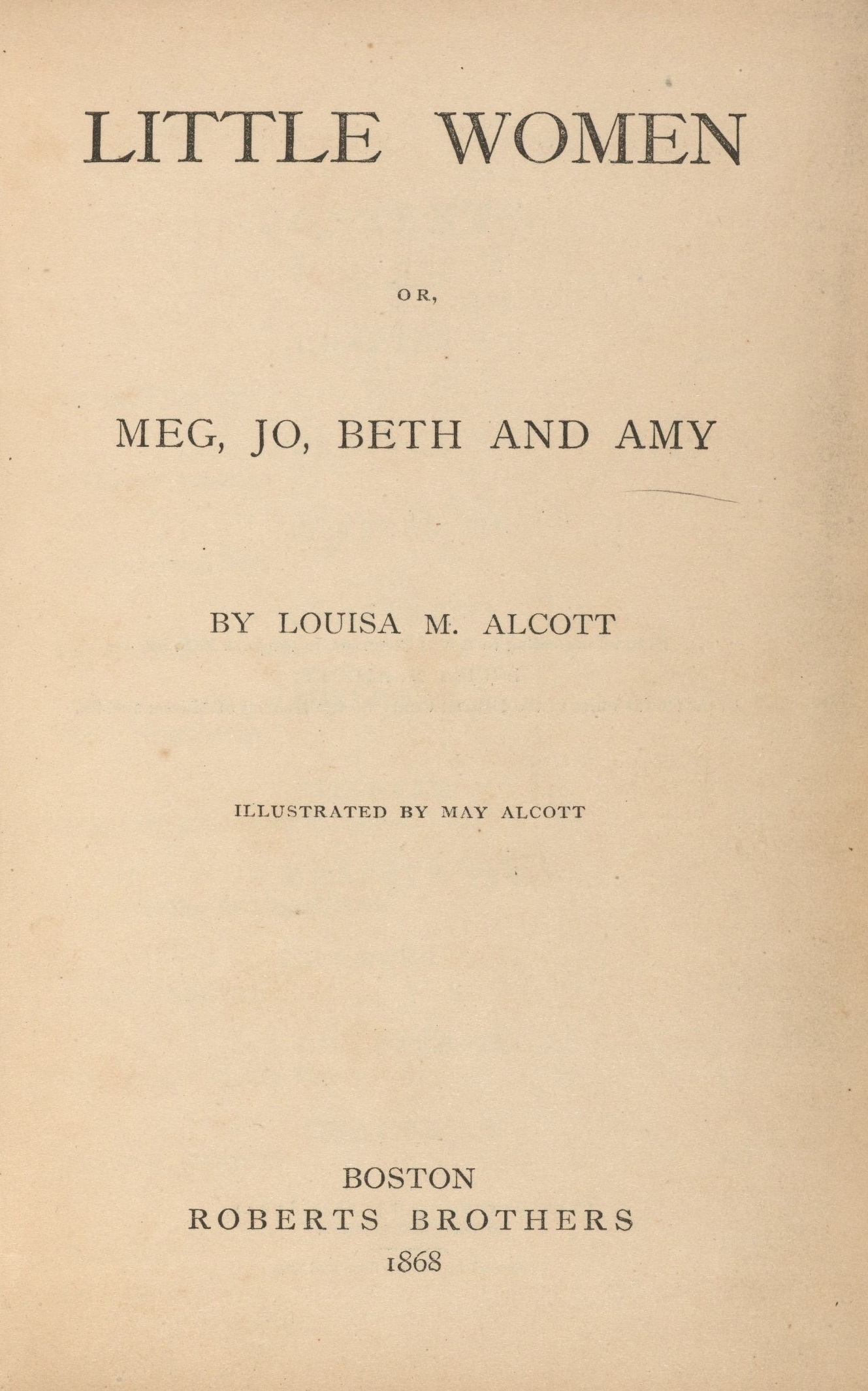
Little Women, Louisa May Alcott, Roberts Brothers, 1868

I have to admit I am a bit exasperated over the “firestorm” from Twitter and other sources over my original book review honoring the 150th anniversary of the publication of Louisa May Alcott’s Little Women which I just found out has been made into a yet another film adaptation for a modern 21st century audience far removed from the semi-nomadic existent back in the day before cellphones and Facebook. Sometimes you just can’t win in any quarters that is for sure. I wouldn’t mind if the prairie fire came from one comment but even side issue stuff raised some ire. Jesus. First, I mentioned- “I thought things were supposed to change around here with the changing of the guard, otherwise known at least among the younger writers as the purge and exile of the previous site manager Allan Jackson and his replacement by Greg Green after a bitter internal fight with no holds barred and no prisoners taken in the fall of 2017.”
Although as a free-lancer, a stringer I did not have a decisive vote in the vote of no confidence that replaced Allan Jackson, in the interest of the seemingly obligatory statement of transparency an old friend of some of the writers here from high school and anti-war Vietnam War soldier days, with Greg I do know from various sources, reliable sources, that among the younger writers their actions were seen as a fight to the death. That Allan had to go, that Greg had to take over the whole site manager operation and that a guiding hand Editorial Board had to be established so one person could not wield an iron hand over the whole operation in the future. All of this over the to me pretty harmless policy decisions of Allan to spent plenty of time in 2017 and 2018 commemorating the 50th anniversaries of the many historically important events of that era beginning with the Summer of Love, 1967. 
At some point, maybe rightly if the extent of coverage projected by Allan is any indication the younger writers ire, who like myself at best knew of those events second or third hand rebelled, got some aid from old-timer Sam Lowell, also an old friend of Allan’s from high school days who decided it was time to “pass the torch” they were able to remove Allan from his post. According to Sam Lowell, who after all as “the father we never knew” of the rebellion should know, the talk around the water cooler was to fight to the finish, to sent Allan packing, no regrets. So now readers who have a partisan interest in defending the actions of the younger writers are up in arms arguing that their “gentile” actions were merely to force Allan to retire. I am done with the silly issue and Sam has agreed to reply to anybody who still feels that terms like “purge” and “exile” were exaggerations of what went on.      
Next up in the batting order a simple statement about Greg’s early stewardship and the pitfalls of following a legendary figure at this publication like Allan Jackson after his purge and exile-“Then Greg, I think to show he was his own boss, his own operator came up with the silly, silly even to Will Bradley who originally presented the idea before thinking better of it, that to appeal to a younger, eventually non-existent audience, that the publication would feature film reviews of Marvel/DC comic book characters gone to screen, serious analysis of rap and current pop music, and review graphic novels. …”
I came on board shortly before this change of leadership while Greg was handling the day to day operations and Allan was making policy decisions, so I had a chance to see what Greg was trying to do to make his own mark, to become his own legend here just as he had been for many years over at American Film Gazette. In the beginning of the Green regime through Senior Film Editor Sandy Salmon I was getting some very good films, books, and music to review. Assignments like the Hammer film noir series pitting my take against Seth Garth’s, commemorating the various anniversaries of books like The Great Gatsby that had heretofore been staples of the Western literary canon and all kinds CD reviews from classic rock to world music.
Then the world caved in. Somehow Greg thought that what was needed to spruce up the publication, to appeal to a younger audience in the 21st century rather than the hard-core Generation of ‘68 devotees who have sustained this publication since their own youths back in hard copy days through the current on-line version was to review comic book character films, video games and such, and rap and techno-music in its various mutations. A bad decision which even Greg knew was true as he retreated back to some more civilized material. The blow-back from readership was this seemingly orchestrated sycophantic echo about how I was being too hard on Greg for a momentary mistake, a good faith effort to reach a new audience, to try something new and that it had been,  and I will quote from one irate tweet “bad taste” to bring up that serious error of judgment now that Greg has righted the ship. Ho hum. 
I certainly have been around long enough in the publishing business now to know how to weather such storms but the next “fire storm,” really a tempest in a teapot to quote Sam Lowell on some internal controversy, a one- man crusade really was too much. Here is what I “wrongly” said- “Then Allan Jackson whom we all though had perished, gone to pot, dope pot, was working for Mitt Romney out in Utah Mormon country, running a whorehouse with an old flame in East Bay or living with an old former hometown corner boy turned “out” drag queen in San Francisco depending on which rumor you believed at the moment, showed up to do a series of encore presentations of material he had produced over the years in order to get back that older audience which had sustained the publication through good times and bad.”
Of course, the one-man crusade was one Allan Jackson, now a contributing editor doing encore presentations at this publication under the good graces of his old friend Sam Lowell and Greg. Apparently Allan does not have Greg and Sam’s good graces and let the whole shady rumored past year or so go to ground. No sooner had he seen my comments that he ripped out a few thousand word “essay” on my “libelous” statements concerning his whereabout after he got that proverbial boot in 2017. If anybody, and I worry about what you have been doing with your precious time if you have, has not seen Allan’s encore presentation introductions which are as self-serving as anything I have seen of late then a brief summary of his slights is in order. Under Allan’s tutelage all rumors were allegedly untrue or half-truths (a nice dodge when you are on the defensive, especially those unfamiliar with the intentionality rule in libel cases to tar the writer that scurrilous “half-truth” tag).
Allan didn’t try to weasel out of what everybody knew was true, that he had been purged and gone into exile like a beaten cur. Gone far away to try to “rebrand” himself where he was not well known. What he has argued, unconvincingly, is that he merely went West to seek work after he had been “blackballed” by some phantom network emanating from this publication along the East Coast. I have recently been given by our legal department five affidavits from publishers in New York and Boston who almost overnight after hearing of Allan’s untimely, their common term, ouster offered him jobs with increases in salary and less responsibility just to have his name on the masthead (and not on some other publication and mercifully not on ours). He allegedly needed money for his various ex-wife alimonies and the onerous college tuitions for his slew of good kids still in the higher education pipeline and has declared (at the notoriously accurate office water cooler) that no East Coast publisher would touch him with a ten- foot pole. In an age of the casual off-hand lie this is a whooper.   
We can dismiss the Mitt Romney press agent rumor out of hand since I looked at the archives for 2008 and 2012 and noted that Allan had skewered him and his white underwear fetish, his inability to keep to one single answer for more than ten minutes before flipping earning the sobriquet “Mr. Flip-Flop,” and his undying hatred for those who have not gouged the populace and not emulated his scorched earth policies at Bain Enterprises. At least I thought I could discount that rumor until I found out from Sam Lowell, who knows Allan like a book, when he went up to Olde Saco, Maine to offer Allan that Encore Presentation gravy job, that he told Sam that when he had landed in Salt Lake City out in the Utahs he approached the editors of the Salt Lake Tribune for a job to tide him over for a while. Here is the totally cynical part when you think about it. He intended to use that position to springboard himself onto Mitt’s campaign when he announced he was running for the U.S. Senate seat ancient Orrin Hatch was vacating. That is neither here nor there job-wise but his “pitch” was that since he had been an expert skewer of Mitt he would be the perfect guy to deflect any hard-ball stuff that those unruly ruffians might throw Mitt’s way. Yeah, cynical is right.
A man, any man, any woman for that matter has the right to have an affair with whoever they want and not have it published throughout the land. The rumor about Allan running a whorehouse, a high-end whorehouse for high-end Asian businessmen with a kinky streak, for a taste for a walk on the wild side, with an old flame, a woman who goes by the name Madame La Rue whose real name I have known for a while but will stick with her alias since my beef is with Allan not her was essentially true. From “an unnamed but reliable source who has asked to remain anonymous since he or she is not authorized to speak publicly about the matter” I found out that Allan landed in Half Moon Bay south of Frisco, the site of Madame’s house of ill-repute as Fritz Taylor put it in his ironic tone with the clothes on his back and not much else and Madame lend him a bunch of money, so-called lent him the money. Back in the day and I am not sure if it was before they split or after Allan (while still married to wife number two) had fronted Madame the dough to buy an old worn-out mansion on the shoreline, fix it up, grease some palms and other start-up costs-with no strings attached and no requirement to pay back. Nice, very nice. So Madame was just paying back that unrequired pay-back. That is the public story-the real story is that Allan acted as “master of ceremonies” at the place to earn his keep. I don’t know about you but that sounds an awful like pimp to me. Frankly I think Madame got the worse of the bargain for her outlay but I will keep mum about that since I am told they had started up their old torch while he was there before she booted him out for some unexplained reason.
Seth, Jack Callahan (who has done yeoman’s service funding this publication in the dark red ink days), Si Lannon, Sam, all Allan’s friend, his corner boys from the old Acre neighborhood in North Adamsville had the usual pre-Stonewall “fag” “light on his feet,” ‘fairy” vocabulary and social distain before they got enlightened about LGBTQI matters. The one person who I have not put in that mix but who was in the thick of the gay-baiting of certain people (and of each other as well accepted ritual in those hard macho days) is Timmy Riley. Timmy Riley who maybe as a defense mechanism of his own preferences suppressed himself as long as he was in the Acre, and before Stonewall at what cost we will never know. Timmy though turned into Miss Judy Garland, a drag queen, who subsequently has run the famous drag queen club in Frisco for many years. What people did not know was that Allan at some point when Timmy was down in the streets lend him the money to buy the Kit Kat Club in North Beach and from there he zoomed along to fame and fortune. So the story-the public story is that after Madame threw Allan out he went to Timmy with some sad tale and Timmy lend him some money. (All of this money supposedly to pay that damn alimony and those blood-sucker colleges, Allan’s expressions). The real story is that Allan, while living above the club in one of Timmy’s spare rooms declared himself “master of ceremonies” downstairs at the club. Yeah, right we can read between the lines.            
Remember boys and girls all these critics of my review have said not word one about the impact, or lack of impact, of the Ms. Alcott’s book on me, or the world of literature. And before I mention what they have said, or not said there is yet another firestorm they had been more than happy to enflame. This is the offending section-“The only thing I knew about Louisa May Alcott, and this second-hand through Sandy Salmon when he was Senior Film Editor and I was his associate editor was that her father, Bronson Alcott, was a wild man, had run amok at Brooks Farm, the holy of holies in the pre-Civil War Transcendentalist movement, you know Emerson, Thoreau and other Buddha-like figures who ran around Cambridge, mainly Brattle Street telling naked truths naked. Bronson has run through whatever dough he had from his inheritance and had fathered, some say illegimately, a bunch of children by various female denizens of that isolated farm including Nathaniel Hawthorne’s wife and had had an affair with Herman Melville’s brother. Such things are hard to pin down but all I know for sure is that he claimed Louisa May and three other young women as his children. Lacking DNA testing who knows. So old Bronson was a certified wild man no doubt…”
I need not stand on the silly defense that the information I got about the old wild man Bronson Alcott, Louisa’s beloved if looney father, was gathered from Sandy Salmon, my boss. I refer the reader, and especially those readers who have decided out of some serious naivete to defend this lout, Sol Sandburg’s classic and some say definitive book on Bronson Alcott and the whole Brook Farm ménage In The Time Before Hippie Times; The Brook Farm Commune. Reading the book made even my jaded ears ring. Sure there were serious things going on in the ante bellum period in America, up in cold New England where the least of it was that they stopped believing in the eternal Father, Son, Holy Ghost trifecta, stopped believing in God if you really delve into the Universalist doctrine without flinching. Started a whole movement called if you can believe this the Transcendentalist movement which let’s face it would draw as many wooly-headed minds as intellectual giants like Thoreau and Emerson. The streets of Cambridge were filled with cranks con-men and drifters of no repute who were ready to listen to anybody except maybe Martin Van Buren about how to break out of the nine to five rat-trap circa the 1840s.
This mayhem was a perfect foil for a flake like Bronson Alcott (who also had several aliases to cover his various bigamous marriages both before Brook Farm and after so when I pose the question of who were actually Bronson’s prodigy I wasn’t blowing smoke although the four Alcott sisters, including literary Louisa May, seen to have been his legitimate daughters-all others including the bastard raised by Nathaniel Hawthorne are different stories). No money, no standing, no anything yet he was able in those odd times to ingratiate himself with a ton of intellectual heavyweights and eventually have a soft landing at Brook Farm where he literally went amok, went crazy with laudanum, morphine, hemp (what we call marijuana), opium anything coming off the China sea Yankee clippers that could be ingested. Had those two billion affairs and whatever number of children and walked away with not so much as a by your leave when the place folded due to corruption, malfeasance and general hubris. Some say he was later kept by a woman who ran a whorehouse next to the Parker House in Boston since he was so dope-addled that he was unemployable and needed whatever alms would provide for the children he would claim as his own. A shabby, shabby man and Sol Sandburg nailed the bugger, put him in the deadbeat hall of fame. This is the guy all those irate tweeters have been defending unto death for the sake of Louisa May’s reputation. But enough.  

Like I said a minute ago nothing about the fucking book, not word one about what to their young impressible lives and I can only conclude, male or female, these tweeters have had nothing better to do with their time that throw cyberspace bombs my way to cover the very hard fact that except for an occasional Seven Sisters Lit major nobody has read the book since about 1960, maybe 1950. That said, that truth uttered why did nobody bother to froth-mouthed respond to my take on the book’s place, or non-place, in the expanded Western canon. In the interest of completeness I will retail what I have written previously in the forlorn hope somebody might pick a real literary fight in L.M. ‘s defense:    
“Here is where things get weird though Sandy who knew Allan Jackson when they both were much younger and had worked the free-lance stringer racket we all go through before getting our so-called cushy by-lines at American Film Gazette asked him what sources I should go to for a look at the lingering influence of the book on modern girls and young women. Told Sandy to tell me to ask my sister, Ellen, when she had read the book and what she had thought of it. Here is the honest truth Ellen had never heard of the book, didn’t know who or what I was talking about and when I told her the outline of the story she laughed, smirked and laughed again saying “are you kidding” who had time to read such old-time melodramas. Failing that avenue I figured that I would work my way back so I mentioned the book I was reviewing to my mother who told me that my grandmother had read her the book at night before bed but she didn’t remember much except there were four sisters who grew up and got married or something like that and were good wives except one who died young of some strange disease. She said ask my grandmother. Bingo. Grandma quoted me chapter and verse without hesitation until I asked how the book influenced her. She told me those were different times, more restrictive times even against her growing up times in the 1930s so she would have to pass on the influence question. She was only a little shocked that my sister knew nada about the book and my mother only a little more. So I am going to take a stab and say as a 150th anniversary honor-women you have come a long way since those homebody marriage child-rearing times.  
I had to think awhile, had to ask Seth Garth who is good at this kind of question and his old flame Leslie Dumont, both fellow writers here what was it about the novel that would have appealed to young girls and women up at least until my grandmother’s growing up times. And why when I later asked some other female contemporaries they came up as blank as my sister on even having heard of the book. Leslie said it best, or at least better. Those were male dominated times and so even the least amount of spunk, independence by say Jo, who is the character in the book who pretty much represents Louisa May’s profile was like a breath of fresh air even to young girls and women who knew the score, knew they would be driven back into the cave if they got too brave. Seth, who was more than willing to defer to Leslie’s judgment took a more historical approach saying there was nothing in the plotline that dealt with eternal truths so that such a novel would have a limited life-span except in the groves of academia where a couple of generations of Ph.ds could get worked up about the social meaning of it all.  
That is about it except to briefly trace the story line, or lines since there are actually two main threads, the almost universal family-centered expectations for women and Louisa May’s struggle to get somebody to survive into strong independence co-managership of the family along with a thoughtful husband. Oldest sister Meg is pretty conventional, beautiful and domestic preaching to the younger sisters’ choir about the need to be civilized and good God-fearing wives. Jo, Louisa May’s character is strong-willed and thoughtful and will make the marriage that Alcott thought should be appropriate for her times and class (and the unspoken truth was to end the shameful lusts and lechery of one Bronson Alcott). Beth is something of a cipher, musical but early on sickly who died young from the after effects of horrible scarlet fever so no real lesson can be drawn from her life. (Funny how these Victorian novelists, male and female, have to have some frail sickly female character hovering in the background.) Amy, the youngest, is the closest to the character that let’s say my daughter could relate to if she ever finished reading the book which she adamantly refused to finish after reading about a third of it and declaring the thing  utterly boring even the Amy character who struggle for artistic self-expression is very similar to her own feelings about what she wants out of life. As Sam Lowell has stated on many occasions-a slice of life circa the 1860s-that is the “hook.”      

As We Come Up To The World War I Armistice Day That War “To End All War”- Yeah, No Question War Is Hell-With Peter Weir’s Film “Gallipoli” In Mind

As We Come Up To The World War I Armistice Day That War “To End All War”- Yeah, No Question War Is Hell-With Peter Weir’s Film “Gallipoli” In Mind 


By Film Critic Emeritus Sam Lowell

As the readers of this site may know I recently have retired, maybe semi-retired is a better way to put it, from the day to day, week to week grind of reviewing film old and young as I just hit my sixty-fifth year. That stepping aside to let Sandy Salmon take his paces on a regular basis did not mean that I would be going completely silent as I intended to, and told the site administrator Greg Green as much, to do an occasional film review and general commentary. This is one of those general commentary times. What has me exercised is Sandy’s recent review of Australian director Peter Weir’s World War I classic Gallipoli starring Mark Lee and Mel Gibson. I take no issue with Sandy since he did a fine job. What caught my attention was Sandy’s comment about Archie’s, the role played by Mark Lee, fervent desire to join his fellow Aussies on Gallipoli peninsula as a patriotic duty and a manly adventure. When I did my own review of the film back in 1981 when the film first came out I make a number of comments about my own military experiences and those of some of the guys I hung around with in high school who had to make some decisions about what to do about the war of our generation, the Vietnam War of the decade of the 1960s. 

While the action of the Australian young men itching to get into the “action” of World War I preceded us by fifty years a lot of the same ideas were hanging our old-time working- class neighborhood in Vietnam War times. (World War I’s ending, “the war that was to end all wars” which turned out to be terribly off the mark, which by the way we are commemorating the 100th anniversary of the fourth and mercifully last year of this year ending with the Armistice on November 11, 1918 at 11:11 AM- how is that for symbolism. Less symbolic is the American turn of the day into a generic veterans day back in the 1950s which some veterans, including me, are trying to have returned to the original purpose of the day-stopping wars in their tracks.) More than a few guys like Jim Leary and Freddie Lewis from the old Acre neighborhood were like Archie ready, willing and able to go fight the “red menace,” tip the dominoes our way a big selling point at the time but totally absurd in the end, do their patriotic duty take your pick of reasons. Maybe in Freddie’s case to get out of the hostile household that he grew up in and maybe Jim like Archie for a little for the adventure, to prove something about the questions he had about his manhood. I did not pick those two names out accidently for those names now are permanently etched on that hallowed black granite wall down in Washington that brings tears to my eyes old as I am every time I go there.

(The most recent time Memorial Day, 2018 to mark the fiftieth year of mourning for Jim who was one of the corner boys, was a real piece of work and, take your pick, enlisted voluntarily or did so under judicial guidance-that being ordered forthwith to the military or five years jailtime for some armed robbery they grabbed him on-He told me he would rather take his chances against the “gooks”  than be a lifer’s “girlfriend” in stir. Yeah, that is exactly the way he put it, the way he put his choice. Wrong move but who is to fault his decision despite 50 years of mourning over his lost youth-and mine. Freddie was just a quiet kid from my street who had a terrible home life and no great prospects so he joined up thinking that those lying bastard recruiting sergeants were for real when they told him he would get training in electronics which he was interested in-that was the “come on” but in no front lines Vietnam that turned him into a dog soldier infantryman whatever else he did-damn the bastards.)
 
Then there were guys like me and Jack Callahan, fallen Pete Markin who didn’t want to go into the military, didn’t want to enlist like Jim and Freddie but who having no real reason not to go when our local draft boards, our friends and neighbors if you are old enough to remember, sent “the letter” requesting our services did go and survived. The main reason that we did not want to go, at least at the time, not later when we got a serious idea of what war was about, was that doing military duty kind of cramped our style, would put a crimp in our drinking, doping, and grabbing every girl who was not nailed down. Later Pete and I got religion, realized that the other options like draft refusal which might have meant jail or fleeing to Canada were probably better options. But we were like Archie and Frank in Gallipoli working class kids even though we had all been college students as well. (Markin, hell, the Scribe which is what we all called him from about junior high school once our leader Frankie Riley dubbed him with that moniker after having spewed out a ton of words of praise on Frankie’s behalf, had made his own fatal decision when he dropped out of Boston University in his sophomore year to pursue the dream inherent the Summer of Love, 1967. That in those hellish man-eating days in Vietnam made him prime “cannon-fodder” a word we did not know then but damn well learned later. When the Scribe finished his Vietnam duty he decided not to return to school since ‘Nam had taught him all he needed to know. Again, who was to fault his judgment then-even though he would too soon fall down to drugs and his own hubris and an early grave-a still mourned early grave.)

When in our past was there even a notion of not going when the military called, of abandoning the old life in America for who knows what in Canada. We did what we did with what made sense to us at the time even if we were dead-ass wrong.         

And then of course there is a story like Frank Jackman’s who grew up in a neighborhood even down lower on the social scale than ours, grew up in “the projects,” the notorious projects which our parents would threaten us with if we didn’t stop being a serious drain on the family’s resources. Frank somehow was a college guy too and like us “accepted” induction although he had more qualms about what the heck was going on in Vietnam and about being a soldier. But like us he also accepted induction because he could see no other road out. This is where the story changes up though. Frank almost immediately upon getting to basic training knew that he had made a mistake-had no business in a uniform. And by hook or by crook he did something about it, especially once he got orders for Vietnam. The “hook” part was that through a serious of actions which I don’t need to detail here he wound up doing a little over a year in an Army stockade for refusing to go to Vietnam. Brave man.  The “crook” part was also through a series of actions which need not detain us now, mostly through the civilian courts, he was discharged, discharged from the stockade, honorably discharged as a conscientious objector.           

Archie, Frank and their Aussie comrades only started to get an idea, a real idea about the horrors of war when they were in the trenches in front of the Turks also entrenched on Gallipoli peninsula and being mowed down like some many blades of grass. Archie and most of the crew that joined up with him were among those blades of grass. It was at the point where Archie was steeling himself to go over the top of the trenches after two previous waved had been mowed down and then being cut down by the Turkish machine-gun firing that I realized how brave Frank Jackman’s actions were in retrospect.


On Childhood Memories-With The Somerville, Ma Honk! Parade In Mind

On Childhood Memories-With The Somerville, Ma Honk! Parade In Mind


By Frank Jackman

[I normally confine myself to current events political commentary or some especially significant anniversary or comment on some event of historical import from the distant past but the other night I ran into Fritz Taylor, a guy I have known for a number of years and a fellow Vietnam War veteran, at Jack’s over in Cambridge where I still like to grab a quick drink when I am in that town. He had just finished up marching in the annual Honk! Parade (that ! belongs there and is no typo) which starts in Somerville and ends in Harvard Square. While we were chatting about this and that he started talking about his childhood remembrances of parades down South in his hometown of Mill Ridge in Georgia. This piece is a short take on what he talked about which might interest those who have their own memories of childhood parades, of long ago parade traditions which attempted to unite communities and did on occasion. Frank Jackman]
*****
Fritz Taylor, was, is a man of institutional memories. Will tell you that using that exact term himself. By that he means that he has grown over the years to think more about certain critical events that formed his life ever since he was a small fry (his term) down in rural Georgia. And do it by comparisons on occasion. Fritz had recently participated in the annual Honk! Parade which is something of an alternative parade from the ones in his, my, maybe your childhood when some town volunteer association, or the town itself went all out on say Memorial Day, July 4th, Christmas time for examples and gathered up various organizations, groups and clubs to form some sort of celebration for town folk, for the young really.         
The way Fritz put it (and I agreed and you would probably do so too) was that the organizers grabbed every viable civic organization, band and exotic float assemblage possible. So an average parade would have the local high school band (maybe college if one was nearby), the school glee club, the school majorette baton twirlers and cheerleaders, 4-H club if in a rural area like his Mill Ridge growing up home, the Elks, Masons, Lions and such, church bands, CYO, Demo-lay, choirs, and whatever other cheap transport musical organization available. Then a ton of automobile, open convertible types housing various public officials, fire engines, police cars, street sweepers, public works dump trucks and so on. Also assorted walkers carrying signs advertising some drugstore, pizza parlor or supermarket usually with some pretty girl leading the procession. Naturally as well floats sponsored by various organizations the most important one being the float carrying the Queen of the May, the town queen or event queen and her court of a bevy of young lovelies. Throw in a few clowns, geeks, nerds, hispsters and some misplaced derelicts and wanderers and you have pretty full picture. Oh yeah, and placed here at the end not by accident the local VFW, American Legion or specialized veterans organizations of specific wars like the Spanish- American War.          

That last category the Spanish-American War veterans (you know the guys who went up San Juan Hill with Teddy R. and hi-jacked Cuba for a few decades or hijacked the Philippines, Puerto Rico other such spots) is what fascinated Fritz when he was a small fry (remember his term), well, that and those wholesome well-shaped lovelies on those preposterous floats when he came of age to notice such things. He said he would always remember these ancient men walking, slowly walking mostly, some with canes some aided by comrades, with erect carriage usually wearing their Sunday best suit laden with medals on their lapels. (Probably when he first started to watch parades in the early 1950s these men were in there seventies and early eighties and so ancient to a young boy who probably thought twenty was ancient in the great scheme of things.) Would notice each year that there were maybe fewer marching, more with canes or being aided but always treated by the very patriotic crowds with much hand-clapping and salutes.      

Fast forward to Somerville Honk! Parade-2017

If the parades of Fritz’s youth were filled with civic pride and immense patriotic fervor the Honk! Parade is the antithesis. Started   
several years ago this parade features every type of odd-ball band which can put instruments and outlandish costume together each Columbus Day Sunday beginning at noon (also known as Indigenous Peoples Day among politically correct progressives in some quarters). Add in people on stilts, people riding bicycles, floats and whatever pleases them. Add in all kinds of progressive activist and peace groups and you get a feel for what is going on that day in Somerville as it wends its way to finish line Harvard Square a couple of miles down the road. A Very Blue occasion in a very blue state in a very blue town. Each year for the past few years, years in which Fritz has felt duty-bound to march, a contingent from Veterans for Peace his organization since after Vietnam War times when he finally got “religion” (my term) on the issue has participated in the extravaganza.     

Veterans for Peace has a great portion of its local membership culled from those who served in ancient times Vietnam War  (a war now being examined by Ken Burns/Lynn Novack in an eighteen hour ten part series on PBS). So come Columbus Day Sunday those who line up to march are very similar in age to those old days Spanish-American War veterans from Fritz’s Mill Ridge growing up days. Except they tend to be a rag-tag army of guys wearing anything from shorts to long pants along with an assortment of VFP tee-shirts of different colors and with different slogans embossed on the back). And of course the now very familiar and famous flags of white with a black dove embossed on them which stick out in an event thet participate in. As Fritz ambled along Massachusetts Avenue as it turned into Cambridge he wondered if the many small fry who lined the route with their parents were as fascinated with the ancient VFP contingent as he has been with those old men Spanish-American war veterans. He hoped so and hoped they got a very different message from than he had back in the day. Thanks Fritz                   


[I did not march that day since I have been recovering from knee replacement surgery but I expect to be back on the line next year to wonder Fritz’s wonder. Frank Jackman]  

As The 100th Anniversary Of The Last Year Of World War I Continues (Remember The War To End All Wars) ... Some Remembrances

As The 100th Anniversary Of The Last Year Of World War I Continues  (Remember The War To End All Wars) ... Some Remembrances


From The Pen Of Frank Jackman  


The events leading up to World War I from the massive military armament of almost all the capitalist and imperialist parties in Europe and elsewhere in order to stake their claims to their unimpeded share of the world’s resources to the supposedly eternal pledges not honored by most of the Social-Democrats and other militant leftist formations representing the historic interest of the international working-class to stop those parties in their tracks at the approach of war were decisive for 20th century history. Also decisive although shrouded in obscurity early in the war in exile was the soon to be towering figure of one Vladimir Lenin (a necessary nom de guerre in hell broth days of the Czar’s Okhrana ready to send one and all to the Siberian frosts and that moniker business not a bad idea in today’s NSA-driven frenzy to know all, to peep at all), leader of the small Russian Bolshevik Party ( a Social-Democratic Party in name anyway adhering to the Second International although not for long), architect of the theory of the “vanguard party” building off of many revolutionary experience in Russia and Europe in the 19th century), and author of an important, important to the future communist world perspective, study on the tendencies of world imperialism, the ending of the age of progressive capitalism, and the hard fact that it was a drag on the possibilities of human progress and needed to be replaced by the establishment of the socialist order. But that is the wave of the future as the sinkhole trenches of Europe are already a death trap for the flower of the European youth.   

The ability to inflict industrial-sized slaughter and mayhem on a massive scale first portended toward the end of the American Civil War once the Northern industrial might tipped the scales their way almost could not be avoided in the early 20th century once the armaments race got serious, and the technology seemed to grow exponentially with each new turn in the war machine. The land war, the war carried out by the “grunts,” by the “cannon fodder” of many nations was only the tip of the iceberg and probably except for the increased cannon-power and rapidity of the machine-guns would be carried out by the norms of the last war. However the race for naval supremacy, or the race to take a big kink out of British supremacy, went on unimpeded as Germany tried to break-out into the Atlantic world and even Japan, Jesus, Japan tried to gain a big hold in the Asia seas.

The deeply disturbing submarine warfare wreaking havoc on commerce on the seas, the use of armed aircraft and other such technological innovations of war only added to the frenzy. We can hundred years ahead, look back and see where talk of “stabs in the back” by the losers and ultimately an armistice rather than decisive victory on the blood-drenched fields of Europe would lead to more blood-letting but it was not clear, or nobody was talking about it much, or, better, doing much about calling a halt before they began among all those “civilized” nations who went into the abyss in July of 1914. Sadly the list of those who would not do anything, anything concrete, besides paper manifestos issued at international conferences, included the great bulk of the official European labor movement which in theory was committed to stopping the madness.

A few voices, voices like Karl Liebknecht (who against the party majority bloc voting scheme finally voted against the Kaiser’s war budget, went to the streets to get rousing anti-war speeches listened to in the workers’ districts, lost his parliamentary immunity and wound up honorably in the Kaiser’s  prisons) and Rosa Luxemburg ( the rose of the revolution also honorably prison bound) in Germany, Lenin and Trotsky in Russia (both exiled at the outbreak of war and just in time), some anti-war anarchists like Monette in France and here in America Big Bill Haywood (who eventually would controversially flee to Russia to avoid jail for his opposition to American entry into war) and the stalwart Eugene V. Debs (who also went to jail, “club fed” and ran for president in 1920 out of his jail cell),  were raised and one hundred years later those voices have a place of honor in this space.

Those voices, many of them in exile, or in the deportations centers, were being clamped down as well as the various imperialist governments began closing their doors to political refugees when they were committed to clapping down on their own anti-war citizens. As we have seen in our own times, most recently in America in the period before the “shock and awe” of the decimation of Iraq in 2002 and early 2003 the government, most governments, are able to build a war frenzy out of whole cloth. At those times, and in my lifetime the period after 9/11 when we tried in vain to stop the Afghan war in its tracks is illustrative, to be a vocal anti-warrior is a dicey business. A time to keep your head down a little, to speak softly and wait for the fever to subside and to be ready to begin the anti-war fight another day. So imagine in 1914 when every nationality in Europe felt its prerogatives threatened how the fevered masses, including the beguiled working-classes bred on peace talk without substance, would not listen to the calls against the slaughter. Yes, one hundred years later is not too long or too late to honor those ardent anti-war voices as the mass mobilizations began in the countdown to war, began four years of bloody trenches and death.                   


Over the next period as we continue the last year of the long night of the 100th anniversary of the start of World War I and beyond I will under this headline post various documents, manifestos and cultural expressions from that time in order to give a sense of what the lead up to that war looked like, the struggle against its outbreak before, the forlorn struggle during and the massive struggles after it in order to create a newer world out of the shambles of the battlefields.      

As The 100th Anniversary Of The Armistice Day 11/11/1918 at 11 AM Commences-Some Creative Artists Who Fought/Died/Lived Through The Nightmare That Destroyed The Flower Of European And American Youth –David Bomberg

As The 100th Anniversary Of The Armistice Day 11/11/1918 at 11 AM Commences-Some Creative Artists Who Fought/Died/Lived Through The Nightmare That Destroyed The Flower Of European And American Youth –David Bomberg


By Seth Garth


A few years ago, starting in August 2014 the 100th anniversary of what would become World War I, I started a series about the cultural effects, some of them anyway, of the slaughter which mowed down the flower of the European youth including an amazing number of artists, poets, writers and other cultural figures. Those culturati left behind, those who survived the shellings, the trenches, the diseases, and what was then called “shell shock,” now more commonly Post-Traumatic Stress Disorder (PTSD) which is duly recognized, and compensated for at least in the United States by the Veterans Administration in proven cases reacted in many different ways. Mainly, the best of them, like the ordinary dog soldiers could not go back to the same old, same old, could not revive the certitudes of the pre-war Western world with it distorted sense of decorum and went to what even today seem quirky with moderns like Dada, Minimalism, the literary sparseness of Hemingway, and so on. I had my say there in a general sense but now as we are only a few months away from the 100th anniversary of, mercifully, the armistice which effectively ended that bloodbath I want to do a retrospective of creative artistic works by those who survived the war and how those war visions got translated into their works with some commentary if the spirit moves me but this is their show-no question they earned a retrospective.