Monday, November 19, 2018

CHUCK WILLIS What Am I Living For MAR '58-When The King Of Rock And Roll Held Forth In The Acre Section Of North Adamsville -And Made It Stick-In Honor Of The Generation Of ’68-Or Those Who Graced Wild Child Part Of It


When The King Of Rock And Roll Held Forth In The Acre Section Of North Adamsville -And Made It Stick-In Honor Of The Generation Of ’68-Or Those Who Graced Wild Child Part Of It

By Zack James

[Zack James has been on an assignment covering the various 50th anniversary commemorations of the year 1968 (and a few in 1967 and for the future 1969 which is to his mind something of a watershed year rather than his brother Alex and friends “generation of ‘68” designation they have wrapped themselves around) and therefore has not graced these pages for a while. Going through his paces on those assignments Zack realized that he was out of joint with his own generation, having been born in 1958 and therefore too young to have been present at the creation of what is now called, at least in the demographical-etched commercials, the classic age of rock and roll. Too young too for any sense of what a jailbreak that time was and a shortly later period which Seth Garth who was deep into the genre has called the ‘folk minute breeze” that ran rampart through the land say in the early 1960s. Too young as well to have been “washed clean,” not my term but Si Lannon’s since I am also too young to have been aware of the import by the second wave of rock, the acid rock period. Hell, this is enough of an introduction to re-introducing the legendary writer here. Lets’ leave it as Zack is back and let him go through his paces. Greg Green, site manager]     

Alex James was the king of rock and roll. Of course he was not really the king, the king being Elvis and no last name needed at least for the bulk of those who will read what I call a “think piece,” a piece about what all the commemorations of events a million years ago, or it like a million years ago even mentioning 50 or 60 year anniversaries, mean. What Alex was though was the conduit for my own musical experiences which have left me as a stepchild to five  important musical moments, the birth of rock and roll in the 1950s, the quick prairie fire called the “folk minute of the early 1960s and the resurgence with a vengeance of rock in the mid-1960s which for brevity’s sake call “acid” rock, along the way and intersecting that big three came a closeted “country outlaw moment” initiated by father time Hank Williams and carried through with vengeance by singers like Willie Nelson, Townes Van Zandt, and Waylon Jennings, and Muddy Waters and friends blues as the glue that bound what others who write here, Sam Lowell, in particular calls the Generation of ’68- a seminal year in many ways which I have been exploring for this and other publications. I am well placed to do since I was over a decade too young to have been washed over by the movements. But that step-child still sticks and one Alex James is the reason why.

This needs a short explanation. As should be apparent Alex James is my brother, my oldest brother, born in 1946 which means a lot in the chronology of what follows. My oldest brother as well in a family with seven children, five boys and two twin girls, me being the youngest of all born in 1958. As importantly this clan grew up in the dirt- poor working- class Acre, as in local lore Hell’s Acre, section of North Adamsville where my mother, under better circumstances, grew up and remained after marrying her World War II Marine my father from dirt poor Appalachia which will also become somewhat important later. To say we lacked for many of the things that others in that now seen “golden age” of American prosperity would be an understatement and forms the backdrop of how Alex kept himself somewhat sane with music although we didn’t even have a record player (the now ancient although retro revival way to hear music then) and he was forced when at home to “fight” for the family radio to get in touch with what was going on, what the late Pete Markin his best friend back then called “the great jailbreak.”     

A little about Alex’s trajectory is important too. He was a charter member along with the late Markin, Si Lannon, Sam Lowell, Seth Garth and Allan Jackson, the later four connected with this publication in various ways since its hard copy start in the 1970s, of the Tonio Pizza Parlor corner boys. These guys, and maybe it reflected their time and milieu, hung out at Tonio’s for the simple reason they never had money, or not enough, and while they were not above various acts of larceny and burglary mostly they hung around there to listen to the music coming out of Tonio’s to die for jukebox. That jukebox came alive in maybe 1955, 1956 when they first heard Elvis (and maybe others as well but Alex always insisted that he was the first to “discover” Elvis in his crowd.) Quickly that formed the backdrop of what Alex listened to for a few years until the genre spent a few years sagging with vanilla songs and beats. That same Markin, who the guys here have written about and I won’t, was the guy who turned Alex on to folk music via his desperate trips to Harvard Square up in Cambridge when he needed to get out of the hellish family household he dwelled in. The third prong of the musical triad was also initiated by Markin who made what everybody claims was a fatal mistake dropping out of Boston University in his sophomore year in 1967 to follow his dream, to “find” himself, to go west to San Francisco for what would be called the Summer of Love where he learned about the emerging acid rock scene (drugs, sex and rock and roll being one mantra). He dragged everybody, including Alex if you can believe this since he would subsequently come back and go to law school and become the staid successful lawyer he is today, out there with him for varying periods of time. (The fateful mistake on the part of Markin stemming from him dropping out at the wrong time, the escalation of the war in Vietnam subjecting him later to the draft and hell-hole Vietnam service while more than the others unhinged him and his dream.) The blues part came as mentioned as a component of the folk minute, part of the new wave rock revival and on its own. The country outlaw connections bears separate mention these days.  
       
That’s Alex’s story-line. My intersection with Alex’s musical trip was that one day after he had come back from a hard night at law school (he lived at home, worked during the day at some law firm  as some  kind of lacky, and went to law school nights studying the rest of the time) he went to his room and began playing a whole bunch of music starting I think with Bill Haley and the Comet’s Rock Around The Clock and kept playing stuff for a long time. Loudly. Too loudly for me to get to sleep and I went and knocked on his door to get him quiet down. When he opened the door he had on his record player   Jerry Lee Lewis’s High School Confidential. I flipped out. I know I must have heard Alex playing this stuff earlier, but it was kind of a blank before. Background music just like Mother’s listening to 1940s stuff on her precious ancient RCA radio in the kitchen. What happened then, what got me mesmerized as a twelve- year old was that this music “spoke” to me, spoke to my own unformed and unarticulated alienation. I had not been particularly interested in music, music mostly heard and sung in the obligatory junior high school music class, but this was different, this got my hormonal horrors in gear. I stayed in Alex’s room listening half the night as he told me above when he had first heard such and such a song.

Although the age gap between Alex and I was formidable, he was out the door originally even before I knew him since at that point we were the only two in the house all the others in college or on their own he became something of a mentor to me on the ins and out of rock and roll once I showed an interest. From that night on it was not just a question of say, why Jailhouse Rock should be in the big American Songbook but would tell me about who or what had influenced rock and roll. He was the first to tell me about what had happened in Memphis with a guy named Sam Phillips and his Sun Record label which minted an extraordinary number of hits by guys like Elvis, Warren Smith, Chuck Berry and Jerry Lee. When I became curious about how the sound got going, why my hands got clammy when I heard the music and I would start tapping my toes he went chapter and verse on me. Like some god-awful preacher quoting how Ike Turner, under a different name, may really have been the granddaddy of rock with his Rocket 88 and how obscure guys like Louis Jordan, Big Joe Turner and Willie Lomax and their big bop rhythm and blues was one key element. Another stuff from guys like Hack Devine, Warren Smith and Lenny Larson who took the country flavor and melted it down to its essence. Got rid of the shlock. Alex though did surprise me with the thing he thought got our toes tapping-these guys, Elvis, Chuck, Jerry Lee, Buddy Holly and a whole slew of what I would later call good old boys took their country roots not the Grand Ole Opry stuff but the stuff they played at the red barn dances down in the hills and hollows come Saturday night and mixed it with some good old fashion religion stuff learned through bare-foot Baptists or from the black churches and created their “jailbreak” music.

One night Alex startled me while we were listening to an old Louvain Brothers song, I forget which one, when he said “daddy’s music” meaning that our father who had come from down in deep down in the mud Appalachia had put the stuff in our genes. He didn’t call it DNA I don’t’ think he knew the term and I certainly didn’t but that was the idea. I resisted the idea then, and for a long time after but sisters and brothers look at the selections that accompany this so-called think piece the whole thing is clear now. I, we are our father’s sons after all. Alex knew that early on I only grabbed the idea lately-too late since our father he has been gone a long time now.                     

Alex had the advantage of being the oldest son of a man who also had grown up as the oldest son in his family brood of I think eleven. (Since I, we never met any of them when my father came North to stay for good after being discharged from the Marine as hard Pacific War military service, I can’t say much about that aspect of why my father doted on his oldest son.) That meant a lot, meant that Dad confided as much as a quiet, sullen hard-pressed man could or would confide in a youngster. All I know is that sitting down at the bottom of the food chain (I will laugh “clothes chain” too as the recipient of every older brother, sister too when I was too young to complain or comprehend set of ragamuffin clothing) he was so distant that we might well have been just passing strangers. Alex, for example, knew that Dad had been in a country music trio which worked the Ohio River circuit, that river dividing Ohio and Kentucky up north far from hometown Hazard, yes, that Hazard of legend and song whenever anybody speaks of the hardscrabble days of the coal mine civil wars that went on down there before the war, before World War II. I don’t know what instrument he played although I do know that he had a guitar tucked under his bed that he would play when he had a freaking minute in the days when he was able to get work.  

That night Alex also mentioned something that hit home once he mentioned it. He said that Dad who tinkered a little fixing radios, a skill learned from who knows where although apparently his skill level was not enough to get him a job in that industry, figured out a way to get WAXE out of I think Wheeling, West Virginia which would play old country stuff 24/7 and that he would always have that station on in the background when he was doing something. Had stopped doing that at some point before I recognized the country-etched sound but Alex said he was spoon-fed on some of the stuff, citing Warren Smith and Smiley Jamison particularly, as his personal entre into the country roots of one aspect of the rock and roll craze. Said further that he was not all that shocked when say Elvis’s It’s All Right Mama went off the charts since he could sense that country beat up-tempo a little from what Smith had been fooling around with, Carl Perkins too he said. They were what he called “good old boys” who were happy as hell that they had enough musical skills at the right time so they didn’t have to stick around the farm or work in some hardware store in some small town down South.       

Here is the real shocker, well maybe not shocker, but the thing that made Alex’s initial so-called DNA thought make sense. When Alex was maybe six or seven Dad would be playing something on the guitar, just fooling around when he started playing Hank Williams’ mournful lost love Cold, Cold Heart. Alex couldn’t believe his ears and asked Dad to play it again. He would for years after all the way to high school when Dad had the guitar out and he was around request that Dad play that tune. I probably heard the song too. So, yeah, maybe that DNA business is not so far off. And maybe, just maybe, over fifty years later we are still our father’s sons. Thanks, Dad.        

The selection posted here culled from the merciful YouTube network thus represents one of the key pieces of music that drove the denizens of the Generation of ’68 and their stepchildren. And maybe now their grandchildren.   

[Alex and I had our ups and downs over the years and as befits a lawyer and journalist our paths seldom passed except for occasional political things where we were on the same wavelength like with the defense of Army whistle-blower Chelsea Manning (formerly Bradley). Indicative though of our closeness despite distance in 2017 when Alex had a full head of steam up about putting together a collective corner boy memoir in honor of the late Markin after a business trip to San Francisco where he went to a museum exhibition featuring the seminal Summer of Love, 1967 he contacted me for the writing, editing and making sure of the production values.]    

Sunday, November 18, 2018

Happy Birthday Townes- It Ain’t The Singer It’s the Song-Townes Van Zandt’s A Far Cry From Dead (1999)-A CD Review

Happy Birthday Townes- It Ain’t The Singer It’s the Song-Townes Van Zandt’s A Far Cry From Dead (1999)-A CD Review


CD Review

By Zack James

A Far Cry From Dead, Townes Van Zandt, Arista Records, 1999

Recently in reviewing a bluesy CD by outlaw cowboy singer Willie Nelson (at least that “outlaw” designation was the basis for my introduction to him back in the early 1980s) I mentioned that I was reminded by my old high school friend, Seth Garth, that back in those late 1970s and early 1980s I was drawn to such outlaw cowboy music that had broken sharply with the traditional stuff out of Nashville that I could not abide, always associated with the Grand Ole Opry and stuff like that, redneck music.     

I also noted that just then, just that late 1970s, early 1980s, rock and roll was taking one of its various detours, a detour like in the late 1950s when the soul went out of rock for a while before the storm of the British invasion and “acid” rock saved it which I could not follow, folk music, the social protest kind anyway that had attracted me in my youth was fading fast even among aficionados as more mundane concerns filled that niche, and the blues was losing its star mostly black performers by the day and the younger crowd, mostly black, was leaving the field to white aficionados like Eric Clapton and Stevie Ray Vaughn and heading to what would become hip-hop tradition so I was up for listening to something different. Something that might catch my ear for roots-based music, the music of the “big tent” American songbook beyond Tin Pan Alley.

What Seth hadn’t remembered was the genesis of that outlaw cowboy moment. My finding of an old used record by the artist under review Townes Van Zandt at Cheapo’s Records in Cambridge (still there) of all places to find such music. And of course once I get on to a sound I like I tend to look for everything I can find by the artist (film-maker or writer too). Done. But more than in that outlaw moment I actually saw Townes in person at, well, several places over a couple of years, but all of them in the heart of “outlaw country” music, ah, Harvard Square. So in those days I was not alone in looking for a new sound since all the venues were sold out.         

What drew me Townes then, and drew me to this CD recently although it had been put out in 1999 a few years after his untimely death in 1996 was he command of lyrics that “spoke” to me, spoke some kind of truth of things that were bothering me just then like lost loves, not understanding why those loves were lost, and about just trying to get through the day. Yeah, that gravelly voice on that first record kind of fit my mood then, and it still sounds good although unlike that first Live in Houston album this one is much more a produced product of the studio. Still the searing burning messages and lyrics are there for to help you get through those tough days that creep up and pile up on you. Listen up.  

You Don’t Need An Easter Bonnet To Know Which Way The Wind Blew-And It Ain’t Toward Fifth Avenue-Judy Garland And Fred Astaire’s “Easter Parade” (1948)-A Film Review


You Don’t Need An Easter Bonnet To Know Which Way The Wind Blew-And It Ain’t Toward Fifth Avenue-Judy Garland And Fred Astaire’s “Easter Parade” (1948)-A Film Review  


DVD Review

By Lance Lawrence

Easter Parade, starring Judy Garland the envy of every drag queen in the world including writer Seth Garth’s old neighborhood corner boy Timmy Riley who perfected his Judy Garland act into the biggest draw in North Beach once he got out of the closet of the Acre in North Adamsville, Fred Astaire, and assorted dancers and hoofers to make a man weep, with Peter Lawford before his stint as Nick Charles in the television version of the Thin Man and male escort to one of the Kennedy fortune women, the Jack Kennedy generation women so there is no confusion, 1948     

Easter, Easter parades via the television with the Mayfair swells, a term totally unknown to me at the time, strutting up and down Fifth Avenue in the heart of Manhattan, meant nothing to me, nothing at all. The simple fact was from an early age I, my family, and especially my four older brothers shunned that so-called holiday since rather than a time to strut our stuff I, we tried to bury the occasion. (I won’t go into the meaning of the holiday to us then, the Christian holiday, where Jesus arose from the dead and went heaven-bound since this screed is about more earthly, plebian and mundane things, rough-hewed sociology if you like not theology.) Bury it for the simple reason that the day represented one of the two times in the year that we received new clothes via my hard-pressed father’s always inadequate paychecks (that “inadequate” something I also didn’t know at the time but probably would not have mattered in the social sense which is what this is all about). The other time of course the start of the school year.         

What is the big deal lots of people, working people, back in the 1970s were hard -pressed to provide their kids and themselves adequate and varied clothing. Half the writers at this publication, for instance, faced the same situation or something roughly approximate which is probably why these many years they are still writing stuff about those times in this space. The big deal is what those clothes were like, what made other kids laugh at me, us when we went to Easter Mass or the next day when we went to school an occasion when everybody, everybody who celebrated Easter which meant just about everybody in the Heights section of Troy in upstate New York. 
See, my, our mother, besides being a bad cook which led me more times than I can count over to my grandmother’s house where she always had something on the old-time cast iron stove that in itself made the food that much tastier, had no taste in clothes. No sense of what growing young boys would want to wear. To emulate whoever were the male fashion-plates or just cool.

Part of her lacks was the lack of money to clothe five strapping boys but part of it was where she shopped. These were the days before Wal-Mart expanded a lot from the South and so what she went to shop was the local equivalent of that type of store called the Bargain Center. The place, a one store operation, was the graveyard for last year’s or maybe the year before’s styles which in the fast changing fashion world of youth meant not cool, not cool at all. Moreover, if it wasn’t outdated fashion it was overstocked or unsaleable goods. I will give my forever classic example. One year, a year when pin-striped shirts were out of fashion and the color purple never in fashion she bought each of us matching shirts like that. I could hear the titter in the pews as the five of us cam marching down the church aisle. The next day was worse, much worse. Thinking back on it I would have had no trouble with one of the lines that I believe the late rapper Biggie Small put out-“birthdays were the worse days, Christmas kind of missed us.” Easter, sad sack Easter too, brother. But enough. 

Now onto a review of high society Fifth Avenue Easter Parade which has nothing to do with what I just mentioned above but which new site manager Greg Green has encouraged us to mention as we go about our reviewing chores to let the reader know more about us and here why Easter stuff makes me blue even now. Of course, it may be a good luck sign, despite the blues, that this musical hit of 1948 is only marginally about Easter, or Easter Parades. Rather the film as to be expected when names like Judy Garland and Fred Astaire are atop the marque is about song and dance. Here is the play by play or rather the Irving Berlin playlist which is really what every musical is about. Well that and the inevitable happy ending to the eternal boy meets girl trope that has not only saved many a Hollywood film, not necessary on this one, but has been the bane of the Western literary canon and hard to topple as mightily as we have tried to wean the damn idea from the list of story-line idea.          

Fred, let’s use their real names since nobody cares about the various stage names because the music and dance are their real calling cards, had been partnered up with Nadine in a dance team around 1912. Did pretty well, career-wise and between themselves, maybe even lovers. But Nadine wanted to go solo, go to the “bigs” alone making me, and maybe others, wonder about that love stuff between them. After pouting for a while, really after being in his cups Fred figures he can make a star out of any hoofer and to experiment he picks up Judy out of nowhere. Teaches her plenty, makes her okay, just okay because what he did was teach her to be a Nadine wannabe. No good.  

Once he lets Judy go through her paces though they also are ready for the “bigs” figure to be in one of Nadine’s shows. Not a good idea because if Nadine does not want Fred she also does not want what she sees as rival Judy’s growing love for Fred. Wants him pining for his thwarted love. Figures. Not to worry though before this thing is over, before Judy and Fred promenade down, or is it up, Fifth Avenue in their beautiful clothes (not a pin-stripe or purple shirt in sight) to not give lie to the title of the film Fred realizes that he is not pounding his heart for bitch Nadine but love for Miss Judy Garland. Some great but probably now not well-known songs except by serious American songbook aficionados from Irving Berlin. Except as well you can bet your Easter bonnet or top hat people still know Easter Parade. Still doesn’t take that childhood sting away, probably never will.     


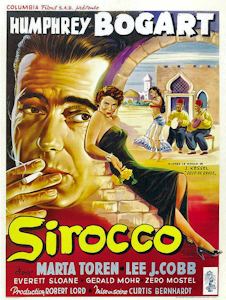
After The Fall-Humphrey Bogart’s “Sirocco” (1951)-A Film Review

After The Fall-Humphrey Bogart’s “Sirocco” (1951)-A Film Review


DVD Review


By Special Guest Commentator Frank Jackman

Sirocco, starring Humphrey Bogart, Lee J. Cobb, Columbia Pictures, 1951

[This review to the extent that it is a film review is based on a five DVD package of films that the legendary craggy-faced actor Humphrey Bogart did for Columbia Pictures mainly in the late 1940s and early 1950s-Frank Jackman]

I do not normally do film reviews in this space but recently Pete Markin, the administrator on this site, asked me if I would be interested in reviewing Humphrey Bogart’s Sirocco since it involved two things that he knew I was interested in-Bogart and the in many ways decisive results of World War I for today’s world troubles, the ‘war to end all wars” which I/we are in the midst of commemorating the final bloody 100th anniversary year of here and elsewhere. I accepted mainly on the latter premise but as it turned out also because although I have seen a ton of Bogart films this 1951 effort for Columbia Pictures had escaped my attention and while I am bound to do the review for other reasons I don’t think this one measures up as a prime Bogie flick.      

As to the other reasons as just mentioned we are in the midst of the 100th anniversary of the bloody seemingly endless butchery of World War I. As I have pointed out elsewhere some of the results of that war were the various stages of the Russian Revolution which brought down the Czarist regime, the defeat of German and its lesser ally Austria bringing down two more empires and most importantly for us here also the fall of the German-allied Ottoman Empire. I have described the first three falls in great detail as to the their contribution to the world we face today elsewhere but the fall of the Ottoman Empire and its aftermath are still very much with us as even slight perusal of the daily news will confirm in places like Iraq, Lebanon, Israel, and Syria all lands formerly part of that decayed empire.          
   
Of course we all know, or should know, that ever since wars have been started that “to the victor belongs the spoils” and that was exactly the situation after the fall of the Ottoman Empire. The British and French decided to carve up the old territories of the Middle East to suit their conveniences, or the conveniences of their emissaries. Maybe conveniences is too strong a word and whim would be more appropriate. During this time we have the Balfour Declaration proclaiming British commitment to creating a Jewish state in that area, the division, the quite arbitrary decision, to carve up the area not by traditional boundaries or allegiances but colonial convenience under the well-trodden colonialist “divide and conquer” stratagem. Those conveniences (whims) which would come back to haunt them especially after World War II when the colonial masses were struggling for liberation from their respective colonial powers after World War I included giving the French a mandate in what was then and now Syria. Today just to mention the name of that benighted country tells much about how little has changed in the post-colonial period.               

What does all this have to do with Bogie and this film. Well the story line here is set in Damascus in 1926 when the French Army was in deep trying to put down a national liberation struggle by the indigenous people led by an Emir who was ready, win or lose, to get the French all the grief they could handle. Bogie, last seen in this space I believe as one of the lead actors in the classic film Casablanca which is commemorating the 75th anniversary of its opening this year as well, is nothing but an opportunist businessman of sorts selling guns and ammo to the colonials, to the liberation fighters for a pretty profit. (I am willing to bet as will be detailed a bit below that Bogie, or rather Bogie’s character here Harry Smith, wished as Rick of Rick’s Café Americian he had never left old Casablanca where running a gin joint and being the conduit for some letters of transport which helped one Victor Lazlo, the famous Czech liberation fighter against the Nazi night-takers, get out of that stinking hole and on to fight another day. Even though that meant giving up lovely Ilsa, his “we will always have Paris” flame. There is a lot in this film which has the feel of the earlier film but lacks energy, plotline and even scenes to match that epic.)

Naturally the French Army commander General LaSalle, played by Everett Sloane, wants this traffic stopped and the uprising suppressed by any means necessary. His strong inclination is to level Damascus to the ground and execute everyone that his troops can round up if necessary to suppress the rebels. Periodically though he gives into the ideas of his chief of intelligence Colonel Feroud, played by Lee J. Cobb, last seen in this space playing the corrupt union leader in On The Waterfront and snitching on every fellow actor he could before the 1950s red scare House Un-American Activities Committee, who thinks that he can buy time and maybe peace by negotiating with that Emir and his underlings.      

The story line goes back and forth based on that idea. Where things get dicey for Bogie, like I said the Harry Smith in this film, is when the good Colonel through snitches is able to grab Bogie before he can leave town. Ready to face the firing squad he makes a deal with Harry to get him out of town if he can lead him to the Emir rather than face a messy death. Done. Done except in trying to save the Colonel’s life by coming up with the idea to the General of paying ransom he forfeits his own since the rebels no longer trust him. So all Harry gets for his troubles is a big step-off, a summary execution.  


[A little romance on the side is always the order of the day in these type films. Here there is an underlying tension between the good Colonel and Harry over the Colonel’s bored and flirty mistress, Violette, whom the Colonel loves to distraction. Nothing comes of her using Harry to get out of town and Feroud’s life since he bought the big step-off by trying to do right once in his ruthless life.]

Corporation Are Not Citizens Despite The United States Supreme Court-The Fight For An Article 5 Consitutional Convention

Corporation Are Not Citizens Despite The United States Supreme Court-The Fight For An Article 5 Consitutional Convention 


The Girl With The Bette Davis Eyes-With Lowell’s Bette Davis And Jack Kerouac In Mind

The Girl With The Bette Davis Eyes-With Lowell’s Bette Davis And Jack Kerouac In Mind


By Special Guest Writer Greg Green   
  
[Greg Green, a writer well known to me in this space for his articles on his and others experiences in the devil’s war, the Vietnam War, that carved a nation in two, maybe more and from which at least culturally it has never recovered mentioned to me one day when he was getting ready to review an old time black and white movie Of Human Bondage for the American Film Gazette for which he writes occasionally that the female star Bette Davis had been born in Lowell, Massachusetts. Something that he did not know although he grew up a few towns over in leafy suburban Westford. Greg has been a longtime admirer of another Lowell native Jack Kerouac who torched a placid post-World War II world with his On The Road some sixty years ago (and which we have as Seth Garth mentioned “seemingly endlessly” and he may be right commemorated in this space recently on the sixtieth anniversary of its publication). That got Greg thinking that there must be some connection that he could draw between two such iconic celebrities from an old dying mill-town (dying even back then as the mills headed cheap textile labor south and then cheaper foreign shorts worldwide-in their respective birth times 1908 and 1922) that had seen better days beside the inevitable “there must be something in the water” theory. So he asked me to let him do a little piece trying to make some cosmic connection between the two icons and the town. Sam Lowell-not related in any way to the founders of the town or the damn wage slave mill-owners]             

A river runs through it. The great rushing from the New Hampshire mountains, at least that is what I have been told is source ground zero of the broken down millwheel towns to the seas and unto the great cold wash Atlantic and there to homeland (homeland before Lowell migration and Quebec flee failing farms up north looking for factory river work) Europe left behind from desolation days Merrimack. Merrimack some potent Indian signifier (excuse me Indian when Indian was the name spoken and not the correct Native American or even better indigenous peoples who can  stake serious and legitimate claim to sacred ground now ill-trodden over by umpteen generations and no reparations in sight) long before the devils came in their blasted wooden hull ships from across that briny North Atlantic no high note in sight unlike the great big blow out in Frisco town when a skinny black kid blew that one to perdition. Great rushing river dividing the town between the remember “fake natives” and the on-coming foreigners come to pick up the slack in the bottomless spinning wheel pits (the noise drowning out sing-song voices and whiskey hoarse alike and maybe that is where the sober siren sought his Jack strange mystifying voice and he his throbbing pace that in the end wound up like whiskey breath).        

River, two forked river come flowing from the great ices of New Hampshire hills laying down sediments (and sentiments) along a path unto the great turn and rock formation by Pawtucketville Bridge-dividing that town even further (or is it farther) pushing out Highland visions of august majesty. Then a poor besotted girl emerges, emerges out of the dust hitting the high trail west landing forlorn and mystified in some fallen angel diner and a gas station town near the Petrified Forest (trees so ancient, think about it, that they have turned to stone some kind of metaphor there-something about staying in one place too long) in the Arizonas, out off of Route 66 heavy-travelled in the next generation by hungry guys tired of diner and gas stations at home drift to the cities but need to catch some dust and grit although what they thought of benighted stone trees who  knows in between those expansive cities). There some Papa generation before her came out looking for El Dorado or gold something different and landed in two bit desert stretches and kind of got stuck, got good and stuck there. (Not everybody made it as the skeletons along the way of cattle, horse, and human set among the bramble and down some aching arroyo tell every daredevil passer-by and every sensational dime store penny a word novelist in the days when that “contract” ruled writers on “spec” too.)

And there abandoned by a big city dream mother and an ill-defined no account wimp father she came of age dreaming the dreams, funny city girl dreams of faraway places away from the dust and those fucking stoned trees when the wind howls through the crevices (making one think of other social howls and wolves and Molochs and white-dressed nurses in mental wards and of cool jazz man hipsters and Times Square con artists working the rubes), her father the king of the species all dressed up and cowardly when it came right down to it. Dreaming book dreams, small printed page books sent from far away by those who could not take the dust, the heat, those howls and once again those fucking night-blinding stone trees which tourists would pay a pretty penny for a clip, a sliver. Jesus. Dreamed fourteenth century or was fifteenth dreams of mad man con man rabble Villon out of some Balzac French novel but real enough speaking about how he could not stay with civil people but sought solace among the petty thieves, the cut throats, the man murderers (little did she know who would come through door to marvel at her bug-eyes and blinkers making sorry Villon nothing but a second-rate Time Square hustler, hey, pacifist even) , the flotsam and jetsam among the people who lived outside the moat, who did not dream but planned.         
          
“Hey there stranger” she spoke quickly to that stranger with the strange pale voice and the paler skin despite walking the sun-drenched walk of the tramp no better than Villon’s men outside the moat and who looked like he had not had three squares in many a moon so that is what she thought when he first came in, came in and recognized in that small book, that funny thought poem by mad monk gone astray Villon and thus was kindred against the Papa silliness and some gas station jockey who tried to make love to her before her time. So they talked, he called it conversation, and told her that the night-takers descending on the flat land earth, out even in the freaking (his term not hers) stone tree desert filled with arroyo-seized skeletons that the day for conversation was quickly coming to froth, was dangerous beyond whatever small thoughts she had ever had out in that vast night sky thunder-blazed desert. She thought him the new Messiah come that she has heard about over the blaring radio that made the diner hours go by more quickly so she could retreat into Villon’s manly dreams without distraction. He, the stranger he, laughed and said no vagabond who was out filching (cadging in what he meant she thought) free eats in dust-bitten rocks could claim Messiah-hood, could survive the new age coming and coming quickly right through her door. Her bug-eyes blinkered at that, at her silly illusions when she thought about it later after he was gone, gone to who knows what savior-driven place.          

No sooner had the stranger taken his filched food (she still insisted it was cadged and would whenever anybody asked her if she had actually seen the savior, had maybe slept with him for good measure) when the night-takers stormed in (stormed in more than one way bringing half the desert hell with them as boon companion) and made her savior stranger sit on his ass on the floor. Made hell come to pass before the night was through. (He, the stranger, would comment that the night-takers took their sweet-ass time whenever they descended and that those descended on took their sweet-ass time figuring out how to get rid of the bastards). Sweet manna. Then that forlorn stranger had an idea, a good one if somebody beside her thought about it later that he would go mano a mano with the night-takers, would play the gallant when all was said and done (giving lie to the idea that he didn’t have any ideas about the night-takers except their time had come). Naturally he lost, better won/lost and left her with her book, her small Villon book, a guy from the fourteenth century or was it the fifteenth and her dreams kind of intact. A few years later some guys in a 1949 Hudson (or was it Studebaker) tired of the Route 66 road came by looking for grub, looking for free eats and some whiskey but by then she was long gone to some city that Papa and father could not fathom            

[On in the frozen Western night the no longer girlish girl hung up on old time French bandit-poets, con men, desolation angels, and holy fools, and lost in thought time of the intellectuals far from the blessed stone trees, as far away as she could get to Southern California and so “frozen” ironic she picks up a book, a paperback left on the counter by a forgetful customer who after paying for his Woolworth-quality lunch must have given up all hope. She flips it into her pocketbook to either wait on his owner’s return or for something to read that night, that lonesome stone tree wilderness night that never left her thoughts. That guy, or whoever it was, never returned and so that night she read, read until the early morning hours and then read some more.          

Read about a guy, although in her mind it could have be a girl, who had the same wanderlust that drove her west, drove her to the great blue-pink American western night he called it looking for some father that he had never known, looking forlornly, for that father from some oil-spilled New Jersey shore river to the wind-swept China seas before the Golden Gate Bridge. Looked high and low for the missing brethren who long ago had crossed her path out in the hard stone tree night when everything was possible but the intellectuals then flabby and ill-disposed to fight the night-takers even to a draw abandoned all hope, decided that primitive man would take the day and crush any free spirits. This guy though flush with the expectations of many new adventures once the night-takers were put to the sword took to the road, took a chance that he could find that father some fucking place-maybe Latimer Street in Denver, maybe Neola, Grand Island, Reno, Winnemucca, Tulsa, Fargo (although give up all hope if you wind up in that locale). She wondered that maybe he had stolen her dreams. Maybe he had stared at the same rivers that drove her desires, yes, just maybe that was the case.]    

A young boy only spoke patois until he went to school played hooky one day and sat in the lost souls library hoping to find something that would challenge his fevered brain and slip-slopped over to the poetry section and found this guy Villon, a poet of the fourteenth or was it the fifteenth century, who spoke of dreams and crashing out (spoke too of ruffian petty larcenies outside the moat but the boy let it pass because he knew all about that, knew that poet kings only spoke of such to work up a sweat, to deal better with hipsters, con men, sullen fallen women, junkies and assorted felons riding on the railroad jungle tracks. Knew he had kindred in that long ago poet king and sought out fellows who could understand such dreams, could understand too the patois that he thought in. Would find plenty of hipsters, cons, con men, Molochs, holy goofs, cowboy angels, a teenage Adonis is spar with his brethren soul. Find Moloch, insanity, the clap, jungle fever, whiskey shakes, penniless forsaken highways, lost boys, sullen youth, Zen, chicken shit and on some days, but only some days, he wished he never left that fucking river, that holy of holies Merrimack and those wistful eyes that he remembered out in cold Winnemucca, Neola, Grand Island, Big Sur nights          

[Weird thoughts along the Merrimack lifeline (remember like bodies make-up filled with arteries and canals) a fervent solemnly disciplined fourteen year old boy armed with Woolworth’s ten cent notepads and chewed raw No. 2 pencils, sits arms akimbo, strange gangling not yet athletic fourteen year old position like some latter day saint Buddha seeing all knowing all with hashish pipe tucked into some secret place sitting out with cans of beans and rat shit on desolation row waiting for fires and damnation, in a silent black back row orchestra seat (no red dress girl singing swinging Benny Goodman songs that night to come hither him to perdition and have to ask the eternal boy-girl question-orchestra or balcony-and he would know the answer always know the answer balcony of course she silly why else would I come into the shadows with you) of the of long gone to condos or cute shops Majestic Theater off of Bridge Street staring intensely at the big white screen suddenly turned to magic motion pictures with a dust storm brewing out in some fucking petrified forest and some girl not his holding off some ragged sweater gas jockey, and dreams too.   

Waiting, eternally waiting like that fervent fourteen year old boy for something to happen, for some kicks, for something better than listening to the average swill the customers brought in the door, waiting she thought for culture, or her idea or culture anyway. What grabbed that poor boy boy though was that scene out of some latter day great American West night when he thought he would be able to choke the Eastern dust from off his shoes and live-and write, always write. So kindred, kindred too when some holy goof hobo, tramp, bum angel Buddha comes traipsing down the road looking for hand-outs and God Jesus that would be the life. He, she, they make small kindred talk and speak of that damn poet, that Villon who knew more than he should about the human condition, more than any fourteen year old boy anyway. 

But before long the dream shattered, the night-takers released from their caves come swooping down like hell’s avenging angels, avenging the lost paradise that he had read a guy by the name of Milton, half-blind had gone on and on about in some heaven’s battle and they the losers-and what of it. But when you take on the night-takers you better realize that you will take some casualties, take some holy sacred blood from the holy earth returned and that ain’t fair, ain’t fair at all but who knows maybe Buddha, Rama. Zoroaster, Jehovah, the unnamed one, planned it out that way. Out the door of that no longer silent black back row orchestra seat he was glad that he had not had some red dress come hither girl to bother him. For he wondered, wondered as he sank his eyes into the white froth of the mighty Merrimack below whether she, that Western tableau girl would ever acknowledge him, ever read his mind like he read hers.]  


Ha, as he tried to climb Bear Mountain with a dollar and a quarter in his stained dungarees (not called jeans then, not around him anyway) splattered flannel shirt and broken toe boots looking for that father he never knew (although his own father had passed on before he knew that he was looking for another father somewhere along the wino camp tracks, some arroyo bush or in some county jail working out a scheme). Had Route 66 cold because if he could search that highway he would miss some connection, some angst the shrinks called it among the hot rod car, surf board, motorcycle lost winding in stir and some rough trade honey to some beast, boys he would meet out in the great blue-pink American Western night. As he pulled his thumb out of his back pocket he finally relaxed and dug the scene. Hit long rides and short, mostly lonely truckers looking for company and searching for the sons they had never known, tramp diner stops, railroad stews on nights so cold his broken toe boots seized up on him, grabbed a couple of big rides with big blondes looking for some max daddy to be-bop with and leave in Doc’s drugstore while they waited to be “found” by some Hollywood agent. Took tokay swigs with the best of them, met up with rabid New Jersey poets, New York City Times Square gangster dope peddlers and sainted poets (funny always the poets driving him forward he would have to write that down, Ivy League junkies on the nod, and finally the Adonis of the western night whom he would be-bop with unto the San Francisco Bay dropped that high white note out in the China seas. Yeah, he had it all except maybe those bug eyes from childhood lost in some flophouse. Still on some days, and only on some days, he wished he never had left that fucking river, never that sacred ground river. He wondered if she though that same thought.               

Happy Birthday Townes -In The Time Of My Country Music Moment- The Work Of Singer/Songwriter Townes VanZant- A Potpourri

Happy Birthday Townes -In The Time Of My Country Music Moment-  The Work Of Singer/Songwriter Townes Van Zant- A Potpourri


CD Review

The main points of this review have been used to review other Townes Van Zandt CDs.

Readers of this space are by now very aware that I am in search of and working my way through various types of American roots music. In shorthand, running through what others have termed "The American Songbook". Thus I have spent no little time going through the work of seemingly every musician who rates space in the august place. From blues giants, folk legends, classic rock `n' roll artists down through the second and third layers of those milieus out in the backwoods and small, hideaway music spots that dot the American musical landscape. I have also given a nod to more R&B, rockabilly and popular song artists then one reasonably need to know about. I have, however, other than the absolutely obligatory passing nods to the likes of Hank Williams and Patsy Cline spent very ink on more traditional Country music, what used to be called the Nashville sound. What gives?

Whatever my personal musical preferences there is no question that the country music work of, for example, the likes of George Jones, Loretta Lynn and Tammy Wynette in earlier times or Garth Brooks and Faith Hill a little later or today Keith Urban and Taylor Swift (I am cheating on these last two since I do not know their work and had to ask someone about them) "speak" to vast audiences out in the heartland. They just, for a number of reasons that need not be gone into here, do not "speak" to me. However, in the interest of "full disclosure" I must admit today that I had a "country music moment" about thirty years ago. That was the time of the "outlaws" of the country music scene. You know, Waylon (Jennings) and Willie (Nelson). Also Kris Kristofferson, Johnny Cash and Jerry Jeff Walker. Country Outlaws, get it? Guys and gals(think of Jesse Colter)who broke from the Nashville/ Grand Old Opry mold by drinking hard, smoking plenty of dope and generally raising the kind of hell that the pious guardians of the Country Music Hall Of Fame would have had heart attacks over (at least in public). Oh, and did I say they wrote lyrics that spoke of love and longing, trouble with their "old ladies" (or "old men"), and struggling to get through the day. Just an ordinary day's work in the music world but with their own outlandish twists on it.

All of the above is an extremely round about way to introduce the "max daddy" of my 'country music moment', Townes Van Zandt. For those who the name does not ring a bell perhaps his most famous work does, the much-covered "Pancho And Lefty". In some ways his personal biography exemplified the then "new outlaw" (assuming that Hank Williams and his gang were the original ones). Chronic childhood problems, including a stint in a mental hospital, drugs, drink, and some rather "politically incorrect" sexual attitudes. Nothing really new here, except out of this mix came some of the most haunting lyrics of longing, loneliness, depression, sadness and despair. And that is the "milder" stuff. Not exactly the stuff of Nashville. That is the point. The late Townes Van Zandt "spoke" to me (he died in 1997) in a way that Nashville never could. And, in the end, the other outlaws couldn't either. That, my friends, is the saga of my country moment. Listen up to any of the CDs listed below for the reason why Townes did.

A Townes Potpourri

Rear View Mirror, Townes Van Zandt, Sugar Hill Records, 1993


Townes Van Zandt was, dues to personal circumstances and the nature of the music industry, honored more highly among his fellow musicians than as an outright star of “outlaw" country music back in the day. That influence was felt through the sincerest form of flattery in the music industry- someone well known covering your song. Many of Townes’ pieces, especially since his untimely death in 1997, have been covered by others, most famously Willie Nelson’s cover of “Pancho and Lefty”. However, Townes, who I had seen a number of times in person in the late 1970’s, was no mean performer of his own darkly compelling songs.

This compilation, “Rear View Mirror”, gives both the novice a Van Zandt primer and the aficionado a fine array of his core works in one place. Start with the above mentioned “Pancho and Lefty”, work through the longing felt in “If I Needed You”, and the pathos of “For The Sake Of The Song” that could serve as a personal Townes anthem. Then on to the sadness of “No Place To Fall” and “Waiting Round To Die”. Finally, round things out with the slight hopefulness of “Colorado Girl” and the epic tragedy of Tecumseh Valley”. Many of these songs are not for the faint-hearted but are done from a place that I hope none of us have to go but can relate to nevertheless. This well thought out product is one that will make you too a Townes aficionado. Get to it.


"For The Sake of The Song"

Why does she sing
Her sad songs for me,
Im not the one
To tenderly bring
Her soft sympathy
Ive just begun
To see my way
clear
And its plain,
If I stop I will fall
I can lay down a tear
For her pain,
Just a tear and thats all.

What does she want me to do?
She says that she knows
That moments are rare
I suppose that its true
Then on she goes
To say I dont care,
And she knows
That I do

Maybe she just has to sing, for the sake of the song
And who do I think that I am to decide that shes wrong.

Shed like to think that Im cruel,
But she knows thats a lie
For I would be
No more than a tool
If I allowed her to cry
All over me.

Oh my sorrow is real
Even though
I cant change my plan
If she could see how I feel
Then I know
That shed understand

Oh does she actually think Im to blame?
Does she really believe
That some word of mine
Can relieve
All her pain?
Cant she see that she grieves
Just because shes been blindly deceived
By her shame?

Nothins what it seems,
Maybe shell start someday
To realize
If she abandons her dreams,
Then all the words she can say
Are only lies
When will she see
That to gain
Is only to lose?
All that she offers me
Are her chains,
I got to refuse

Oh but its only to herself that shes lied
She likes to pretend
Its something that she must defend,
With her pride
And I dont intend
To stand her and be the friend
From whom she must hide

COLORADO GIRL
Townes Van Zandt
Copyright � 1969 Silver Dollar Music
Performing rights w/ASCAP
http://www.ascap.com/ace/ACE.html
#-------------------------PLEASE NOTE--------------------------#
#This file is an interpretation of Townes' work, and does not #
#necessarily represent the actual way he recorded or performed #
#the song, and is not intended to be used for any purpose other#
#than for private study, scholarship, or research #
#--------------------------------------------------------------#

-----------------------------------------------------
Version 1 submitted by unknown
-----------------------------------------------------

D G D
I'm goin' out to Denver, see if I can't find
G D
I'm goin' out to Denver, see if I can't find
A7 G D
That lovin' Colorado girl of mine

Well the promise in her smile shames the mountains tall
She can bring the sun to shinin', tell the rain to fall

Been a long time Mama, since I heard you call my name
Been a long time, long time, since I heard you call my name
Got to see my Colorado girl again

I'll be there tomorrow, Mama, now don't you cry
(I'll) be there tomorrow, Mama, don't you cry
Gonna tell these lonesome Texas blues goodbye

DOLLAR BILL BLUES
Townes Van Zandt
Copyright � 1977 Silver Dollar Music
Performing rights w/ASCAP
http://www.ascap.com/ace/ACE.html
#-------------------------PLEASE NOTE--------------------------#
#This file is an interpretation of Townes' work, and does not #
#necessarily represent the actual way he recorded or performed #
#the song, and is not intended to be used for any purpose other#
#than for private study, scholarship, or research #
#--------------------------------------------------------------#

-------------------------------------------------------
Submitted by F. Schwarz 10/15/2006
-------------------------------------------------------

#--------------------------------------------------------------#
>>>Here is how Townes plays it on Flyin' Shoes<<<

Cm Fm
if I had a dollar bill
Cm
Yes, I believe I surely will
Gm
Go to town and drink my fill
Cm
Early in the morning

Cm Fm
Little darling, she's a redhaired thing
Cm
Man, she makes my legs to sing
Gm
Gonna buy her a diamond ring
Cm
Early in the morning

Cm Fm
Mother was a golden girl
Cm
I slit her throat just to get her pearls
Gm
Cast myself into a whirl
Cm
Before a bunch of swine

Cm Fm
It's a long way down the Harlan road
Cm
Busted back and a heavy load
Gm
Won't get through to save my soul
Cm
Early in the morning

Cm Fm
I've always been a gambling man
Cm
I've roled them bones with either hand
Gm
Seven is the promised land
Cm
Early in the morning

Cm Fm
Whiskey'd be my dying bed
Cm
Tell me where to lay my head
Gm
Not with me is all she said
Cm
Early in the morning

Cm Fm
If I had a dollar bill
Cm
Yes, I believe I surely will
Gm
Go to town and drink my fill
Cm
Early in the morning


>>>On A Far Cry From Dead and on Rain On A Conga Drum he plays<<<

Hm Em
If I had a dollar bill
Hm
Yes, I believe I surely will
F#m
Go to town and drink my fill
Hm
Early in the morning

Hm Em
Little darling, she's a redhaired thing
Hm
Man, she makes my legs to sing
F#m
Gonna buy her a diamond ring
Hm
Early in the morning

Hm Em
Mother was a golden girl
Hm
I slit her throat just to get her pearls
F#m
Cast myself into a whirl
Hm
Before a bunch of swine

Hm Em
It's a long way down the Harlan road
Hm
Busted back and a heavy load
F#m
Won't get through to save my soul
Hm
Early in the morning

Hm Em
I've always been a gambling man
Hm
I've roled them bones with either hand
F#m
Seven is the promised land
Hm
Early in the morning

Hm Em
Whiskey'd be my dying bed
Hm
Tell me where to lay my head
F#m
Not with me is all she said
Hm
Early in the morning

Hm Em
If I had a dollar bill
Hm
Yes, I believe I surely will
F#m
Go to town and drink my fill
Hm
Early in the morning

#--------------------------------------------------------------#


#--------------------------------------------------------------#
IF I NEEDED YOU
Townes Van Zandt
Copyright � 1972 Columbine and UA Music
Performing rights w/ASCAP
http://www.ascap.com/ace/ACE.html
#-------------------------PLEASE NOTE--------------------------#
#This file is an interpretation of Townes' work, and does not #
#necessarily represent the actual way he recorded or performed #
#the song, and is not intended to be used for any purpose other#
#than for private study, scholarship, or research #
#--------------------------------------------------------------#

----------------------------------------------------------
Submitted by David Byboth via about-townes@physitron.com
----------------------------------------------------------

On Jun 2, 1:14pm, Rolland Heiss wrote:
> I would be interested in tab to "If I Needed You". I figured out a way
> to pick it that sounds ok but not quite right I'm afraid. I noticed that
> Townes often used that southern method of picking like on "Waiting Around
> to Die" where the thumb plays out a steady beat while the rest of the
> fingers do something different. I haven't mastered this yet but figured
> out a pretty fair way to play "Waiting Around to Die" that sounds good.
> I've only been trying to pick seriously for about a year. Before that I
> strummed chords mostly. I began playing guitar in the early 1980's and
> love it. I can barely get through a day without picking up the guitar at
> least once. Every evening I try to write a song; sometimes they come and
> sometimes not.


Man.... I should be careful what I volunteer to do!... I got hammered with
requests for this.....when are all you pickers going to come to Dallas and play
some Townes songs with me?

The pick is very much as Rolland describes.... it's a little hard to keep the
thumb cranking out the bass rhythem while the fingers are doing their work but
with some practice it all comes together....

To get you started (It may take me a while to get a real tab done with all the
fill in stuff) you have to play it in G. I play it with the Capo on the fourth
fret. While fingering a regular G Chord (you have to finger it with your
little finger on the high string to free up your pointer!) the fingers pick:

NOTE: I just tabbed this at work from memory with no guitar...it has just the
basic bass and lead line. I'll check it tonight but it should be close enough
to get everyone started, feel free to feed me back corrections. (backchannel)

Learn it without the hammers first then you can work in the timing to hammer on
the notes with a "h" on them.


and ease my pain?

If you needed me
I would come to you
I'd swim the seas
for to ease your pain

In the night forlorn
the morning's born
and the morning shines
with the lights of love
You will miss sunrise
if you close your eyes
that would break
my heart in two

The lady's with me now
since I showed her how
to lay her lily
hand in mine
Loop and Lil agree
she's a sight to see
and a treasure for
the poor to find

#--------------------------------------------------------------#
NO PLACE TO FALL
Townes Van Zandt
Copyright � 1973 EMI U CATALOG INC
Performing rights w/ASCAP
http://www.ascap.com/ace/ACE.html
#-------------------------PLEASE NOTE--------------------------#
#This file is an interpretation of Townes' work, and does not #
#necessarily represent the actual way he recorded or performed #
#the song, and is not intended to be used for any purpose other#
#than for private study, scholarship, or research #
#--------------------------------------------------------------#

-----------------------------------------------------
Submitted by David Byboth
-----------------------------------------------------
Capo on Second fret

D DMaj7 D7
If I had no place to fall
G D
and I needed to
Em G
could I count on you
D
to lay me down?

D Dmaj7 D7
I'd never tell you no lies
G D
I don't believe it's wise
Em G
you got pretty eyes
D
won't you spin me 'round

Em A
I ain't much of a lover it's true
Em F#m
I'm here then I'm gone
D E
and I'm forever blue
A
but I'm sure wanting you


Skies full of silver and gold
try to hide the sun
but it can't be done
least not for long

And if we help each other grow
while the light of day
smiles down our way
then we can't go wrong

Time, she's a fast old train
she's here then she's gone
and she won't come again
won't you take my hand

If I had no place to fall
and I needed to
could I count on you
to lay me down?

(QUICKSILVER DAYDREAMS OF) MARIA
Townes Van Zandt
Copyright � 1968 Silver Dollar Music
Performing rights w/ASCAP
http://www.ascap.com/ace/ACE.html
#-------------------------PLEASE NOTE--------------------------#
#This file is an interpretation of Townes' work, and does not #
#necessarily represent the actual way he recorded or performed #
#the song, and is not intended to be used for any purpose other#
#than for private study, scholarship, or research #
#--------------------------------------------------------------#

-----------------------------------------------------
Version 1 submitted by Neal
-----------------------------------------------------

C Am Em Am Dm
Well a diamond fades quickly when matched to the face of Maria
F Dm F Dm C
All the harps they sound empty when she lifts her lips to the sky
C Am Em Am Dm
The brown of her skin makes her hair seem a soft golden rainfall
F Dm F G C
That spills from the mountains to the bottomless depths of her eyes

Well, she stands all around me her hands slowly sifting the sunshine
All the laughter that lingered down deep 'neath her smilin' is free
Well, it spins and it twirls like a hummingbird lost in the mornin'
And caresses the south wind and silently sails to the sea

Ah, the sculptor stands stricken and the artist he throws away his brushes
When her image comes dancin' the sun she turns sullen with shame
And the birds they go silent the wind stops his sad mournful singin'
When the trees of the forest start gently to whisperin' her name

So as softly she wanders I'll desperately follow her footsteps
And I'll chase after shadows that offer a trace of her sigh
Ah, they promise eternally that she lies hidden within them
But I find they've deceived me and sadly I bid them goodbye

So the serpent slides slowly away with his moments of laughter
And the old washer woman has finished her cleanin' and gone
But the bamboo hangs heavy in the bondage of quicksilver daydreams
And a lonely child longingly looks for a place to belong

PANCHO AND LEFTY
Townes Van Zandt
Copyright � 1973 EMI U CATALOG INC,
Performing rights w/ASCAP
http://www.ascap.com/ace/ACE.html
#-------------------------PLEASE NOTE--------------------------#
#This file is an interpretation of Townes' work, and does not #
#necessarily represent the actual way he recorded or performed #
#the song, and is not intended to be used for any purpose other#
#than for private study, scholarship, or research #
#--------------------------------------------------------------#

-----------------------------------------------------
Submitted by Neal
-----------------------------------------------------


C G7
Livin' on the road my friend is gonna keep you free and clean
F C G7
Now you wear your skin like iron, your breath's hard as kerosene
F C F
You weren't your momma's only boy, but her favorite one it seems
C Dm F Am
Began to cry when you said, "good-bye", sank into your dreams.


Poncho was a bandit boys, his horse was fast as polished steel
He wore his gun outside his pants for all the honest world to feel
Poncho met his match, ya know, on the desert down in Mexico
No one heard his dyin' words, but that's the way it goes.


F C F
All the Federales say, they could'a had him any day
C Dm F Am
They only let him go so long, out of kindness I suppose.


Lefty he can't sing the blues, anymore like he used to
The dust that Poncho bit down south, ended up in Lefty's mouth
The day they laid poor Poncho low, Lefty split for O-hio
Where he got the bread to go, ain't nobody knows.


Cho: (slip away)


The poets tell how Poncho fell, Lefty's livin' in a cheap hotel
The desert's quiet, Cleveland's cold and so the story ends, we're told
Poncho needs your prayers it's true, but save a few for Lefty too
He only did what he had to do but now he's growin' old.


Cho: (slip away)
Cho: (go so wrong)


-----------------------------------------------------
Submitted by Denny
-----------------------------------------------------

Here's one of my favorite ballads which was written by the inimitable Townes Van
Zandt. Emmylou Harris recorded it, as did Willie Nelson and Merle Haggard in a
duet (don't ask me why). I first heard it in a coffeehouse at RPI (remember
coffeehouses, where people went to hear good music, not get drunk) by Robin and
Linda Williams, of later Prairie Home Companion fame.

I play this with a D, C#, B bass run transition from the D chord to whatever
follows. I've indicated this with the following chord notation.

D x00232
D/C# x40232
D4/B(?) x20032

I also lead into the verse with
e+-----------2--
b+--2--3--5-----
g+-------------- then picking out of the D chord, etc.
d+-----------0--
a+--0--2--4-----
e+--------------
Livin' on the road, my friend.....

which is nice for many songs played in D.

Enjoy,
Denny Straussfogel


Pancho and Lefty by Townes Van Zandt

D
Livin' on the road, my friend
A
Was gonna keep us free and clean
G
But now you wear your skin like iron
D D/C# D4/B A
And you breath's as hard as kerosene
G
You weren't your mama's only boy
D D/C# D4/B
But her favorite one, it seems
D
She began to cry
D/C# D4/B A A7
When you said good bye
G Bm
And sank into you dreams

(same chords as first verse)
Pancho was a bandit, boys
Rode a horse fast as polished steel
Wore his guns outside his pants
For all the honest world to feel
Pancho met his match, ya know
On the deserts down in Mexico
No one heard his dyin' words
But that's the way it goes

Chorus (words change slightly, each time)
G
And all the federales say
D D/C# D4/B
They could of had him any day
D D/C# D4/B A A7
They only let him slip away
G Bm
Out of kindness, I suppose

Now Lefty he can't sing the blues
All night long like he used to
The dust that Pancho bit down South
It ended up in Lefty's mouth
The day they laid old Pancho low
Lefty split for Ohio
Where he got the bread to go
Well there ain't nobody 'knows

But all the federales say
They could of had him any day
They only let him slip away
Out of kindness, I suppose

Now poets sing how Pancho fell
Lefty's livin' in a cheap hotel
The desert's quiet and Cleveland's cold
And so the story ends, we're told
Pancho needs your prayers, it's true
But save a few for Lefty, too
He only did what he had to do
And now he's growin' old

And all the federales say
They could of had him any day
They only let him go so long
Out of kindness, I suppose

Yes a few old gray federales still say
They could of had him any day
They only let him go so wrong
Out of kindness, I suppose

Happy Birthday Joni Mitchell-The Cultural Wars-Part 247- Woodstock 2007

Happy Birthday Joni Mitchell-The Cultural Wars-Part 247- Woodstock 2007


COMMENTARY

As a political writer who stands well outside the traditional political parties in this country I do not generally comment on specific politicians or candidates, unless they make themselves into moving target. Come on now, this IS politics after all. How can I justify not taking a poke at someone who has a sign on his chest saying –Hit Me? Lately Republican presidential hopeful Arizona Senator John McCain has fallen all over himself to meet that requirement.


And what is the fuss about. Studied differences about how to withdraw from Iraq? No. Finding ways to rein in the out of control budgets deficits? No. A user friendly universal health care program? No. What has sent the good Senator McCain into spasms is a little one million dollar funding proposal (since killed in the Senate) that would have partially funded a museum at Woodstock, site of the famous 1969 counter-cultural festival. His view is that the federal government should not be funding projects that commemorate drug, sex and rock and roll. Well so be it. However, the topper is this. In order to sharply draw the cultural war line in the sand he mentioned (just in passing, I’m sure) to the Republican audience that he was speaking to that he did not attend that event as he was ‘tied up’ elsewhere.

Unlike his draft dodging fellows, like Bush Cheney, Wolfowitz, et. al in the Bush Administration McCain saw action in Vietnam. Of course that action was as a naval pilot whose job it was to attempt to bomb North Vietnam back into the Stone Age, a task in which they very nearly succeeded. Through the fortunes of war he was shot down and spent several years in a POW camp. That comes with the territory. In the summer of 1969 this writer also had other commitments. He was under orders to report to Fort Lewis, Washington in order to head to Vietnam as a foot soldier. That too comes with the territory. The point is why rain on someone else’s parade just because you want to be a hero. Moreover, it is somewhat less than candid to almost forty years later belly ache about it.


A note on Woodstock as an icon of the 1960’s. The slogan- Drugs, sex, and rock and roll. We liked that idea then, even those of us who were rank and file soldiers. Not everyone made it through that experience . Others recoiled in horror later, including some of those today on the right wing of the culture wars. And others who did not 'inhale' or hang around with people who did formed another reaction to those events. Those experiments and others like communal living, alternative lifestyles and ‘dropping out’, however, were part of the price we felt we had to pay if we were going to be free. And creative. Even the most political among us felt those cultural winds and counted those who espoused this vision as part of the chosen. Those who believed that we could have a far-reaching positive cultural change without a fundamental political change in society proved to be wrong long ago. But, these were still our people.

Note this well. Whatever excesses were committed by the generation of ’68, and there were many, were mainly made out of ignorance and foolishness. Our opponents, exemplified by one Richard M. Nixon, President of the United States and common criminal, and today by John McCain spent every day of their lives as a matter of conscious, deliberate policy raining hell down on the peoples of the world, the minorities in this country, and anyone else who got in their way. Forty years of ‘cultural wars’ in revenge by them and their protégés is a heavy price to pay for our youthful errors. Enough.

In Defense Of What Now Figures To Be “Premature” Anti-Fascist Fighters-Cary Grant And Ingrid Bergman in Sir Alfred Hitchcock’s “Notorious” (1946)-A Film Review


In Defense Of What Now Figures To Be “Premature” Anti-Fascist Fighters-Cary Grant And Ingrid Bergman in Sir Alfred Hitchcock’s “Notorious” (1946)-A Film Review


DVD Review

By Fritz Taylor

Notorious, starring Ingrid Bergman, Cary Grant, Claude Raines, directed by the late Sir Alfred Hitchcock ( I was not sure whether when somebody had the honorific “sir” before his name and it is not hereditary whether it sticks for eternity and nobody else around the publication knew either so lacking somebody connected with the College of Heraldry I will keep it and let the bloody queen and her minions figure it out), 1946

The regular reader may wonder why I, Fritz, Taylor, who usually does commentary on wars and military affairs and not film reviews drew this assignment. That can be answered with two remarks. First, sort of strangely given the casualty numbers I was the only one on the staff, regular or contributing as is my status, who had lost a relative, actually two relatives, my uncle on my mother’s side and a cousin on my father’s side in World War II. Specifically, in the European Theater where the Soviet-led and American-assisted struggle was against the Nazi, fascist scourge. The anti-fascist sentiment runs very deeply in my family, my Southern-roots family who take such things seriously, take the military seriously. The second was that of all the people associated with this publication who are actively, meaning not just writing about it but out on the streets, opposing the current wave of fascist expression in social media and out on those very same streets which goes under several names Nazi, White Nationalist, Alt-Right but they are birds of a feather it has been determined around the water cooler that I am the most vociferous and involved. Sam Lowell, who under normal circumstances would hit a home run on the subject matter of the film under review, Notorious, is not only in a running battle with a young up and coming colleague but has sensed that I can do greater justice to the subject and so persuaded Greg Green to let me take a stab at it.

I was not familiar with this film although as a kid I saw several Sir Alfred Hitchcock films, mostly in color like Vertigo, The Bird, and his re-make of his original The Man Who Knew Too Much so I was a bit shocked by the premise that the American government in 1946, in the person of Dev a federal agent of some sort, played by suave and solid Cary Grant, was gung-ho about tracing down some recalcitrant and nasty exiled Nazis and their agents down in Rio. More so since the reality was that the American government was, except for the hardened Nazis at Nuremburg and such were trying to rehabilitate this ramble in the struggle against the Soviet Union in the ice-cold Cold War. But what really galled me was the idea then, today too in the age of Trump, that the anti-fascist struggle was to be left in the hands of governmental agents. My every instinct rebelled against that false idea, those “alternative facts” knowing what has been happening in the past several years. 

But to the film on its own premises. We already know about Dev, about the federal agent part but that would get the agency he worked for now nowhere since the guys who they were dealing with, those rats down in Rio were hooked into what was going on, were wise to the idea that the feds were on to them. Dev and friends needed a “lure,” needed a stoolie and who better that the party girl daughter of a guy who was sentenced in federal court in Miami for treason against the United States and who subsequently took his own poison pill just like in the movies. Enter one Alicia, played but off-handedly, ah, beautiful to fall down and cry for Ingrid Bergman, she last seen in this space according to Seth Garth who keeps tabs on such things as Victor Lazlo’s wife and rock in Casablanca leaving Rick of Rick’s Café and Louie to form a beautiful friendship. After lots of hemming and hawing and a little off-hand romancing Alicia buys into the project although what role she will play is not yet determined. So off to Rio but don’t blame that torrid town for harboring rats and their ilk.

Enter the plan once Dev and Alicia get settled in. The “mark” one Alex, played by Claude Rains last seen in this space according to Seth Garth who as I have already mentioned keeps tabs on such things as Rick of Rick’s Café out of Casablanca that’s in Morocco next beautiful friend after Victor Lazlo and Ingrid take off on the last plane to Lisbon to lead the anti-fascist resistance in sunken Europe, who with an overbearing mother is central to the financing of what they plan will be the 4th Reich (and no mistakes this time letting a bum like Hitler grind things down to nothing). That is where the “lure” literally comes in. Somehow Alex and Alicia knew each other, and Alex had been smitten -and would still be smitten. 

Of course, that would complicate the Alicia-Dev budding romance but the fight against the rats and the closing down of their rathole had to come first. The thing got so carried away though that smitten Alex actually married Alicia as a test of whether she was sincerely smitten by him. Sorry Alex she only has eyes for Dev whatever eye wash both try to put out to the public. The trouble, big trouble for Alex, is that Alicia is not only beautiful, hey lets’ call it by its right name, drop dead beautiful, but smart and worms some secret info out of him in passing before he realizes that she is a freaking American agent. Alex tries to slowly poison Alicia to get out from under what is in store for him but ready Dev comes to the rescue and Alex has to play along. Play along to his doom once his confederates figure out Alicia knew too much via the Alex pipeline. The last scene is great at some level when one of the Nazi confederates calls Alex to come hither and the dreaded door closes behind him. Gone.               

If assuming the American government gave enough of a rat’s ass about crushing a fascist revival in the bud in 1946, which we now know was hooey, to put an agency on the task it is also wrong to assume that we can let the cretins, and here I mean today’s progeny of those cretins, take care of their own like that last scene mentioned above. That said maybe the best way to really look at this film in order to get my blood pressure down is to see it as yet another variation on old Hollywood chestnut-boy meets girl- that has saved a million films and we will deal with the political conclusions ourselves. Yeah, Sam was right to tag me for this review. Enough said.