Tuesday, February 12, 2019

DA Krasner: At long last, turn the page on Mumia Abu-Jamal case

RootsAction Team<info@rootsaction.org>


GRAPHIC: Sign here button
 Share this action on Facebook
 Share this action on Twitter
Please donate 3 dollars
In 1981, Mumia Abu-Jamal was a former Black Panther and respected public radio journalist in Philadelphia, when he was jailed after a disputed incident in which police officer Daniel Faulkner was killed. In 1982, Abu-Jamal was convicted of murder and sentenced to death by Judge Albert Sabo, known as a “hanging judge” who’d sent more people to Death Row than any other U.S. judge.

Human rights groups like Amnesty International criticized the trial, pointing to racial bias and “possible political influences that may have prevented him from receiving an impartial and fair hearing.” Unsuccessful appeals over the years have argued that prosecutors suppressed evidence and that blacks were systematically purged from the jury. 

But after 37 years behind bars, much of it on death row in solitary confinement, Abu-Jamal now has some real hope.

Click here to tell Larry Krasner, Philadelphia’s progressive District Attorney, that it’s time to turn the page on Abu-Jamal’s case.

Last December, Abu-Jamal won a major victory when Philadelphia Judge Leon Tucker ruled that he had the right to re-appeal his case because of the appearance of bias during the appeals process – specifically that a former DA-turned-Pennsylvania Supreme Court justice who’d blocked Abu-Jamal’s appeals should have recused himself from the case.

This victory, clearing the path for a possible new trial, seemed especially hopeful because in 2017 Philadelphia voters, especially African American voters, had elected Krasner – a longtime foe of mass incarceration, the death penalty, and racism in criminal justice.

Click here to urge DA Krasner not to resist Judge Tucker’s ruling and let justice be served.

At the end of January, Krasner shocked many by announcing that he would challenge Judge Tucker’s decision to give Abu-Jamal the right to appeal, apparently over his concern that it might open up appeals for other convicted prisoners. Days later, Krasner was disinvited from a progressive law conference at Yale which he was to keynote, and conference organizers urged Krasner to drop his resistance to Abu Jamal’s appeal: “We cannot understand how DA Krasner’s decision in this case serves justice or the transformative vision that he ran on.”

Add your voice to those who want DA Krasner to reverse course on Abu-Jamal’s case – and to ask the DA: “Isn’t nearly four decades behind bars more than enough?!” 

After signing the petition, please use the tools on the next webpage to share it with your friends.

This work is only possible with your financial support. Please chip in $3 now. 


-- The RootsAction.org Team

P.S. RootsAction is an independent online force endorsed by Jim Hightower, Barbara Ehrenreich, Cornel West, Daniel Ellsberg, Glenn Greenwald, Naomi Klein, Bill Fletcher Jr., Laura Flanders, former U.S. Senator James Abourezk, Frances Fox Piven, Lila Garrett, Phil Donahue, Sonali Kolhatkar, and many others.

Background:
>> Amnesty International: “A Life in the Balance: The Case of Mumia Abu-Jamal” (Feb. 2000)
>> Essence: “Judge Rules Mumia Abu-Jamal Can Reargue Appeal To The Pennsylvania Supreme Court” (Dec. 28, 2018)
>> Philly.com: “Philly DA Larry Krasner disinvited to speak at Yale Law conference” (Feb. 2, 2019)
>> The Intercept.com: “Larry Krasner Responds to Progressive Critics” (Feb. 9, 2019)


Donate buttonFacebook buttonTwitter button

empowered by Salsa

In Honor Of John Brown Late Of Harpers Ferry-1859 *"We Are Coming Father Abraham"-A Song Of The American Civil War

Click on title to link to YouTube's film clip of a New York Regiment performing "We Are Coming Father Abraham".

On the 166th anniversary of the start of the American Civil War.

An example of an American Civil War song that I gleaned from reading the book, Civil War Curiosities" by Webb Garrison.

In the event, although the United States Congress authorized and budgeted for those 300,000 soldiers, I do not believe that the quota was met.


WE ARE COMING, FATHER ABRAHAM
Words by James Sloan Gibbons
Music L.O. Emerson


We are coming, Father Abraham, 300,000 more,
From Mississippi's winding stream and from New England's shore.
We leave our plows and workshops, our wives and children dear,
With hearts too full for utterance, with but a silent tear.
We dare not look behind us but steadfastly before.
We are coming, Father Abraham, 300,000 more!

CHORUS: We are coming, we are coming our Union to restore,
We are coming, Father Abraham, 300,000 more!

If you look across the hilltops that meet the northern sky,
Long moving lines of rising dust your vision may descry;
And now the wind, an instant, tears the cloudy veil aside,
And floats aloft our spangled flag in glory and in pride;
And bayonets in the sunlight gleam, and bands brave music pour,
We are coming, father Abr'am, three hundred thousand more!

CHORUS

If you look up all our valleys where the growing harvests shine,
You may see our sturdy farmer boys fast forming into line;
And children from their mother's knees are pulling at the weeds ,
And learning how to reap and sow against their country's needs;
And a farewell group stands weeping at every cottage door,
We are coming, Father Abr'am, three hundred thousand more!

CHORUS

You have called us, and we're coming by Richmond's bloody tide,
To lay us down for freedom's sake, our brothers' bones beside;
Or from foul treason's savage group, to wrench the murderous blade;
And in the face of foreign foes its fragments to parade.
Six hundred thousand loyal men and true have gone before,
We are coming, Father Abraham, 300,000 more!

CHORUS

***Poet’s Corner- Langston Hughes – On Lincoln’s Birthday Lincoln Memorial: Washington

***Poet’s Corner- Langston Hughes – On Lincoln’s Birthday Lincoln Memorial: Washington


From The Pen Of Frank Jackman


February is Black History Month


Lincoln Memorial: Washington


Let's go see Old Abe
Sitting in the marble and the moonlight,
Sitting lonely in the marble and the moonlight,
Quiet for ten thousand centuries, old Abe.
Quiet for a million, million years.

Quiet-

And yet a voice forever
Against the
Timeless walls
Of time-
Old Abe.


…he, Father Abraham he, pug-ugly he that no midnight moonless night or early morning darkest hour before the dawn monument chiseled stone could render beautiful (damn, that age of tin-type sepia photography, that Mathew Brady and his merry band hunched inside those clothed lightless, airless boxes, that damn warts and all pre-digital photography, when a painterly touch, say rough-hewn campsite wise and bloody wounded battle weary Winslow Homer’s, might have made him, well, just plain). Yes, warts and all, sitting arched in lighted stone in judgment, eternity self-judgment (did he do this or that action right to further that furrowed brow first of all, overall, preliminary assessment right on union and slow on the inevitable abolition call that old Frederick Douglass and the ever-hovering ghost of Captain John Brown late of Kansas and Harper’s Ferry fight had urged upon a blood-stained land).


He, furrowed in youth and pug-ugly, in youth, thus no catch for gentile Kentucky bourbon belle daughters sitting astride Stephen Foster’s old black Joe, the old darkies are gay, or so it seemed, waiting for Mister Brett Butler to come a-calling, all Kentuck born and Illini-bred (where the best they could do was say nigra when talking about the slave problem. And later, much later the sons and grandsons of poor as dirt Kentuck hills and hollows mountain boys, Harlan County roughs, picked that up nigra expression too, and went to their graves with that on their lips, Jesus.). He meant to keep all the races split, let them, the blacks, (nigras, remember) go back to Canaan land, go back to Africa, go to some not American union place but keep them out of Chi town (sounds familiar) had a conversion, maybe not a conversion so much as a lining up of his beliefs with his “walk the walk” talk. Get this reasoning: if he could save the union by NOT freeing slave one he would do so, if he could save the union by freeing some rebel-held slaves he would do so, if he could save the union by freeing every goddam slave in every stinking corner of every stinking cotton plantation he would do. By 1862 the vagaries of war, the skimpy logic of his position, would lead him kicking and screaming to the latter. But despite being a man of his time on the “colored” question he did what he had to and hence that righteous small marble tribute at the river end of the National Mall.    


He ran for president, President of the United States, not as a son of William Lloyd Garrison, all Newburyport prissy and hell- bent on damning the Constitution for that third-fifth of a man error and for Taney’s Dred Scott decision, his Abe well-thumbed, well-read constitution, or some reformed wild boy Liberty man barely contained in the Fremont Republican dust but a busted out Whig when whiggery went to ground, (hell, no, he would not go down with the ship on that tack, otherwise he would still be stuck in Springfield or maybe practicing law in bell-weather Podunk Peoria, although he would note what that burg had to say and move slowly). Nor was he some righteous son, Thoreau or Emerson-etched son, of fiery-maned Calvinist sword-in-hand black avenging angel Captain John Brown, late of Kansas blood wars and Harper’s Ferry liberation fight (he had no desire to share the Captain’s blood-soaked fate, mocked his bloody efforts in fact, as if only immense bloods would render the national hurts harmless when later the hills, hollows and blue-green valleys reeked of blood and other stenches).

His goal, simple goal (in the abstract), was to hold the union together, and to curb that damn land hunger slavery, that national abyss. And since they ran politics differently in those days (no women, latinos, nigras to fuss over) and were able to touch up a picture or two even if inexpertly by digital standards (and stretch his biographic facts a bit when the “wide awakes” awoke) he won, barely won but won, was a minority president no question, his writ ran only so far and no further.  And then all hell broke loose, and from day one, from some stormy March day one, he had to bend that big long boney pug-ugly body to the winds, his winds.

And he did, not unequivocally, not John Brown prophet proud, fearlessly facing his gallows and his maker, to erase the dripping blood and canker sore from his homeland, but in a revolutionary way nevertheless, broke down slavery’s house divided, broke it down, no quarter given when the deal went down, when he found Grant to steel his troops and no quarter (and let hell and brimstone Billy Sherman and his “bummers” light up the Southern sky). So more like some latter day Oliver Cromwell (another warts and all man) pushing providence forward with a little kick. More like old Robespierre flaming the masses with the new dispensation, the new words slave freedom. Kept freeing slaves as he went along, kept pushing that freedom envelope, kept pushing his generals south and west and east and tightening , anaconda tightening, the noose on the old ways until Johnny Reb cried “uncle,” cried his fill when righteous Sherman and his cutthroat bummers got to work too. Yes, old Father Abraham, the last of the revolutionary democrats, the last of the serious ones, who couldn’t say black better that nigra, and never could, but knew the old enlightenment freedom word, knew it good.

…and now he belongs to the ages, and rightfully so, warts and all.

Questions mount on new VA access standards From Military Update’s Tom Philpott at The News Tribune: The number of veterans eligible for health care services in their communities, using networks of private sector providers contracted by the Department of Veterans Affairs, is expected to jump this summer when regulations setting new access standards for community care become final.

VeteransPolicy.org<execdirector@veteranspolicy.org>

Questions mount on new VA access standards

From Military Update’s Tom Philpott at The News Tribune:

The number of veterans eligible for health care services in their communities, using networks of private sector providers contracted by the Department of Veterans Affairs, is expected to jump this summer when regulations setting new access standards for community care become final.

Veteran service organizations and congressional committees with oversight responsibilities for the Department of Veterans Affairs contend that the barebones details released last week raise many more questions than they answer.

Top among them is whether VA will have the budget dollars, the complex procedures and the enhanced administrative tools in place to avoid the kind of calamitous launch that scarred the Choice program from its inception in late 2014.


But the community care access rules are drawing the most attention from veteran groups and members of the veteran affairs committees.

Many of them are complaining that after partnering with VA to shape community care reform language in the Mission Act, they’ve been kept largely in the dark by VA Secretary Robert Wilkie and his staff during the months they drafted implementing rules.

As a result, when VA released first details on access standards last week, many previously supportive lawmakers and veterans groups expressed only caution, claiming not to understand from preliminary briefings how decisions were made, how they will impact veterans and VA budgets and how VA procedures and tools can be made ready in time to support a launch in June as planned.

Democrats on the Senate Veterans Affairs Committee criticized Wilkie for lack of transparency and VA’s failure to engage while preparing its new access rules.

“Once briefed, we were disappointed that VA couldn’t provide basic information on how the proposed wait and drive-time standards would affect the Department, the veterans who rely on it for care and the American taxpayer,” the senators wrote in Feb. 5 letter to Wilkie.

Carl Blake, executive director of Paralyzed Veterans of America, and Randy Reese, executive director of Disabled American Veterans, said in separate interviews that they have no choice but to remain cautious on the access standards.

Key questions DAV needs answered, said Reese, are whether the access rules are fully funded, are realistic and feasible to implement. One great unknown, he said, is whether VA-funded community provider networks will be sufficiently staffed to deliver faster, more convenient and quality care to veterans.

With revised network contracts delayed by challenges from a losing bidder, VA conceded to veteran groups that contractors haven’t been able to produce market assessments on the availability of community care for veterans nationwide.

“The assumption is the VA can’t and private providers can. But they don’t know that that’s true,” Reese said.
 

Investigation of the ‘Mar-a-Lago three’ moves forward

From Jennifer Steinhauer at  The New York Times:

The investigation was announced in a letter to Robert Wilkie, the secretary of the Department of Veterans Affairs, from Representative Mark Takano, Democrat of California, the new chairman of the committee. Mr. Takano requested documents and “information about alleged improper influence” of the members, Isaac Perlmutter, Bruce Moskowitz and Marc Sherman, “over policy and personnel decisions of the Department of Veterans Affairs.”

Mr. Takano said the three men exerted inappropriate influence over procurement at the sprawling department.

Mr. Perlmutter is the former chief executive of Marvel Entertainment, Mr. Sherman is a lawyer and Dr. Moskowitz is a doctor. The three do not possess special expertise in veterans health care issues, but were reported to be influential over Trump administration policy, including its  plans to push the department’s health care system toward private providers. The three are frequently at Mar-a-Lago, Mr. Trump’s private club in Palm Beach, Fla.

According to a report last year by the nonprofit investigative news organization ProPublica, the three pressured Mr. Trump’s first veterans secretary, David J. Shulkin, then peppered him with demands before ultimately working with personnel in the department to oust him. The group also pushed — in most cases, unsuccessfully — for certain vendors to manage health care records, and had a direct line to the president.
“I think most Americans would agree that wealthy private citizens should not be having back-channel influence” on veterans services, Mr. Takano said in an interview Friday. He said that he could use his subpoena power as a “last resort” if the requested documents were not relinquished. “This doesn’t have to be a drama,” he said. “It is a legitimate request.”

The three men released a joint statement in response to the committee action.

“We were asked by the president and, repeatedly, by the former secretary and his senior staff to assist the V.A. in enhancing the level of service it provides to our veterans,” the statement said. “Our primary focus was to introduce the V.A. to experts in various areas where V.A. staff asked for our help. We do not regret trying to do our small part, and even given the unjust and unrelenting criticism we have faced, each of us would step in to help our veterans again.”
 

Apple partners with VA on health records

Apple’s Health App will now integrate with veterans’ medical records as part of its new partnership with the VA. ProPublica reported on one of the Mar-a-Lago member’s contact with Apple in a December article. Read the health app announcement at Cult of Mac.
 

Quick Clicks:

  • VAntage Point Blog: The VA exceeded 1 million video telehealth visits in fiscal year 2018
  • VA Press Room: The VA and CDC are sharing mortality data to enable “faster analysis and the delivery of more timely healthcare interventions”
  • USA Today: A massive conspiracy defrauded the military’s TRICARE insurance program some $65 million

Bill would provide child care for veterans

From Natalie Gross at Military Times:

The Veterans Affairs Department could soon provide free child care for veterans undergoing treatment for mental health and other medical issues — a move some lawmakers hope will make it easier for veterans to get help.

The House of Representatives passed a bill Friday that seeks to make permanent an existing pilot program rolled out in 2011. At the time, a VA survey found that more than 10 percent of veterans had to cancel or reschedule VA appointments because they lacked child care, and one-third said they were interested in child care services.

“We made a promise that our veterans will get the care they’ve earned,” Rep. Julia Brownley, D-Calif., said in an email. “We can’t put insurmountable roadblocks in front of their ability to receive that care.”

The Veterans’ Access to Child Care Act calls for the VA to provide child care on site, pay veterans a stipend for the full cost of child care at licensed facilities, pay the facilities directly or collaborate with other agencies.
 

Veteran suicides on VA campuses

From The Washington Post:

Veterans are 1.5 times as likely as civilians to die by suicide, after adjusting for age and gender. In 2016, the veteran suicide rate was 26.1 per 100,000, compared with 17.4 per 100,000 for non-veteran adults, according to a recent federal report. Before 2017, VA did not separately track on-campus suicides, said spokesman Curt Cashour.

The Trump administration has said that preventing suicide is its top clinical priority for veterans. In January 2018, President Trump signed an executive order to allow all veterans — including those otherwise ineligible for VA care — to receive mental-health services during the first year after military service, a period marked by a high risk for suicide, VA officials say. And VA points out that it stopped 233 suicide attempts between October 2017 and November 2018, when staff intervened to help veterans harming themselves on hospital grounds.


Miller called the Veterans Crisis Line last February to report suicidal thoughts, according to the VA inspector general’s investigation.

The responder told him to arrange for someone to keep his guns and to go to the VA emergency department. Miller stayed at the hospital for four days.

In the discharge note, a nurse wrote that Miller asked to be released and that the “patient does not currently meet dangerousness criteria for a 72-hour hold.” He was designated as “intermediate/moderate risk” for suicide.

Although Miller had told the crisis hotline responder that he had access to firearms, several clinicians recorded that he did not have guns or that it was unknown whether he had guns. There was no documentation of clinicians discussing with Miller or his family how to secure weapons, according to the inspector general’s report, a fact that baffles his father.

“My son served his country well,” said Greg Miller, his voice breaking. “But they didn’t serve him well. He had a gun in his truck the whole time.”

Franklin, head of VA’s suicide prevention program, called the suicide rate “beyond frustrating and heartbreaking,” adding that it’s essential that “local facilities develop a good relationship with the veteran, ask to bring their families into the fold — during the process and discharge — and make sure we know if they have access to firearms.”

Note: These tragic stories show the importance of safe storage of firearms and strong community bonds – the focus of the partnership between the VA, the American Foundation for Suicide Prevention (AFSP), and the National Shooting Sports Foundation (NSSF).
Copyright © 2019 Veterans Healthcare Policy Institute, All rights reserved.
You’ve subscribed to the Veterans Healthcare Policy Institute newsletter (formerly FFVHC).

Our mailing address is:
Veterans Healthcare Policy Institute
4081 Norton Ave
OaklandCA 94602-4013

Add us to your address book


Want to change how you receive these emails?
You can update your preferences or unsubscribe from this list

ART 2: University of Florida and the “4 for Fair Food” Tour… Coalition of Immokalee Workers

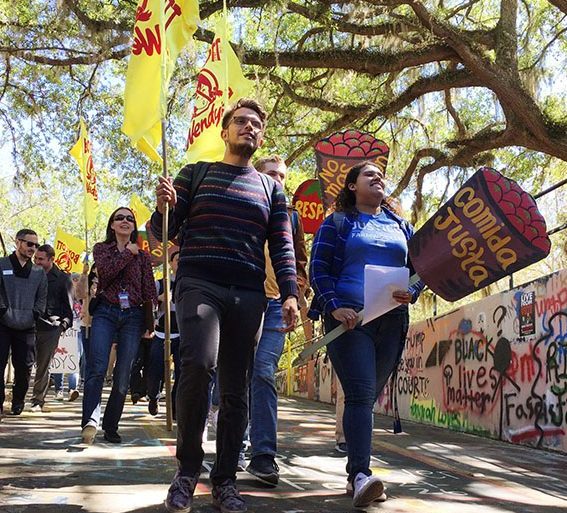
From the earliest – and we mean earliest – days of the Campaign for Fair Food in 2001, students from the University of Florida have stood with the CIW, hosting some of the most powerful, and creative, actions in the Taco Bell Boycott (which you can see for yourself from one of the stunning photos, here on the right, from a 2002 Gainesville protest replete with stilt walkers and fire dancers!). Florida “Gators” were among the founders of the Student/Farmworker Alliance (SFA) nearly twenty years ago. Today SFA has become a national force from coast to coast in the fight for Fair Food – and, of course, is the driving force behind the Boot the Braids Campaign to have Universities disassociate themselves from Wendy’s, the only major fast food chain not to support Fair Food!
With not one, but two Wendy’s on campus, UF students launched their campus-wide Boot the Braids Campaign five years ago, organizing colorful action after colorful action across the school’s sun-filled campus and marching to the Reitz Union, where the main Wendy’s is nestled in the school’s food court. 

Yet despite the strong and growing protest movement on campus, the President’s office has not once in five years agreed to sit down with students to hear their urgent concerns about Wendy’s unconscionable behavior. 

This year, the 4 for Fair Food Tour will be bringing the full force of the Fair Food movement to UF’s doorstep: farmworkers and their families from Immokalee on the official cross-country tour, fresh off of visits to Chapel Hill, Columbus, and Ann Arbor; caravans from cities across the south; and more farmworkers and their families from Immokalee, who will be taking advantage of spring break that week to bring their children and youth to the finale of the 4 for Fair Food Tour!

When:  March 14th, 12:30 PM
Where: Norman Field, 1200 SW 8th Ave, Gainesville, Florida
Contact:  Uriel Perez, uriel@allianceforfairfood.org

What could explain the University of Florida’s resistance to the Presidential Award-winning Fair Food Program? The dark history of the UF agricultural program and farmworkers’ human rights…

The fact that UF has managed to ignore the well-documented exploitation and abuse of farmworkers for generations may have an explanation. Perhaps the most widely-recognized and influential department at the University of Florida is the Institute of Food and Agricultural Sciences (IFAS), a research and teaching institution that is intimately connected to Florida agriculture, providing cutting-edge research, resources, and freshly-trained leaders for the industry...
Coalition of Immokalee Workers
Connect with us