Sunday, May 26, 2019

As The Classic Film "Casablanca" Turns 75 (2017)-A Look Back

As The Classic Film "Casablanca" Turns 75 (2017)-A Look Back

Comment by Sam Lowell 

As the person who did the piece on NPR noted at the end of her piece on the making of Casablanca-even after 75 years the romance of the film and the story line still grabs one attention.


http://www.wbur.org/npr/515372794/after-75-years-heres-looking-at-you-casablanca


Here's a recent comment by Seth Garth in honor of the occasion:
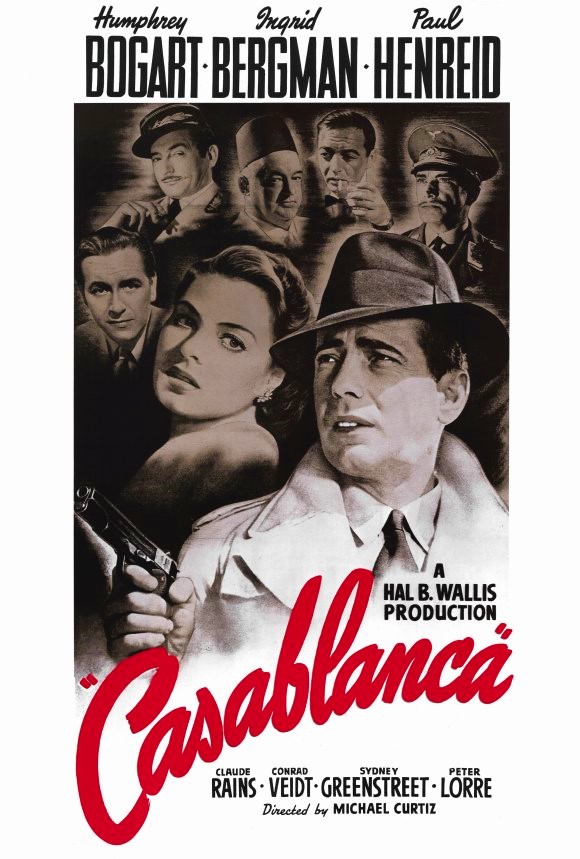

Memories Of Rick-With Humphrey Bogart and Ingrid Bergman’s “Casablanca” In Mind


By Seth Garth

[Before he passed away in the late 1980s the long time French police officer, Commandant Louis Renault (everybody, everybody but the bad guys who crossed his path and there were plenty and not all of them Germans, called him “Louie” for his mild-mannered easy style when he was not in hot pursuit of some nefarious types)who had worked both in colonial Algeria and French Morocco before heading back home to work with the National Police in his hometown of Lyon, liked to sit in the Café Algiers there and reminisce about all his adventures as a cop. When asked about the most memorable person, friend or foe, he had been up against in his times he would without much hesitation blurt out the name of Rick Blaine.

Rick of Rick’s Café in Casablanca when Louie had worked in French Morocco early in World War II after the fall of the French Republic and the rise of the Vichy government which controlled that colony then. He as a police officer noted the changing of the guard and went about his business as usual-regimes come and go he had always said but the cops are forever. After investigation of Rick’s past, most of the early part as a tough guy out of Hell’s Kitchen in New York City a place where Rick would make people laugh when he said even the mighty Germans would think twice about occupying and had included some troubling adventurous activity for the “wrong” side in Ethiopia and Spain during the 1930s, he, after having had his palm “greased” issued the liquor and nightclub license for Rick to keep his Cafe Americian open under his prefecture.
For most of the time he knew Rick in Casablanca they had had a good working relationship. Rick would let him “win” at the roulette wheel as his pay-off for letting illegal gambling go on in full sight, “comp” him for drinks and dope, mostly hashish, and let him have his women “rejects” on the rebound. Then she came in, came in as Rick said one drunken night when she had her claws in him bad again “of all the gin joints in all the world she had to show up at his door.” From then on things got interesting, very interesting. The following is a translation by Jean Marais of what Louie had to say when he was asked by a National Police archivist for details of his relationship with one Rick Blaine (1920-1982)-SG]             

“That Rick Blaine was a piece of work, one of the last of the pre-war, pre-World War II if anybody is asking which war we are talking about, romantics tilting his lance at the windmills in the name of love-or the thrill of adventure, maybe even the thrill of tweaking somebody’s nose just for the hell of it, Louie Renault was reminiscing out loud to those who were attending his retirement party. Retirement from the National Police, [the French coppers although they are not national cops like the FBI in America but just like city and town cops there run through the central government], the guys who keep order in places like Paris and Lyon (since it was a governmental pension he was about to receive after much haggling his service during Vichy times first in Algiers and then in French-controlled Morocco, in Casablanca, was included as well as his Lyon assignments). He had been asked a question by one of the younger policer officers about what was his most memorable episode in a long and illustrious career. Of course Louie had to go back to those early war days when he ran the operation for Vichy in godforsaken Casablanca to find some events, some characters who could qualify for what that young officer was asking about. Had to go back to Rick Blaine without question.             

“Yes, Rick was the real thing, I wasn’t kidding when I mentioned his name,” Louie blurted out when the officer did not comprehend why a guy whom he had on other occasions called nothing but a saloon keeper, a guy out for himself whatever checkered past he might have had rated so high. “Let me fill you and see if I am not right about this whole matter.” He would say out of earshot that even De Gaulle would gladly take a back seat after hearing this story since he was safely in London being a pain in the ass to the British and American while “little guys” like Rick and a guy who looked pretty big even by De Gaulle standards Victor Lazlo were mercilessly tweaking the German’s tail.        

“Once the Germans marched into Paris they controlled the whole political situation but since they couldn’t handle a total occupation of France and wreak havoc on the rest of Europe at the same time they left part of the country to the French military, to General Petain who worked out of Vichy, the place where the specialized water comes from. Yeah, collaborators, liked they used to try to hang on me before Rick came to Casablanca, Lazlo too, and got everybody well. I had been in Algiers during that time but once the new political reality hit I was assigned to run the police operations in bloody Casablanca-a backwater where every odd-ball thing could and did happen as well as plenty of illegal stuff from dope to women to smuggling. Just my cup of tea. I figured that I could make more graft there in the Casbah than staying in Algiers once the British and Americans got serious about dislodging the Germans from Northern Africa.   

“No sooner had I landed in Casablanca then I spied Rick’s place, Rick’s Café Americian he called it, a place where there was plenty of booze, women, gambling, dope and whatever else you wanted. Or wanted done-life was cheap there-dirt cheap. The bloody Arabs could barely keep themselves busy except when some silly “blood honor” thing came up and we had to pick up the mess after the killings. Some he said, the other guy said stuff and then bang-bang. Had to arrest about fifteen people, family members from both sides and show them a little baton to the head just to let them know we meant business. Nobody ever faulted me on that score. I walked in and introduced myself to Rick without saying anything further. He looked at me with a twinkle in his eye he said later after all the smoke had cleared and we could be honest with each other, sized me up and down and knowing that I would do “business” after that appraisal said would the previous arrangement with the Prefect I was replacing be okay- a cut of the profits, a slice of the gambling [paid out by his “winning at roulette” with lucky red 22], my pick of women, free liquor and dope, and deep discounts on anything else I needed. Also told me of his dealings, his working relationships for dope, booze and Moslem women which it seemed some of the Europeans were crazy for although I was strictly for the low-rent French tarts who found Casablanca easy on their virtue, with Sydney Greenstreet, an émigré merchant of sorts from England over in the Casbah. I immediately issued the necessary licenses that each new Prefect was entitled to issue as was my prerogative. Done.

“This Rick was a hard guy to figure though the more I ran into him on the street or more regularly in his place either to grab some young woman, to grab my cut, to “win” at roulette, or just to have some high shelf bonded whiskey that I became very fond of. Somebody said, I think it was Frenchie the main bartender, that Rick had had some kind of an adventurous past, had run some guns to Ethiopia when they were trying to hold off the Italians when Mussolini was flexing his muscles and later fought with the International Brigades, with the Communists in Spain when Franco was working up to flexing his muscles. I had already known that past from the files the previous Prefect had left and from a couple of snitches I had run through Rick’s place but the “grease” from Rick’s deal said otherwise in my eyes.   When I first met him he was all business like I said, if you said green he said okay what shade, that kind of thing.

“Somebody said, maybe it was Frenchie again since I sat at the bar of the joint many a night to “enforce” the no gambling regulation and to drink a few high shelf scotches, that Rick had been unlucky in love and that was why when he, Rick,  had his choice of any girl he wanted, two if he was feeling frisky, would take them up to his office and apartment upstairs from the club, do whatever it was that they did, some wild stuff I heard from a couple of them that I caught on the “rebound” especially from one who took him “around the world” which she would later do with me and the next night would not know them. Tell them to sell their wares in the Casbah, a low thing to say to a European woman if you knew anything at all about what went on in the Casbah. I never went there personally but would sent for this Greenstreet to deliver me my graft and whatever dope I was looking for at the time. Like I said mainly hashish from the pipe. In the end it would be that lost love that had been bothering Rick once she came to town but early on you couldn’t tell what was eating at him. Just knew that he had a chip on his shoulder which would not fall off.

“Jesus, in those days there were all kinds of people as you can imagine trying to get out of Europe for one reason or another and once France and the countries around it fell to the Germans that was doubled up. Homeless, stateless Jews, who we all knew were being savaged by the Germans and by Vichy too, International Brigaders who couldn’t go back to their occupied homelands, local Communists who didn’t get or who couldn’t get underground, anybody out of the ordinary, we even had a couple of kids, rich kids who had left Hamburg once Hitler said that jazz was a Negro-Jew conspiracy and banned the music. If you looked at a map of Europe in say 1941 you would notice that there was not much wiggle room to work with in order to get out of some occupied spot. The road out though however they got there led to Casablanca no matter what the individual reason for leaving Europe was. The link. The air flights to Lisbon and from there anyplace but the old canard Europe.

“So you know that there was plenty of money to be made by those daring enough to act as smugglers to get these desperate people out one way or another. I could have made plenty if I had decided to use my position to get real greedy but I didn’t want to deal with a bunch of desperate people bothering me about why they weren’t getting out fast enough. Rick and the Casbah made me plenty-for a while. All the action either went through that guy Sidney Greenstreet who ran his operation out of the Casbah where he mainly handled small fry, people of no account but with money, or at Rick’s for the higher class clientele. Mostly the wealthier Jews and previously high placed officials of democratic governments who the Germans were desperate to find and make an example out off for their compatriots under occupation. Some seriously shady characters, art forgers, crazed jazz aficionados, con artists, three card monte hustlers, independent dope dealers-mainly heroin out of the Afghan fields working their way West to the cities, jack-rollers, rapists and assorted slugs, characters who even we had to keep an eye on to keep any kind of order plopped themselves there.          

“Things though were going fine until some horse’s asses, as it turned out guys we had on our radar but couldn’t quite nab, decided they would murder a couple of German couriers and grab a couple of letters of transit they were travelling with. Now these letters of transit were like gold-would make their possessor a pot of gold. Maybe two pots if they worked it right. These were no questions asked documents which only had to have names filled in order to catch a flight to Lisbon and from there wherever else they wanted to go. This weasel, well known to us from a couple of rip-off jobs he did on unsuspecting travelers, a guy named Peter Lorre was part of the gang who took the couriers down. One night he showed up at Rick’s the natural place to start looking for high-end buyers and we nailed him-took him in “custody” but he didn’t have the letters of transit on him. He hanged himself in his cell before we could get much more out of him. Rick had been as cool as a cucumber when this weasel, this sweaty little nobody showed his ugly face there. This Lorre begged Rick to hide him. Rick just blew him off, told him to get lost. A couple of customers made noises when we grabbed and manhandled Lorre saying they wouldn’t patronize Rick’s again because of his attitude in the matter. Rick told them something that impressed me at the time-he wasn’t sticking his neck out for anybody. Those customers by the way were back the next night when I let Rick reopen the place and he sent them over a couple of drinks. They were his best buddies then.   

“That courier murder business though would lay us all low. See the Germans had sent over this hard-ass major, Major Veidt (sic) I think his name was if I remember the name correctly, to look into the matter. I was trying to impress him so he would put in a good word for me with Vichy. That was the whole idea behind making a big deal out of the Lorre arrest (and I was happy when he hung himself because he would have not stood up well under German methods and he might have spilled who knows what about what was going on in Casablanca at the time). That made Rick’s gesture at the time this guy Lorre begged him to save him from my men even more important. Rick just looked the other way and Lorre was a goner. We never did get the other guys in with Lorre when we rounded up, our what did we call them, oh yes,  “usual suspects”, Communists and con men and a few whores who we regularly rounded up to fill the jails full and make it look like we were doing our jobs. Some wound up out in a desert graveyard once we were done with them.                                                                                                                                             

“Like I said in those days all kinds of people were coming through town. One of them a guy I mentioned before and said I would speak of again named Victor Lazlo had escaped from a German concentration camp and somehow he had worked his way through whatever network he had in Europe to Casablanca. This Lazlo was well-known as a leader of the resistance to the German occupations of half of Europe so a guy whom the Germans, especially this Major Veidt, were foaming at the mouth to get their hands on. But as long as he didn’t do anything illegal I had no reason to arrest him. I had half-figured when I heard he was in town to see who the highest bidder, strictly cash, was for his hide and take my cut that way. 

“But here is where things got interesting. This Lazlo, a good-looking guy with good manners and a good tipper according to Frenchie, was not travelling alone. He had this beautiful woman with him, one of the most beautiful I have ever seen then or now, Ilsa something, I am not sure we ever knew her last name and it didn’t matter with a beauty like that. When she showed up our Rick went crazy, went crazy like a loon. See he had come to Casablanca just ahead of the German armies advancing on Paris with this black guy who was an entertainer, a singer and piano player named Sam and a sour look on his face. He had “known” Ilsa in Paris, had been her fancy man from what I could tell. They were supposed to blow town together and meet at the train station one evening on the last train out of Paris before the Germans stopped the trains. She was a “no show.” She was in living color the reason that Rick had been so indifferent to everything. Why he turned over perfectly good women to me without batting an eyelash.            

“Of course the minute she showed up the old flames were re-kindled-for both of them. She had spied Sam at the piano through the heavily smoke-filled room, had forced him to play “their” song, If I Didn’t Care I think and when Rick heard that he went ballistic, was ready to come to blows with Sam since Sam had been ordered never to play the song. Then he spotted her across the piano and he melted down like an ice cube. It seems that in Paris she had assumed her husband, this Lazlo was dead, had been killed by the Germans. False report. That last day in Paris she found out through some underground source that Lazlo was still alive and she had gone to him. Leaving Rick standing in the rain at the fucking train station. Naturally all of this stuff I learned later but that “left standing in the rain” is what drove Rick to get up on his high horse and create nothing but trouble for me and my men once she came into view.  

“That long gone Lorre had given Rick the letters of transit to keep for him the night Rick looked the other way when we grabbed the weasel and made him squeal or whatever weasels do when they are caught. When with Rick’s help he fell down, wound up at the end of his checkered tie, Rick figured that he would use the letters to get himself out of hellhole Casablanca. He said that even Hell’s Kitchen in New York where he had grown up (and had “advised” the Germans to think twice about trying to occupy if you recall) was less dangerous than Casablanca so you get an idea how bad things were-how cheap life was on in the desert. Worse than the bloody wogs the British were always moaning about in the Raj, in India. He wasn’t going alone though. She, Ilsa, was going with him. She had snuck up into his apartment one night when Lazlo was out doing his organizing of the local resistance. As a result of that outlawed meeting I had Lazlo picked up when he surfaced, you couldn’t have such meetings and I knew that German major would be happy to hear that I had the great Victor Lazlo locked up like a caged animal.

“Whatever Rick and Ilsa did and from what Frenchie said Oscar the head waiter told him they had definitely gone under the sheets from his disheveled look and the blush on her face when Rick told Oscar to escort her home they were blowing town together. When Oscar told me that story a few days later I wondered about what had happened. What had made sour Rick decide to blow a good thing in Casablanca (my good thing too don’t forget). No question Ilsa was a beauty, an exceptional beauty but after the way she had left him high and dry in Paris I figured maybe a quick roll in the hay and then off alone. But you never know about beautiful women, sometimes they can be just as kinky as any whore or any low-rent tart. She didn’t look that way but maybe with a few drinks and an agenda of her own-like getting Lazlo out- alone- she took him around the world like that ex-flame Lisette had.      

“Somehow and I never could get him to tell me exactly what happened he had had an epiphany after that night some kind of turnaround. All he would say back then was the way the world was just then the troubles of three people, him, Ilsa and Lazlo weren’t worth a hill of beans compared what was going on. But whatever the source from then on he was on fire, was maybe thinking back to that old fight in Spain, thought about some payback for lost comrades, maybe what would happen if the Germans won, maybe he just didn’t like that Major Veidt and his arrogant ways closing up his café when the high rollers were coming in for their weekend beatings.

“So he gave Ilsa one story about how they should meet at the airport and blow town. She was all over that idea and had dropped any mention of Lazlo. He told me another. Talked me into a deal that when I thought about it later I should have figured was bullshit from minute number one. Confessed to me that he had the letters. Was blowing town with Ilsa and that was that. He said -let’s do this though. Let Lazlo out, let him get to the airport with the letters and grab him as an accessory for the courier murders. A feather in my cap was all I could think of. Would get that fucking Major Veidt off my back about picking up Lazlo and showing him the desert sights. When the deal went down though Rick was faking the whole thing. Maybe not about wanting to flee with Ilsa but about his attitude toward Lazlo. He had convinced me of his plan but when the deal went down I was the fall guy, well, one of the fall guys. That German major took the big fall when he tried to stop the plane to Lisbon as Lazlo and Ilsa got on the plane. Rick took him down without a murmur in one clean shot making me wonder how the Loyalists lost in Spain with a guy like that working with them.
         
“Needless to say when I was caught in a bind I stepped away from danger by refusing to arrest Rick. I went into the usual dodge-round up the usual suspects, double it up this time since a goddam German major was under the ground. I resolved the bind I was in pretty simply. I figured my days in Morocco were finished and so I saw the writing on the wall. I walked away with Rick (an action that I was successfully able to use in order to have my service time there count toward my retirement which I had many hassles over before I won). We made our way to Brazzaville with the dough Rick grabbed from Greenstreet when Rick sold him his interest in the café. I stayed there grabbing my graft until the end of the war and had worked various grifts with Rick until he went back to Europe a few months later where he joined up with the French Resistance, worked with Samuel Beckett the exiled Irish playwright who was deeply into the organization from what I heard later. I heard from him a few times over the years before he passed away a few years ago. I guess Casablanca was in his blood because after the war he ran the Café Casablanca in New York City for some thirty years before he gave it up to retire. But what a guy that Rick was, giving up that luscious piece for unsung glory underground in France. Making that big gesture for love. Yeah, the last of the pre-war romantics.


 [A1]

 [


"Our Side of Town" – A Red House Records 25th Anniversary Collection”- A CD Review

"Our Side of Town" – A Red House Records 25th Anniversary Collection”- A CD Review


CD Review

“Our Side of Town – A Red House Records 25th Anniversary Collection”
Various Artists, Red House Records, 2008


I have, except as the occasion called for it as in the case of Sun Records or Chess Records, not spent much time discussing the various ups and downs of particular record labels and their attempts to corner a piece of the music market. There is certainly history there, sometimes very interesting history as in the cases of those labels mentioned above, but I leave that for others to toil over. I prefer to concentrate on various musical influences that flow through the folk world, except that here one can not avoid, or should not avoid, paying some respect to the Red House Record label that has been a mainstay of post-1960s folk revival folk music and artists.

Frankly, I know Red House mainly as the long time vehicle for one of the artists performing on this anniversary CD, Greg Brown. And also for a few late efforts by Rosalie Sorrels, especially her tribute to Utah Phillips last year. Of course, those two names tell you much about what this label is about and about the musical traditions of not just the past 25 years of folk and folk rock but the last half century.

This label has also been the launching pad for some lesser known names like Jimmy LaFave, Lucy Kaplansky, Eliza Gilkyson, and the Wailin’ Jenny’s. What you have here, my friends, are tributes by the performers who have struggled, and sometimes struggled in lonely spots, to keep the folk genre part of the great American songbook. So match up the performers and the label and you have quite a piece of history and a primer of the latter-day folk scene. Listen up.

Washington Tightens Vise Defend the Cuban Revolution!

Workers Vanguard No. 1155
17 May 2019
 
Washington Tightens Vise
Defend the Cuban Revolution!
Last month, the White House levied a series of punitive measures designed to starve the Cuban workers state into submission: hardening economic sanctions, cracking down on tourist travel and capping remittances from relatives abroad. The Trump administration is reversing Barack Obama’s modest “Cuban thaw.” Obama had normalized diplomatic relations and eased some trade restrictions while keeping intact the decades-long embargo, which continues to strangle workers and peasants on the island. It is crucially necessary for the working class in the U.S. to defend Cuba, oppose all imperialist sanctions and demand an end to the embargo, an act of economic warfare. Cuba should have every right to trade with whatever countries it chooses.
The Cuban Revolution laid the basis for the overthrow of capitalism in 1960-61, and since then the U.S. ruling class as a whole has relentlessly sought to restore capitalist slavery and imperialist domination there. Both Democratic and Republican administrations have combined their economic blackmail with everything from terror attacks and assassination attempts to military invasion, namely the CIA-organized 1961 Bay of Pigs, ordered by John F. Kennedy.
Before a crowd of gusano Bay of Pigs veterans in April, Trump’s national security advisor, John Bolton, pledged gunboat diplomacy in U.S. imperialism’s “backyard,” gloating that the 19th century Monroe Doctrine, which designated the Americas as the sole dominion of the U.S., “is alive and well.” The Obama administration was a tad more subtle in how it packaged the same counterrevolutionary goal, seeking to develop a class of entrepreneurs and flood the island with cheap imports, as well as to further bolster pro-imperialist “dissidents” from within. Meanwhile, he kept open the U.S. military’s torture center in Guantánamo Bay, which has long served as a staging ground for provocations against Cuba. We say: U.S. out of Guantánamo now!
The Trump administration presented the new measures as a way to strong-arm Cuba into severing ties with Venezuela, its major trading partner. Cuban president Miguel Díaz-Canel has been accused of “controlling” Venezuelan president Nicolás Maduro, whom the U.S. political establishment wants to depose. Deeming both countries part of the so-called “troika of tyranny” (along with Nicaragua), Bolton demanded that Cuba remove the 20,000 soldiers that it supposedly has in Venezuela. In response, a Cuban official dubbed Bolton a “pathological liar,” remarking that there are no such troops or security forces and that “we can’t withdraw something that does not exist.” Rather, tens of thousands of Cuban doctors and teachers remain in Venezuela as part of an agreement, implemented by the Hugo Chávez government in 2003, to provide subsidized oil to Cuba in exchange for medical and educational services.
Unlike Venezuela, which is a capitalist state where the bourgeoisie is fully intact as a class, Cuba is a deformed workers state where property is collectivized but a nationalist bureaucratic caste, not the workers, holds political power. When Fidel Castro’s peasant-based rebel forces marched into Havana in 1959, the army and the rest of the capitalist state apparatus that had propped up the U.S.-backed Batista dictatorship collapsed. In the face of imperialist aggression, the new Cuban government began a series of nationalizations in 1960. By the time Castro declared the country “socialist” the next year, the Cuban bourgeoisie and the U.S. imperialists had been expelled and private property expropriated.
Nonetheless, Cuba was never socialist. Socialism is a global, classless, egalitarian society based on material abundance, in which economic productivity is at the highest level. From the outset, the Cuban bureaucracy politically suppressed the working class and opposed the perspective of international socialist revolution. The fact that a petty-bourgeois guerrilla movement could smash capitalist property relations was due to historically exceptional circumstances: the absence of the working class as a contender for power, hostile imperialist encirclement, the flight of the national bourgeoisie and a lifeline thrown by the Soviet Union, which supported Cuba with billions in annual aid and provided a vital military shield against the U.S. Decisively, there was no authoritative revolutionary Marxist party to intervene into the political development of the Cuban Revolution and put it on the path of workers democracy.
Though Cuba remains underdeveloped and beset by scarcity, not least due to the crippling effect of the U.S. blockade, its social revolution led to enormous gains for the working masses, particularly women and blacks. With Soviet aid, a centralized, planned economy was built, guaranteeing jobs, housing, food and education. To this day, Cuba’s health care system remains far superior to its capitalist Caribbean neighbors.
As Trotskyists, we stand for the unconditional military defense of Cuba against capitalist counterrevolution and imperialism. At the same time, we oppose the rule of the privileged Stalinist bureaucratic caste, which has always promoted the fallacy of building “socialism” in a single country, in this case a resource-poor island 90 miles from U.S. imperialism’s shores. We stand for proletarian political revolution to oust the Castroite bureaucracy and institute a regime committed to the fight for world socialism.
Cuba’s stagnant economy has never fully recovered from the severe crisis following the 1991-92 counterrevolutionary destruction of the Soviet degenerated workers state, even with the relief provided by the subsidized oil from Caracas. During the last couple decades, the Cuban government has been promoting “market reforms” like small-scale private enterprise, though at times it has pulled back from them. While these measures by themselves do not constitute the restoration of capitalism, they have significantly increased social inequality. Under Stalinist rule, such schemes are the only available “answer” to bureaucratic mismanagement and commandism. As against both bureaucratic centralism and Stalinist “market reforms,” we are for centralized planning under democratic organs of workers rule, which would determine the direction and operation of the economy.
Nationalized industry remains overwhelmingly dominant on the island. At the same time, the Cuban regime has opened up the economy to imperialist capital penetration from West Europe and Canada in the form of joint ventures with state-owned companies and enacted trade deals with Venezuela and the Chinese deformed workers state. Imperialist economic penetration comes with risks to the socialized economy, underlining the need to maintain a strict state monopoly of foreign trade.
Today, as Cuba struggles with low world prices for nickel and sugar—its only substantial exports—stagnant food production and widespread shortages, the White House is putting pressure on its foreign investors to cease any involvement in Cuban enterprises and projects. Trump has activated the Title III provision of the 1996 Helms-Burton Act, signed into law by Bill Clinton, which grants the former owners (and heirs) of nationalized property the right to sue for compensation in U.S. courts. The measure, waived by every previous administration, promises to open the floodgates to potentially hundreds of thousands of lawsuits against international firms with operations in Cuba. Already, dozens of corporate sharks, including Texaco, Coca-Cola, and IBM, are salivating over their claims amounting to billions of dollars.
Some in Washington view a belligerent policy toward Cuba as outmoded and counterproductive to U.S. imperialist interests. In a 3 May Foreign Policy article, Rebecca Bill Chavez, a former Defense Department official under Obama, argues that Trump’s sanctions will harm American commercial ventures and Cuba’s “emerging private sector.” Her main concern is that the Cuban government will be driven into the arms of China and Russia: “If the U.S. goal is a democratic transition in Cuba, it should not deliberately create the conditions for the country to fall under the sway of the United States’ two most powerful strategic competitors.” Whatever cynical catchphrase they employ—“democratic transition,” “human rights,” etc.—the American rulers are committed to turning Cuba into a neocolony for untrammeled capitalist exploitation.
The isolated Cuban deformed workers state will not be able to endure forever the vast economic and military pressures exerted by the U.S. and the capitalist world market. For Cuba to not only survive but thrive requires workers revolution throughout the rest of the Caribbean and Latin America and not least in the U.S. imperialist bastion. The Stalinist misrulers have always opposed the fight for workers revolutions elsewhere and instead fostered deadly illusions in “progressive” bourgeois rulers—e.g., Salvador Allende’s Chilean popular front in the early 1970s and Venezuela under both Chávez and Maduro.
The Spartacist League is dedicated to forging a revolutionary workers party as the necessary leadership in the fight for proletarian rule in the U.S. The multiracial working class, in liberating itself from capitalist wage slavery and bringing down the imperialist beast, will come to the aid of its international class brothers and sisters, including the courageous working people of Cuba.

Poets' Corner- On Memorial Day For Peace-War And Remembrance

Poets' Corner- On Memorial Day For Peace-War And Remembrance 

Not all war poetry can stand the test of literary greatness or longevity but it is almost all very poignant and to the point


Poets' Corner- On Memorial Day For Peace-War And Remembrance

Poets' Corner- On Memorial Day For Peace-War And Remembrance 


Not all war poetry can stand the test of literary greatness or longevity but it is almost all very poignant and to the point


Riverdale Blues-For Allen Ginsburg On The 60th Anniversary Of “Howl” (1956)

Riverdale Blues-For Allen Ginsburg On The 60th Anniversary Of “Howl” (1956)


By Lance Lawrence

A sad-eyed dope hung around the back of the old-fashioned framed schoolhouse lazily drawing the summer breeze (he lied since the school had only recently been constructed in the big post World II baby boom and he had gone to school here since the place opened-he lied for the sake of lying,  lying to himself mostly especially about his sexual longing just then as he hoped to get some chick who was hanging out by the bushes to give him a hand job, give him one like Lucinda had given him that time at the movies when sitting up in the balcony she had unzipped his pants and let her hand move so fast he jerked off after about a minute he was so excited and she only twelve imagine what she will be like when she gives it all up but fat chance he would have to grab that piece since his quick spurt, his sperm, his cum,  had gotten all over her dress and she was pissed off at him when it dried and got all crusty on the way home so some other guy would grab her cherry-that  was only a matter of time), wished he could get “washed clean,” washed clean real clean which is what the guys around school called it when their Lucindas moved their hands fast, get his sperm count down, his hot flash temperature, whatever that was.
Cock sore, cock was what the guys called their hanging things, their pulsating penises, so he followed although he got flushed when some guy maybe Billy, Billy Bradley the guy who always seemed to be the first guy with the sex knowledge, first said the word and he had asked what that was-damn. Cock and cocksuckers, waiting on his corner boy, waiting on Billy, waiting on his secret comrade in arms the hazy night as he looked around over heaven’s nightshade (and the guy who would probably be the first to get into Lucinda’s panties since she had already given him her fast hand action and according to Billy something more although Billy wouldn’t  specify but at least that action which is why he had, on Billy’s solemn advise taken Lucinda to the movies in the first place, had asked if she wanted to go to the balcony and when she said yes he knew he was going to get his clock cleaned-he just wished he hadn’t gotten off so fast with Lucinda since Billy’s older brother, Max, had given them a vivid description of what was what when you got a girl all wet and then stuck your stick in her and listened to her moan, moan like humankind had been doing for a million years, and he sure could have put his stick wherever she wanted it-probably laugh at him if he got off too fast-again).
Billy at first nowhere to be found, nowhere to be found that is if he did not want to be found and then the next thing you knew Billy, secret comrade in arms, came sauntering, his style just then before puberty would turn his feet around and he would thereafter walk like some Western movie cowboy would now sing his life-song, what did the poet, the old Solomonic poet call to the high heaven’s, oh yes, plainsong for a candid world, a world before massive bombings, massive unacknowledged deaths for shady ladies and other figment s of his imagination. Come sauntering in the bejesus night looking both ways to see some straggling ungainly girls, some young Lucinda who knew the score, knew if they had hung around that back of the school just then that they had heard about Lucinda, had maybe asked their older sisters or brothers what a hand job was and how to do that. They were eager if they were hanging in the shadows and the dope was hoping that some innocent would get moved by the Billy plainsong (he would learn later that plainsong was more religious that any old rock song even big bop doo wop song but by then rock and roll was his religion anyway) hovering around the fence waiting for something, anything to happen and then a word, a sullen word came off his tongue and the night’s work had begun, maybe a generation was on its way to immortality, was ready to break out of the quiet of the 1950s night without shame and without confession.
Tripping over “she’s so fine, so fine, wish she were mine doo lang doo lang” or the corner boys, the male version of He’s So Fine by the Chiffons, the big bopping song of 1956, the guys, including the dope, backing Billy up in the doo wop frenzy that had swept tween and teen just then and the scent of the jasmine coming from the girl-shadows by the harbor, the marsh’s fetid mephitic smell giving way to the night’s splendor, maybe stolen perfumes from mother’s dresser or some girlish bath-soap all fresh and dewy. Doo lang, doo lang  along with Eddie, Jason, Frank and beloved Peter Paul slapping time and those wanderlust girls along the fences came drifting to the scent of Old Spice that the boys had splashed on father’s bureau, father’s time, father’s sweat but not to  be thought of in the hazy summer night. And as the moon hovered against the sun the girls got closer and closer, one Lucinda’s younger sister, Laura, all the sisters in that family playing off mother Lottie having “L” –encrusted first letter names,  aimed his way and he waved her over to head toward old dead sailors’ graveyard down the far corner of the school lot (oh what those sailors could have told those young bucks from their rotted graves and pock-marked burial stones about hand jobs and blow jobs too when the ante was up about what a girl had to come across with-and if out to sea some young sailor boy plaything but that latter knowledge would not click until later).  A few minutes later the dope came back out of the sailor shadows looking like the king of the hill and Laura wiping her hand with a handkerchief with a faint smile (they had already agreed to meet that next night down at that sailors’ last rest, down among the mortal stone forsaking the last ship out  and by-past the foreplay plainsong-the young learn fast so maybe those sailors would have been stating the obvious when the poured forth in their dank, damp waterfront taverns about blow jobs and hand jobs). 
But hell all that was coming of age, coming of age in a time when things were moving too fast even for quick learners and the corner boys got further and further along in their primitive sex lessons and no more stupid thoughts of red scares, Uncle Joe’s scourge in Moscow town, and Cold War down in the basement hide your ass under some oaken desk and somebody said that was real, that was okay but that scent lingered against the jimson in the jeans from Satan’s tower, look homeward, look homeward angels. Ecstasy-pure ecstasy in the hazy night of some youthful dream. 
Billy would declare (and the dope would secretly agree and write every word down to be passed around later like some latter day glad tiding-like some Mount Sinai-filched grainy stone tablet) that they were in a spin, the world was changing and although he had no empirical evidence, when did the king of the hill need hard-boiled evidence going back to Adam’s time, facts,  he had heard from his oldest brother who already had graduated from high school that not only was the music changing, not only were people, and not just kids, starting to laugh at the idea that going down some rat hole of a basement and hiding under some rotten oaken desk when the big one came [the bomb] would do anybody any good. Started to challenge everything from the whole idea of the red scare night, the whole idea that everybody needed to live their ticky-tacky lives in dread of the reds, having a big ass finned gas-eating car and not “keeping up with the Jones.” Especially day to day the latter.
Billy didn’t get most of what that oldest brother said (and neither did the dope who dutifully wrote it all down anyway which he had “contracted” with his secret comrade Billy to do, to act as scribe which became his nickname at first resented as part of the price of Billy letting a dope hang around with him and his boys and through that circumstance to get to the girls already mentioned above) but he did get that the way things were couldn’t be the future, couldn’t be the way they would have to operate in the world. Couldn’t be the down at the heel existence that he, his family and all the poor bedraggled families that resided in the Five Points “wrong side of the tracks” neighborhood. His oldest brother, Jack to give him a name, the guy telling him all this stuff with the idea of making him wise to the world he was about to face in the not too distant future, had been something of the family rebel.
Jack was always heading to Harvard Square even in high school which was no mean task by bus and later by car when he came of age for a driver’s license, since that place was about forty miles from Riverdale to soak up whatever rebellion was going down (that family rebel designation would fall on Billy later in a very different way when it came his turn to figure out the freaking world and after a short attempt at a break-out rock and roll musical career turned to armed robberies and such eventually getting killed in a shoot- out with cops down in North Carolina trying to all doped up rob a White Hen convenience store). Jack was always talking about “beat” this, “beat” that, some kind of fraternity of rebels who wanted to turn the world upside down (and it was mostly a fraternity the women were mainly around for decoration and whatever sex they wanted to provide). Or maybe better resign from the “square” world and find a little breathing space to do their thing-to write, drink, travel, do dope, have sex but mostly to write for a candid world, a world where the rules didn’t make sense-no way.      
One night when Jack was home for minute during summer semester break from college-he went on a scholarship, how else would the family get the money to send the first in the family to go to college, to Boston University, Class of 1959- he decided to tell Billy and his boys in an excited manner his latest tale “what was what,” the expression all the guys used then to signify, well, they had an idea of what was what. Tell them what it was to be a “beat daddy” (not literally a daddy okay but Jack had had to make the distinction because you never knew when somebody in the neighborhood might be a daddy having knocked up some older Lucinda and had to head out of town or get hitched under the sign of the paternal shotgun). Said it was all summed up, everything that was pushing the world forward in a poem, a “beat” poem not like those rhyming simon poems Mister Riley, the old-time Jazz Age English teacher at Riverdale High  a would spout forth from some old Englishman’s pen, Alfred Lord Tennyson or Byron or Browning, guys like that, a guy named Ginsburg, Allen Ginsburg, a smart Jewish guy who was the chief propagandist for the beat-ness thing in a poem, Howl,  that was making the rounds in Harvard Square and would have its fair share of legal problems but that was later. (Jack was not exactly right about who had been the “real” max daddy of the beats-influence wise it was probably Jack Kerouac when he boiled the 1950s youth nation with his wild men travelogue On The Road, the immediate post-war whirlwind adventures of him and his buddy, Adonis personified Neal Cassady with Ginsburg playing a bit role in that one. But Ginsburg was right in the mix with that fucking long mad monk poem-Brother Jack’s exact words remembered by the Scribe-written down).              
Jack said that Ginsburg had had it right-had seen in the great American blue-pink western night stuff that would drive a guy crazy with what was happening to the world as the machine was getting the upper-hand. Ginsburg had had some kind of vision, one of the guys who hung around the Hayes-Bickford in Harvard claiming that it was dope, marijuana favored by the down-trodden cold fields braceros from old Mexico, or peyote buttons, the stuff favored by the Hopis and the “ghost dancers” out where the states are square that fueled the visions. Visions of an unkempt, unruly world where the philosopher-king was a guy named Carlo Solomon who had the whole thing down cold. Knew the West had been saturated, that there was nowhere else to go but the China seas and so he hammered home the idea that out in the Coast was where humankind had to make a last stand against the Molochs, against the fucking night-takers who have been with us forever. Only the righteous warrior-poets would enter the garden. That Hayes-Bickford clarion calling claimed Ginsburg was talking about the Garden of Eden before the Fall.   


The madness, the sheer madness making everybody from the hunger days of the 1930s and the rat rationing days of World War II hustle to the sound of steel and iron and not the freaking sound of waves slashing timidly to shore. Started ripping up words a minute not all complete phrases and without some kind of formal pacing sense, although if you heard the thing out loud it would have its own jazz-like cadence somebody who was at the recital in Frisco town had been quoted in a newspaper as saying, jazz cadence and stoned on dope or liquor was all you needed that same source ventured. Ginsburg was not hung up on form, like those old fart Englishman who were totally hung up on form almost as bad as those sonnet bastards Riley made the class memorize but talking about post-war modern minds beaten down by the sound of industry humming away talking about a meltdown, talking crazy stuff about angel hipsters (portraying a sentence of 1940s pre-beat daddies hanging around Times Square hustling and conning an unsuspecting world), talking about Negro streets which they all knew as “n----r streets” over in the Acre section of Boston, a place to stay away from, talking about taking on the monster in the mist Moloch mano y mano, talking about the new heroes of the American night all-American swordsman Jack and secret love that dare not speak its name crush on Adonis of the New Western night courtesy of Laramie Street in mile-high Denver Neal Cassady to be exact the new model of the  last cowboy standing. Neal some amazing cocksman to be envied and emulated screwing every honey who was not tied down to a chastity belt on farms, in the restrooms of diners and out in the back alley if the restroom was occupied. Damn. 

Ginsburg had actually been in the nut house in New York someplace, had dedicated the poem to some fellow inmate who was crazier that he was or dedicated to all the crazies, the looney bin Jack had called the place like the place all the guys in Riverdale did when they talked about where screwballs and goofs, even Kerouac’s holy goofs learned about later, should have landed, so he knew what deal was going down, knew that America had turned into a cesspool even if nobody else saw the drain coming. Jack had made Billy and the dope laugh when he told them the reason Ginsburg was in the looney bin was he had been sent there by some judge after he got into legal trouble, committed or was present at some unknown crime, an event which made the pair respect this Ginsburg more since cons in the old Riverdale neighborhood were looked up to with respect and admiration, to try to get rid of his faggot-ness, his homosexuality, his liking boys and not girls. (They laughed not because they knew that Jack hated fags and queers which he did and had put paid to that idea having gone down to Provincetown where all the fags and queers hung out all dressed up and all leering at anybody who came off the Provincetown boat from Boston with his own boys and raised hell with them-more than once. Beat a couple up who were eyeing him too closely and one in drag whom he thought was a girl until he got close enough to see some slight stubble on “her” face. Seems that Jack was giving Ginsburg a pass on his sexual preference just because he was a beat guy-Billy and the dope wouldn’t have given the fucker the time of day even if the guy was a prophet if he hadn’t been a con when they talked about it later since they shared Jack’s hatred of fags-and dykes like every red-blooded guy did then.)     

Jack knew what the unholy kid goofs were laughing about, about his seeing literary merit even if the guy was a faggot. The minute he said “faggot” he knew they would goof but he thought they should know what else the guy had to say. He told them a lot of good writers and poets were “light on their feet” and that was something you had to deal with if you wanted to read anything worth reading and let the faggot stuff slide, you don’t have to meet them in person anyway. So he told Billy and the dope to forget the stuff he said about Ginsburg’s queer as a three dollar bill situation and “dig” (that was the word Jack used) what he had to say to the world, to the young really. The stuff about machines devouring humankind and making the world crazier than it already was. That maybe the guys in mental hospitals like the ones who were his comrades at the time were the sane ones-that what they knew was too powerful to let them stay out on the mean streets for long. That the Molochs were in charge (“what the fuck is a Moloch,” Billy asked, interrupting, not comprehending what Jack was talking about as he droned on about stuff that seemed weird). Tried to tell the kids that this thing was Ginsburg plainsong, his way of putting in raw language his spiritual trip, his karma on the world. (the dope would run into Ginsburg later at an anti-war rally in New York City in his later incantation as a Buddhist so karma was the right word even though they were clueless about what it really meant in Buddhist traditions).


After about fifteen minutes Jack could see his audience’s eyes glazing over and so he stopped, stopped and told them that when they got his age they would be thinking about all the stuff Ginsburg laid out in that not-fit-for-public-school-classrooms poem. They laughed, snickered really and wondered what Lucinda and Laura were up to just then. The hell with Jack and his fucking homo poem.            

An Encore Presentation-The Big Sur Café- With The “King Of The Beats” Jean-bon Kerouac In Mind

An Encore Presentation-The Big Sur Café- With The “King Of The Beats” Jean-bon Kerouac In Mind  


From The Pen Of Zack James

Josh Breslin, as he drove in the pitch black night up California Highway 156 to connect with U.S. 101 and the San Francisco Airport back to Boston was thinking furious thought, fugitive thoughts about what had happened on this his umpteenth trip to California. Thoughts that would carry him to the  airport road and car rental return on arrival there and then after the swift airbus to his terminal the flight home to Logan and then up to his old hometown of Olde Saco to which he had recently returned. Returned after long years of what he called “shaking the dust of the old town” off his shoes like many a guy before him, and after too. But now along the road to the airport he had thought that it had been a long time since he had gotten up this early to head, well, to head anywhere.

He had in an excess of caution decided to leave at three o’clock in the morning from the hotel he had been staying at in downtown Monterrey near famous Cannery Row (romantically and literarily famous as a scene in some of John Steinbeck’s novels from the 1920s and 1930s, as a site of some of the stop-off 1950s “beat” stuff if for no other reason than the bus stopped there before you took a taxi to Big Sur or thumbed depending on your finances and as famed 1960s Pops musical locale where the likes of Jimi Hendrix and Janis Joplin rose to the cream on top although now just another tourist magnet complete with Steinbeck this and that for sullen shoppers and diners who found their way east of Eden) and head up to the airport in order to avoid the traffic jams that he had inevitably encountered on previous trips around farm country Gilroy (the garlic or onion capital of the world, maybe both, but you got that strong smell in any case), and high tech Silicon Valley where the workers are as wedded to their automobiles as any other place in America which he too would pass on the way up.

This excess of caution not a mere expression of an old man who is mired in a whole cycle of cautions from doctors to lawyers to ex-wives to current flame (Lana Malloy by name) since his flight was not to leave to fly Boston until about noon and even giving the most unusual hold-ups and delays in processings at the airport he would not need to arrive there to return his rented car until about ten. So getting up some seven hours plus early on a trip of about one hundred miles or so and normally without traffic snarls about a two hour drive did seem an excess of caution.

But something else was going on in Josh’s mind that pitch black night (complete with a period of dense fog about thirty miles up as he hit a seashore belt and the fog just rolled in without warnings) for he had had the opportunity to have avoided both getting up early and getting snarled in hideous California highway traffic by the expedient of heading to the airport the previous day and taken refuge in a motel that was within a short distance of the airport, maybe five miles when he checked on his loyalty program hotel site. Josh though had gone down to Monterey after a writers’ conference in San Francisco which had ended a couple of days before in order travel to Big Sur and some ancient memories there had stirred something in him that he did not want to leave the area until the last possible moment so he had decided to stay in Monterrey and leave early in the morning for the airport.

That scheduled departure plan set Josh then got an idea in his head, an idea that had driven him many times before when he had first gone out to California in the summer of love, 1967 version, that he would dash to San Francisco to see the Golden Gate Bridge as the sun came up and then head to the airport. He had to laugh, as he threw an aspirin down his throat and then some water to wash the tablet down in order to ward off a coming migraine headache that the trip, that this little trip to Big Sur that he had finished the day before, the first time in maybe forty years he had been there had him acting like a young wild kid again.        

Funny as well that only a few days before he had been tired, very tired a condition that came on him more often of late as one of the six billion “growing old sucks” symptoms of that process, after the conference. Now he was blazing trails again, at least in his mind. The conference on the fate of post-modern writing in the age of the Internet with the usual crowd of literary critics and other hangers-on in tow to drink the free liquor and eat the free food had been sponsored by a major publishing company, The Globe Group. He had written articles for The Blazing Sun when the original operation had started out as a shoestring alternative magazine in the Village in about 1968, had started out as an alternative to Time, Life, Newsweek, Look, an alternative to all the safe subscription magazines delivered to leafy suburban homes and available at urban newsstands for the nine to fivers of the old world for those who, by choice, had no home, leafy or otherwise, and no serious work history.

Or rather the audience pitched to had no fixed abode, since the brethren were living some vicarious existences out of a knapsack just like Josh and his friends whom he collected along the way had been doing when he joined Captain Crunch’s merry pranksters (small case to distinguish them from the more famous Ken Kesey mad monk Merry Pranksters written about in their time by Tom Wolfe and Hunter Thompson) the first time he came out and found himself on Russian Hill in Frisco town looking for dope and finding this giant old time yellow brick road converted school bus parked in a small park there and made himself at home, after they made him welcome (including providing some sweet baby James dope that he had been searching for since the minute he hit town).

Still the iterant, the travelling nation hippie itinerants of the time to draw a big distinction from the winos, drunks, hoboes, bums and tramps who populated the “jungle” camps along railroad tracks, arroyos, river beds and under bridges who had no use for magazines or newspapers except as pillows against a hard night’s sleep along a river or on those unfriendly chairs at the Greyhound bus station needed, wanted to know what was going on in other parts of “youth nation,” wanted to know what new madness was up, wanted to know where to get decent dope, and who was performing and where in the acid-rock etched night (groups like the Dead, the Doors, the Airplane leading the pack then).

That magazine had long ago turned the corner back to Time/Life/Look/Newsweek land but the publisher Mac McDowell who still sported mutton chop whiskers as he had in the old days although these days he has them trimmed by his stylist, Marcus, at a very steep price at his mansion up in Marin County always invited him out, and paid his expenses, whenever there was a conference about some facet of the 1960s that the younger “post-modernist”  writers in his stable (guys like Kenny Johnson the author of the best-seller Thrill  were asking about as material for future books about the heady times they had been too young, in some cases way to young to know about personally or even second-hand). So Mac would bring out wiry, wily old veterans like Josh to spice up what after all would be just another academic conference and to make Mac look like some kind of hipster rather than the balding “sell-out" that he had become (which Josh had mentioned in his conference presentation but which Mac just laughed at, laughed at just as long as he can keep that Marin mansion. Still Josh felt he provided some useful background stuff now that you can find lots of information about that 1960s “golden age” (Mac’s term not his) to whet your appetite on Wikipedia or more fruitfully by going on YouTube where almost all the music of the time and other ephemera can be watched with some benefit.

Despite Josh’s tiredness, and a bit of crankiness as well when the young kid writers wanted to neglect the political side, the Vietnam War side, the rebellion against parents side of what the 1960s had been about for the lowdown on the rock festival, summer of love, Golden Gate Park at sunset loaded with dope and lack of hubris side, he decided to take a few days to go down to see Big Sur once again. He figured who knew when he would get another chance and at the age of seventy-two the actuarial tables were calling his number, or wanted to. He would have preferred to have taken the trip down with Lana, a hometown woman, whom he had finally settled in with up in Olde Saco after three, count them, failed marriages, a parcel of kids most of whom turned out okay, plenty of college tuitions and child support after living in Watertown just outside of Boston for many years.

Lana a bit younger than he and not having been “washed clean” as Josh liked to express the matter in the hectic 1960s and not wanting to wait around a hotel room reading a book or walking around Frisco alone while he attended the conference had begged off on the trip, probably wisely although once he determined to go to Big Sur and told her where he was heading she got sort of wistful. She had just recently read with extreme interest about Big Sur through her reading of Jack Kerouac’s 1960s book of the same name and had asked Josh several times before that if they went to California on a vacation other than San Diego they would go there. The long and short of that conversation was a promise by Josh to take her the next time, if there was a next time (although he did not put the proposition in exactly those terms).            

Immediately after the conference Josh headed south along U.S. 101 toward Monterrey where he would stay and which would be his final destination that day since he would by then be tired and it would be nighttime coming early as the November days got shorter. He did not want to traverse the Pacific Coast Highway (California 1 for the natives) at night since he had forgotten his distance glasses, another one of those six billion reasons why getting old sucks. Had moreover not liked to do that trip along those hairpin turns which the section heading toward Big Sur entailed riding the guardrails even back in his youth since one time having been completely stoned on some high-grade Panama Red he had almost sent a Volkswagen bus over the top when he missed a second hairpin turn after traversing the first one successfully. So he would head to Monterrey and make the obligatory walk to Cannery Row for dinner and in order to channel John Steinbeck and the later “beats” who would stop there before heading to fallout Big Sur.

The next morning Josh left on the early side not being very hungry after an excellent fish dinner at Morley’s a place that had been nothing but a hash house diner in the old days where you could get serviceable food cheap because the place catered to the shore workers and sardine factory workers who made Cannery Row famous, or infamous, when it was a working Row. He had first gone there after reading about the place in something Jack Kerouac wrote and was surprised that the place actually existed, had liked the food and the prices and so had gone there a number of times when his merry pranksters and other road companions were making the obligatory Frisco-L.A. runs up and down the coast. These days Morley’s still had excellent food but perhaps you should bring a credit card with you to insure you can handle the payment and avoid “diving for pearls” as a dish-washer to pay off your debts.      

As Josh started up the engine of his rented Acura, starting up on some of the newer cars these days being a matter of stepping on the brake and then pushing a button where the key used to go in this keyless age, keyless maybe a metaphor of the age as well, he had had to ask the attendant at the airport how to start the thing since his own car was a keyed-up Toyota of ancient age, he began to think back to the old days when he would make this upcoming run almost blind-folded. That term maybe a metaphor for that age. He headed south to catch the Pacific Coast Highway north of Carmel and thought he would stop at Point Lobos, the place he had first encountered the serious beauty of the Pacific Coast rocks and ocean wave splash reminding him of back East in Olde Saco, although more spectacular. Also the place when he had first met Moonbeam Sadie.

He had had to laugh when he thought about that name and that woman since a lot of what the old days, the 1960s had been about were tied up with his relationship to that woman, the first absolutely chemically pure version of a “hippie chick” that he had encountered. At that time Josh had been on the Captain Crunch merry prankster yellow brick road bus for a month or so and a couple of days before they had started heading south from Frisco to Los Angeles to meet up with a couple of other yellow brick road buses where Captain Crunch knew some kindred. As they meandered down the Pacific Coast Highway they would stop at various places to take in the beauty of the ocean since several of the “passengers” had never seen the ocean or like Josh had never seen the Pacific in all its splendor.

In those days, unlike now when the park closes at dusk as Josh found out, you could park your vehicle overnight and take in the sunset and endlessly listen to the surf splashing up to rocky shorelines until you fell asleep. So when their bus pulled into the lot reserved for larger vehicles there were a couple of other clearly “freak” buses already there. One of them had Moonbeam as a “passenger” whom he would meet later that evening when all of “youth nation” in the park decided to have a dope- strewn party. Half of the reason for joining up on bus was for a way to travel, for a place to hang your hat but it was also the easiest way to get on the dope trail since somebody, usually more than one somebody was “holding.” And so that night they partied, partied hard. 

About ten o’clock Josh high as a kite from some primo hash saw a young woman, tall, sort of skinny (he would find out later she had not been so slim previously except the vagaries of the road food and a steady diet of “speed” had taken their toll), long, long brown hair, a straw hat on her head, a long “granny” dress and barefooted the very picture of what Time/Life/Look would have used as their female “hippie” poster child to titillate their middle-class audiences coming out of one of the buses. She had apparently just awoken, although that seemed impossible given the noise level from the collective sound systems and the surf, and was looking for some dope to level her off and headed straight to Josh.

Josh had at that time long hair tied in a ponytail, at least that night, a full beard, wearing a cowboy hat on his head, a leather jacket against the night’s cold, denim blue jeans and a pair of moccasins not far from what Time/Life/Look would have used as their male “hippie” poster child to titillate their middle-class audiences so Moonbeam’s heading Josh’s way was not so strange. Moreover Josh was holding a nice stash of hashish. Without saying a word Josh passed the hash pipe to Moonbeam and by that mere action started a “hippie” romance that would last for the next several months until Moonbeam decided she was not cut out for the road, couldn’t take the life, and headed back to Lima, Ohio to sort out her life.

But while they were on their “fling” Moonbeam taught “Cowboy Jim,” her new name for him, many things. Josh thought it was funny thinking back how wedded to the idea of changing their lives they were back then including taking new names, monikers, as if doing so would create the new world by osmosis or something. He would have several other monikers like the “Prince of Love,” the Be-Bop Kid (for his love of jazz and blues), and Sidewalk Slim (for always writing something in chalk wherever he had sidewalk space to do so) before he left the road a few years later and stayed steady with his journalism after that high, wide, wild life lost it allure as the high tide of the 1960s ebbed and people drifted back to their old ways. But Cowboy Jim was what she called Josh and he never minded her saying that.

See Moonbeam really was trying to seek the newer age, trying to find herself as they all were more or less, but also let her better nature come forth. And she did in almost every way from her serious study of Buddhism, her yoga (well before that was fashionable among the young), and her poetry writing. But most of all in the kind, gentle almost Quaker way that she dealt with people, on or off drugs, the way she treated her Cowboy. Josh had never had such a gentle lover, never had such a woman who not only tried to understand herself but to understand him. More than once after she left the bus (she had joined the Captain Crunch when the bus left Point Lobos a few days later now that she was Cowboy’s sweetheart) he had thought about heading to Lima and try to work something out but he was still seeking something out on the Coast that held him back until her memory faded a bit and he lost the thread of her).          

Yeah, Point Lobos held some ancient memories and that day the surf was up and Mother Nature was showing one and all who cared to watch just how relentless she could be against the defenseless rocks and shoreline. If he was to get to Big Sur though he could not dally since he did not want to be taking that hairpin stretch at night. So off he went. Nothing untoward happened on the road to Big Sur, naturally he had to stop at the Bixby Bridge to marvel at the vista but also at the man-made marvel of traversing that canyon below with this bridge in 1932. Josh though later that it was not exactly correct that nothing untoward happened on the road to Big Sur but that was not exactly true for he was white-knuckled driving for that several mile stretch where the road goes up mostly and there are many hairpin turns with no guardrail and the ocean is a long way down. He thought he really was becoming an old man in his driving so cautiously that he had veer off to the side of the road to let faster cars pass by. In the old days he would drive the freaking big ass yellow brick road school bus along that same path and think nothing of it except for a time after that Volkswagen almost mishap. Maybe he was dope-brave then but it was disconcerting to think how timid he had become.

Finally in Big Sur territory though nothing really untoward happen as he traversed those hairpin roads until they finally began to straighten out near Molera State Park and thereafter Pfeiffer Beach. Funny in the old days there had been no creek to ford at Molera but the river had done its work over forty years through drought and downpour so in order to get to the ocean about a mile’s walk away Josh had to take off his running shoes and socks to get across the thirty or forty feet of rocks and pebbles to the other side (and of course the same coming back a pain in the ass which he would have taken in stride back then when he shoe of the day was the sandal easily slipped off and on) but well worth the effort even if annoying since the majestic beauty of that rock-strewn beach was breath-taking a much used word and mostly inappropriate but not this day. Maybe global warming or maybe just the relentless crush of the seas on a timid waiting shoreline but most of the beach was un-walkable across the mountain of stones piled up and so he took the cliff trail part of the way before heading back the mile to his car in the parking lot to get to Pfeiffer Beach before too much longer. 

Pfeiffer Beach is another one of those natural beauties that you have to do some work to get, almost as much work as getting to Todo El Mundo further up the road when he and his corner boys from Olde Saco had stayed for a month after they had come out to join him on the bus once he informed them that they needed to get to the West fast because all the world was changing out there. This work entailed not walking to the beach but by navigating a big car down the narrow one lane rutted dirt road two miles to the bottom of the canyon and the parking lot since now the place had been turned into a park site as well. The road was a white-knuckles experience although not as bad as the hairpins on the Pacific Coast Highway but as with Molera worth the effort, maybe more so since Josh could walk that wind-swept beach although some of the cross-currents were fierce when the ocean tide slammed the defenseless beach and rock formation. A couple of the rocks had been ground down so by the relentless oceans that donut holes had been carved in them.                          

Here Josh put down a blanket on a rock so that he could think back to the days when he had stayed here, really at Todo el Mundo but there was no beach there just some ancient eroded cliff dwellings where they had camped out and not be bothered  so everybody would climb on the bus which they would park by the side of the road on Big Sur Highway and walk down to Pfeiffer Beach those easy then two miles bringing the day’s rations of food, alcohol and drugs (not necessarily in that order) in rucksacks and think thing nothing of the walk and if they were too “wasted” (meaning drunk or high) they would find a cave and sleep there. That was the way the times were, nothing unusual then although the sign at the park entrance like at Point Lobos (and Molera) said overnight parking and camping were prohibited. But that is the way these times are.

Josh had his full share of ancient dreams come back to him that afternoon. The life on the bus, the parties, the literary lights who came by who had known Jack Kerouac , Allan Ginsberg, Lawrence Ferlinghetti and the remnant of beats who had put the place on the map as a cool stopping point close enough to Frisco to get to in a day but ten thousand miles from city cares and woes, the women whom he had loved and who maybe loved him back although he/they never stayed together long enough to form any close relationship except for Butterfly Swirl and that was a strange scene. Strange because Butterfly was a surfer girl who was “slumming” on the hippie scene for a while and they had connected on the bus except she finally decided that the road was not for her just like Moonbeam, as almost everybody including Josh figured out in the end, and went back to her perfect wave surfer boy down in La Jolla after a few months.

After an afternoon of such memories Josh was ready to head back having done what he had set out to which was to come and dream about the old days when he thought about the reasons for why he had gone to Big Sur later that evening back at the hotel. He was feeling a little hungry and after again traversing that narrow rutted dirt road going back up the canyon he decided if he didn’t stop here the nearest place would be around Carmel about twenty-five miles away. So he stopped at Henry’s Café. The café next to the Chevron gas station and the Big Sur library heading back toward Carmel (he had to laugh given all the literary figures who had passed through this town that the library was no bigger than the one he would read at on hot summer days in elementary school with maybe fewer books in stock). Of course the place no longer was named Henry’s since he had died long ago but except for a few coats of paint on the walls and a few paintings of the cabins out back that were still being rented out the place was the same. Henry’s had prided itself on the best hamburgers in Big Sur and that was still true as Josh found out.

But good hamburgers (and excellent potato soup not too watery) are not what Josh would remember about the café or about Big Sur that day. It would be the person, the young woman about thirty who was serving them off the arm, was the wait person at the joint. As he entered she was talking on a mile a minute in a slang he recognized, the language of his 1960s, you know, “right on,” “cool,” “no hassle,” “wasted,” the language of the laid-back hippie life. When she came to take his order he was curious, what was her name and how did she pick up that lingo which outside of Big Sur and except among the, well, now elderly, in places like Soho, Frisco, Harvard Square, is like a dead language, like Latin or Greek.

She replied with a wicked smile that her name was Morning Blossom, didn’t he like that name. [Yes.] She had been born and raised in Big Sur and planned to stay there because she couldn’t stand the hassles (her term) of the cities, places like San Francisco where she had gone to school for a while at San Francisco State. Josh thought to himself that he knew what was coming next although he let Morning Blossom have her say. Her parents had moved to Big Sur in 1969 and had started home-steading up in the hills. They have been part of a commune before she was born but that was all over with by the time she was born and so her parents struggled on the land alone. They never left, and never wanted to leave. Seldom left Big Sur and still did not.

Josh said to himself, after saying wow, he had finally found one of the lost tribes that wandered out into the wilderness back in the 1960s and were never heard from again. And here they were still plugging away at whatever dream drove them back then. He and others who had chronicled in some way the 1960s had finally found a clue to what had happened to the brethren. But as he got up from the counter, paid his bill, and left a hefty tip, he though he still had that trip out here next time with Lana to get through. He was looking forward to that adventure now though.