Wednesday, July 24, 2019

As We Enter The Final Phase Of The 100th Commemoration Of World War I With Armistice Day-November 11, 1918-Thoughts On The Film “King Of Hearts” (1966)
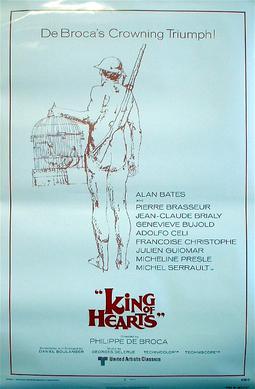
As We Enter The Final Phase Of The 100th Commemoration Of World War I With Armistice Day-November 11, 1918-Thoughts On The Film “King Of Hearts” (1966)


DVD Review

By Josh Breslin
  
King of Hearts, Alan Bates, Genevieve Bujold, 1966    


These days, apparently, we can no longer just go through our paces and do whatever review or commentary we were assigned but also have to comment on how and why we received the assignment from our still fairly new site manager Greg Green. Greg has encouraged, if not demanded, that we go to genesis, so the reader can be more informed about how the new field of on-line publication works with the new technology. These kinds of insights in publishing used to be reserved in the now old-fashioned hard copy days to insider memoirs by publishers, writers and editors. Greg has told me he is trying to demystify the whole process and get the story out while it is “hot” and fresh. 

That said, normally anything of late having to do with commemorating the 100th anniversary of the end of World War I would be the purview of Seth Garth who has been running a couple of series the past four years (the duration of  that war from August, 1914 on until November, 1918) around the effect that the carnage had on the flower of the European youth especially the cultural worker, the writers, artists, poets, musicians, and occasional dancers who were engaged in this conflict along with the rest of their generation. He worked, is working still, on retrospectives for the extraordinary number of cultural figured killed or maimed in the war. And of those who maimed or not survived the war and as a result produced a very different kind of work, noticeably different than either their own pre-war work or that of the leading schools and academies in the various disciplines. The reason I got this review of the classic French film King of Hearts though, even though Seth very much wanted the assignment as part of his take on World War I, was that way back when, back in 1973 if I recall I had reviewed the film for The East Bay Other. I had actually seen the film in Cambridge where it played continuously for many years at the now long-gone Central Square Cinema to usually sold-out crowds and became a local cult classic which people would have contests over how many times they had seen the film or cite various lines from the film off the cuff for fun. Greg’s idea was for me to compare that first review with my recent re-watching (along with Seth and our respective companions) and do a comparison. Genesis over here goes.         

There are many quotes, many of them by military figures who should know the hard face of war and have opinions on its futility even if they cannot go the distance and in effect become conscientious objectors to war after the fact. Famously key Union Army General U. S. Grant said “war was hell,” bemedaled Marine Corp General Smedley Butler said “war was a racket,” Colonel James Johnson said after Vietnam that war was not a fit occupation for human endeavor and those who profess otherwise should be in an insane asylum, a mental hospital, a nut house is what he actually said but I wanted to soften the blow for today’s sensibilities about the mentally challenged. That latter comment gives me a segue into the film under review where the metaphor, and the reality of that statement meet.

We have all heard about the inmates running the asylum and in this case not only are they running the asylum but are running amok, harmlessly running amok during the catastrophe of war and who is to say that they are not better off for their troubles, Certainly compared with the inmates who are running the war which has come to their door. Let’s set the stage (Sam Lowell, good old, what did one young reviewer here call him, oh yes, wizened, Sam Lowell used to harp on giving the ‘skinny” but Greg Green has frowned on that expression since none of the younger writers and stringers know what the damn thing means) for this beauty of an anti-war film which stops everybody in his or her tracks when you see the very visceral comparison between the mentally ill asylum patients in their harmless splendor and the mentally ill guys running the rack on French soil toward the end attempting to kill every last enemy and a few extra if necessary in the fog of war, October 1918 to be more specific, tidying up the loose ends of the war machine, of the war that would end all wars if I recall somebody rashly said in defense of starting the whole thing at all.     

The Germans, facing defeat, facing mutiny in their navy and in some army units and unrest back home in the factories in dear Berlin, are in the last throes of their military activities in northern occupied France. As a parting gift they are setting up enough explosives to blow the whole town to kingdom come. Nice gesture toward armistice, right. The British who are in front of the town and who have been there for years it seems in the stalemated trench warfare that defined that conflict are informed of that provocation and are prepared to take measures to ensure that when they retake the town for their French brethren they too are not blown to bits. Fair enough. Those measures, rather that measure is to send an explosives expert, played by Alan Bates, to disarm the whole munitions dump. Problem, problem number one, really this private soldier doesn’t know thing number one about explosives being part of the messenger pigeon unit. From there it is one escapade after another as he tries, as any “good” soldier would to do as ordered. No luck, none really since he can’t decode the information headquarters has received about its location. Don’t worry in the end that dump will be neutralized. That’s the subplot anyway and would make this film a snorer with the silly antics around disarming the dump if there wasn’t a stronger message.

Here is the real deal. Since the Germans have left as have all sane citizens once they know the place is ready to blow the only ones who are clueless, who don’t know what is about to happen are the inmates, are the cuckoos in the insane asylum. Since the good Sisters in charge have scrammed the inmates open the door and walk into town where they make the place a playground for fun and amusement. Meanwhile that earnest private is trying to do his best to disarm the munitions-and is drawn into their doings-drawn in as their very own king of hearts for whom they have been waiting. Nice.

To make a long story short because both the antics of the “simple-minded” who somehow seem very sane and made me wonder why they were the ones locked up and the soldiery trying to disarm the dump need not detain us let’s get to the point, points rather which are drawn from this film. On the war front the Germans find out that the British have disarmed the munitions dump and march back into town and the British in turn assuming the coast is clear are ready to march in and do so. Enemies again they square off-not in the trenches of yore, none are around but each side going back to some bizarre and arcane 19th century drill formation set up firing lines against each other. Bang, bang every freaking soldier is uselessly dead over this pratfall. Except our King of Hearts who was elsewhere hanging around a beautiful butterfly of a young woman, one of the inmates, one too delicate for the real world, played by Guinevere Bujold who many guys, maybe gals too, would lose sleep over. As the townspeople return and the King of Hearts sullenly goes back to his regiment, or what is left of it, the inmates seeing that reality is far from what it cracked up to be if what they witnessed with the combative soldierly was any example return to the asylum and lock themselves back in. Beautiful. Better, better still the King of Hearts torn maybe between two duties heads back up the road to the asylum. Desertion yes, but another beautiful scene.              

All Quiet on the Western Front, The Grand Illusion, Johnny Got His Gun may all be extremely good examples of cinematic excellence around the madness of World War I. Throw this one in the mix too and you will not be too far off.

The Centennial Of Pete Seeger’s Birthday (1919-2014)- In Honor Of Newport 1965-Folk Music- The Graduate Course

Click on the headline to link to a "YouTube" film clip of Woody Guthrie performing "Pastures Of Plenty".

CD REVIEW

Classic Folk Music, Woody Guthrie, Pete Seeger and various other artists, Smithsonian FolkWays, 2004

Recently, in a review of a three volume set of CDs entitled “Troubadours of The Folk Era” containing songs done by many of the folk singers then coming in prominent in the 1960’s, I headlined the entry “Folk Music 101-There Are Many Rooms In That Mansion” . That entry however, in a way, begged the question of how those singers (or listeners like me) traced their ways back to the roots of folk.

Well, my friends, I have the answer, or at least part of it, here in this little gem of a CD. Sure we all, later when we understood things better, appreciated that John and Allan Lomax did yeomen’s service to roots music by their travels into the hinterlands in the 1930’s and 1940’s (and had Pete Seeger tag along for a year and thus serve as a little transmission belt to the latter generation) to find blues, mountain and other types of American traditional music. However, most of us got our folk infusion second-hand through our addiction to local coffeehouses and the fledgling performers who provided us entertainment there. They, in turn, learned their material from the masters who populate this CD.

You doubt the truth of that statement? Well, let’s go through the litany. On one CD we have Woody Guthrie doing “Pastures of Plenty”; Pete leading “We Shall Overcome; Lead Belly on “Rock Island Line”; Doc Watson on “John Henry”; Elizabeth Cotton on the super-classic “Freight Train" (a right of passage for virtually every 1960’s performer); Paul Robeson on “No More Auction Block” (it will give you goose bumps to hear that voice); Big Bill Broonzy on “This Train” (fighting Jim Crow version) and on and on. This is the core of folk, take my word for it. No don’t. Get this CD and get ‘religion’ on your own.

A word is also in order about the role of Moses Asch, his Asch recording studio in New York City and his role as the producer of many of the classic folk songs in the 1940’s and 1950’s gleaned from the always excellent liner notes provided by Smithsonian Folkway. As I have noted previously in this space the folk revival of the 1960’s did not form tabula rasa. Asch’s commitment is a testament to that proposition. It therefore is no accident that the early flowering of the folk revival was in New York City as that is where one could find the ‘refugees’ from elsewhere during the "red scare" during the hard political winter of the 1950’s.

Nor is it accidental that left-wingers blacklisted, like Pete Seeger, Woody and Paul Robeson, by the government are liberally represented in this collection. When one is searching for some kind of critique of society there is bound to be a folk song by some damn radical that reflects that outrage. Or gets prominence due to that struggle. Witness in that regard the history of the song “We Shall Overcome” and its relationship to the black civil rights movement. I should also point out that the liner notes provide an interesting fact about the older generation of folk performers like Woody Guthrie and the young revivalists of the 1960’s. The notes point out that a fair proportion of the folk revivalists came to love the music from songs they learned as children at summer camp. Woody and Pete Seeger are well-known for their children’s songs. So, maybe the government was right to see “reds” under every bunk bed corrupting the morals of the youth. Oh, well.

As a general observation the producers of this CD, Smithsonian Folkway (the name itself should be a give away about the quality of this production) went out of their way, way out of their way to get the best renditions available of the songs by the individual artists represented and to provide the best range of what folk meant to those who wrote the songs, sang them and listened in. As I mentioned above in that earlier review of the 1960’s folk scene for those too young to have heard the music then you have been given a reprieve- take advantage of it.

On The 60th Anniversary Defend The Gains Of The Cuban Revolution- The Legend Of Ernesto “Che” Guevara- The Heroic Guerrilla Face


In Honor of Anniversary Of The July 26th Movement


From The Pen Of Frank Jackman (2015)


Every leftist, hell, everybody who stands on the democratic principle that each nation has the right to self-determination should cautiously rejoice at the “defrosting” of the long-time diplomatic relations between the American imperial behemoth and the island of Cuba (and the freedom of the remaining Cuban Five in the bargain). Every leftist militant should understand that each non-capitalist like Cuba going back to the establishment of the now defunct Soviet Union has had the right (maybe until we win our socialist future the duty) to make whatever advantageous agreements they can with the capitalist world. That despite whatever disagreements we have with the political regimes ruling those non-capitalist states. That is a question for us to work out not the imperialists.

For those who have defended the Cuban Revolution since its victory in 1959 under whatever political rationale (pro-socialist, right to self-determination, or some other hands off policy) watching on black and white television the rebels entering Havana this day which commemorates the heroic if unsuccessful efforts at Moncada we should affirm our continued defense of the Cuban revolution. Oh yes, and tell the American government to give back Guantanamo while we are at it.    


DVD Review

This year is the 59th Anniversary of the July 26th Movement, the 53rd Anniversary of the Cuban revolution and the 45th anniversary of the death of Ernesto, “Che”, Guevara. Defend The Cuban Revolution


Che, starring Eduardo Noriega, 2006


On more than one occasion I have mentioned that “Che” Guevara, as icon and legend, despite his left Stalinist politics (at best) and the political gulf that separated him from those who fought, and fight, under the banner of Leon Trotsky and the Fourth International, was, and is, a justifiably appealing revolutionary militant for the world’s youth to consider. A number of films have come out over the years that portray one or another aspect of the “Che” personality. Here the central thrust of the film is the creation of “Che” as a revolutionary cadre in the guerilla warfare movement that dominated much of the political action of the 1960s, in the wake of the success and survival of the Cuban revolution in the face of American Yankee imperialism.

This little film, really a docu-drama since there is an abundance of black and white newsreel film footage to set the story line throughout most of the 1950s, goes, up close and personal, into the transformation of the Argentine free spirit and free booter pre-“Che” of the “Motorcycle Chronicles” period into a commandant of the Second Front in the Fidel and Raul Castro-led rural insurgence against the hated dictator (except in Miami) Batista.

In that sense it almost does not work. Eduardo Noriega is “Che” in his mannerisms, his good and manly looks and in his earnestness (no pun intended) to free the Americas of the Yankee beast. However, the situation gets saved when “Che” gets to show more aspects of his personality when he is being interviewed by an American reporter in the post-victory period. And also by his determination to end up where he started, as a guerrilla fighter extraordinaire fighting against the world’s injustices.

That, my friends, today is refreshingly appealing. That said, though “Che” deserved a better fate that to be caught out in the bush in Bolivia. And here is where the irony (and the political differences) comes in. What the hell was he doing in the Bolivian bush, of all places in Bolivia when they was a working class (mainly miners) who had a history of extreme militancy and readiness to do class battles against the state (and have since then). “Che”, mainly deserves his status as icon, in some sense, but a whole generation of militants in Latin America and elsewhere got torn up based on this wrong strategic assumption.

Tuesday, July 23, 2019

Tell Me: What Does The Resistance Looks Like-This Is What The Resistance Looks Like-Join The Resistance Now!!

Tell Me: What Does The Resistance Looks Like-This Is What The Resistance Looks Like-Join The Resistance Now!!  


“Oh What Tangled Web We Weave”-With The Film Adaptation Of W. Somerset Maugham’s “The Letter” In Mind

“Oh What Tangled Web We Weave”-With The Film Adaptation Of W. Somerset Maugham’s “The Letter” In Mind


By Josh Breslin 

“I swear I wish sometimes I could be a woman. NO I am not talking about turning from male to female or anything like that [revealing true sexual identity which some people are now in 2017 correctly asserting their right to do -JB]. Society in the year of our lord 1936 would not put up with it, would not put up with such an idea even though anybody who is anybody who has read any amount of history, the history of sexual experiences anyway knows, that cross-dressing, cross-sexing I guess you could call it has been going on since Eve came out of Adam’s rib, maybe before,” Roger Saint John mentioned in passing to his dear friend Bernard Baron.

The causes for Mister Saint John’s comment were two-fold. He had just read his close friend Somerset’s latest novel, The Letter, after having avoided the pleasure as long as possible since he did not like the subject matter as a rule of whatever concoction Somerset had cooked up to titillate the literate reading public here adultery and murder, murder most foul. Moreover this same Bernard Baron had insisted that they go see the opening of the film adaptation of Somerset’s novel starring Bette Davis and he had had quite enough of the whole thing. However Roger was intrigued by the craziness, his term, that the woman would go through to hold a man, a man who was no longer interested in being with her.

This Clara, Bette Davis’ role in the film, starts off directly in scene one doing her version of rooty-toot toot on her paramour who went south on her, Steven something. Yes, dear Clara was in a tizzy over hard fact than this Steven cad was smitten by another woman. Maybe it was that Steven had gone “native” on her, had taken up with a beautiful Polynesian woman whom he swore he was pledged to eternal devotion. For that transgression he paid with about two fistfuls of bullets and plenty of splattered blood (to speak nothing of the defamation of his character as this Clara came up with the usual tart story that this Steven had made improper advantages toward her and she had to defend her honor, her womanhood in the only way that woman can-with a handy revolver.]

But Saint John once he started to get up a head of steam decided that perhaps it would be better for the reader to have a little background as to why he was at pains to try to figure out what made the female sex tick. The ploy was pretty simple. Clara, married, unhappily married to Donald Smythe, the famous geological engineer for the East Coast Oil Company, was stuck unto death in dreary Indonesia where Donald was often called away on business for his company out in the boondocks. Clara none too strong on Donald anyway except as a meal ticket out of the West End of London from whence she came got easily bored and started hanging around the Leeward Inn where she met this guy Steven   who would wind up with many holes in him before Clara was through with him. They became hard and fast lovers for over a year and Clara, at least had dreams of getting out from under her Donald burden and leave the goddam archipelago and then Steven lowered the boom on her. Told her that he was in love with his native woman, Sisil. End of story. No, end of Steven. Clara was going to have her man or else she was going to take care of business her own way.

Here’s where things got dicey, where Saint John was at a lost to figure out what was running behind a woman’s mind when she has been unceremoniously dumped. She developed this whole elaborate plot about how her lover, now dead, and unable to contradict her had really been public nuisance number one, had thrust himself upon her. This weak sister of  an alibi which anybody who ever spent ten minutes at the Leeward Inn would know was false since Clara and Steven had their little corner love nest spot in the bar got her easily past her gullible and witless cuckolded husband, no problem. More importantly got her past the friendly constabulary which was friendly with Donald and wanted to be friendly toward whatever wishes East Coast Oil had. She was ready to walk after a perfunctory trial which was necessary given the death in the case,

Then the fucking letter came to light, the letter where Clara expressed her undying devotion to Steven and gave the back of her hand to the foolish Donald. She moved might and main to get that fucking letter back from whoever had found it. Of course it was Sisil who figured to cash in on Clara’s school girl indiscretion, cash in for ten thou in cold hard cash. So the suppression of the letter got her off the murder rap. Didn’t get her off the rub out list which Sisil who was as crazy about Steven as she had been compiled just for her. Go figure.             


Dancing Cheek To Cheek, Oops-Ginger Rogers And Fred Astaire’s “Roberta” (1935)-A Film Review

Dancing Cheek To Cheek, Oops-Ginger Rogers And Fred Astaire’s “Roberta” (1935)-A Film Review 


DVD Review

By Sandy Salmon

Roberta, Ginger Rogers, Fred Astaire, Irene Dunne, music by Jerome Kern, 1935

I can’t dance, can’t dance a lick. Like a lot of guys, maybe gals too but I will just concentrate on guys here, I have two left feet. Nevertheless I have always been intrigued by people who can dance and do it well. Have been fascinated by the likes of James Brown and Michael Jackson growing up. As a kid though I, unlike most of the guys around my way, I was weaned on the musicals, the song and dance routines where the couples kicked out the jams. Top of the list in those efforts were the dance team of Fred Astaire and Ginger Rogers whose dancing mesmerized a two left feet kid just at a time when I was coming of age, coming of school dance and checking out girls age and once in a while in the privacy of my lonely room I would try to work out a couple of steps seen by me on the big screen. No success. Although I had never viewed the Rogers-Astaire film under review back then I got a distinct rush of déjà vu watching this film, Roberta.          

Déjà vu is right since although I had not viewed the film on one of those dark Saturday afternoon matinee double-features when they were running a retrospective at the local theater I already knew what was going to happen. I had seen say Top Hat then and if the truth be known the formula did not vary that much in the whole series of song and dance films they did together. It was not about story line although it probably helped the director to have a working script so he could figure out where to have somebody burst out in song, or trip over a table and begin an extended dance routine.


That said the “cover” story here is Fred leading a band of upstart Americans into gay Paree (in the old fashioned-happy way not as a designation for sexual orientation) expecting to have a gig which went south on them. Fred meets Ginger working as Polish countess down on her uppers who is into high fashion which I expect everyone knows old Paris is famous for. That’s allows those bursts into song and dance to go forth without too much interference from the story-line. In short do as I did as a kid and now too just watch Ginger and Fred go through their paces. That’s worth the price of admission.  That and tunes like Smoke Gets In Your Eyes via the magical and under-rated composer Jerome Kern          

From The Archives-POOR PEOPLE’S CAMPAIGN: A NATIONAL CALL FOR MORAL REVIVAL Organizing Guide for State Capitol Press Conference and Demand Deliveries Action Purpose & Overview


POOR PEOPLE’S CAMPAIGN: A NATIONAL CALL FOR MORAL REVIVAL
Organizing Guide for State Capitol Press Conference and Demand Deliveries
                                                                       
Action Purpose & Overview

As part of the Poor People’s Campaign: A National Call for Moral Revival state leaders will organize news conferences/rallies inside state and federal capital buildings across the nation within the first few weeks of state legislatures going into session to deliver our campaign demands.

This is an opportunity for states to express collective power by acting in coordination with one another. When we act in coordination we can bring more media attention to our work, we build off the energy of other state actions and we remind our base and each other that we aren’t alone.

These actions will not include nonviolent moral fusion direct action but will instead put our state legislators on notice of what we expect from our lawmakers. For those states that will engage in nonviolent direct action as part of their legislative strategy, these actions will lay a path for escalation as the session continues.

These actions will provide an opportunity to announce the upcoming work of your state campaign such as the statewide media tours in late March, organizing drives, poor people’s hearings, etc.


Our Organizing Principles
                                                                                                                                   
While these actions will be different in each state, the spirit of each must align with the Fundamental Principles of the campaign. Consider each of these points at every step of your planning process.

       In our efforts to shift the narrative, we know that we must shift the narrator. We create a platform for and uplift the leadership of those who are most directly impacted by the immoral policies that contribute to and maintain systemic racism, poverty and inequality, the war economy and militarism, and ecological devastation.

Questions to consider: Who is speaking? Are those most directly impacted by systemic injustice speaking in place of organizational leaders and non-profit leads. Who is organizing? In organizing for this action are emerging impacted leaders from your campaign engaged in the organizing process? Who is participating? Is your event accessible to people with disabilities? How will you meet the needs of your participants in terms of language barriers?

       We are confronting the distorted moral narrative of Christian nationalism by making visible the true moral issues of our day. One of the ways we do this is by involving and making visible leaders of many faiths who provide moral framing to contextualize our movement and issues.

Questions to consider: How are we providing a moral framing? Are faith leaders from your campaign engaged in the organizing process? Have they been encouraged to organize their congregation to attend? Have you asked clergy to wear their vestments appropriate for public witness (these are key to visualizing their involvement)? Do you have faith leaders speaking in your program to provide moral framing? Are speakers prepared to have a moral framing in their remarks?

       We engage in fusion organizing. We intentionally build our campaign across lines of difference and historical division and make our fusion movement visible from every platform we create. We resist a single-issue mindset and at every opportunity reveal the connections between the issues we each face. We are not allies to one another but partners and we uplift each others struggles as our own.   

Questions to consider: Are we demonstrating fusion politics? Are the speakers a visual representation of coming together across lines of division including race, age, gender, gender identity, ability, sexual orientation, region and other lines of difference? Are the people standing behind your speakers and within the video/camera frame also visually demonstrating a coming together of people across lines of division? How are we using our program to show the connections across issues? How are all regions of your state campaign being included in your event framing and outreach efforts?

       We understand the importance of a culturally grounded movement. When we gather as a movement, theomusicology can unite, galvanize, energize, inform, comfort, calm, direct, encourage and much more. Visual art helps effectively communicate our message and goals as a movement while creating a unified visual identity across all of our state campaigns.

Questions to consider: How will you bring the PPC spirit to your action? Will you have a theomusicologist lead campaign songs and chants during the news conference and demand delivery? Will you bring your PPC banners, flags and placards?

       We understand the importance of building a mass movement and reaching as many people as possible and recognize the important role the media plays in maximizing our reach. A central goal of the campaign is to shift the narrative. To do this, we don’t let the media tell the story they want to tell, we teach the media about how they should understand and report on what they see.

Questions to consider: What is your media outreach/creation strategy? Have you identified and prepared media spokespeople who are committed to the campaign and can effectively communicate about the campaign and the event? How will you create your own media with this news conference? Examples: writing letters to the editor, creating videos, memes, and social media engagement.

       Our most effective weapon in our fight to shift the narrative is the truth. We have made a serious commitment to revealing the truth both through personal testimony and through empirical research and analysis. At every opportunity, we tell the truth about what is happening in our communities, across our states, and across the country.

Questions to consider: How are you using the action as an opportunity for political education? Are you passing out your state fact sheets at the news conference to both participants and media? How are you incorporating these facts and others from the Souls of Poor Folks Audit in remarks and testimonies given during your news conference?

       We are committed to nonviolence. While this takes many forms, we believe that all people have the right to feel safe.

Questions to consider: Does your news conference feel safe and welcoming? What are your plans for making sure your action is safe and people are able to get their questions answered (marshalls, etc)? What is your plan to make sure your action is accessible? How will people new to the Campaign feel welcome and invited into the work? Are you passing a clipboard with pledge cards and/or registration forms?

       We are political and we are nonpartisan—no elected officials or candidates get the stage or serve on our organizing committees. This is not about left and right, Democrat or Republican but about right and wrong.


How Is This Action Rooted In Our Goals?
Shift the narrative; Build power; & Impact elections and policies

Center our narrative
       The narrative around our state legislature’s policy agendas, those most likely to have widespread negative impact on the lives of poor and marginalized people, are largely controlled by lawmakers. We will interrupt this narrative and bring media attention to 1) the truth about what is happening in our communities and the moral crisis we are in and 2) the ways that these policy agendas either contribute to or at the least maintain systemic racism, poverty, ecological devastation, the war economy, and a distorted moral narrative. These institutions of power are not living up to their constitutional mandate to “govern for the good of the whole” or the “general welfare.”

Change the moral and political landscape
       Many of the organizations that are part of the PPC: NCMR will likely be involved in specific policy endorsements during your legislative session. It is unlikely that legislation introduced during this session will meet campaign criteria for policy endorsement (see page 7 of the Phase II Organizing Guide) because legislation is usually based on what lawmakers see as possible in the moral and political context they are operating in. This means our strategy for impacting policy is not endorsements. Instead, we are creating a moral and political landscape where these demands are the norm rather than the extreme. This begins by focusing the conversation around our demands.

Engage new leaders and consolidate emerging leaders
       We will reach new audiences by engaging in a highly publicized action and provide an opportunity for new people to get involved in the campaign.
       When we organize together, we have the opportunity to consolidate current and emerging campaign leader’s commitment, clarity and capacity. Any action or event can be used to strengthen our skills as organizers, speakers, canvassers, etc.; to deepen our understanding of the campaign demands and vision; and to strengthen our relationships to other leaders in our campaign.


Materials and Resources

Mobilization
       Review the list of organizations and list of faith bodies that have endorsed the Poor People’s Campaign: A National Call for Moral Revival. Don’t forget to invite these groups to take action with you.
       Flyer for those who request it

Communication
       Materials to come
       Template press advisory
       Template open letter to deliver with the demands
       Template Op-Ed
       Click here to review the Communications Webinars to refresh your memory on strategies for media outreach, building your media link, and training media spokespeople.


From The Archives Of The Struggle Against Climate Change And Animal Preservation-East Coast Version-Professor Johnny Allan-Climate Guru-Moves East


From The Archives Of The Struggle Against Climate Change And Animal Preservation-East Coast Version-Professor Johnny Allan-Climate Guru-Moves East                

By Bart Webber

Reputation is a hard dollar, no question. Take that of one Professor Johnny Allan, Emeritus U/Cal-San Diego who back in the 1970s was treated as a living god among the environmentally conscious, the ecologists, the Sierra Club bureaucracy who used him almost like a poster child to raise funds (if not the rank and file who barely knew his name despite his fame). For those who do not remember his name he was the first to suggest that places like zoos start putting out canisters for donations to endangered species (starting with his own beloved San Diego Zoo where before he was banned from entry was treated with the same distant but real respect as say the Pope of the Catholic religion, pardon if any other religions have a Pope but the Catholics are the only ones I know of what have such a figure, only one I think ever since maybe Avignon or when Attila the much maligned Hun came to town and busted everything in town).

The good professor built on that solid foundation by proposing that zoos, and here he expanded his reach which is how Sierra Club-like organization worshipped at his feet, and concerned animal protection groups like the various save the whale, save the polar bears, save the almost extinct rocker macaw, the save the also almost extinct bantam leopard organizations spruce up their operations by featuring their “poster child” animals on their donation literature. (Ironically, today despite the good professor’s fade from prominence and in some quarters his bad odor, more on this below, those groupings since ceaselessly do such features on their pervasive and endless contribution literature. Without acknowledging who tuned them in to the gold.)

Today, maybe literarily today, we are so wedded to the very real idea that climate change is knocking us for a loop that we forget that such efforts to fight the worst effects of the crisis have been going on for a long time. As I have mentioned previously Johnny was one of the key leaders who noticed something was dramatically wrong back in the 1950s when he was doing research for the government around the effects of nuclear weapons and power plants on planet Earth, a figure out of the mold of John Muir, guys like that. Johnny was one of the early advocates of the very sound idea that we do something about the matter before it got too late, too expensive or we didn’t have the technological resources to combat whatever affront we had made to Mother Nature.

There is more to the Johnny Allan story though and it also relates to the San Diego Zoo with which he was associated with for many years after being stonewalled in government service by the craven bureaucracy which would not publish his results. Johnny put in many years of thoughtful study thinking through the idea of making animals in captivity more comfortable, more in tune with their natural habitats as a way to dramatize what would happen if things were not changed, changed quickly. One of the first things he protested about was the idea of bringing polar bears and penguins to the zoo which would have entailed a vast array of structures and conditions that did not make sense in a semi-tropical climate. I believe he got an award for that long drawn out effort. That struggle against changing habitats became the central thrust of some of his later work when he got, finally got, the zoo (and others followed suit) to make the spaces the animals were caged in more like home. With the added proviso that prominent captions tell the story of those back in the wilderness who are being pushed out or otherwise driven to near extinction.  

Those efforts alone would have assured Johnny an eternal place in the ecological pantheon except for what appears to have been a fatal gene in his makeup. Not only was Johnny when young a brilliant student and polymath but a sneak thief, a confidence man, in short a bullshit artist. Johnny had grown up dirt poor in the rural area south of Stone Mountain in a place that had no name and where the major religion was evangelical snake-handlers and people speaking in tongues so he was from early on was walking contradiction, had his wanting habits on as much as his search for some climate change solution and the like. I won’t go into the details of the six million scams he was involved in while with the Cedar Mill gang working out of Stone Mountain when he was a hungry student, somebody did a book on it so look it up. (Somebody eventually brought that gang low by ratting them out to save his own ass but by then Johnny had left for school and bigger opportunities-legal and illegal.) What brought Johnny down in the end was his inability to separate out his brilliant ideas from his greenhead mad monk desires. Despite his meek demeanor and soft speech, a trademark throughout his career apparently he could not help himself when “gold” was discovered.

Nobody will ever know the full extent of the scams the good professor ran since the government, state and federal, refused to prosecute based on lack of evidence, criminal evidence. What Johnny saw when he looked at the results of pitching the endangered species angle hard by various concerned groups was that their contributions expanded exponentially. With larceny in his heart, and we will leave it at that since no criminal charges were brought, Johnny set up a number of ecological friendly or endangered species organizations like “save the barking puma,” “stop the Artic melt,” things like that using organizational names like High Sierra Club, Greenspace and asking for donations to a post office box in Mendocino. He set himself up as treasurer after creating various bank accounts. The biggest asset though was to pitch his name to the project, to the mailed literature. The money kept rolling in.

When a few contributors who had been solicited several times asked about progress and got stalled at first and then no reply they put investigators and lawyers on the case. Here is the beauty of Johnny operation, a solo job which made sense, he would actually give money to say the Sierra Club or some group doing endangered species work. When the books were checked the ratio of dough given to “administrative” costs was about one to ten. Many, many trips by him and companions to exotic places and some not so exotic were listed.  Nice-for Johnny and whoever. Rather than face the bad publicity and cut real donation flows everybody balked when the feds wanted them “to play ball with the law.” Moreover, Johnny kept his job, got his retirement pay and all.

That is not the end of the story though-the last anybody heard Johnny had tried to interest the folks at Mystic Seaport into making a Sea World-like operation to increase revenue. In a sign, perhaps, of senility or cunning he applied to run the operation and be chief ambassador for the place (see photograph below used in his resume)