This space is dedicated to the proposition that we need to know the history of the struggles on the left and of earlier progressive movements here and world-wide. If we can learn from the mistakes made in the past (as well as what went right) we can move forward in the future to create a more just and equitable society. We will be reviewing books, CDs, and movies we believe everyone needs to read, hear and look at as well as making commentary from time to time. Greg Green, site manager
The Mad Monks Of The Pre-War (World War I If Anybody Is Asking) Germanic Art- Klimt And Schiele At The Boston Museum Of Fine Arts
Gustav Klimt and Egon Schiele’s Twisted Fates in Paint
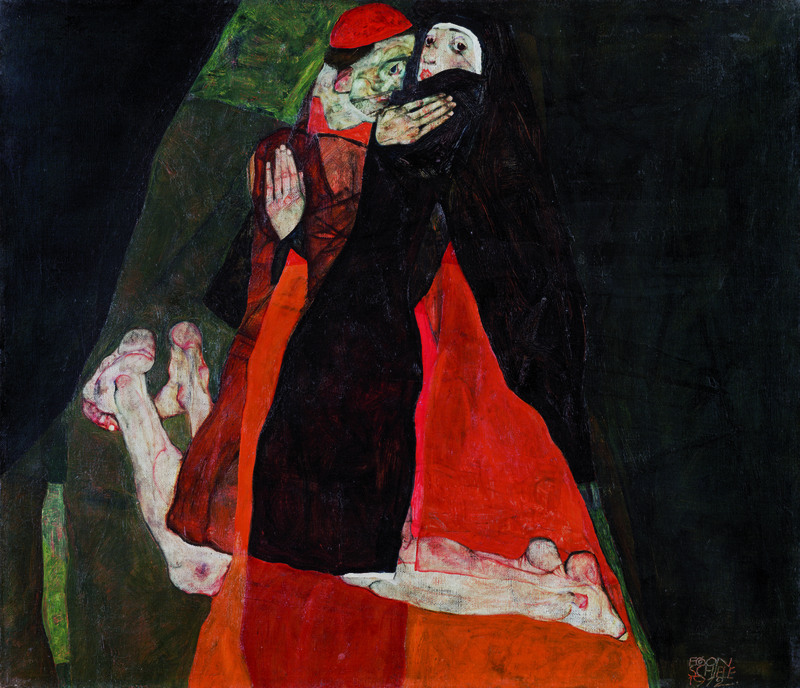
Cardinal and Nun (Caress), 1912, Egon Schiele.
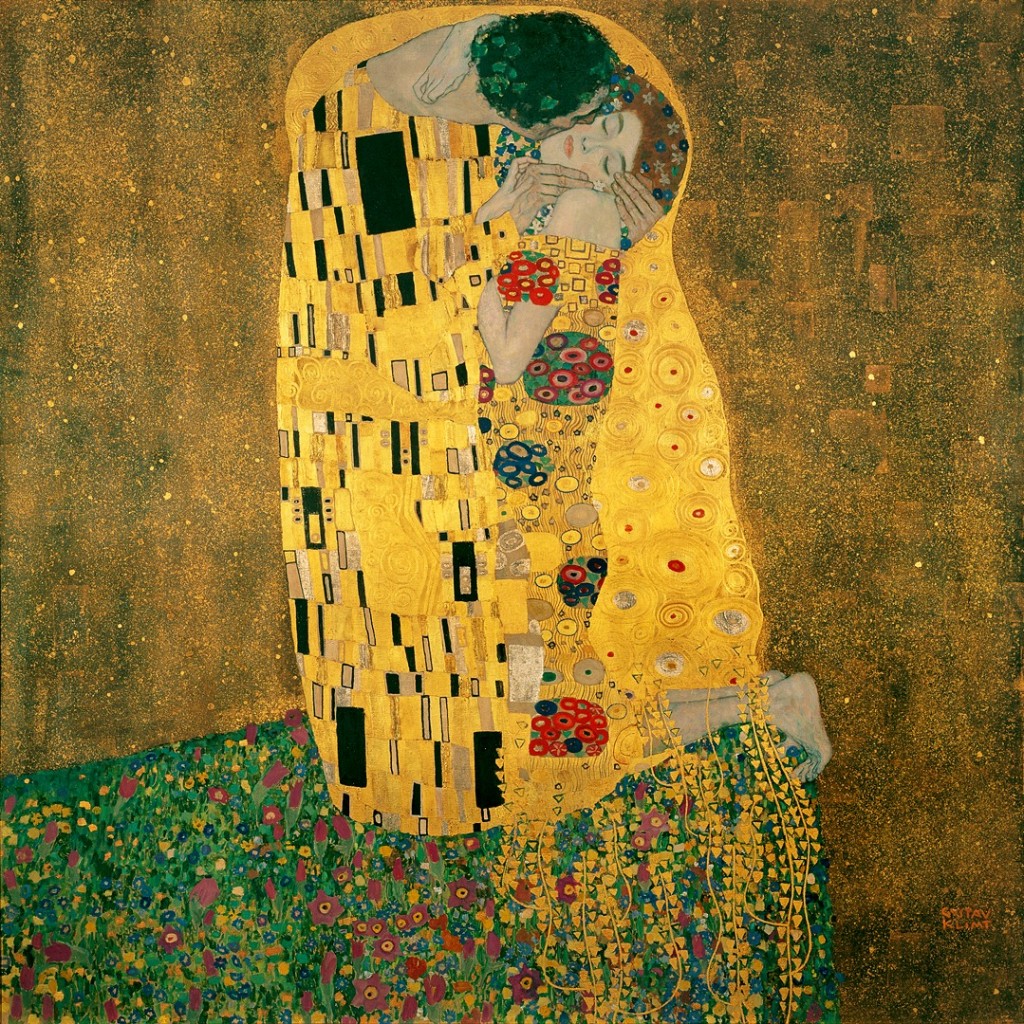
Kneeling forms against an indeterminate background, two figures interlocked as one… perhaps this painting looks familiar? The work is a tongue-in-cheek play by Egon Schiele and a slightly sacrilegious homage to his master, Gustav Klimt’s The Kiss. Rather than love and passion, these religious figures are caught in the act, stiff against religious vow.
The Kiss (Lovers), 1907-1908, Gustav Klimt.
The Mentor and His Star Pupil
With a nearly 30 year age difference, Schiele and Klimt had a mentor-student relationship that lasted throughout their artistic careers. From copycat styling to love triangle rumors, this twisted story is told in their paintings.
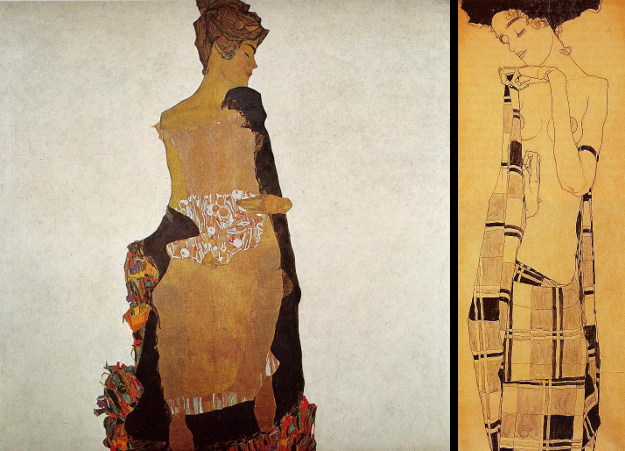
In 1907 a then-teenaged Schiele saw Klimt as an idol and sought him out. The two fostered an artistic friendship and elements of Klimt’s avant-garde style can be found in many of Schiele’s early works and drawings, including these:
Left: Portrait of Gerti Schiele. Right: Standing Girl in a Plaid Garment. Both by Egon Schiele, 1909.
The Love Triangle with Wally Neuzil
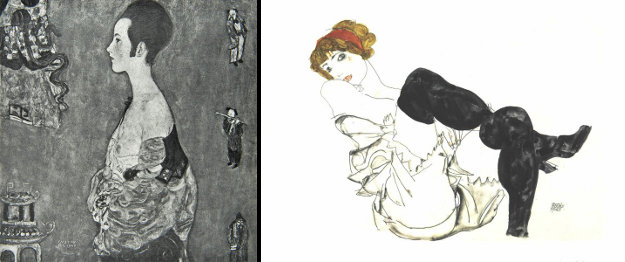
Klimt’s influence was never far away. He introduced Schiele to many gallerists, fellow artists, and models, including the perhaps infamous Valerie (Wally) Neuzil. Neuzil had previously modeled for Klimt, and is rumored to have been his mistress. In 1911 she moved with Schiele to Krumau in the Czech Republic and thus began a four-year affair with him. In 1916 she returned to her old lover, posing again for Klimt.
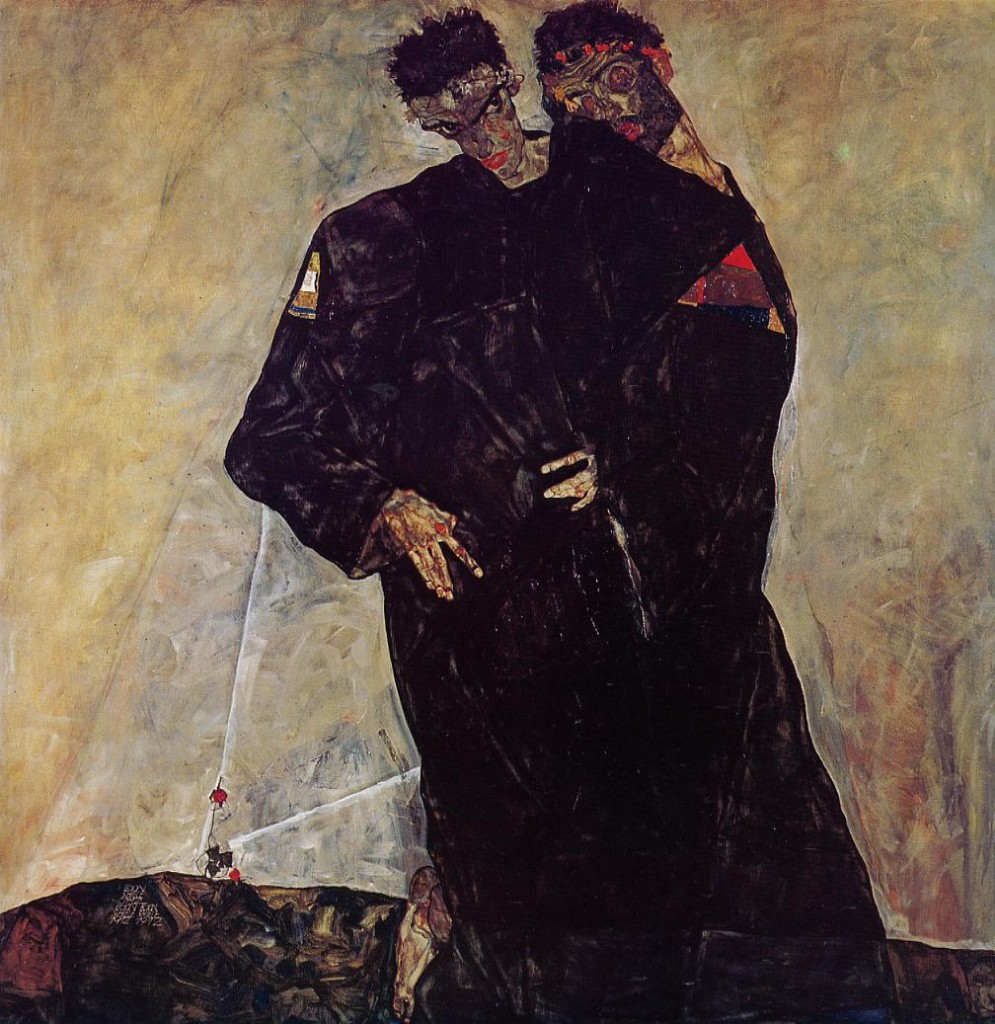
The Hermits, Egon Schiele, 1912.
Left: Portrait of Wally, Gustav Klimt, 1916. Right: Woman in black stockings (Valerie Neuzil), Egon Schiele, 1913.
In fact, Schiele slyly alludes to this shared love in his 1912 painting The Hermits. The artist depicts two male figures in a Klimt-esque embrace, who on second take appear to be the mentor (on the left) and student (on the right) themselves. Dressed in all black, these two “hermits” are one mass but two thin white lines in the background connect the couple to a wilting rose, red like the color of Neuzil’s fiery hair.
Muse Shared, Again?
Klimt and Schiele portraits also reveal another shared subject: Viennese society woman Friederike Maria Beer-Monti. She rang Klimt’s doorbell in 1915 and asked if she could pose for his artworks. The process took six months and, in that time, she is rumored to have been one of his many flames. Just one year earlier, she had been the subject of a work by Klimt’s mentee.
Left: Portrait of Friederike Maria Beer-Monti, Egon Schiele, 1914; Right: Portrait of Friederike Maria Beer-Monti, Gustav Klimt, 1916
Both artists were notorious for their affairs with women. Klimt, who never married, is said to have fathered 17 children with his muses. Schiele often found himself in hot water with the authorities for his choice of studio visitors, children and adult, who posed nude.
Breaking Conventions in Art, Too
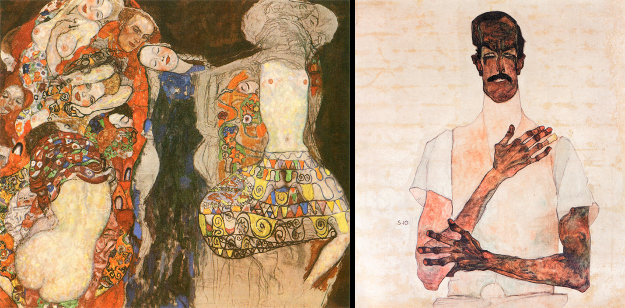
As personal relationships grew more interconnected so did their artistic styles. The bright colors and elongated bodies in Klimt’s unfinished The Bride and the more jagged lines and gestural coloring in Schiele’s Portrait of Dr. Erwin von Graff would lead their contemporaries to a new – and more personal – way of thinking about color and form in art.
Left: The Bride, Klimt, 1917; Right: Portrait of Dr. Erwin von Graff, Schiele, 1910.
With a relationship based on mutual respect, Klimt and Schiele continued to support and guide each other through the art world. There was an obvious amount of humor between the two; only a prized pupil could have gotten away with such sheer parodies of his mentor.
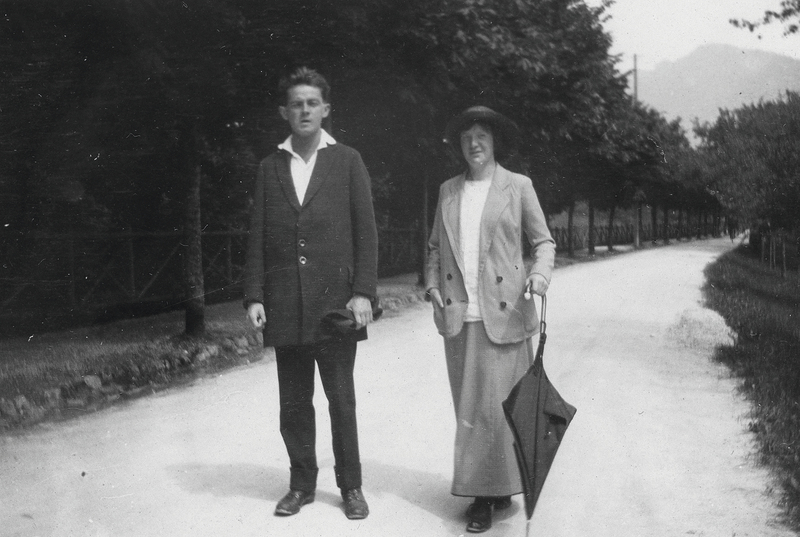
And, by the way, here’s a more banal portrait of Wally that her artists’ paintings didn’t show:
Schiele and Neuzil in Krumau, Czech Republic, 1913. Image via Leopold Museum.
Gustav Klimt is currently abuzz in the pop culture world. Actress Dame Helen Mirren is starring in The Woman in Gold, a movie about Klimt’s painting of Adele Bloch-Bauer. Watch the trailer here: https://www.youtube.com/watch?v=geJeX6iIlO0
“The Hardest Working Man In Show Business”- “Mr. Dynamite”-The James, Please, Please, Please Brown Story (2014)-A Documentary Review Of Sorts
DVD Review
By Josh Breslin
Mr. Dynamite: The Rise Of James Brown, starring James Brown, the Famous Flames, and others, 2014
No question I wanted to do this documentary evaluation of the life and times of the “godfather of soul” James Brown who came all surly and cocky out of Augusta, Ga around the middle third of the 20th century and had to fight off Sam Lowell, the former chief film editor here and now something of an emeritus although such designations are frowned upon under the new dispensation of one site manager Greg Green. The reason that I wanted to do this review though is probably not exactly what the reader would think-the place of a man, a black man in the history of rock and roll, of soulful rock, and his effect on young white guys who came up dirt poor in places like North Adamsville and Carver, Ma and Olde Saco up in Maine without the racial harassment part that James suffered growing up in the redneck, white supremacist Southern non-hospitality. Maybe say three or four years ago I might have centered on those points and only made some pointed but passing reference to his shameful treatment of women throughout his life.
But in the age of #MeToo that is hardly an adequate way to treat his life. The problem, a problem Sam Lowell first brought up a couple of years ago when he did an Alfred Hitchcock film review is exactly what one, no, what a male reviewer, or maybe any reviewer is supposed to do about some kind of balance between whatever cultural meaning any performer from acting to painting and everything in between has on society and the personal life factors where the power balance is askew. I cannot help but in the back of my mind in the case of James Brown be aware that his art, however much honored and historically relevant, is decisively marred by his personal hostilities and actions toward women.
James Brown came up from the dirt down in Augusta, Ga from a family setting that was not good. He “escaped” via music first through the gospel traditions which a number of musicians from his generation and a little later were grounded in. Later moving “uptown” to rhythm and blue he latched onto various groups which would evolve into the Famous Flames and form the core of back-up bands under various names for most of his early career. The big breakthrough hit was Please, Please, Please in 1956 which had enough sexual energy and innuendo to become something like an anthem for the post-World War II baby boomer generation which was in many ways trying to break out of the many-sided box they had been raised in from sex to patriotism. After that it was more a question of refining his music to ride with the times for a while as long as rock and roll had some energy left. Subsequently he moved on to become, well, the Godfather of Soul, the precursor of funk that had its heyday before hip hop nation emerged in the 1980s, No question James Brown on a professional musical basis deserved all the awards and honors he received all the way up to induction in the Rock and Roll Hall of Fame.
To show how the contradictions worked James Brown also created many songs headed by I’m Black and Proud which became something of an anthem itself although he disclaimed the publicly accepted militant sense of the song. He also went against the black stream politically hanging out with weirdo Republicans like Nixon and Reagan. He fired band members for using drugs yet he had his own drug jones, was practically a junkie. The list of number of allegations of domestic violence is staggering and in the end would do him in. His claim to fame that he chilled the crowd at a concert in Boston when Doctor Martin Luther King was assassinated seems rather an exception to his life although no question he did keep violence epidemic elsewhere down in that town. Maybe it is best to say today in 2018 that like a lot of other men whose cultural talents are unquestioned James Brown carries the sins of his times heavily on his back. That is the best I can do here since he will be among the exhibits of how primitive we were when societies evolve beyond sexism, sexual abuse, domestic abuse, racism, classism and all the other oppressions which hold back humankind.
From The Archives-On The 100th Anniversary Of Irish Easter Uprising 1916- A Word
A word on the Easter Uprising.
In the old Irish working-class neighborhoods where I grew up the aborted Easter Uprising of 1916 was spoken of in mythical hushed reverent tones as the key symbol of the modern Irish liberation struggle from bloody England. The event itself provoked such memories of heroic “boyos”(and “girlos” not acknowledged) fighting to the end against great odds that a careful analysis of what could, and could not be, learned from the mistakes made at the time entered my head. That was then though in the glare of boyhood infatuations. Now is the time for a more sober assessment.
The easy part of analyzing the Irish Easter Uprising of 1916 is first and foremost the knowledge, in retrospect, that it was not widely supported by people in Ireland, especially by the “shawlies” in Dublin and the cities who received their sons’ military pay from the Imperial British Army for service in the bloody trenches of Europe which sustained them throughout the war. That factor and the relative ease with which the uprising had been militarily defeated by the British forces send in main force to crush it lead easily to the conclusion that the adventure was doomed to failure. Still easier is to criticize the timing and the strategy and tactics of the planned action and of the various actors, particularly in the leadership’s underestimating the British Empire’s frenzy to crush any opposition to its main task of victory in World War I. (Although, I think that frenzy on Mother England’s part would be a point in the uprising’s favor under the theory that England’s [or fill in the blank of your favorite later national liberation struggle] woes were Ireland’s [or fill in the blank ditto on the your favorite oppressed peoples struggle] opportunities.
The hard part is to draw any positive lessons of that national liberation struggle experience for the future. If nothing else remember this though, and unfortunately the Irish national liberation fighters (and other national liberation fighters later, including later Irish revolutionaries) failed to take this into account in their military calculations, the British (or fill in the blank) were savagely committed to defeating the uprising including burning that colonial country to the ground if need be in order to maintain control. In the final analysis, it was not part of their metropolitan homeland, so the hell with it. Needless to say, cowardly British Labor’s position was almost a carbon copy of His Imperial Majesty’s. Labor Party leader Arthur Henderson could barely contain himself when informed that James Connolly had been executed. That should, even today, make every British militant blush with shame. Unfortunately, the demand for British militants and others today is the same as then if somewhat attenuated- All British Troops Out of Ireland.
In various readings on national liberation struggles I have come across a theory that the Easter Uprising was the first socialist revolution in Europe, predating the Bolshevik Revolution by over a year. Unfortunately, there is little truth to that idea. Of the Uprising’s leaders only James Connolly was devoted to the socialist cause. Moreover, while the Irish Volunteers and the Irish Citizen Army were prototypical models for urban- led national liberation forces such organizations, as we have witnessed in later history, are not inherently socialistic. The dominant mood among the leadership was in favor of political independence and/or fighting for a return to a separate traditional Irish cultural hegemony. (“Let poets rule the land”).
As outlined in the famous Proclamation of the Republic posted on the General Post Office in Dublin, Easter Monday, 1916 the goal of the leadership appeared to be something on the order of a society like those fought for in the European Revolutions of 1848, a left bourgeois republic. A formation on the order of the Paris Commune of 1871 where the working class momentarily took power or the Soviet Commune of 1917 which lasted for a longer period did not figure in the political calculations at that time. As noted above, James Connolly clearly was skeptical of his erstwhile comrades on the subject of the nature of the future state and apparently was prepared for an ensuing class struggle following the establishment of a republic.
That does not mean that revolutionary socialists could not support such an uprising. On the contrary, Lenin, who was an admirer of Connolly for his anti-war stance in World War I, and Trotsky stoutly defended the uprising against those who derided the Easter rising for involving bourgeois elements. Participation by bourgeois and petty bourgeois elements is in the nature of a national liberation struggle. The key, which must be learned by militants today, is who leads the national liberation struggle and on what program. As both Lenin and Trotsky made clear later in their own experiences in Russia revolutionary socialists have to lead other disaffected elements of society to overthrow the existing order. There is no other way in a heterogeneous class-divided society. Moreover, in Ireland, the anti-imperialist nature of the action against British imperialism during wartime on the socialist principle that the defeat of your own imperialist overlord in war as a way to open the road to the class struggle merited support on that basis alone. Chocky Ar La.
Suddenly Is Right-Frank Sinatra’s “Suddenly” (1954)-A Film Review
DVD Review
By Film Critic Sandy Salmon
Suddenly, starring Frank Sinatra, Sterling Hayden, 1954, based on a 1943 story Active Duty by Richard Sales who wrote the screenplay, 1954
For my generation, the generation of ‘68 as one political pundit who I read occasionally called those of us who were involved in the great counter-cultural wave of the mid to late 1960s, November 22, 1963 the day President Kennedy was assassinated by an ex-military man, Lee Harvey Oswald, was a touchstone in our lives, as December 7, 1941 was for an earlier generation and 9/11 for a later one. Thus the subject matter of the 1954 film under review, Suddenly, an assassination attempt on the President of the United States as he passed through by train the Podunk fictional town of Suddenly out in California was a little shocking. If I had seen the film in 1954 at a time when I knee-deep, as were many of my fellow film critics, in attending Saturday afternoon matinee double features I probably would have passed it off as another great B-film noir effort. And at some level that was my reaction recently as well but the film brought to the surface more questions than I would have expected for such an old time film.
The plot-line was like this if it helps the reader understand my perplexity. In advance of the unnamed President (although if you go by the original 1943 story the film is based on Active Duty by the screenwriter here Richard Sales hard it would have been Franklin Delano Roosevelt but by the film’s release Dwight Eisenhower) heading to some Western mountain retreat the town of Suddenly was suddenly (I couldn’t resist that, sorry) infested with all kinds of cops, feds, Secret Service, naturally, state and local cops. The important one of the latter here is Sherriff Shaw played by gruff he-man type Sterling Hayden. With all this police action it was fairly easy for a bunch of guys led by John Baron, played by Frank Sinatra, to pose as FBI agents and gain access to a primo location at a house across from the railroad station where the President was expected to stop. That house also just happened to be the home of Sherriff Shaw’s hoped for paramour, a war widow, her son, and her ex-Secret Service father.
After a series of ruses Baron and his boys set up for the ambush in a position in the house and with a rifle that reminded me of what the situation was like at that 1963 Texas School Depository. But remember this is 1954 and fiction so that you know that this plot like many others before and since would be foiled before the dastardly deed was consummated. Foiled one way or another although not before a senior Secret Service agent was killed and Sherriff Shaw was wounded and taken hostage along with his sweetie and her family. The long and short of it was that the plot was foiled by the heroic action of that son, that paramour, her father and even the Sheriff. So you can see the film to get the skinny on the how of that.
What is of interest, beyond the excellent job that Frank Sinatra did of playing an ex-soldier who learned to love to kill, who gained self-respect and dignity during World War II when he could freely shoot on sight anything that moved and nobody thought anything of it and the good job Sterling Hayden did as the Sheriff also an ex-soldier trying to figure out Baron’s motivation for shooting the President. Baron was nothing but a flat-out psychopath who had no more feeling about what he doing and who he was doing it to than the Germans he wasted in the war. I have seen guys like that, saw them during my own military service, saw them at the VA hospitals too when they completely broke down. With this caveat in Baron’s case he was a hired killer, was being paid big money, half a million, no mean sum back then, by unnamed sources to perform his task and blow the country. Who was behind it and their motivation didn’t interest him.
In light of all the controversy surrounding the Kennedy murder by an ex-Marine of unknown psychological stability and a million theories about whether he acted alone or as part of greater conspiracy that got me thinking about who might have hired Baron to do the dastardly deed. That was a matter of some speculation among the hostages in that ambush house and since it was the post-World War II 1950s and the heart of the red scare Cold War night the obvious possibility was the “commies” (although not the Cuban variety since their revolution was several years away). But that did not end the possibilities. It could have been some nefarious criminals, the mob, unhappy about their exposure to public scrutiny. It might have been the military-industrial complex unhappy about their contracts, or lack of them. It could not have been Lyndon Johnson since he was not Vice President then but it could have been the sitting Vice President. You know who I mean in 1954 if you are old enough. Yeah, Richard Milhous Nixon, later to be a President and a known felon. Don’t tell me he wasn’t mean and craven enough to order that hit. Don’t be naïve. Watch this film and develop your own conspiracy theory.
The Roots Is The Toots: The Music That Got The Generation Of
’68 Through The 1950s Red Scare Cold War Night-“You Are On The Bus Or Off The
Bus”-With The Chiffons Performing Their
Classic Sweet Talkin’ Guy In
Mind
By Allan Jackson
[A lot of this rock and roll series of
which I am what Greg Green calls giving modern introductions to although the
series only got completed six or seven years ago got a big push as I, we,
entered some 50th anniversary milestones, particularly upcoming high
school class reunions. Something about the 50th anniversary of
anything in human experience draws us like lemmings to the sea to reflection
which let us say the 100th anniversary which most of us would not be
around to commemorate does not. At least fifty has something to commend itself
for those who have survived the long march, have not fallen as a look at any
high school class yearbook will disclose that a number, maybe ten to fifteen
per cent, did not make and wonder about what happened to this or that person who
you swore eternal allegiance to and then let disappear off your map the day you
graduated.
Things like that and things like in my,
our case how the Tonio’s Pizza Parlor corner boys whom everybody expected to
spent serious time in some forlorn prison didn’t do so badly in the aggregate
(a few did fall down the prison rat hole and a few fell down in Vietnam and
wound up etched in a black granite wall down in Washington and beloved Scribe
was wasted early by his own hubris and those damn wanting habits that burned
away at his heart, our hearts, still do). So we wanted to “show the colors,”
stick a finger up and you can guess which one at the sullen jocks, social whirl
butterflies who would not give us the time of day and assorted other clichés
who made a big turn whenever they saw us coming. In the end all of that was not
as important maybe as I found the hard way in 2017 as what Scribe inspired us
to do later, to break out of some predetermined mold and breathe our own airs.
All of this to say one simple thing, or
one simple thing that drove me to distraction while I was nursing the series
along, about rock and roll music getting us through the rough parts, about
every good and bad thing of our youth cutting across the hard fact that rock
and roll was our salvation music, was our very own gospel music. And if I
mention the ill-fated beloved Scribe too much for a guy who fell under the
wagon early and whose actual influence lasted only a few years then it because
all that he taught us, all we learned via that mad monk came tied with a ow
called rock and roll which we would have never appreciated so much without his
driving cadence to see us through some rough spots as much as we bitched and
moaned about the stuff he tried to fill our heads with at the time. Amen Allan
Jackson]
Sweet talking guy, talking sweet kinda lies
Don't you believe in him, if you do he'll make you cry
He'll send you flowers
And paint the town with another guy
He's a sweet talkin' guy
(Sweet talkin' guy)
But he's my kind of guy
(Sweet talkin' guy)
Sweeter than sugar, kisses like wine
(Oh, he's so fine)
Don't let him under your skin, 'cause you'll never win
(No, you'll never win)
Don't give him love today, tomorrow he's on
his way
He's a sweet talkin' guy
(Sweet talkin' guy)
But he's my kind of guy
(Sweet talkin' guy)
Why do I love him like I do
He's a sweet talkin', sweet talkin'
(Sweet talkin', sweet talkin')
Guy
Stay away from him, stay away from him
Don't believe his lyin'
No you'll never win, no you'll never win
Loser's in for cryin'
Don't give him love today, tomorrow he's on
his way
He's a sweet talkin', sweet talkin'
(Sweet talkin', sweet talkin')
Sweet talkin', sweet talkin'
(Sweet talkin')
(Sweet talkin')
Guy
Stay away from him
(Sweet, sweet, sweet talkin' guy)
No, no, no you'll never win
(Sweet, sweet, sweet talkin' guy)
Add song
meaning
Not sure what
to write?See example
Example Song Meanings
Here is where
you can write about what the highlighted lyrics
Songwriters
MORRIS, DOUG/GREENBERG, ELIOT/BAER, BARBARA J / SCHWARTZ, ROBERT MICHAEL
A while back, a couple years ago now I
guess, Sam Lowell the recently semi-retired Boston lawyer from our high school
class looking for some things to fill up his spare time and to respond to the
nostalgic feelings that he had been having once he reconnected with a couple of
his old corner boys from our North Adamsville High days in the early 1960s,
Frankie Riley and Josh Breslin, started writing little sketches about “what was
what” back in the day. That “what was what” could have been anything from the
local meaning of “submarine races” (that is simple, this was just an expression
to denote what those who, boyfriends and girlfriends, were doing who went by
midnight automobile down to Adamsville Beach and eventually came up for air and
you can figure out what they were doing that required such a motion without any
further comment); the grooming habits of working-class guys like Sam before the
big school dance (plenty of Listerine, plenty of Old Spice, plenty of Right
Guard, plenty of Wild Root hair oil, and new shirt and pants from the “Bargie,”
a local pre-Wal-Mart institution for the chronically poor to look good for one
night); the midnight “chicken run” down the back roads of Adamsville
(self-explanatory for any brethren who craved a fast “boss” car, the ’57 Chevy
being the prize of prizes or had seen Rebel
Without A Cause which enflamed the hunger), or the nefarious way to get six
to eight males and females into the local drive-in for the price of two (easy,
a snap, just load up that big old trunk and have said occupants stop breathing
at the admissions booth, yeah real easy and then you could spent the collective
“savings” on the cardboard hot dogs, the over-salted, over-buttered popcorn not
quite popped to perfection, the leathery hamburgers in wanted of a barrelful of
ketchup and a big pickle to get through, and the heavy-ice flat soda, then in
New England called “tonic”).
Sam made a few people laugh beside
Frankie and Josh when they placed his stuff on their Facebook pages and got a response from several of our old high
school classmates asking for some more sketches (and other “friends,” you know
the way that social network explodes once you take the ticket,take the ride and
click on, who came of age in the early 1960s and had similar stories to tell
and get a chuckle over as well). Sam felt “compelled” to reply.
A lot of what helped Sam remember
various events from those days was going to the local library, the main
Cambridge Public Library, and check out materials from their extensive holding
of classic (ouch!) rock and roll compilations. One commercial series which
covered the time period from about 1955 to 1968 in many volumes also had
time-appropriate artwork designs on the cover of each CD. Those covers brought
to Sam’s mind the phenomenon that he wanted to write about. In this case, this
1966 case, the cover art detailed the then almost ubiquitous merry
prankster-edged converted yellow brick road school bus, complete with assorted
vagabond minstrel/ road warrior/ah, hippies, that “ruled” the mid-1960s highway
and by-ways in search of the great American freedom night. The “merry
prankster” expression taken from the king hell king “hippie” philosopher-king
of the time author Ken Kesey and his comrades who Tom Wolfe immortalized in his
“new journalism” book The Electric
Kool-Aid Acid Test. That cover triggered memories of his own merry
prankster moments with another corner boy from high school that he went west
with in that year, Phil Larkin, and what happened to Phil when he “got on the
bus” looking, well, “looking for the garden,” the Garden of Eden is what they
called the adventure between themselves then. Sam said wistfully after he had
finished the sketch that “We never found it in the end, but the search was
worth it then, and still worth it now.” That is about right brother, just about
right. But let Sam explain why he said that.
*****
A rickety, ticky-tack, bounce over
every bump in the road to high heaven, gear-shrieking school bus. But not just
any yellow brick road school bus that you rode to various educationally “good
for you” locations like movie houses, half yawn, science museums, yawn, art
museums, yawn, yawn, or wind-swept picnic areas for some fool weenie roast, two
yawns there too, when you were a school kid. Two yawns because the teachers
were trying to piece you off with some cheapjack sawdust hot dog with a Wonder
Bread air-holes bun, some grizzled hamburger, ditto on the bun, maybe a little
potato salad from Kennedy’s Deli for filler, and tonic (a New England localism
meaning soda) not your own individual bottle but served from gallons jugs into
dinky Dixie cups. [Sam not knowing until much later that the teachers had
pitched in to buy the provisions from their own pockets, so belated thanks.]
And certainly not your hour to get home daily grind school bus, complete with
surly driver (male or female, although truth to tell the females were worst
since they acted just like your mother, and maybe were acting on orders from
her) that got you through K-12 in one piece, and you even got to not notice the
bounces to high heaven over every bump of burp in the road. No, my friends, my
comrades, my brethren this is god’s own bus commandeered to navigate the
highways and by-ways of the 1960s come flame or flash-out.
Yes, it is rickety, and all those other
descriptive words mentioned above in regard to school day buses. That is the
nature of such ill-meant mechanical contraptions after all. But this one is
custom-ordered, no, maybe that is the wrong way to put it, this is “karma”
ordered to take a motley crew of free-spirits on the roads to seek a “newer world,”
to seek the meaning of what one persistent blogger on the subject has described
as "the search for the great blue-pink American Western night." [Sam
an inveterate blogger since the first days he found out about that medium.]
Naturally to keep its first purpose
intact this heaven-bound vehicle is left with its mustard yellow body surface
underneath but over that “primer” the surface has been transformed by
generations (generations here signifying not twenty-year cycles but numbers of
trips west, and east) of, well, folk art, said folk art being heavily weighted
toward graffiti, toward psychedelic day-glo hotpinkorangelemonlime splashes and
zodiacally meaningful symbols. Mushroomy exploding flowers, medieval crosses,
sphinxlike animals, ancient Pharaoh’s pyramids, never-ending geometric figures,
new religion splashes whatever came into a “connected” head.
And the interior. Most of those
hardback seats that captured every bounce of childhood have been ripped out and
discarded to who knows where and replaced by mattresses, many layers of
mattresses for this bus is not merely for travel but for home. To complete the
“homey” effect there are stored, helter-skelter, in the back coolers, assorted
pots and pans, mismatched dishware, nobody’s idea of the family heirloom china,
boxes of dried foods and condiments, duffle bags full of clothes, clean and
unclean, blankets, sheets, and pillows, again clean and unclean.
Let’s put it this way, if someone wants
to make a family hell-broth stew there is nothing in the way to stop them. But
also know this, and know it now, as we start to focus on this journey that
food, the preparation of food, and the desire, except in the wee hours when the
body craves something inside, is a very distant concern for these “campers.” If
food is what you desired in the foreboding 1960s be-bop night take a cruise
ship to nowhere or a train (if you can find one), some southern pacific, great
northern, union pacific, and work out your dilemma in the dining car. Of
course, no heaven-send, merry prankster-ish yellow brick road school bus would
be complete without a high-grade stereo system to blast the now obligatory
“acid rock” coming through the radiator practically, although just now, as a
goof, it has to be a goof, right, one can hear Nancy Sinatra, christ, Frank’s
daughter, how square is that, churning out These Boots Are Made For Walkin.’
And the driver. No, not mother-sent,
mother-agent, old Mrs. Henderson, who prattled on about keep in your seats and
be quiet while she is driving (maybe that, subconsciously, is why the seats
were ripped out long ago on the very first “voyage” west). No way, but a very,
very close imitation of the god-like prince-driver of the road, the "on
the road” pioneer, Neal Cassady, shifting those gears very gently but also very
sure-handedly so no one notices those bumps (or else is so stoned, drug or
music stoned, that those things pass like so much wind). His name: Cruising
Casey (real name, Charles Kendall, Harverford College Class of ’64, but just
this minute, Cruising Casey, mad man searching for the great American be-bop
night under the extreme influence of one Ken Kesey, the max-daddy mad man of
the great search just then). And just now over that jerry-rigged big boom sound
system, again as if to mock the newer world abrewin’ The Vogues’ Five O’
Clock World.
And the passengers. Well, no one is
exactly sure, as the bus approaches the outskirts of Denver, because this is
strictly a revolving cast of characters depending on who was hitchhiking on
that desolate back road State Route 5 in Iowa, or County Road 16 in Nebraska,
and desperately needed to be picked up, or face time, and not nice time with a
buzz on, in some small town pokey. Or it might depend on who decided to pull up
stakes at some outback campsite and get on the bus for a spell, and decide if
they were, or were not, on the bus. After all even all-day highs, all-night
sex, and 24/7 just hanging around listening to the music, especially when you
are ready to scratch a blackboard over the selections like the one on now,
James and Bobby Purify’s I’m Your Puppet, is not for everyone.
We do know for sure that Casey is
driving, and still driving effortlessly so the harsh realities of his massive
drug intake have not hit yet, or maybe he really is superman. And, well, that
the “leader” here is Captain Crunch since it is “his” bus paid for out of some
murky deal, probably a youthful drug deal, (real name, Samuel Jackman,
Columbia, Class of 1958, who long ago gave up searching, searching for
anything, and just hooked into the idea of "taking the ride"),
Mustang Sally (Susan Stein, Michigan, Class of 1959, ditto on the searching
thing), his girlfriend, (although not exclusively, not exclusively by her
choice , not his, and he is not happy about it for lots of reasons which need
not detain us here). Most of the rest of the “passengers” have monikers like
Silver City Slim, Luscious Lois (and she really is), Penny Pot (guess why),
Moon Man, Flash Gordon (from out in space somewhere, literally, as he tells
it), Denver Dennis (from New York City, go figure), and the like. They also
have real names that indicate that they are from somewhere that has nothing to
do with public housing projects, ghettos or barrios. And they are also, or
almost all are, twenty-somethings that have some highly-rated college years
after their names, graduated or not). And they are all either searching or,
like the Captain, at a stage where they are just hooked into taking the ride.
One young man, however, sticks out,
well, not sticks out, since he is dressed in de rigeur bell-bottomed
blue jeans, olive green World War II surplus army jacket (against the mountain
colds, smart boy), Chuck Taylor sneakers, long, flowing hair and beard (well,
wisp of a beard) and on his head a rakish tam just to be a little different,
“Far Out” Phil (real name Phillip Larkin, North Adamsville High School Class of
1964). And why Far Out sticks out is not only that he has no college year after
his name, for one thing, but more importantly, that he is nothing but a
old-time working-class neighborhood corner boy from in front of Salducci’s
Pizza Parlor back in North Adamsville, a close-by suburb of Boston.
Of course back then in town Far Out
Phil was known, and rightly so as any girl, self-respecting or not, could tell
you as “Foul-Mouth” Phil, the world champion swearer of the 1960s North
Adamsville (and Adamsville Beach) be-bop night. And right now Far Out, having
just ingested a capsule of some illegal substance (not LSD, probably mescaline)
is talking to Luscious Lois, talking up a storm without one swear word in use,
and she is listening, gleam in her eye listening, as ironically, perhaps, The
Chiffons Sweet Talkin’ Guy is beaming forth out of his little
battery-powered transistor radio (look it up on Wikipedia if you don’t
know about primitive musical technology) that he has carried with him since
junior high school. The winds of change do shift, do shift indeed.
[Sam and Phil were on that hell-broth
road about a year, maybe a little more, until Phil faced an ugly draft notice
from his “friends and neighbors” in Adamsville and figuring no other course, no
jail, no Canada, no conscientious objector application came on the horizon to
move this son of the working class from his fateful decision to accept his
draft induction. Sam, another son of the working-class with a congenial heart
problem (which his then drug intake could not have helped but we were young
then and expected to live forever) and therefore 4-F decided to apply for law
school and spent the next three years tied down to law books, court decisions,
memoranda, and how to survive the bar exam.]