Friday, October 12, 2018

Targeting immigrants on public assistance SocialistWorker.org

SocialistWorker.org<no-reply@socialistworker.org>

SocialistWorker.org

From our ISO comrades<br /> <br /> Fyi from Mike Heichman

Targeting immigrants on public assistance

Lucy Herschel, a paralegal with the Legal Aid Society in New York City, reports on the Trump administration’s latest assault on immigrant communities and what advocacy groups are doing to push back.
October 9, 2018
THE TRUMP administration is opening up a new front in its scorched-earth anti-immigrant campaign, this time taking aim at visa holders and visa seekers.
Since the initial days of his administration, Donald Trump has waged an all-spectrum, multi-front war on immigrants of all statuses in this country, with Black and Brown immigrants being the obvious target.
This war has ranged from the Muslim ban, to the sickeningly inhumane treatment of child refugees, to ramped-up efforts to retroactively strip citizenship in certain cases.
The intended message is clear: No one is safe, especially if you are nonwhite and low income.
So here’s what’s new: On September 22, the Department of Homeland Security issued a new proposed rule that would massively expand the definition of who they consider to be a potential “public charge,” and therefore not eligible for entry, visa renewal or permanent status. In the past, “public charges” were restricted primarily to people receiving government cash assistance or who were likely to need institutionalized care.
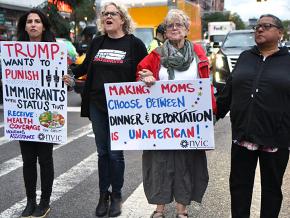
Activists protest Trump's new welfare restrictions for immigrants in New York City
Activists protest Trump's new welfare restrictions for immigrants in New York City (New York Immigration Coalition | Facebook)
One aspect of the rule change would be to consider any history of receipt of government assistance, from Medicaid and Medicare to food and housing assistance, as “heavily weighed negative factors” when determining whether an applicant should be granted a visa or green card.
This would effectively prevent millions of documented immigrants from applying for government benefits they are legally entitled to. Clinton-era welfare reforms already restrict the availability of public assistance to many legal immigrants, and undocumented immigrants are barred from nearly all assistance programs. Nonetheless, millions of low-income immigrants rely on some type of assistance or another.
The rule would impact everyone — from the parent whose child receives food or medical assistance, to elderly immigrants on Medicare Plan D, to a U.S. citizen seeking to sponsor a spouse or a family member.
But the rule change goes beyond the use of public assistance.
“In determining whether an immigrant would become a public charge, USCIS [U.S. Citizenship and Immigration Services] will also consider factors such as age, health, family status, assets, education and skills,” explained immigration attorney Soo Kyung Vitale. “In sum, this is an all-out attack on the poor, the sick and the less educated.”
While certain categories of visa holders will be exempt under the current version of the rule, earlier leaked drafts did not have such exemptions. Thus, the panic among visa holders has been universally felt. Rumors of the proposed change have been circulating since the beginning of the year and have already had a devastating impact. Fear among immigrant communities has led to a significant drop in enrollment for food assistance programs such as the Supplemental Nutrition Program for Women, Infants and Children (called WIC) and the Supplemental Nutrition Assistance Program (or SNAP, formerly known as food stamps).
On September 24, immigrant rights and social service advocates, led by the New York Immigration Coalition (NYIC), staged a rally and direct action in front of New York City’s historic Tenement Museum to protest the proposed rule change.
“We have HIV positive clients consulting counselors on whether they should suspend their HIV medication while they apply for a green card,” said Amanda Lugg of the African Services Committee and one of 14 people arrested blocking traffic to protest the change. She also noted how the proposed change “violates long-standing protections for people living with HIV/AIDS under disability discrimination law” and “essentially operates as a backdoor reinstatement of the HIV immigration ban.”
“If adopted, the rule will create a nationwide health crisis impacting millions and deter families from seeking vital medical care when they need it the most,” said Hasan Shafiqullah of the Immigration Law Unit at the Legal Aid Society.

BY DEFINING anyone who legally accesses these programs as a potential “public charge,” Trump is simultaneously taking aim at low-income Black and Brown immigrants on the one hand and public assistance programs themselves on the other.
The reality is that public assistance has become part and parcel of the U.S. economy and working-class life. According to a 2016 Economic Policy Institute report, a majority of workers making $9.91 an hour or less, or about a fifth of all wage earners, receive some sort of public assistance, either directly or through a family member.
In addition, nearly half of all working recipients of public assistance work full time. In reality, low-wage employers rely on government assistance programs to subsidize and maintain a relatively stable workforce. In 2014 Forbes magazine reported that Walmart’s low wages were costing taxpayers $6.2 billion a year in public assistance to its employees.
As Alison Hirsh, vice president of SEIU Local 32BJ, put it, “With poverty wages, unaffordable health care options and rampant food insecurity across the country, a reliance on public assistance is not a fair indication of how much a person contributes to their communities.”
Along with Trump’s comments denigrating immigrants from “shithole” countries, this current rule change underlines that the primary targets of this attack are low-income Black and Brown immigrants. Trump has no problem with family reunification policies (or in Trumpspeak, “chain migration”) when it allows his in-laws to become citizens, but he wants to bar those he deems “inferior” from taking advantage of those same pathways.
While Democratic Party politicians line up to pose as defenders of immigrant rights, this current assault can be tracked directly to the attacks on both low-income immigrants and government entitlement programs ramped up by the Clinton administration in the ’90s.
And while Mayor Bill de Blasio claims that New York is a sanctuary city, his police department was out in overwhelming force at the NYIC protest and civil disobedience on September 24.
Nonetheless, activists pledged to continue the fight to prevent this new rule from being instituted. Once the rule change is posted to the Federal Register, it is subject to a 60-day public comment period before implementation. Activists need to use this period not only to organize public commentary against the rule, but also to build broad action against this change.
That fight needs to foreground a defense of public assistance in a country where the labor of low-wage workers generates massive profits. Immigrant rights activists have their work cut out for them in order to reverse the decades-long war on immigrants and the poor that has culminated in this moment.

Original article

print print reply reply

A new Q&A interview with NSA whistleblower Tom Drake

To  


Thomas Drake
Here’s an update and fascinating new Q&Ainterview with National Security Agency whistleblower Thomas Drake.

We should remember that the U.S. government’s “national security” apparatus is eager to crush the brave few who expose the official lies that sustain illegal surveillance, fraud, corruption, and warfare. Whether or not the whistleblowers go to prison, a key official goal is to drive them close to the poverty line for the rest of their lives, deprived of pensions and rendered unemployable for all but low-paid jobs.

Thanks to supporters of the RootsAction Education Fund, several of the most selfless and high-impact whistleblowers are now getting back on their financial feet. But we must not fade away with our support.

Millions of taxpayer dollars went into persecuting Tom Drake. It’s now poeticjustice each time someone can make a tax-deductible contribution to Tom’s current work in support of whistleblowing.

During the first years of this decade, Tom Drake endured a legalistic siege that threatened to keep him in prison for the rest of his life. Although he ultimately prevailed in court, the government completely wrecked his personal finances.

As the end of this tax year approaches, you can engage in a bit of poetic justiceif you click here to support Thomas Drake as an NSA whistleblower who continues to speak truth to -- and about -- power. A contribution of whatever you can afford would be deeply appreciated. Half of every dollar you donate will go directly to Tom, while the other half will support the Whistleblowers Public Education Campaign that he chairs.

Thanks a lot!

-- The RootsAction Education Fund team
________________________

Days ago, Tom Drake wrote a message to RootsAction Education Fund supporters and responded to some questions. Here’s what he had to say:

Want to thank you all once again and am most grateful and appreciative for your continuing support as I continue to travel and speak out on a number of critical and contemporary core issues including privacy, digital surveillance, abuse of power and rise of autocratic governance and what I have coined the de-evolution of democracy that we face today (and well into tomorrow) in the U.S. and around the globe in our post 9/11 national security world.

I recently participated in a panel hosted by the Cato Institute in Washington, DC discussing 9/11 lessons learned and unlearned that was moderated by Pat Eddington.

9/11 is always a most difficult day for me, given that I am still very much burdened by the “what if” of history. I know that 9/11 was fully preventable and never should have happened as the government failed to keep almost 3,000 people out of harm’s way that very tragic day.

C-SPAN aired the panel live, and here is the link for all of you interested to view and consider what was discussed, with some Q&A with the audience at the end.

I am also scheduled to participate in an upcoming panel on national security and whistleblowers in New York City on 18 October. (If any one of you are in the area I invite you to attend. Here is the link for more information.)

I also agreed to answer a few questions posed to me by Norman Solomon, below, and encourage you all to respond (via info@rootsaction.org) with further questions and comments and any additional observations you may wish me to consider that I can address and discuss in a future email newsletter.

Q:  A lot of Americans are concerned about the rise of authoritarian government in the U.S. To what extent are issues of surveillance directly related to such concerns?

The rise of autocracy and calls for a more authoritarian government raise real and very troubling concerns about the further abuse of surveillance to erode democracy and our precious rights and freedoms through the monitoring and targeting of dissenters, resisters and activists as well as political opponents and domestic enemies. Surveillance in the hands of authorities is about control and keeping track of people, and in the modern age of digital communications it is enormously tempting to use surveillance for “other” purposes that are far removed from keeping the nation safe.

Q:  Do you think the NSA has significantly changed its domestic activities from the George W. Bush to Obama to Trump presidencies?

I do not. There is clearly a line of succession with respect to domestic surveillance from Bush to Obama and now under Trump. The government willfully violated the Constitution in secret under the banner of national security and the issuance of executive orders and “other” authorities right after 9/11 and put a mass surveillance regime in place protected and hidden by the deepest of state secrets. Several years later Congress passed legislation that effectively legalized what was unlawful, thereby normalizing surveillance and other violations of the Constitution. For example, the USA Freedom Act passed a few years ago under Obama was essentially a face-saving kabuki move that still gave the NSA and other national security agencies and authorities the ability to access vast amounts of data from the telecoms, simply by asking for it with some other changes that were bones tossed to appease the civil liberty advocates and organizations.

Q:  What were the top priorities of NSA leaders that you observed from inside the agency?

The top priorities I observed from NSA leaders during my 6.5 years there as a senior executive were focused on protecting the institution, burying the secrets and covering up any possible or actual wrongdoing committed by NSA, while promoting massive programs that were largely outsourced to contractors.

Q:  How would you rate overall media coverage of the NSA?

NSA is still too often misunderstood by much of the mainstream media press outlets, or they simply recycle talking points. In addition, using former heads of agencies as regular commentators who will more often than not simply protect the more secret institutions of government does not bode well for transparency and openness necessary in a democracy regarding the questionable activities and violations of law and the Constitution committed by their own former agencies.

Q:  How would you rate overall media coverage of civil liberties?

I would rate overall media coverage a bit better than before, but still too often beholden to access press, five-minute sound bites, the addiction to celebrity and personalities as well as tribal partisanship. More independent press has emerged, but having a president of the U.S. call the press the enemy of the people is simply chilling and speaks of autocracy and authoritarianism as well as censorship and suppression. 

Q:  How would you describe the ties and oversight roles of the courts in relation to agencies like the NSA?

The courts have largely avoided the issues raised by the often hidden and secret actions of the national security centric agencies in the U.S. government until more recently during the latter years of the Obama and now the Trump administration. Certain lawsuits (including Jewel v NSA and others) were essentially given new life under Obama due to the Snowden revelations. Recent Supreme Court cases including the Jones and Carpenter cases have placed privacy and the 4th Amendment back in the limelight as indications of checks on the overreach and abuse of executive power, while also giving Congress notice for rolling back existing legislation that has given the executive additional power under the cover of national security. However, real oversight must come from Congress and that is sorely lacking as the oversight committees have devolved into largely serving as lapdogs of the national security establishment instead of their mandated watchdog roles.

Q:  Overall, do you think Americans are too worried about government becoming repressive?

I believe a number of Americans are VERY concerned and worried about the government becoming more repressive. The trend lines are not good. On the other hand, many people are better informed about the dangers of democracy caught up in a dystopian drift that erodes our basic rights and freedoms. Once key freedoms and rights are eroded by a central government it is very difficult to get them back, let alone restore what was lost.

Q:  What would you recommend as some of the most important things that people can do to support civil liberties and constitutional freedoms? 


It is critical that people as in “we the people” are the ultimate defense against the de-evolution of democracy. We are in this together and it is vitally important to act locally to make a difference while considering the long arc of history.

Right now, getting out and voting for candidates seeking office during this election season that align with the inalienable rights we all possess is key, while also supporting directly and indirectly efforts and campaigns that advocate action to preserve our rights and freedoms and highlight the abuse of power, no matter the source.

________________________

PS from the RootsAction Education Fund team:

Truth-telling can be inspirational. Another NSA whistleblower, Edward Snowden, has said: “If there hadn’t been a Thomas Drake, there couldn’t have been an Edward Snowden.”

Meanwhile, Tom Drake remains deeply in financial debt. Ironically, we are in hisdebt -- morally, politically and ethically. We owe him so much because he stood up for civil liberties and human decency.

Let’s continue to help repay that debt to Tom Drake, who exposed extreme mass surveillance by the NSA.

Living in what is supposed to be a democracy, we get vital information because of the courage of whistleblowers.


Tom Drake has no intention of going silent. He wants to keep writing, traveling and speaking out. But he needs our help.

Please make a tax-deductible contribution in support of his work.


Thanks!

GRAPHIC: Sign here button

Please share on Facebook and Twitter.

Background:
>  Daily Beast: “U.S. Intelligence Shuts Down Damning Report on Whistleblower Retaliation”
>  Freedom of the Press Foundation: “Beware of Trump Administration’s Coming Crackdown on Leaks -- and Journalism”
>  Minneapolis Star Tribune: “Former NSA Executive Urges Public Vigilance Against Government Overreach”
>  “The Constitution and Conscience: NSA’s Thomas Drake”: Video of speech on May 2, 2017
>  The Washington Times: “Donald Trump on Edward Snowden: Kill the ‘Traitor’”
>  
Jesselyn Radack, The New York Times"Whistleblowers Deserve Protection Not Prison"
>  
Jane Mayer, The New YorkerThomas Drake -- "The Secret Sharer"


Donate buttonFacebook buttonTwitter button

Click here to unsubscribe and stop ALL email from RootsAction.
empowered by Salsa

Channeling The Lost Ghost Of Ti Jean Kerouac- In Honor Of the 60th Anniversary Of The Publication Of “On The Road” (1957)

This summary is not available. Please click here to view the post.

The Golden Age Of The B-Film Noir- “The Black Glove” (1954)

The Golden Age Of The B-Film Noir- “The Black Glove” (1954)


DVD Review

By Film Editor Emeritus Sam Lowell


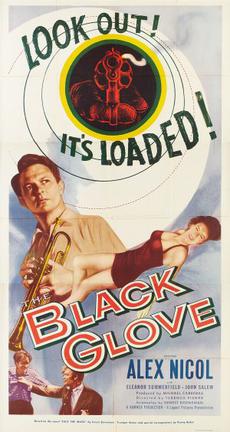
The Black Glove, starring Alex Nichol, Hammer Productions, 1954

Recently in a review of the British film Terror Street (distributed in Britain as 36 Hours) I noted that long time readers of this space know, or should be presumed to know, of my long-standing love affair with film noir. I went on to mention my introduction to the classic age of film noir in this country in the age of black and white film in the 1940s and 1950s when I would sneak over to the now long gone and replaced by condos Strand Theater in growing up town North Adamsville and spent a long double feature Saturday afternoon watching some then current production from Hollywood or some throwback from the 1940s which Mister Cadger, the affable owner who would let me sneak in for kid’s ticket prices long after I reached the adult price stage at twelve I think it was, would show in retrospective to cut down on expenses in tough times by avoiding having to pay for first –run movies all the time. I further mentioned that on infrequent occasions would attend a nighttime showing (paying full price after age twelve since parents were presumed to have the money to spring  for full prices) with my parents if my strict Irish Catholic mother (strict on the mortal sin punishment for what turned out to have been minor or venial sins) thought the film passed the Legion of Decency standard that we had to stand up and take a yearly vow to uphold and I could under the plotline without fainting (or getting “aroused” by the fetching femmes).
What I did not mention although long time readers should be aware of this as well was that when I found some run of films that had a similar background I would “run the table” on the efforts. That is the case with a recently obtained cache of British-centered 1950s film noirs put out by the Hammer Production Company as they tried to cash in on the popularity of the genre for the British market (and the relatively cheap price of production in England). Terror Street had been the first review in this series (each DVD by the way contains two films the second Danger On The Wings in that DVD not worthy of review) and the film under review the ominously titled The Black Glove is the second such effort. On the basis of these three viewings I will have to admit they are clearly B-productions none of them would make anything but a second or third tier rating.         

After all as mentioned before in that first review look what they were up against. For example who could forget up on that big screen for all the candid world to see a sadder but wiser seen it all, heard it all Humphrey Bogart at the end of the Maltese Falcon telling all who would listen that he, he Sam Spade no stranger to the seamy side and cutting corners, had had to send femme fatale Mary Astor his snow white flame over once she spilled too much blood, left a trail of corpses, for the stuff of dreams over some damn bird. Or cleft-chinned barrel-chested Robert Mitchum keeping himself out of trouble in some dink town as a respectable citizen but knowing he was doomed and out of luck for his seedy past taking a few odd bullets from his former femme fatale trigger-happy girlfriend Jane Greer once she knew he had double-crossed her to the coppers in Out Of The Past. Ditto watching the horror on smart guy gangster Eddie Mars face after being outsmarted because he had sent a small time grafter to his doom when prime private detective Phillip Marlowe, spending the whole film trying to do the right thing for an old man with a couple of wild daughters, ordered him out the door to face the rooty-toot-toot of his own gunsels who expected Marlowe to be coming out in The Big Sleep. Those were some of the beautiful and still beautiful classics whose lines you can almost hear anytime you mention the words film noir.


In the old days before I retired I always liked to sketch out a film’s plotline to give the reader the “skinny” on what the action was so that he or she could see where I was leading them. I will continue that old tradition here (as I did with Terror Street and will do in future Hammer Production vehicles to be reviewed over the coming period) to make my point about the lesser production values of the Hammer products. A saving grace of The Black Glove is that the lead guy, the guy whose task it is to solve the mystery of the murder of a London torch-singer whom he barely had known but who had the come hither look that might have played out in pillow talk if she had been not killed with a couple of unexplained slugs is that the “private eye” double-downs as a big time American in London trumpet-player. Yeah, a guy who despite his off-hand detective work is searching for the high white note every jazz guy, hell, maybe everybody involved with music, is looking to corral and sent out into the streets. To make aficionados and amateurs remember his calling card.         

Famous trumpeter James Bradley, known as Brad, played by Alex Nichol, by happenstance hears some torch-singer on his way back to his hotel after a well-received concert in some London large venue. He takes the leap and goes into the place where the music comes from and sees this dishy dame singing torch stuff to beat the band. They meet and between one thing and another they wind up at her apartment although no sexual stuff happened as far as we know. That is when things go awry. That dishy dame torch singer is found dead by gunshot after Brad leaves. Naturally he is the number one suspect for the job, for the frame as could be expected of a guy leaving some dishy dames place late at night and no other candidates for the frame are around. Something about the whole thing didn’t sit right with him once the coppers let him go after they grilled and half-believed his story (although he no-no left his trumpet case in the dishy dames living room). So he began to see if the pieces could be fit together see who put the frame on him and why.         


As expected Brad figures it out. Seems that dishy dame had been part of an up and coming young women trio that never quite got off the ground. Reason, one reason anyway-tangled romances. Tangled romances involving a high-end jazz piano player who really just wanted to play his stuff, another well-known jazz piano player and a record company producer. One way or another they were all involved with that dead dame. Like I said Brad figured it out via his knowledge of music. Figured it out very much like Nick Charles did in The Thin Man series from the 1940s where he brought every possible suspect into a room with coppers at the ready to grab the villain. You know you can never trust a record producer who should have been the prime suspect from minute one. In the end our Brad though gives up the “tec” business and goes back to searching for that high white note every jazz guy is looking for. Better that Terror Street but can’t get pass that Blue Gardenia second tier in the film noir pantheon. Sorry Hammer.